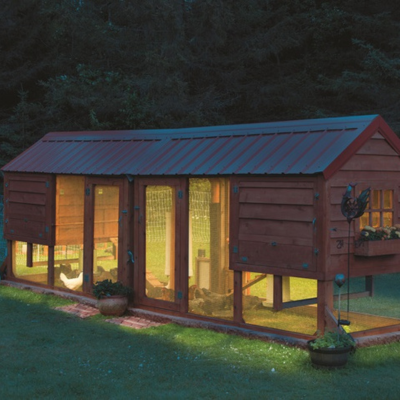
Knowing how to light a chicken coop becomes a priority when it’s a cold winter evening, and by the time you get home from work, the sun has long since sunk below the horizon. Even though it’s dark, you still have chicken chores to do before dinner. The coop that was so warm and friendly all summer now seems dark and chilly, and manipulating the flashlight that you needed so infrequently in the previous months has become a real nuisance as you tend to the flock’s feed, bedding and water. What’s really needed to make the work easier and give the coop a much more welcoming feeling is light.
Does this sound like your situation? Maybe you have a great chicken coop, but it lacks electricity. If flashlights or headlamps just aren’t working for you anymore, no worries, because you have many options for how to light a chicken coop.
Can you run underground power from your home to the coop? Can you utilize a simple solar panel system that runs a few low-wattage lights? Can you wire the coop for lights and supply the electricity via a small power station? Is a gasoline generator practical? What about battery-powered LED lanterns? All of these are viable options, and here’s what you might experiment with and expect from them.
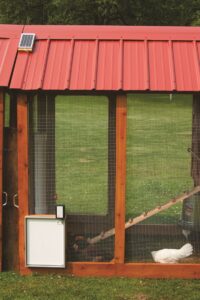
This coop features a solar-powered automatic door-opener.
DANIEL JOHNSON
Key Takeaways
- Running underground electrical wiring from your home or barn provides the most permanent and flexible lighting option.
- A portable power station can supply electricity to standard light fixtures without connecting the coop to the grid.
- Small solar-powered LED lights offer a simple, inexpensive option for smaller coops.
- Rechargeable LED lanterns and floodlights provide portable lighting without requiring any installation.
- Choose a lighting system based on your coop’s size, location, available power and how often you need to work in it after dark.
How to Light a Chicken Coop with Power From the Grid
If your chicken coop is within a reasonable distance from your home or barn, perhaps you can run an underground wire from your electrical panel to the coop. This is straightforward, very reliable and will provide more wattage than you’ll ever need for the chickens.
Small coops might need only a light or two, but larger walk-in coops could potentially be wired just like a garage or shed, with as many light fixtures as you want. You can add an outdoor light or two to help you navigate at night, along with standard switches to control everything, and even some GFCI receptacles for heated water buckets or other poultry care accessories.
At first glance, wiring a chicken coop in this way is probably among the simplest types of electrical work one could hope for. A couple of light fixtures and an outlet aren’t too complex. However, the process of connecting to your electrical panel, routing a buried wire from your home, connecting it to the coop and making sure the electrical fixtures are suitable for dusty and moist conditions make the job a bit more challenging.
If you have experience with this type of work, you might be comfortable performing the task yourself, especially because it’s not always easy to find electricians willing to take on small jobs. But if you aren’t experienced, maybe you can search your network of neighbors to find a friend-of-a-friend-of-a-friend who’s a licensed electrician and more than willing to do a small job. (Who knows: Maybe you can pay them with eggs!)
Some people might be tempted to simply use a very long extension cord run on top of the ground to power the coop, but this isn’t a good idea long-term, as extension cords aren’t intended as permanent solutions and may be vulnerable to weather.
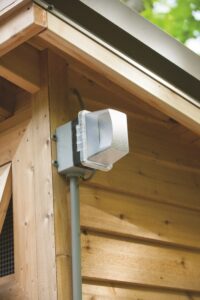
This exterior coop light is wired for permanent electricity with wiring and conduit.
DANIEL JOHNSON
Take Power From a Battery
If you love the idea of standard light fixtures, switches and even receptacles in the coop but you can’t (or don’t want to) get it tied to the grid, there is another option. Wire the coop as you would normally, but then power that system with a portable power station — those self-contained lithium battery/inverter products usually designed for camping.
While you probably wouldn’t want to leave the power station outdoors or in the coop when not in use, many of these devices are extremely lightweight and very portable, especially considering the wattages they can output, so they’re easy to take with you back and forth to the coop.
Walk out to chickens, plug your power station into the coop, and you have all the lighting you need, especially if you use low-wattage LED bulbs. The power station can be quickly recharged from a standard AC outlet but can also be combined with solar panels for added convenience or flexibility.
Similarly, it would be possible to light up your coop with a gasoline generator in the same fashion, but the extra inconvenience, noise and exhaust make it a much less practical solution.
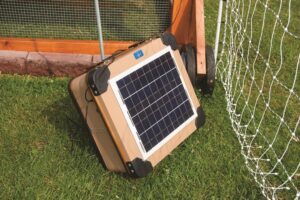
A small solar panel near the coop could power a number of useful things, such as poultry netting.
DANIEL JOHNSON
How to Light a Chicken Coop with Simple Power From the Sun
Maybe these first two options sound too complex. Maybe you don’t want an all-out grid-tied electrical update for your coop, and maybe multiple fixtures and switches are overkill. For people who like keeping things easy, there are plenty of other, simpler options.
One would be a basic, self-contained LED lighting package powered by small solar cells. These products are widely available — some designed specifically for chicken coops. In this case, the bulb itself has a small battery with enough capacity for several hours of use. They’re very inexpensive, incredibly simple and most suited to small coops.
This is really an example of technology making life simpler (which doesn’t always feel like the case!). Once upon a time only a few years ago, trying to operate even a simple solar-powered setup was somewhat DIY intensive and not always practicable. Solar cells didn’t produce as much power for their size, batteries were heavy, and incandescent lighting ate up wattage at a hungry rate. But the rise of low-power LED lights and modern battery and solar solutions have made this so much easier.
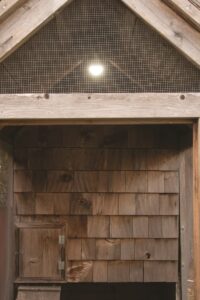
A self-contained LED light bulb with a tiny solar panel for charging is an inexpensive and simple way to install lighting in a coop.
DANIEL JOHNSON
Rechargeable Lanterns & Floodlights
If you’re looking for truly simple, you can easily light up a small chicken coop with a rechargeable LED lantern. Designed for camping or worksite use, these lanterns are much brighter than a flashlight and capable of spreading the light over a wider area.
There are rechargeable lanterns designed with a shape reminiscent of vintage Coleman lanterns; these are able to shine light in a full 360 degrees, so you can hang one in the center of the coop and have decent lighting all around, though perhaps not as bright as the light you’d get from “real” wiring and lighting.
Portable rechargeable floodlights are a similar option but offer a more directional light. These floodlights can be quite bright and can light up the place enough for some quick chores. In either case, the lights can be plugged into a standard AC outlet back at the house for recharging.
You should be able to easily light up your coop this winter; it’s just a matter of choosing the system that best suits the situation. Slightly more complex setups allow more light and better flexibility, but simple solutions are inexpensive. And don’t forget that spring — with longer days and plenty of evening sunshine — is just around the corner!
This article about how to light a chicken coop was written for Hobby Farms and Chickens magazines. Click here to subscribe.