Have you spotted fuzzy black caterpillars in your yard or crossing a trail? Late summer through fall is peak caterpillar season in much of North America, and several species fit the “black and fuzzy” description. Caterpillar identification is key and helps you decide whether to simply admire it or take action in the garden.
So, what are the black fuzzy caterpillars you’ve been seeing around, especially if you have a dedicated caterpillar garden? Well, that depends on where you live.
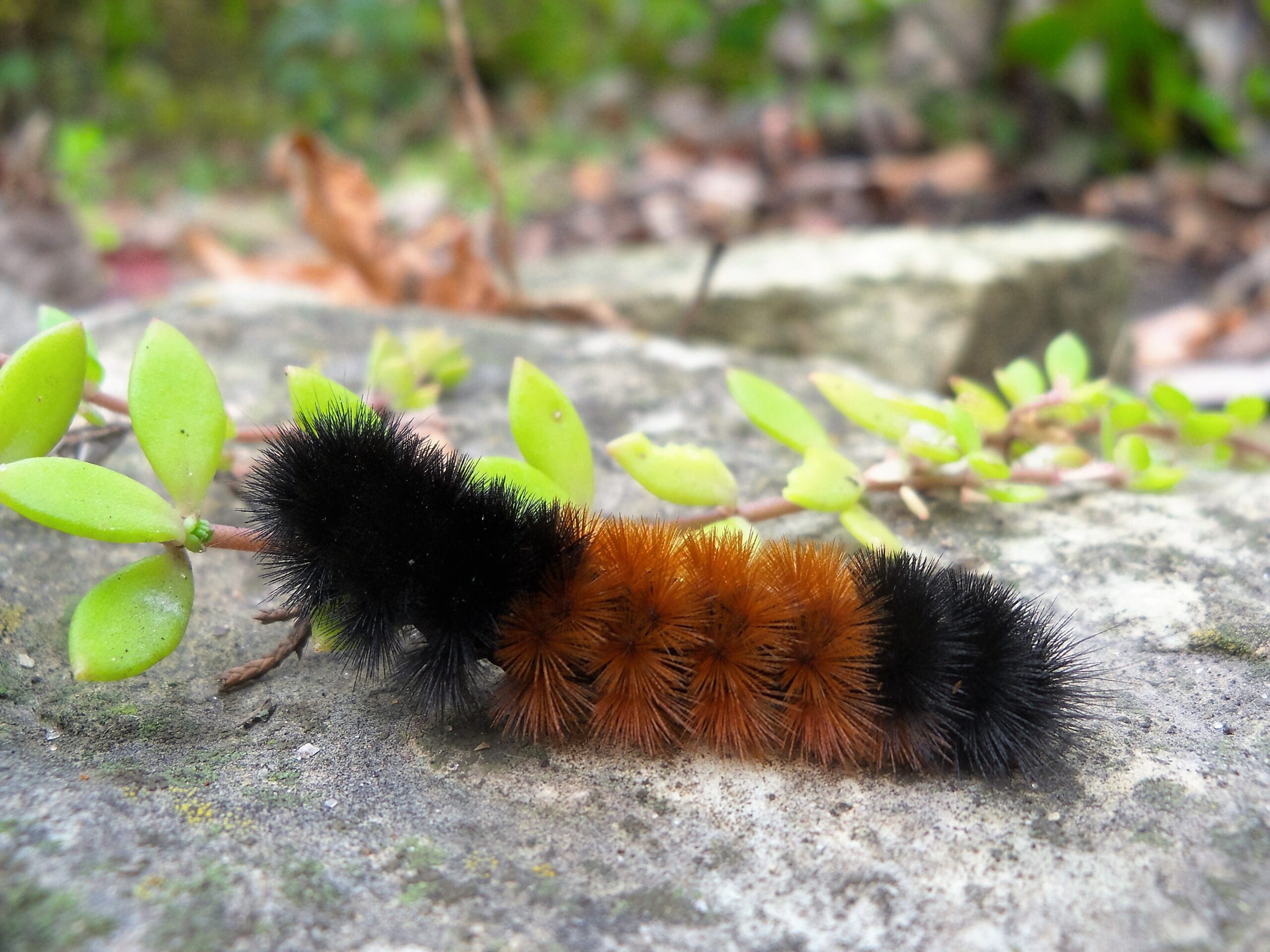
It’s likely that the most common fuzzy black caterpillar you’ve heard of or seen in nature is the Woolly Bear caterpillar. All caterpillars go through a transformation process and turn into either butterflies or moths. Woolly Bear caterpillars are the larval stage of the Isabella Tiger Moth.
Common Fuzzy Black Caterpillars
Woolly Bear Caterpillar (Pyrrharctia isabella)
Appearance: Black at both ends with an orange-brown band in the middle (sometimes mostly black or mostly brown).
Adult form: Isabella tiger moth.
Range: Across most of the U.S. and southern Canada.
Fun fact: Folklore says the width of the brown band predicts winter severity — but science says it doesn’t.
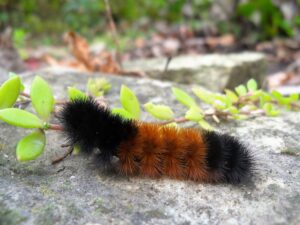
Woolly Bear Caterpillar
Tanya/Adobe Stock
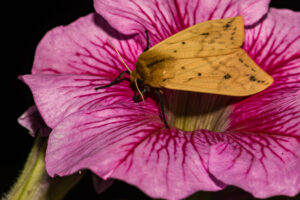
Isabella Tiger Moth – Pyrrharctia isabella
ondreicka/Adobe Stock
Giant Leopard Moth Caterpillar (Hypercompe scribonia)
Appearance: All black with stiff bristles; when rolled into a ball, bright red rings show between segments.
Adult form: Striking white moth with black leopard-like spots.
Range: Eastern and southern U.S., from New England to Texas and Florida.
Notes: Often mistaken for Woolly Bears, but lack the brown middle band.
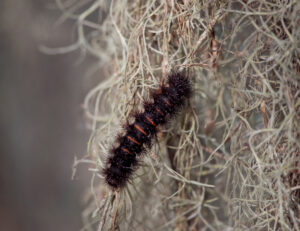
Giant Leopard Moth Caterpillar
SunnyS/Adobe Stock
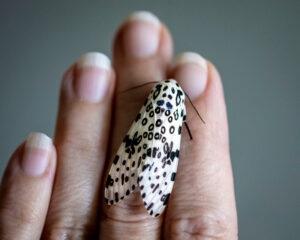
Giant Leopard Moth
Heather Burditt/Adobe Stock
Hickory Tussock Moth Caterpillar (Lophocampa caryae)
Appearance: White overall with black tufts or bands; not fully black but sometimes lumped in with “fuzzy” searches.
Adult form: Cream-colored moth with black markings.
Range: Eastern North America, especially in hickory, walnut, and ash trees.
Caution: Hairs can cause stronger skin irritation than other species.
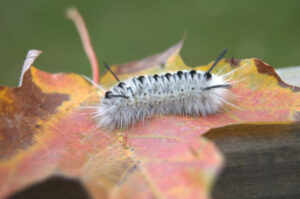
Hickory Tussock Moth Caterpillar
jodi McGee/Adobe Stock
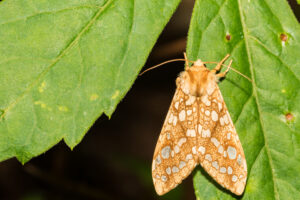
Hickory Tussock Moth (Lophocampa caryae)
ondreicka/Adobe Stock
Salt Marsh Caterpillar (Estigmene acrea)
Appearance: Can be rusty brown, yellow, or black; dense coat of bristles.
Adult form: Salt marsh moth.
Range: Found in grasslands, gardens, and agricultural fields across most of the U.S. — not just marshes.
Diet: Beans, alfalfa, clover, and many garden vegetables.
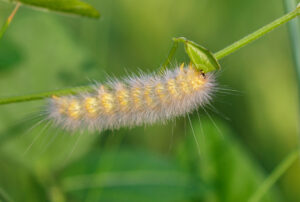
Salt marsh moth (Estigmene acrea) caterpillar.
Ivan Kuzmin/Adobe Stock
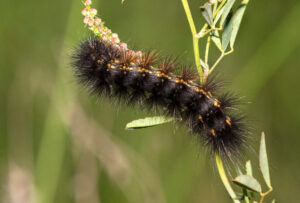
The salt marsh moth (Estigmene acrea) caterpillar. Natalia Kuzmina/Adobe Stock
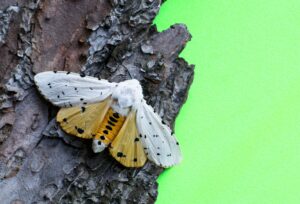
An Acrea or Salt Marsh moth (Estigmene acrea) on tree bark with wings spread, displaying bright orange under wings. Brett/Adobe Stock
Fun Facts & Folklore
No fuzzy black caterpillar is more famous in North America than the Woolly Bear, thanks to the weather myth that the size of its orange-brown band predicts winter severity. According to folklore, a wide brown band means a mild winter, while a narrow one warns of a harsh season. Scientists have tested the claim and found no connection — the band width simply reflects the caterpillar’s age and the conditions it experienced while growing.
The Giant Leopard Moth caterpillar also has a quirky defense trick — when disturbed, it rolls into a tight, bristly ball, revealing bright red rings between its segments. Those red flashes are thought to warn predators that it’s not worth the trouble to eat.
Hickory Tussock caterpillars have earned a slightly scary reputation because their hairs can irritate skin, but for most people, it’s no worse than a brush with fiberglass.
In some coastal communities, Salt Marsh caterpillars were once considered “living barometers,” with sudden mass appearances thought to signal changes in weather or seasonal shifts.
Are Fuzzy Black Caterpillars Dangerous?
The short answer is: No. Most are harmless, but some can cause mild to moderate skin irritation if handled. Reactions vary by person and species — Hickory Tussock hairs tend to be the most irritating. If you’re unsure, use gloves or avoid touching them. None of the species mentioned here is poisonous.
Do They Harm Plants?
Some, like the Woolly Bear, rarely cause serious damage. Others — especially Salt Marsh caterpillars — can defoliate vegetable crops if populations are high. Spongy Moth caterpillars (which are not fuzzy black but sometimes mistaken for them) can strip entire trees.
Garden Control Tips
It’s possible that you may find the caterpillars feasting on your crops or landscaped shrubs. However, they prefer the edges of crop fields.
Identify before acting — Many are harmless or even beneficial. Maybe it will become a beautiful butterfly or a nocturnal moth. Think of the Hornworm caterpillar, which turns into the Sphinx Moth.
Hand-pick pests and remove them from the area.
Encourage predators such as birds, parasitic wasps and predatory beetles.
Use targeted treatments like Bacillus thuringiensis (Bt) for confirmed pest outbreaks, following label directions.
Fuzzy Black Caterpillar Quick ID Guide
|
Fuzzy Black Caterpillars: Final Thoughts
There are more than 150,000 caterpillar species worldwide, and less than 1% are poisonous — most of those outside North America. Next time you see a fuzzy black caterpillar crossing your path, take a closer look. Do a little research to find out what type of moth or butterfly larvae you’re seeing before you dispose of it. You may have found a harmless garden wanderer, a future moth with a striking pattern, or a tiny garden pest in disguise.
This article was written for Hobby Farms magazine. Click here to subscribe.