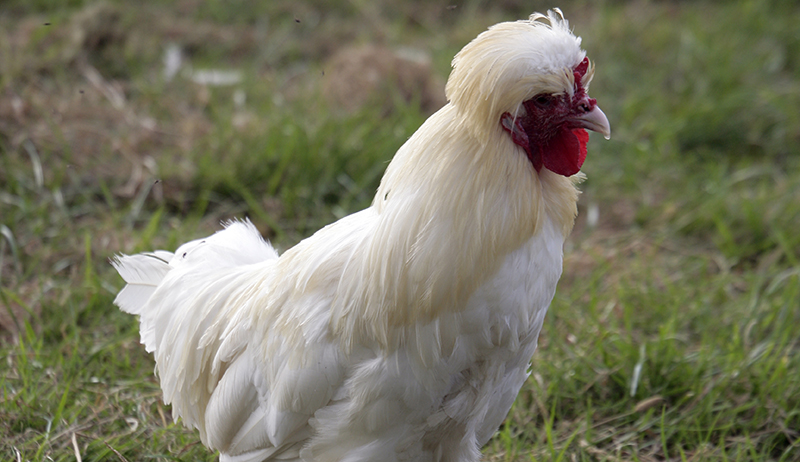
Sultan chickens are primarily used for exhibition. They were once considered fine table chickens, but due to their scarcity, they’re rarely eaten nowadays.
The breed originated in Turkey, where they’re called “Serai Täook,” meaning sultan’s fowl. They arrived in England from Istanbul in 1854 and came to the United States in 1867. Sultan chickens were recognized in the first volume of the American Poultry Association’s Standard of Perfection, published in 1874.
The Sultan has more distinguishing features than any other chicken. Murray McMurray Hatchery describes this extremely rare breed as having “a full list of distinguishing characteristics including a top crest, muff, beard, vulture hocks, fully-feathered shanks and feet, and a fifth toe. Sultan chickens have a dramatic appearance with their pure white feathering and contrasting bright red V-comb and wattles. Males sport a larger crest and tail, and females have a dainty, rounded crest and shorter tails.”
Sultan chickens come in a single recognized color: White with slate blue shanks and toes, though Blue and Black varieties occur, as well. It comes in standard and bantam sizes. Standard Sultan cocks weigh 6 pounds; hens, 4 pounds. Bantam cocks weigh 26 ounces, and hens weigh 22 ounces.
George O. Brown, poultry expert and co-editor of the early 20th-century classic, The Poultry Book, wrote that his Sultan chickens were the tamest and most contented chickens he ever owned. Modern Sultan owners agree. Sultans are friendly, ultra-calm chickens that bear confinement well. They make gorgeous, ornamental pets as well as eye-catching exhibition chickens. They are nonbroody and lay 50 to 70 large, white eggs per year.
Sultan chickens are listed as Threatened on The Livestock Conservancy’s Conservation Priority List with fewer than 1,000 breeding birds in the U.S., with seven or fewer primary breeding flocks, and an estimated global population less than 5,000. If you’re looking for a rare and exotic but friendly chicken, this is your bird