How a chicken’s body works is more than just identifying chicken anatomy on a diagram. It’s about understanding how each system functions—and how chicken owners can support those systems to keep their birds healthy, productive, and thriving. From vision to digestion, circulation to reproduction, learning how a chicken’s body works will help you better care for your flock from the inside out.
Vision: How a Chicken’s Eyes Work to Detect Danger and Food
A chicken’s vision is fascinating. Did you know that the left eye on a chicken functions differently from the right eye? It’s true. While a graph on the anatomy of a chicken doesn’t show this unique trait, the left eye and right eye have different purposes.
Chickens use their left eyes for spotting far-off predators, such as a hawk in the sky, while their right eye allows chickens to see things clearly that are up close.
This is how your flock can be foraging for tasty bugs in the garden, while still keeping an eye on the sky and land for potential predators.
Chicken Care Tip:
Just like humans, chickens need vitamin A to support healthy vision. Supplementing your flock’s diet with broccoli, carrots, cantaloupe, cilantro, dark leafy greens, parsley and sweet potatoes will help to boost vitamin A levels and maintain healthy vision.
Beak: How a Chicken’s Beak Functions Beyond Eating
The beak is often thought of as simply “the mouth” on a chicken. Chickens do use their beaks to feed themselves, but that is not it’s only function.
Chickens also use their beaks to insert their place in the pecking order, investigate the world around them, and preen and oil their feathers from the gland located at the base of the tail.
Chicken Care Tip:
Chicken beaks to be in good working order to survive. Too short or too long can make it challenging for our flocks to go about their daily lives.
To help keep your flock’s beaks in tip-top condition, never debeak your flock. Check your flock’s beaks regularly to ensure they are not becoming overgrown. If beaks are overgrown, take them to a qualified veterinarian for a beak trim.
Circulatory & Immune System: How a Chicken’s Heart and Spleen Keep It Alive and Well
The heart and spleen are part of the circulatory system. The circulatory system moves oxygen and blood throughout the body.
Like mammals, chickens have a four-chambered heart. These chambers receive and send blood through the body and back again to the heart. When compared in size, chickens have a much larger heart than humans, due to their higher metabolism.
The spleen also plays a large role in the immune system as well as the circulatory system. The spleen helps to filter blood and fight off diseases. In a chicken, the spleen also does the work of the lymph nodes.
Chicken Care Tip:
To best protect the circulatory and immune system, feed chickens a healthy diet, complete with supplemented prebiotics and probiotics. Do not allow chickens to become overweight. Avoiding stress factors in the flock is another way to keep both the spleen and heart in optimal conditions.
Shutterstock
Respiratory System: How a Chicken’s Lungs and Trachea Work Together
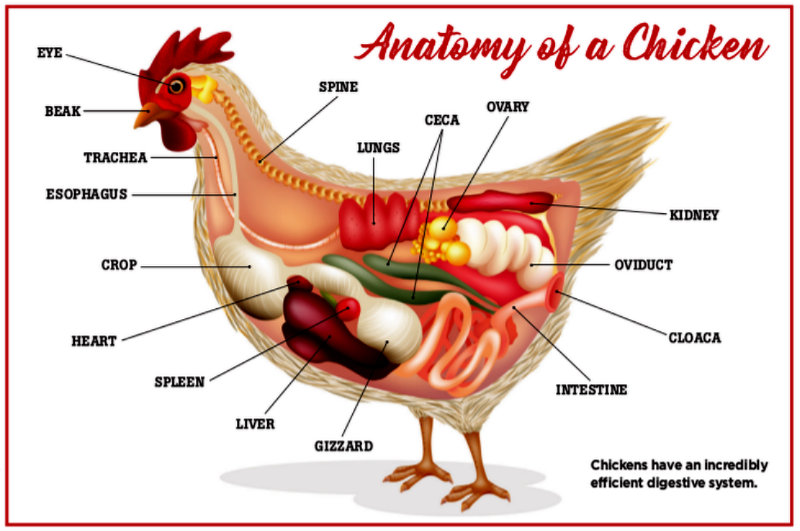
Just like humans, chicken lungs are what make it possible to breathe air in and out, but what the anatomy of a chicken graph doesn’t show is how complex a chicken’s respiratory system is.
Chicken lungs work differently than human lungs, as chickens’ are attached directly to the rib cage without a diaphragm.
Chickens’ lungs are relatively small and work in conjunction with the bird’s air sacs. These sacs act like bellows to help move air in and out of the lungs.
The trachea may seem like a little part of the respiratory system, but it is an important part of the respiratory system, aiding airflow to the lungs.
The trachea helps to move air and gases in and out of the respiratory system, and even helps to regulate body temperatures by removing excessive heat when a chicken exhales.
This vital part of the respiratory system is what helps with our flock’s vocalization.
Chicken Care Tip:
Chickens have a delicate respiratory system and lungs, so care should be taken to promote good husbandry skills to prevent respiratory problems.
House chickens in a well-ventilated coop or barn to promote good respiratory health, and frequently clean the coop to keep dirt and dust at bay.
Supplementing your flock’s diet with respiratory boosting herbs such as basil, lavender, rosemary, and sage is another good way to keep your flock’s lungs in tiptop condition.
Digestive System: How a Chicken’s Digestive System Processes Food
The digestive system is comprised of seven unique parts, and is one of the most complex systems when studying the anatomy of a chicken. This system is where seventy percent of a chicken’s immune system is located and enables your chickens’ bodies to digest food and ward off disease at the same time.
The Esophagus and How it Works:
The esophagus is the long tube that runs down the neck into the crop and then into the stomach. It is here where the digestion starts to take place. The muscles located in the esophagus walls help to break down the food before it enters the crop.
The Crop and How it Works
The crop is the holding sack at the base of the esophagus, located directly in front of the breast, and is easy to spot on a diagram of the anatomy of a chicken.
The crop has earned its popularity due to its notorious health concerns, such as crop impaction and sour crop. Crop problems are usually caused by a secondary issue, so let’s take a look at how the crop works to learn more.
The crop holds whatever a chicken has consumed, slowly releasing the feed bit by bit into the next area of the digestive tract called the proventriculus.
Feed is never digested in the crop, but if there is a blockage in the crop or further down the digestive tract such as a reproductive tumor, enlarged liver, or a foreign body (material that isn’t safe for chickens to consume, i.e. long grasses, string, twine, screws, ect.), the crop will back up and refuse to empty.
Proventriculus and How it Works
Translated from Latin as “before the cavity,” the proventriculus is known as a chicken’s true stomach. The proventriculus is oblong and connects the crop and the gizzard.
The proventriculus is where digestive enzymes and hydrochloric acids are secreted and mixed with the bird’s food to begin breaking it down. From here, the food travels to the ventriculus, also called the gizzard.
The Gizzard and How It Works
The gizzard is the muscular part of a bird’s stomach, which crushes the food to aid in digestion. Since chickens don’t have teeth to chew their food, they rely on the gizzard to crush feed for their bodies to absorb nutrients.
Offering grit to your flock free choice in the form of commercial grit or coarse dirt is essential to helping the gizzard function properly.
The Ceca and How They Work
The ceca are two blind pouches where the large and small intestines meet. The ceca help to absorb water, break down fibrous material, and produce B vitamins to aid in the fermentation process.
Large and Small Intestines and How They Work
The intestines work to digest food and eliminate waste, and are a critical part of the chicken’s digestive system.
The small intestine is used to digest food, adds enzymes to aid in digestion, and is where most of the nutrients are absorbed into the bloodstream.
The large intestine absorbs remaining water from the feed. This process helps to solidify the waste before excretion. Any waste is then stored in the large intestine until it passes through the cloaca.
Chicken Digestive System Care Tip
Proper nutrition is the best way to keep the digestive system running smoothly and your flock’s immune system strong.
Avoid feeding harmful treats such as baked goods, breads, pasta, and tomatoes, as these treats can cause potential digestive upsets.
Supplementing your flock’s diet with fennel seeds, fresh herbs, probiotics, and prebiotics will help to keep the digestive system in working condition.

Shutterstock
Legs & Bone Health: How a Chicken’s Hocks and Shanks Support Its Whole Body
The hock is the leg joint located at the base of a bird’s thigh. Its placement in the middle of the “leg” and the way it bends when chickens walk readily draws comparisons to our knees. However, the hock is most like an ankle, connecting the bird’s thigh to its shank. What we consider the leg to be is actually the foot.
The anatomy of a chicken contains a lot of cool facts about how our chickens’ bodies work, including how body parts work together. Hocks and shanks are a good example of showcasing how the chicken’s body works, as they have a direct impact on eggshell quality.
When you think of how an egg is formed through the reproductive tract, it would appear like a hen’s feet have nothing to do with the quality of an egg shell. However, a hen draws calcium from her legs, feet, and other bones from her body to provide calcium to form an egg shell.
Chicken Care Tip
Laying hens often suffer from a lack of calcium in their diet. Not only does this deficiency create weak eggshells, but it can also cause broken leg bones.
Supplement your flock’s diet with free-choice oyster shell at all times to be sure your flock is receiving enough calcium to keep both egg shells, hocks, and shanks strong.
Reproductive System: How a Chicken’s Body Forms and Lays Eggs
If you’re raising chickens for eggs, the most important parts of a chicken make up the reproductive system. Chickens have two parts to their reproductive system, called the ovary and the oviduct.
When a hen hatches, the right ovary stops developing, while the left ovary continues to develop until the hen has reached the point of lay.
The oviduct and left ovary work together to form eggs. The eggs start off in the ovary, where the yolk is developed, and then are released into the oviduct.
The oviduct is a long, tube-like organ that the yolk must pass through, and is where the yolk is fertilized and the rest of the egg is formed. Finally, the egg passes through the cloaca as it is laid.
Chicken Care Tip
Since chickens are bred to lay an abundance of eggs, their reproductive tract is constantly working. This constant wear and tear of egg laying can be hard on a hen’s reproductive tract, causing inflammation and reproductive tumors.
Allowing your chickens to rest over winter, by eliminating artificial light and giving your hens’ reproductive tract a break, will help to reduce reproductive diseases in the flock.

Shuttersock
Fluff and Cloaca: How a Chicken’s Fluffy Butt and Cloaca Function Together
Chicken fluff may be one of the best parts of a chicken anatomy lesson, as most flock owners love their hens’ fluffy butts. Fluff is those soft, fleecy feathers on your bird’s bottom. After all, not all scientific terms have to be complicated!
Chicken fluff covers the entire backside of a chicken’s bottom end. These small, fluffy feathers help protect against flystrike and work to regulate body temperature.
The cloaca is located at the end of a chicken’s digestive, urinary, and reproductive tracts, leading to the shared external opening known as the vent.
The cloaca chamber shifts and folds depending on what bodily function needs access to the vent. When a chicken defecates, the cloaca folds back, sealing the oviduct. At egg-laying time, the cloaca covers the excretory exit to keep feces and uric acid from contaminating the egg.
When chickens mate, the rooster’s cloaca comes into contact with that of the hen. This is called a “cloacal kiss.”
Paying attention to your flock’s fluffy butts and cloacae is a good idea if you’re concerned that your flock is suffering from vent gleet (a condition where a chicken’s cloaca becomes inflamed, causing diarrhea, messy feathers, and a foul odor).
Chicken Care Tip
Vent gleet is usually easy to treat and prevent with a few dietary changes. If you notice a flock member frequently has messy feathers, chances are she is suffering from this condition.
To prevent and treat vent gleet, keep treats to a maximum of ten percent of your flock’s diet. Adding probiotics and apple cider vinegar to your flock’s drinking water is an excellent way of preventing and combating this condition.
Knowing the anatomy of a chicken can go a long way in helping our flocks live healthy lives, produce an abundance of eggs, and live longer.
Final Thoughts: How a Chicken’s Body Works to Stay Healthy
Understanding how a chicken’s body works—from the eyes and beak to the lungs, digestive system, and reproductive tract—gives flock owners a powerful advantage. When you know how each system functions and supports the others, you can spot issues early, provide better nutrition, and create a healthier environment. Whether you’re raising chickens for eggs, companionship, or both, learning how a chicken’s body works is one of the best ways to keep your flock thriving for years to come.
This article about how a chicken’s body works was written for Hobby Farms and Chickens magazines. Click here to subscribe.