The Polish chicken breed has won the hearts of many poultry owners with big, floppy crests and striking feathers. But their stunning looks aren’t the only thing to gain the admiration of so many devoted fans.
Polish Chicken Breed Origins
The Polish chicken breed’s ancestry is a bit of a mystery, as no one knows exactly where the breed originated from. Another mystery is that there is no date for when the breed was created, although the Polish first appeared in Italian and Dutch paintings dating as far back as the fifteenth century.
Despite their name, the Dutch are credited for originally breeding these fancy-feathered fowl. And in the eighteenth century, it was the Dutch who worked hard to create today’s feather patterns and large crest.
In the mid-nineteenth century, Polish chickens worked their way to America, where they quickly gained popularity. However, in 1850, the breed lost favor to the higher-producing Leghorn and started being kept as exhibition birds instead of egg layers. The Polish entered the American Poultry Association (APA) Standard of Perfection in 1874.
These days, Polish chickens are kept mainly as exhibition birds and pets.
What Do Polish Chickens Look Like?
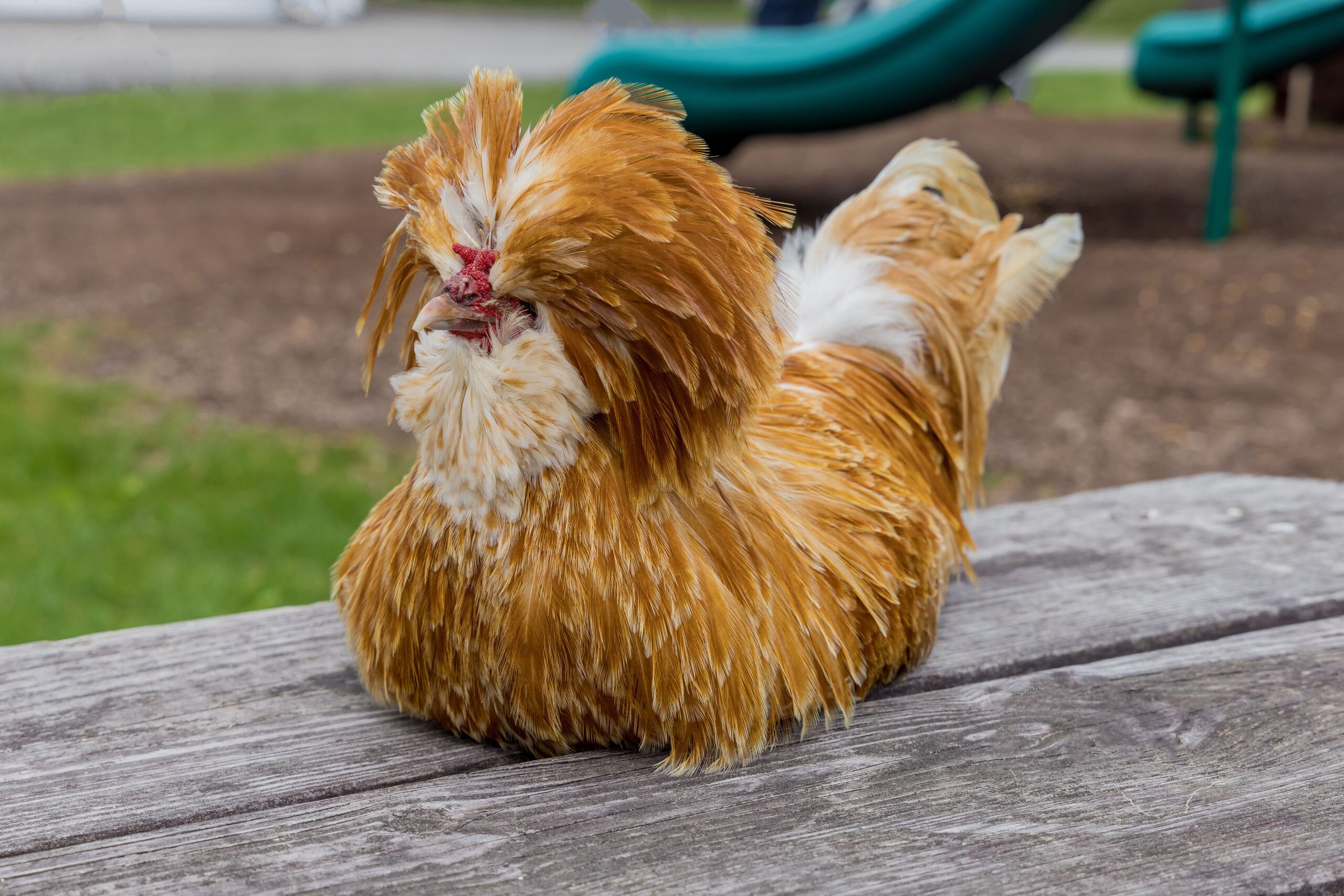
Nicknamed “showgirls of the poultry world,” Polish chickens have striking feather patterns and large floppy crests. These beautiful birds sport small V-shaped combs, which are usually hidden beneath their crests.
Polish roosters have distinct male feathering and are easy to tell apart from the females despite the lack of wattles and large combs.
Sporting white earlobes and clean slate-gray legs and feet, the Polish chicken has four toes and should not be confused with the five-toed Sultan. The color of the beak varies with the color.
One of the things that sets Polish chickens apart from other breeds is that they come in three varieties: bearded, non-bearded, and frizzled (a gene that causes feathers to curl outward instead of lying flat). The breed also comes in a bantam variety.
- Standard Rooster: 6 lbs.
- Standard Hen: 4.5 lbs.
- Bantam Rooster: 30 oz.
- Bantam Hen: 25 oz.
The APA recognizes Polish chickens in a variety of eye-catching feathers and patterns, including black, blue, buff laced, gold laced, silver laced, white, white crested black, and white crested blue.
Polish Chicken Breed Egg Production
Polish chickens are dependable egg layers and offer backyard enthusiasts a fair number of eggs. While they are consistently outproduced by serious egg layers, Polish hens lay a respectable three to four medium white eggs weekly.
Although they start laying later in the season, Polish hens rarely go broody, so when they begin to lay, they remain dependable egg layers until the fall molt.
Due to their small and lightweight stature, the Polish chicken is not considered a meat bird.
Do Polish Chickens Make Good Pets?
Polish chickens make lovable pets for both novices and veteran chicken keepers. These delightful hens are great with kids, as their gentle nature and comical looks make them endearing to young children.
Sweet, friendly, calm, curious, and interactive, the Polish requires daily bonding with its owner. These sweet chickens can startle easily if their vision is impaired by their large crest. Therefore, it is critical to form a strong bond with your Polish chickens to avoid scaring them. Talking to your hen before approaching is another good way to prevent startling a vision-impaired chicken.
Polish roosters are reported to have a fifty/fifty personality, with some roosters displaying aggression towards their handlers and others remaining calm and friendly.
In the henhouse, Polish chickens seem to prefer the company of another Polish. They get along well with other breeds, but due to their large crest and docile personalities, they can be easily bullied by more dominating breeds.
Are Polish Chickens Healthy?
Due to their large crest, the Polish can be prone to more health concerns than other breeds, including “water on the brain” (a curable neurological condition caused by an infection in the cranial cavity), head lice, mites, and eye infections.
Other non-crest-related health concerns include bumblefoot, Marek’s disease, and respiratory conditions.
When kept in a clean and dry coop and run and vaccinated against Marek’s disease, Polish chickens are usually hardy and healthy.
How Long Do Polish Chickens Live?
When kept dry and protected from predators, Polish chickens live a respectable five to eight years.
What to Know Before Acquiring Polish Chickens
- Polish chickens have poor vision and should not be allowed to free range.
- Due to their poor eyesight, Polish chickens must have a completely predator-proofed coop and run to protect them against predators.
- Carefully trimming the crest back can help reduce risks of eye infections and help increase vision
- Polish chickens must be kept dry during the winter months to avoid ice buildup on their large crests.
Polish Chicken Breed FAQ
Are Polish chickens good egg layers?
The Polish chicken breed lays a respectable three to four medium white eggs per week. While not a production breed, they are consistent layers once they begin.
Do Polish chickens make good pets?
Yes. The Polish chicken breed is known for its gentle, friendly temperament and does well with families and children when handled calmly.
Why do Polish chickens have trouble seeing?
Large feather crests can obstruct vision in the Polish chicken breed, making them prone to startling and more vulnerable to predators.
Can Polish chickens free range safely?
Free-ranging is not recommended for the Polish chicken breed due to poor eyesight and increased predator risk.
How long do Polish chickens live?
With proper care and protection, the Polish chicken breed typically lives five to eight years.
A Final Word on Polish Chickens
Polish chickens are a delight to own. With their endearing personalities, large, floppy crests, beautiful feathers, and dependable egg laying, it’s easy to see how these chickens have won the hearts of chicken lovers.
This article was written for Hobby Farms and Chickens magazines. Click here to subscribe.