How many doors does your house have? In our little two-bedroom house, I count 16. That includes screen doors and closet doors as well as attic and basement doors. But that’s not counting the refrigerator door, cupboard doors and even the door to the dryer in the basement.
Chicken coop doors do much more than let your flock in and out. The right doors make daily chores easier, improve predator protection, simplify cleaning, and make collecting eggs far more convenient.
While many coops include only a pop door and a people-sized entrance, a well-designed coop benefits from several access points. From automatic chicken doors to clean-out doors and nest box hatches, each serves a specific purpose. Here’s how to design chicken coop doors that save time while keeping your flock safe and comfortable.
Key Takeaways
- Well-designed chicken coop doors improve flock safety and make daily chores easier.
- Doors should generally swing outward to prevent interference from bedding and reduce drafts.
- Automatic chicken coop doors add convenience but should include battery or solar backup when possible.
- Large clean-out doors simplify coop maintenance and composting.
- Exterior nest box doors make collecting eggs and cleaning boxes much easier.
- Strong hinges, sturdy framing, and predator-proof latches help keep chickens secure.
Should Chicken Coop Doors Swing In or Out?
For the doors on the coop it’s better that they open out. If they were to open in, they would conflict with the bedding and poop.
Plus, you’d have to leave a gap at the bottom so they could swing in above the floor. That would create drafts and a space for snakes and mice to enter.
The same issues apply to the gate. If the hens have scratched a bunch of debris in front of the gate, it will be difficult to open if it swings in. Installing doors so that they open out also makes it easier to install the hinges.

Frank Hyman
How to Keep Chicken Coop Gates from Sagging
How many gates have you seen that are sagging? Plenty, right? The remedy to sagging gates is to incorporate a diagonal piece of wood. In construction, triangles are more stable than rectangles.
I have a gate built of cedar branches, and each corner has a short wooden brace that’s at a 45-degree angle. It forms a triangle at each corner to stiffen the gate and keep it square.
If you go this route, be sure to predrill a hole at each end of the diagonal brace. That allows a screw to slip through easily and then bite into the frame of the gate.
Read more: Keep your flock safe with this coop security checklist.
Should You Install Automatic Chicken Coop Doors?
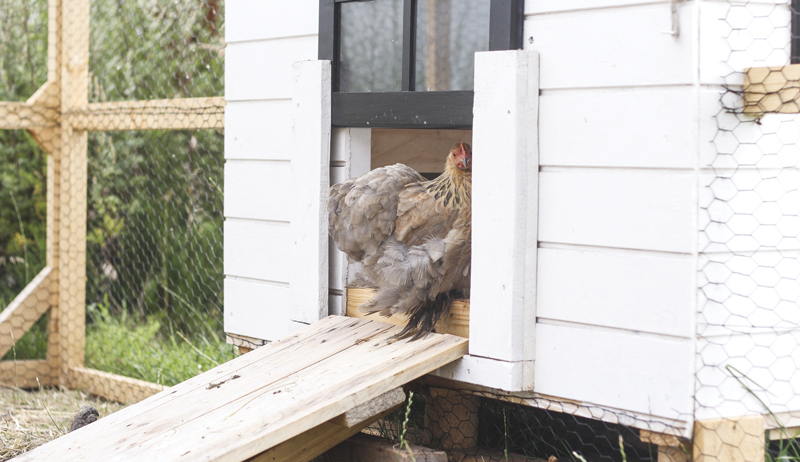
One common feature of coops promised to interfere with our goal of enjoying two-week vacations. They’re called pop doors. This is the small door on a coop that allows hens to go out in the morning and back in at dusk.
My wife, Chris and I are compatible in many ways. One being we both firmly believe in “early to bed and late to rise.” Neither of us is inclined to get up at daybreak to let the hens out of their coop.
We considered three ways to resolve this quandary and you may want to choose one of these.
A: If you’re confident that the fencing of the hen pen is secure against predators, then you could actually forgo an operating pop door. It is, after all, just a second layer of security if the pen is well made.
B: A chicken-activated door seems ideal to me. Andrew Wells in England appears to have figured it out. Watch his YouTube video and read his comments.
When all of his chickens have climbed on the roost, their combined weight shifts the roosting bar so that cables and pulleys lower the pop door. When they hop off the roost, it shifts again and opens the pop door. And the counter-balancing milk jugs, partly full of soil, look adjustable to allow for changes in chicken population (and weight!).
C: Automatic coop doors are available online. This is the route we chose. There are several designs on the market. Chris was more than happy to pay if it meant we could wake up in a leisurely way while listening to the happy clucking of hens in their pen.
Things to Consider Before Buying Automatic Coop Doors
Most of the automatic doors that I’m aware of depend on a common timer that turns living room lamps on and off while you’re away. Plug the cord into the timer. And plug the timer into the outlet. You’re all set to go on a road trip. That is unless the power goes out.
If the power goes out overnight, then the chickens will stay sequestered in the coop until you either prop the pop door open, prop open the keeper door or are able to reset the timer when the power returns.
This is the one downfall of some automatic doors. And a good selling point for using a solar panel.
If this happens while you are out of town, it may be tricky to get a neighbor to reset the timer as the process is a bit counterintuitive. (Consult the instructions!) For our out-of-town trips, we sometimes turn the door off and leave it open, so the chickens can come and go freely.
Because we have a predator-proof pen, we don’t worry about their safety.
Read more: What’s the best coop roof design? Here are 3 reasons to consider the skillion.
Why Every Coop Needs a Keeper Access Door
I wanted a door into the coop so that I could lean in and do any maintenance. From the keeper access door, I can reach:
- the automatic door
- the roosts
- the nest box
- the floor
- the inside of the walls
- underneath the roof
- all the vents of the coop
It also gives me a position from which I can sweep out or even hose out the floor of the coop. All the spent bedding can flow out through the clean-out doors on the opposite side of the coop and into the compost bins (more about that later).

Frank Hyman
Make Cleaning Easier with Large Clean-out Doors
Clean-out doors are built just the same as the keeper access door, with thick plywood and exterior-grade hinges. The differences are that I recommend a pair of clean-out doors wide enough so that the entire width of the coop can be open for ease of cleaning out.
That way you won’t have any hard-to-reach corners.
I also recommend a pair of doors so that each door can be aligned with a compost bin. And since a raccoon could stand on the bins, you want to use raccoon-proof latches like swivel safety hasps.
Choose an Easy-to-Access Nest Box Door
Whoever came up with the idea of putting nest boxes on the outside of the coop should get a medal … and a pension … and a monument on the National Mall. It’s a great time-saver.
However, most nest boxes are accessed through the roof of the nest box. That makes it kind of difficult to clean the boxes. Also some members of the family may not be tall enough to reach that far.
We wondered: Why not let the wall of the nest box open into a tray, as we saw on one coop tour? It gives you someplace to put your carton while you gather eggs. It also makes clean-out easier, and, best of all, shorter members of the family can help with fetching eggs.
For the hatch to form a counterlike surface when it’s open, you’ll need a wooden “arm” that will swing out under it for support. I use scrap 2-by-2 pieces of lumber, but any dimension will do really.
I cut the pieces about 10 inches long with a 45-degree bevel on each end for a more finished look.
Predrill a hole through the middle of each arm that’s just wider than the screw threads. Choose a screw that’s short enough that it won’t come up through the floor of the nest box and poke a chicken. Or line up the screw so it comes up through the floor and into one of the walls so it doesn’t poke anyone.
Slide the screw through the support arm, and screw it up into the floor of the nest box. It shouldn’t be so tight as to keep the arm from rotating.
When the arm is put away, it should be flush with the hatch when it’s closed. When I want to open the hatch, I just swing the arm out 90 degrees, release the latches and gently swing the hatch down to rest on the support arm.
This arrangement keeps out drafts and critters. When we want to collect eggs, we have easy access. When we want to clean out the nest box, we leave the support arm where it is and let the hatch hang straight down.
Frequently Asked Questions
How many chicken coop doors should a coop have?
Most backyard coops benefit from several doors, including a pop door for chickens, a keeper access door, clean-out doors, a nest box hatch, and gates leading into enclosed runs.
Should chicken coop doors swing inward or outward?
Outward-swinging doors are usually the better choice. They won’t be blocked by bedding or manure and help reduce gaps that can allow drafts or pests inside.
Are automatic chicken coop doors worth it?
For many flock owners, yes. Automatic doors let chickens out at dawn and secure them at dusk, making daily care easier while helping protect birds from predators.
How do I keep chicken coop gates from sagging?
Build gates with diagonal bracing to create triangular supports. This helps the frame stay square and prevents sagging over time.
What type of latch should I use?
Choose sturdy predator-resistant latches or safety hasps. Raccoons are surprisingly skilled at opening simple hook-and-eye or sliding latches.
Chicken Coop Doors Final Thoughts
Designing better chicken coop doors isn’t just about convenience—it’s about creating a safer, more efficient home for your flock. From automatic pop doors that simplify daily routines to wide clean-out doors that make maintenance easier, each opening serves an important purpose. Thoughtful door placement, durable hardware, and predator-resistant latches can save time while helping keep chickens healthy and secure for years to come.
Love practical poultry projects? Subscribe to Chickens magazine for expert coop-building ideas, flock management advice, seasonal care tips, DIY projects, and trusted guidance to help you raise healthier, happier backyard chickens all year long.