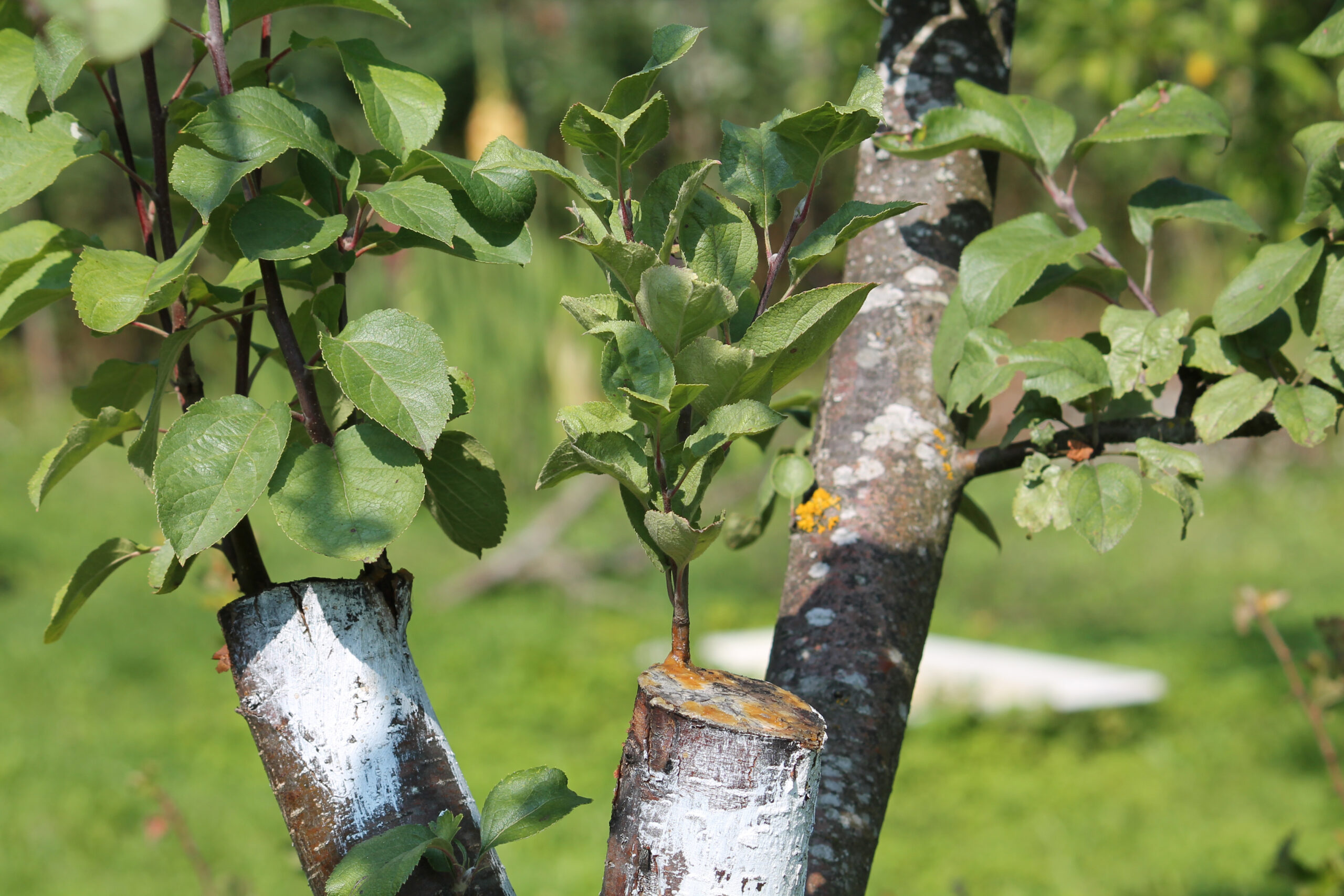
Rootstock plays a major role in how an apple tree grows and performs. Graft scion wood from your favorite apple variety (say, Fuji scion wood) onto a G.11 apple rootstock, and you’ll get a vastly different outcome than if you graft Fuji scion wood onto a B.118 rootstock.
The rootstock on which an apple tree is grown influences the tree’s size, disease resistance, precocity, and more. Many different types have been developed, with some of the most common falling into a few broad categories: Budagovsky (also known as Bud or B), Malling (M), Malling and Merton (MM), and Geneva (G).
You’ll also run across EMLA (East Malling-Ashton Long) rootstocks, which are improved, virus-free varieties of M and MM rootstocks.
How to Choose the Right Apple Rootstock
Choosing the right apple rootstock starts with understanding your growing conditions and long-term goals. Rootstock determines how large an apple tree will grow, how soon it bears fruit, how well it resists disease, and how it tolerates cold, wet, or poor soils.
If space is limited, dwarfing rootstocks like B.9, G.11, or G.935 allow you to grow productive apple trees in small yards—but they usually require staking. Semi-dwarf options such as M.7 or MM.111 strike a balance between size and resilience, making them popular for home orchards. For cold climates or traditional orchards with plenty of room, larger rootstocks like B.118 or Antonovka offer excellent hardiness and strong anchorage.
Also consider local disease pressure, soil drainage, and whether early fruit production is a priority. Matching rootstock traits to your site is just as important as choosing the right apple variety.
A number following the rootstock’s category name or letter provides further identification. Budagovsky 9, Bud 9, and B.9 are all the same. But B.9 is different from Budagovsky/Bud/B 118.
B.9 Apple Rootstock (Dwarf, Cold-Hardy)
B.9 apple rootstock produces dwarf trees growing as little as 25% the size of standard apple trees. B.9 offers many positives—early maturity, excellent fruit production, resistance to fire blight and phytophthora, and respectable cold hardiness (it should be fine in Zone 4 of the USDA Plant Hardiness Zone Map). However, its dwarfing tendency does come with a price: B.9 doesn’t anchor into the ground very well, so trees must be staked for support.
G.11 Apple Rootstock (Early Bearing Dwarf)
Another choice for a dwarfing apple rootstock is G.11, which yields trees roughly 30-35% of standard size. As with B.9, trees grown on G.11 rootstock require staking for extra support and best results. G.11 trees produce fruit from an early age and are resistant to fire blight, but woolly apple aphids can be an issue.
G.935 Apple Rootstock (Disease-Resistant Dwarf)
Apple trees grown on G.935 rootstock stay on the small side, growing to 40% or less of standard size. But they’re resistant to many diseases, including fire blight and phytophthora.
M.7 / EMLA 7 Apple Rootstock (Semi-Dwarf)
For decades, the M.7 and the improved EMLA 7 variety have grown semi-dwarf trees about 60-65% of standard size. They offer resistance to fire blight, but are known for their tendency to produce suckers.
MM.111 / EMLA 111 Apple Rootstock (Adaptable Semi-Dwarf)
MM.111 and EMLA 111 produce semi-dwarf trees reaching around 80% of standard size (though they can be smaller). Resistance to woolly apple aphid is a positive, and these apple rootstocks are known for anchoring firmly in the ground and growing in many different kinds of soil, including wet soil. One downside, however, is their tendency to sucker.
B.118 Apple Rootstock (Cold-Hardy, Large Trees)
B.118 apple rootstock is an excellent choice for orchardists in search of large, cold-hardy apple trees. B.118 grows trees about 85-90% as large as standard while offering some resistance to fire blight and phytophthora. It can handle Zone 3 winters and bears fruit early compared to other large trees.
Antonovka Apple Rootstock (Full-Size, Extremely Hardy)
If you want cold-hardy, full-sized apple trees, consider using Antonovka seedlings. This Russian variety can tolerate cold temperatures found in Zone 3 and even Zone 2, but the trees need lots of room to grow—space them around 30 feet apart.
Frequently Asked Questions
What is apple rootstock?
Apple rootstock is the root system onto which a fruiting apple variety (scion) is grafted. The rootstock controls the tree’s size, vigor, disease resistance, and adaptability to soil and climate.
Do dwarf apples need staking?
Yes. Most dwarf apple rootstocks, including B.9 and G.11, have weaker root systems and require permanent staking or trellising to prevent trees from falling over.
What is the most cold-hardy?
Antonovka and B.118 are among the most cold-hardy apple rootstocks available, tolerating winter temperatures in USDA Zones 2–3.
Final Thoughts
Rootstock selection is one of the most important decisions you’ll make when planting or grafting apple trees. From compact dwarf trees suited to small spaces to cold-hardy, full-sized orchard trees, different apple types offer distinct advantages. By considering climate, space, soil conditions, and management style, you can choose a variety that supports healthy growth, reliable fruit production, and long-term success in your apple planting.
This article was written for Hobby Farms magazine. Click here to subscribe.