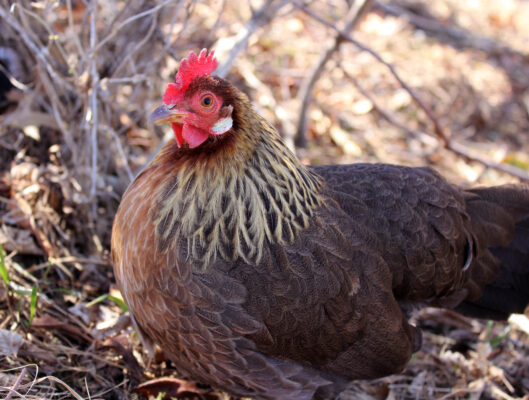
Free-range chickens thrive when given space to roam, forage, and explore beyond the coop. Not all breeds adapt equally to outdoor life, so choosing the right birds is essential for a healthy, productive flock.
Free-Range Chickens
Free-range chickens are birds that tend to be energetic, observant, and better equipped to handle the challenges of outdoor living. From hardy egg layers to dual-purpose and meat birds, the following top ten breeds are well-suited for free-ranging flocks and perform best when allowed to live and forage naturally.
#1 Rhode Island Red
Hardy and vigorous, the Rhode Island Red is an ideal breed when considering free-range chickens. The breed’s solid build and heavy weight make them too large for aerial predators to carry off.
While they can fall prey to ground predators, these robust hens are highly alert and notice an approaching predator more quickly than other breeds. Like all chickens, they need protection from nocturnal predators and require a safe predator-proofed coop to sleep in.
These friendly and inquisitive hens average two hundred to three hundred large brown eggs annually. Roosters are prone to aggression but make decent table birds, reaching market weight (six lbs.) in fourteen weeks.
#2 Ancona
The Ancona is a popular breed when choosing free-range chickens. Strong fliers and active, the Ancona does not bear confinement well. These lively hens are talkative and avoid contact with their owners. Due to their noise levels and their love of roaming, they are not an ideal breed for backyards with close neighbors.

Anconas are excellent layers, producing an average of two hundred and twenty large white eggs annually. Hens are not prone to broodiness, making them an ideal breed for individuals looking for a steady flow of eggs throughout the laying season.
#3 Andalusian
An excellent choice when considering free-range chickens, the Andalusian is a must-have breed for the free-ranging flock. Active, flighty, and robust, they do not tolerate confinement and, despite their unaggressive nature, do not make good pets.
Good egg producers, Andalusian hens lay an average of one hundred and sixty to two hundred medium-sized eggs. Though small, they make a delicious table bird with a white carcass.
#4 Buckeye
The Buckeye is a chicken worth considering for individuals seeking friendly, free-range chickens. Their calm and outgoing personalities make this breed a good choice as pets.
Active and curious, Buckeyes will happily come running across the yard for a visit and can stray to the neighbors if they spot someone outside. Their love of people can cause them to wander, so they may not be the best breed for backyard flocks with close neighbors.
Buckeye hens are good egg producers, averaging one hundred and fifty to two hundred medium-sized light brown eggs annually.
#5 Brown Leghorn
Though not as popular as the White Leghorn, the Brown Leghorn is the better option of the two color varieties for free-range chickens. Due to their darker feathers, Brown Leghorns are more challenging for predators to spot, making the breed less likely to get picked off.
Like their white cousins, Brown Leghorns are flighty and nervous and do not make good family pets. These energetic and alert chickens are good foragers and adapt well to a free-range environment.
Excellent egg layers, these striking hens produce an average of two hundred and twenty to three hundred medium-sized white eggs.
#6 Freedom Ranger
If you are looking for friendly and docile free-range chickens that also double as meat birds, look no further than the Freedom Ranger.
Sweet and gentle, the breed possesses a calm personality both with its flock mates and humans. Even when aged, the Freedom Ranger is not prone to aggression within the flock.
Fast growers, Freedom Rangers reach market weight (about five to six pounds) in nine to eleven weeks.
Another interesting thing about the breed is that female chicks can go on to become laying hens, averaging one hundred and fifty brown eggs annually.
#7 Hamburg
One of the most eye-catching of the free-range chickens, the Hamburg is hardy and active.
Hamburgs revert to a feral lifestyle easily and can often be found roosting in trees. However, if protection from predators is a concern, training them from an early age to go to the coop each night is advised.
Curious and intelligent, the Hamburg is a quick-moving chicken, helping the breed avoid daytime predator attacks.
Hens are good layers of small to medium-sized eggs, averaging 200 to 250 eggs annually.
#8 Welsummer
The ideal-looking free-range chickens, Welsummers, are what most people think of when they think of a chicken.
This beautiful breed is a good choice for free-ranging, as Welsummers need plenty of physical and mental stimulation to keep them out of trouble. Hens are good foragers but can be prone to wandering, making them an easy target for predators.
As layers, Welsummer hens produce an average of one hundred and fifty to two hundred large brown eggs with reddish-brown speckles. While they can be raised for meat, their primary purpose is as a layer.
#9 Red Ranger
Another good broiler option for farmers looking to raise free-range chickens is the Red Ranger. Easygoing and calm, they are a good alternative to the Cornish Rock. However, unlike the Cornish Rock, the breed was developed to have stronger legs and live longer lives.
Fast-maturing, Red Rangers reach market weight (four to six pounds) at twelve to fourteen weeks of age. Unlike other meat birds, they lack a large quantity of breast meat.
The breed can also double up as an egg layer, producing an average of one hundred and seventy medium-large light brown eggs annually.
#10 Jersey Giant
If you’re looking for friendly, dual-purpose free-range chickens, look no further than the Jersey Giant. Sweet and docile, Jersey Giants are good layers and quickly become part of the family.
Due to their large size, they are not usually picked off by smaller predators, but they can frequently fall prey to larger predators, such as coyotes and bobcats.
As layers, Jersey Giants produce an average of one hundred and fifty to two hundred large/extra-large light brown eggs.
When raised for meat, Jersey Giant capons are a good-quality table bird. Their meat has an excellent taste, and the carcass is large enough to feed a family of four. Although they produce a lot of meat, the breed is slow-growing and requires eight to nine months to reach market weight.
FAQ: Free-Range Chickens
What are the best breeds for free-range chickens?
The best breeds for free-range chickens are hardy, active, and alert birds that forage well outdoors, such as Rhode Island Reds, Anconas, Buckeyes, and Welsummers.
Can all chickens be raised free-range?
Not all chickens thrive outside. Breeds that are flighty, small, or slow to detect predators may struggle. Choosing birds adapted to outdoor life ensures a healthy, productive flock.
Do free-range chickens lay more eggs than confined chickens?
Free-range chickens often produce healthier eggs with richer yolks, but total egg production depends on the breed, diet, and management practices rather than free-ranging alone.
How much space do free-range chickens need?
A general guideline is at least 8–10 square feet per bird in the yard or run, plus a secure coop for nighttime protection from predators.
Final Thoughts
When choosing a good breed for foraging, raising free-range chickens for eggs and meat is a good way to decrease feed costs and raise healthier food for your family.
This article was written for Hobby Farms and Chickens magazines. Click here to subscribe.