Categories
Recipes

Peanut Butter Cups

Peanut butter cup
Photo by Rachael Brugger

Ingredients

  • 1/4 pound butter or margarine, melted
  • 3/4 pound powdered sugar
  • 1 cup creamy peanut butter
  • 2 small bags milk-chocolate chips
  • 2 T. vegetable shortening

Preparation
Mix first three ingredients with hands. Form into little balls and flatten in the palm of your hands. Set aside.

Melt chocolate, one bag at a time, in the top of a double boiler over medium-low heat with 1 tablespoon of shortening. Using paper cup liners in mini-muffin tins, cover the bottom of each muffin cup with chocolate, place a peanut-butter patty on top, and cover with more chocolate. Place in freezer for about 5 minutes to harden; store in refrigerator.

Makes about 100.

Categories
Recipes

Crustless Bacon Quiche

Ingredients

  • 12 slices bacon, crisply fried and crumbled
  • 1/3 cup chopped onion
  • 1 cup shredded Swiss cheese
  • 2 cups milk
  • 4 eggs
  • 1/4 tsp. salt
  • 1/8 tsp. pepper

Preparation
Sprinkle bacon, cheese and onion in greased 10-inch pie plate. Combine remaining ingredients in a large bowl and beat until smooth. Pour over bacon-cheese mixture. Bake at 400 degrees F for 35 to 40 minutes, until knife inserted just off center comes out clean.

Categories
Recipes

Homemade Baking Mix

This mix is typically used to make biscuits, pancakes, quiche and more. The cost? About $0.39 per cup, compared to the commercial equivalent, which sells for about $0.44 per cup.

Ingredients

  • 8 cups all-purpose white flour (or 5 cups white flour and 3 cups whole wheat)
  • 1/4 cup baking powder
  • 3 T. sugar
  • 1 T. salt
  • 1 1⁄3 cups powdered milk
  • 3/4 cup solid vegetable shortening

Preparation
Combine dry ingredients and mix well. Cut in shortening with a pastry blender until the mixture resembles coarsely ground meal. Store mixture in an air-tight container; refrigerate in warm weather. Mixture can also be stored in the freezer. Use in two to three months or longer if it’s been stored in the freezer.

When you’re ready, put your mix to use in biscuits or another of your favorite recipes.

Categories
Recipes

Cookies

Ingredients

  • 2 1⁄4 cups homemade cookie mix
  • 2 eggs, beaten
  • 1/4 cup water
  • 1/2 tsp. baking soda
  • 1 tsp. vanilla
  • 3/4 cup flour
  • 18 walnuts or pecans, halved (optional)

Preparation
Combine ingredients. Drop spoonfuls onto greased cookie sheet, 2 inches apart. If desired, place half a walnut or pecan in the center of each. Bake at 375 degrees F for 10 to 12 minutes.

Makes 3 dozen.

Categories
Recipes

Homemade Cookie and Brownie Mix

Cookie and brownie mixes probably rank at the top of the convenience-food favorites list. A typical package at the store, which yields about a dozen brownies, costs about $2.80. The following mix costs about $2.06 and makes enough for two batches of one dozen brownies or six dozen cookies.

Ingredients

  • 2 cups sugar
  • 1 cup flour
  • 3/4 cup unsweetened cocoa powder
  • 1 tsp. baking powder
  • 3/4 tsp. salt
  • 1 cup solid vegetable shortening

Preparation
Place dry ingredients in a large bowl and mix well. Cut in shortening with a pastry blender until the mixture resembles coarse meal. Store in an airtight container in a cool, dry place.

 
When you’re ready, put your mix to use in cookies or brownies.
Categories
Recipes

Brownies

Brownies

Ingredients

  • 2 1⁄4 cups homemade brownie mix, well-packed
  • 2 eggs, beaten
  • 1 tsp. vanilla
  • 1/2 cup chopped nuts (optional)

Preparation
Mix first three ingredients to form smooth batter; add nuts if desired. Spread in greased 9-inch square pan and bake at 350 degrees F for 30 to 35 minutes, or until toothpick inserted off
center comes out clean.

Makes 1 dozen.

Categories
Equipment

Overwinter Tools

It’s getting cold here in Minnesota, and that means it’s time to put away some of the motorized tools for the yard and farm.

If you’re like me, it’s awfully easy to push or carry them into a corner of the shed and forget about them until spring.

While it may be easy, it’s not smart. It doesn’t take much to winterize now so we don’t have to spend the best part of a day next spring getting them cleaned up and running.

The first step in any maintenance should be to make note of any spot where oil appears to be leaking. Then clear away dirt, grease or debris before working on fluids or filters. Debris and dirt are also a likely place for moisture to collect and cause corrosion over winter.

Sharpen blades and knives that have dulled over the past season. A few minutes with a file or grinding wheel will save lots of time in the spring. If the blade is too pitted or worn to renew, replace it now.

Give the engine a break. At the very least, siphon out excess fuel and run the tank dry before storing. Better yet is to change the oil and add a stabilizer like Sea Foam to it and the fuel tank if you intend to leave old fuel in the tank over winter.

Best of all is to add it to the fuel tank and oil as directed. Then start the engine and run it until it is out of fuel. As it burns, it cleans engine components, leaving them in good shape for the winter ahead.

Lubricate chains and grease joints and bearings and replace or clean air, fuel and oil filters. It’s easy to forget them, but clean filters protect the motor and maximize efficient operation. A few dollars spent replacing a filter now beats hundreds to replace a motor later.

Finally, before you walk away, jot down what you did and when in a notebook. Place the notebook where you can find it next spring. If there is a problem when you go to start the motor, you’ll know where to begin troubleshooting.  More likely, there won’t be a problem, but there will be a lot of satisfaction, thanks to time well spent now.

<< More Shop Talk >>

Categories
News

USDA Grants to Help New Farmers

The USDA's National Institute of Food and Agriculture is granting $17 million to educate new farmers
Twenty-nine grants distributed throughout the U.S. will be used to help train and educate beginning farmers.

The USDA’s National Institute of Food and Agriculture will award more than $17 million in grants to 29 institutions in 2009 to address the needs of beginning farmers and ranchers and enhance the sustainability and competitiveness of U.S. agriculture.

“Beginning farmers and ranchers face unique challenges and need educational and training programs to enhance their profitability and long-term sustainability,” said agriculture deputy secretary Kathleen Merrigan during the Nov. 3, 2009, announcement. “The training and education provided through these grants will help ensure the success of the next generation of farmers and ranchers as they work to feed people in their local communities and throughout the world.”

Merrigan announced the funding in Elgin, Minn., at Hidden Stream Farm and was joined by representatives from the Land Stewardship Project, a local grant recipient that provides local and regional training, education, outreach and technical assistance initiatives that address the needs of beginning farmers and ranchers. Eric and Lisa Klein, the proprietors of Hidden Stream Farm, were some of the first graduates of the Land Stewardship Project’s Farm Beginnings course. Since graduating from Farm Beginnings, the Kleins have developed a thriving pasture-based livestock operation that markets pork, chickens and beef in southeastern Minnesota and the Twin Cities.

The grants will be awarded through NIFA’s Beginning Farmer and Rancher Development Program. BFRDP is an education, training, technical assistance and outreach program designed to help U.S. farmers and ranchers, specifically those who have been farming or ranching for 10 years or fewer.

Congress authorized the 2009 funding for the program in the 2008 Farm Bill, with an additional $19 million in mandatory funding for 2010. Under the program, USDA will make grants to organizations that will implement programs to help beginning farmers and ranchers.

The grants are also part of USDA’s “Know Your Farmer, Know Your Food” initiative, which was launched in September 2009 to emphasize the need for a fundamental and critical reconnection between producers and consumers. The initiative focuses on major agricultural topics such as supporting local farmers and community food groups, strengthening rural communities, enhancing direct marketing and farmers’ promotion programs, promoting healthy eating, protecting natural resources, and helping schools connect with locally grown foods.

Beginning farmers and ranchers interested in participating in any of the education, outreach, mentoring or internship activities are asked to contact the following 2009 grantee institutions:

    Developing Innovations in Navajo Education, Inc., Flagstaff, Ariz.
    Arkansas Land and Farm Development Corporation, Brinkley, Ark.
    Agriculture and Land-Based Training Association, Salinas, Calif.
    California FarmLink, Sebastopol, Calif.
    Florida A&M University, Tallahassee, Fla.
    University of Florida, Gainesville, Fla.
    University of Hawaii, Honolulu, Hawaii
    Angelic Organics Learning Center, Inc., Caledonia, Ill.
    University of Kentucky, Lexington, Ky.
    Cultivating Community, Portland, Maine
    USDA National Agricultural Library, Beltsville, Md.
    Land Stewardship Project, Minneapolis, Minn.
    Farmers’ Legal Action Group, Inc., St. Paul, Minn.
    Thomas Jefferson Agricultural Institute, Columbia, Mo.
    University of Missouri, Columbia, Mo.
    University of Nebraska, Lincoln, Neb.
    Holistic Management International, Albuquerque, N.M.
    Cornell University, Ithaca, N.Y.
    Fort Berthold Community College, New Town, N.D.
    Langston University, Langston, Okla.
    Pennsylvania State University, State College, Pa.
    South Dakota State University, Brookings, S.D.
    University of Tennessee, Knoxville, Tenn.
    University of Texas-Pan American, Edinburg, Texas
    Washington State University, Pullman, Wash.
    Midwest Organic and Sustainable Education Service, Spring Valley, Wis.

Categories
Animals

Martok’s Story

Martok and Bella before Bella had to leave
Photo by Sue Weaver

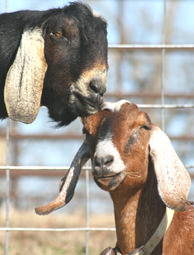
Don’t we make a handsome bridal couple?

I’m a big guy now and very manly—just ask Bella, the beautiful Nubian who came to visit last week. I helped her make babies! Here is the portrait Mom shot of us together before Bella went home.

Today mom looked at the sore where I’ve peed on my nose so much the hair came off. She said, “Martok, you were such an adorable kid; how did you grow up to be you?”

I think that’s called a hypothetical question.

But it made me stop and think about being a kid, back to the night I was born. That was pretty scary—my sisters and I almost died!

The education process of computing began early for Martok and Uzzi
Photo by Sue Weaver

Dad taught me to compute when I was four days old, that’s why Uzzi and I are so good at Googling things.

My first human mom was Emily Dixon of Ozark Jewels. She’s a very conscientious breeder and she loves us goats really much, but a weird thing happened that night.

Emily set her alarm to check my mom in the night but she somehow turned it off in her sleep.

It was 5:30 a.m. when Emily woke up. It was March 4, super-cold and icy, and my mom had never had kids before. Emily grabbed a flashlight and raced to the does’ pen. Duke, the livestock guardian dog, dashed out of the farthest shed when he heard her coming.

Emily found my mom in another shed. She’d given birth and we weren’t there! Emily raced from shed to shed and found us in the one Duke had been guarding. We were dog-slobbery and nearly frozen, but alive!

Martok and Uzzi are now inseperable
Photo by Sue Weaver

Uzzi and I were buddies right from the start. He was bigger than me, but I caught up!

Emily rushed us to the house and placed two of us by the woodstove but my other sister was more dead than alive, so Emily held her in warm water until she thawed out and then tube-fed her warm colostrum. Finally my sister was okay.

My present mom wanted a buckling to raise with Uzzi (he was a month old and came from Emily’s too), so two days later, Emily called Mom to come get me to be Uzzi’s pal. Mom named me after a Klingon warrior: Ozark Jewels General Martok so I’d grow big and strong. And I did!

And my sister, the cold one who almost died? She had triplets on our birthday this year and one of them is Edmund! He’s Mopple the sheep-geep’s buddy, just like Uzzi is my own best friend.

And that’s how I came to be me.

« More Mondays with Martok »

Categories
News

Gates Foundation Grants to Benefit Africa’s Small Farmers

The Bill and Melinda Gates Foundation is donating $120 million to improve agricultural knowledge and methods in Africa
Courtesy the Bill & Melinda Gates Foundation/ Prashant Panjiar.
Francis Adunoye, agronomist and plot manager for the International Institute of Tropical Agriculture, shows Bill Gates, founder of the Bill and Melinda Gates Foundation, various types of grain in Abuja, Nigeria.

Computer guru and philanthropist Bill Gates is taking his entrepreneurial spirit to the agriculture scene to help fight world hunger. According to the Microsoft founder, reducing hunger and poverty starts with helping small farmers in developing countries.

Gates announced at the World Food Prize in Des Moines, Iowa, that the Bill and Melinda Gates Foundation will provide $120 million through nine grants that will focus on improving agricultural methods and increasing agricultural knowledge in Africa.

According to the World Bank, the 750 million small farmers in developing countries face challenging conditions, including depleted soils, pests, drought, diseases and lack of water. Many of the grants will help combat these problems. In Sub-Saharan Africa, two-thirds of the population work in agriculture with only about 4 percent of federal budgets allocated to that industry, according to Gates Foundation research. 

The Alliance for a Green Revolution in Africa has already received significant aid from the Gates Foundation through grants to support its Soil Health and Africa’s Seed Systems programs. In its most recent reward, AGRA will focus on creating policies to support farmers in different agricultural arenas, including seeds, soil health and environmental sustainability.

“Many of [Africa’s] parliaments do not have the capacity to effectively advocate for critical public investments in African agriculture,” said Akin Adesina, AGRA’s vice president for policy and partnerships. “There is a lack of evidence on which to base policy and a shortage of highly trained African policy experts.”

He said AGRA will facilitate the establishment of policy hubs at leading think tanks and government agencies. In these hubs, the organization will work with the various African governments to in develop sound policies to support small farmers and sustainable agricultural development.

“As smallholder farmers prosper, their farms will become self-sustaining engines of economic growth that can end widespread hunger and poverty,” Adesina said.

Other grants will be used for improving agricultural methods.

The International Crops Research Institute for Semi-Arid Tropics, which has worked for 25 years in Africa, is using its $18 million grant to increase the production of sorghum, pearl millet and finger millet—three cereals commonly consumed in Sub-Saharan Africa.

The crops are used to make flatbread and porridge, health food for pregnant and nursing women, and grain in alcohol, said William Dar, director general for ICRISAT. The stalks and leaves of the plants are also used as livestock fodder.
“By working on these crops, ICRISAT hopes to touch at the very heart of semi-arid tropical food sources of both humans and livestock,” he said.

The organization has been working to develop varieties of the crops that are resistant to pests, disease and drought.
“ICRISAT developed maturing varieties that escaped terminal drought and varieties that needed shorter growing periods thus giving farmers a chance to increase the number of harvests per year,” Dar said.

Other organizations will use the grants to increase other crops’ yields. The International Potato Center is using its $21 million to develop stress-tolerant sweet potatoes, with the intention of distributing the new varieties to up to one million families in the next five years. In The Netherlands, Wageningen University aims to use its $19 million to help 225,000 farmers in seven African countries increase legume productivity by improving soil’s nitrogen fixation.

Food security has been a major concern among international leaders. With a recent $22 million pledge from the G20 group, a focus is shifting toward supporting small farmers. Gates encourages these world players involved in eliminating world hunger to draw inspiration from the Green Revolution—the agricultural transformation in Latin America and Asia in the 1960s to the 1980s—but also warns them against repeating mistakes such as the overuse of fertilizer and irrigation.

“The next Green Revolution has to be greener than the first,” Gates said. “It must be guided by small farmers, adapted to local circumstances, and sustainable for the economy and the environment.”

The Gates Foundation took its first steps in agricultural development in 2006 when it established the Global Development Program, aimed at eliminating poverty in developing countries. Its mission is to help 150 million farming families by 2025, and it has provided $1.4 billion to support agricultural development thus far.