Categories
News

2010 Growing Green Awards

Growing Green Awards- 2010

If you know a leader of a farm, business or organization that is green-centric, consider nominating them for a 2010 Growing Green Award, sponsored by the Natural Resources Defense Council. In the second year of the awards, NRDC wants to recognize leaders in sustainability who have made advancements in ecologically integrated farming practices, climate stewardship, water stewardship, farmland preservation and social responsibility from farm to fork.

Awards will be given in four categories:

  • Food Producer: farmers or other food producers who employ innovative techniques to sustain agriculture, the natural environment, workers and community
  • Business Leader: entrepreneurs who effectively use the marketplace to promote sustainable food systems, develop infrastructure that enables sustainable production, or advance sustainable innovations anywhere on the supply chain from farm to fork
  • Thought Leader: visionaries who advance sustainability as it relates to food through creative research, public education and outreach
  • Water Steward: farmers or other food producers who have made extraordinary contributions in demonstrating water efficiency, sustainable water use and the protection of water quality

    The nominees will be judged by a panel of sustainable food leaders. The judges are Susan Clark, executive director of the Columbia Foundation; A.G. Kawamura, secretary of the California Department of Food and Agriculture; Michael Pollan, author of The Botany of Desire and other books on food, agriculture and the environment; and Nora Pouillon, the chef and founder of Restaurant Nora, the first certified-organic restaurant in the U.S.

    Upon making their selections the judges will consider the nominee’s innovation in promoting ecologically integrated food systems; potential to achieve wide-scale adoption, implementation or behavior change; and advancement of health, safety and economic viability for farmers, farm workers and rural communities.

    The winner in the Food Producer category will receive a $10,000 prize and all winners will be promoted by NRDC to the media and its networks.

    Nominations for the 2010 Growing Green Awards must be submitted to the NRDC by Dec. 4, 2009. Click here to make your nomination.
  • Categories
    Crops & Gardening

    Preboggin

    This local weed is used in the wild green mix
    Photo by Rick Gush

    With the recent rains, the weeds around here are jumping again. But that’s mostly good news for us because we really like to eat the local wild greens mix. The group of weeds that are harvested here in Liguria are called preboggin (pray-boo-zhawn). It’s unusual in that it is both a traditional food for poor people and now a prized delicacy in fancy local restaurants.

    This mix of young leaves from a group of about 30 plant species is used like spinach in cooked dishes such as vegetable pie and stuffed ravioli and is often mixed with potatoes and green beans.  Of the 30 or so collectable species, each harvester finds a slightly different mix, so the composition of preboggin is variable. The group includes a few species like curly dock, sorrel, cats-ears and milkweeds but is largely made up of a bunch of different dandelion cousins. All of the perhaps twelve dandelion types in preboggin are in the Taraxacum genus.  I think this entire genus produces young leaves that are used in cooking.

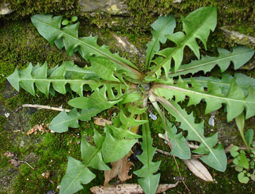
    Preboggin feature large leaves
    Photo by Rick Gush

    The first picture is of one of my favorite dandelions; the tagginetti. (I’m horrible at Italian spelling, as my wife will attest, so this could perhaps actually be spelled taeginetti or something similar.) The leaves are a bit small, being only three or four inches long, but where tagginetti are growing, the leaves are plentiful. The severely jagged edges make this edible leaf the easiest to recognize when one is out in the field picking greens.

    The second photo is of the second most common component of preboggin, and that is the milkweed. There are two or three types of milkweed on the preboggin list, and they are particularly vigorous and opportunistic growers, and they produce nice big leaves. The stems and flowers are not eaten, but the succulent new leaves are plucked off. These plants have flowers like dandelions, except they are on two foot tall stems.

    I’ll confess, I’m not sure the scientific name of what I’m calling milkweed. They are not Asclepias.  I think they are just another branch of the Taraxacum genus. When I was wandering the woods as a kid and eating all the edible plants, this is one that I missed eating. Because the stems exude a milky sap when broken, I always thought milkweeds were slightly poisonous, but instead they are delicious!

    <>

    Categories
    Crops & Gardening

    Castagne

    With fall comes the chestnut season
    Photo by Rick Gush

    Fall is here and the castagne (chestnuts) season has started. The woods around here are loaded with castagne (Castanea sativa) trees, and the nuts start falling once the weather turns cold. We usually collect alongside a paved road where there are castagne trees overhead, so when the nuts fall and remain in their spiny pod we can squash the pods with a foot to make the nuts squirt out. The biggest nuts usually fall out of the pod, though, so when we find a tree that makes big nuts, we can just pick them up off the ground. Often when we are collecting, the nuts are falling at the same time so during the some of the best collection trips, we get hit by nuts falling from the trees.

    When I first moved here, I was interested to hear of these big nuts. Of course I’d heard of chestnuts (“Chestnuts roasting on an open fire…”), but I’m from California, and the closest we have there are the chestnut cousins called horse chestnuts or buckeyes (Aeschylus). Buckeyes have great big nuts, but they’re not edible. I’ve also sold a lot of flowering chestnuts (a different Aeschylus species) in the nursery business, but I had never lived where there were edible chestnuts growing wild.

    About a month after I moved here to Italy, I was at a fair somewhere and there was a guy with a little wagon set up to roast chestnuts, so I excitedly bought a little paper bag full of the roasted nuts, expecting a great tasting treat. Unfortunately, I thought the chestnuts were just mealy and not so flavorful. I ate one and ended up throwing the rest into the garbage.

    I don’t remember how I decided castagne were delicious, but it probably had something to do with my love for collecting edible stuff in the woods. Or it might have been one of the festivals in the fall around here that celebrate castagne and roast a whole bunch on the beach or something like that.  Anyway, now I’m nuts for roasted chestnuts. Actually, I now enjoy castagne in all forms and I even peel a few and eat them raw while we’re out collecting. My mother-in-law really likes it when we bring her chestnuts we’ve collected, and she and my wife use the castagne to make a nice rustic pastry called castagnacia, which is sort of a hardened chestnut pudding with nuts and raisins.

    The lumber from castagne trees is the hardwood of choice around here. Almost all of the old rural houses have ceiling beams made from big castagne logs, and the two story places use castagne beams as the flooring support. The wood is also used for fenceposts because the wood is resistant to decay and water damage.

    <>

    Categories
    Homesteading

    Holiday Food with a Twist

    Create your own Brussel Sprout and Cauliflower Gratin with Pine Nut-Breadcrumb Topping with help from Hobby Farms
    Photo by Kate Savage

    It’s about this time every year that, with a degree of wistfulness, I realize I’m just about sated on corn and tomatoes.  I’ve canned and frozen, picked and shucked for what seems like weeks, not to mention made and consumed all variations known to man of salsa, Greek Salad, Bolognese sauce, corn pudding, corn fritters and corn bread.  Every bite has been wonderful, this year I even traveled to Greece to eat my fill of Greek salad there! 

    But by now I’m casting about for some alternatives as summer has run its course.  The ghosts, goblins and ghouls of Halloween have been dispatched for another year, and I am beginning to anticipate the other two events that make up the “triple treat” of Halloween, Thanksgiving and Christmas.  The robust vegetables of winter are now in season, and I am happy to see some of those rough-skinned old friends back on the shelves at the grocery.

    Coming up with a menu for the holidays that isn’t so far flung from the traditional fare and yet has a different twist to it, is always a challenge.  Other holidays throughout the year offer more flexibility in their expected menus, but Thanksgiving and Christmas cannot be tinkered with!

    A year-round favorite in my home is a really cheesy cauliflower casserole.  (A tip to keeping the cauliflower “bleach” white is adding some lemon juice to the water used for blanching.)  

    I know this preparation will always meet with approval and applause, but in order to refashion it into a dish that steps up to the holiday requirements—a cauliflower cheese redux—I have redesigned the sauce and the topping and added another humble but much-loved vegetable, the brussel sprout.  

    The finished product has sophistication and a slight international flair but at the same time, for those of us who love the cold-climate vegetables and our holiday food traditions, it satisfies all the basics.

    Brussel Sprout and Cauliflower Gratin with Pine Nut-Breadcrumb Topping
    Serves 10-12 people

    Ingredients

    • 1 ½ lbs of brussel sprouts, trimmed, quartered lengthwise
    • 1 ½ lb head of cauliflower, trimmed into small florets
    • 2 ¾ cups of heavy whipping cream
    • ½ cup chopped shallots
    • 1 T chopped fresh sage
    • 1 ½ T olive oil
    • ½ cup plain dry breadcrumbs
    • ½ cup pine nuts, light toasted
    • 2 T chopped fresh Italian parsley

    Preparation

    Preheat oven to 375 degrees F. Cook brussel sprouts in boiling water for 2 minutes. Add cauliflower to the same pot and cook until both are crisp-tender. Drain. Refresh in iced water. Drain. Combine cream, shallots and sage in large saucepan. Bring to a boil.
    Reduce heat, simmer until mixture is reduced to 2 ½ cups, 10 minutes. Season with salt.  Remove and cool.
    Heat oil in skillet, add breadcrumbs and stir until browned. Stir in toasted pinenuts and parsley. Butter a 13 x 9 x 2 casserole dish or equivalent. Arrange half of the vegetables in dish.  Sprinkle with salt and pepper and then 1 ½ cups of Parmesan. Arrange remaining vegetables evenly over, then sprinkle with remaining 1 ½ cup of Parmesan. Pour Cream evenly over.
    Cover Gratin with foil and bake covered for 40 minutes. Uncover, sprinkle breadcrumb topping over and bake uncovered 15 minutes.

    Happy Holidays!

    About the author: In addition to being a freelance writer, Kate Savage has owned and operated Bleu Ribbon Catering in Lexington, Ky., for over 25 years.  

    Find more casserole recipes in Side Dishes

    Categories
    Homesteading

    Celebrate National Cat Day


    October 29th is National Cat Day
    Photo by Cherie Langlois

    According to the National Cat Day website, tomorrow—October 29—is (how did you guess?) National Cat Day. 

    Founded by animal behaviorist Colleen Paige, this day is intended to increase public recognition of the many wonderful cats needing rescue, plus give us a special day to celebrate our own feline friends. 

    The website cites a tragic statistic: each year some 4 million cats enter U.S. shelters.  These include strayed and abandoned pets, cats discarded because the family plans to move or can’t deal with a behavior issue, and litter upon litter of kittens. 

    Around 1 to 2 million of these cats and kittens—many of which would make fabulous pets—will be euthanized.  Despite the plethora of no-kill rescues and shelters trying to place adoptable animals, there just isn’t space for them all. 

    There are many things you can do to make a difference on National Cat Day
    Photo by Kelsey Langlois

    Here are some ideas for how to join in the celebration:

    • If you have room in your farm home and heart for a purring companion, why not adopt a cat or kitten from a local shelter or rescue group (check out pet finder)? Most of my cats have been rescues, so I can vouch for the fact that saving a life feels awesome. 

    What’s more, the adoption option is generally a bargain when compared to acquiring a so-called “free kitten” from the classifieds.  The rescue group I volunteer with, for example, ensures each kitten has been altered, tested for feline leukemia/AIDS, examined by a vet, given its first shots, de-flead, dewormed and microchipped—all for an $85 adoption fee that will help the group continue its work.      

    • If, like me, you currently don’t have room for any more pets, consider helping these hardworking groups in another way, perhaps with a donation of money, pet supplies or your time as a volunteer or foster parent.  For the past three years, my daughter and I have had great fun fostering a never-ending procession of adorable kittens and cats in our large mud-room.  When we can, we also volunteer on adoption days.

    • If you have an unaltered cat, do your part to save lives by making an appointment for kitty to get fixed ASAP.  Having financial difficulties?  Ask your vet or any local shelters/rescue groups if they know of low cost spay/neuter programs operating in your area.           

    • Finally, don’t forget to bestow some special attention on your feline farm friends tomorrow.  I plan to give my trio of indoor cats, pair of outdoor feral cats, and two foster kittens a favorite treat: a little canned tuna.  

    ~ Cherie 

    « More Country Discovery » 

    Categories
    News

    Equine Industry Survey

    AHP’s Equine Industry Survey is designed to gather information regarding the most important issues in the equine industry

    Small farmers and hobby farmers who own horses are invited to participate in a survey conducted by the American Horse Publications before Jan. 15, 2010.

    AHP’s Equine Industry Survey is designed to gauge participation trends in the U.S. equine industry. In addition, the survey seeks to gather information regarding the most important issues facing the industry.

    Those eligible to participate in the survey are men and women, 18 years of age and older, who currently own, manage, or lease at least one horse and live in the United States. Dr. C. Jill Stowe, an assistant professor of agricultural economics at the University of Kentucky, is providing consulting services for data collection and analysis to the AHP.

    The study is anonymous. No one, including members of the research team, will be able to associate information you give with responses. When the survey results are tallied, only aggregated results will be presented.

    To take the survey, click here.

    The survey is sponsored by Intervet/Schering-Plough Animal Health and Pfizer Animal Health, who are avid supporters of the horse industry.

    AHP is a nonprofit association that promotes better understanding and communications within the equine publishing industry. Its members include equine-related publications, websites, professionals, students, organizations and businesses. AHP’s member publications, websites and newsletters reach 3 million people in the horse industry in the United States and around the world.

    Categories
    News

    Michigan Amends State Animal Industry Act

    HB 5127 ensures any covered animal the proper amount of space when tethered or confined
    Michigan HB5127 amends the state’s Animal Industry act to give covered animals, such as those in gestation stalls and battery cages, ample space.

    The governor of Michigan recently signed a bill that will modify the state’s Animal Industry Act. The amendment, HB 5127 sponsored by Rep. Mike Simpson (D-Jackson), ensures any covered animal—that is, any gestating cow, calf raised for veal or egg-laying hen—the proper amount of space when tethered or confined.

    “The language is performance oriented on what the animal ought to be able to do,” says Janice Swanson, director of Animal Welfare at Michigan State University’s Department of Animal Science. The bill states an animal must be able to lay down, stand up, fully extend its limbs and turn around freely.

    The bill will not apply, however, to certain groups of farm animals. Those include covered animals used for research or veterinary purposes; being transported; shown at rodeos, fairs or similar exhibitions; being sent to slaughter under government regulations; or within seven days of a gestating sow’s expected date of giving birth.

    Representatives from a number of farming organizations, including Michigan Allied Poultry Industries and Michigan Pork Producers Association, sat in on discussions of the bill’s content, with Jim Byrum of the Michigan Agro Business Association serving as mediator. As a result, there seems to be few qualms about what the bill means for the Michigan farming industry, Swanson says.

    “It will take some time to see how it plays out,” she says. “If you are not someone using the production equipment affected by the language of the bill, then you don’t have to worry about it.”

    Farmers using gestation crates or stalls for sows or battery cages for hens will have 10 years from the bill’s enactment to comply with the regulations, and those using veal crates will have until Oct. 1, 2012. Swanson says it will be up to public scientists, such as her department at the MSU extension office, to look into what needs to be done to make these transitions happen.

    According to Simpson, chair of the House Agriculture Committee and the bill’s sponsor, these standards set an example for a national model.

    “This plan strikes a reasonable balance between protecting the hundreds of thousands of jobs and billions of dollars generated by the Michigan agricultural industry and safeguarding the health and safety of millions of animals raised on Michigan farms,” he says.

    Categories
    Recipes

    Brussel Sprout and Cauliflower Gratin with Pine Nut-Breadcrumb Topping

    How to make Brussel Sprout and Cauliflower Gratin with Pine Nut-Breadcrumb Topping from Hobby Farms
    Photo by Kate Savage

    Serves 10-12 people

    Ingredients

    • 1 ½ lbs of brussel sprouts, trimmed, quartered lengthwise
    • 1 ½ lb head of cauliflower, trimmed into small florets
    • 2 ¾ cups of heavy whipping cream
    • ½ cup chopped shallots
    • 1 T chopped fresh sage
    • 1 ½ T olive oil
    • ½ cup plain dry breadcrumbs
    • ½ cup pine nuts, light toasted
    • 2 T chopped fresh Italian parsley

    Preparation

    Preheat oven to 375 degrees F. Cook brussel sprouts in boiling water for 2 minutes. Add cauliflower to the same pot and cook until both are crisp-tender. Drain. Refresh in iced water. Drain.
    Combine cream, shallots and sage in large saucepan. Bring to a boil.
    Reduce heat, simmer until mixture is reduced to 2 ½ cups, 10 minutes. Season with salt.  Remove and cool. Heat oil in skillet, add breadcrumbs and stir until browned. Stir in toasted pinenuts and parsley.
    Butter a 13 x 9 x 2 casserole dish or equivalent. Arrange half of the vegetables in dish. Sprinkle with salt and pepper and then 1 ½ cups of Parmesan. Arrange remaining vegetables evenly over, then sprinkle with remaining 1 ½ cup of Parmesan. Pour Cream evenly over.
    Cover Gratin with foil and bake covered for 40 minutes. Uncover, sprinkle breadcrumb topping over and bake uncovered 15 minutes.

    Recipe is from Holiday Food with a Twist by Kate Savage

    Categories
    Crops & Gardening

    Horseradish and Millipedes

    It’s just about horseradish harvesting time! Yummy! Most horseradish growers wait until the first frost kills the leaves, but I like to harvest earlier, not just because I’m almost finished with the last jar of prepared horseradish from last year’s crop. I also think that the shoots re-planted in fall grow better than those replanted in winter. Although the leaves don’t look anything similar, horseradish, Armoracia rusticana, is a relative of cabbage and broccoli and is native to Eastern Europe. Horseradish is a very common condiment in the cuisine of most northern European countries, southwestern Illinois produces 85 percent of the world’s commercially cultivated horseradish. There are a few horseradish growers in the hills around Umbria, but Italians, including my wife, aren’t generally big horseradish consumers.

    Making prepared horseradish couldn’t be much easier. I dig up the roots and wash them off well, which is the hardest part. I separate out a few nice shoots to plant for next year’s crop and then throw the rest of the roots into the blender. I like my horseradish a bit chunky so I just chop the roots for a minute or so, but if I leave the blender running for longer I can produce a very creamy blend.  I mix a small amount of salt and vinegar into the horseradish slurry and then pour the mix into little jars that I have previously boiled.  I don’t use any fancy sealing, just the regular jar cap screwed on tightly.  The resultant jars of prepared horseradish can last for a whole year easily, and they don’t seem to ever attract any mold, even once they have been opened.

    I should mention how spicy and gaseous the chopped horseradish in the blender is.  It makes chopped Cayenne peppers look tame by comparison. Lifting up the cover and smelling the mix is a very bad idea as the gas can burn one’s eyes, as I know from experience. Wives who do not like horseradish should definitely be away from home during horseradish preparation.

    Martin Cooper/Flickr
    Martin Cooper/Flickr

    Today’s second photo is of a good looking millipede in the garden. Unlike centipedes that do bite sometimes, millipedes just secrete stinky compounds that can be poisonous. I remember some of the yellow spotted millipedes in the States emit a cyanide juice that can make people sick.

    I don’t have trouble with either centipedes or millipedes in the garden and consider them helpful predators. I wasted a good quarter of an hour as I watched a millipede wander around my garden table while I photographed him. It was one of those moments when I marvel at how wonderful our whole biological system is and how many amazing creatures make up the mix.

    Categories
    Crops & Gardening

    Olive Harvest

    Most farmers choose to harvest their olives a different and unique way 
    Photo by Rick Gush

    The olive harvest has started, and all over in the hills around here people have unfurled their harvest nets and are collecting olives. The most common technique is to roll up the big plastic mesh nets and string them in-between the trees.  When I first saw all these nets, I thought they were perhaps some strange sort of hammock, but then when olive season rolled around, I saw the nets unfurled and I understood that leaving the rolled nets attached to the trees was just a time-saving device. This is, in part, because the olive harvest can last five months, from October to February.  Some people spread the nets and then just let the olives fall naturally, skimming off the collected olives two or three times during the long harvest. Those who are a bit less casual will lay the nets out on the ground, and then collect all the olives on the trees during one big harvest.  Some olives are beaten off the trees with long bamboo poles, and other olives are harvested by hand with ladders to climb up into the tree tops.

    This year is an exceptionally small harvest for olives. Last year was a huge harvest and most everybody still has a lot of oil left over from last year, so they’re not crying too much.  Personally, the small harvest isn’t such great news. After the resounding success of my olive curing experiment last year, I was looking forward to curing 10 gallons or more of olives, but the places where I can usually find free olives to harvest are all empty this year. I may have to go help my friend Richard harvest his olives in order to justify mooching a sackfull of olives from him.

    The nets used to catch the olives are a big time-saver
    Photo by Rick Gush

    I’m also having a hard time finding a source for some new gallon-sized, wide-mouth glass jars, which are perfect for curing olives. My compliment-winning olives last year were made by filling a big glass jar with olives and water and changing the water almost every day for about two months. I am a bit irregular in my method and didn’t change the water for days on end a few times, but that didn’t seem to matter. I sample tasted an olive or two every once in a while, and when the flesh seemed to have lost all the bitterness, which was almost two months after starting, I packed the olives in mildly salty water for a week and they were ready to eat. 

    Most everybody just takes their olives to the frantoio (fran-toy-oh) where they are ground up and squeezed to make oil.  There are a dozen or more frantoios around here, and last year there were so many olives, it was difficult to schedule an appointment.  I heard about one friend who was thrilled to get an appointment at midnight. This year, things are different, and most of the farmers can just go to the frantoio without even scheduling an appointment.

    <>