Categories
News

‘Know Your Farmer, Know Your Food’

Know Your Farmer, Know Your Food is a program set up by the USDA to help spread word about local food systems

Agriculture Secretary Tom Vilsack and Deputy Secretary Kathleen Merrigan today announced a new initiative – ‘Know Your Farmer, Know Your Food’ – to begin a national conversation to help develop local and regional food systems and spur economic opportunity.

Secretary Vilsack launched the initiative with the first of several videos, which can be viewed at USDA’s YouTube channel.

“An American people that is more engaged with their food supply will create new income opportunities for American agriculture,” said Vilsack.

“Reconnecting consumers and institutions with local producers will stimulate economies in rural communities, improve access to healthy, nutritious food for our families, and decrease the amount of resources to transport our food.”

The “Know Your Farmer, Know Your Food” initiative, chaired by Deputy Secretary Merrigan, is the focus of a task force with representatives from agencies across USDA who will help better align the Department’s efforts to build stronger local and regional food systems.

“Americans are more interested in food and agriculture than at any other time since most families left the farm,” said Merrigan.

“‘Know Your Farmer, Know Your Food’ seeks to focus that conversation on supporting local and regional food systems to strengthen American agriculture by promoting sustainable agricultural practices and spurring economic opportunity in rural communities.”

In the months to come, cross-cutting efforts at USDA will seek to use existing USDA programs to break down structural barriers that have inhibited local food systems from thriving.

Today, USDA announced a small initial group of moves that seek to connect local production and consumption and promote local-scale sustainable operations:

  • USDA’s Risk Management Agency announced $3.4 million in funding for collaborative outreach and assistance programs to socially disadvantaged and underserved farmers. These programs will support “Know You Farmer” goals by helping producers adopt new and direct marketing practices.

    For example, nearly $10,000 in funding for the University of Minnesota will bring together experts on food safety and regulations for a discussion of marketing to institutions like K-12 schools, colleges, universities, hospitals and other health care facilities.

  • USDA’s Food Safety and Inspection Service proposed regulations to implement a new voluntary cooperative program under which select state-inspected establishments will be eligible to ship meat and poultry products in interstate commerce. The new program was created in the 2008 Farm Bill and will provide new economic opportunities for small meat and poultry establishments, whose markets are currently limited.
  • USDA’s Rural Development announced $4.4 million in grants to help 23 local business cooperatives in 19 states. The member-driven and member-owned cooperative business model has been successful for rural enterprises, and bring rural communities closer to the process of moving from production-to-consumption as they work to improve their products and expand their appeal in the marketplace.
  • USDA’s Rural Development will also announce a Rural Business Opportunity Grant in the amount of $150,000 to the Northwest Food Processors Association. The grant will strengthen the relationship between local food processors and customers in parts of Idaho, Oregon and Washington, and will also help the group reduce energy consumption, a major cost for food processors.
  • As the “Know Your Farmer, Know Your Food” initiative evolves, USDA will continue to build on the momentum and ideas from the 2008 Farm Bill and target its existing programs and develop new ones to pursue sustainable agriculture and support for local and regional food systems.
Categories
Crops & Gardening

Garden Pollinators

There are a majority of great pollinating insects
Photo by Jessica Walliser

I was lucky enough to be invited to Rhode Island this summer to film a segment for the television show Cultivating Life

Last year, on the tails of the release of my book Good Bug Bad Bug, I was invited to talk about beneficial insects in the garden.  This year they asked me to discuss alternate pollinators. 

The show’s overall focus was the honeybee, but they also wanted to focus on some of the lesser known pollinators found every day in our landscapes. 

Most gardeners don’t know there are over 3,000 species of native bees across North America; most of which don’t sting and live solitary lives.  They do the important work of pollinating literally millions of plants and are busily trying to pick up the slack left behind by Colony Collapse Disorder. 

Unfortunately, many of these little guys are suffering from habitat loss, parasites, and pesticide exposure just like the European honeybee (who seems to get all the press lately). 

Orchard mason bee nesting blocks
Photo by Jessica Walliser

These little native bees are real workhorses in the orchard and garden.  You can encourage them by planting a diversity of blooming plants, especially those with clusters of small flowers (like dill, fennel, alyssum, yarrow and the like), by cutting out the chemicals, and by allowing a portion of your garden to stand through the winter. 

Cutting perennials and grasses to the ground each fall, eliminates overwintering and egg laying sites for all sorts of beneficial creatures, including some species of native bees. 

Making a few orchard mason bee nesting blocks and hanging them up around the farm is another sound idea for luring in this specific, and very important, pollinator. 

Bees, though, aren’t the only pollinator we discussed on the show.  Beetles, flies, wasps, and other insects, as well as hummingbirds, moths and butterflies are all helpful pollinators. 

A diversity of plants around the farm is always a good idea.  The more the merrier.           

<< More Dirt on Gardening >> 

Categories
News

Help for New England Dairy Farms

The Keep Local Farms program is a way to ensure farmers are paid a sustainable price for their milk

On September 13, New England state agriculture leaders joined forces with dairy promotion organizations to launch the Keep Local Farms program.

Inspired by the “Fair Trade” concept, Keep Local Farms will help get more money directly to dairy farmers while creating stronger connections between farmers and their customers.

The program is an effort to ensure dairy farmers in the Northeast are paid a sustainable price for their milk and to provide consumers with a way to support local dairy farmers, their community and the local economy.

“The Keep Local Farms program is a creative and innovative approach to help our struggling dairy farmers in a very difficult economic environment. Vermonters are committed to helping preserve our dairy heritage and this program is one way we all can contribute.  I look forward to the seeing the Keep Local Farms program succeed,” said Governor Douglas.

The Problem

Dairy farmers all across the Northeast and the nation are struggling to survive due to the low prices they are paid for their milk and the high cost to produce milk.

Most consumers are not aware that a dairy farmer currently gets about .97 cents per gallon of milk while it costs about $1.80 to produce. This is not sustainable and threatens to undermine the dairy industry in the Northeast.

“Our dairy farmers are the backbone of agriculture in Vermont. They are stewards of the land and contribute significantly to our economy and way of life,” said Roger Allbee, Vermont Secretary of Agriculture.

“There is not a dairy farmer in the state who has not been impacted by this crisis and while not a silver bullet, Keep Local Farms is a way for people to support this important industry and help dairy farmers get a more equitable price for their product.”

What’s at Stake

The dairy industry in New England has a significant economic impact on the region. The milk produced on these farms is valued at $12.2 billion, and creates over $5 billion in economic activity.

There are approximately 1880 farms in New England and 99 percent of them are small, with fewer than 100 cows per farm. Nonetheless, they provide upwards of 22,000 jobs in the dairy industry, including farming, farm supply businesses, milk haulers, processors, marketers, farm service firms and agencies.

Consumers Vote with Their Dollars

Consumers play an essential role in the Keep Local Farms program and the future viability of dairy farmers in the region.

In addition to purchasing nutrient-rich dairy products at the store, Keep Local Farms allows consumers to contribute directly to dairy farmers through the Keep Local Farms website (KeepLocalFarms.org) and in the future, through co-branded dairy products.

By contributing to a fund that will be shared with farmers of the Northeast, consumers can help guarantee a fair wage for dairy farmers and support the fresh, local food network they help to sustain.

“We encourage consumers to purchase and enjoy nutritious, high quality and dairy products from our New England dairy farms,” stated Darryl Williams, Dairy Farmer and board member of the New England Family Dairy Farm Cooperative, “And if consumers would like to do more to support dairy farmers the Keep Local Farms program helps them do that.”

The Keep Local Farms program will grow through partnerships with retailers, organizations, colleges/universities and businesses that share the core values of support for local farms, community, economy and you the consumer.  These are partners who value farms, local foods and sustainable business practices.

For more information on the Keep Local Farms program please visit www.keeplocalfarms.org or call 877-388-7381. Keep Local Farms is a partnership between the Vermont Dairy Promotion Council, the New England Family Dairy Farm Cooperative with Cooperative Development Institute, and the New England Dairy Promotion Board.

Categories
Animals

Autumn in the Ozarks

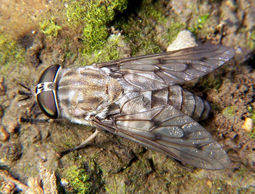
Horse flies are pests to the goat community due to their taste for goat blood
Photo by Dennis Ray/Wikipedia Commons

It’s autumn in the Ozarks. Know how I know? There are horse flies everywhere, and they bite!

Mom says they’re as big as B-12 bombers but I don’t know what that is. What I do know is that they’re big enough to make us goats race around like banshees when they land on our butts. And they do that all the time.

Mom has been very busy finishing a book about us goats (it’s called Get Your Goat). She hogs the computer but we finally got online last night. Uzzi said we should look up horse flies at Wikipedia, so we did. Wikipedia’s the place to learn lots of things.

Uzzi tapped in the Web address, then we read about tabanids (those are flies that drink our blood). When we read what it said, our hair stood on end!

Imagine this: “Unlike insects which surreptitiously puncture the skin with needle-like organs, horse flies have mandibles like tiny serrated scimitars, which they use to rip and/or slice flesh apart. This causes the blood to seep out as the horsefly licks it up. They may even carve a chunk completely out of the victim, to be digested at leisure.”

Carved up chunks of Martok meat! No wonder it hurts so much. Uzzi and I looked at each other and nodded; we’ll be glad to see fly time end.

But autumn is a good time too. All of my Boer girlfriends are in heat! They line up by my buck run and pose and prance and purr because they want me to help them make babies.

But mean old Mom and Dad say “no”, ‘cause they don’t want us to have a lot of kids. I have to wait until December to breed Bon Bon! Uzzi thinks it’s funny but I don’t think it’s fair. 

« More Mondays with Martok »

Categories
Crops & Gardening

Pumpkins and Zucchini

An unknown pumpkin seed type produced the biggest pumpkin the Wallisers have ever grown

We’ve got one lovely pumpkin currently fattening up in the veggie patch. 

My son planted a few seeds at the end of May in a crack in the soil right next to the compost bin.  I never thought they would amount to much, but now, we’ve got the biggest pumpkin we’ve ever grown! 

It hasn’t started to color up yet, but I swear if you stand there long enough you can actually watch it grow.  I have no idea what variety the seeds are as they were purchased out of a ‘cheap seed’ bin at our local Agway store.  Sometimes it’s the unplanned stuff that turns out the best. 

There is a smaller pumpkin now growing further up the vine and I suspect that it may not fully mature in time for Halloween, but that’s OK, it’s still pretty cool. 

The zucchini continue to pump out plenty of fruits, much to the chagrin of all my friends who have received more free zucchini than you can shake a stick at. 

I think one of the smartest things I did this spring was hang up 5 wren houses here and there around the garden. 

For the first time ever, I have no squash bugs or cabbage worms in the garden.  I watch the little wrens hopping on the zuch leaves and broccoli heads plucking off the pests. 

I have had a concrete bird bath in the center of the garden for the past few years now and I think that’s a good draw too.  I also watched a paper wasp munching on a cabbage worm a few weeks ago.  I knew paper wasps are ‘meat eaters’ but I had no idea they were so beneficial to the garden. 

I certainly don’t want a big old wasp nest in the garden, but apparently, having one in the surrounding woods is not a bad idea.  I guess the garden is proof that there’s good in everyone.

<< More Dirt on Gardening >>

Categories
Homesteading

Loving Life

Take moments to appreciate the finer things in life

I wanted to write about something, anything else, but all I could think about last night, and again this morning, was Chris, and the final words on his Facebook page:  “I love life.”

A few weeks ago, when my daughter Kelsey got the tragic news that her 16-year-old friend had died during surgery to remove a brain tumor, she looked stunned as well as grief-stricken. 

“He was one of the most alive people I knew,” she said.  “I didn’t know he was sick.”

Last night at the memorial service, she learned he had been fighting cancer since 4th grade.  I’d only been acquainted with Chris through Kelsey – pictures she took, conversations recounted, glimpses at band performances. 

But, believe me, seeing this teen with the longish raven hair, sweet smile, the vitality that shone in his eyes, you would never have guessed.

Why is it that we so often need a brush with death, or even a death sentence, to appreciate and love life? 

Last night, I realized I’d been guilty of late: guilty of stressing about life (Endless farm chores!  Story deadlines!), worrying about life (Teen driver in the family!  Swine Flu, the Sequel!), complaining about life (Why did I have to get bursitis in my hip now, with everything that needs to be done?!), and rushing through life (gotta feed the animals fast so I can go for a fast walk and then – fast – get to work!). 

But for awhile now I haven’t truly been appreciating life, and certainly not loving it enough.  And somehow that makes the loss of this boy who wrote “I love life” feel even sadder, and even more unfair.

So last night I decided that today, so as not to feel like this gift of life was wasted on me, I would ditch my stresses, worries and complaints.  I would slow down and savor life. 

 Today, so far, I’ve experienced and loved –

• The sweet-tart taste of fresh-picked blueberries on my cereal.

• How perfect the morning air felt against my skin – not too warm, not too cool.

• The dappled gold sunlight playing over the trees and flowers.

• Talking with our silly turkeys as they trailed me around their pasture.  

• How soft my old sheep Marigold’s wool felt when I scratched her neck.

• Sticking my nose into my mare Sophie’s neck and inhaling her horsy scent.

• Listening to Kelsey play The Offspring’s tunes on her bass guitar.

I’ll try hard to keep living and loving life for the rest of today, and tomorrow, too. 
For Chris, and for myself.

~ Cherie  

« More Country Discovery »

Categories
News

Practice Farm Safety This Fall

Farm families are being reminded to be safe this season

As fall harvest nears, farm families are reminded to be alert to the dangers and practice farm safety this season.

Studies show that a majority of farm-related injuries and fatalities occur from May through October with peaks during planting and harvesting seasons. Most of these accidents are caused from falls and machinery.

“To reduce the likelihood of a mishap, make sure surfaces are free from spilled grain or debris,” said Tom Schlenker, executive vice president for Farm Credit Services of Mid-America based out of Louisville, Ky.

“Also check to see that all machinery and equipment are operating properly. Ensure that shields are covering all moving parts on grinder mixers, mowers and other implements. What may seem like minor repairs now could have major implications later.”

Some of the most alarming accidents involve power take-off (PTO) units, yet these injuries are also the most preventable. Developing safe work habits is key to reducing the number of PTO-related accidents.

Additionally, farm tractors provide the primary source of power on many farms. Studies show that the farm tractor is involved in a high proportion of farm fatalities and severe injuries. To avoid them, follow safe management principles and implement a tractor safety program on your farm.

“For example, you should make sure your platform is clear of debris and that you have a slow moving vehicle emblem posted properly,” said Schlenker. Slow moving vehicle emblems can be purchased as tractor supply companies.

Farm safety checks also should involve children. Talk to children about dangerous areas, and make sure they understand which areas are off limits.

“Remind them of the rules on a regular basis,” said Schlenker. “Listing the rules once isn’t enough. Devote a day to family safety instruction. It’s important that everyone develops a ‘safety first’ attitude on the farm.”

Farm safety is just one component of a risk management plan. “Now is also a great time for farmers to double-check their financial safety,” said Amy Jackson, vice president of insurance. “Crop insurance and life insurance coverage are just a few of the tools available to protect you and your family from loss.”

Categories
Crops & Gardening Farm Management

Soil Contamination: A Farm Buyer’s Primer

By Alexandra Kicenik Devarenne & Shayla M. Salzman

It looks like you’ve found the perfect piece of property to start your small farm: a beautiful old farmhouse on top of a grassy hill, a great workshop off to the side with its own gas pump, a convenient location just off a major road, and even a year-round creek babbling along at the bottom of the hill.

But before you sign those papers, knowing what might be lurking in the soil on that property is vital to the health of your family and the future of your small farm. 

There is very little virgin land to be found that is good for farming. Most arable land’s potential was found years ago, so you can only hope that the farmers or tenants of yesteryear were as careful with your land as you will be.

Years of land use can result in the build-up of soil contaminants. That beautiful old farmhouse was almost certainly painted with lead-based paint whose dust could contaminate the area around the building. The convenient workshop probably housed pesticides, fertilizers and solvents that may, over time, have leaked or been spilled into the soil.

Street dust from busy roads can accumulate and cause severe soil pollution alongside. That old gas pump by the workshop represents the very real possibility that there might be petroleum pollution. And if any of those things have made it into the creek, there may be liability for neighboring lands to think about.

Buying a rural property has the potential to be just as hazardous to your financial future as soil pollutants are for the environment. While most properties will have had a small oil leak or pesticide spill at one time or another, there are some red flags that signal bigger problems and the need to ask questions before proceeding with a purchase.

Fortunately, as the buyer, you have the option of looking into the possible contaminants present and, if needed, the cost of remediating the property before you become liable. All states have disclosure laws requiring the seller to inform the buyer of anything that may affect the value of the property or the buyer’s desire to purchase it.

This is most often information about structures, but it should also inform buyers of any known contamination or chemical accidents that may have occurred on the property. While disclosures will probably not be fully inclusive—no one is likely to know everything about their property’s history—they are starting points. There are also additional sources for information about your potential property, including county records, pesticide-use reports and neighbors’ testimonials.

If soil contamination falls above the Environmental Protection Agency’s Maximum Contaminant Levels (MCL) for a pollutant, it’s the responsibility of the seller to pay for remediation. For this reason alone, it’s hugely important to assess the contamination levels of the soil before making a purchase.

Soil can be sampled and sent to registered laboratories for testing. You will need to let them know what you think might be present or at least why you are sending in the samples. 

Common Contaminants

Soil contaminants fall into two categories: deliberately applied and inadvertently applied or released. Deliberately applied contaminants include properly used pesticides, lead paint, fertilizers, fireproofing material and even dust-control materials.

Inadvertent contaminant applications include fuel-tank leakage, pesticide and fertilizer spills, drift from nearby roads, manure concentration, industrial effluent, and, an increasing problem in rural areas, byproducts from illegal methamphetamine labs.

The most common soil contaminants to expect are lead, petroleum hydrocarbons, arsenic and pesticides. With a good eye, some well thought-out questions and a little investigative work, you can learn a lot about the soil of your potential purchase. 

To paraphrase the old saying, buy in haste, repent at leisure. Be thorough and persistent, and seek advice from legitimate agencies.

Fuel and Oil
Both lead and petroleum hydrocarbons can come from gasoline, fuel or automotive oils. Obvious warning signs to look for when touring a property are gas pumps and workshops that appear to have housed tractors and other machinery. Look for the age of the pump and whether it’s still in use.

The EPA’s Office of Underground Storage Tanks (OUST) is the federal agency assesses contamination, determines required control measures and assists with funding. They confirmed 7,364 new cases of tank leakage in 2008 alone. 

Older fuel-storage systems are much more likely to suffer from wear and may require expensive clean-up measures. Ask the seller or real estate agent if there has ever been suspicion of leakage or if the soil has been tested around the site.

If a case was reported to the state EPA office already, it should be stated in the disclosure, and treatment should already have begun. Take time to walk through any workshops, storage sheds, barns or garages, and look at their condition. 

Keep an eye out for old pesticide and fertilizer containers: Are they neatly organized and clean looking, or are they haphazardly thrown into a corner with signs of spills and leaking? The order of a farmer’s workspace can tell you a lot about the potential for accidental spillage or leakage on a scale large enough to be a problem. 

Another thing to consider is the proximity to busy roads or highways. Dust and emissions from cars can drift onto the property and contaminate the land with lead. This is even more likely for land that has been adjacent to busy roads for a long time. Lead, an ingredient of gasoline for many decades, has a slow rate of degradation and can readily accumulate. 

Lead Paint
Any painted structure that was built before 1978, when lead-based paint was banned for use in the United States, is likely to contain leaded paint that may have cracked, chipped and fallen into soil surrounding the building.

Was the structure well maintained or allowed to fall into disrepair in the past? These are again questions for the seller. If this information is unavailable, lead-paint test kits are available at most hardware stores for less than $10. Soil samples can be tested for lead by a registered laboratory.

Page 1 of 2 More >>
 

Categories
Equipment

Got a Screwdriver?

Having a good set of screwdrivers, all kinds, can save time and money

A good set of Craftsman screwdrivers was one of the first additions to my tool chest when my wife and I bought our first house.

All too often, those screwdrivers were used “as needed.” I hate to think how many times one served as a pry bar or a punch.

I still have a couple of those originals 30 years later. Over that period, I would like to think I have learned a little about appropriate use of tools. Some of those lessons have been painful.

About ten years ago, we needed a shelving unit for our storeroom. Of course, I overbuilt with 3/4-in. plywood for the back, sides and shelves. Everything was screwed together in the 2-ft. deep by 8-ft. long by 4-ft. high unit.

While I did drill pilot holes, I had no power screwdriver. Each and every one of the 40 to 50 1 to 2-in. screws were driven in by hand power with a standard screwdriver. When I was done, my wrist and elbow were in pain. I had overdone the shelving unit structurally and my arm physically. 

I ended up going to physical therapy on a weekly basis for about two months to relieve the pain. Needless to say, the cost in time alone, not to mention gas and medical bills, exceeded the price of a good power screwdriver many times over.

Since then I have invested in several models that take the strain out of projects of all sizes, including difficult to reach household repairs. In my next entry I will review three that fit my needs to a T.

« More Shop Talk »

Categories
News

Harvest for America

Harvest for America, the FFA Alumni-led program that collects food donations, is working with Tractor Supply Company and Carhartt to help even more

Harvest for America, the FFA Alumni-led program that collects food donations in five states—Wisconsin, Ohio, Tennessee, Florida and Michigan—is teaming up with Tractor Supply Company and Carhartt to reach more families in need.

FFA Alumni members are working with current FFA members to promote and organize events and food-collection sites while working closely with local food banks to ensure proper distribution.

Tractor Supply is providing each participating FFA chapter with donation bins, promotional materials and space for bins inside its stores.

The series of food drives in the participating states will be conducted over six months. During that time, each participating FFA chapter will organize three food-drive events plus a food drive in conjunction with an existing local event or the chapter’s own event.

In addition to Tractor Supply stores, collection bins will be available at grocery stores, high school football games, and other heavy-traffic sites where FFA students feel they can collect substantial food donations.

The FFA chapter from each participating state with the highest number of donations will receive bonuses, including a free trip to the FFA National Leadership Conference in Washington, D.C., a free trip to their state FFA Leadership Conference and a $500 Tractor Supply gift card.

Also, three FFA members will be selected for a free trip to the Tractor Supply Manager’s Meeting in Nashville, Tenn.

The National FFA Organization, formerly known as the Future Farmers of America, is a national youth organization of 507,763 student members—all preparing for leadership and careers in the science, business and technology of agriculture—as part of 7,439 local FFA chapters in all 50 states, Puerto Rico and the Virgin Islands.

The FFA mission is to make a positive difference in the lives of students by developing their potential for premier leadership, personal growth and career success through agricultural education. Click here for more information.