Categories
Equipment

Gotta Love That Internet

Whatever did we do before we had the World Wide Web?

When I was growing up on the farm, I could always go ask Truman Austin. He was a neighbor, a fisherman, a fur trapper and hunter, and a farmer.

He could get up in the morning and go down to the creek, catch his limit of trout and be home before 7 a.m. His wife Olga would fix some trout for breakfast and freeze the rest.

Truman was also the neighborhood handyman/welder. If it was broken, he could fix it. Just walking into his shop was like walking into another world with its homemade gadgets and adapted fixings.

Unfortunately, Truman is no longer with us. Neither are a lot of the old craftsmen who seemed to instinctively know what needed to be done. Now I turn to the computer and type in whatever it is I want to know. This is especially true when it comes to household repairs or projects.

My earlier blog this month was on chainsaw sharpening. Type in those two words, and you pull up countless how-tos in print and video. Even if you you’ve done it before, it is a great way to refresh yourself before tackling a job for the first time in months or years.

One of my favorite project sites is https://www.instructables.com. It has a seemingly unending series of projects completed by members. They send in detailed explanations with visuals that make it a snap to follow along and duplicate results.

What I really enjoy is the comments and questions that follow, as members question the project maker about details or offer suggestions for improvements.

It is a great place to get ideas for your own projects, and I’ve found most of the contributors to be more than happy to answer questions. It’s like having the ultimate handyman living next door. No, I take that back. Truman was a lot more interesting, and Olga made great cookies.

« More Shop Talk »

Categories
Crops & Gardening

Garden Fortune

The vegetables are growing in spectacularly well for Jessica, who is starting to keep track of her produce

What a superb year for the garden!

We’ve gotten just enough rain right when we’ve needed it (I have only had to lug the hose into the veggie garden once this season!); my harvests have been exceptional; no diseases have struck; no insect plagues (so far anyway); and, best of all, no deer, no groundhogs and no rabbits.  Something must be up with my karma.

Whatever the reason, I’m not going to argue.  I was discussing my good gardening fortune with a friend.   While early blight has struck her tomatoes, she agreed with me that this has been the best year for onions we’ve ever had.

The cabbage heads are nearly 18 inches across (!) and even my kid likes the carrots this year – they’re super sweet.

It’s a good thing that such excellent fortune has struck this season.  I read an article this spring quoting research from The Burpee Seed Company that said if you invest $50.00 worth of seeds and transplants into the garden, you can get up to $1,250.00 worth of produce as a result.

I’ve never kept track of what my garden produced and naturally I wondered how close my own garden would get to those research numbers.  So, I’m keeping track to find out.

I’ve added up my veggie gardening expenses (seeds, plants, soil amendments, etc) and now I’ve got a paper tacked to the fridge listing all my harvests by weight or volume depending on what’s picked.

When the garden is put to bed this fall, I’m tallying up the value of the produce I harvested using supermarket prices as a base.  I’ll post my results in the autumn.  So far I’m on the right track.

<< More Dirt on Gardening >>

Categories
Animals

The Ugly Part of Farm Life

Castration is normally done after the lamb is a few months old
Sue Weaver

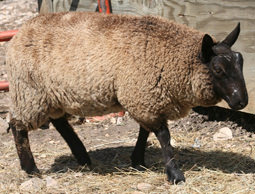
Smoke as a lamb.

Uzzi and I are feeling sorry for Smoke and Baarley, the ram lambs born this spring. Mom and Dad banded them yesterday. Now they’ll be fleece wethers instead of rams.

Banding is when humans use a tool called an elastrator to put a strong latex band around a lamb or kid’s scrotum to castrate him. Most people do this when lambs or kids are tiny but Mom and Dad wait until they’re several months old.

They wait because male goats and sheep are prone to a very serious ailment called urinary calculi. That means mineral stones can get lodged in their urinary tracts and it sometimes happens if a buckling or ram lamb is castrated too young because then his urethra stops growing and it’s too skinny to pass mineral stones.

If a stone forms and then gets stuck, he can’t pass urine or he only dribbles a little bit. It’s very painful, so he stretches out and tries very hard to pee and he cries and cries. Then, if he isn’t treated (and sometimes even if he is), his bladder bursts and fills his belly with urine. Then he dies.

Sheep like Smoke can get infections is castrated too early in life
Sue Weaver

Smoke as an adult

Urinary calculi is a deadly, scary thing, so people who want their wethers to live a long time wait until they’re somewhat mature to have them castrated (five or six months is best).

Usually they have a vet castrate them surgically but our farm vets think anesthetic isn’t important. After just once having a vet do it his way, Mom emphatically disagrees.

So, when it’s time, Mom holds the kid or lamb and Dad injects Lidocaine (a numbing anesthetic they get from our horses’ vet) around his scrotum. They wait awhile and then put on the band, making sure both testicles are descended and the kid or lamb’s nipples aren’t below the band.

After that, they give him Banamine (a prescription veterinary pain killer) for several days. In ten days or so his scrotum is very shriveled and dry. Then Dad uses a scalpel to cut it off below the band.

Not every part of farm life is fun. Mom and Dad hate this job but it’s an important part of keeping wethers on our farm (between the rams and me and the goat and sheep wethers, there are 22 of us and in six years no one has gotten urinary calculi yet!).

We also drink a lot of clean water (that’s important) and eat a diet that helps prevent stones—but that’s a topic for another blog!

« More Mondays with Martok »

Categories
Homesteading

Potato Hunt

The potato hunt is something Cherie looks forward to

It feels a lot like the dyed Easter Egg hunts I loved as a kid, and staged for our daughter when she was little. 

The building anticipation as you seek something cunningly hidden – something special and pretty – followed by the delicious thrill of finding each brightly-hued egg, and the satisfaction of adding it to the growing pile in your basket.

This must be what it feels like to be a pirate who finds buried treasure, too.

I’m talking about digging potatoes, something I can’t wait to do this afternoon.  But not just any old potatoes – purple potatoes. 

Several years ago, my eyes opened to the wonderfully (and genetically) diverse world of heirloom plants.  Essentially, these are open-pollinated plant cultivars with long histories, many of them endangered because they fell out

The purple potato known as the Purple Viking

of favor as the popularity of commercial hybrid cultivars boomed. 

I’ve always been a fan of potatoes, but now love them even more as I continue to discover different heirloom varieties.  The first year of my heirloom conversion, I grew a fantastic dusky purple potato with creamy-white flesh called the Purple Viking. 

The next season, I planted Viking seed potatoes I’d saved, and added super-productive All Blues, which shimmered a gorgeous deep purple on the outside after washing, and once cut open, were a startling purple-blue through and through. 

Today, I’ll be searching for All Blue potatoes, as well as this year’s new variety:  slender French Fingerlings with red skin, creamy-yellow flesh, and a buttery texture when cooked.

Here’s what I’ll be making with my buried treasure:

Garlic Roasted Potatoes
(adapted from Greek Meze Cooking, Tapas of the Aegean, by Sarah Maxwell)

Ingredients
• About 2 lbs. large heirloom potatoes
• ½ cup olive oil
• ½ cup lemon juice
• 2 tsp. dried oregano
• 3 to 4 garlic cloves, finely chopped
• salt and pepper to taste
• ½ cup water

Preparation
Preheat oven to 450 degrees.  Cut potatoes into small wedges and put in large shallow baking dish.  Stir together the remaining ingredients in a small bowl and add to the potatoes.  Toss to coat. 

Bake at the top of the oven, uncovered, for 1 hour until the potatoes are crisp outside and soft inside.  Stir several times during cooking to rearrange potatoes, and add a little more water if needed.
 
Gotta go dig, 

~ Cherie 

« More Country Discovery »


Categories
Crops & Gardening

Figs and Ferragosto


The time for fig-picking has come in Italy

It’s fig-picking time here in Italy, and I get a significant amount of my daily snacks from the fig trees that are all over the place here. 

The photo is of a plate of figs from our own tree that I’m going to try to dry.  One can see the sugar covering the outsides of these really sweet fruits.  I also find a fair amount of other figs free for the taking as I walk around Rapallo.

It’s sort of a Ligurian tradition to have a fig tree growing out of a rock wall in one’s garden, and there are hundreds of walls around here that have figs growing out of them.  Very seldom does one see a fig tree growing on flat land here, as flat land is too valuable to waste by letting a fig grow on it.

Our figs are little black ones and are really sweet.  I get them all to myself because my wife and mother-in-law don’t like the little black figs and instead prefer the huge green figs that appear most often in the markets. 

I find plenty of the big green figs too, and I eat both types equally eagerly.  My wife delicately peels all her figs before eating them while I just wolf down the whole figs skin and all. 
 
August 15 is a big holiday in Italy called Ferragosto.  This ancient holiday is attributed to Emperor Augustus, and represents the end of the hard spring and summer seasons’ work.  The Italians take this break very seriously, and this date finds almost all Italians on vacation. 

Driving around cities like Milan and Rome is amazing in August because the streets are all empty and the shops, bars and restaurants are all shuttered.  This is because all the residents are at the beach. 

In August, the population of Rapallo swells to ten times its normal size when what seems like all the residents of Milan come to enjoy their vacation apartments here on the coast.

Of course, the Catholics try to put a religious face on the holiday, and they celebrate the date as the Assumption of the Virgin Mary, or the date on which Mary ascended into heaven.  There are lots of religious processions involving carrying the huge crosses followed by food festivals and fireworks. 

I regret to admit that I’m so jaded that I didn’t take my wife to the fireworks this year because by the time they started the show I was already in my pajamas as usual at that hour, thinking about how I should graft some big green fig scions onto our fig tree one of these years. 

All in all, I’m a pretty exciting guy.

<>


Categories
News

Conservation Reserve Program

The USDA Farm Service Agency is listening to comments on the CRP

The USDA Farm Service Agency, on behalf of the Commodity Credit Corporation, is seeking comments on the Conservation Reserve Program.

Nine public meetings are scheduled this fall (see dates below) to solicit your input.

Topics to be discussed at the public meetings include provisions dealing with cropping history requirements, crop rotation practices, contract incentives, program enrollment terms and the CRP enrollment authority of 32 million acres established for the remainder of the 2008 Farm Bill.

“These workshops will be important to receive feedback about how we can make the Conservation Reserve Program more effective for producers as well as increase the environmental benefits of the program,” said FSA Administrator Jonathan Coppess.

USDA will consider each comment received at the public meetings and during the comment period when preparing a Supplemental Environmental Impact Statement, which will be reviewed by USDA decision-makers.

CRP is a voluntary program that supports the implementation of long-term conservation measures designed to improve the quality of ground and surface waters, control soil erosion, and enhance wildlife habitat on environmentally sensitive agricultural land.

In return, CCC provides participants with rental payments and cost share assistance under contracts extending from 10 to 15 years. CRP is a CCC program administered by the FSA with the support of other federal and local agencies.

Be heard
The public meetings schedule is:

Sept. 15, 5:30 to 7:30 p.m.
Hilton Garden Inn Spokane Airport
Spokane, Wash.
509-244-5866

Sept. 17, 5 to 7 p.m.
Hampton Inn Great Falls
Great Falls, Mont.
406-453-2675

Sept. 21, 5 to 7 p.m.
AmericInn Lodge and Suites
Moorhead, Minn.
218-287-7100

Sept. 23, 5 to 7 p.m.
Clarion Hotel
Manhattan, Kan.
785-539-5311

Sept. 25, 5 to 7 p.m.
Hilton Garden Inn, Springfield
Springfield, Ill.
217-529-7171

Sept. 29, 5 to 7 p.m.
Oklahoma City Marriott Hotel
Oklahoma City, Okla.
405-879-7042

Oct. 1, 5 to 7 p.m.
La Quinta Inn and Suites
Clovis, NM
575-763-8777

Oct. 6, 5 to 7 p.m.
Hilton Garden Inn
Albany, Ga.
229-888-1590

Oct. 8, 5 to 7 p.m.
Courtyard by Marriott
Harrisburg, Pa.
717-558-8544

Public comments are due by Oct. 19, 2009, to be considered in the Draft Supplemental Environmental Impact Statement.

Submit comments online or the Federal eRulemaking PortalEmail comments; or mail or hand-deliver comments to CRP SEIS, c/o TEC Inc., 8 San Jose Dr., Suite 3-B, Newport News, VA 23606. Fax comments to: 757-594-1469.

For more information about the CRP, visit your FSA county office or click here.


Categories
Crops & Gardening

Pullets in Pittsburgh

Jessica got some of her hens off of Craigslist, which can be used to acquire farm animals
Jessica Walliser

Hammy the chicken.

The ladies have finally arrived!  We have 6 happy, young hens – and one happy little boy. 

If you recall in a previous post, I was supposed to get our chickens from a farmer friend, but that fell through.  It was very frustrating. 

As a result, we had an empty coop for months just sitting there waiting to be filled.  For a brief moment, I considered getting a rabbit instead!  Then, on a whim one night, I googled ‘Pullets in Pittsburgh’ to see what I would get. 

I ended up on Craigslist (which I had never used before) looking at a listing for 10-week-old pullets being sold by a young woman a mere 45 minutes from where I live.  Of course, I emailed immediately and we had a chicken pick-up scheduled within the hour.  Two days later I had my ladies. 

Two days after that, all the hens had names assigned to them by the resident 3-year-old.  Hammy and Cobby are Barred Rocks, Bock-Bock is a Rhode Island Red, Boo-Boo is a red sex link, and Flower and Buffalo are Welsummers.  The Rocks are a bit older and are laying already – gorgeous, plump brown eggs.  We couldn’t be more pleased.

And so now, every night, I do a quick scan of Craigslist’s Farm and Garden listings.  The neighbor across the street got himself two young turkeys from a listing there. 

Who knows, maybe someday I’ll get that rabbit after all…

<< More Dirt on Gardening >>   

Categories
Equipment

Got a Chainsaw? Get a File, and Keep It Clean!

My brother Ed doesn’t fool around when it comes to the farmstead where he and his family spend free weekends.

If there is a chore to tackle, he hits it hard, especially when one of his adult sons is available to help. This past week he and his son Chris were hard at it, cutting cedar trees with a chainsaw.

In our part of Minnesota, the Eastern Cedar is an invasive weed. Unchecked, it transforms a pasture to a scraggly forest in only a few years. Ed and Chris were attempting to reverse the tide.

A few days later at a family party he asked me why chainsaw cutting chains get dull so fast. “I bought a new one, and it was dull in no time,” he complained. “We had only cut about 50 trees, and I had to change it.”

“Did you get it in the dirt?” interjected our older brother Charles. One of the full-time farmers in the family, he has plenty of experience with chainsaws and cedars.

“Well, yeah,” admitted Ed.

“Did you sharpen it when it stopped cutting easily? I asked.

“Sharpen it? asked Ed.

Brother Ed had violated two key rules to chainsaw work. They are to never let the blade get in dirt or other debris and to stop and sharpen the cutting chain or replace it when it starts to cut hard.

Okay, I break those two rules all too often myself and so do most of us, if the truth be known. That doesn’t mean we shouldn’t try not to. If you keep your cutting chain out of the dirt and clean, it will last longer.

When it stops pulling itself through the wood and you have to push into the cut, when the discharge is dust instead of chips and when the chain looks shiny (chrome has worn away exposing steel), it is time to sharpen or replace.

That doesn’t mean you have to break out a file and begin honing the teeth there in the woods. I know professional woodcutters who never use a file in the woods. However, they do keep extra cutting chains with them and swap out sharp for dull.

So keep your cutting chain clean and sharp. It is easier on you and the saw. It is also safer.

« More Shop Talk »

Categories
Animals

Everybody’s Got a Water Buffalo

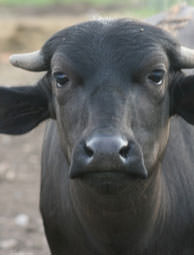
Ludo is one of many Riverine water buffalo at the Turkey Creek Farm
Ludo

Do your kids watch Veggie Tales on TV? Mine don’t (we don’t even have a TV in our barn), but Mom sometimes sings a song from Veggie Tales called the Water Buffalo Song.

In fact, she sings it to our water buffalo, Ludo. This is how it goes:

“Everyone’s got a water buffalo
Yours is fast but mine is slow.
Oh, where we get them, I don’t know,
but everybody’s got a water buffalo!”

Mom thinks everyone should have a water buffalo. That’s because, she says, Ludo and his kin are so adorable, gentle and sweet.

Mom and Dad got Ludo and his buddy Fezzik from Tom and Shannon Olson of Turkey Creek Farm in Texarkana, Arkansas. The Olsons have hundreds of water

Fez sadly passed a few days before Christmas
Fezzick

buffalo on their ranch! Most of them are riverine (dairy-type) buffalo like Ludo but some are swamp buffalo too.

Ludo and Fez arrived last October when they were only a few days old. They lived together in a stall in the dairy goat shelter (that’s right by my buck pen), at least until Fezzik died a few days before Christmas and Ludo was left all alone.

He was sad, so we goats knew we had to be his special friend until he was big enough to live with Aiah the steer.  

Now he’s big and he lives with Aiah but he still likes to stop by and lick us. His nose is wet and his tongue is bumpy, so it feels weird when he does that (yuck!). He sounds funny too, because he doesn’t moo.

If you visit the Philippine Carabao Center website (carabao is another word for water buffalo) and click on About Us on the top menu, you can hear the kind of grunt that Ludo makes. 

Water buffalo aren’t just cute, they also do neat things. Ludo is a steer and Mom is going to ride him some day, like

Ludo in his early adolescence
Ludo growing up

people do in a place called Asia.

If Ludo was a cow, he’d give lots of yummy, extra high-fat milk. Some people eat water buffalo, too (but Ludo is safe; my mom and dad don’t eat meat).

Mom got interested in water buffalo when she wrote an article for Popular Farming: Cattle called “Alternative Bovidae.”

Now she’s working on an article about them for the January-February 2010 issue of Hobby Farms; she’s going to furnish some pictures of water buffalo, too. She hopes Hobby Farm readers look at their cute faces and fall in love with them the way she did.

Uzzi and I agree: they’re pretty neat—even with those big, wet noses.

« More Mondays with Martok »

Categories
Crops & Gardening

Wild Koi

A newly discovered koi pond featured around 300 koi at one point!

The coastal mountains around here are famous for their vast network of hiking trails. 

The trails around the Cinque Terre are the most famous, but there are hundreds of others, including a bunch right near our home in Rapallo.  Most of these trails are the old pathways that people used for transportation back in the old days. 

The steep trail closest to our home leads up and over the mountain to the interior valley known locally as the “entroterra,” which just means inland. 

Up until a generation or two ago, this trail was the main highway between the coast and the interior valleys, and the farmers who lived in the entroterra would haul their products up and over the mountain to get to the market in Rapallo. 

These days the climb takes about three or four hours for a one-way trip.  I’ve heard stories of entroterra families who would send their children into town to sell a dozen eggs.  By my calculations, that’s about an eight hour round trip.  Boy are we spoiled these days.

One of our favorite hiking trails is the one that goes up to the top of the promontory above the super-chic town of Portofino.  The views are great, the forests are marvelous, and there are a number of surprises to discover among the dense growth, including a whole bunch of old water wheels and stone buildings that used to be water powered mills. 

People used boats to get here and then climbed up the mountain to one of the mills in order to grind their grain into flour.  At one time there were something like fifty mills on this little mountain, because there are a lot of fast moving little creeks here.

One of the surprises hidden in the brush is a little concrete dam that someone built years ago on one of the little creeks.  The dam is solid and still holds water, so there is a good sized pond behind the dam. 

The first time we discovered the dam the water was full of brightly colored fish. A closer inspection revealed that they were all young koi, maybe three hundred in all!  Unfortunately, I didn’t have my camera. 

Later that summer, we returned and saw that seagulls and herons had eaten almost all of the little fish, but we also noticed the two large koi that must be the parents.  Over the years we’ve returned a number of times, and some springs there have been a few young koi again, but never anything like that first amazing scene.

Photographing the big koi is difficult, because it’s impossible to get down to the water except by going through a muddy overgrown mess to get down there.  The two big koi, almost three feet long, are also fairly shy, and disappear whenever I do crawl down there. 

Nonetheless, the pond is still a magical place, and we enjoy taking friends up there to show them the wild koi.  It’s a long hike to get up there, but nowhere near as daunting as the prospect of hiking up and over the mountain and back just to sell a dozen eggs. 

<>