Categories
News

Graziers: Get the Most out of Your Land

Follow these steps on how to measure your pasture

For livestock producers wanting the most out of their pastures, measuring forage dry matter content before and after livestock grazing is the most effective way of managing an intensive grazing system.

Pasture measurement allows a grazier to determine how much forage dry matter is available in a pasture paddock, and once estimated, the producer can calculate how many animals should be grazed for a given period of time.

“Pasture measurement will help the grazier to make decisions about how to best use pasture paddocks and over time will provide a trend of how much forage dry matter is being produced per week,” says Rory Lewandowski, Ohio State University Extension agriculture and natural resources educator.

“Using this type of information can help a grazier plan the livestock rotation for periods of rapid growth as well as periods of slow growth,” he says. “The trend can provide an early warning system in a drought year and help the grazier plan accordingly.”

When to Measure Your Pasture

Lewandowski offers some strategies for taking pasture measurements. One strategy is to measure a paddock due to be grazed on a weekly basis.

“This will give you an idea about your rotation speed,” Lewandowski said. “If you consistently measure 2,400 to 3,000 pounds of forage dry matter per acre in paddocks about to be grazed, this indicates the rest period has been long enough.

“If forage dry matter is less than 2,200 pounds per acre, then rotation speed should be slowed down to allow the pasture more time to recover and grow.”

Another strategy is to measure the paddock before and after animals are turned out.

“These additional measurements will give you information about how you are managing plant residual, an important part of how quickly a plant recovers from a grazing pass,” he said. “Most pastures should be managed so there is 1,200 to 1,400 pounds of forage dry matter after animals have grazed. This will also give you a good idea of pasture growth rate in terms of how much dry matter is being added per acre each week.”

How to Measure Your Pasture

The Pasture Stick
To take pasture measurements, the most economical option is to use a pasture stick. The current pasture stick model being used in Ohio has a scale to measure forage height, a scale to estimate forage density, a table of pounds of dry matter per inch for various pasture forage types, information about length of grazing rotations and information about calculating the pounds of dry matter available for grazing.

  • To use the grazing stick, measure pasture height in 20-30 random areas of the paddock and record those heights.
  • Then add the measurements to get a total and divide the total by the number of measurements. This will give you average pasture height.
  • Estimate pasture density using the dot scale on the pasture stick. This allows you to estimate the pounds of dry matter per inch.
  • Now multiply the average height (in inches) by the pasture density (pounds of dry matter per inch) to get the total dry matter per acre in that paddock.
  • Subtract the amount of residual dry matter you want to leave in the paddock. This is plant height after grazing times the pounds of dry matter per inch. “If you plan for a 3- to 4-inch residual, 1,200-1,400 pounds is about right,” Lewandowski said. “Consider the result of total dry matter minus residual dry matter to be the forage available for grazing.”
  • Figure out the amount of utilizable forage. All of the forage available for grazing will not actually get grazed. There will be waste, Lewandowski said. The smaller the paddock size and the fewer days animals spend in the paddock the higher the grazing efficiency. If animals are moved every 3-4 days, use a 60 percent grazing efficiency to start with, he said.
  • To do this, multiply the available forage dry matter by the grazing efficiency expressed as a decimal. For example: 1,500 pounds of dry matter times 0.60 equals 900 pounds of utilizable forage dry matter per acre. Graziers also will need to figure out the livestock need in pounds of dry matter per day. “Most livestock will consume between 2.5 to 3 percent of their body weight in dry matter per day,” Lewandowski explained. “You’ll need to know the average body weights of your livestock.”
  • To do this, multiply the dry matter per day requirement for an individual animal by the total number of animals to graze in that paddock. For example: 30 head of sheep that average 150 pounds, consuming 2.75 percent of body weight in dry matter per day is 150 times .0275 equals 4.1 lbs of dry matter per day. And 4.1 times 30 head equals 123 pounds of dry matter per day that is needed.
  • Then to figure out what the paddock can support, divide the utilizable forage by the livestock requirement to get how many days of grazing the paddock will provide. For example: 900 pounds of utilizable dry matter divided by 123 pounds of dry matter needed per day equals 7.3–about a week’s worth of grazing in this paddock.
  • Lastly, make any necessary adjustments. “For example, if your goal is to rotate every 3-4 days and in our example we found that one acre is providing 7 days worth of grazing for 30 head of sheep, then provide about 0.5 acre every 3 days,” he said.

The Rising Plate Meter
Another option to measure pastures is the rising plate meter, which has a built-in counter.

  •  To use the rising plate meter, record the beginning number on the counter, make 30 measurements, and record the end number.
  • Then subtract the end number from the beginning number and divide that result by the number of measurements to get an average.
  • Multiply this average by a conversion factor (currently 107.04) for cool season grass pastures. Use this number as the total forage dry matter acre and follow the steps outlined for the pasture stick to make the remaining animal use calculations.

“The plate meter is quicker, but the cost of this instrument is about $450, compared to $5 to $7 for the pasture stick,” said Lewandowski. “It is important for graziers to put some effort into pasture measurement. Pasture measurement can help take some of the guesswork out of allocating pasture forage and it can help reduce the slope of the learning curve associated with management intensive grazing.”

For more information on pasture measurement and the instruments used, contact Lewandowski at lewandowski.11@osu.edu.

Categories
News

Summertime Fire Hazard

Combusting hay bales can be dangerous to a farm
iStock photo
If a fire or other tragedy happens, you want
to be prepared. Click here for tips on how
you can prepare in case danger strikes.

This year’s unusually wet spring and early summer has led many farmers to store hay that’s wetter than normal, increasing the danger of barn fires, according to Davis Hill, senior extension associate and director of the Managing Agricultural Emergencies program in Penn State’s College of Agricultural Sciences.

“Often, farmers have reported that they know the hay they are baling is wetter than they’d like, but with additional rain in the forecast, they are taking a chance, hoping to save a better-quality product versus letting the rain cause the crop to deteriorate in the field,” says Hill.

“We have seen an increase in barn fires during the past few weeks, at least some of which were caused by hot hay igniting through spontaneous combustion.”

Most farmers strive to bale hay that’s field-dried to 20 percent moisture or less, Hill explains. At this moisture level, the baled hay can cure properly and maintain quality.

This year, some have had to bale their hay at 25 percent moisture. With a moisture content that high, hay in storage will generate more heat.

Hay Monitoring

“As temperatures rise, dangers of spontaneous combustion increase,” Hill says.

“Farmers need to be diligent in checking their hay, especially if they know they baled hay that was wetter than normal. Smoldering hay gives off a strong, pungent odor. This odor is an indication that a fire is occurring. If even the slightest smell is present, farmers should attempt to take temperature readings of the stack.”

Reaching inside a hay stack will give a cursory clue, Hill notes. “If it feels warm or hot to the touch, that’s a good indication that problems may exist. Taking temperature readings of the stack is most important and the only real way of determining how bad the potential fire problem is before flames arrive.”

Infrared thermometers and digital thermometers are accurate, and local fire companies may be willing to come out with thermal imaging cameras to evaluate a situation.

“Most would prefer to come out prior to an actual fire event as a way to help avoid a catastrophic fire,” he says. “A number of fire companies and silo-fire experts also have probes available that producers can borrow to help them monitor a stack of hay.”

Critical Temperature Points

Research and experience suggest that farmers and firefighters should be aware of several critical temperature points:

  • Between 150 and 174 degrees F, a hay stack is entering the danger zone. Temperatures should be checked twice daily, and if possible, the stack should be disassembled to allow more air to cool it.
  • At 175 degrees F, hot spots and pockets of fire are likely. Stop all air movement around the hay and alert a fire service to a possible hay-fire incident.
  •  At 190 degrees F, remove the hot hay with the assistance of a fire service—be prepared for the hay to burst into flames as it contacts the air.
  •  At 200 degrees F or higher, a fire is almost certain to develop. Call a fire service and have the hay removed—again, expect the hay to burn as it contacts fresh air.

“Keeping a watchful eye on heating hay can save your barn or storage building,” Hill says. “Checking the temperature of (your) hay can help you make critical decisions. If you see the temperature rising toward the 150 degree (F) mark, you might consider moving the hay to a remote location, away from any buildings or combustible material.

“If you have to have a hay fire, it’s better to have it away from your main hay storage or barn. Use caution when moving heated bales, because they can burst into flames when they are exposed to fresh air. Wetting hot bales down before moving them can help control this hazard.”

Categories
Equipment

Taking Care

My grandfather was a meticulous man when it came to his possessions, and the care he took paid off in many ways.

When he and my grandmother gave up living on their own, he gave his 1938 Chevy coupe to one of my brothers.

It was 1966, and he told me that three of its four tires had been purchased new when he bought the car in 1941. 

Imagine a pair of tires today lasting for 25 years.

Of course, if I followed his example, they might. He never pulled out of his garage without checking the air pressure. If it was off by a pound, he pulled out his hand pump and topped it off. I am also certain he never accelerated quickly, nor did he need to hit the brakes hard.

Rubber was left where needed, on the tire, not on the pavement.

My grandfather took a slower and steadier pace through traffic and life than I have managed. I don’t know if it was a better life or if he enjoyed life more.

I do know he left a smaller consumption footprint behind. In this day of concern over dwindling natural resources and global warming, it is an example worth following.

Perhaps we all need to “take more care” and check our tires a bit more often.

« More Shop Talk »

Categories
Urban Farming

The Big Green Bus

The Big Green Bus cross-country trip

The classroom has hit the road this summer for 15 students at Dartmouth College in Hanover, N.H.

The team is embarking on a trip across America in a refitted 1989 MCI motorcoach powered by waste vegetable oil in an effort to promote sustainability and green living.

“This year, the bus interior will resemble a ‘green’ living room. We hope to connect with homeowners by presenting environmental and economic issues facing our society today and how individual action can help mitigate these problems,” says Merritt Jenkins, a member of Dartmouth’s Class of 2010 and co-general manager of the Big Green Bus. “From New York to San Francisco, we will be traveling the country helping Americans make energy-conscious choices.”

A green living room is exactly right … even down to their 100 percent recyclable computer cases made from PET plastic bottles.

With solar panels providing the energy, the efficient Split Cool air conditioning system keeps the bus cool, and the LCD flat screen TV allows the group time to relax. They can also access wi-fi—powered by renewable energy—to keep followers updated with blogs, podcasts, photos, videos and tweets from the road.

“I’m excited about putting to use all the new teaching tools we have this year to help the public learn about the energy issues facing our society,” says Marissa Knodel, a 2009 Dartmouth graduate and the Big Green Bus’s education director.

With five key educational pillars in mind, the bus and its drivers will focus on promoting:

1.   Recycling and reduction of consumption

2.   Energy efficiency

3.   Clean and renewable energy

4.   Wise food choices

5.   Personal action through voting

The Big Green Bus left the Dartmouth College campus on June 16 and will travel more than 12,000 miles through 40 states from New Hampshire to California and back again.


Categories
Animals

Writer’s Butt

Sue got "writers butt" from working too hard at the computer
Check out what else is
happening on my farm!

Our mom has piriformis syndrome.

That happens when the piriformis muscle (that’s a muscle in each side of a human’s butt) contracts and won’t stretch out again. It pinches the sciatic nerve and causes pain all the way down the human’s leg.

Athletes like cyclists get it from sitting on hard bicycle seats but our mom isn’t an athlete (she’s soft and fat like Ursula the sheep but we love her anyway).

Mom got it from sitting on her computer chair many hours every day for the past few months. She got behind on her writing and had to work hard to catch up. That’s why she calls it “writer’s butt.”

At first Mom could hardly walk and it hurt too much to sleep, so mostly she whimpered all the time. Dad told her she walked like Walter Brennan playing Grandpa McCoy (Uzzi and I don’t know who that is but Mom didn’t laugh).

She walked like that so much that she hurt something in her other knee too. So Mom was not a happy camper.

But she took care of us anyway (she whimpered especially loud when she milked Bon Bon and Latifah). Dad helped but sometimes he has to work all day and Mom has to handle both feedings.

Uzzi and I volunteered to carry buckets of grain to the other goats but Mom said no. We were disappointed (I don’t think she trusts us).

But she’s feeling better now and she hardly limps.

Yesterday she stopped to scratch our chins. “Boys,” Mom said, “This is why people should think before they get livestock (we nodded—some of the animals here are livestock, they aren’t all goats like Uzzi and me), because livestock has to be cared for, no matter what. It’s a great responsibility when animals depend on humans for their every need. Animals mustn’t be purchased on a whim.”

“But you know,” she added as she scratched Uzzi’s neck, “The biggest lesson in this is that ‘all work and no play makes Jack a dull boy’ (Uzzi and I looked at each other—who is Jack?). It’s important to do your job but work isn’t everything.

“The kids are almost grown up and I didn’t take time to play with them the way I did with you boys. I wish I could tell every hobby farmer this: take advantage of your blessings. Take time to walk in the meadow. Take time to play with the lambs. Paying bills is important but it isn’t everything and overwork hurts in the end.”

Then—she laughed! “Or at least it hurt me in the end.”

Uzzi and I don’t get it. Humans are confusing some times!

P.S. Mom put her computer chair in the back room and she’s sitting on a squooshy, yellow thing called a Swiss ball. Uzzi and I hate it. When we sit on it to compute, it rolls and we fall off!

« More Mondays with Martok »

Categories
Crops & Gardening

Snake Time

This is the time of the year when we see the most snakes.

I suppose that some of them come out of the forests that surround us here when the hills start drying out.

Others seem to consider June the month for love, and they become more interested in romance and less interested in hiding themselves.

We don’t have too may poisonous snakes here in Rapallo.  I’ve been hiking around in the woods here for eight years now, and I’ve never even seen one, as hard as I might be trying.

The poisonous snakes, called “viperi” are short, triangle-headed snakes. Some of them have horns on their snout, like the dangerous Vipera ammodytes. I’ve heard of a few local sightings, but the viperi in general stay on the other side of the coastal mountains.

But we do have a bunch of other, non-poisonous snakes here. Most of them are called “bisce” (bee-she).

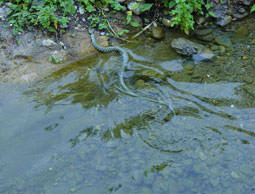
The first photo was taken in the creek in front of our house. I think this is a Natrix tessellate, known as a river snake that eats rats and frogs. This one was really big, and I estimated it as over six feet long. The head was huge, and sort of triangular in shape.

Once I spotted it lounging on the bank, I scampered back to the house to get my camera and my snake identification guide. Once I determined it wasn’t poisonous, I got close and took some nice pictures before he ducked into the water and swam to the other side. Another magnificent beast.

The second photo was taken by my friend Louis Salmone in his garden. These two snakes are, I think, Coluber viridiflavus. These are the second most common snakes around here, and I see this species frequently.  They eat mice and the common lucertole lizards. These two exhibitionists are about three feet long, but some of the Coluber species grow even longer, sometimes up to seven feet!

The most commonly seen snakes here are the orbettini, the little legless lizards that look like snakes. Known as glass snakes, they are Anguis fragilis.

I probably rescue one of these fellows at least once a month, as they seem to end up on the steps to my office frequently.  Unfortunately, the street is frequently spotted with the flattened corpses of these little guys.

The most exciting road kill I ever found here was the huge chartreuse lizard I found once.  Even flat I could see that it was about three feet long including the tail.  The head was a bright blue and the belly was chrome yellow.  This spectacular lizard, Lacerta lepida is the largest lizard in Europe, and looks like a slimmer iguana.

I’ve seen live specimens of the cousin Ramaro (copperhead), Lacerta viridis in the woods a few times.  Pretty exciting for me.

<>

Categories
Crops & Gardening

Slugs, the Coldframe and Fungus

The slugs in Rick's village are large

We’ve got some cool looking slugs here in Italy.

This first photo is one of the dark ones I saw in the garden this week. I’m pretty sure he’s in the Arion genus. Note the red stripe on his tail and the turquoise spots on his sides. A beautiful beast.

The big news in the garden is that I got the new coldframe set up this week.

It’s a manure heated coldframe that I built for an article I’m writing on the subject. The Romans used this technique in their mica-covered coldframes to grow vegetables. The photo shows the box built underneath to hold the manure, and the glass covered coldframe above.

Rick's coldframe features a technique the Romans used

I’ve painted the box in stripes of white and grey sort of as a joke. In medieval times, the nobility in this area used stripes of white marble and grey slate to build their fabulous churches and palaces. I tell my neighbors the box is the Castello dei Fieschi. (The Fieschi family were one of the genovese Doria family’s big rivals.

My plan is to use the manure heating for two months in the early spring, when the seedlings will appreciate the bottom heat. Then for the rest of the year I’ll make compost in the box.

I’ve added a hopper on the left side for adding the daily vegetable refuse from our kitchen and a big door on the right side so I’ll be able to open the box and turn the compost pile with a rake. I’m really quite pleased with the clever design. I’m sure I’ll find out later what’s wrong with my theory.

I just love how Pride goeth before a fall. Of course, my exultation about the exploding tomatoes last week has been followed by the first discovery of fungus this week.

I had one plant so infected that the green fruits were streaked brown, so I cut that out and I also cut out three other plants to make more room between the remaining plants.

I think the plants had grown so big that they were crowding each other, and then after a week of warm and humid weather, the plants couldn’t dry out and perfect conditions for the fungus were created.

I think this fungus is Phytophthora infestans, the same fungus that caused the Irish Potato disaster. It’s pretty common in Europe, but not so much in the states.

Losing four of my thirty tomato plants freaked me out a bit, but yesterday I planted four new plants in a distant terrace.

It’s been a few days now since I’ve seen any new signs of fungus, and I’ve again got my fingers crossed.

I’ve also painted the outside of the coldframe dark green, and while I like it, my wife says it’s ugly, and clashes with the grey and white stripes on the box.  Oh well, a gardener’s life is never easy.

<>


Categories
Crops & Gardening

Radishes, Lettuce and Potatoes … Oh My

The garden is producing great vegetables like these peas
Jessica picks fresh peas—one of her
favorite veggies—from this pea plant.

This has been a great year for the garden already.
Plenty of rain and so far the weeds have been manageable.  Let’s hope that continues through July and August!

The lettuce harvest will come to an end in another week or two and the shell peas are really starting to fatten up.

I think that if I had to pick one favorite veggie from the garden I would choose peas.  There is no way to compare a fresh picked pea (either shell, snow or snap) with those from the grocer’s freezer or even at the farmer’s market.

At least with tomatoes there is some sort of shelf life, even with the heirlooms, but it seems to me that peas loose their sweetness even just a day after picking.  I’ll always grow them in the garden.

I yanked the radish out a few days ago and planted more cucumbers in their place.

A few nights ago a raccoon found its way into the garden (not sure what it was after) and knocked over all the potato plants.  They’re lying on the ground, but my guess is that it’s no matter, they’ll grow anyway—they always do!

I’ll dig up some young ‘new’ potatoes in two weeks.  It’s always fun to snitch them from around the edges of the potato patch.  They’re soooo sweet roasted on the grill or in the oven.

<< More Dirt on Gardening >>

Categories
Homesteading

Part 2: Mixed-up Moms

Tica the Muscovie duck was granted parental rights to the chicks

When hatching day came, Velma possessed 7 eggs and Tica had 10 eggs. 

I think. 

I’m unsure because during the entire incubation period the expectant mother Muscovies kept tradingor more likely stealingeggs from each other. 

One morning I found the ducks hovering over their nests rather than sitting flata sign the eggs might be hatching. 

Sure enough, when I pulled out a warm egg, I spotted small cracks at the larger end.  Holding it to my ear, I heard soft peeps and scrapes.  Known as “pipping,” this signals the duckling’s imminent arrival over the next 12 hours or so. 
    
Amazingly, all but two ducklings heroically chiseled out of their eggshells at about the same time, meaning the girls had begun incubation simultaneously (what a team!). 

Velma and Tica kept stealing the two remaining eggsand their ducklingsfrom each other, shifting them gently from nest to nest.  After everybody emerged, I found Tica hovering over both broods while Velma ate from the food dish.

I needed to move the ducklings to an adjacent pen, where they wouldn’t be bothered by the other fowl, but I worried about putting both females in with them.  Although Muscovies make dedicated mothers, they can step on and accidentally crush their babies when disturbed.
 
Studying the moms and their little bundles of fluff, I observed that Tica, the younger duck, seemed more enthusiastic about the whole mothering thing than Velma. 

Every time I came near, Tica lowered her head and gave me a menacing hiss, while Velma seemed more concerned about making up for lost time at the food dish. 

My oldest duck at 6 years, Velma had experienced the joys and frustrations of motherhood a number of times, so maybe she felt burnt out.  I decided to give the babies to Tica.

I caught Tica up and moved her to the next pen, then whisked the adorable ducklings into a hay bucket and transferred them into their new “nest.”

As inevitably happens whenever I move moms and ducklings, Tica became frantic.  She desperately looked for a way out of the pen, back to her old nest, ignoring the babies right beneath her beak.

“Your babies are right there!” I told her.

After much persuasion on my part, Tica finally got a clue.  Oh!  There they are!

Meanwhile, Velma had discovered HER babies were missing.  Furious, she paced outside the pen door, squeaking up a storm.  The next day, even though I plied her with treats, she still hadn’t forgiven me.

Oh well, you just can’t please everybody.

Happy beginning of summer!

~  Cherie

« More Country Discovery »

Categories
News

Working Through Life’s Challenges

By Lisa Munniksma, HF Managing Editor

Cattle farmer George Green hadn’t anticipated needing a 15-inch steel rod in his back when he set out to work on his feed grinder one morning, but one accident later, he found himself in the hospital with just that.

Left with arthritis and decreased mobility, his prospects for continuing his cattle operation weren’t good.

No one expects his life to change overnight, but injury, illness and the effects of aging aren’t something that are in our control. Small farmers in general are a passionate lot who take their on-farm duties seriously.

Whether or not the farm is a means of income or simply for enjoyment, experiencing a life-altering event that threatens the work you do there could be devastating. Recognizing an aging farming population and the risk of the work they do, there are organizations dedicated to assisting farmers who aren’t able to carry on at the farm on the level they once were.

The AgrAbility Project is a nonprofit partnership that offers free education and assistance to people with disabilities who are involved in agriculture.

Sponsored by the USDA, 22 states have AgrAbility Project offices, and the National AgrAbility Project serves residents in the other states. Among the services offered by AgrAbility is a broad-based assessment of a farmer’s situation that includes recommendations for facility and equipment modifications that will allow the farmer to continue to work toward his or her goals.

In Green’s experience, AgrAbility worked with him to transition his operation from cattle to organic fruit and vegetable production, including connecting him with the local small-business enterprise program for additional assistance.

Industry-wide, equipment manufacturers are taking notice of the needs of this population, as well. John Deere, for example, has introduced several automation features for its equipment, allowing farmers to work more efficiently and with less physical effort.


The John Deere iMatch AutoHitch
Photo Courtesy of John Deere
John Deere’s iMatch AutoHitch allows you to
hook up the PTO drive shaft without leaving
the operator’s seat.

The Possibilities
The range of disabilities and issues facing farmers are as varied as farming operations.

Steve Swain, rural rehabilitation specialist and outreach coordinator with the National AgrAbility Project, says he sees a lot of arthritis, back impairments, spinal-cord injuries and amputations.

“I’m seeing more age-related issues,” he says. He can identify with the people he’s helping, too: “I’m going on 58. Growing up on 220 acres, we didn’t have a lot of money, so we did things the hard way. It does damage that you don’t think about at the time.”

Whether due to age, injury or desire for easier-to-operate machinery, John Deere’s equipment automation advancements are easing the difficulty of working with these issues.

“Several years ago, we identified some key, unmet needs in compact tractors. One of the big needs is the ease of attaching,” explains John Deere compact tractor representative Dan Paschke.

The John Deere AutoConnect
Photo Courtesy of John Deere
The AutoConnect mid-mount mower deck
allows you to drive the tractor over the
mower deck, lock down the wheels on the
mower deck, and hook up the PTO
automatically.

The first of their compact-tractor automation features was the iMatch Quick–Hitch, a quick coupler for the 3-point hitch. Paschke explains this feature was already in use in other equipment but wasn’t available for compact tractors.

In 2007 came the iMatch AutoHitch, which is a PTO coupler that allows you to hook up the PTO drive shaft without leaving the operator’s seat.

“It’s easy to use, and it’s safe. You don’t have to get on and off the tractor, and you can reach the levers,” Paschke says.

The latest automation feature is the AutoConnect mid-mount mower deck. Rather than having to get off of the tractor and fumble around with heavy attachments, you drive the tractor over the mower deck, lock down the wheels on the mower deck, the PTO hooks up automatically.

These automation advancements aren’t only assisting disabled farmers but are making equipment operation safer industry-wide. If tractor implements are easier to attach and unattach, users are more likely unhook unneeded equipment, which makes equipment operation safer.

Asking for Help
As a hard-working, self-sustaining bunch, it’s often difficult for people in the ag community to reach out and ask for assistance. It’s important for everyone to know that assistance is there when it’s needed, though.

Swain recalls one farm show where AgrAbility was exhibiting. There was a man in a wheelchair going down the aisle of display booths, and he was hugging the far side of the aisle away from the AgrAbility booth.

“It’s like he was saying, ‘I don’t want to face this right now.’ It takes a different timeframe for everybody. We try to show people what is possible and jog their mind to say, ‘OK. Maybe I need to look at these things.’

“There are some people who are rough and tough and very independent. It’s hard to get information to the general farming public.”

Learn more about the National AgrAbility Project at www.agrabilityproject.org or by calling 800-825-4264.