Categories
Equipment

Trash Pile or Treasure Trove

I admit it. I have wood lot envy.

I drive by farmsteads and there in the wood lot or on the edge of the farmstead stands lines of old implements, carcasses of tractors and cars.

I can sense that inside the outbuildings–no longer used for livestock or crops–there are piles of old appliances, tools, boards and barrels.

No longer needed, busted or in some cases collected by the owner at various farm sales and auctions, they just sit there…until needed.

What some see as a pile of trash, I see as a trove of treasure and a source of envy.

For nearly half of my married life, I moved from place to place as jobs demanded. There was little opportunity to hold on to things, and each move necessitated a fresh look at “collected” artifacts and the value of retention.

Even after staying put for the past 13 years, my treasure trove is distressingly small.

Troves are Valuable
Such collections are not built up quickly. In fact, they are best handed down from one generation to another, or at from least one landholder to the next. Thus the envy; for having grown up on a farm, I know the value of such troves.

When an extra board or post is needed to patch a fence or wall, perhaps a bit of tin to cover a hole or even an axle for a cart, they are at hand, easy to access.

When you have to stop and drive to the nearest town to buy new, it takes something (aside from the lost time and out-of-pocket cost) away from the project at hand. However, being able to recycle things that were thought to have no value adds value to the entire effort.

So the next time you consider clearing out those old posts or calling the salvage truck for that worn out plow in the fence line, stop and think about it. They might be just what you need for that next project or timely repair.

« More Shop Talk »

Categories
News

Eco-Friendly Water System Developed for Philly Park

By Krissa Smith, HF Assistant Editor

Has the city of brotherly love also become the city of eco-love? Philadelphia’s popular park, Liberty Lands, is being renovated with a stormwater management system to cut water waste, decrease erosion and keep water out of the city’s system.

The park also has a new ADA-accessible performance stage, contoured lawn and new plantings of native trees and grasses.

To kick off the changes, the Northern Liberties Neighbors Association held a Spring Music Festival on June 6 with over 1,000 residents in attendance.

Janet Finegar, co-coordinator of Liberty Lands, said the music festival was a success, and attendees’ reactions to the changes were positive. “We see the park as not just an amenity for the neighborhood, but an example of things we can do differently.

“We knew this system worked—the cisterns were full and water was going where it was supposed to—so Saturday was an opportunity to get the news out to the community,” she says.

The Philadelphia Horticulture Society has worked on a master plan for the park’s water system for the past three year. The storm system plans include an inlet on Third Street to capture stormwater runoff. The runoff travels under the sidewalk, is released along a grass swale into a rain garden, and drains into an underground cistern for park irrigation.

With the park’s new water management system, is Philadelphia is one step closer to becoming one of the nation’s greeniest cities—the goal of Mayor Michael Nutter?

According to the PHS, Joan Reilly, senior director of PHS’ Philadelphia Green program thinks so.

“This neighborhood treasure now has a high-tech system that will reduce stormwater flow into the city’s system,” she says. “Sustainable stormwater management—rain gardens, rain barrels, and other nontraditional methods of controlling stormwater—is an important next step in making Philadelphia one of the greenest cities in the country.”

Philadelphia Green, the nation’s most comprehensive urban greening program, has partnered with the Philadelphia Water Department’s Office of Watersheds to improve stormwater management at more than 20 sites in Philadelphia, including Cliveden Park in East Mount Airy, the Springside School in Chestnut Hill and Clark Park’s basketball Court in West Philadelphia, reports the PHS.

Categories
Animals

Did You Ever Want to Ride … A Cow?

Did you ever want to ride a cow?

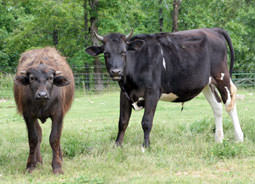
Ludo and Aiah are being raised to be riding cowsMy mom wants to ride one—or really a steer, that is.

She’s raising two calves to ride: Aiah (he’s a Jersey-Holstein) and Ludo (Ludo is a water buffalo). Other cattle breeds>>

They both already know how to stand tied and to lead and Aiah will be old enough to train ride this fall. Mom plans to start ground training Aiah soon.

Riding cows (and steers) is nothing new.

Mom has antique photos of people riding them, like this postcard picture of Bobby, the famous trick-trained steer.

Bobby the Wonder Steer was trained to rideShe’s also inspired by other people who ride cattle like Texas Longhorn steers and Hazel, the Swiss riding cow (watch video below).

Cows can do all kinds of neat things beside give milk and get make into beef for folks who eat meat.

In Japan, at Ebino City’s annual Cow Jumping Festival, cows jump 20-inch hurtles while wearing traditional regalia and they’ve been doing it for 300 years!

According to Wikipedia, “Participants pray that the gods will notice this display of [the jumping cows’] energy and health and protect their livestock.”

Cattle owners in Japan and Switzerland hold events where specially trained cattle shove and push each other around an area without drawing blood.

In the Swiss combats de reines (“queen fights“), Eringer cows have been doing it since 1923. In Japanese Togyu contests, bulls do the pushing and shoving.

Everybody knows about oxen but did you know you can drive just one cow or steer to a cart or buggy?

Yes, you can!

Calf pulling a cart  Single harness on a cow

Cattle are smart.  You just need to know what makes cows tick. And they’re affectionate too—just ask my mom and dad—at least as affectionate as horses.

When Aiah and Ludo are happy, they like to lick my mom. They also lick visitors who come to see them.

Hazel, the Swiss riding cow

So stick around. As mom trains Aiah, I’ll blog about it.

You can go along for the ride!

« More Mondays with Martok »

Categories
News

Farmers’ Market Shopping Tips

Farmers Markets are full of opportunties--get some tips before you goHeaded to the farmers’ market? Grab this list first.

If you’re a newbie or just need a few practical reminders, here are a few courtesy of the Kansas State University Research and Extension.

  • Go early for best selection. 
  • Allow time to shop leisurely, to survey the market and make selections.
  • Encourage children (and family and friends as well) to shop – and learn-with you; leaving pets at home is, however, recommended.
  • Don´t be shy. Ask about less familiar foods, such as a pink – or purple – heirloom tomato, white eggplant, unfamiliar squash or greens.
  • Take advantage of the opportunity to get to know the grower. Ask where the food was grown, when it was harvested, how to select the best of the crop and cook, store, or freeze for future use.  (Have you voted for your favorite farmers’ market?)
  • Plan to choose one or two new food items or varieties each week to add flavor, color, texture and health-promoting nutrients to meals.
  • Buy quantities sized to fit your household; overbuying increases waste and runs up food costs unnecessarily.
  • Carry a basket or re-usable grocery bags to reduce waste.
  • Store foods promptly to preserve freshness; use perishable items first.

    (Want to preserve what you bought? Consider canning or read all about drying in the July/August 2009 Hobby Farm Home. For using dried foods, try a few of our dried food recipes.)

  • As a general rule, wait to wash fresh produce until ready to use it. For example, wash melons before slicing and serving to reduce the risk of transferring naturally occurring bacteria found in the soil in which the melon was grown to the edible portion of the melon.
     
    Brushing off dirt, sand or other debris from freshly harvested crops grown either in soil or in close proximity to the ground is, however, recommended.

What are your best farmers’ market tips? Comment below.

Categories
Crops & Gardening

Taccole: My Favorite Green Beans

Green taccole beansSome of my favorite green beans are just now showing up in the markets.  These are the green beans with larger, flattened pods that are usually called Romano beans when American seed companies sell them.   In Italy we call these fresh beans taccole (tack-o-lay).

Some people also call them piattoni or “big flat ones.”

Not only do these beans deliver all the taste and crunch of green beans, but they are pretty big and have an awful lot of flesh compared to a regular green bean. 

This is good for both the cook and gardener, as they are easier to harvest and easier to prepare just because one needs less beans to fill the bowl. 

There are two main kinds of taccole in the markets:

  • the green ones
  • the pale yellow ones.

Yellow taccole beansThe yellow beans have a slightly sweeter flavor, but we prefer the green ones in our kitchen. 

How We Eat Them
We eat these beans steamed like regular green beans, and in main dishes such as pasta with pesto and taccole.  The taccole also mix very well with potatoes and cheese in making casserole sorts of dishes. 

When lightly steamed, the taccole are nicely crunchy, but when we make them with pasta we usually cook them a bit longer, at which point they become softer and deliver a sensation of more bean flesh per bite, which is quite satisfying when one is really hungry.

Planting Them–And the Trouble with Snails
I have planted a lot of beans in the garden this year, and they’re just now starting to grab onto the trellis supports and climb upward. 

I’ll admit that this is my third planting, (!) because the first planting more than a month ago was into soil that was too cold and did not warm as I had hoped it would, and lots of the second planting was eaten by snails as soon as it germinated. 

Now it’s really warm, so that slows the snails down, and speeds up the seed germination, and everything’s super. 

I have trouble with snails. 

I don’t want to use metaldehyde products, which includes essentially every snail bait.

In the states I used a powder to make the soil surface annoying to snails and slugs, and I’m going to have to try to find that same stuff, (ferrous sulphate of some sort), somewhere in Italy. 

I’m pretty sure it’s organic acceptable, because I ate some once to demonstrate that it’s not a poison.  Tart, as I recall, but the snails can’t stand it.

In the bean plots I’ve planted all climbers this year, because climbing beans on trellises expand the surface growing area in my postage stamp planting areas. 

The bush beans produce much more quickly, but over the course of the season, the pole beans produce a larger quantity. 

My main planting is the old American variety Blue Lake, which is also the most popular variety here in Italy.

I’m also growing a row of taccole, a row of purple Trionfo Violetto beans, and a row of red Borloto beans for making dry beans that we’ll add to soups this fall.  All of these different varieties are Phaseoulus vulgaris.

<> 

Categories
Equipment

Small Scale Tool Resources and Safe Operation Tips

Operate with Care

Before buying (or even operating) a skid steer, read up on safety information. One good resource is the University of Wisconsin Cooperative Extension’s publication, “Safe Use of Skid-steer Loaders on the Farm.” 

These are a few of the highlights:

  • Never use a skid steer that isn’t equipped with a rollover protective structure , falling object protective structure, side screens, and a seatbelt or operator restraint bars. These safety features have saved many lives; don’t put yours at risk.
  • Never mount or dismount a skid steer with the lift arms up unless they’re supported by a restraining device other than its hydraulic system. Safe dismounting means lowering the bucket, turning off the engine, putting the controls in neutral and, using both hands to support yourself, facing the machine as you step down.
  • Always stay completely inside the operator’s compartmentóthat includes your fingers, hands and feet.
  • Don’t carry riders, ever! And clear the area of bystanders before operating a skid steer in tight places.
  • Carry the bucket low (the higher the load, the higher the center of gravity and more likely the skid steer is to tip), but don’t let it drag the ground. Never swing the bucket over someone’s head.
  • Avoid operating on steep slopes where skid steers are wont to tip over.

Small-equipment Resources

Abbriata (Italy)
www.abbriata.com
Sold through Masters Farm Supply
Columbia, Ala.
850-762-3221

Bobcat
www.bobcat.com
800-743-4340

CAEB (Italy)
www.caebproductions.com
Sold through Earth Tools BSC
Owenton, Ky.
www.earthtoolsbcs.com
502-484-3988

IHI Star Machinery Corporation (Japan)
www.ihi-star.com/english/index.html
Sold through Agriquip
Lindale, Ga.
www.agriquip.com
706-290-3941

John Deere
www.deere.com
309-765-8000

Millcreek Manufacturing
www.millcreekspreaders.com
800-311-1323

Molon Machinery (Italy)
www.molonmachinery.com
Sold through Earth Tools (see above)
New Holland
www.newholland.com
888-365-6423

Newer Spreader
www.newerspreader.com
866-626-8732

Roth Manufacturing
www.loyal-roth.com
800-472-2341

Categories
Recipes

Garden Chop Salad with Thai Vinaigrette

This recipe calls for chopping or dicing the vegetables, as these cuts are less time-intensive. To dress up the presentation a bit, slice the cucumber thinly on the diagonal, cut the tomato into thin wedges, and julienne the zucchini and bell pepper.

Ingredients

  • 1 cup chopped cucumber (peel only if skin is bitter)
  • 1 cup chopped tomato
  • 1 cup diced zucchini (unpeeled)
  • 1/2 cup diced red bell pepper
  • 1/2 cup coarsely grated carrot
  • 1/4 cup coarsely grated daikon radish
  • 3 T. thinly sliced green onions (include some of the green part)

Vinaigrette

  • 1/4 cup freshly squeezed lime juice
  • 2 to 4 T. brown sugar (to taste)
  • 3 T. light soy sauce
  • 3 T. rice wine vinegar
  • 2 T. vegetable oil
  • 1 T. minced fresh hot chile pepper, any variety (optional)
  • 2 tsp. minced fresh garlic
  • 1 tsp. grated lemon zest
  • 1/8 to 1/4 tsp. cayenne (to taste)

Garnish

  • large lettuce leaves, washed, dried and chilled
  • 2 T. coarsely minced fresh basil
  • 2 T. coarsely minced fresh cilantro
  • 2 T. coarsely minced fresh mint
  • 1/2 cup finely chopped roasted peanuts or cashews

Preparation
In a large bowl, toss vegetables together. Combine all vinaigrette ingredients in a container with a tight-fitting lid and shake until well-combined. Pour vinaigrette over vegetables and toss to coat. Chill for at least one hour; toss again before assembling servings.

Create individual servings by placing lettuce leaves on chilled salad plates and using a slotted spoon to place the desired quantity of salad on top of the lettuce. Toss together the chopped fresh herbs, and sprinkle generously over salad; top with chopped peanuts or cashews.

Categories
Recipes

Southwest Black-bean Burgers with Chipotle Mayonnaise

Ingredients

  • 15-ounce can black beans
  • 2 T. olive oil, divided
  • 1/3 cup chopped onion
  • 1/3 cup diced poblano pepper
  • 1 T. chopped garlic
  • 1/2 cup packed fresh cilantro leaves, washed and thoroughly dried
  • 1/3 cup instant masa
  • 1 large egg, beaten
  • 1 T. minced fresh oregano
  • 1/2 tsp. sweet or mild chili powder
  • 1/2 tsp. ancho chile powder
  • 1/2 tsp. cumin
  • 1/2 tsp. salt, or to taste

Chipotle Mayonnaise

  • 1/3 cup mayonnaise
  • 1 T. minced canned chipotle peppers

Preparation
Make the chipotle mayonnaise by beating together the mayonnaise and peppers until well-combined. Refrigerate until ready to serve.

Rinse beans, drain well and dry between two layers of paper towels. Mash with a fork until crumbly but not smooth.

Heat 1 tablespoon of olive oil over medium heat, and sauté the onion, poblano pepper and garlic until vegetables are soft and beginning to brown. Remove from heat and let cool for a few minutes. Then, place in a food processor with the cilantro and process until mixture is finely chopped.

Add the vegetable-cilantro mixture to the black beans, then add the rest of the ingredients and mix until well-combined. Form into four patties. Heat remaining olive oil in a large skillet, and fry the patties over medium heat until crisp and browned on each side.

Serve with chipotle mayonnaise on the side. These also freeze well; wrap each patty separately after forming (do not fry) and stack in a freezer bag.

Makes four burgers.

Categories
News

First National Goat Study Launched by USDA

Goat producers to be surveyed this summer in the U.S.Goat producers in 21 states may be asked to participate in the first national study of health and health-management issues facing the U.S. goat industry.

The survey, conducted by two USDA agencies–the Animal and Plant Health Inspection Service (APHIS) and the National Agricultural Statistics Service–in July and August 2009, will focus on the health, productivity and management practices of the meat, dairy and fiber goat industries.

The 2007 Census of Agriculture showed the percentage of farmers raising goats increased in 2007, while many other production sectors showed a drop or little change.

Participation in the study is voluntary and confidential.

According to the USDA, the Goat 2009 study has the following major objectives:

  • Determine producer awareness of veterinary services program diseases;
  • Describe management and biosecurity practices important for the control of infectious diseases-including brucellosis, scrapie, caprine arthritis encephalitis, Johne’s disease and caseous lymphadenitis;
  • Establish a baseline description of animal health, nutrition and management practices in the U.S.goat industry;
  • Estimate the prevalence of Johne’s disease infection, internal parasitism and anthelmintic resistance;
  • Characterize contagious ecthyma (sore mouth) in U.S. goats. Determine producer awareness of the zoonotic potential and practices to prevent sore mouth transmission, and assess producer interest in an improved vaccine for sore mouth;
  • Examine factors (e.g., genetic and management) that correlate with caprine arthritis and encephalitis virus levels; and
  • Provide genetic and serological banks for future research.
Categories
News

Food for Thought: NAIS–Heating Up

(Editors Note: “Food for Thought,” a regular column by Carol Ekarius, runs in most every issue of Hobby Farms. For the July-August 2009 Hobby Farms, we posted the “Food for Thought” column online. We hope you have a chance to read and comment.)

by Carol Ekarius

The USDA's NAIS is getting closer to being put into effectIn March, secretary of agriculture Tom Vilsack said he would consider making the USDA’s National Animal ID System (NAIS) mandatory.

Since NAIS is of great concern to large- and small-scale farmers and ranchers as well as backyard livestock owners, I decided this month’s “Food for Thought” column should be dedicated to the topic.

Rather than interview an author or documentary producer as I usually do in this venue, I turned to Ann Wells, DVM, of Praire Grove, Ark.

Although we’ve never met in person, I’ve become virtual friends and colleagues with Dr. Wells over the last decade or so. She’s not only a shepherd, but also one of the leading small-ruminant (sheep and goats) consulting veterinarians in the country, and she served for nine years as a livestock specialist at what’s now known as the National Sustainable Agriculture Information Service.

I chose Dr. Wells because I know she has a strong and balanced view on NAIS—both the benefits and the problems.

A Recap
NAIS was proposed under a draft plan released by the USDA in 2004.

The plan proposed registration of all livestock “premises,” from farms to backyards, or anyplace where livestock animals are kept—from a single horse or a single chicken in suburbia to giant feedlots and poultry houses containing thousands of animals.

It also called for the use of Radio Frequency IDs (RFID) or injectable transponders to track individual animals, with the information kept in a national database for tracking all animal movements.

In other words, taking your horses for a trail ride? Report their movements. Showing a couple of chickens at the county fair? Report their movements.

USDA’s justification for NAIS is that it will help protect the health and economic well-being of the country’s livestock and poultry by enabling efficient tracing of an animal disease to its source.

However, the program development was backed in part by an industry-led group that counts among its members some of the biggest corporate players in United States meat production (for example, National Pork Producers, Monsanto and Cargill Meat), manufacturers and marketers of high-tech animal-identification equipment, and industrial farms.

One area of the plan that has caused much controversy is a giant loophole: The corporate farms could get a single identification number for all of the animals on their premises, whereas we small, diversified producers need to register each and every animal.

To say the least, the program, which was billed as voluntary, has been extremely controversial with many farmers, ranchers and backyard livestock owners, many of whom are refusing to voluntarily sign up. Thus, Vilsack brought forth the comment about making the program mandatory, and a new round of heated debate erupted.

NAIS Pluses and Minuses
Dr. Wells says, in theory, the upside of the NAIS “would help to more quickly locate herds or flocks of animals that were exposed to a potentially life-threatening or economically threatening disease. I tend to think of things like avian flu and foot-and-mouth disease but probably mad cow as well.”

NAIS, it turns out, probably wouldn’t stop disease outbreaks (something I think most of us would support), but in truth, no one really knows.

“There isn’t really strong scientific evidence—no studies or models—suggesting how effective this could be, so are we spending hundreds of millions for something that may not be effective,” Dr. Wells explains. “That is a point that needs to be made to Congress. I think the Congress members who funded this probably just thought it would be easy to ID every premise and every animal, but there are giant challenges.

“Anyone who raises animals realizes that if there’s a way to lose a tag, animals will do it. Lost tags would have to be replaced with tags that bear the same ID number. No one knows how much that will cost.

“Also, you have data overload. There would be trillions of bits of information, and no one has tested how tracing back that information would work in an actual outbreak.

“And finally, nobody has figured out how to pay for it. If every animal owner has to buy tags, and a reader, and collect all this data on all these animals, and enter it into databases and so on, and so on, and so on, who is going to pay for all that? The cost could be enormous, but no one knows.”

An NAIS Alternative?
As currently proposed, NAIS obviously has shortcomings, but there must be other solutions to developing a system of protecting human health and the economic vitality of the livestock industry.

Some of the suggestions we discussed include:

  • Set a scale-of-production exemption. “I don’t think, for example, that anybody raising fewer than 100 sheep or a few hundred chickens would bring—nor likely fuel the transmission of—such diseases as avian flu or foot-and-mouth disease,” she says.
  • Provide exception for all closed herds or those where the farmer only introduces additional animals from nearby through private-treaty sales until those animals hit the commercial system. In other words, when the animals are sent to a sale barn, they would be tagged at that juncture. This makes the most sense, because this is when the animals get into the system and when disease exposure and transmission risks increase.
  • Close loopholes and create additional monitoring on live-animal imports, as many of the diseases of concern are imported into this country. Require all imported livestock to meet health and safety standards identical to those established for the United States, including adherence to prohibitions against certain feed ingredients, pesticide use on feedstuffs and certain livestock pharmaceuticals.
  • Allow individual meat processors to optionally test—and advertise the results—for “mad cow.” Current law prohibits small-scale farmers and packers from doing so. If we’re serious about the protection of human health, this would be a logical step.
  • As it relates to human health, fully fund and increase plant inspectors at large packing plants. The most critical food-safety issue for the meat and dairy industries relate to E. coli and other bacterial outbreaks that will not be prevented by NAIS. These health issues are prevented by not allowing manure in our food; that has nothing to do with tracing animals and everything to do with the sanitary handling and preparation of the country’s food supply.
  • USDA should work with groups like the American Livestock Breeds Conservancy to identify genetically important groups of animals that can be preserved during an outbreak of disease. Typically in an outbreak, all of the animals in a geographic area are slaughtered, but in the case of heritage breeds, their genetics are critical for preservation.
  • USDA needs to do a more detailed cost analysis. They could select a university herd or track the animals that pass through one of the major sale barns and really follow those animals throughout their lives to understand the cost and effectiveness of the program prior to any mandatory implementation.

With a vested interest in the outcome of the NAIS program, livestock owners need to actively participate in USDA listening sessions.

“We little people really can be heard if we deliver a uniform and consistent message,” says Dr. Wells.

About the Author: Carol Ekarius is an HF contributing editor and author of Hobby Farm: Living Your Rural Dream for Pleasure and Profit (BowTie Press, 2005).