Categories
Recipes

Dried Tomato Pesto

Dried tomato pesto

This tasty pesto is versatile. Serve it tossed with hot pasta or spread on toasted baguette slices and topped with feta.  It makes a great stuffing for chicken breasts, too.

Ingredients

  • 1 cup dried tomatoes (home-dried, not in oil)
  • Boiling water
  • 1/2 cup extra-virgin olive oil
  • 1/2 cup fresh grated parmesan or asiago cheese
  • 2 T. pine nuts
  • 1/4 cup packed fresh basil leaves
  • 2 to 3 garlic cloves
  • salt and pepper to taste

Preparation
Cover the dried tomatoes with boiling water and let sit 10 minutes or until soft.  Drain.

Combine soaked, drained tomatoes and olive oil in the work bowl of a food processor fitted with a sharp metal blade.  Pulse several times to chop tomatoes.  Add parmesan, pine nuts, basil, and garlic.  Process until the mixture forms a paste.  Taste purée and add salt and pepper if desired.

Store pesto in a glass jar in the refrigerator for up to one week.

<>

Categories
News

Listening Sessions to Inform Public of Animal Identification System

The USDA is running NAIS listening sessions

The USDA is seeking to inform stakeholders, like small farmers and producers, about the National Animal Identification System and to hear concerns and possible solutions to those concerns.

Agriculture Secretary Tom Vilsack has announced that the USDA will hold a series of listening sessions on the National Animal Identification System (NAIS).

The sessions will include information about the current program as well as testimonies and a question-and-answer time for the public. The information and ideas will help Secretary Vilsack in making future decisions regarding animal identification.

The meetings will be held from 9 a.m. to 4 p.m. Eastern time with registration one hour prior to each meeting.

Eight states will hold the meetings:

  • Thursday, May 14:  Harrisburg, Pa.
  • Monday, May 18:  Pasco, Wash.
  • Wednesday, May 20:  Austin, Texas
  • Thursday, May 21:  Birmingham, Ala.
  • Friday, May 22:  Louisville, Ky.
  • Wednesday, May 27:  Storrs, Conn.
  • Monday, June 1:  Greeley, Colo.

Read more about the NAIS.

Categories
Crops & Gardening

Soil Sifters

A smaller sifter creates finer dirt
Photos by Rick Gush

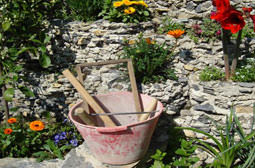
Rick’s small sifter creates finer dirt for
seedlings and potting.

Recently, Italy celebrated the Festa Della Liberazione in honor of the day in 1945 when Italian partisans finally liberated Milan and Torino from the Nazi and Fascist troops.

Me, I’ll be busy today liberating another piece of my garden from the Rock and Stone troops.

I adore all my garden tools, and I think one of the reasons I like gardening is because I like having an excuse to work with my hands and use tools.

Two of my favorite tools are my soil sifters.  There are a whole lot of rocks in the soil where I’m building my garden.  I frequently need to dig down to the bedrock, and I do encounter many areas where there’s more rock than dirt.

This means that a lot of my time is spent trying to separate the rocks from the dirt.  I need the rocks as building materials for all the walls and steps, and I need the dirt to fill back into the terraces once I’ve built the retaining walls.  The big rocks I can separate by hand.

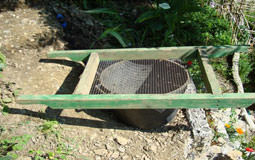
The larger sifter is used to remove large objects like rocks
Rick’s big green sifter takes the big rocks
and gravel out of the dirt.

Get Rick’s step by step instructions on
making your own sifter!

To clean up the dirt, I pass it through my big green sifter.  The resulting dirt falls into the big bucket below, and the rocks and gravel stay on the screen.  I use the gravel to cover the pathways in many places, and this lets me harvest in the garden even when it’s wet.

I have a smaller sifter too, with a smaller mesh.  When I need really nice dirt for seedlings or potting, I use the small screen to remove even the smaller rocks.

I frequently mix steer manure in with the dirt when I’m passing it through the screens, as that adds both organic material and a bit of nutrition to the resulting soil mix.

P.S.

Our HF editors’ blogs are starting to get some reader mail, which we greatly appreciate.  Several readers have asked how I ended up in Italy, so, here’s the short version:

I also work in the computer games industry and had the good fortune to make a few well known games.  I was recruited to work in several foreign countries, and I did start thinking that I might enjoy living in Europe for awhile.

In 2000 I accepted an offer to fly me to Italy for an interview, never really considering that I would accept that job, thinking instead that would get a free vacation in Italy and then job hunt on the way home in Belgium, which has a tremendously attractive agricultural industry.  I think they are even more tractor crazy than the US.

But once the plane landed in Italy I immediately felt strangely comfortable, even in this strange world that is so different from California.

At the interview I ended up getting down on my hands and knees and begging for the job.  I got a special hard-to-get visa because of my computer game development skills, moved to Italy the following month, and I’ve been here ever since.  Cool huh?

<>

Categories
Homesteading

Desert Discoveries Part 3: Desert Pricklies

A prickly pear cactus near Saguaro Lake
Photos by Cherie Langlois
Prickly pear cactus is a tourist fave.

Our time in the desert flies by in a sandstorm blur. 

We take a scenic boat ride on Saguaro Lake (strange to see so much water – and bald eagles! – in this dry country), enjoy a night of eclectic music at the Arizona Opry (Elvis was there), visit Old Tucson movie studios (gosh, those cowboys are cute), and hike through birdwatching mecca Madera Canyon (spotted wild turkeys, lots of hummingbirds; missed the coveted Elegant Trogon).

We also participate in some less-touristy activities, like running around the neighborhood golf course at dusk looking for javelina and bobcat, only to find about 1,000 bunnies (and one pack rat) instead. Hello? Bobcats?  You’re totally missing out here.

We manage to squeeze in some quality time with my folks, too.

The ocotillo's red flowers are favorites of birds and humans alike
Hummingbirds adore the red flowers of the ocotillo.

But the star attraction is the Sonoran desert, a rugged, prickly, sun-struck place completely unlike home.

I know people raise livestock here–we see horses and scrappy cattle–but I can’t imagine my own menagerie living in this desolate country full of venomous snakes, threats of heat stroke, and spine-armored plants. 

Here’s just a sampling of the desert pricklies we bumped into (not literally, thank goodness!):

Arizona Barrel Cactus: These stout cacti sport hooked spines and tend to lean to the southwest.  Sometimes they lean so far they fall right over. 

Brown-Spined Prickly Pear: This cactus species has thin, green oblong pads with spaced clusters of long, straight spines.  Juicy red prickly pear fruits make delicious candy, jam, and syrup – popular southwestern souvenirs.

Ocotillo: During dry times, these odd, tall plants look like dead, thorny sticks.  When the rains come, though, they bristle all over with small green leaves.  Hummingbirds adore the red flowers.

The well-known Saguaro cactus
This desert icon, the Saguro, is Cherie’s favorite.

Velvet Mesquite: For the indigenous people here, this thorny, deciduous tree with the feathery leaves offered up a treasure trove of fuel, shelter, food, dye, medicine, and more.

Jumping Cholla: We’ve learned to give this bristling, many-branched cactus a wide berth on our hikes; its wickedly barbed spines are famously difficult to yank out.

Saguaro: My hands-down favorite, this desert icon can grow up to 50 feet tall and live over 150 years. It won’t even branch or flower until it reaches the ripe old age of about 70!

Each year, the Tohono O’odham Indians harvest the fruit of this cactus for its tasty red pulp.

Back in Washington, I’m struck by how soft and cool everything looks:  cushy green pastures, furry fir trees, puffy rain clouds. 

Wet and dismal, too, but I’m trying not to dwell on that.  It’s still nice to be home on the farm.

~  Cherie

PS.  Thanks Mom and Dad for a terrific time in the desert!

« More Country Discovery »

Categories
Equipment

Finding Treasure in a Used Bookstore

Finding that hidden treasure in a used bookstore is a rewarding experience
iStockphoto

Used bookstores are a great place to look for treasure.

Especially for someone who enjoys fixing things. And even for someone who doesn’t, but recognizes that it has to be done.

I have always been fascinated by the inventor, the creative craftsman who can take perfectly useless junk and turn it to a valued purpose, someone like my father’s father.

It always seemed that he could fix anything.

One of my older brothers told of a time when a bearing had frozen to a shaft on an implement.

In short order, out of scrap bolts and bits of steel, Grandpa Ruen had fashioned a “puller” to bust the bearing loose.

My dad, in his rush to be a “successful” farmer, didn’t have that gift, nor do any of my siblings or myself. It is a gift, often born out of necessity.

Grandpa, with his small farm in the hills of northeast Iowa, had had no choice. He couldn’t afford to hire things done or buy new, so he learned to do.

He was a carpenter who built his own barn and outbuildings, a blacksmith who made his own tools, a craftsman who fashioned skis and toys for his children and grandchildren and an orchardist, beekeeper and horseman.

Arnold Hexum, a boyhood friend of my father, came from a large and wealthier farm up the road.

He once told me how much he enjoyed visiting my grandparents’ home.

“They had apples and nuts that lasted all through the winter,” he said.  Arnold recognized that wealth came in many forms.

In his later years, Grandpa would spend long weeks of his summers with us, fixing and mending things about the farm. Only after Grandpa was gone did my father realize how vital that fixing was and what a role Grandpa had played about the farm.

I was too young to appreciate that wealth of creativity and craft. Now that I am older, it’s too late to ask him to teach and share…which brings me back to used bookstores and treasure.

I have become a collector of books with titles like Practical Skills, Back to Basics, Old Ways of Working Wood and Down Home Ways. Old and new, they are filled with ideas and answers to questions not yet asked.

So when I am faced with a task I don’t know how to do or a need I didn’t know I was going to have, I turn to my books and treasure yet to be found.

« More Shop Talk »

Categories
News

Swine Flu Advice for Consumers, Pig Owners

Swine Flu - Pig breed namePig owners and consumers alike have plenty of reasons to want to learn more about the recent swine flu outbreak.

Centers for Disease Control and Prevention (CDC) reports 64 cases of swine flu in humans in the United States, as of April 27, 2009.

For farmers who own pigs, Purdue University Veterinarian Sandy Amass, who specializes in swine production medicine, offers three basic, common-sense ways to approach the situation and protect their pigs:

Do not permit people, including employees that have the flu or flulike symptoms, in or around barns.

Do not allow any visitors to the farm, especially international visitors who have had contact with other livestock.

If pigs show flu symptoms – coughing, runny nose, fever and a reduction in feed intake – call a veterinarian and have them tested.
Another good practice for pig owners–and any livestock owner: Clean up!

If you’ve been around other animals, clean your shoes and clothing that may have been in contact with the animals. Also, wash your hands with warm water and soap thoroughly before and after handling your own pigs–or any livestock.

No Pigs with Swine Flu
No reports of U.S. pigs having the current swine flu virus, known as H1N1 (currently causing illness in humans), have been made, according to the U.S. Department of Agriculture.

Still, Purdue’s Amass says pork producers should take the suggested precautionary measures to protect their herds from being infected with any flu virus. The USDA, as well, has put U.S. pork producers on a high alert for safety.

Pet Pigs
If you have pigs as pets, the same precautions apply.

Pig owners–or prospective pig owners–according to the USDA, should:

Learn the warning signs of swine flu and if your pig is showing any of these signs, call your veterinarian.

Buy your animals from reputable sources and ensure that you have documentation of your new pet’s origin.

Have new animals checked by a veterinarian.

Keep your pigs and areas around them clean.
If You Eat Pork: No Worries
If you are a consumer of pork–or a farmer who has encountered consumers with questions about eating pork–Purdue University nutrition specialist Melissa Maulding says there is no risk to the food supply.

Because the flu virus is not a food-borne pathogen, you cannot get swine influenza from eating pork or pork products, she says.

Both the Centers for Disease Control and Prevention and the U.S. Department of Agriculture also have reported that influenza is not passed through food.

Instead, pork consumers should simply follow the normal pork cooking guidelines, says the USDA:

Properly cook pork to an internal temperature of 160 degrees F kills all viruses

Prevent cross-contamination between raw and cooked food by washing hands with warm water and soap for at least 20 seconds before and after handling raw pork

Keep raw pork away from other foods

After cutting raw meat, wash cutting board, knife, and countertops with hot, soapy water

Sanitize cutting boards by using a solution of 1 tablespoon chlorine bleach in 1 gallon of water
More Swine Flu Information
To stay up-to-date on the swine flu situation, here are some places to obtain information:

For more information about swine flu and biosecurity measures, contact Amass at 765-494-8052, amass@purdue.edu

World Health Organization (PDF)

Centers for Disease Control and Prevention

U.S. Department of Agriculture

Categories
News

U.S. to Survey Organic Practices

The USDA is performing a Organic Production Survey

Organic has gone beyond being a buzz word. We raise our livestock organically. We look for organic labels when we shop. And many of us grow organic crops for the health of ourselves, our customers and the land. And if we’re not, we’re thinking about starting.

According to the 2007 Census of Agriculture, more than 20,000 U.S. farms engaged in organic production.

But will organic farming receive the kind of policy attention and funding allocations that other practices receive?

To help determine the answer to these questions and others, the U.S. Department Agriculture is conducting the first survey of organic agriculture.

“The Organic Production Survey is a direct response to the growing interest in organics among consumers, farmers and businesses,” said Vilsack. “This is an opportunity for organic producers to share their voices and help ensure the continued growth and sustainability of organic farming in the United States.”

Starting in May, the USDA will mail the survey to all known organic producers in the United States. Participants have until June 17 to return the survey, and the results will be published in winter 2009.

The survey will consider many aspects of organic farming from the 2008 calendar year, including production and marketing practices, income and expenses. It will focus on current operating organic farms as well as those making the transition to organic production.

The survey results will not only help producers make informed decisions regarding their own farming operations, but also help shape future decisions regarding current farm policies, funding allocations, availability of goods and services, community development and other key issues.

For more information about the Organic Production Survey, visit www.agcensus.usda.gov or call 800-727-9540.
Categories
Animals

The Mama Black Sheep Blues (Part 2)

Ursula finally gave birth to her lambs
Photos by Sue Weaver

Ursula and one of her lambs.

All day long Mom wrote for fifteen minutes, then she’d run out and check the ewes. Ursula was restless and nesting (that means she kept turning in circles and pawing the ground) but she just didn’t lamb.

Dad went to work and the day grew on. Pretty soon it was time to feed. Mom raced around flinging feed and watering, so she could get back to Ursula. She speed-milked Latifah in record time.

Night fell and a big full moon rose in the sky. Ursula waddled here and there, checking all the comfy, bedded shelters and outdoor places Mom made for her, then flopped down in the dirt by Ramsgate (that’s the rams’ pen). I guess she wanted the rams to see what trouble they cause.

Since we don’t have electricity in the sheep fold, Mom helped Ursula lamb by flashlight. She was not amused. Especially by Ursula’s choice of birthing spots. Ursula pushed and pushed and got up and lay back down and pushed and pushed some more. No lambs came out. Finally two little hooves appeared. Mom says they were enormous!

See, Ursula is fat. Really fat. She’s the fattest of the big fat sheep on our farm. It’s not good to be fat and pregnant because the babies get big and it’s hard to push them out.

Mom kept saying, “Here comes Lambie!” (She always says this; we could hear her down by our pen) But Lambie wasn’t coming, so Mom had to help. She put slippery stuff on Ursula and on her hand and then she waited until Ursula pushed really hard.

While Ursula pushed, Mom reached in and grasped both front legs at the fetlocks and gently pulled in an arc down toward Ursula’s hocks.

Ursula's newborn black and cream colored twins
Ursula’s twins.

Then, out came Lambie! It was a big, black girl.

Mom stripped the goo from her nostrils and waited until Ursula started to stand. That broke the umbilical cord. Mom whipped up the gooey lamb, snipped her cord an inch and a half from her tummy, dipped the stump, and took her to a nice, bedded spot.

Ursula followed. She licked Lambie (mamas know to do that when you’re born) and Mom used her sweatshirt to wipe dirt off of the lamb. Then Ursula stopped licking and looked thoughtful. And she started nesting again.

Ursula gave birth to a second lamb. It was white and another girl! She looked happy but confused. She never had twins before.

When Dad got home, he and Mom put Ursula and her lambs in a comfy, bedded Port-a-Hut and shut them in for the night. That way the ewes had time to bond with their brand new lambs.

Now they’re all together, except for Wren and her lamb. Wren “loses” Hannibal when they’re out and about. She forgets she’s a mom and runs off with her friends, then notices that Hannibal is missing. Then she gallops around baahing till she finds him again. Mom says she needs more time in the jug. Uzzi and I think she needs a GPS.

Mom loves lambs but wishes Wren hadn’t got bred through the fence.
(Psssst, let me tell you a secret: I bred K’ehleyr the Boer through the fence too! Won’t Mom be surprised!)

« More Mondays with Martok »

Categories
Crops & Gardening Recipes

Mother’s Day Quiche

By Kate Savage
asparagus and feta quiche delicious for Mothers Day

Whether she’s Mother, Mom, Mommy, Mum, Muv, Meeps or just plain old Ma, there is only one, and it’s the one you’ve got.

So this month it’s important to remember her and celebrate her day on May 10 by making it special in some way.

One of the best ways to commemorate your mother is by giving her the day off from her regular chores and routine, especially the cooking!

Rather than eating out, think about fixing a delicious family meal using fresh local produce.

This is the height of the asparagus season which is short, because it is a sensitive plant and will not push up its tender spears from the ground till it feels warm enough, so local supplies are not available until late April, early May and won’t last the month.

You can buy imported asparagus all year round, of course, but it loses flavour the minutes it’s picked so best be buying from nearby sources whilst the time is right.

For a meal that is complete in nutrition and a crowd pleaser, it’s hard to match a quiche.

Pair it with a salad of early greens like rocket (arugula) that’s coming in right now, blood oranges that are right in season, chopped green onions and celery with caramelized almonds and a citrus vinaigrette. An eye-popping accompaniment. Include some crusty bread and farm-fresh butter and this quiche holds it own for brunch, lunch or even as a supper dish.

The following recipe also calls for mushrooms so you think about local morels that are also in season, and be sure to use organic eggs for a much richer flavour.

Fresh Asparagus and Mushroom Quiche

Ingredients

  • 5 slices of bacon
  • 2 tablespoons butter
  • 1 small onion, cut into ½ inch pieces
  • 1 cup mushrooms, stems removed, cut into 1 inch pieces
  • 1 cup chopped fresh asparagus
  • 1 8-inch unbaked pie shell
  • 3 egg whites, lightly beaten (optional)
  • 1 cup shredded sharp Cheddar cheese
  • ¼ cup crumbled feta cheese
  • 2 eggs
  • ¾ cup half and half
  • Salt and freshly ground pepper

Preparation
Preheat oven to 400 degrees F.

Cook bacon in a large skillet over medium heat until evenly brown and crisp.  Drain on paper towels, crumble and set aside.

Heat butter in large skillet over medium-high heat.  Add onions, cook and stir until translucent.  Reduce the heat to medium and add the mushrooms.  Continue cooking until the mushrooms are tender.  Set aside.

Bring a saucepan of salted water to a boil over high heat.  Cook asparagus in boiling water until just tender, 1-2 minutes.  Immediately drain and run under cold water to cool.

Brush the pie shell with the beaten egg white, if using.  Place the onion and mushroom mixture, asparagus and bacon into the bottom of the pie shell.  Sprinkle the Cheddar and feta cheeses over the vegetables.  In a small bowl, whisk together the eggs, cream, salt and pepper until smooth.  Pour this mixture over the vegetable and cheese filling.

Bake uncovered for 35-40 minutes, or until firm and lightly browned on top.  Let cool to room temperature before serving. Serves 6.

About the Author: Kate Savage is a freelance writer and runs Scarborough Fare Catering in Lexington, Ky.

Categories
Crops & Gardening

A Potager at Your Door

By Amy Grisak

Potagers can be used in your cooking
Photo by Amy Grisak

Click here for a list of vegetables and herbs to include in your potager.

Kitchen gardens have been commonplace for generations.

These “potagers” – derived from the French word meaning a soup of broth and vegetables – marries form and function in an aesthetic garden that has all the ingredients for dinner at your fingertips.

Potagers traditionally are filled with herbs and vegetables, but their unique style also has room for flowers making it truly one-stop shopping where you can harvest your meals as well as a gorgeous bouquet for the table.

Blooms at Hand
Other benefits to adding flowers to the design are the extra blooms that attract pollinators, which is critical for successful crops, plus, some of the blossoms are equally delicious in salads.

Plant bee balm, nasturtiums and borage (which bees adore) to brighten up your greens and bring in the bees. 

If possible, keep the potager convenient to the kitchen.

It’s wonderful to be able to pop out in your bare feet and pajamas to harvest for breakfast instead of having to be properly dressed!

If you’re growing your garden in containers, this can be easy to do since they can be kept close at hand on the porch or patio.

A Style for Your Potager
The style of the garden is completely up to you, although the typical European and early homesteading kitchen garden was often a four-square design.

This makes it easy to rotate crops, segregate perennial herb varieties and fence the area to discourage wildlife harvesting before you do.

Whether you opt for the classic four-square, planting in beds optimizes space and efficiency. Keep them 4-feet wide at the most so you can reach the middle for harvesting or weeding from either side, and create comfortable sized pathways in between to allow you to maneuver a wheelbarrow or cart.

Planning Crops
Because the potager isn’t meant to grow an enormous quantity of crops like a field garden, making the most out of the space is a concern.

Plan the garden to grow successive crops throughout the season.

For instance, you can grow lettuce and spinach in an area early in the spring, but once the heat of late spring arrives pull them to make room for peppers or another heat-loving variety. When the summer vegetables wane, pull them and plant for a fall harvest.

Look at your kitchen garden as a three season effort instead of planting in the spring and letting it go.

A potager is an easy garden for anyone to grow. Plant what you like to eat, keep it simple and keep it close for a convenient way to enjoy the freshest produce around.

About the Author: Amy Grisak is a freelance writer in Montana. She’s played in the garden for more than 25 years.