Categories
Equipment

Tools of the Trade: Alternative Water-well Pumps

By John & Sue WeaverHobby Farms Magazine

Readily available water is a luxury many of us take for granted on the farm. Pumps are the unsung heroes of our watering systems, be it for household needs, for irrigation purposes or for livestock drinking-water.

Alternative energy pumps could be the better choice over electronic
SunPumps SDS Series
solar-powered pump

Electric water-well pumps are the norm, but as anyone who has experienced a prolonged power outage knows, they don’t always deliver when the going gets tough. Thankfully, there are other well-pump options.

Before we discuss those options, you should understand the basic difference between types of well pumps:

  • Shallow well pumps. These are located above ground and designed to lift water out of the well through a suction pipe. They are rarely useable on wells more than 30 feet deep.
  • Deep-well jet pumps. Deep-well jet-pump heads are mounted above ground, but their jet body extends into the well below water level. They lift water from depths of 20 to more than 100 feet.
  • Submersible deep-well pumps. Submersible pumps are long and slender. They fit inside the well casing and force water upward from a pumping element below water level. They aren’t restricted by suction lift limitations, so a powerful submersible pump can lift water from most any depth.

Most of these pumps rely on electrical current, but muscle-power, solar energy, wind energy or a combination thereof can be used as a power source for a number of well pumps.

Hand Pumps
During an extended power outage, you’ll be glad you have a hand pump on your farm. A properly chosen hand pump requires nothing more than muscle power to lift water from a well up to 300 feet deep. Most can be set up as permanently mounted fixtures in tandem with conventional pumps or easily fitted to a wellhead only when needed.

A hand pump is a must-have on almost any farm
Bison Pumps hand pump

On the downside, all hand pumps require priming before use, and cast-iron hand pumps can freeze.

The simplest of these are shallow-well pump heads like Oasis Pumps’ no-frills Model No. W1 and Lehman’s cast-iron hand pumps. The Oasis W1, like all Oasis hand pumps, is crafted of lightweight, unbreakable thermoplastics that show no wear on the cylinder or plunger cup after millions of strokes. Its closed design prevents the entry of airborne or other contaminants, and it pumps up to 10 gallons of water from depths up to 30 feet.

If you prefer a more traditional approach,you’ll like Lehman’s American-made, cast-iron beauties. They have an array of hand-operated, cast-iron, deep-well pump heads that lift water from wells from 75 to 300 feet deep, several of which can be driven by windmills with the addition of Lehman’s Pump Jack attachment.

Bison Pumps builds easily installed, stainless-steel, deep-well hand pumps. Manufactured in Houlton, Maine, they provide generous volumes of fresh water with every stroke, from wells with a static water level of up to 200 feet.

Batteries can be used to operate some pumps
Simple Pump lever-arm hand
pump

Simple Pump’s stainless steel and aluminum deep-well pumps in lever-arm and ADA 100-accessible, crank-arm versions require just 10 pounds of force to lift 3 gallons of water per minute from up to 100-foot static water depths. (Static water depth indicates how far water comes up a well pipe, so pumping from great depth is possible.)

Simple Pumps can be fitted with the company’s 1/5-horsepower gear-motor attachment that operates on 12 to 15 volt DC current from an automotive or deep-cycle marine battery or an idling truck or tractor.

Solar-powered Pumps
Photovoltaic-powered (PV) solar pumps work well for household purposes and for farm applications like watering the garden. Photovoltaic panels produce energy from sunlight through the use of silicon cells; they work equally well in hot and cold climates and have a life expectancy of roughly 20 years.

These cells are enclosed in a glass frame (called an array) that makes up the solar module. Because the sun doesn’t shine every day, water storage tanks are important elements of these units. When storage tanks are filled to capacity, further energy generated by the solar array is routed to and stored in batteries.

Solar pumps lift and store water year-round, though short days and cloudy weather reduce energy production. They’re fairly easily moved between locations, making them a fine bet for watering livestock on far-flung ranches.

Conergy’s Solar Slowpump (formerly the Dankoff Solar Slowpump) was the world’s first commercially available low-power solar pump. While it’s non-submersible, it neatly draws water from shallow wells, springs, cisterns, tanks, ponds, rivers and streams and pushes the water as high as 450 vertical feet and through miles of pipeline.

Slow pumping minimizes the size and cost of the solar array, wire and piping necessary. Made in a range of sizes, it survives most freezes, and its wearing parts typically last five to 10 years, with an overall pump life expectancy of 15 to 20 years.

Sunelco offers a variety of solar-powered pump brands for farm use, including Shurflo and SunPumps. The Shurflo 9300 is designed to be able to run dry or process dirty or silty water without sustaining damage. The 9300 delivers 112 gallons per hour at its maximum depth of 230 feet. The SunPumps SDS series are low-cost submersible pumps that offer 1/2 to 5 gallons per minute with up to 230 feet of lift.

Wind-powered Pumps
Wind power is another alternative to electricity-driven pumps. Windmills have been used to water livestock on America’s farms and ranches for more than  100 years, beginning with the Halladay windmill in 1854 and continuing

Windmill pumps have been around for more than 100 years
Aermotor windmill pump

to the Aermotor and Dempster designs, which are still in use today.

In addition to drawing water with windmills, wind generators can provide electricity to drive well pumps in emergency situations and to home and farm owners who choose to live off-grid. They work best in locations where the wind blows steadily (but not too hard). As with solar pumps, household water is stored in tanks, and excess generated energy is directed to a battery array.

For a traditional, full-sized windmill to pump water for livestock, irrigate crops or keep your pond full, it’s hard to beat Aermotor; they’ve been building farm windmills since 1888, so they’ve had ample time to get things right. Six- and 8-foot diameter, complete windmill packages (excluding towers) still cost less than $3,000 and come with a seven-year warranty.

For a more modern approach, Airlift Technologies’ water-pumping windmills offer 315 feet of lift from the static water level and pump 1 to 30 gallons per minute, with no moving parts below ground. These units can be located up to 1/4 mile from the well they power and can be installed by one person in less than a day.

Gas-powered Pumps
High-pressure, gasoline-powered pumps are designed for moving water (excluding drinking water) from one place to another, such as for irrigation purposes on the farm or for flood control. Honda makes two of the best.

Honda and McCulloch make some of the best gas-powered pumps
Honda WH20XK1AC1 gas-powered
pump

Honda’s WH15XK1C1 11/2-inch, high pressure, self-priming pump comes with a Honda GX120, 118cc easy-start commercial engine and provides a 115-gallon-per-minute discharge capacity and 127-foot head lift. The somewhat larger WH20XK1AC1 2-inch unit has a Honda GX160, 163cc engine; it pumps 134 gallons per minute, and its total head lift is 141 feet.

On either side of that spectrum, McCulloch offers its FPP10B gasoline-powered, high-pressure pump, a lightweight, easily portable unit with a 1-horsepower, 26cc McCulloch engine capable of pumping 24 gallons per minute with a total head lift of 82 feet; as well as a big, brawny behemoth, the McCulloch FP300A with a 6.5-horsepower, 196cc McCulloch engine that pulls 265 gallons per minute with a total head lift of 85 feet.

John and Sue Weaver are long-time hobby farmers based in Arkansas.

This column first appeared in the May/June 2009 issue of Hobby Farms magazine. Subscribe to Hobby Farms today!

Back to Hobby Farms May/June 2009 Table of Contents
Categories
Farm Management

Old-country Organic: Italian Organic Farmers

Text & Photos by Rick Gush

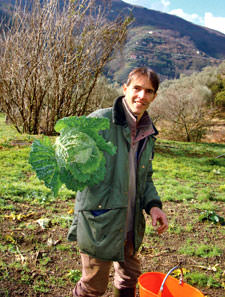
Alberto Cecconi is an Italian Organic Farmer
Photo by Rick Gush

Alberto Cecconi comes from a family of gardeners and farmers; his farm is now organic certified and produces olives, vegetables and fruits.


La Dolce Vita
Rick Gush’s whimsical tales of farming Italian-style on his blog.

It might not seem like farms in Italy have much to do with American farmers.

They have different markets, different crop varieties and, most importantly, different cultures. But still, farming is all about learning; learning from our neighbors, learning from farm consultants, and learning from our own mistakes and successes.

In this regard, it’s useful for American farmers to read a bit about farmers in Italy.

Although American farming is definitely the star of the world agricultural scene, we can’t rest on our laurels.

Competition from foreign producers and new pests is ever-increasing, and the pressures of staying alive can shake even the most confident farmer.

Survival skills is one thing that distinguishes Italian farmers; they’ve been farming for several thousand years—and you certainly don’t hear much complaining about the quality of the food they produce.

That said, American small farmers enjoy a number of advantages over their Italian counterparts. Nice, flat farmland is relatively abundant in the United States; there’s a wealth of university and cooperative extension scientific assistance available; and the commercial opportunities continue to increase for small farmers.

But Italian small farmers have always enjoyed one thing that American farmers are just beginning to realize—respect from the public.

Despite, or perhaps due to, the general Italian insistence upon extremely high food quality, small farmers in Italy enjoy appreciation from their customers that might be the highest in the world. The Italians’ preference for locally produced and seasonally appropriate foodstuffs is a centuries-old tradition, and the number of actively cultivated heirloom varieties of fruit, vegetable and animal products is remarkably high.

The Italian media reflects this reverence for the producers of food products, and every day, at least a dozen television shows feature segments in which small farm producers are showcased. 

Small-plot cultivation of edible crops is a dominant feature of the social fabric of Italy, much more so than in the United States.

Cultivation of one’s own olives and vegetables is taken very seriously; a large number of citizens grow some of their own food.

Italians also eat more small-farmer-produced food, and the small farmers in Italy contribute a much higher percentage of the national total of consumed food than in other European Union (EU) countries and the United States.

The products of small and family-run agricultural enterprises are given governmental support through an active system of local certification, and these denominations are universally respected. 

Fortunately for small Italian farmers, the worst part of the current crisis in the agricultural sector in Italy is mostly restricted to commercial agribusiness, where farms that bulk-ship their products beyond local markets are feeling the pressures from Chinese and East European producers who have recently begun supplying the same large commercial markets.

Farming the Hard Way
There’s not a lot of flat land in Italy, and it’s used predominantly by the agribusiness industry. The abundant, hilly land is where the majority of small farmers are active.

Some farmers have found small strips of flat land even in the mountainous areas, as the alluvial zones of the many creeks and rivers provide small, useable slices of flat land.

The general lack of available flat land is symbolic of the hard work involved in being a small farmer in Italy. Most small-scale farming is done on terraces created by piled-up rocks to make retaining walls. Luckily, farmers have been piling up rocks for a few thousand years in Italy, and modern farmers can take advantage of the many terraces made years ago.

Page 1 | 2 | 3

Categories
Equipment

Making My Workbench

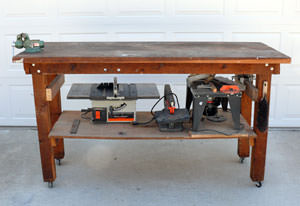
You can make a workbench like Jim's
Jim’s workbench that travels well can be constructed by following his basic workbench plans.

I like simple things, and the basic design of my workbench is simple and easily adapted.
 
With a little thought, I know that you can certainly make one finer and even more versatile.
 
My Workbench Specs
The bench stands 34″ high with a work surface of 29 1/2″ x 72″ and a shelf 16 ” above the floor.
 
The odd width is due to the use of three 72″-long 2 x 10s (true measurement 1 3/4″ x 9 1/2″).
 
My choice of working height, as well as redwood lumber, was simply personal choice. In the case of the wood, it is solid without being too heavy which has been nice when breaking it down for moves.
A Frame for the Surface
Two, 24″-long 2 x 4s inside two, 60″ 2 x 4s, all on edge with corners roughly squared, form a frame for the surface.
 
After drilling pilot holes, I nailed them together with 16-penny nails and then did the same with the planks, nailing them to the frame. 
 
The Legs
The surface sits on two sets of 4 x 4 legs. Each set is stabilized with two, 24″-long 2 x 4s nailed in place.
 
I bolted the leg sets to the inside corners of the table frame, staggering the holes so they didn’t intersect. The sets are positioned so their cross braces face each other.
 
Two, 10″ boards laid between the lower crosspieces on opposite leg sets add stability to the workbench. They also serve as shelving to store my bench top table saw, router and scroll saw.
 
A set of lockable casters attached to the legs makes it easier to clean the work area and move the bench away from the wall for larger projects.
 
For most of the 30 years I’ve had my bench, I’ve envisioned the day that the space between the legs was filled with drawers that held my hand tools and various supplies. Perhaps someday I will build them.
 
Until then it will be what it is, a workbench plain and sturdy.

« More Shop Talk »

Categories
News

Got Grant Money?

The USDA's Specialty Crop Block Grant Program is offering money to states interested in developing more efficient farming

Money for states interested in developing more efficient farming practices, including farmers market organizations, is available through the USDA’s Specialty Crop Block Grant Program.

This year, 12 Washington agricultural organizations are on the receiving end of nearly $260,000 to do just that. Forty-seven states applied for 2008 block grant funds.

The 12 Washington organizations successfully applied for the funding through the Washington State Department of Agriculture (WSDA).

The state then selected candidates for a single application it submitted to the USDA.

Your First Step
If you believe your group or organization has a program worth supporting, get in touch with your state’s Specialty Crop Block Grant Program contact person. They’ll let you know if you’re eligible and how to complete the process.

What’s In the Application?
For specifics, you’ll want to talk to your state’s contact person; but generally, the block grant program is designed to help state organizations make improvements in the way they grow and market fruit, vegetable and horticulture products.

It’s looking for programs that help your state stay competitive, expand markets, save and create jobs.

For each project, the USDA considers such factors as:

  • Specific issues, problems, interests or needs being addressed.
  • Timeliness and importance of the project
  • The impact and benefits of the project.

Applicants need to be ready to provide detailed information on items such as project purpose, potential impact, expected measurable outcomes, a work plan, budget information, and project oversight and commitment.

About Washington’s Projects
According to the WSDA, the state is the third leading producer of specialty crops in the nation.

The state’s growers rank number one in U.S. production of commodities ranging from apples and hops to spearmint oil and raspberries, reports the department.

The WSDA said it included “projects that build on the expertise and success of the industry, have the potential to boost the income of farming families, develop or expand direct marketing opportunities for farmers, or support economic growth in rural Washington.”

The Washington state projects to receive funding:

  • Washington State Horticultural Association ($49,500) to provide tree fruit growers a workbook of technical support and education on safe and sustainable practices.
  • FarmCity Alliance, Mercer Island Farmers Market ($17,400) to expand customer awareness and attendance of the market through promotion and outreach.
  • Washington State University ($35,591) to conduct research to prevent the spread of Grapevine fanleaf disease to promote sustainability of the wine grape industry.
  • Cascade Harvest Coalition ($29,500) to conduct a marketing research project and develop a strategy for growing sales opportunities at Puget Sound farmers markets.
  • Neighborhood Farmers Market Alliance ($18,759) to promote sales at Seattle farmers markets by producing and mailing a newsletter twice a year during the high market season that will reach 136,000 potential customers.
  • Washington Mint Commission ($30,000) to develop and demonstrate Solvent Free Microwave Extraction of essential mint oil. The process could reduce significantly the amount of energy required in the production of mint oil and increase the overall efficiency of mint production.
  • Vashon Island Growers Association ($5,705) to develop a promotional campaign and provide community education about their Wednesday and Saturday farmers markets.
  • Washington State Farmers Market Association ($10,100) to promote Washington farmers by increasing the number of the 2009 Farmers Market Directory Guides that are printed and distributed.
  • Washington State Potato Commission ($35,717) to continue a food safety training program with informational materials to help potato growers become certified under USDA’s Good Agricultural Practices (GAP) program.
  • Institute for Washington’s Future ($17,000) to hold conferences for producers to learn about the latest research and development on the application of bio-products for improved soil fertility and pest control.
  • Maple Valley Farmers Market ($8,800) to establish a new farmers market in Maple Valley where producers can sell their fruit and vegetables.
  • Poulsbo Farmers Market ($1,043) to help promote farmers and their products by developing and distributing marketing materials.

Will your organization be among those receiving funding from the next round of grants?

Categories
News

$17 Million in Grants Available

Beginning farmers can apply for USDA grants in 2009 and 2010
Photo courtesy USDA

If you’ve been farming for 10 years or less, the Beginning Farmer and Rancher Development Program could have a grant for you.

Funding through government programs may not be available for individual applicants.

The first thing any potential applicant will want to do is obtain additional information about eligibility and how to apply.


<< Read about another grant program >>


The program is an education, training, technical assistance and outreach program designed to help U.S. farmers and ranchers -specifically those who have been farming or ranching for 10 years or less, according to the USDA’s Cooperative State Research, Education and Extension Service. In 2009, $17 million is available; another $19 million, approved by congress in the Farm Bill, will be available in 2010.

This year’s applications are due May 13. Funding is available to state, local, tribal, regional, nonprofit and community-based organizations, academic institutions, and networks of appropriate private and public organizations, according to the USDA.

USDA says it’s looking for proposals from these areas:

  • Mentoring, apprenticeships, and internships;
  • Resources and referrals;
  • Assisting beginning farmers or ranchers in acquiring land from retiring farmers and ranchers;
  • Innovative farm and ranch transfer strategies;
  • Entrepreneurship and business training;
  • Model land leasing contracts;
  • Financial management training;
  • Whole farm planning;
  • Conservation assistance;
  • Risk management education;
  • Diversification and marketing strategies;
  • Curriculum development;
  • Understanding the impact of concentration and globalization;
  • Basic livestock and crop farming practices;
  • The acquisition and management of agricultural credit;
  • Environmental compliance;
  • Information processing; and
  • Other similar areas that would be useful to beginners. 
     

The projects will be limited to three years. Budget requests in the proposals must not exceed $250,000 per year.

Note on Eligibility
According to the USDA:

“The recipient must be a collaborative, State, tribal, local, or regionally-based network or partnership of public or private entities, which may include: state cooperative extension service; community-based and nongovernmental organization; college or university (including institutions awarding associate degrees); or any other appropriate partner. Others may be eligible to apply. Please refer to Part III of the current BFRDP Request for Applications for complete eligibility requirements.”

Visit this page for all the details: https://www.csrees.usda.gov/fo/beginningfarmerandrancher.cfm

Categories
Animals

The Mama Black Sheep Blues (Part 1)

New-born Hannibal on her birthday
Photos by Sue Weaver

Hannibal with her human Dad on their birthday.

We have five baby lambs at our house!

Four of them were born yesterday. It was my human dad’s birthday too.

Our first lamb was born on Monday morning.

Mom was tapping on the keyboard when Dad came in and told her, “You’d better come look at one of your sheep—there’s a white string hanging from its behind.”

It was cold, so mom grabbed her coat and ran to the sheep fold just in time to see Wren drop her lamb. Wren was standing up. It’s her first lamb so she didn’t know what she was supposed to do.

Mom was speechless.

Wren was not supposed to be bred! I heard the rams snickering. One of them bred Wren through the fence.

So, Mom and Dad made Wren a lambing jug (that’s where new moms and their babies go to get to know each other really well), then Mom picked up the lamb and tried to get Wren to follow. The problem is that ewes don’t look for flying lambs. So, whoever is carrying the lamb has to bend over and carry it with its feet just skimming the ground.

It’s a funny sight!

Mom named the baby Hannibal. He’ll have to be a wether because his dad is unknown (well, the rams know but they won’t tell). That’s okay because wether sheep grow the nicest wool.

Shebaa spending time with her new twins
Shebaa and her twins.

Shebaa's adorable baby ram
Shebaa’s ram.

Wren liked her little lamb but didn’t know she had to stand still so it could eat. She kept turning and turning so she could admire it.

Mom milked two ounces of colostrum (that’s antibody-rich first milk) into a bottle and fed it to Hannibal because babies should ingest colostrum right away. Then he felt really zippy. As Wren turned, he followed, and pretty soon they connected just right.

Yesterday morning Mom got a ‘hunch’ she should roll out of bed and check the sheep.

She did and surprise! Shebaa was giving birth to her second lamb.

It was a surprise because Sheeba was only with Oran the ram for 35 minutes before Dad decided we didn’t want to have a lot of lambs this year.

Mom struck a bargain and left Baatiste with him and took Shebaa out of Oran’s breeding pen. I guess it wasn’t fast enough.

Mom snipped and dipped (navels), stripped (Shebaa’s teats), and headed to the house to wake Dad so he could help her watch them sip (nurse).

As she passed Aunt Lori’s ewe, Ursula, she noticed Ursula was ready to lamb too.

NEXT Monday: Find out from Martok what happens to Ursula …

Right now, you can catch up on on his previous adventures.

« More Mondays with Martok »

Categories
Crops & Gardening

Ain’t Spring Great!

Lovely calla lilies
Photo by Rick Gush

Spring helped deliver stunning long stemmed calla lilies from Rick’s garden.

Well, we’ve arrived at that moment finally.  A bit late this year, but Spring is finally here. 

As I write this, I am for the first time since November, not wearing my long underwear. 

Ahh! What delicious freedom. It won’t be long until I’m wearing short pants every day and working in the garden with no shirt.

Finally, the dirt is dry enough to work, and I’m scrambling to make the final bed preparations and get the planting done. I planted squash seeds yesterday, the cherry tomatoes have been in for a few days, and I’m almost ready to plant the beans and corn.

I do have a few areas where the winter crops are still going strong.

I ate the first edible pod peas yesterday, and all the fave are at last making beans.

The little horse bean pods are only about two inches long now, and I’m worried that they won’t reach their full potential length of 15 inches by the end of the month. May first is the traditional fave eating day, and I’ll bet we have to settle for smaller pods for our own traditional first picnic of the year at the beach.

Visual Entertainment
Aside from the clothing and physical comfort aspects, spring offers a lot of visual entertainment here in Rapallo.

Although I mostly concentrate on constructing new beds and cultivating vegetables in my garden, last year I decided to start working more on the flowers mixed in among the various terraces. This year, that effort is starting to pay off.  

The yellow Euryops and purple Iris in my own garden look nice with the Calendulas and last Tulips, and the white and pink Dimorphotheca are exploding. The big shady wall on the north side is starting to get covered by the orange and yellow Nasturtiums that are hanging down fifteen feet in some spots already.

Flowers are opening all over the place here and Rapallo is filled with long fences covered by gorgeous purple wisteria, pots of big pink rhododendrons everywhere and bunches of brilliant orange Clivias in the shady nooks. 

Rapallo really does a good job with the municipal flowers, and most of the streets have tree, shrub and flower plantings that are well maintained.

It looks a little like Disneyland here sometimes, particularly at Easter, when they put up extra sumptuous displays in all the key locations downtown. This year they’ve even added flowers in pots to all the numerous bridges in town.

All this flowering also has a useful side. In my garden this afternoon I was able to cut a stunningly beautiful huge bunch of long stemmed calla lilies to take to my wife’s mother for Easter, which is tomorrow. 

Scoring points with mother in law is one of my rules for a happy existence.

« More La Dolce Vita »

Categories
Crops & Gardening

Edible Nettle (And Other Uses)

It's harvest time for nettle
Photo by Rick Gush

Nettle uses include eating it steamed, as a filling–even a nettle tea fertilizer.

It’s high season now for harvesting nettles here.
When I was a kid this weed was sometimes a problem when I was tramping around in the woods in shorts, because it can really sting and my legs would often become bloody from so many nettle stings.

But now I think of nettle as a tasty plant that grows all over around here.

The locals harvest it and it is sometimes sold in the local vegetable market. It can be eaten steamed, with vinegar, and they say it has more vitamins than spinach. More commonly, nettle is combined with some cheese and made into a filling for ravioli.

Nettle is one of those weeds that have been getting a lot of attention from organic gardeners in the last decade, because it seems to offer both nutritive and disease prevention qualities.

Nettle teas, made not for drinking, but instead sprayed or poured on cultivated vegetable plants, work about as well as any other fertilizer.

I made some nettle fertilizer last year.

I took about two pounds of nettle leaves and stuffed then into a plastic five gallon bucket and filled it with water.

I let the mix stand for about a month, and stirred it fairly frequently, but not every day.

I had planned to pour off the water into another bucket, but in the end there wasn’t much nettle branches or anything left, and it was more or less a homogenous soup.

There was a darker colored liquid at the bottom of the bucket and the mix stunk like typical anaerobic decomposition at first but the smell disappeared in a day after it was poured on the ground around the tomato and squash plants. I didn’t dilute, but many gardeners do so.

My guess is that I could refine my technique. Other gardeners report their nettle teas having an NPK ratio of 8-3-20. That’s a lot of potassium! That’s also much higher nitrogen fraction than dried cow manure, maybe four times as potent.

I’ve read similar reports about gardeners making comfrey teas, and even dandelion teas, and I think I might try a few more experiments this year.

« More La Dolce Vita »

Categories
News

Extra Land? Consider Leasing To Hunters

John Morgan discusses hunting on the farm and bartering hunting access
iStockphoto

Read an article by John Morgan for more
information about
hunting on the farm,
including bartering hunting access.

Do you have land in a rural area that you’re not using? Consider leasing your land to hunters.

Leasing for recreational hunting has become a major source of revenue for many landowners, says Dwayne Elmore, Oklahoma State University Cooperative Extension wildlife specialist in the department of natural resource ecology and management.

In fact, Elmore says in some cases, revenue from hunting leases has surpassed lease rates for traditional agriculture production.

If you choose to lease your land, Elmore suggests keeping these four precautions in mind:

  • Carefully screen and select good participants. Visit with potential lessees to ensure you select the right person. The ideal lessee will have liability insurance.
  • The lease should contain conditions for termination, a legal description of the property, rights granted or withheld, terms of payment, effective dates, liability waivers and acknowledgements of risk.
  • Consider leasing the land for reasons other than monetary. For example, access to private land in exchange for services or labor rendered.
  • Consider the compatibility of a lease with current land management. Management for wildlife can work well with cattle and agriculture production with the focus on having abundant native habitat.

An example of a draft lease agreement, Oklahoma Cooperative Extension Service fact sheet NREM-5032, is available through all OSU Cooperative Extension county offices.

Categories
Crops & Gardening

Lovely Things Are Blooming

Flowers, like these pretty pansies, are beginning to bloom in Jessica's garden
Photo by Jessica Walliser
Pretty pansies make an appearance.

I’ve got some lovely things blooming in the garden right now.

My daffodils are looking great (I like the orange and yellow ones the best), the bleeding hearts have popped, the wood phlox is as stunning as always, and the Johnny jump ups are doin’ their happy little thing.

And, there’s more to come. That’s one of the most exciting aspects of gardening to me.

The fact that there is always change and surprise and unpredictability.

There aren’t many aspects of my life (in fact I can’t think of ANY) where I can say I actually welcome those three qualities.

Gardening is just so darned fun – and if you screw something up, it’s not the end of the world.  In fact, you can just chalk the mistake up to Mother Nature and go on without remorse.

Click here for more spring fever

Spring’s Here!
See what’s blooming in Rick Gush’s Garden>>

Of course, I don’t want to screw things up, no gardener in their right mind does, but inevitably a few things go awry each season.  No big deal.  We just move onwards and upwards.

This is making me wonder what will go wrong in 2009.  My best guess says it will be the death of the dogwood tree we planted in the dead of winter, or maybe an explosion of chickweed from the not-quite-fully-cooked compost I spread last fall.

Who knows?

See, there it is again: the unpredictable charm of gardening.

« More Dirt on Gardening »