Categories
News

Gardening is Good for You

gardening is good for your healthYou might love gardening because of the connection it offers with nature, the nutritious vegetables it produces for your family or the way coming home to a beautifully landscaped acreage makes you feel.

Now, researchers at Kansas State University are saying the act of gardening offers health benefits, too: It can offer enough moderate physical activity to keep older adults in shape, keep older hands strong and nimble, and improve self-esteem.

“One of the things we found is that older adults who are gardeners have better hand strength and pinch force, which is a big concern as you age,” said Candice Shoemaker, KSU professor of horticulture.

Shoemaker is part of a KSU research team studying the ways in which gardening affects the health of older adults.

She works with Mark Haub, associate professor of human nutrition, and Sin-Ae Park, a research associate in horticulture who earned her doctorate in horticulture from K-State in December 2007.

The American Society for Horticultural Science publication, HortScience, published information in February based on a study that assessed 15 areas of health in older adults, from both those who garden and those who don’t. The researchers looked at measurements like bone mineral density, sleep quality, physical fitness, hand strength and psychological well-being.

“We found that with gardening tasks older adults can, among other things, improve their hand strength and self-esteem at the same time,” Park said.

Although Shoemaker said that differences between gardeners and non-gardeners showed up in a few health assessments like hand strength, overall physical health and self esteem, results from some of the other areas were more ambiguous.

“If we had a larger sample, I think we would see more health differences between those who garden and those who don’t, including in areas like sleep quality and life satisfaction,” she said.

The results about the positive impact of gardening on hand strength prompted Park and the researchers to explore this area further. They are now analyzing data from an eight-week horticulture therapy program that targeted hand strength in stroke patients.

“They did tasks like mixing soil and filling pots,” Park said. “They had to use their hands all of the time, so that was good exercise—and they really enjoyed it.”

Shoemaker, who also researches gardening as a prevention strategy to childhood obesity, said that studying the physical benefits of gardening is important for older adults because gardening is a physically active hobby that provides an alternative to sports or other exercise.

“There’s a lot of natural motivation in gardening,” Shoemaker said. “For one thing, you know there’s a plant you’ve got to go out and water and weed to keep alive. If we get the message out there that older adults can get health benefits from gardening, they’ll realize that they don’t have to walk around the mall to get exercise.” 

Categories
Equipment

Beware the Pitchman

Last week I encouraged attending local farm shows.

However, like the side effect warnings in pharmaceutical commercials, I should have warned you about the pitchmen.

These guys make the most professional TV infomercial look like amateur hour.

I should know. My workshop has more than a few of the handiest, slickest, most useful, all-around ideal “whiz-bangs” ever devised to make my day easier, more effective, more fun and more productive.

I can cut metal without a torch, join metals without a welder and sharpen/grind/burnish metal with just my power drill. In short, I am a sucker for a good pitch.

It isn’t that I can’t resist these guys. It’s just that I really enjoy watching them work the crowd and practice their craft.

The good pitchman or woman makes those of us watching sure that we too could perform this bit of magic. Just buy the product and what a difference it will make in our lives.

The reality hits when we get home with the whiz-bang and it doesn’t work quite as well or as easily as at the show.

Of course, it doesn’t help that it may sit on the workbench or on a shelf for a few months before we give it a try. The fact is that if the whiz-bang worked like it did at the show, we would find it in every hardware store or farm supply store we entered.

While it may be a very good whiz-bang, it may not be everything it was cracked up to be.

So sit back and enjoy the show. Watch the pitchman do his thing. Just beware.

When you least expect it, he may grab your attention. Before you know it, like me, you will be the proud owner of the handiest, slickest, most useful whiz-bang you’ve ever seen.

Categories
Equipment

Fairs … Or Farm Shows

The Minnesota State Fair featured exhibits of all things farm equipmentWhen I was growing up, country life revolved around county and state fairs.

Not only were there 4-H and open class exhibits of livestock, crops and hobbies, but also the fair was where you went to see the latest farm equipment and products.

You could walk from one exhibit to another, comparing tractors, chain saws, lawn mowers and countless other tools of the good life.

Increasingly fairs, county and state, are more about entertainment than agriculture.

The Minnesota State Fair maintains the livestock show where I exhibited my Ayrshire heifer 40 years ago. However, the major agricultural suppliers have long since pulled out of Machinery Hill, not that there aren’t still many interesting exhibits to visit.

The real action for agricultural window-shopping has become the regional and national farm shows.

This past week, I returned from the New York Farm Show in Syracuse, New York, just in time to catch the Midwest Organic Farming Conference in La Crosse, Wisconsin. Both were packed with window shoppers and loaded with interesting exhibits. Walking the aisles opened up new opportunities with crops and livestock, and equipment and products to help you raise both.

If you are considering moving to the country or already there, check out the local and state fairs, but also watch for news of farm shows in your area.

They are a great place to pick up information, compare products and visit with people who share your love of the country and building a life on a farm.

If you’re lucky you may find a new supply of popcorn as I did in Syracuse, or a new tool for weeding the garden as I did in La Crosse. Regardless, you’ll come away reinvigorated with ideas for new projects, new opportunities or perhaps that perfect tractor for your farmstead.

Categories
Animals

Ice Storm–Oh, What an Ice Storm! (Part 1)

Uzzi and I have our own Port-a-Hut (that’s a goat-size metal building; you can see some at the port-a-hut.com website!), so we hunkered into our cozy bedding, munched our yummy hay, and listed to sleet pounding our roof.

Around midnight the sleet turned back into rain.

By morning, everything was coated with ice! Lots of ice. The fences, our hut, Latifah and BonBon’s big barn, everything had ice on it two inches deep!

There was so much ice that when Mom came out to feed us, she couldn’t yank open the feed room door (and her wrecking bar for opening iced-up doors was sealed inside).

Dad pounded the edges of the door with a big rubber mallet to loosen enough ice to get inside. Then they saw that the gates were iced shut. Dad reefed the one to the dairy girls’ barn open, it was under a ledge and partially protected, but we were iced in!

Mom and Dad wore things on their shoes so they could walk on the ice. Mom called them Spikys (check them out at the spiky.com website).

She says without them they couldn’t have come outdoors. Since Uzzi and I don’t have Spikys, we stayed in our hut.

Mom flung hay across the fence, some of it into our hut and some to make a pathway to the fence. Then she lowered down a bucket of warm water. That’s how we and the other animals ate and drank until the ice melted off our fences later that week.

At midday trees began to fall.

It was scary for Uzzi and me but scarier for some of our friends. The horses have shelters but they aren’t smart like goats, so they came outside; the silly young rams did too.

They raced around like crazy things when the big trees cracked and shattered under the weight of the ice, and limbs and ice came crashing down.

Then, at 2 p.m. the electricity failed!

« More Mondays with Martok »

Categories
News

“Locavore”–Term Has Company

By HF Staff

Growing your own food is one way to be a "hyperlocavore"
Building a raised bed garden and growing your own food is one way to be a “hyperlocavore.”

“Locavore” was the word of the year in 2007, according to the New Oxford American Dictionary’s annual selection.

Now, people are starting to come up with new terms to describe eating local, growing your own food and sharing the food you grow.

For example, “foodshed.”

According the foodroutes.org, “the term ‘foodshed’ is similar to the concept of a watershed: while watersheds outline the flow of water supplying a particular area, foodsheds outline the flow of food feeding a particular area. Your foodshed encompasses the farm, your table and everything in between.”

And “hyperlocavore.” Well, that might be self-explanatory, but check out the hyperlocavore.com website.

Are you a hyperlocavore?

What about “yardsharing?” The folks over at hyperlocavore.com talk about yardsharing as a little bit like sharing resources and the things you’re good at with others–with the goal of eating local food.

They say, “Yardsharing is an arrangement between people to share skills and gardening resources in order to grow food as locally as possible! The group can be friends, family and/or neighbors.”

These terms are just a tiny part of our evolving food-supply discussions.

Let us know what you think about these terms–and what terms you’ve discovered.

(By the way, a locavore is a person who pays attention to where his or her food comes from and commits to eating local food as much as possible.)

Categories
Animals

Hutch’s Arrival (Part 2)

When my human mom and dad took baby Hutch away, Latifah cried and cried.

My friend, Uzzi, and I looked at each other—we didn’t know what to do.

But we Nubians cry really loudly and my mom could hear her in the house, so she wrapped Hutch in a warm blanket and brought him out every few hours so Latifah could lick him and see he was okay. But then he had to go back to the house.

Hutch couldn’t eat by himself. He was weak and cold and he didn’t have a suck reflex at all. So, my human dad made Hutch an incubator in a big, plastic box.

He put a towel in the bottom, next a heating pad set on low, then another towel, and then Hutch.

They covered him with a little blanket so he’d stay warm.

He stayed in the incubator for a whole day, then he moved to the bottle baby crate in the living room where Uzzi and I lived when we were babies.

Mom milked Latifah’s colostrum—that’s the antibody-rich first milk that mothers make—and took it inside.

Every two hours Mom and Dad fed Hutch with a stomach tube (you can learn how to do it here)

They did that for four whole days!

Photos courtesy Sue Weaver
Meegosh had to get splints to help his contracted tendons
Meegosh before splints.

Meegosh was soon given splints and his walking improved
Meegosh with splints.

Three days after Hutch was born, Mom came home with another newborn kid and she showed him to Uzzi and me.

She called him Meegosh. Meegosh was huge, twice as big as Hutch, and he had contracted tendons.

Mom said Emily from Ozark Jewels gave him to her to be a pal for Hutch. Emily was my first mom too, that’s why I’m Ozark Jewels General Martok.

Mom and Dad took Meegosh in the house. They put splints on his legs and placed him in the crate with Hutch. At first they ignored each other but pretty soon they cuddled together to stay warm. That’s how friendships begin.

The next morning Mom and Dad raced around like crazy.

They hauled home a bunch of hay and feed and filled all the tanks and buckets they could find with water. After Dad left for work, Mom bedded our huts extra deep with straw and put blankets on the old horses.

It got real cold as the day wore on, and then it started to rain. As night fell, the rain turned to sleet …

« More Mondays with Martok »

Categories
Crops & Gardening

Italian Farm Trucks

My blog is off to a bad start.  I realize I’ve already lied about trucks.

This is an Ape (Ah-Pee) Italian Farm TruckAs cool as my Vespa “farm truck” is, I must officially retract my previous statements, apologise and announce that the Vespa is not in fact the coolest agricultural vehicle possible.

That honor would go to the little three wheeled scooter trucks called Ape (Ah-Pee).

One of my favorite features of the Italian small farmer scene is the way products get to market.

The owner of the Ape in the photo is a local small farmer. 

She has a nice flat piece of ground by one of the smaller creeks that run down from the surrounding hills, and she grows vegetables and a few fruits. 

She also collects and sells flowers and the mixture of wild greens called Preboggin.

She sells some of her products to local restaurants, she has a few regular customers who have standing orders, and she has a little booth at the local daily fruit and vegetable market in the center of town.

To carry her products on deliveries and to the market, she drives her Ape, which is essentially a little truck, built around a scooter.

The handlebar and seat of the scooter are enclosed in a little cabin, and the truck bed behind is about three feet by four feet. There is one wheel in front and two wheels in the rear.

These Ape are by far the most common type of agricultural truck in all of Italy.

I like trucks. I’ve owned a 49 Ford flatbed, a 59 El Camino, a 66 Ranchero, a 72 Chevy pick up, and a 1995 Isuzu Trooper in the states and I drove a Ford 250 Diesel for awhile as a work truck. 

That’s all history now.

These days I can’t wait until I finally get my own three wheeled Ape. Now’s that’s true agricultural chic!

Categories
Crops & Gardening

Nature’s Medicine Cabinet

By Bruce Burnett, CH

Find instructions for making these natural remedies:

“Let food be your medicine and medicine be your food,” were the words of Hippocrates, the “Father of Medicine,” in 400 B.C. What was true 2,400 years ago is even truer today with the typical American diet being high in processed foods that contaminate our bodies with anarchist-sounding rogues named “free radicals.”


Jump to more about: Thyme, Sage, Calendula, Bay, Rosemary


Free radicals are the leading villains in the aging process and are a major cause of age-related diseases such as arthritis, heart disease and cancer.


Although fruits and vegetables have been traditionally regarded as the best dietary source of free-radical fighting antioxidants, a recent report by the U.S. Department of Agriculture (USDA) in the Journal of Agriculture and Food Chemistry revealed that many common kitchen herbs have higher antioxidant activity than fruits and vegetables.

A quick tour of your pantry and garden will help you get started on the path to good taste, nutrition and well-being.

Thyme
Pun-provoking thyme is one of the most popular and commonly used culinary herbs.

It grows well in most climates and prefers a light, sandy, well-drained soil in full sun. It’s one of the easiest herbs to grow in containers, but it’s quite susceptible to root rot and fungal disease if grown in soil that’s too moist or heavy.

Thyme requires no fertilizer and grows well with lavender and sage. This herb will attract bees to your garden, but it will repel cabbage worms.

Propagate thyme by seed, cuttings, root division or layering. Its fine root system makes it more difficult to transplant than most herbs. It should be moved well in advance of any risk of freezing; a layer of sand applied on the soil will help protect the delicate roots from frost.

Common thyme (Thymus Vulgaris) is the most-preferred species for use in the kitchen and in essential-oil products.

Common thyme includes both English—or German or winter thyme—and the narrower-leafed French thyme. The latter is the sweeter of the two and certainly preferred in French cuisine. Both are perennials, but French thyme is less robust than the English variety and may require some winter protection.

Today, thyme’s well-documented antiseptic and tonic qualities make it the ideal immune-system booster. It’s particularly effective for chest infections such as bronchitis, whooping cough and pleurisy.

Thyme may be taken as a tea in a natural cough syrup found at your local health-food store. The essential oil of thyme, however, must not be taken internally as it can destroy intestinal flora and cause digestive and nutrient absorption problems.

Some herbalists recommend a handful of dried thyme—in a porous bag or cheesecloth—added to bath water to ease back spasms.

Sage
Sage is a hardy (to zone 4) perennial that should be watered frequently until it’s well established; it can then be watered infrequently.

The seed doesn’t store well and although it germinates quickly, it takes about two years for the bush to grow to the productive stage. Therefore, it’s better to propagate sage from cuttings.

Medicinally, sage is an antiseptic and astringent, and is recommended as a mouthwash for canker sores, sore gums and sore throats. The astringency of the herb makes it beneficial in cases of mild diarrhea. Sage is a digestive tonic and stimulant.

In his book, The Green Pharmacy, James A. Duke, Ph.D., claims he has identified six anti-inflammatory compounds in sage and advocates its use in cases of carpal tunnel syndrome. He also extols the herb for treating Alzheimer’s disease (British researchers have confirmed that sage inhibits the enzyme that breaks down acetylcholine, thus preserving the compound that seems to help prevent and treat Alzheimer’s), asthma, bad breath, baldness, body odor, gingivitis, tonsillitis, wrinkles and yeast infections.

Sage has an affinity for other muscular Mediterranean herbs such as rosemary, oregano and thyme. The combination produces a rich flavor in robust, winter soups and stews. Also, fresh sage contains delicately flavored oils, which are a delight in contrast to the pungent taste of dried sage that has languished in the kitchen cabinet too long.

Sage contains potent antioxidants that retard spoilage, endorsing the herb’s traditional use as a sausage preservative.

Calendula
The sunny face of calendula, or pot marigold, is a year-round delight in our herb beds, especially in the fall, when other plants are succumbing to declining light and temperature. This very hardy, beautiful and useful herb will continue to bloom until the first frost.

One appealing Greek legend concerning calendula tells the story of four wood nymphs who fell in love with Apollo, the god of the sun.

The nymphs became so jealous of each other that they began neglecting their duties to Apollo’s sister, the goddess Diana. She turned them into four dull-white marigolds. This upset Apollo and he countered by sending down his most brilliant golden rays to color them.

Calendula prefers a rich loam and full sun, but will grow in most soils and partial shade. A self-seeding annual, it can become quite invasive if grown in ideal conditions.

Medicinally, calendula has proven itself as an effective skin conditioner for cuts, scrapes, wounds and burns. It’s beneficial for diaper rash and for soothing soreness associated with breast-feeding.

Calendula petals added to a salad not only enliven it with color, but also contribute nutrients. The herb is a good source of lutein, a powerful antioxidant. It’s particularly effective in combating age-related macular degeneration, the leading cause of irreversible blindness in the United States.

Calendula also makes a delightful tea, especially when combined with lemon balm. One caveat: If you’re allergic to ragweed, you might also react to pot marigold.

Bay
The death of a bay tree was historically regarded as a portent of evil or pending disaster.

In Richard II, Shakespeare wrote: “‘Tis thought the king is dead; we will not stay/ The bay trees in our country are all wither’d.”

In the garden, the bay tree is a tender perennial and extended freezing temperatures will kill it. Although the bay will grow to 60 feet in its native Mediterranean habitat, in a temperate or cooler climate it’s best grown in a pot so it can be moved to a protected area during the coldest months.

Bay laurel is used medicinally primarily to treat upper digestive tract disorders, having a similar effect as spearmint—cooling and soothing. It’s also used to ease muscular aches and pains.

Bay leaves are an effective insect repellant; they can be placed in closets and drawers, as well as in flour canisters to deter weevils.

The taste of bay is tangy and slightly peppery. It enhances the flavor of just about everything, but especially soups, stews and tomato-based dishes. Pot roasts and shellfish should almost never be served without bay. It even improves the taste of custard sauces if the milk is scalded with one or two leaves.

Rosemary
Rosemary is a perennial in zones 6 to 8, but even mature plants will not survive a severe frost. If one is forecast, mulch your plants heavily. To avoid mildew, plant your rosemary where it will enjoy good air circulation. With adequate light, rosemary can be grown indoors and can easily be cultivated as a topiary.

The name comes from the Latin Ros maris or “dew of the sea.” It was later called “Rose of Mary” or “rosemary” in honor of the Virgin Mary because it supposedly was the bush that sheltered the Holy Family on their flight to Egypt.

Rosemary traditionally symbolizes memory and in Shakespeare’s Hamlet, Ophelia cries, “There’s rosemary, that’s for remembrance, pray you love remember.” Rosemary is also entwined into brides’ head wreaths to help couples remember their wedding vows.

Medicinally, studies show that rosemary improves circulation, especially to the head, helping to relieve headaches and improve concentration and memory.

It also helps combat bacterial and fungal infections, and makes a good antiseptic gargle for sore throats, gum problems and canker sores. As with all herbs, do not use medicinally when pregnant except under the direction of a doctor.

In the kitchen, rosemary is superb with lamb, pork and poultry. It also turns plain, old spuds into a gourmet dish.

According to the American Dietetic Association, free radicals in your body are like rust on your car; the same oxidation damages cells and contributes to aging. Antioxidants reduce oxidation (by neutralizing the free radicals), help increase immune function and lessen the risk of infection and disease. So, grow those herbs for good taste and good health!

About the Author: Bruce Burnett is an award-winning writer, a chartered herbalist and author of Herb Wise: Growing, Cooking, Wellbeing (HerbWise, 2002). Contact Bruce Burnett through his website at  www.herbwiseproducts.com 

Categories
Homesteading

Bay Laurel Mint Bath

(from Nature’s Medicine Cabinet by Bruce Burnett)

This recipe will ease and relax tired muscles after a hard day’s work.

Ingredients

  • 1⁄2 cup dried mint leaves
  • 1 cup bay leaves, chopped
  • 1 tsp. coconut oil
  • 1 tsp. almond extract

Preparation
Toss all the ingredients in a mixing bowl, then place in a 1-square-foot piece of cheesecloth. Tie with string and submerge it under very hot, running bath water. Allow the bath water to cool to a comfortable temperature while the bouquet infuses.

Relax in the bath for at least 30 minutes, adding warm water to maintain a comfortable temperature.

Categories
Animals

Healthy Homemade Dog Treats

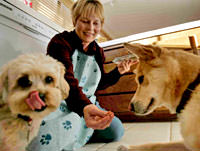
Arden Moore serves up her homemade marvelous mutt meatballs
Photo courtesy Sandy Huffaker, Jr.

This photo of Arden Moore and her dogs Cleo and Clipper first ran in the Business Monday section of the New York Times; she’s dishing up her homemade marvelous mutt meatballs.

The cover of Real Food for Dogs by Arden Moore


Arden Moore’s newest book has vet-approved recipes for dogs.

Got a hungry farm dog?

Here are some good, healthy homemade dog treats for your faithful canine farm hand. (*A couple are good enough for people, too!)

Pet expert Arden Moore, known as “America’s Pet Edu-Tainer™,” travels all over North America helping millions better understand why dogs and cats do what they do.

She has authored 20 pet books, including Happy Dog, Happy You and Real Food for Dogs, and hosts the “Oh Behave!” podcast on Pet Life Radio.com.

She is editor of Catnip and editor-at-large of Fido Friendly magazines. Visit her at www.ardenmoore.com.

Check out all the Hobby Farms animal treat recipes.