Categories
Recipes

Sorrel Soup

Sorrel Soup
Sorrel, with its broad, lemony-tasting leaves, makes a nice addition to a spring salad, mixed in amongst the lettuce and baby spinach leaves that are the centerpiece for many a spring salad. Its tang gives a nice bite that won’t get lost under the dressing.

If you don’t have any sorrel in your garden, you may be able to find it in a local market. But sorrel isn’t just for salads—it also makes a very satisfying soup.
~ Lynda King, HF Contributor

Ingredients

  • 3 T. butter
  • 1 medium onion, chopped
  • 2 cups sorrel leaves, chopped
  • 2 quarts chicken stock
  • 1 cup cream
  • 1/8 tsp. nutmeg
  • salt and pepper to taste
  • sour cream for garnish
  • a roux, or thickener, make of 2 T. flour and 2 T. water

Preparation
In a medium saucepan, heat butter over medium heat. Add onion and cook until softened, about 4 to 5 minutes. Add sorrel and stir briefly, then reduce heat to low and cook 8 to 10 minutes or until sorrel is well-wilted. Add chicken stock and roux; mix well.

Raise heat to medium-high. Boil gently, stirring constantly, another 8 to 10 minutes or until thickened. Season to taste with salt and pepper. Add cream and heat through, but do not boil. Serve in warmed bowls; garnish with a dollop of sour cream. Good with a crusty bread. Makes 4 servings. Can be frozen.

Categories
News

Michael Pollan on the Importance of Food Systems

The American Flag

Michael Pollan, author of the “The Omnivore’s Dilemma” and other popular food-related books, wrote an article for the New York Times Magazine titled “Farmer In Chief,” which begins, “Dear Mr. President-Elect.”

In it he makes the case that the current political environment is ready for “real reform of the food system.”

We think the article is worth reading.

Here are some points we found most interesting:

  • He says our current food system is “designed to produce cheap calories in great abundance.” Besides higher food prices, this has resulted in crises of:
    1. health care
    2. energy independence
    3. climate change
  • The system should, says Pollan:
    • provide a healthful diet for all people that focuses on quality and diversity of calories
    • improve the resilience, safety and security of our food supplies
    • reconceive agriculture as part of the solution to environment problems like climate change
  • The gist of Pollan’s recommendations:

    “Wean the American food system off its heavy 20th-century diet of fossil fuel and put it back on a diet of contemporary sunshine.”

    To do this, he describes changes needed to in the “many moving parts” of the food chain:

    1. The farm field
    2. The way food is processed and sold
    3. Our kitchens and the American dinner table

  • He details three main goals extensively:
    1. Resolarizing the American Farm: encourage the growth of more diverse crops (rather than just focusing mainly on a few key money-makers or commodity crops) and cover crops that promote fertile soil…and that’s just a fraction of the definition.
    2. Reregionalizing the Food System: Decentralize the food system by changing the infrastructure to one that can support diversified farming, which would shorten the food chain and reduce the amount of fossil fuel needed. A few tactics he mentions: Four-season farmers’ markets, agricultural enterprise zones, local meat-inspection corps, strategic grain reserve, regionalized federal food procurement and a federal definition of food (to avoid things like junk food being considered real food).
    3. Rebuilding America’s Food Culture: Begin with our children and in their schools to understand the basics of growing and cooking food; also offer more toughness and clarity in how health-problems can be caused by the types and quantities of food we all eat.
  • He ends by asking the new president to set an example in the White House.

Read the entire article here (registration may be required)>>

Top

Categories
News

USDA Expands Drought Assistance

Has drought hit your farm and livestock hard this year?

If you live in a county designated as having extreme drought, you may be able to receive assistance from the U.S. Department of Agriculture (USDA).

A recently approved measure under the Conservation Reserve Program (CRP) expanded the assistance available to ensure livestock in drought-affected states have the hay and forage they need to survive.

The CRP areas eligible for emergency haying and grazing in Alabama, Indiana, Mississippi, Montana, Ohio, Oregon and Tennessee has been expanded. It now includes land in an area radiating 210 miles out from all counties previously approved for emergency haying and grazing.

CRP is a voluntary program that offers annual rental payments and cost-share assistance to establish long-term resource-conserving cover on eligible land.

The expansion permits approved CRP participants to cut hay or graze livestock on CRP acreage, providing supplemental forage to producers whose pastures have been negatively affected by drought.

Basic Eligibility Details
Here are some basic eligibility details, according to the USDA:

  • To be approved for emergency haying or grazing, a county must be listed as a level “D3 Drought-Extreme” or greater according to the U.S. Drought Monitor, or have suffered at least a 40 percent loss of normal moisture and forage for the preceding four-month qualifying period.
  • Only livestock operations located within approved counties are eligible for emergency haying or grazing of CRP acreage.
  • CRP participants who do not own or lease livestock may rent or lease the grazing privilege to an eligible livestock farmer located in an approved county.
Categories
News

A Visit to the Lexington Farmers’ Market

Scott Evans, Jessamine County Farmer
Scott Evans is a Jessamine County farmer and a 15-year veteran of the farmers’ market.

Drought! It’s hit much of Kentucky hard this year.  

Still, we saw proof that the farmers at the Lexington Farmers’ Market have found ways to work around the obstacles of a hot, dry summer.

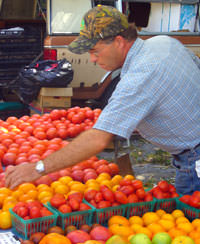
During a recent visit to the market, our mouths watered at the sight of the colorful, warm tomatoes, peppers, melons and squash covering the tables.

We stopped by to talk with several farmers—all trying to keep cool under the clean, white canopies they set up to shade their garden wares. We asked for advice on how they get started, about their biggest challenges–and what they do with their leftover produce.

Scott Evans, who owns a farm in Jessamine County, Ky., has been farming for about 20 years—and has been coming to the farmers’ market for 15 years.

Lexington Farmers' Market Promise
Pay a visit to the Lexington Farmers Market or find a farmers’ market near you.

Surrounded by luscious orange and red tomatoes and baskets of bright green peppers, Evans echoed the words of other farmers saying the biggest challenge for vegetable farmers like him is the weather.

“It’s the growing conditions,” he says, “and managing diseases, too.”

(Even our CSA is struggling a bit to fill our vegetable boxes this month—but that’s part of the risk we accepted when we signed up to share in the bounty of the local harvest.)

Evan’s advice to farmers wanting to enter the farmers’ market business, “Be patient.”

Roland McIntosh Runs the Paw Paw Plantation
Roland McIntosh runs the Pawpaw Plantation in Powell County, Ky.

“It takes a while to build up a customer base,” he says. “But once you do, customers will come; they appreciate the fresh, local food. They know I grow everything I sell. They’re looking for that.”

Roland McIntosh, who runs Pawpaw Plantation in Powell County, Ky., has this advice for those who want to set up shop at the farmers’ market.

  • Research: “This should come first. Talk to other farmers at the market, observe and see what is being sold,” he says.
  • Learn: “Then learn how to grow the crop that you decide on. Your university cooperative extension service is a great place to start.”
  • Start Small: He encouraged farmers to start small, visit farmers’ markets to see what works–and then, later on, consider adding more to their stalls. 

Over at the Crooked Creek Farm stall, Jason and Darlene Bailey offer a spread that looks like a mini grocery store. 

Darlene and Jason Bailey of Crooked Creek Farm
Darlene and Jason Bailey took over the Crooked Creek Farm after Jason’s parents retired.

The couple took over the Jessamine County farm from Jason’s parents–and their life-long farming experience showed. 

Jason takes the farmers’ market challenges in stride. His biggest business challenge: making sure he has enough staff available to help in the fields and getting all the produce to the market.

Otherwise, he tells other farmers’ market hopefuls, “Just go for it!”

Another burning question for the farmers: What do you do with all the tomatoes, beans and other produce that doesn’t sell?

            • Give it away to people who need it.
            • Plan ahead and try to grow only what you know you can sell.
            • And as Jason Bailey says, “Just feed it to the cows and the goats!”
               
Categories
News

Single Male Farmers Sought for Reality Show

Single Farmers Sought for Reality TV ShowDo you or somebody you know work on a ranch or farm, been in the rodeo circuit, live the farming lifestyle and have an especially charming side?

If so, the CW network (formerly known as the WB and UPN) wants to hear from you—casting for their new network romantic reality show is underway, with filming slated to begin early July 2007.

Prospective guys must be:

  • Single
  • Age 23 – 30
  • Confident in real life and in your/his environment
  • In good shape
  • Have a “good-ole-boy” attitude
  • Able to charm the ladies

Please e-mail the following information to Alicia Good, alitexas@mac.com:

  • Age
  • Contact information including e-mail and phone numbers
  • How you/they fit description: rancher/farmer/cowboy
  • Farm/ranch experience
  • Five to 10 photos showing: face, body (at least one with the shirt off), anything showing you/them on the ranch/farm

Interested? E-mail your information today or contact Alicia Good at (818) 748-1273 for more information.

Categories
Recipes

Chicken Salad in Tomato Cups

Chicken Salad in Tomato CupsA top reason to raise chickens is the bounty of fresh, healthy meat it provides you and your family and friends. Low in fat, but bursting with valuable protein and a delicious, delicate flavor, chicken lends itself to an astonishing range of dishes, from hearty stews to clear soups, from robust curries to the most subtle of sauces.

Make this delectable salad–served in tomato cups–even richer by using homemade mayonnaise or mixing in chunks of avocado.

Ingredients

  • 4 to 6 medium or large tomatoes
  • 2 cups cooked, chopped chicken, white and dark meat
  • ½ cup celery, diced
  • ¼ cup green onion, finely chopped
  • ½ cup almonds, chopped

Dressing

  • 1 cup mayonnaise
  • 2 tsp. Dijon mustard
  • 1 tsp. lemon juice
  • 1 clove garlic, minced
  • Salt and cracked black pepper to taste

Preparation
To prepare tomato cups, cut a slice off the stem end and use a sharp paring knife or grapefruit spoon (a narrow spoon with serrated edges) to remove seed bed and other soft flesh, leaving the firm exterior wall. Invert on paper towels to drain while preparing salad.

Whisk together dressing ingredients and combine with chicken, celery and green onions. Add almonds just before serving.

To serve, spoon salad mixture into tomato cups. If desired, place on a bed of lettuce and garnish with additional chopped almonds.

More chicken recipes …

Categories
Beginning Farmers

The Basics of Country Life

The Vegetable Gardener’s Bible
As a new or maybe even seasoned hobby farmer, no doubt your land is home to one or more gardens. But, is your garden all that it can be? Growing vegetables for your own consumption is one of the greater joys in life, and this attitude is extremely evident in Edward C. Smith’s The Vegetable Gardener’s Bible. Smith begins by describing his gardening system “W-O-R-D” (which stands for wide rows, organic methods, raised beds and deeply dug soil) and conveys his expert knowledge on the subject. He describes why this method is superior to the standard, narrow rows with wide footpaths and more importantly, he does so in an extremely vibrant and easy-to-follow format. The key to this system of gardening is that it has shifted from “gardener-centered” to “plant-centered,” creating an environment that is friendlier to plants and their needs—rather than the gardener’s—making the vegetable garden much more conducive to higher yields. In Smith’s wide-bed system, because of the high ratio of bed space to walking space, you can grow substantially more vegetables in substantially less space. The phrase “less is more” comes to mind. Beautifully descriptive color photos and illustrations accompany the step-by-step sequences, formulas for calculating various measurements and tips on everything from garden tools to seed catalogs. Never once did I have unanswered questions on how to lay out a wide bed, or even how to build and install a garden trellis.

Perhaps the most valuable section of the “Bible” is the last—the Plant Directory. This is where the author profiles each vegetable from A to Z, and gives the reader useful and detailed information about each one. Each profile describes the vegetable, the site that will be most optimal for planting, sowing, growing, harvesting and storing, winter care and the best varieties. So, whenever you decide to attempt a new vegetable in your garden, turn to the VGB for all the vital statistics. By getting to know each plant well in the plant directory, I felt as though I had grown them many times in the past. I came away from this book with the knowledge necessary to reap a successful harvest.

After reading this comprehensive text, I trusted the author’s knowledge completely and strangely enough, felt that the author had faith in me and my gardening endeavors. Well written and edited, and artfully illustrated, The Vegetable Gardener’s Bible is spreading the W-O-R-D one gardener at a time.
—KKA

Basic Country Skills: A Practical Guide to Self-Reliance
From finding your first piece of land in the country to learning how to live off that land, Basic Country Skills: A Practical Guide to Self-Reliance has you covered. Published by John and Martha Storey, longtime veterans of country living and publishers of books on the rural lifestyle since the 1980s, Basic Country Skills is a compilation of writings by nearly 200 “country pros.” As John Storey aptly says in his introduction, the book provides “a lifetime of country wisdom in one volume.”

The 564-page book is divided into four sections: the home; yards, gardens and orchards; country cooking; and barns, stables and fields. Within each of these sections are detailed instructions on how to do just about anything related to the country lifestyle, whether it’s decorating your home with country charm, preserving and storing eggs, or improving the chemistry of your soil. The book offers a rural education you can carry with you and refer to as you tackle various tasks around your home or farm.

Almost as impressive as the amount of information Basic Country Skills provides is the way in which it is presented. Illustrations, tables, sidebars, lists and short tips break up the text, making for quick, easy reading. Don’t be surprised how quickly the pages become dog-eared from use. Whether building a barn for the family cow or trying to sort the good bugs from the bad in your vegetable garden, you’ll find yourself referring to this handy reference again and again.

While Basic Country Skills is a must-have for novice farmers and others just starting out in the country, it may also be of value to old hands at the rural life. After all, even experienced country folks may someday need a refresher on pulling taffy or planting water lilies.
—VHD

Small Scale Livestock Farming
Whether farm life is yet a dream you are working toward, or you already find yourself starting out on your own Green Acres, Small-Scale Livestock Farming by Carol Ekarius will show you how to roll up your sleeves, get started and most importantly, succeed with a small livestock farm.

No one can tell it better than someone who has been there, and Ekarius and her husband have raised and marketed livestock for over a decade. Neither came from a farming background, yet they learned how to farm. This perspective is especially beneficial to those new to agriculture. However, more experienced farmers might glean new insights as well from the creative and progressive ideas Ekarius presents.

Throughout, the book emphasizes a natural, organic approach to livestock management and farming in harmony with the environment. It’s more than tree-hugging sentiment, however—you’ll find down-to-earth science and practical advice within.
 
The natural connection, explains Ekarius, is grass forage. She says, “The industrialization of animal agriculture has eroded the importance of grass and replaced it with grain and processed feeds, but for the small-scale farmer grass needs to again become the centerpiece of the farm.”

The book gives basic information about pasture management and grazing for grass-based farming, and a comprehensive overview of raising and caring for livestock on this type of small farm.

Successful farming not only depends on hard work; it also takes planning and monitoring. Detailed chapters cover the business end of things specifically geared to the small livestock farmer with advice on marketing strategies, farm planning and financials.

I found the most enjoyable reading to be the Farmer Profiles—case studies of real life farmers—that illustrate the principles author Ekarius sets forth in a personal way and sharing valuable insight. It was encouraging and inspiring to read about small farmers who are making a go of it and learn from their successes and failures. While there are no glossy photos of happy cows, green fields and country kitchens, this book actually tells you how to butcher poultry, lay a straight fenceline and all kinds of useful information in down-to-earth terms, just like talking to a helpful neighbor up the road.
—LM

Categories
Recipes

Pasta with Edamame and Peppers

Pasta with Peppers and EdamameGrow edamame (vegetable soybeans) as you would other bush beans: Plant in full sun, after the soil has warmed, in successive sowings. Early varieties mature in about 65 days. For maximum flavor and nutrition, harvest beans when pods are 80 percent filled out and eat soon after picking. Pods also freeze well; blanch, chill and pack in plastic freezer bags.
Ingredients

  • 8 ounces whole-wheat or multi-grain penne pasta
  • 1 cup red, orange and/or yellow bell pepper, chopped
  • 8 ounces button or baby bella mushrooms, sliced
  • 1 T. soy sauce
  • 1 cup shelled edamame, from fresh or frozen pods (approximately 10 ounces of pods)
  • 1 clove garlic, finely minced
  • 2 T. fresh parsley, chopped
  • 3 T. olive oil
  • 1 oz. goat cheese crumbles
  • 1/2 tsp. salt and pepper to taste

Preparation
In a non-stick skillet, use nonfat cooking spray and the soy sauce to sauté peppers and mushrooms until peppers are tender. Set aside.
Cook edamame: place pods in shallow, microwave-safe bowl, add water just to cover and cook on high, uncovered, for 5 minutes if frozen, or 3 minutes if fresh. Let sit in hot water for an additional 5 minutes. Drain and shell. Set aside.
Cook pasta according to package directions. Drain and return to saucepan. Stir in peppers, mushrooms, edamame, garlic and parsley. Drizzle olive oil over mixture, add goat cheese crumbles and stir.
Makes approximately six, 1-cup servings.

Categories
Equipment

How Do I Repair Cracked Welds?

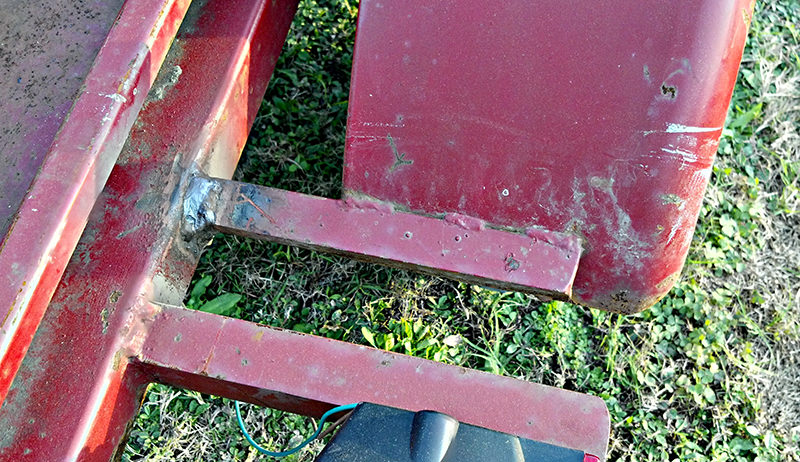
They are lightweight and not prone to rust like their steel counterparts. Aluminum trailers come in all shapes and sizes for use around the hobby farm. However, they’re more expensive to own and because aluminum is a soft metal, it can flex when heavily loaded, sometimes causing welds to break on the frame and cross-members. Repairing stress points immediately after they occur will keep your trailer safe, prolong its life and protect your investment.

You don’t need to be a professional welder to make a simple aluminum repair, but you need to have the right equipment. This repair can be made with a tungsten-inert-gas (TIG) welder or a metal-inert-gas (MIG) welder, which is far more common and easier to use.

Spray transfer is a process used when MIG welding aluminum that is 1/4 inch or thicker. It provides excellent fusion and bead appearance with little or no spatter, making cleanup easy. Spray transfer requires more power than a 115-volt MIG welder can produce. Find a MIG welder that uses a 200- to 230-volt input with an output of at least 200 to 250 amps.

Achieve the best results with the following:

  • Shielding gas: Protects the weld from atmospheric gases, such as oxygen, nitrogen, carbon dioxide and water vapor. Use only pure argon.
  • Welding wire: 4043 is a silicon alloy, which eases welding with good control of the weld puddle. 5356 is probably the most widely used and offers greater tensile strength.
  • Spool Gun: Aluminum can easily bind in the welder like a wet noodle before feeding out the 15-foot gun cable. Welders that can accommodate a spool gun are ideal. The spool guns feature a 4-inch-diameter, 1-pound spool on top of the gun so the wire only feeds a few (less than 12) inches to the contact tip.
  • Stainless Steel Brush: Avoid puddle contamination by dedicating a brush for aluminum only.

Repairing Aluminum Welds

Before attempting the real repair, practice on scrap aluminum coupons available from local farm equipment stores or scrap yards. When MIG welding aluminum, use a push technique: Angle the gun back 10 to 15 degrees, point the nozzle in the direction of forward travel and push the weld puddle forward. This technique produces less penetration with less burn-through and creates a wider, flatter bead appearance.

Step 1

Repairing Aluminum Welds Step 1
Use an angle grinder to completely remove the cracked weld. For cracks leading onto the frame, drill stress-relieving holes at the ends of the crack prior to welding.

Step 2

Repairing Aluminum Welds Step 2

Next, vigorously brush the area to be welded using a stainless-steel wire brush. Dedicate this brush for aluminum-use only to avoid weld contamination. The aluminum should appear bright and shiny indicating that the dull oxide layer is completely removed.

Step 3 

Repairing Aluminum Welds Step 3

Weld in a well-ventilated area free from flammable material and remember to wear proper skin and eye protection.

Step 4

Repairing Aluminum Welds Step 4

Make all the gas and electrical connections to your welder. This welder (the Hobart Handler 210) has a door chart that helps set the voltage and wire-feed speed based on your material thickness.

Step 5

Repairing Aluminum Welds Step 5a

Begin welding at the drilled end of the crack where restraint is greatest and move forward. This repair on 3/16-inch aluminum is being made with .030-diameter 4043 aluminum wire, a voltage setting of 6 and wire-feed speed of 85.

Step 6

Repairing Aluminum Welds Step 6

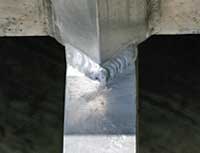
Lastly, use the wire brush to polish the weld or blend-grind the bead for a seamless appearance. A good weld bead will look like a row of stacked dimes. The discoloration at the edges indicates good penetration and a strong weld.

Tips For Achieving A Perfect Weld

Incorrect wire feed and voltage are the usual troublemakers that hinder a sound MIG weld. Avoid the most common welding problems:

  • Mind your gas coverage while welding; avoid wind and breezes.
  • If spatter occurs, adjust the wire-feed speed to match the voltage.
  • Check the contact tip at the gun’s nozzle. It should be replaced if the opening appears oblong rather than round.
  • Burn-back results from the wire melting back into the contact tip, which is caused by loose tension on the drive roll, a blocked contact tip or too high voltage.
  • If the weld appears to “crown” or sit on top of the joint, there’s insufficient
    penetration. This is caused by a travel speed that’s too slow, excess wire-feed speed or insufficient voltage.
Categories
Animals

Adopt A Donkey: The Donkey Adoption Option

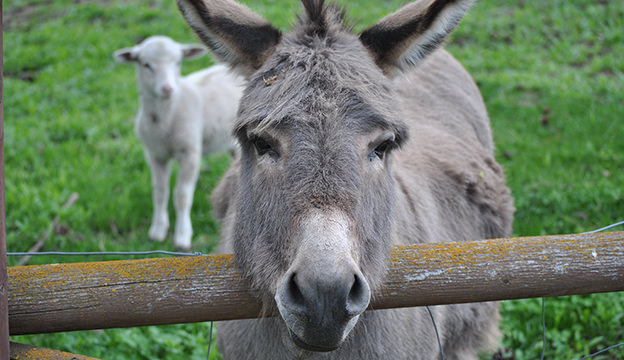
If you’d like to have a donkey (or mule) and also do a good deed, adopt one! Hundreds of long ears in rescues need homes and people to love them (people just like you).

Many people think animals in rescues are old, infirm or second-rate survivors of abuse, but that’s not necessarily true.

It’s not unusual for responsible owners to surrender young, sound donkeys (and sometimes mules) to rescues due to catastrophic life changes such as a death in the family, divorce, loss of income or military deployment.

They have to give up their animals quickly, but they don’t want their equine friends to go to unsuitable homes or sale barns, so they do the right thing and donate them to a group to be re-homed.

Some rescue-group long ears are, indeed, old-timers and survivors of neglect. When these come into rescue, they receive the medical attention they need to be restored to full health before they’re offered for adoption to new homes.

Others, especially donkey jacks, are sometimes surrendered due to behavior issues. These boys are castrated, then kept in knowledgeable foster homes and retrained until they’re deemed fit for adoption.

What Does the Rescue Organization Do?

When reputable rescues take in donkeys (or any type of equine for that matter), each is carefully evaluated before placement.

They’re dewormed, their hooves trimmed and dental issues are addressed, if needed. Each is observed closely over a period of time and his behavior patterns, quirks and eccentricities are duly noted.

The bottom line: By adopting from a reputable rescue, you’ll eliminate most of the unknowns. And, if the donkey or mule you adopt doesn’t work out for any reason at all, the rescue gladly takes it back.

A rescue is not the place to obtain breeding stock. Every responsible rescue gelds jacks before adoption and females are placed under no-breeding contracts.

Also, paying an adoption fee doesn’t mean you own the animal you adopt.

If, at any time you choose not to keep a donkey or mule you’ve adopted through a rescue, he must be surrendered back to the organization from which he came or to an individual or agency approved by the original rescue.

You must also agree to allow rescue personnel or their representatives to visit the adoptee periodically to ascertain that he is, in fact, being properly cared for.

Adoption is Right for You If:

  • You’re unsure of your ability to choose a healthy, well-behaved donkey or mule on your own (rescue agency animals are always carefully vetted prior to placement).
  • You want to be assured your donkey or mule will be provided for in the event you can no longer keep him (all responsible rescues stipulate that the animals they place in your care re-enter the system if you can no longer care for them.
  • You’re seeking a donkey or mule suited for a specific job (herd guardians are pretested; the soundness and training level of donkeys and mules placed as riding or driving animals has been fully evaluated).
  • You’re a good-hearted person who wants to give a home to a donkey or mule that needs one

Adopting Long Ears

Each organization’s adoption policies differ somewhat, but these stipulations adapted from the Peaceful Valley Donkey Rescue’s adoption application are very typical.

  • Applicants are carefully evaluated to make certain the new home meets the standards set forth by the agency. The agency reserves the right to visit the prospective home prior to placement and to visit placed donkeys as often as necessary to ensure their well-being.The adoption agreement is made based on the location listed in the application; donkeys can’t be moved to another property without the agency’s prior consent and may only leave the state under special circumstances.
  • The agency retains the title for the life of the donkey. Adopters agree that they will not sell, trade or loan their animal for any reason. If the adoption is deemed unsuccessful at any time, the animal must be returned to the rescue.The adopted donkey can be returned and traded for another if it isn’t fitting in with the adopter’s other animals.
  • Adopted jennies cannot be used for breeding. No donkey of either sex will be placed in a home where they’ll be used for roping or any other cruel sports.
  • Because adopted donkeys require equine companionship, if adopters don’t already own a horse, pony, donkey, mule or some other type of equine, the agency requires they adopt two donkeys.
  • Adopters must agree to accept full financial responsibility for the animals they adopt through the agency, including damages caused by the animals in their care.
  • To adopt, applicants must agree to provide: a 24- by 24-foot pen; a roofed shelter with a windbreak; grass hay fed twice a day (no alfalfa or other high protein feeds); a mineral salt block; paste deworming every three months; hoof trimming as needed; annual vaccines as deemed necessary for the locale.

Sound picky? They are! Agencies want their animals to find good, loving homes.

If you can provide one, contact the donkey rescues listed in “Rescue Me” or visit Rescue Centers for Horses to find a horse rescue in your locale; most of these have donkeys for adoption from time to time.

And the cost to adopt? It varies from group to group, ranging from $250 (at Peaceful Valley) to $650 (at Turning Pointe Donkey Rescue).

Foster Care

Most rescues also need foster homes for animals awaiting adoption.

To foster, you must comply with adoption criteria and agree to provide everyday care and feed at your own expense. In return, most agencies cover emergency medical expenses and give caregivers first chance to adopt.

When You Just Want to Help

Another way to help rescues help donkeys and mules in need is to donate money or items on your favorite group’s “wish list.” A typical equine rescue wish list might include:

  • Feed, supplements and bedding
  • Dewormers, vaccines and medical supplies
  • Blankets, turnout rugs and waterproof sheets
  • Halters (in all sizes) and lead ropes
  • Larger items like fencing and building materials
  • Volunteer labor—always!