Country Matters Of all the country-living yarns I’ve read, Michael Korda’s memoir, Country Matters, was certainly the easiest to read and the most enjoyable. Korda, editor-in-chief of Simon and Schuster and bestselling author, along with his wife, Margaret, take leave from their New York City apartment when they purchase a farmhouse in Dutchess County, N.Y.
Country Matters details the couple’s transformation from city slickers to full-time hobby farmers, as each chapter unfolds a different aspect of this progression. From “Murphy’s Law”-type home fiascos to property-use disputes to Great Gatsby-esque visitors from the City to their acquisition of pigs (the key to country acceptance in his opinion), Korda goes about the business of telling it like it was. I found myself smiling at passages that uncovered some kind of country fluke like when repairmen would show up to do a job, but never return. “You always knew that whenever a workman stood up, stretched his back, and said he’d have to go down to the hardware store for a left-handed clevis, that was it for the day.”
However, despite all of the headaches, the Kordas’ love for their new life ultimately shines through in the pages. Margaret is able to cultivate her equestrian eventing career by moving her horse to their 20-acre property (and occasionally hosting events there), and Michael is able to work his literary career from the relative serenity of the country. Since this is a memoir, not a novel, I felt more connected to its words and they filled me with a great sense of satisfaction… There they were, the big-city couple, living the “charmed” rural life happily. Yes!
For an honest-to-God true assessment of a city-to-country transformation, don’t miss Country Matters. It will entertain as well as inform, and I promise, be very hard to put down! —KKA
The Classic Zucchini Cookbook Zucchini is bountiful this time of year—whether it’s the local fresh market or the generous offerings from friendly neighbors. From green varieties so dark as to be near black, to lighter shades and those of yellow, with and without stripes or speckled, during the warm months, farmers and gardeners are knee-deep in zucchini, as well as other summer squashes.
But what to do with this “dull” vegetable that doesn’t pack much of a taste punch? Well there’s much ado about squash, including zucchini, if you’re willing to get a little creative in the kitchen using The Classic Zucchini Cookbook by Andrea Chesman as your guide.
Squash never tasted so good. The Classic Zucchini Cookbook provides 225 recipes for “all kinds of squash.” The book, first published in 1977 as Garden Way’s Zucchini Cookbookby Nancy C. Ralston and Marynor Jordan, proves that you can never have too much of a good thing. Whether it’s a recipe for Creamy Yellow Summer Squash Soup or Zucchini Chocolate Crinkle cookies, squash doesn’t disappoint. The Classic Zucchini Cookbook has got you covered from chayote to zucchini in the summer and acorn to turban in the winter, and every variety in between. In addition to recipes, The Classic Zucchini Cookbook offers lots of squash tips and facts. For instance, it turns out that zucchini is often incorrectly prepared which has lead to the misnomer that it is a tasteless, albeit nutritious, vegetable. The authors suggest combining sliced zucchini with coarse salt for approximately 30 minutes (one tablespoon of salt per two medium-sized zucchini). Then prior to cooking, drain the zucchini, wrap in a clean dishtowel and wring as tightly as you can. According to Molly Stevens, food writer and culinary instructor, “It’s amazing what this does for zucchini.” Other fun and useful information from the book includes a primer to squash varieties, different cooking methods, freezing, pickling and preserving, as well as growing and harvesting.
Like squash, The Classic Zucchini Cookbook is best when shared with others. It’s the type of book that friends and family will enjoy pouring through together. The recipes are surprisingly tasty and fun, too good to keep to one’s self. Chesman succinctly makes the point, “It is my hope that armed with this cookbook, you will have as much fun in the kitchen as I have had, and that your friendships are always enriched and never strained by an abundance of zucchini…” —TM
Making Wild Wines & Meads About 10 years ago a friend gave me a bottle of homemade coffee liqueur as a Christmas present. The bottle was pretty with its unusual ornamentation, adorning holiday ribbon and dark, syrupy contents. To this day, that bottle sits on a shelf next to some of my favorite books. Whenever I see it, I am reminded of Andrea and her thoughtfulness.
That bottle of coffee liqueur also makes me think about the process of making and enjoying homemade spirits. For me it conjures up a candle-lit Old World ambiance: handed-down secret recipes, dark cellars with heavy smells of oak and fermenting potions, celebratory toasts before big feasts, dancing and singing.
After reading Making Wild Wines & Meads, 125 Unusual Recipes Using Herbs, Fruits, Flowers & More, by mother-and-son-team Pattie Vargas and Rich Gulling, fortunately I’m still in that dark, pungent cellar, waiting for the celebration to begin. The book stirs my imagination and persuades me to try my hand at a craft that has endured for thousands of years.
What I especially liked about Making Wild Wines & Meads is that it’s not just another winemaking how-to. While there is excellent step-by-step instruction, the book emphasizes “unusual recipes using herbs, fruits, flowers & more.” Marigold, dandelion and blueberry wines, or clove metheglin and cherry melomel are just a few of the delights. No matter what you might be growing in your garden, Making Wild Wines & Meads has a recipe to suit your crops.
Think it takes a big investment to get started in winemaking? On the contrary, the basic equipment doesn’t go much beyond a soup kettle and an earthenware crock according to the authors. Simplicity is what readers of Making Wild Wines & Meads get. The book breaks down the mystery of winemaking with chapters dedicated to the type of wine or mead you are interested in: fruit, herb, flower, nut or vegetable (ever tried carrot wine?). A chapter on wine coolers and punches is also provided featuring recipes that can be adapted (using a little creativity and store-bought alcohol) by non-winemakers as well. Making Wild Wines & Meads also has a resources chapter and a glossary of winemaking terms for the uninitiated (a mead is a honey-based wine; a metheglin is a wine based on honey and herbs or spices; a melomel wine has a honey and fruit base).
Making Wild Wines & Meads is a fun introduction to home winemaking. Whether you’re thinking of bottling for your own use or for gifts, the resulting elixirs are sure to arouse spirits. This book is a keeper. —TM
Making Wild Wines & Meads, 125 Unusual Recipes Using Herbs, Fruits, Flowers & More, by Pattie Vargas and Rich Gulling (Storey Books, 210 MASS MoCa Way, North Adams, Mass., 01247), 1999, 169 pages, softcover, $16.95.
Want to make some treats for your goats? Try this recipe. Remember to give all treats in moderation.
Ingredients 1 cup uncooked oatmeal 2 cups raisin bran (crunched up works best) 1 cup raw wheat germ 4 large shredded carrots 1 cup molasses ½ cup applesauce
Preparation Combine molasses and applesauce in a bowl. Combine all other dry ingredients in a separate bowl. Gradually add the molasses and applesauce mixture to the dry ingredients to obtain a thick dough. (If more dry ingredients are needed, add a little more raisin bran and/or wheat germ to the mixture.) Shape into desired-sized balls and place onto a greased baking sheet. Bake at 300 degrees until dried out and done (about 30 minutes). Can burn easily.
Zucchini pile-up on the kitchen counter. Tomato tie-up. Barn chore back-up. Gapers block due to fireflies darting through the night sky.
Despite the fact that I moved to the country to escape the craziness of urban traffic congestion, I quickly realized I gained a rural form of rush hour: summer. But summer on the farm involves no smog, stalled vehicles or road rage.
A season of beauty and abundance, summer magnifies all the fundamental joys of country living all at once: garden-fresh food; postcard-perfect scenery; a rainbow of flowers in bloom and an outdoor-living mindset that begs for spontaneous picnics. On the other side of the Popsicle stick, summer ushers in the busiest farm season. Since we moved to our farm in Wisconsin, I start energetically lusting for summer early in the spring, holding back the temptation to transplant seedlings before our mid-May frost date.
Flash to the end of the summer and I’m craving the first frost and hibernating around the woodstove.
Like a torrid love affair, my relationship with summer goes through predictable cycles: We crave each other, passionately adore each other, then mutually burn out in the end, part ways and retreat to solitude. The key to fully savoring summer on the farm is keeping balanced—working hard while having a satisfying dose of fun.
By the time autumn rolls around, you want to feel a bit tired, yet fulfilled—gratified with both the produce and the memories harvested along the way.
Tap into summer’s potential by exploring themes of the season. Prioritize & Focus More than any other time of year, the average summer day offers a buffet of options and possibilities. Mow, weed, harvest, repair, process. Summer’s to-do list never ends.
The key to finding balance between summer sanity and lunacy is accepting exactly that: You’ll never be “done.”
Try to focus on identifying and prioritizing the most imperative tasks for that day. Postpone nonessential projects till the fall or next spring.
Weather plays an important role in summer prioritizing. Thanks to the Internet, we can assess a quick snapshot of the weather for the week to help prioritize our days.
Get the harvest in before the heat wave starts at the end of this week. Run into town for errands when the mercury peaks. Why burn up in the heat when we can wait a few days for a break in the weather to get farm chores done? Hang out laundry on Friday after the storms roll out and weed after the pounding rains soften the soil, making it less of a chore. For many hobby farms, most income comes in during the summer, so our livelihood is automatically prioritized. The world won’t stop if the lawn grows a bit hairy, but if you don’t have fresh produce harvested for your roadside stand, no income will come in.
To-Dos for Summer Take advantage of summer’s bounty:
Eat Fresh Our zealousness for processing often overshadows the fact that summer remains the time to eat fresh. Harvest salad greens every morning for daily salads (not in the afternoon when they’re wilted from the heat). Don’t start canning strawberry jam until you’ve completely gorged on fresh berries.
Take Everyday Photos We often forget to document the everyday beauties of this farm season. We started an album devoted to farm photos, capturing summer abundance with shots of the kitchen counter buried with fresh produce or a magical, misty summer sunrise.
Dress Up for Town With summer’s workload, grubby old clothes reign wardrobe supreme. Take a needed break from muddy grunge and make a habit of taking a shower and donning a bright sundress and straw hat for trips to town. Even if you’re just dropping off library books, you’ll feel like you’re going to a party.
Share Zucchini Bread Summer abundance begs to be shared, particularly with senior neighbors who may no longer be physically able to garden. Given that most seniors typically live alone and don’t cook big portions, our neighbors love small samples from our many mega-batches of zucchini bread, tomato sauce and stir-frys.
Rekindle Childhood We all have a favorite summer childhood memory, most likely linked to the outdoors. Tap into your memories this summer and hang a swing from your favorite tree, keep the freezer stocked with bomb pops and rekindle your inner Picasso with a fresh box of sidewalk chalk.
Take Bodily Care Summer takes its toll on our bodies, so give tender care when possible. I’ve found light, long-sleeved, cotton shirts and long, loose pants—scavenged from our local Goodwill shop—make the best outdoor work attire. I don’t have to worry about sunscreen all over my body and it’s easier to shower at night without mud caked on my knees.
Fix a Signature Drink Celebrate summer with your “official” summer farm drink, something you savor in the shade after chores are done.
Rhubarb is abundant in the Midwest and is the inspiration for our “Rhubarb Fizz,” a church punch bowl recipe adaptation designed for one-glass servings without all the high-fructose corn syrup common in soda pop. The rhubarb-sugar-pineapple juice syrup will keep for several weeks in the refrigerator.
Ingredients
12 c. chopped fresh or frozen rhubarb
2 c. water
3 c. sugar, unrefined like turbinado
1 c. pineapple juice
2 liters unflavored seltzer water
Directions In a crockpot or large saucepan, cook rhubarb and water over low heat for approximately two hours or until rhubarb is a soft pulp.
Drain pulp and place warm liquid in large bowl. Stir in sugar until completely dissolved. Add pineapple juice. Chill.
For each individual serving, add ice to glass and fill serving glass half full with rhubarb syrup. Top with seltzer water and stir.
Experiment with how sweet you like your drink, adding syrup or seltzer water accordingly. Serves 4 to 5.
We run a B&B on our farm, with the majority of that income generated during summer. This means we keep the house tidy and ready for the next round of guests at the expense of weeding time in the garden.
Breaking down jobs into bite-sized, more manageable pieces helps tremendously. I learned this the hard way with canning salsa.
Our family harvested tomatoes in the morning and had them cooked up by the afternoon, but then ended up staying up past midnight to get everything canned as we still had our other farm chores.
The next morning I woke up to a dirty disaster of a kitchen, deflating my zest for food preservation.
Next round, we improved. The first day we harvested, cleaned and cut the tomatoes, chopped the onions, peeled the garlic, and gathered the canning jars and gear. The following day we sterilized the jars, and cooked and canned the salsa. A simple change, but it made all the difference in energy level and attitude.
In the middle of the necessary to-dos, try to prioritize a dash of newness. What was that one thing at the end of last summer you wished you would have done? Focus on that one thing.
My new thing this season is to harvest and preserve fresh grape leaves so I can learn to make dolmathes—traditional Greek stuffed grape leaves. For the last few years I’ve talked about it, but by the time I catch up with weeding and processing, the first autumn leaves have begun to fall and the grape leaves are too tough to process.
Weed Weeding is like exercising on the treadmill: It’s not your favorite thing to do, but it’s the price you pay for a good-looking butt—or butternut squash. When it comes to weeding, the key is to minimize labor while maximizing results.
The first step for me was to cancel my magazine subscriptions with picture-perfect country gardens and embrace the “good enough” mantra: I will never pull the last weed in the garden and be “done.”
The strategy then shifts to efficient weed control and our resulting passion for mulch. We recycle a variety of biodegradable materials, such as cardboard flats, to put around established plants. We also purchase straw bales from a nearby farmer to use as mulch. Mulch not only keeps down weeds, it helps retain moisture in the soil, which means less time needed for watering.
Invest in the right tools for easy weeding. We’re loyal to our stirrup hoe, which gently cuts weeds (way before they go to seed) at the soil line, leaving the greens to break down to compost. I can stirrup hoe a vegetable bed in minutes, which took some getting used to because I felt guilty for not kneeling down and pulling weeds by hand. My return for the time invested was much greater.
Strip Yes, strip refers to paring down clothes due to summer heat. But as you slip bare feet into flip-flops, think more broadly of ways summer impels us to concentrate on the bare necessities. When life overflows with a never-ending farm-chore list merged with a buzzing social calendar filled with picnics and community events, we need to strip down days to our essentials, shaking off gratuitous activities in favor of what we really want to do.
Summer garden bounty recipes exemplify stripping down to core essentials. When I gathered my recipes together for our B&B and farm cookbook, I needed to write a qualifier in the opening paragraph of the vegetable side dish chapter.
I realized most of the ingredient lists for the recipes were atypically short: asparagus, olive oil, balsamic vinegar, salt. I didn’t want readers to think ingredients were accidentally omitted, so I explained how summer garden dishes warranted no extra cheese sauce or anything other than a few flavor enhancers.
Consider a summer without, or with limited, air conditioning. While some of you may be gasping in horror, remember it was only a short generation ago that all farms were “naturally cooled.”
We open our windows at night to let in the cool air, then close them and draw the shades around mid-morning, when the mercury starts to rise.
If needed, we put a large fan at the bottom of the basement steps to blow cool air upstairs. We have a ceiling fan above our bed and a small window air conditioner unit in our home office where there’s limited air flow. This hybrid model works well since our house stays surprisingly cool. And not going from extreme outdoor to indoor temperatures—like walking from the parking lot into the mall—keeps our body temperatures more consistent and comfortable.
Stock up on cool drinks and remember that the more time you spend outside, the better your body can adjust to the heat.
Go Local Summer provides a roster of ways to experience and celebrate your local scene. This summer, try going to an area event that isn’t typically on your radar, like the county fair tractor pull or the local pool, even if your kids have long since fled.
Prioritize going to your community’s key summer event. For us, it’s our town’s hot-air balloon rally in mid-June, an afternoon when we take a break from weeding and gaze at the vibrant display of color floating across the sky.
Given the busyness of summer schedules, I’ll double-up and tie errands with an event in town, bringing a picnic and staying for the town’s evening concert after shopping. Local food opportunities abound this time of year. Despite the fact that we raise all our own garden produce, I’m always tempted by a farmers’ market.
A celebration of seasonal abundance, I surprise myself with what I find there that I can use, but that we don’t grow. From honey to black walnuts to fish from local farms, forage off the beaten path of the supermarket aisle and you’ll find ample occasions to both eat fresher and support your local economy. Celebrate Farm Life Parties and summer go hand-in-hand, be it a large bash or an intimate gathering under the stars.
Create simple social rituals to bring people together to relish the beauty of the farm during this season. Informal potlucks reign at our place, never with a planned menu of who is bringing what (and if you don’t have time to make something, come anyway as there is always enough food), yet we always feast fantastically with minimal effort and stress on our part. Think beyond the classic Fourth of July for a reason to gather. Celebrate the Summer Solstice (June 21), French independence on Bastille Day (July 14) or let the garden stimulate a theme. Our fellow Wisconsin farming friends at Vermont Valley Community Farm host an annual “Pesto Fest” that is legendary among their CSA (community supported agriculture) subscribers, during which folks both harvest and whip up on-site (thanks to rows of borrowed food processors) their own pesto variations. Sharing and sampling, of course, is encouraged! Identify a spot on your farm as your signature summer gathering spot. A campfire pit readily jumps to mind, but perhaps one of your outbuildings may inspire a social spot?
We have a covered shed that once housed tractors or farm equipment. The four walls are long gone, but the concrete floor, foundation beams and metal roof are functional. We cleaned it out, strung old holiday lights around the rafters and created our “Cantina,” a favorite seasonal nighttime gathering spot, particularly during a rainstorm. Live it. Love it. Leave it. Before you know it, you’ll be harvesting pumpkins for autumn soup batches. Relish summer while it’s here and croon along with Sandy and Danny from “Grease” as you crunch those pea pods off the vine: “Summer lovin’, had me a blast. Summer lovin’, happened so fast.”
This article first appeared in the Summer 2007 issue ofHobby Farm Homemagazine.
About the Author Lisa Kivirist is the co-author of Edible Earth: Savoring the Good Life with Vegetarian Recipes from Inn Serendipity and Rural Renaissance. She runs the award-winning Inn Serendipity with her family in Browntown, Wis.
To most cats, tuna is almost as attractive as catnip. Try making this delicious tuna cat treat recipe for your cat!
Ingredients
1 3-ounce can albacore tuna in water or oil, undrained
1/2 cup whole wheat flour
1/2 cup nonfat dry milk
1 T. vegetable oil
1 large egg
1/4 cup water
Preparation Preheat the oven to 350 degrees. In a large bowl, use a fork to shred the tuna into small pieces. Add the remaning ingredients, mixing well. The dough will be sticky. Flour or oil your hands so you can handle the dough and form the dough into small, marble-sized balls. Place the balls on a greased cookie sheet, and use your fingers to gently flatten them. Bake for about 10 minutes or until the bottoms of the treats are golden brown. Flip the treats and bake for another five to 10 minutes or until both sides of the treats are golden brown. Remove from the oven, let cool thoroughly, and store in an airtight container in the refrigerator. Makes 55 to 65 marble-sized treats.
Soon after birth, however, these living stuffed toys become luxury fiber-producing machines, yielding 20 to 25 percent of their body weight each year in soft, durable mohair.
This high level of production makes Angora goats the most efficient fiber-producing animal in the world and an intriguing option for today’s hobby farmer.
“Angoras fit perfectly into our lives,” says Sue Ann Nissen, a 20-year veteran of raising Angora goats in Marshall, N.C. “They are fairly gentle and their size and temperament allow women and children to work easily with them.” Nissen cites personality, straightforward maintenance and diversified income sources as compelling reasons for hobby farmers to take a second look at these fuzzy, captivating creatures.
History of Angora Goats
“I was drawn to these creatures through a desire to utilize their wonderful fiber,” says Diane Coon, an Angora goat breeder in Hamilton, Mont. “Spinning goats’ hair is an ancient art even mentioned in the Bible.”
Angora Goats originated in Asia Minor and early references in Sumerian cuneiform tablets and the Bible date the origin of the breed to somewhere between the 12th and 15th centuries B.C. In time, the breed became well established near Ankara, Turkey, from which the name “Angora” is derived.
The word “Mohair” is derived from the Arabic “mukhaya” which means “to choose or prefer.” In the 15th and 16th centuries, mohair fabrics began to reach markets in Europe. Demand soon outstripped supply and the Sultan of Turkey placed an embargo on the export of raw mohair.
In 1838, the first successful importation of purebred Angora goats established the breed in South Africa. Eleven years later, in 1849, the first Angora goats were imported into the United States, having been received by Dr. James B. Davis of South Carolina as a thank-you gift from the Sultan of Turkey for his assistance in experimental cotton production in that country.
Today, South Africa and the United States remain the two largest mohair producers, with smaller populations of goats being found in Turkey, Argentina, Australia, New Zealand and Great Britain.
Dying Angora Goat Fiber
The main product of Angora goats is their mohair fiber (not to be confused with Angora fiber, which is produced from rabbits).
An Angora goat’s fleece grows at a rate of one inch per month and they are shorn twice per year, typically in the spring and fall. Each goat yields an average of five to 10 pounds of mohair at each shearing.
The fiber from the youngest goats is the finest and most valuable because an Angora’s fleece continually coarsens with age.
“Mohair has strength and durability unmatched by wool, and as a dyer and fiber artist, the beauty of the dyed yarn is second only to silk,” says yarn designer Sherry Brooks.
Brooks, and her husband Randall, manage a flock of 100 colored Angoras on their farm in Lancaster, Texas. Fiber from their goats, along with purchased white kid mohair, makes the basis of their upscale hand-dyed yarn line, which is marketed at fiber festivals across the country. “Mohair’s affinity for dye produces colors with clarity and luster that makes it unique when used alone or blended with other fiber,” she says. This luster and brilliance gives mohair its common moniker as “The Diamond Fiber.”
In addition to its ability to be dyed a vibrant array of colors, mohair is strong and durable with a tensile strength for its fiber diameter that rivals steel.
Yet mohair garments pack in less space than similar wool garments. Elasticity of the fibers helps garments made of mohair resist wrinkling. Essentially non-flammable, mohair is also a popular choice for upholstery fabrics.
For the hobby farmer, a little ingenuity with the fiber can yield sound profits to the farm’s bottom line.
“The more you put into the fiber, the more you will profit,” says Coon.
“Think of it this way … if you sell one pound of mohair to the commercial market, you may receive $3 for that pound; if you wash it and card it for spinners, you can bump that up to $40 a pound. If you spin that carded fiber into yarn, you can sell that pound for anywhere from $80 to $150 dollars; or, if you take that yarn and knit a sweater or shawl, you can bump that pound up to $300 to $500.”
Coon markets all of her fiber as spinning fiber or as finished garments.
Angora Goats Have Many Colors
Christine McIntosh/Flickr
To satisfy the requirements of the textile industry for a fiber that will take dye in a uniform manner, Angora goats in the United States have traditionally been selected for a pure white fleece.
Mohair buyers at the large Texas wool warehouses that handle this country’s commercial mohair clip will not accept colored hair, but this has not deterred the hobby-farm-driven development of colored varieties.
At different points in history Angoras have been crossed to domestic goats of various colors to increase the population of mohair-producing goats. Thanks to this mixed background from hundreds of years ago, occasionally a colored “throwback” will pop up in otherwise all white purebred flocks. Breeder interest in these colored animals has led to the cultivation of colored Angora goats in a wide variety of shades.
From black to brown to red, the fiber from these colorful goats satisfies a niche market demand for naturally colored fibers that do not require dyes. This niche demand helps breeders command premium prices for both breeding stock ($300 to $600 per head) and fiber ($10 to $24/lb.) and compete favorably with other niche livestock options, like alpacas.
While Coon has both white and colored Angoras, the colored animals hold special appeal for her. “They are tremendous animals that exhibit wonderful variety,” she explains.
Proper Feeding Helps Mohair Growth
Angoras have a high nutritional requirement due to their rapid mohair growth. Without proper nutrition Angoras are robbed of the fuel required to produce mohair. “A well-balanced diet suited to your area and fresh, clean water is essential to their well being,” says Coon.
Roughage is important for proper health and rumen function, so good quality pasture or hay is the foundation of any solid Angora feeding program. Goats are good foragers and eat a wide variety of weeds, woody plants, shrubs, briars and grasses. Because of their penchant for eating brush and weeds, they are excellent at reclaiming land that may be too weedy or brushy for other livestock species to utilize.
During growth, breeding and kidding, grain is supplemented to meet the energy and protein requirements that the goats are unable to meet with available forages. An Angora goat’s protein requirements vary between 12 to 16 percent dry matter of the complete ration, depending on the goat’s stage of production. A free-choice mineral mixture formulated for goats (which may include selenium if your area is deficient, and salt), and fresh, clean water should be provided at all times.
Shearing Angora Goats
Spring and fall shearings are the most important times of year for Angora goat breeders, as a large percentage of farm income comes from the sale of properly prepared and shorn mohair.
Hay or bits of chaff in the mohair can downgrade the value of a fleece or make it unsaleable, especially to discriminating fiber artists. “Feeders built with a plywood manger, only open at the bottom for the last six inches, with a nice tray below works well for the goats. Having the manger made of mostly plywood keeps hay from falling onto the backs and necks of the animals during feeding which keeps the fleece clean,” advises Coon.
The shearing process is straightforward, although it does take a strong back. Breeders with just a few animals can use scissors or non-electric hand shears if a shearer is not willing to come to the farm for just a few animals. For larger flocks, a good shearer frees up the flock owner to concentrate on preparing the shorn fleeces and doing the legwork to stay organized on shearing day. Ambitious breeders who want to shear their own animals can invest in electric sheep shears and modify them for mohair shearing with a 20-tooth goat comb.
Preventing fleece damage from external parasites is also an important part of management between shearings. “It is essential to keep the goats dewormed and free from external parasites. Lice can be a real enemy to these animals,” advises Coon.
Goats are usually deloused with a pour-on product (such as Permethrin or Pyrethrin) a few weeks after shearing to prevent lice and ticks. Shearing is also a good time to give the flock their annual shots for overeating (enterotoxemia) and tetanus, and to take the opportunity to trim feet. Most breeders trim feet three to four times a year and deworm on a similar schedule, depending on climate and pasture-rotation practices.
Adequate shelter after shearing is key. In the four to six weeks following shearing, Angoras are susceptible to becoming chilled if subjected to a cold rain. With shelter, however, shearing even in the most frigid weather is a matter of routine and presents few problems.
How to Prepare for Shearing
Keep goats dry for 24 hours prior to shearing.
Shear youngest goats first and oldest goats last to prevent coarser fiber from becoming mixed with finer, higher-value hair.
Keep the shearing area clean. A plywood platform works well, especially if swept between age or color groups.
Communicate with your shearer. Let him know that you don’t mind a slower pace as long as the animals are treated gently and there is a minimum of second cuts (short cuts that downgrade the value of the fleece).
Remove stained or soiled hair from the clip before
storing the fleece.
Breeding Angora Goats
Angoras breed seasonally, usually from August through January. Does are induced into estrus by the presence of a buck and cycle every 19 to 21 days until pregnant. Artificial insemination in Angoras is not common, so most breeding is done by a live buck that runs with the doe herd for the two or three months of breeding season.
Recommended pre-breeding management of the doe flock includes shearing, delousing and increasing the plane of nutrition several weeks in advance of breeding. Supplementing the diet with additional feed in the weeks preceding breeding, a process called flushing, encourages multiple births. In some herds, twin births are very common, in other flocks, single births will predominate. The two largest factors influencing multiple births in Angora goats are pre-breeding nutrition and body size. Larger, stouter nannies that have been flushed prior to breeding are more likely to have twin births than those that are smaller bodied or that have not been flushed prior to breeding.
“Your does can live to be 16 and still be productive at 12, 13 and even 14 years old,” says Coon. “That is why good conformation is such an essential trait along with beautiful fiber.” Generally, nannies need to weigh 60 pounds to breed, which means most females are bred as yearlings and kid for the first time as 2-year-old goats.
Kidding Issues with Angoras
“Angoras have few breeding or kidding problems,” says registered white Angora goat breeder Sue Ann Nissen.
Newborn kids are delicate, however, especially in cold weather and can chill easily in temperatures below 40 degrees F if they do not nurse quickly after birth. Breeders who show early in the year and those in milder climates generally kid in the early winter months (January through March). Many hobby breeders prefer to forgo harsh winter weather for a later kidding. “April kidding has worked well, giving us healthy robust kids,” says Nissen, who compensates for her late spring kidding by showing her goats later in the year.
Angoras are raised by their dams and weaned at three to four months of age. Providing a creep area where the kids can eat without competition from adults helps to increase the kids’ rate of growth and most breeders include a coccidiostat in the kid ration to prevent coccidiosis (a parasite common to goats).
After weaning and shearing breeders begin evaluating the kid crop, a process that usually continues through until the spring of the goat’s yearling year. If kids do not show breeding or show-stock potential, breeders can market these animals for meat or keep them for fiber production.
Showing Angoras
Angoras are show-ring naturals, being friendly, reasonable in size and requiring very little show preparation. Unlike sheep, you do not wash or trim an Angora’s hair before entering the show-ring (a process called fitting). In fact, trimming hair, washing the goat or adding products to the mohair can get you quickly disqualified at most shows.
This easy show preparation makes the breed a popular choice at specialty fiber festivals around the country and at county and state fairs in Angora-populous regions. These same traits also make them a popular 4-H project. “They’re more like pets when they are handled,” says Roy Sanders, a breeder and president of the Texas Angora Goat Raiser’s Association, from Harper, Texas. “Children like playing with them because they are so soft and cute,” he says. That, coupled with several significant scholarship programs in his area, make them a popular youth option.
The breed’s natural affinity for the show-ring also provides an excellent marketing avenue for breeders. The demand for show goats is strong says Sanders. “Show quality goats are where the profit is for selling breeding stock.”
Starting Your Own Angora Flock
Nissen advises beginners interested in Angoras to find the right breeder and ask lots of questions. “From that person you will get all the help you need. Share your ideas and information with that person. The amount of land you have will be important, your personal schedules, fencing requirements, housing for the goats, et cetera. Your own situation and goals will establish how you start with Angoras,” she says.
Sanders concurs, and emphasizes the importance of quality over quantity when starting a flock. “Get some high-quality goats to start with, maybe two or three does and a really good buck. It may not be the quantity you wanted, but spend the same money on better quality so that when you get your numbers up you can use what you have and avoid heavy culling to improve.”
Ease of day-to-day management, strong demand and creative marketing options make Angoras a popular and potentially lucrative hobby-farming option. However, most small farmers like Nissen are simply drawn to them out of a deep appreciation of the striking elegance of the breed as a whole. “There are few other sights as beautiful as seeing a small flock of Angoras out in the meadow,” she says.
This article first appeared in the August/September 2003 issue of Hobby Farms magazine.
Got extra stalls? Consider boarding horses as a small business and help earn some extra income.While big-biz horse boarding establishments are usually located on the fringe of metro areas where a strong customer base is assured, horse-savvy entrepreneurs can operate a profitable boarding businesses anywhere in the country when they think small, think quality, and, maybe, think specialize.
According to the 2002 USDA Census of Agriculture, on Jan. 1, 2003, there were 5.2 million equines in the United States. A 1996 study commissioned by the American Horse Council sets the figure at 6.9 million.
The race industry accounts for 725,000 horses. Another nearly 2 million are show horses and close to 3 million are used for recreational pursuits. A surprising number of these animals reside at boarding establishments.
Consider Pennsylvania and its 220,000 horses. According to the 2002 Pennsylvania Equine Impact Study data, 31,000 of those animals were housed at boarding stables at a cost of $42.1 million to their owners. Or Colorado, where in 1998, sales of equine-related services totaled $130 million, 30 percent of which was generated by boarding establishments. Of the 87,100 horses, ponies, mules and donkeys in Maryland, 31 percent were kept at boarding and training facilities, says the 2002 Maryland Equine Census.
It’s a fact: Americans love horses. For many of us, keeping horses is a necessary luxury and for the landless, that means boarding their horses out.
What it Takes to Be a Boarding Stable Owner
It takes a special sort of person to manage a horse-boarding business.He (or she) must be an experienced horseperson or be willing to become one. Horses are complex creatures and their owners are notoriously fussy. A client expects the person to whom she entrusts her treasured steed to handle him correctly, to accurately recognize illness and distress, to feed him a balanced diet, and to generally care for the horse the way she’d do herself.
A boarding stable owner must relate positively with the public. He must market his services and keep his clients satisfied. This entails patience and tact, especially when inter-stable squabbles arise. Playing peacekeeper can be the hardest part of the job (said by one who’s been there and knows).
New boarding stable entrepreneurs must possess the financial wherewithal to build or renovate existing facilities; money to meet start-up costs like increased liability insurance, legal and accounting services, and advertising; and the financial acumen to operate his stable in a professional manner.
He also needs considerable time to devote to the business, even if it’s a part-time venture. Barring that, employees or family members should be available to pick up the slack.
More Than One Way to Board a Horse
So you want to board horses … which sort of service will you sell? Unless you’re situated within 20 miles of a fairly affluent metro area, you probably can’t attract enough clients to make a large-scale venture really pay. The trick is to stay small and offer added value such as an indoor arena, on-site riding trails, or close proximity to public bridle paths or horse camping facilities. By doing so, you’ll keep your stalls full.
An advantage to one-fee-covers-everything, full-service board is that you control feeding, stall cleaning, and if you choose, routine chores such as parasite control and hoof care. You needn’t provide separate storage areas for each client’s feed and bedding, nor wonder if a given horse has been dewormed.
Partial-board means different things to different people. In some cases the client furnishes everything except stall space or pasture—feed, bedding and labor are her domain. At other stables, partial-board clients furnish feed and bedding and the stable owner or an employee handles daily chores such as feeding, stall cleaning and turnout.
Pasture-board entails supplying the client’s horse with pasture and a place to get out of the weather. You might supply additional feed or the client will provide it; that’s the sort of thing you’ll spell out in your contract.
However, small-scale establishments do best when they serve a specialized clientele.
Chesapeake Bay Program/Flickr
Consider providing board and services for:
Boarding Lay-ups
If you’re a patient and caring experienced horseperson with lots of time to devote to your business, consider boarding lay-ups. While most lay-up operations cater to racehorses, anyone with an injured or chronically ill equine and not enough time to devote to its needs may be willing to pay for your time and expertise.
In addition to regular full-board tasks, your job description might include hosing or icing a bowed tendon, hand walking a lame pony, treating an ulcerated eye, or changing dressings and administering medications. Because of your boarders’ special needs, your establishment must be located within easy driving distance of an excellent equine vet and a top-notch farrier.
Caring for Older Horses
What do compassionate horse folks do when a favorite old steed becomes too infirm to breed or ride?
They turn Dobbin out to pasture—your pasture if you keep can him in style at a lower cost than boarding at his present digs. And since expensive-to-build-and-maintain features like indoor arenas and on-site groomed trails aren’t necessary at elder care facilities, you can likely do just that.
Aged boarders require comfortable stalls or field shelters, high quality pasture, concentrates designed for elder horses, and soft, high quality hay. All oldsters require ongoing dental work and many need specialized hoof and veterinary care.
Elder care establishments are traditionally country operations, so if your farm is off the beaten path but you have empty stalls, spacious pastures, and a special affection for golden-age equines, this might be the boarding op for you.
Boarding Broodmares and Young Stock
Boarding broodmares is another service you can run from the boonies, as long as you have a great vet. You could full-board broodmares year-round or operate a seasonal foaling service, where mares arrive a few months prior to giving birth and leave shortly after their foals hit the ground.
You’ll provide improved pasture and stalls or field shelter access throughout each boarder’s stay, and you’ll monitor her pregnancy and foaling. You might also imprint her newborn foal, sometimes for an additional fee.
In addition to standard boarding amenities, you’ll need large, safe foaling stalls (more than one in case several mares foal around the same time) with monitoring systems or in- stable sleeping facilities where you can observe all occupied foaling stalls.
Most boarders will be expensive Thoroughbred or Standardbred mares producing valuable future racehorse foals, so you’ll need high-ticket liability insurance and ultra-safe stalls, turnout enclosures and pastures.
Clients who board broodmares often seek accommodations for growing young stock too. Most will be weanling and pre-training yearling racehorses worth a great deal of money, so the same requisites apply.
Boarding Stallions
Few standard facilities board adult stallions. If you’re a veteran horse handler living in a horse-rich locale and you enjoy working with stallions, consider operating a stallion station out of your barn.
You’ll need ultra-stout facilities, safe accommodations for mares (many with new foals at their sides), and access to an equine practitioner skilled in equine artificial insemination. In some localities, these facilities are in extremely high demand.
Boarding Specialty Horses
Natural Boarding is a system of horse care pioneered by German veterinarian Dr. Hiltrud Strasser, who believes the lives of domestic horses should mimic those of their wild ancestors.
In A Lifetime of Soundness, Dr. Strasser outlines the evils of what she terms Conventional Boarding vs. Natural Boarding. Dr. Strasser has a huge American following and Natural Boarding is a growing movement. If specialty boarding is your style, this could be your game.
Natural Boarded equines must be given paddock or pasture access 24/7. They’re kept in herds; if that’s impractical, they require constant physical contact with other horses, perhaps a pasture buddy or access to other horses across adjoining fences. They are never shod and never blanketed. They must be provided with free-choice pasture, hay, and minerals, and feeding is done at ground level.
Horse Motels
Horse motels (overnight accommodations for horses) are rarely stand-alone ventures, but at $5 to $30 per night, per horse, they can neatly augment your regular boarding income.However, to protect your regular boarders from incoming disease, horse motel facilities must be separate from regular boarding amenities. Another option: open a B&B for traveling horse folk and their steeds.
Plan a Successful Boarding Business
Still think you want to board horses? Good! Boarding is a necessary service and a grand way for horsey folk to earn a part-time living. However, to boost your profit potential, be sure you do your groundwork going in.
Scope out legalities. Consider zoning, business permits and your state’s lien laws. Counties often restrict the number of horses you may keep per acre, especially on smaller, hobby farm-type properties, so don’t omit this step!
Evaluate your facilities. If you must build from scratch or make major improvements, boarding might not be economically feasible. To quash escapes or injuries, safe fences are a must: stout plank, pipe, anti-climb woven wire horse fence or its equivalent.Field shelters and stalls must be roomy and sturdily built, and all metal structures must be fitted with kick-resistant lumber or plywood linings. For incoming or sick horses, an isolation stall in a separate building is a definite boon. You’ll need adequate feed and bedding storage (a lot of it if you offer “furnish your own” partial-board).Clients expect access to securable tack lockers; a gathering place or lounge with a bathroom; room to park vehicles and trailers; and riding facilities, be they an indoor arena, an outdoor riding ring, or access to trails. And because the average horse generates 45 pounds of manure and 6 to 10 gallons of urine per day, there will be manure and soiled bedding (and lots of it) to deal with on an ongoing basis.
Investigate the cost of liability insurance. Most homeowner’s insurance does not protect policyholders from claims arising from business activities, including boarding ventures large or small. You’ll need two types of horse business-specific liability insurance: Commercial Equine Liability (CGL) and Care, Custody and Control (CCC). Both are pricey but absolutely essential, so make certain to factor them in when establishing boarding fees.
Research your market. Is there an immediate need for the type of boarding you wish to provide? Are others in your neighborhood offering similar services? Visit your future competition and poke around. Ask questions, request price lists and contracts. What sort of facilities and services do they provide? At what cost? Are their barns full? What can you do to make your stable and services more attractive than theirs?
Crunch the numbers. While boarding horses is satisfying work, you won’t want to do it for free. Expect to charge between $200 and $800 or more per month for full-board depending on your geographic locale, facilities and the type and quality of services you offer.Make certain it’s enough! For help drawing up a workable budget, review Western Maryland Research & Education Center’s bulletin, “Horse Boarding Enterprise”; Penn State’s “Agricultural Alternatives: Boarding Horses”; University of Florida’s “The Economic Aspects of a Small Equine Boarding Operation in North Florida”; and Ohio State’s “Horse Boarding Budget.”
Draw up a legal boarding contract. Have an attorney double check it. Make certain you’ve covered all the angles. Customize readymade boarding contracts or start from scratch, but make certain the contract:
Provides positive equine identification and detailed client contact information. List the client’s name, address and contact data. Include a detailed description of her horse, noting preexisting injuries and physical condition; consider attaching photos or a digital image printout. Request the names of at least two other contacts authorized to make decisions in the client’s absence, along with permission to procure veterinary services if neither can be reached. If the horse is insured, indicate the insurer’s name, contact information and all applicable policy numbers.
Explains precisely what your fees include. A perpetually skinny-Minnie animal that needs twice as much feed to stay half as fat as the rest of your charges can quickly gobble up profits. So can the client who cleans her own stalls using four wheelbarrow loads of fresh shavings every day. If clients demand additional feed, supplements or bedding above and beyond the basics, the cost should come from their pockets, not yours. The same goes for services. Stipulate what basic board entails and provide a list of extras clients can choose to add—for a fee.
Details barn owner and client responsibilities. Who deworms the horse, when and with what? Who calls the farrier? When the client is responsible for deworming, feeding, turnout or cleaning stalls, what happens if she fails to fulfill her obligation? When is board due? What if it’s late? Very late? What actions will the barn owner take to recoup his investment? What recourse does the horse owner have if he does take action? If the client’s horse inflicts excessive damage to your facilities or another horse, who pays? What are acceptable barn hours? May the client bring visitors to the barn? Her friends’ horses? Her dog? What are your smoking, drinking alcohol on the premises, and helmet policies? Thwart future unpleasantness by having everything in writing before the new client’s horse moves in.
Incorporates a Release of Liability. Forty-four states uphold laws that help shield equine professionals from frivolous lawsuits. To peruse your state’s statute and access sample liability release forms, long on to www.horse-insurance.com/law.html
Takin’ Care of Business, Every Day
To earn a profit, you must continually market your product. Depending on the services you offer, advertise your establishment online; at gatherings such as race meets, shows and horse expos; in breed-specific or general interest horse magazines; or in newspaper classifieds and Yellow Pages. Have quality business cards and flyers printed; post them in veterinarians’ offices, tack shops and feed stores. Wear caps and T-shirts emblazoned with your business logo. Give talks and demonstrations to 4-H clubs, Pony Clubs and civic groups. Let your services be known.
A successful boarding stable entrepreneur projects a positive public image and makes favorable first impressions, so keep your facilities clean and in good repair, answer the phone in a businesslike manner, and return calls now rather than later.
Keep your clientele happy. Address clients’ concerns promptly and in person. Be tactful. Mediate inter-barn problems as they arise. Periodically request your clients’ feedback; whenever possible, adjust policies to meet reasonable demands.
And most of all, be ready, willing and able to put in the time. Boarding isn’t a do-it-when-you-feel-like-it proposition. Even if you hire work done, show up at the barn every day. Make yourself accessible and make certain your equine charges are healthy and happy.
Sound good? Then go for it—running a hobby farm horse boarding establishment could prove to be the perfect country biz for you!
Ten thousand years or so ago, humans partnered up with denizens of the animal kingdom to create the world’s first domesticated livestock.
Since then, thousands upon thousands of types and breeds of poultry and farm animals have evolved through natural and human selection, all tailor-made to suit the needs of the people who kept them and the climate and conditions in which they lived.
Now they’re disappearing from the earth at an alarming rate and it’s up to dedicated conservators to save them.
According to the United Nations Food and Agriculture Organization (FAO), at least 1,500 of the world’s estimated 6,000 livestock breeds are in imminent danger of extinction. The organization further asserts that the world is currently losing an average of two domestic animal breeds each week and that half of the breeds that existed in Europe in 1900 are already extinct.
Poultry breeds are likewise threatened. In 2004, the American Livestock Breeds Conservancy conducted a census of chicken breeds.
Of 70 breeds maintained by American poultry breeders, half are endangered and 20 are practically extinct.
Industrialized farming fans the flames of this alarming, worldwide trend.
Large corporations maintain factory farmed livestock in controlled environments (eliminating a need for breeds adapted to various regions or climates); they control their animals’ “health” through liberal doses of antibiotic cocktails (quashing the need for disease-resistant heritage strains); and they feed their unfortunate victims exacting rations of high-protein, growth-hormone enhanced feed so they reach market size in record time.
The result: a bountiful supply of cheap, essentially tasteless, hormone- and antibiotic-laced milk or meat produced at the cost of the animals’ health and well being.
Fortunately, growing legions of farmers are stepping forth to reclaim our forbearers’ heritage livestock and poultry breeds. This rare-breed renaissance is occurring throughout the world and for numerous reasons.
Some conservators long for the mouthwatering fried chicken Grandma used to serve for Sunday dinner or melt-in-your-mouth, home-smoked hams like the ones Great-grandpa fashioned from his homegrown hogs. Some yearn to preserve living remnants of our distant past such as Spanish goats or Florida Cracker cattle, Colonial Spanish horses and Dominique chickens.
Others do it in the name of biodiversity—they feel that if disease or genetic malady should strike down, for example, the world’s Holstein cows (which represent 91 percent of America’s dairy herd), there must be hardy, heritage breeds ready to take up the slack. Some simply prefer livestock and poultry breeds created for specific environments and needs: Canadienne and Randall Lineback cattle for New England’s snowy winters; parasite-resistant and heat-tolerant Gulf Coast sheep and Pineywoods cattle for the deep South; Guinea Hogs for small-farm family tables; Buckeye and Holland chickens for free-range eggs.
The ALBC Speaks Out
However, as admirable and exciting as the concept may be, raising heritage livestock or poultry is not quite a stroll in the park.
The Key to Breed Stewardship is Education
Before you accept the responsibility of heritage breed conservation, learn as much about breed stewardship as you can.
Join the American Livestock Breeds Conservancy (ALBC).
The ALBC is a nonprofit membership organization devoted to the promotion and protection of over 150 breeds of livestock and poultry. Now in its 30th year of service, it’s the only organization in the United States working to conserve rare breeds and genetic diversity in heritage livestock. As a member, you’ll receive the bimonthly ALBC News and an annual directory chock-full of ALBC-breeder contact information. These ALBC breeders make up an active network of people who participate in hands-on conservation, marketing and public education; they are definitely people you want to know.
The American Livestock Breeds Conservancy Pittsboro, NC 27312
(919) 542-5704 https://www.albc-usa.org/
Visit historic estates and farms where heritage breeds are kept.
Meet the breeds that interest you and talk with the conservators in charge of their care. To locate such facilities, contact your state and county historical societies or visit one of the organizations on this list.
Breeds: Milking Devon cattle; Leicester Longwool sheep; American Cream Draft and Canadian horses; Dominique, Hamburg, Dorking and Nankin Bantam chickens
Old Sturbridge Village
Sturbridge, MA
(508) 347-3362 www.osv.org
Breeds: Gloucester Old Spots and Large Black pigs; Devon and Milking Shorthorn cattle; Dorking chickens; Narragansett turkeys; Cotswold and Wiltshire Horn sheep
Breeds: Milking Devon and Kerry cattle; San Clemente goats; Tamworth hogs; Wiltshire Horn sheep
SVF Foundation
Newport, RI (does not accept visitors)
(401) 848-7229 www.svffoundation.org/
Breeds: Santa Cruz, Gulf Coast, Cotwold and Jacob sheep; Pineywoods, Milking Devon, Randall Lineback, Dutch Belted, Ancient White Park, Belted Galloway and Kerry cattle; San Clemente and Tennessee Myotonic goats; Narragansett turkeys; Dominique chickens
Network with other conservators in person or online. Yahoo’s free e-mail groups represent an excellent source of ongoing information for both new and established conservators. Some groups worth pursuing are:
Additional conservators are needed (sometimes desperately so), but it’s important to understand what’s really involved in a meaningful conservation effort before you begin. We discussed the challenges of raising rare breeds with Don Schrider, communication director for the American Livestock Breeds Conservancy. Based on our conversation, here are some things to consider:
Understand the Nature of America’s Rare Breeds “Despite FAO figures,” Schrider says, “since 1985, no American breed has gone extinct. This is largely because the breeds on our Conservation Priority List (CPL) remain the breeds of choice for small, diversified farms; grass-fed operations; organic production and sustainable farming. They were developed to meet small-farm needs that in many cases still exist today.
“Consider CPL hog breeds like Guinea Hogs and Mulefoot pigs. These are heritage breeds ideally suited to the South where their dark skin pigmentation protects them from the sun’s harmful UV rays.”
In the old days, he tells us, pigs not only furnished pork for the dinner table, in the winter they were fenced on the family’s garden spot where they tilled the earth with their snouts—an important service when garden produce meant life. They were hardy pigs, easy keepers that foraged for meals in the woods. Shelter needs were negligible; they virtually raised themselves.
Now fast forward to 2007 and imagine these hogs in an organic pastured pork situation. It works!
Or picture the Buckeye hen, he says. She lays fewer eggs than production Leghorns, but the flighty, little production Leghorn in her cramped battery cage requires a controlled climate and a good amount of feed to crank out her sorry egg each day. When she’s spent, her value as meat is nil.
The Buckeye, on the other hand, is a free-range hen. She’s a friendly, mellow bird, but very active: In season, she chases down much of what she eats. This big, red hen lays tasty, brown eggs year-round; since she tips the scale at a meaty six-and-a-half pounds, she makes fine stewed chicken when her laying life is over. Which would be most productive on your farm?
However, all of these breeds are critically endangered—there are a finite number of animals to go around. Dabbling in rare breeds won’t do. Their survival hinges on knowledgeable and fully dedicated conservation efforts.
Don’t Be a Fly-By-Night Breeder“If you choose to raise heritage breeds, don’t jump in and jump back out,” cautions Schrider. “
This causes far more harm than good. New breeders, particularly those who have never worked with that species before, must thoroughly educate themselves and have a plan in place before purchasing endangered breeds. The more critically endangered the breed, the more important this is.
Imagine if someone buys the last of a line or an entire generation of a critically endangered population,” he says, “then changes his mind and sells them at a sale barn. The loss of potential genetic diversity could be staggering.”
Conservators must fully appreciate the responsibility they’re assuming when they commit to raising an endangered breed.
“Do what’s best for the breed, not just what’s best for you,” Schrider cautions. “Find out how the breed needs to be maintained before you buy animals. Make sure registration papers are in order. If you choose a Critical or Threatened breed, be willing to maintain both sexes. Populations are severely limited and frequently spaced far apart. Semen for artificial insemination may not be available, so you need to be willing to keep a boar, bull or stallion; if not, choose a breed with a larger population, perhaps one from the Recovering list.
“A great deal of genetic potential is sacrificed when rare breed females are bred to males outside of their breeds. The Cleveland Bay [horse] is a perfect example. This is a British breed that traces back to the 17th century. It’s critically endangered worldwide, yet registered mares are still being crossed with Thoroughbred stallions to produce sport horses. The cross could as easily be made the other way around: a Cleveland Bay stallion on Thoroughbred mares. The end result is the same, but those precious mares could be saved for conservation efforts within the breed.
“Critically rare breeds are not always readily available … a byproduct of being ‘rare.’ These animals are maintained in small herds, so breeder-quality stock isn’t always available for immediate purchase. Have patience. Network with other breeders and expect to follow some blind leads. And know what will happen to your animals when you stop breeding. Make sure your heirs know how precious they are and keep in touch with other responsible conservators who can take them in an emergency.”
Choose an Existing ALBC-listed Breed “Many breeds on our Conservation Priority List are critically endangered,” Schrider tells us. “All of these breeds have a long history of use in America and these are the breeds we promote. We believe that breeds developed elsewhere are best conserved elsewhere.
“We discourage the importation of new breeds because there is a limited niche for the qualities and products each has to offer. For example, if additional longwool sheep breeds were imported, fewer conservators might be interested in working with our CPL Cotswolds or Leicester Longwools. As new breeds are imported and gain a foothold, existing breeds suffer. The ones we already have need our support.”
Conservators Share Their Wisdom
To round out the picture, we spoke with a number of breeders already involved in heritage-breed conservation. When asked about the pitfalls of rare-breed conservation, these points were mentioned:
Gain experience first with a mainline breed. If you’ve never raised a species before, learn the ropes with a similar common breed. For instance, before committing to rare Oberhasli goats, hone your goat-keeping abilities with Nubian or Saanen dairy does (they’ll reward you with tasty milk while you learn).
Scarcity is a given. Be prepared to be placed on waiting lists. Expect to spend time and money in travel or on shipping to obtain the foundation or replacement animals you desire. The more critically endangered the breed, the more this tends to be.
Understand the principles of genetics. Individuals in some critically rare breed populations may be related. A certain amount of line- and in-breeding must sometimes be done to preserve a breed. This can be a blessing (when common ancestors are free of glaring genetic faults, line- and in-breeding can be used to successfully set type) or a curse (indiscriminate breeding to faulty individuals can result in birth deformities and lack of breeding vigor). In any case, it’s never OK to indiscriminately breed your rare-breed animals; you must understand the principles of maintaining a breeding population first. Established breeders and the ALBC are often willing to help plan matings if you’re willing to accept their assistance.
Hook up with support groups, but choose them wisely. It’s impossible to raise rare breeds in a vacuum. Investigate associations and registries before you choose a breed; some organizations are infinitely easier to work with than others. By nature, conservators are strong-minded individuals who are firmly dedicated to preserving their breed; when groups come together, viewpoints may differ and personalities may clash. The answer is not to form a new organization; multiple registries tend to weaken conservation efforts as a whole. Find a group you can work with or consider choosing a different breed.
Find a mentor (or two or three or four). The best way to learn about these unique breeds is to network with breeders in the know. Local, hands-on assistance is obviously best, but when unavailable, long-distance (phone or Internet) mentors can be a godsend.
Locate veterinarians for your animals before you buy them. When critically endangered breeds are placed in your hands, you have a moral obligation to keep them well. Talk to area vets before choosing a species. In areas where sheep are practically an exotic species, where will you find a vet who understands the parasite-resistance of Gulf Coast sheep?
The shortage of farm vets in the United States is felt deepest by hobby farmers. Try to find a vet who is knowlegable about the species you want to raise and who shows an open and supportive attitude about what you are doing.
If your vet already knows your chosen species, he or she may grow to appreciate the good qualities of the rare breed in comparison to the more popular breeds.
Expense can be prohibitive. While some rare breeds are surprisingly inexpensive to obtain and maintain, others are pricey indeed. When pricing breeds, don’t forget to factor in travel expenses to view potential purchases, shipping and even veterinary costs if artificial insemination or embryo transfer will be part of your breeding protocol. Obtain a breeders directory and price quotes from many breeders—some will sell for reasonable prices.
Choose a breed adapted to your locale. Most heritage breeds were established in or developed for specific climates and might not flourish in the one where you live. When Cynthia Creech brought endangered Randall Cattle (“New England’s Own Heritage Cattle,” January/February 2007) to her Tennessee farm, the cattle failed to thrive; when transplanted to her new home in Connecticut, they do. Highland cattle in Florida, Miniature Zebus in Minnesota, Leicester Longwool sheep in the arid Southwest—it’s doable, but probably not in these breeds’ best interest.
Productivity is sometimes an issue. Heritage and rare breed food-producing animals and poultry invariably take longer to finish to marketable size. They sometimes produce smaller litters, fewer eggs or less meat than breeds developed for maximum production. If super-productivity is your goal, heritage breeds might not deliver. Investigate the breeds that interest you before you decide.
Toot your own horn. The public may not be aware of your heritage breed’s fine-eating qualities, so it’s up to you as a producer to establish niche markets and promote products derived from your animals. Marketing non-food-producing, rare livestock, such as equines, can be problematic as well, since buyers tend to choose the breeds they know.
Consider forming rare breed co-ops to raise public awareness or exhibiting at livestock shows to build your reputation and to network with other knowledgable breeders. Education and promotion are the keys to showing a profit with rare breed animals and poultry.
There is no doubt about it, raising heritage livestock and poultry can be a rewarding and valuable experience. But consider the ramifications. As a conservator, you accept stewardship of your chosen breed. It’s an enormous responsibility. Think before you act.
This article first appeared in the May/June 2007 issue of Hobby Farms magazine. Pick up a copy at your local bookstore or tack and feed store or subscribe online>>
Farming, early 20th century-style, is a young person’s game.
As Alex Foell–the 23-year-old, male supervisor at the 1900 Farm at the Living History Farms near Des Moines, Iowa–walks out of the barn, fresh-faced and well-muscled in blue overalls and a white T-shirt, it’s immediately evident that, yes, 100 years ago the daily work of farmers was physically demanding.
Only someone oblivious to aches and pains would say about the back-breaking labor, as he did, “It’s kind of relaxing.”
But Foell isn’t just talking about the fresh air environment where he does his daily chores. He’s also commenting on the quiet, where the soft snorts of horses replace the grind of tractors churning up the soil.
By day, the recent college graduate tends to the outdoor needs of this 25-acre homestead. In the evening, he returns to his city apartment with all the beeps and flashes of the high tech, visually stimulating environment that exists in most 21st century American homes.
How does the farm compare to his bachelor pad? “It’s a lot calmer,” he says.
Standing in the gravel driveway, between house and barn, under a blue and white summer sky, it’s obvious what he means.
Except for the low hum of cars on the interstate nearby, there’s almost no sound. Birds chirp, the windmill clacks in the breeze and time hangs in the Iowa air.
Is this heaven? No, but it might very well be the perfect hobby farm. Lacking the stresses of modern life, it’s physically beautiful, essentially sustainable, and requires the hard work and commitment of dedicated individuals with distinct and important roles.
With a large, red horse barn, heirloom garden, small chicken coop and tiny white house with a picket fence, this place is a rural dream come true.
It’s also a lovely, pristine illusion. The 1900 Farm is, actually, a full-on sensory overload of stark reality.
Everywhere on this breathing chronicle of Iowa farming, the sun burns, wind blows, pigs slop, hail strips and mowers maim.
Traveling Through Time The Living History Farms are located in Urbandale, Iowa, just west of Des Moines in the central part of the state.
The 550-acre museum, which showcases five different historical sites, is open daily May through early September and partial weeks in the fall.
It’s easily accessible via interstate highway (I-35) and several major air carriers fly into the Des Moines International Airport, a short distance away. A number of overnight accommodations are located nearby.
This summer the museum will again host its popular, hands-on program, “Get Your Grip on History,” as well as many other special events.
For more information, visit www.lhf.org or call (515) 278-5286.
In fact, fantasies about the bucolic farm life quickly disappear when Foell discusses just how threatening the farm, which uses only authentic animals and implements, could (and can) be.
Where Reality Does Bite “When you work with the machines and the horses, you have to keep your eyes open,” he says in a clearly understated way.
He is talking, candidly, about body parts, as in if you throw the reins over your shoulder while driving a side-delivery hay rake, you might lose some.
Foell is expressing the matter-of-factness common to farmers of the time (even if they were missing a limb or two).
Their newfangled threshers and plows were Industrial Age gifts straight from the labor-saving gods, a welcomed evolution from the simple, ox-driven sodbuster invented by Illinois neighbor John Deere a mere 50 years earlier.
Foell and the other male interpreter–along with well-educated volunteers and an occasional enthusiastic tourist–currently have 25 acres under production, a typical amount for most Iowa farmers in 1900.
They husband a combination of oats, corn and hay cover, all planted in a five-year rotation to maximize production in the days before chemical fertilizers and pesticides.
The corn, an irregular, heirloom variety called Reid’s Yellow Dent, yields a lowly 40 bushels per acre, all of which must be shelled by men throwing cobs into a menacing, but decidedly automated, shelling machine.
The farm is mostly self-contained, with field crops meeting the nutritional needs of the animals for the year and a handful of hogs (10 now, 50 in the old days) serving as the primary cash generator for the family.
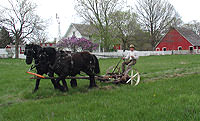
Horses, not surprisingly, are animal royalty. Foell relies on six Percherons to generate energy for non-mechanical tasks, such as running the simple pulley system that lifts hay into the barn loft, powering the more-complicated mechanisms of the various implements needed to maintain and increase farm production.
“They’re just the right size and they’re very docile,” he says about the Percherons, who weigh in at approximately 1,800 pounds each. And, he adds, “We do most of our work with them by voice command,” showing that at 23, Foell has already joined a brotherhood of equine handlers dating back millennia.
Horse handling aside, the jobs performed at the 1900 Farm each day by college educated professionals are not for the weak or weary, which suits Jen Schroeder, the 27-year-old domestic supervisor, perfectly fine.
Reflecting on her years growing up on a farrow-to-finish hog farm in northwest Iowa, she says she was never the prissy type.
“I wasn’t afraid of animals, wasn’t afraid of getting dirty,” she explains. “I was out helping my parents all the time.”
The inherent dangers don’t seem to bother the secondary education and history major out of Drake University, either.
She says they serve as a filter by which to see more clearly the lives of her rural ancestors. “It showed me what my grandparents and great-grandparents went through” to provide for the family.
Dress Codes Like the old proverb, there is no such thing as bad weather, just bad clothing.
Although the Living History Farms museum does not send folks out in thunderstorms, you can expect to feel the effects of the Iowa heat and humidity when you visit in summer.
Except for the visitor center and the Wallace Exhibit Center, buildings lack air conditioning and, once the shuttle stops at each site, you’ll walk (and sweat) a lot.
Keep in mind, too, that life in the past was messier than today.
Tourists are encouraged to participate in chores with the site interpreters, but don’t be surprised if a sow tips the slop bowl on you or you get “poofed” by flour. It’s all part of the fun–you’ll enjoy it more if you dress appropriately!
For her, the primary risk centers on the stove, a cast iron beast that, when fully heated, smokes in four directions.
“That’s the biggest threat,” Schroeder says. “It all gets hot.” Like Foell, she seems to have a never-you-mind mentality about this “modern” machine that keeps the household running and feeds everyone, including the large threshing crews that come in for dinner on sweltering, summer-harvest days.
Dressing for Success One would think it’s pretty warm, also, on the underside of the voluminous calico dress she and her companion interpreter must wear on Iowa’s sticky, 98-degree, corn-growing days. Schroeder claims those icons of prairie fashion are quite comfortable and, literally, lifesaving. “Hopefully you don’t get burned if you have your sleeves rolled down,” she says about her constant proximity to the stove. She shares enthusiastically the benefits of the outdoor chin-to-toe costumes. “They protect you from the sun, and the heat.” And, clearly, excessive perspiration doesn’t worry her. “I don’t mind sweating,” Schroeder says. Her skirt, which would seem to trap warm air, actually serves as a fabric fan, allowing air to flow better than, say, a pair of jeans. She says, too, that cotton fiber has an advantage over man-made materials because it “breathes.”
So, how does a 20-something woman trade her modern freedoms for the seemingly restrictive, backward role of unappreciated farmwife? The simple answer is: She doesn’t. Schroeder puts the stereotype to rest by explaining that her life on the 1900 Farm is nothing like the picture associated with women stuck at home in pre-feminist America. “You have to be a team to make a farm,” she says about her relationships with the men and women there. “We don’t want to show it’s females inside the picket fence and males outside … because it’s not true.”
She expresses this with certainty, and not just because she grew up watching several generations of men and women partnering on her own family farm. Schroeder and other interpreters spend hours pouring over journals and other historical documents to determine the best way to show early 20th century life; in her reading she has found that spouses of that time recognized the need to get work done, when it needed to be done, regardless of gender. Women, she says, work outdoors with animals when necessary; during the winter months, the men were more than willing to help around the house with domestic chores such as laundry. “We interpret that the men would want to be inside,” she says.
Dieting 1900 Style Talking to Foell, it’s readily apparent how much the men at the 1900 Farm appreciate the women, particularly at meal time. At the 1900s Farm, the workers have a diet significantly different from the high sodium, “can-o-corn” fare at the agricultural-themed restaurant (not affiliated with the 1900s Farm) near the museum entrance. Schroeder manages all the homegrown nutrition, cultivating plant varieties that reflect what was available to acreage dwellers of the time. Both supervisors feel blessed to have a constant supply for warm-weather meals. “You always have fresh produce in the garden from spring until fall … which is wonderful,” Schroeder says. Foell, for his part, admits that eating all his vegetables has made him much healthier and that he’s given up soda pop, preferring, even in his off hours, the taste of his daytime staple: water.
Schroeder also talks about the calorie load required by farm workers and why traditional farm meals, with their huge portions of protein and carbohydrates, were so vital. Between the heavy lifting required by the male farm workers and the women’s day-to-day exercises of kneading bread, hauling wood and pumping water, she assures concerned visitors that everything ingested is definitely being used by the body. “When you see us working outside, we’re working it all off,” she says. “We’re doing different jobs than most people have in today’s society.”
Except, maybe, chores. Although a great many characteristics of small farms have changed in 100 years, some have stayed the same. Foell shares with modern livestock owners the never-ending job of feeding animals appropriately throughout the year and hauling manure. He also faces that familiar list of house and building repairs. “There is a lot of maintenance,” he says.
Of course there is no perfect acreage, but, according to Schroeder, it is possible to integrate some of that old magic into today’s hobby farm. She recommends one very specific 1900s routine: “A home-cooked meal–the roast and mashed potatoes–really isn’t hard to make,” she says. “It should be part of your weekly habit.” To be sure, that’s one way to cross back into a simpler time where, Foell says, even if it is a lot of work, “You can still get away from the modern world.”
About the Author Freelance writer Gretchen Heim Olson grew up in central Iowa, the daughter and granddaughter of farmers.
Want to read more stories like this one?Hobby FarmsandHobby Farm Home magazines are your resources for rural living. Subscribe today!
Preparation Place whole, unpeeled potatoes in saucepan, cover with water and bring to boiling. Cook 30 to 40 minutes, or until tender. Drain and cool slightly; then peel and cut into 1/4-inch slices.
Arrange half the potatoes in a greased 1½-quart casserole pan and sprinkle with 1/4 cup brown sugar. Dot with butter and sprinkle 1/2 cup cranberries over the top. Cover with remaining sweet potatoes, 1/4 cup brown sugar and remaining cranberries.
Pour orange juice over all. Cover and bake at 350 degrees F. for 45 minutes. Uncover and sprinkle top with walnut topping and cranberries, and bake 10 minutes more. Serves six to eight.
All winter we hustle in and out of a chilly shop, promising ourselves we’ll get it cleaned out the first warm day of spring.
Then, all of a sudden, the grass needs mowing, the chicks are about to arrive and we’re still climbing over empty gas cans, bicycles and the hubby’s rusty 1966 Mustang.
Next year, we swear, we’ll get organized earlier.
Well, now’s the time. Put on a pot of coffee or tea, bundle up, and head out to the shop with paper, pencil and tape measure to take a quick look at the mess. First job: seeing what’s out there, thinking about how it should be organized and planning ahead for disposal.
This isn’t the most pleasant task, but as you walk outside, think ahead to both the invigorating work and the beauty of spring, and especially how much you’ll enjoy it when this duty is out of the way. Best Laid Plans When you get to the shop, pick a central spot (if you can find one!) and observe the area.
Look around at what you have and begin to categorize broadly.
Typically most farm shops or sheds contain: lawn and garden equipment; tools and supplies; home repair tools and materials; auto-related tools and supplies (and sometimes the actual auto, running or not); salvaged wood as well as woodworking tools and equipment; livestock and pet supplies and feed; sporting goods; snow removal equipment; outdoor furniture; and things unique to your farm or items that just don’t seem to fit a larger category.
Disposable Confusion Some items that need to be disposed of are difficult to categorize. Should this tire go in the burn pile, the garbage pick-up or the hazardous waste dump? Here is a list of common household hazardous waste items and where to find information about their disposal:
Batteries. Contact your local government waste office or a battery store.
After you’ve thought for a few minutes about what’s there, grab the pencil from your coat pocket and write down those major categories.
You’ll organize them by type and by your specific needs, so in addition to listing them, examine how much space will be required for each section and what sub-categories exist within the larger groups, making notes as you go. This is where the tape measure comes in.
Take time to get the dimensions of storage containers and boxes you’ll be keeping (width, length and height), and measure odd-shaped or extra large items that need special consideration. Don’t forget to start a disposal list. You know some of that junk has to go!
Before your fingers go numb, hustle back inside, pour that warm beverage and get settled in a comfy chair with your notes. You’ve probably got several things on the list, but there are a few more to consider while everything is still fresh in your mind. First, what particular hobbies or areas of interest should you accommodate in the shop reorganization? One advantage of living in the country is that we have room to pursue activities close to our hearts, so be sure to set aside appropriate space. The market gardener or plant enthusiast will have different requirements for tools and equipment than the farm owner who uses the shop primarily for antique auto restoration and woodworking.
Also, what subcategories of items in the shop need to be considered? Within lawn supplies, for example, you likely have equipment of various sizes—mowers, rakes and other tools—that have distinctly different storage needs than fertilizers, pots and baskets. Ask yourself the same question about auto, wood, metal shop and other categories, and make notes about what types of shelving, containers and space are needed for each, as well as how you want to group them in the area available.
Shop Cleaning Supplies Here’s a quick list of what to take out to the shop on the big cleaning day:
broom
dust pan
old mop or squeegee
cleaning solution
garden hose
kitty litter
crack and hold repair supplies
chalk or heavy duty tape
garbage can
empty cardboard boxes or bags
permanent marker
recycling container(s)
HHW disposal guidelines
dust mask
This is also a good time to think about the chemicals you typically keep in the shop. All hazardous materials must be stored in their original containers and, of course, kept far out of the reach of children. They should be grouped together in a locked cabinet or within their appropriate categories, but not near sensitive items such as livestock feed or supplements. Make a special note for old chemicals and damaged containers, which will go onto the household hazardous waste disposal list. Garbage Disposal As you’re working through the specific areas to be organized in the shop, you should also be thinking about items that will be thrown away; this requires a different list altogether. Because so many things cannot go directly into landfills, divide your notes into the following categories: recycling; charitable donations; garbage pick-up; burn pile; and household hazardous waste. If you’re like most of us, you’ll be confused about how to categorize some of the things on your list, perhaps because laws have changed in recent years or because you have new materials or modern components in the shop that didn’t exist during the last big clean-up. That means you’ll need to schedule time in the coming days to research the particulars in your area.
If you don’t remember exactly what is allowed in recycling bins or wonder if anything new is being accepted, contact your local provider. For donations, call or stop by your favorite charity and find out the specifics of its donation policy so you arrive during opening hours and you avoid donating items they cannot use. The same advice holds for garbage pick-up. If you have curbside service, visit the company or government office website and print out a list of waste products they absolutely will not take; keep that list with your other shop notes. Your waste pick-up provider also might offer guidance on the disposal of household hazardous waste products (commonly referred to as HHW) and how you should properly handle them. Most states and counties give direction for HHW disposal on their Web sites; you can also get this information by calling your county administrative offices. Some communities have particular days for HHW drop-off, whereas others have permanent locations open during specific hours. In special cases, you may have to drive your HHW to a private business for disposal. Perhaps you live in an area that allows burning. If you haven’t recently checked the regulations, be sure to contact your local municipality so you aren’t visited by the local sheriff. As the United States population grows, more and more communities are limiting burning, even in rural areas far outside towns and villages. One last consideration as you plan for disposal: If you have other people, particularly adults, sharing the farm shop with you, be sure to consult with them before unceremoniously junking their possessions. Otherwise you might find out later that those broken ìthingsî were actually non-replaceable collectible car parts or precious memories from great-grandma’s country kitchen. And finally, before getting up from that comfy spot, take time to sketch a rough floor plan of your newly organized shop so when it’s time to head outside again you know where to put things and you know they will fit. Let’s Go Shopping After you’ve finished your list of categories and sub-categories, planned for garbage disposal and given thought to your unique needs for organization, phase two begins: preparation and execution. First job? Make a shopping list. Most likely you’ll need some containers and perhaps shelving, so ask yourself a few more questions: What could be contained that isn’t? Do we have enough cardboard boxes or plastic see-through containers? Are tool boxes easy to find and carry? Is shelving adequate for boxes, tools, pots, baskets and other supplies? Will current shelves and cabinets accommodate the weight, height and width of boxes and odd-shaped items? Are frequently used items going to be easy to reach and put away? (Bicycle hooks on the ceiling aren’t much good if you can’t get the bikes down yourself.) Think about the inside of the shop, look at your list and jot down what you still need to acquire to help with storage. If necessary, run back out and measure to save trips later. Late winter and early spring are good times to shop for storage needs since many stores offer specials around this time of year. Watch newspaper circulars for seasonal sales of organizing supplies, shelving and tool racks, and gather your storage containers while you’re waiting for the weather to warm up. Put them directly in the shop. You’ll also want to mark out dates and times on the calendar for cleaning, organizing and disposal. Some women have the ability to schedule one or two days at once; others will need to spread the process over a week or more, so be realistic about your lifestyle. Also, honestly assess how fussy you will be when cleaning time comes. If you know you won’t be happy unless the floor cracks have been scrubbed with a toothbrush, make time on the calendar for that, too. Don’t forget to add in special times for dropping off household hazardous waste and donations; otherwise you may have to wait weeks or even months to dispose of them if you miss a particular Saturday. Lift and Separate We’ve all seen the “clean up your act” television shows where everything is dumped onto the front lawn—pink flamingos and velvet paintings right along with dented gas cans and broken rakes. Well, the reason they toss all of it outside is because that truly is the best way to clean and organize well. It’s also the next step in re-claiming your space. First, though, watch the weather reports. When it looks like you’re going to have a few days without rain, snow or excessive breezes, plan to spend an hour hauling everything out of the shop (and don’t forget the dust mask). Recruit anyone who can help. After you’ve got a big pile outside the building, take a good look around inside, at the walls and the floor, to see if you need to make any repairs. You know rodents and insects find every nook and cranny in farm structures, so spend a few minutes closing up holes and fixing cracks while the area is clear. Next, grab the broom and sweep down everything from top to bottom; finish by flushing the floor with water and a de-greasing solution. If you have oil spots, cover them first in absorbent kitty litter, let soak for several hours or days, then sweep. If you use your shop floor to meet short-term livestock needs (such as chick brooding), use a cleaning solution appropriate to the task. After the floor dries, get out chalk or heavy-duty tape and mark off areas that must be kept open for vehicles, large equipment and foot traffic. Phew! Now it’s time to get out the floor plan. Move or install shelving first, then begin sorting through all those items outside, placing them in containers and putting things back in the shop on the appropriate shelves. You can work through your inventory either by category or randomly, depending on whether or not you think you’ll need to move things around later. The idea, as the old saying goes, is to find a place for everything and put everything in its place.
Be sure to have containers for disposal, too, so garbage, recyclables, charitable donations and hazardous materials can be separated as you sort. Watch your time and adjust accordingly. Your shop cleaning doesn’t have to be done perfectly, but it should, at the end of your allotted time, allow you to quickly find and reach what you need. Don’t forget to put your disposal containers in places where they will be emptied as soon as possible; leave them behind the building and they’ll become “out of sight, out of mind.” The last task, of course, is getting rid of all those things you swore would leave the property and never come back. Deliver all of them to their designated resting places, and promise yourself you won’t go through the donation bag one more time or resurrect that worn-out whatchamacallit with a final repair. Once you’ve happily finished your task, pour yourself another beverage, find that comfy chair again and enjoy your well-deserved rest. It’s almost time to mow.
About the Author: Gretchen Olson just wants to find the pliers in the shop on her acreage in northern Illinois.
This article first appeared in the Spring 2007 issue of Hobby Farm Home magazine. Subscribe online>>