You stroll out into the garden, picking ripe fruits and vegetables, knowing that come February you’ll still be enjoying their freshness. For those of us attracted to the romantic aspects of small-farm life, this is an appealing scenario.
Root cellars, the ancient technology that makes such scenes possible, are currently experiencing a rediscovery, but not merely because of the pleasures of eating self-grown food, but also because of the actual possibility of reducing expenses and providing for significant food storage in times of potential trouble.
History
Native Australians were the first people to take advantage of the cooling and insulative properties of buried foodstuffs in the earth. Records indicate that over 40,000 years ago they grew large amounts of yams and developed the technique of burying their produce in order to preserve it for future use. In the process, they also discovered the phenomenon of fermentation, and ever since, alcoholic beverages have been a large portion of those products stored in underground repositories.
Underground storage facilities from the Iron Age have been discovered, and the Etruscans commonly buried their immature wine, but the actual use of walk-in root cellars as a means to prolong the freshness of fruit and vegetable crops was probably an invention that occurred in 17th century England. It might seem surprising that the great civilizations of China and Egypt did not develop root cellars, but the Chinese were the masters of food preservation via salting, pickling and the additions of spices; the Egyptians, residents of an arid environment, were the masters at drying food. It took the right combination of cool winters and hungry Englishmen to finally invent the concept of root cellars.
Certainly the most notable practitioners of root-cellar arts were the early colonists that arrived in North America from the United Kingdom. The eastern halves of America and Canada contain thousands of old root cellars, and the small Newfoundland town of Elliston actually claims the title of “Root Cellar Capital of the World,” and boasts of over 135 root cellars, some dating back 200 years.
Temperature
The basis of all root cellars is their ability to keep food cool. They were, essentially, the first refrigerators. A well-insulated root cellar can keep the food inside 40 degrees cooler than the summertime temperatures outside. This coolness also has benefits during the winter, as maintaining food at a temperature just slightly above freezing has the effect of slowing deterioration and rot. Temperatures inside the home, even in basements, are noticeably warmer, so food stored inside the house has a tendency to spoil much more rapidly than food stored in a cooler root cellar. Temperatures above 45 degrees F cause toughness in most stored vegetables, and encourage undesirable sprouting and considerably more rapid spoilage.
The temperature in a root cellar is never uniform. The temperature near the ceiling is usually 10 degrees warmer than elsewhere in the cellar, so the ceiling area is therefore appropriate for placement of produce that tolerates warmer temperatures well, such as onions, garlic and shallots.
Storing Food
What can you plan on storing in your root cellar once you build it? Certainly, many of us probably have visions of root cellars in the 19th century, packed with bushels of apples and sacks full of potatoes. Today’s root cellars are really not much different, and potatoes and apples are two eminently storable farm products. But the problem with that pair is that they don’t really go well together. Apples have a tendency to emit ethylene gas, which causes problems for potatoes stored nearby, and will also make any exposed carrots or other root crops bitter. As a matter of fact, many fruits, including plums, pears and peaches, and some vegetables, such as tomatoes, cabbage and Chinese cabbage, are also notorious ethylene producers.
So, what is a dedicated food saver to do? Luckily, there are ways around this problem. A good root cellar has a variety of shelves, some higher than others, and some closer to the air vents. Placing the ethylene producers up high and nearer the exit vents has a tendency to move harmful gases away from produce stored on the floor below. Many root crops are also regularly stored in boxes of loose soil or sawdust, further insulating them from their neighbors’ emissions. Some produce, like cabbages and onions, often emit odors that can taint the flavors of other vegetables, as well as fruits, so finding high, remote corners for these pungent items is a good idea too.
In addition to raw produce, root cellars are excellent locations for a number of other foodstuffs as well. The previously mentioned beverages, like wine, cider and beer, all enjoy the cool, dark environment of a root cellar. Cured meats, like ham, bacon and other smoked meats store very well in temperatures below 40 degrees F. Milk, cream, butter and cheese all appreciate the environment of root cellars. Grains and nuts store very well in root cellars, but require extra precautions against insects, and must be sealed tightly to be secure. Dried and canned foods also keep well, provided they are kept either in less humid cellars, or in separate, drier compartments.
Fresh vegetables and fruits last different lengths of time when stored in a root cellar, but potatoes probably last the longest among vegetables; apples among fruit. Other good keepers include cabbage, beets, kohlrabi, onions, sweet potatoes, winter squashes, pumpkins and turnips. Beans, nuts and dried peppers are very long keepers.
Humidity
After temperature, humidity is the next most important feature of a typical root cellar. It is a good idea to equip your root cellar with a humidity gauge called a hygrometer. Most fresh fruits and vegetables require high humidity to avoid shriveling. A typical underground root cellar will naturally maintain a high humidity if it has an earthen floor, but depending on your particular environment and intended cellar use, you may wish to adjust the humidity level up or down by your management practices. Coolness is generally a desirable characteristic regardless of what you’re storing, but if you are storing a lot of canned goods, nuts or dried fruit, humidity can be your enemy because dried fruit can easily rot and metal canning lids can rust in humid environments. Once you make a list of the products you would like to store, the value of a root cellar with one humid chamber and another dry chamber might become more evident.
Humidity can be increased with an exposed dirt floor, sprinkling water on gravel floors and packing vegetables in wet sawdust. Humidity can be lowered by using concrete floors, barrels of rock salt or by allowing for more ventilation entering from drier air outside.
One problem with high-humidity environments is that sometimes the air will condense as it cools, and that condensation can be a problem if it drips off the ceiling structures onto produce stored below. Avoid placing storage barrels below potential drips. Pre-treating the ceiling with disinfectants like chlorine can also slow the potential spread of dripping diseases.
Hot And Cold Places
Root cellars serve different purposes depending on their locations, and cellars in regions with excessively hot or cold temperatures are modified to suit their purpose. If winters are mild, as in Arizona or Florida, low temperatures can be difficult to obtain, no matter how deeply a root cellar is buried. But even in these warm areas, root cellars can help keep produce as cool as possible, and some builders are particularly inventive in designing methods whereby water dripping across burlap sacks cools the air near the root cellar’s intake vents. Other warm-weather residents content themselves, like the Egyptians, with storing nuts, grains and dried foodstuffs in warmer, low-humidity cellars. Arizona is a particularly good environment for producing sun-dried fruits, and those products will keep for many months without preservatives if kept dry and a bit cooler than the normal environment.
In very cold areas, the purpose of a root cellar is generally to prevent the stored food from freezing. Toward this end, such cellars are usually constructed to be extra heavily insulated, and with vents that allow some sun-warmed air to be conducted inside. Large barrels of water inside the cellars can act as thermal buffers; some builders even go so far as to build covered manure pits because the slow decomposition gives off a bit of heat. Other people use the more modern solution of hanging a light bulb from the ceiling, taking care to shield any potatoes, onions or other root crops from the light.
Air Circulation
One of the key control features of a root cellar is the set of air vents that allow air to enter and exit the cellar. These vents not only allow a greater amount of temperature adjustment than available to a static space, but the air circulation can also be a valuable tool to deal with the ethylene gases and odors produced by a mixed assortment of fruits and vegetables.
The minimum arrangement is one inlet vent and one outlet vent, although there are a variety of situations in which multiple vents would be appropriate. In general, inlet vents should be placed low, and exit vents placed high. This is conducive to a nice, passive air flow through the root cellar.
The outsides of the vents should all be sealed where they enter the structure with packed cloth, expanding foam or tight rubber gaskets. The vents themselves should be equipped with closing and opening valves, and it is convenient to make these valves operable from outside the root cellar. Closing vents in freezing weather and during summer heat spells will help keep the temperature inside the cellar more uniform. Vent pipes that can be twisted depending on the season to catch cooler or warmer winds are also a good idea. In the spring and the fall, cooling can be encouraged by opening the vents and possibly even the door at night when the temperature outside is dropping below the current temperature in the cellar.
Inside the cellar, the arrangement of shelves should allow for generous distances between them. The shelves should also be kept a few inches away from the walls to encourage greater air circulation. Materials placed on the floor should be raised a few inches by small blocks or racks.
Pests And Diseases
Rodents are the single most common pest problem for food stored in root cellars. Installing metal wire mesh in common entry points, such as open vents, is a good idea, as is a frequent trapping program. Poison baits placed away from stored food are fairly effective, and even some of the battery-powered sonic repellers can do a good job.
The next most vexing problem for stored food is plain old rot. The saying that “one rotten apple will spoil the lot” is quite true in this situation, so care should be taken to remove any spoiling produce or other foodstuff. In general though the lower temperatures will combat the mold and bacteria problems that are common in warm, wet conditions.
If there are nuts or grains stored in the cellar, insects may become a problem, but still, it is not a good idea to use insecticides, as they may contaminate the stored foodstuffs. It is better to seal susceptible foods in tight containers.
Legalities
There is much ambiguity about root cellars when it comes to building permits. Although not usually listed among typical projects, they are nonetheless usually required to have building permits.
However, in some rural areas they are considered “agricultural sheds,” and therefore not subject to building-permit requirements.
- Any addition of utilities, such as electricity or water, is likely to change any building-department nonchalance and cause the local agency to insist upon permits and inspections.
- Renovating an already existing root cellar can usually be accomplished without a building permit, provided no extreme expansion is planned.
- Hiring a contractor to build a root cellar will certainly necessitate building permits and periodic inspections of the work.
- Digging a root cellar into the exposed soil in a basement may allow for an unobserved and therefore un-permitted construction, but such illegal additions to a house can become problematic when it undergoes inspections prior to being sold.
For you and your family’s safety, always consult knowledgeable professionals for sound building advice.
Building A Root Cellar
There are a number of different basic root cellar designs.
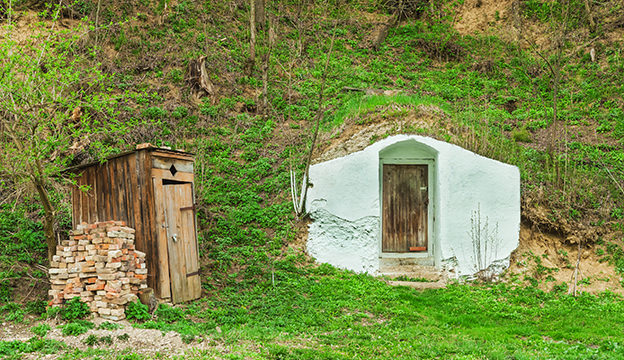
Certainly the most classic is that which is dug into the side of a hill. But many modern root cellars are dug down into flat ground, and feature a set of stairs that lead down to the door. Read more about one design.
In very cold areas, there may also be a second door at ground level to further insulate the cellar. Modern survivalists have been particularly inventive about constructing root cellars, and have made enormous root cellars from sections of metal culvert (these serving also in some cases as potential underground shelters in which people could live for long periods of time). In other cases, simple root cellars constructed from barrels, pallets or packing crates serve the purpose of creating an underground storage area for a quantity of emergency food.
Regardless of the specific style, the basis of any root cellar is the insulative value of the soil into which the cellar is dug. With only as little as one foot of earth above it, a root cellar dug into flat ground can create a temperature of 20 degrees less than the summertime temperatures above. Several feet of soil, optimally at least three or four, will suffice in most cases, but one must have a full 10 feet of soil above and alongside to ensure the maximum possible insulation and temperature stability.
An obvious rule of construction is to keep the doorway and any exposed parts of the structure in the shade during the day. Building on the north side of a hill or digging in the shade of your home or other building is one mandatory design principle.
The next consideration should be to design a structure that does not suffer from leaks or drainage problems during times of rain. This may require sloped doors, creating drainage ditches outside or positioning the floor level above the base level of the surrounding terrain.
As mentioned previously, the most flexible root-cellar design will include two chambers, one colder and more humid than the other. This complexity certainly makes construction doubly difficult, but will also double the variety of foodstuffs that can reasonably be preserved in the cellar. Making the drier section essentially the foyer that leads to the entrance of the innermost area is the usual method of dividing the two sections of a root cellar.
When planning the size of your cellar, general wisdom holds that an 8-foot by 8-foot area should provide plenty of storage space for the average family. Larger structures are certainly more luxurious, but also may be more difficult to insulate and maintain at an even temperature.
It is a good idea to use waterproofed wood in any construction, but be cautious of the chemicals in pressure-treated lumber. Treating wood with waterproofing materials can result in an environment in which stored food picks up the undesirable odors of the treated wood. If you can use bricks or concrete blocks for some parts of the construction, you may avoid some of those problems.
Remember to design and install a good ventilation system, and run a few smoke tests to make sure the intake and outflow vents create a siphon between them that moves air automatically through the cellar.
Finish your new root cellar with a thermometer and a humidity gauge, and from there observe and adjust until conditions produce the desired results.
This article first appeared in the June/July 2003 issue of Hobby Farms magazine.


 Ingredients

 When you live in the country, you get pretty handy at satisfying your cravings for your favorite restaurant food with home-cooked versions–after all, you can’t call for pizza delivery or run down to the corner for Thai food.