Categories
Recipes

Maple-Cinnamon Glazed Nuts

Maple Cinnamon Glazed NutsMarch is maple month!  Try this simple twist with salmon and learn more about how New England celebrates the maple harvest>>

Ingredients
2 cups mixed, raw or roasted, unsalted nuts of your choice, such as almonds, peanuts, hazelnuts, walnut or pecan halves and Brazil nuts
3 T. butter
2/3 cup brown sugar
2 tsp. maple extract
1/2 cup white sugar
2 tsp. cinnamon

Preparation
Line a baking sheet with foil. Butter the foil; set aside. In a large, heavy-bottomed skillet, combine nuts, butter, brown sugar and maple extract. Cook over medium-high heat, shaking skillet occasionally to combine ingredients and coat nuts, until sugar begins to dissolve. Do not stir. Reduce heat to low and cook for 5 minutes, stirring occasionally. Pour nuts onto prepared baking sheet and let cool completely.

Combine white sugar and cinnamon in a sturdy plastic bag; shake to combine. Break nuts into small clusters. Working in four batches, shake nuts in bag to coat with cinnamon sugar. Store tightly covered. Makes 2 cups.

Categories
Recipes

Farmhouse Cornbread with Fresh Corn Kernels

Farmhouse cornbread is a way to include the harvest

Get more autumn-themed treats here

Ingredients

  • 1 2/3 cups unbleached organic flour
  • 1 1/4 cups stone ground organic cornmeal
  • 2 1/2 teaspoons baking soda
  • 1 1/2 teaspoons baking powder
  • 1 teaspoon seasalt
  • 3 large or 4 medium freerange eggs
  • 1 cup organic buttermilk
  • 1/3 cup melted organic butter, cooled slightly
  • 1/3 cup local and/or organic honey
  • 2/3 cup fresh sweet corn kernels

Preparation
Heat oven to 425°. Grease a 9-inch square baking pan with butter.
In a large bowl, mix together the dry ingredients: flour, cornmeal, baking soda, baking powder, and seasalt.

In a separate bowl, whisk together the eggs, buttermilk, butter, corn kernels and honey. Pour this wet mixture into the dry mixture, stirring only until blended. Pour into greased baking pan and bake until a toothpick inserted in the center comes out clean, approximately 20 to 25 minutes. Check after 15 minutes to assess whether you need to cover with foil for the rest of the baking time because top has gotten very brown. Serves well warm from the oven with butter and honey.

More Breads and Baked Item Recipes 

Categories
Recipes

Ham-biscuit Spirals

Ham-biscuit SpiralsOne key to light, flaky biscuits is baking them quickly at a high temperature. Give your oven plenty of time to preheat.

Ingredients

  • 2 cups all-purpose baking mix, such as Bisquick
  • 2⁄3 cup milk
  • Enough boiled, country-style ham, thinly sliced (not shaved or deli-style), to cover an 8- by 10-inch area
  • 2 T. Dijon mustard

Preparation
Preheat oven to 450 degrees F. Stir milk into biscuit mix until just combined; do not overmix. Let dough sit for five to 10 minutes to firm slightly. On a well-floured surface, knead dough gently for about 30 seconds. Dough will be very soft. (If it’s too soft to work with, you can add up to a 1⁄2-cup more biscuit mix; again, wait a few minutes after adding mix because dough will firm up as it sits.) Press and then roll dough to form an 8- by 10-inch rectangle.

Spread mustard evenly over dough, not quite to the edges. Lay ham slices over mustard, overlapping them slightly if necessary to cover the area. Starting with an 8-inch edge, roll dough up as you would a jellyroll or pinwheel cookie dough. Moisten the edge and pinch to seal. Slice rolled dough into 8 equal portions. Bake on an ungreased cookie sheet for 10 to 14 minutes or until biscuits are set and lightly browned. Makes 8 biscuits. 

Categories
Crops & Gardening

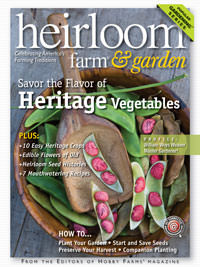
Heirloom Farm & Garden

Hobby Farms' Heirloom Farm & Garden
 
An Heirloom Tradition

Before the advent of hybrid technology, farmers saved seeds for the next year’s garden. These seeds sprouted new plants each season that were similar in appearance and taste to their parents. Seeds saved from generation to generation, known as “heirlooms,” are said to be seeds that have been saved for at least 50 years and grow true to their parents.

Unlike heirlooms, hybrid seeds can’t be saved in the same manner because they are cross-pollinations of plants and upon reseeding do not grow similar to their parent plant. Hybrids gained popularity among commercial farmers and backyard gardeners alike because of their disease resistance, uniform appearance and their ability to withstand travel and handling.

People today are becoming more concerned with what types of food they eat as well as how it is grown, which has also led them to seek more flavorful and healthy produce—heirlooms provide just that. Popular Gardening™ Series: Heirloom Farm & Garden has everything you need to know about saving seeds and growing heirloom produce and flowers. With beautiful photos and in-depth articles, Heirloom Farm & Garden is a must-have for every garden and food enthusiast.

What You’ll Find
The Popular Gardening™ Series is a collection of magabooks™ that covers farming topics of interest to small farmers with more editorial pages and fewer advertisements. The series is designed to provide valuable information to both those who already have a small farm as well as those who are pondering the big move to the country.

As an all-encompassing guide to raising heirlooms, you’ll find helpful and interesting information about all aspects of growing heirloom crops: what types of heirloom seeds are available, histories of rare varieties, how to control pests and boost soil fertility, how to preserve the harvest, how to save and start seeds, and ideas for cooking with heirlooms.

“The history of seeds is pretty straightforward, as you might expect. Man collects seeds from plants, man plants seeds the following year, man continues pattern in perpetuity …. In recent years, however, that circle has been fraught with controversy, one that pits 10,000 years of survival tradition against high technology. As heirloom gardeners and farmers around the world continue saving seed, propagating the best into next year’s plantings, multi-national agribusiness companies are introducing an increasing number of new technologies to challenge those age-old habits.” –Gretchen Heim Olson

Heirloom Farm & Garden has all the information you need to begin growing your garden produce and harvesting the seeds for future planting; all while enjoying the vivid colors, flavors and histories of these old-time varieties.

Start with Seeds
Saving seeds year after year may seem like daunting task at first, but the savings to your pocketbook and the delight to your tastebuds will reward you time and again. However, this is not the only reward for saving seeds. The process of saving seeds is also one of weaning out the weakest among a variety—saving only the best seed for the next planting season. This ensures genetic diversity and food security as well as stronger varieties that are less susceptible to disease and more tolerant of environmental conditions.

“Seed savers cite several reasons for preserving the garden’s offspring: assuring genetic diversity and thereby ensuring food security; breeding stronger heirloom and hybrid vegetable varieties for more nutrition, flavor, color, shelf-life, hardiness and disease resistance; and developing old varieties to be adaptable to a specific place and environment.” –Tom Meade

If you are looking for even more information on how to find, grow and save heirloom seeds, check out the Resources section for more references on all aspects of planting, saving and buying heirlooms.

How To…
From starting seeds to managing garden pests to harvesting seeds for the following year, there’s a lot to know about growing heirlooms. Popular Gardening’s Heirloom Farm & Garden can offer help. Get detailed, do-it-yourself plans for freezing, drying and canning your heirlooms, as well as hints from expert gardeners on how to create your own cloches and warming lamps. Also get food historian William Woys Weaver’s advice on how to select an heirloom variety and how to uncover its history in “A Scholar with Mud on His Boots.”

“Preserving heirloom plants by saving seed entails more than knowing how to prevent cross-pollination or how to properly gather, store and dry the seeds. It requires careful attention to selection as well.” –Cherie Langlois

Beyond the Seed
Popular Gardening’s Heirloom Farm & Garden brings you more than seed-saving tips. From transplanting seedlings to planning your garden layout to preserving your harvest to sharing your heirlooms as gifts, this is an adventure steeped in dazzling colors, Old World traditions and delectable flavors. The joy in growing your own food is the joy in savoring its delicious flavor and in providing good food for others to enjoy.

Discover how to build your garden with heirlooms that can be enjoyed year-round. Heirloom Farm & Garden has the tools and information to help you add a little history to your garden. It’s the essential resource for every heirloom gardener and farmer.

Back to All Popular Gardening Series Publications

Contents

History Sown in Seeds
Seed saving is an act necessary for human survival. Learn why it’s our duty to carry on tradition. 
By Cherie Langlois

A Taste of Yesterday
Heirloom varieties have their own unique histories. Find out what makes these top 10 crops worth growing.  
By Andy Tomolonis

Sprouting Seeds
Starting your own seeds, rather than buying seedlings, can free you from a pre-ordained gardening schedule.
By Andy Tomolonis

Planting the Heirloom Garden
Choose varieties and plan the arrangement of your heirloom garden to reduce pests and boost soil fertility.
By Jessica Walliser

12 Tasty Tomatoes
When it comes to flavor, heirloom tomatoes rule! Pick a few to entice your tastebuds.
By Sue Weaver

Our Edible Heritage
Cooking with heirlooms is a taste adventure. Try these recipes to discover the unique tastes and textures these prizes provide.
By Roger Yepsen

Gifts from the Heirloom Larder
Say “thank you” with a gift of goodies straight from your kitchen.
By Cheryl Morrison

Preserving the Heirloom Harvest
Learn to safely dry, can and freeze your heirloom harvest for year-round enjoyment.
By Cheryl Morrison 

Blooming Heirlooms
Vegetables aren’t the only plants with colorful pasts—think of heirloom flowers to add a bit of history and fragrance to your garden.
By Linda Tagliaferro

A History of Seeds in America
The business of selling seeds has a rather short but illustrious history. Learn where it’s been and where it’s going.
By Gretchen Heim Olson

Saving Seeds for Survival
Learn exactly how to save the seeds of some common garden crops. 
By Tom Meade

A Scholar with Mud on His Boots
Discover what inspires internationally known and respected food historian, professor, plant breeder and seed saver, William Woys Weaver.
By Cherie Langlois

Slow Down with Slow Food
Preserving dying culinary traditions is the mission of the eco-gastronomic association, Slow Food USA.
By Sue Weaver

Resources
Heirloom seed sources, planting guides, organizations and books.

Glossary
Heirloom and garden jargon defined.

Why We Love Them
Heirlooms are the original “local food.”

All Current Popular Gardening Issues

All Publications

 
Categories
Crops & Gardening Farm Management

Organic Farm & Garden

Organic Farm and Garden

An Organic Overview
These days, more of us almost seem obsessed with knowing exactly what we put into our bodies, and that contributes to the appeal of organic farming. Instead of overspraying plants with pesticides and adding synthetic fertilizers to the soil, organic gardeners use natural products to encourage growth and thwart pests and diseases. The results speak for themselves: delicious, nutritious vegetables, fruits and herbs to eat and enjoy.

Then there’s the fact that organic gardening is a lot of fun! It offers a great way to stay in touch with the seasons, enjoy the outdoors and get some exercise. When we select the vegetables, fruits, herbs and flowers best suited to our climates and soil types, we help our gardens reach their greatest productivity.

Whether you have an experienced green thumb or need a few tips, the second edition of Organic Farm & Garden™, part of the Popular Gardening Series™, can help you reap the benefits of your plot of land.

What You’ll Find
The Basics: One of the most important elements in a successful organic system is diversity. Learn about some of the most popular and easy-to-grow classic crops, including cabbage, carrots, potatoes, tomatoes, squash, corn, rhubarb, strawberries, blueberries and apples. Each profile includes expert-provided tips and techniques as well as growing instructions.

Soil Solutions: Healthy, productive soil naturally leads to an increase in plant vigor, pest tolerance, production outputs and animal health. Every organic farm begins with proper soil management, and we can help you achieve just that with recommendations for soil amendments, composting instructions and more.

Pest Control: Even the healthiest of organic gardens might be struck by pests and weeds. Find out how to rid your farm of these unwanted visitors the organic way.

Recipes: Once it’s been harvested, what’s a gardener to do with all that organic produce? Enjoy it, of course! That’s why you’ll find more than 50 recipes for salads, entrees, side dishes, desserts and beverages. These healthy, delicious recipes will help you savor the results of all your efforts.

Organic Farm & Garden™ will help you plant, grow, sustain and cook your very own harvest. Get out there and discover what organic gardening can do for your health and happiness.

All Current Popular Gardening Issues

All Publications

Contents

Go Green!
Make your farm or garden organic by following these simple tips.
By Linda Tagliaferro

Classic Crops
Use our expert advice to grow your favorite fruits and veggies.
By Andy Tomolonis

Sum Up the Soil
Set your garden’s foundation with these tips and techniques.
By Jessica Walliser

Designing Do’s
Our expert advice will help you plant your ideal organic garden.
By Deb Buehler

Compost, Naturally
Put bacteria to work in your garden.
By Jessica Walliser

Weed it Out
Rid your garden of invasive plants the organic way.
By Susan Brackney

Say Goodbye to Unwanted Visitors
Rid your garden of pests with these organic methods.
By Jessica Walliser

Basic Herbs
Learn about some of the most commonly grown herbs.
By Susan Brackney

Beautiful Blossoms
Adorn your garden with six of the most commonly grown types of flowers.
By Lindsay Evans

Throughout the Four Seasons
Extend the growing season to go green year-round.
By Andy Tomolonis

Canning Basics

Small Space, Big Yield
Learn how to grow bushels of organic fruits and veggies in space-saving container gardens.
By Wendy Bedwell-Wilson

Salads
Recipes for berry medley; spicy potato salad; tomato, cucumber and feta salad; carrot ginger salad; and harvest salad
By Rhoda Peacher

Entrees
Recipes for tomato pie, winter squash bisque, chicken-veggie kabobs, bibimbap, and summer cornucopia pasta
By Lisa Kivirist

Side Dishes
Recipes for cheesy zucchini potato pie, carrots and edamame with ginger-lime dressing, hot and spicy potato wedges, sugar snap peas with honey-teriyaki glaze, eggplant and red pepper medley, baked tomatoes and radicchio, and navy bean salad with lemon-garlic dressing
By Fiona Green

Desserts
Recipes for maple-pecan apple crisp, black cherry ice cream, summer berry tarts, crepes with honey-baked figs and cream, and strawberry-rhubarb pie
By Lindsay Evans

Beverages
Recipes for rhubarb ginger cordial, honeyed fig smoothie, cherry-watermelon vanilla froster, blueberry-basil mojito, and carrot-apple juice
By Jennifer MacKenzie

Glossary

Garden Wisdom

All Current Popular Gardening Issues

All Publications

Categories
Recipes

Curried Apple & Onion Sauté

recipes, sidedishCurried Apple & Onion SautéCurry, apples and onions combine for a unique side dish to try in your farm kitchen today.Food & KitchenCurried Apple & Onion SauteThis simple, somewhat sweet side dish is a wonderful complement to roast pork or turkey.

Ingredients

  • 4 firm, tart apples, cored and cut into wedges
  • 1 medium yellow onion, peeled and thinly sliced
  • 3 to 5 T. butter
  • 1 to 2 T. mild curry powder (depending on taste)
  • Salt and freshly ground black pepper to taste

Preparation
In a heavy-bottomed sauce pan over medium heat, melt the butter, add onions and sauté until they become translucent. Add the apples and continue sautéeing, adding one or two more tablespoons of butter if necessary, until apples are not quite tender (do not overcook). Add the curry powder, salt and pepper; toss to coat. Makes 4 side-dish servings.

More Side Dishes


Click here >>


Categories
Animals

Bird Bread

Have a favorite pet bird? Try this healthy, homemade bird treat.

Ingredients

  • 1 cup flour
  • 1 cup yellow cornmeal
  • ¾ tsp. salt
  • 4 tsp. baking powder
  • ½ cup frozen mixed veggies
  • ½ cup chopped broccoli
  • ½ cup dried fruits and nuts (We used cranberries, mangoes pineapples, cashews and coconut flakes.)
  • ¼ cup vegetable oil
  • 2 eggs (with shell)
  • 1 cup milk

Directions
Pre-heat oven to 350 degrees. Mix together the dry ingredients (flour, yellow cornmeal, salt and baking powder).
Add the frozen mixed veggies, chopped broccoli, dried fruits and nuts. Add liquid ingredients (eggs with shells, vegetable oil and milk). Mix together until smooth. Make sure to scrape the sides and the bottom of the bowl to ensure that all of the ingredients have been mixed together. Bake for 20-25 minutes or until the toothpick comes out clean from the center of the bread. Cool and cut into ½ inch cubes to eat and store the extra for later.

Categories
Beginning Farmers

Sheep, Horses and Corn – Learn About All Three!

Storey’s Guide to Raising Sheep
If you have a yen to raise livestock but don’t have the space for cattle, the authors of Storey’s Guide to Raising Sheep have news for you: You can breed sheep on a relatively small amount of land, and their book can help you do it.

Author Paula Simmons has been raising sheep her entire life, and co-author Carol Ekarius has also raised sheep in addition to being a livestock writer. Together, the team has created a book that serves as an excellent primer for keeping sheep, whether your goal is producing wool, meat, milk or pelts.

Storey’s Guide to Raising Sheep begins by giving good reasons why sheep make excellent livestock for small farmers. On the amount of land that can carry one cow and calf, five to seven ewes and lambs can easily live.
In order to successfully keep sheep, however, you need the right facilities and know how. This is where the book comes in. The authors start out with an overview of sheep farming, behavior and breeds (including black and white photographs of each), and segue into facilities. Pasture plants and land management have their own chapter, and rightfully so. The quality of facility management can make or break your sheep operation.

Following are two chapters focused on animals other than sheep: herding dogs and guardians. The chapter on herding dogs serves as an introduction to the concept of training and keeping a herding dog—an incredibly valuable asset to the large flock owner. In the chapter on predators and guardians, the authors do a great job of emphasizing the use of nature-friendly means such as guardian animals like dogs, donkeys and llamas and predator discouragement methods, rather than poison and guns.

In keeping with the book’s theme of being a thorough guide to raising sheep, the authors include chapters on nutrition, health, flock management, lambing, showing and marketing sheep products. While each of these topics could warrant an entirely separate book, Simmons and Ekarius do a good job of providing beginners with a general overview of everything involved in the keeping of sheep.
—Audrey Pavia

Horse Housing
“I wrote this book to horse owners, but for horses,” says co-author Richard Klimesh in his introduction to Horse Housing, How to Plan, Build, and Remodel Barns and Sheds. His point is well taken—if you’ve got building aspirations remember you’re the one who will have to do the work, but it’s the horses that have to live in the barn. Klimesh, along with his wife and co-author, Cherry Hill, don’t let readers of their book forget that basic fact.

However, owing to their backgrounds, the authors are also extremely sensitive to the importance of functionality and human comfort when it comes to good barn design.After all, Klimesh and Hill know horse barns. Klimesh studied architectural design at Iowa State University, is an accomplished carpenter, and has built and remodeled horse facilities throughout the United States and Canada. For her part, Hill has written several books on horse training and has been a trainer for over 30 years. She was also an instructor of university equine courses in the United States, as well as Canada, and has judged horse shows for over 25 years.

Whether building a new barn or just remodeling, the authors take you through the planning, design and building stages in great detail—from how to get a building permit to estimating and ordering concrete. Since most people have some budget constraints, Horse Housing provides extensive information regarding various building materials (along with the pros and cons associated with each option) in addition to 17 design plans to help get you started. From bare necessities, to the elaborate show barn, the authors never lose sight of important safety, comfort, efficiency and health standards. A vast resource directory for locating services and products, along with a glossary of more than 300 terms to help you better understand the “start-to-finish” process, can be found. Along with barn building, the book provides design and construction ideas for wash racks, tack rooms, arenas, hay and feed storage sheds, utility rooms, veterinarian/farrier areas and more. Horse Housing also has useful color photos (taken by the authors) so you can visualize the concepts being discussed.

For me Horse Housing is like my favorite gardening book: It collects a lot of dust just sitting on a shelf, but once I get started on a project, the book becomes a comprehensive tool I just can’t do without. Even if you don’t read it cover to cover, you will probably find some handy tips in Horse Housing that are well worth the read.
—TM

Corn: Roasted, Creamed, Simmered + More
The next time you consider serving corn as a side dish for supper, think again. Instead of the usual—corn with a little salt and butter (okay, maybe lots of butter)—how about “tastying-up” that side? Maybe a delicious blend of corn, oysters and a handful of exotic spice (better known as a little dish called “The Red Fox’s Cornmeal Oysters with Salsa and Remoulade”)? Or how about “Baked Tomatoes with Corn Custard”? Better yet, my personal favorite, “Shrimp Ceviche with Corn.”

If you need inspiration when it comes to serving corn for supper (or breakfast and lunch for that matter), be sure to check out Corn: Roasted, Creamed, Simmered + More by Olwen Woodier. With 140 luscious, imaginative, easy-to-prepare recipes using corn (including those mentioned above), this book offers something for every palate and every meal. Woodier gives us corn for breakfast, breads, soups, salads, starters and sides, main courses, snacks and sweets.

“I add corn to many dishes not only because I love its sweet flavor but also because it provides a splash of color when combined with dark green vegetables or when tossed on top of a salad or into soup,” says Woodier. “You can add a cup or so of whole kernels to practically any dish—meat, fish, or poultry—without diffusing the flavor or altering the liquid content. You will increase the nutritional quality and have more servings to go around.”

In addition to recipes, Woodier celebrates corn and all its glory with a brief chapter dedicated to the history of this important grain. Did you know that in 1950, fossilized wild corn pollen was discovered 200 feet below Mexico City and radiocarbon dating determined the pollen was 80,000 years old? This discovery confirmed that corn predated the arrival of humans in the Western Hemisphere and substantiated that corn is indeed indigenous to the North American continent.

The author also gives us lots of helpful hints regarding how to buy, prepare, freeze, dry and grind corn. So no matter what the weather brings, you can extend the summer season by enjoying the freshness of corn year-round by using tips from the book.

Woodier also provides detailed information regarding the various corn varieties, so depending on your region, you can learn to choose a corn that is sure to tempt your taste buds. In addition to the most common corn varieties, Woodier dedicates several pages to the subtleties of popcorn and flint or Indian corn (the decorative variety usually on full display at roadside produce stands this time of year).

As Woodier points out, besides savory flavor, corn provides high-quality nutrition. As a complex carbohydrate, corn is a low-fat energy booster that supplies protein, thiamin and fiber to the diet. Even the staunchest vegetable haters seem to go for corn (just ask any 8-year-old). So if maybe you’ve never considered corn to be an exciting food—or sole subject matter for a book—this seemingly simple sustenance is really quite complex as Woodier reminds us.

For some fabulous recipes calling for corn, along with tidbits of engaging background information regarding this hugely important staple, this cookbook is a great choice.
—TM

Categories
Recipes

Chicken Kebabs

Chicken KebabsThese light chicken kebabs recipe will have your mouth watering before you even get them to the grill. Skewer these in any way you like, but be sure to place the chicken between the peppers and pineapple to tenderize and flavor the meat.

Ingredients

  • 1 to 2 pounds skinless, boneless chicken breasts
  • ¼ cup plus 1 T. extra-virgin olive oil
  • 3 medium garlic cloves, minced
  • 2 T. soy sauce
  • Salt and pepper
  • 1 large pineapple, peeled, cored and cut into 1-inch chunks
  • 1 red bell pepper, stemmed, seeded and cut into 1-inch pieces
  • 1 green bell pepper, stemmed, seeded and cut into 1-inch pieces
  • 1 large red onion, peeled and cut into 1-inch pieces

Preparation
Cut chicken breasts into 1 1/4 inch cubes. Combine ¼ cup oil, garlic, soy sauce, ¾ teaspoon salt and ½ teaspoon pepper in a medium bowl. Add chicken, toss to coat, and marinate for 15 minutes. In a separate bowl, toss pineapple, peppers, and onion with remaining 1 tablespoon oil and season with a little salt and pepper. Thread chicken, pineapple, peppers and onion onto eight 12-inch metal skewers. Brush skewers with any remaining marinade. Grill kebabs over medium-high heat, turning skewers, until chicken is cooked through and juices are clear, about 10 to 12 minutes. Serve.

More chicken recipes …

Categories
News

NAIS Lawsuit Filed

Farmers opposed to the National Animal Identification System (NAIS), a U.S. Department of Agriculture (USDA) plan to electronically track every livestock animal in the country, have another group in their corner.

The Farm-to-Consumer Legal Defense Fund (FTCLDF) and Farm-to-Consumer Foundation moved to stop the USDA and the Michigan Department of Agriculture (MDA) over its mandatory implementation of the NAIS, according to a release.

Michigan, like the states of Indiana, Wisconsin, Illinois, North Carolina, and Colorado, have transformed the “Voluntary” NAIS into mandatory programs based on current state health programs, such as tuberculosis, pseudorabies, and brucellosis. 

Legal Defense Fund’s move to sue is the first example of legal recourse against NAIS and asks USDA/MDA to stop implementation immediately and to correct violations or face litigation with unspecified financial claims for relief.

Attorneys for the Farm-to-Consumer Legal Defense Fund sent a Notice of Intent to Sue letter to the USDA and the MDA asking that the USDA and MDA to “immediately suspend the funding and implementation of NAIS,” and “fully and fairly examine” whether there is even a need for such a program.

Taaron Meikle, Fund president, said that contrary to USDA’s claim, NAIS will do nothing to protect the health of livestock and poultry.
 
“At a time when food safety and costs are a concern, the USDA has spent over $118 million to promote a program that will burden everyone from pleasure horse owners to ranchers and small farmers to individuals who raise a few chickens or steers on their own land for their own use.”

Once fully implemented, the NAIS program would require every person who owns even one livestock or poultry animal (a single chicken or a pet pony) to register their property with the state and federal government, to tag each animal, and to report “events” to a database within 24 hours.

Reportable events would include such things as a private sale, a state fair, or a horse show.

The Notice charges that USDA has never published rules regarding NAIS, in violation of the Federal Administrative Procedures Act; has never performed an Environmental Impact Statement or an Environmental Assessment as required by the National Environmental Policy Act; is in violation of the Regulatory Flexibility Act that requires them to analyze proposed rules for their impact on small entities and local governments; and violates religious freedoms guaranteed by the Religious Freedom Restoration Act.

“We also think there are constitutional issues at stake here,” Meikle noted. “The requirement to use electronic ear tags or RFID chips violates the religious beliefs of some farmers, such as the Amish, and provisions in a memorandum of understanding between the USDA and the MDA could violate the Fourth and Fifth Amendments to the Constitution by requiring the state to stop and inspect vehicles carrying livestock without a warrant or probable cause.”

The MDA has implemented the first two stages of NAIS –property registration and animal identification – for all cattle and farmers across the state as part of its mandatory bovine tuberculosis disease control program, which is mandated by a grant from the USDA.

“While touted as a disease control program, the NAIS will drive many small farmers out of business” Meikle noted, “and burden every person who owns even one horse, chicken, cow, goat, sheep, pig, llama, alpaca, or other livestock animal with expensive and intrusive government regulations.”

Joe Golimbieski, a farmer from Standish, Michigan and Fund member, explains: “The cost of the tags is just the start. We’re at the mercy of whatever price the stockyards charge to do the tagging. And our farm doesn’t have extra employees to deal with paperwork. NAIS is likely to put us out of business.”

Gary Cox, General Counsel for the Fund, states that “USDA and MDA have exceeded their authority and they have completely failed to follow the proper procedures. We are calling on the agencies to immediately halt implementation of the program or face appropriate action.”

The Farm-to-Consumer Legal Defense Fund’s mission is to defend the freedoms and to broaden the rights of sustainable farmers and their consumers to produce and consume local, nutrient-dense foods. The Notice of Intent to Sue the (USDA) and (MDA) is available at www.farmtoconsumer.org

Top

Excerpts from the Lawsuit
The Notice charges that USDA:

  • Has never published rules regarding NAIS, in violation of the Federal Administrative Procedures Act;
  • Has never performed an Environmental Impact Statement or an Environmental Assessment as required by the National Environmental Policy Act;
  • Has failed to analyze proposed rules for their impact on small entities and local governments, in violation of the Regulatory Flexibility Act;
  • Violates religious freedoms guaranteed by the Religious Freedom Restoration Act.

Quote from Legal Defense Fund President

“We also think there are constitutional issues at stake here.

“The requirement to use electronic ear tags or RFID chips violates the religious beliefs of some farmers, such as the Amish, and provisions in a memorandum of understanding between the USDA and the MDA could violate the Fourth and Fifth Amendments to the Constitution by requiring the state to stop and inspect vehicles carrying livestock without a warrant or probable cause.”

                      – Taaron Meikle, Fund president

Related Articles