Categories
Animals Large Animals Poultry Urban Farming

Colostrum for Your Livestock Bottle Babies


Livestock babies need colostrum to survive early on


In this article …
What Is Colostrum?

A floppy-eared baby goat caroming through the house or a soft, black lamb to cuddle after supper–if there’s anything more fun and satisfying than raising bottle babies, I don’t know what it is.

There are lots of good reasons to raise bottle-baby livestock, including mine: It’s a relatively inexpensive way to add popular genetics to my breeding stock, the youngsters raised this way are friendlier and more easily handled than their dam-raised peers, and the satisfaction of successfully raising a favorite bottle-fed lamb or kid is priceless.

There are plenty of questions and preparation to consider, too.

Knowing whether you need colostrum or colostrum replacer is an important consideration when your raising a bottle baby.

What Is Colostrum?
Colostrum is the thick, immunoglobulin-rich, first milk that all livestock babies need to ingest in order to survive.

Colostrum Feeding Chart

DaysFeed
1-2Feed 2 to 3 ounces of colostrum every three hours
3-4Feed 3 to 5 ounces colostrum, gradually changing over to milk replacer, every four hours
5-14Feed 4 to 6 ounces milk replacer, four times a day
15-21Feed 6 to 8 ounces, four times a day
22-41Work up gradually to 16 ounces, three times a day
42 +Begin slowly decreasing the morning and evening feedings, leaving the middle feeding of 16 ounces, until you’ve eliminated the morning and evening feedings entirely (Baby will be eating his share of hay or pasture by then). Continue with one, 16-ounce bottle for two more weeks, then eliminate bottle feedings entirely.

Neonates’ immune systems remain nonfunctional for weeks to months, depending on their species. However, they’re born with the ability to absorb disease-fighting antibodies from their mothers’ milk, but only for a short period of time after birth.

A lamb, for example, should ideally ingest one ounce of colostrum per pound of bodyweight within one hour after birth and another three ounces per pound of bodyweight spread over eight to 12 feedings during its first 24 hours of life. After 12 to 24 hours, it can no longer absorb antibodies through the wall of its small intestine, so time is of the essence.

What If Babies Don’t Get Enough Colostrum?
Babies that don’t ingest enough colostrum are much more likely to succumb to disease during infancy. That’s why livestock-auction babies are an especially poor risk. If you buy one, you won’t know anything about his background and by being at the sale barn, he’ll be exposed to diseases he isn’t equipped to handle. If you succumb to a cute and needy sale-barn baby (and it’s easy to do), raise him indoors away from other livestock and watch him like a hawk: At the first sign of illness, rush him to a vet!

Colostrum Alternatives
If you’re willing to take a brand-new baby that hasn’t yet ingested colostrum, you need to have a supply on hand to feed him. Many breeders freeze it for emergencies, so ask around and locate some in case you need it.

Alternately, use an oral IgG (immunoglobulin) supplement designed for your baby’s species; they’re expensive, but they have a refrigerator shelf life of two years—if you raise many babies, sooner or later you’ll need it.

Seramune Equine IgG, Seramune Bovine IgG and Goat Serum Concentrate are typical IgG supplements produced by Sera, Inc., (www.seramune.com) for foals, calves and kids respectively (shepherds use Goat Serum Concentrate for newborn lambs, as well).

These are not the same thing as the powdered supplements (based on cow colostrum) that you’ll find on the shelf at your local feed store; if you don’t have frozen colostrum or an oral IgG supplement, try the powdered variety.

This article contains excerpts from Bottle Babies, by Sue Weaver, a Hobby Farms contributing editor. It first appeared in the March/April 2008 issue of Hobby FarmsBuy one online or subscribe today.

Categories
Animals

Sheep – The Other Dairy Animal

by Heather Smith Thomas

Around the world, sheep are raised for milk as well as meat and wool, and traditionally there have been more sheep milked than cows and goats combined.

However, the U.S. dairy sheep industry is in its infancy, and American production of sheep milk cheese is currently only about 450,000 pounds per year—a very small percentage of the worldwide total.

For More Information 

  • Carol Delaney, Small Ruminant Dairy Specialist
    Center for Sustainable Agriculture, University of Vermont
    Secretary, Dairy Sheep Association of North America
    (802) 656-0915
  • David L. Thomas
    Professor of Animal Sciences and Extension Sheep Specialist
    College of Agricultural and Life Sciences, University of Wisconsin, Madison
    (608) 263-4306
  • Yves Berger
    Researcher, Spooner Research Station, College of Agricultural and Life Sciences, University of Wisconsin, Madison
    (715) 635-3735
  • Dairy Sheep Symposium
  • Wisconsin Sheep Dairy Cooperative
  • Dairy Sheep Association of North America (DSANA)
  • Willow Hill Farm
    Sheep’s milk products and also handmade fleece blankets
  • Old Chatham Sheepherding Company
    Sheep’s milk products
    (888) SHEEP-60
  • Vermont Shepherd Sheep Cheese
    (802) 387-4473
    Vermont Shepherd holds several “Cheese Cave Open Houses” to provide the public with an opportunity to see how their cheese is made. The tours include cheese tasting, a tour of the cheese cave, and an explanation of the cheese-making process. Visitors can also view the dairy’s sheep on pasture.

However, the United States imports more than 70 million pounds of sheep milk cheese annually. The imported cheese goes to specialized gourmet markets and into the hands of savvy consumers. Thus, there is plenty of room in the market for our domestic production to expand.

SHEEP MILK AROUND THE WORLD
Sheep dairying is an important enterprise in many European, Middle Eastern and Mediterranean countries. There are more than 50 varieties of cheese, as well as various types of yogurt, ice cream and butter, made from sheep milk.

In France, Roquefort cheese is made from the milk of about one million Lacaune ewes, producing 16,000 tons of cheese annually. In Greece, 560,000 tons of ewe’s milk is produced each year and made into yogurt, many cheeses (including Feta) and about 4,000 tons of butter. Sheep cheeses from Italy include the hard Pecorino, and the light, fresh Ricotta. Manchego is Spain’s main sheep cheese.

In the United States, the dairy sheep industry is relatively new. According to David L. Thomas, professor of Animal Sciences and Extension Sheep Specialist at the College of Agricultural and Life Sciences, University of Wisconsin, Madison, in the early 1980s “Dr. William Boylan at the University of Minnesota developed the first research program with dairy sheep in the United States. His research program evaluated various domestic breeds of sheep for their suitability for commercial dairy production. His program provided needed information to the infant dairy sheep industry and gave the industry some public exposure.” In 1982, U.S. dairy sheep took center stage at the World Sheep Festival in Bethel, Mo. As a result of all the publicity, private sheep dairies began to pop up, such as Stuyvesant, N.Y.,-based Hollow Road Farm owned by Joan Snyder and established in 1985. The genetic research begun at the University of Minnesota has since been taken over by the University of Wisconsin, and continues at their Spooner Research Station, in Spooner, Wis.

Today there are approximately 100 dairy sheep farms in the United States, with flocks ranging from 25 to 250+ ewes, and this number is slowly growing. Commercial farms are spread out over the states of Maine, Pennsylvania, Vermont, New York, Wisconsin, Oregon and California, and there are many others that milk a few sheep, but are not considered producers.

The Dairy Sheep Association of North America was formed in 2002 by a group of sheep dairymen in Wisconsin, New York, Vermont and Quebec. They held their charter meeting at the 2002 Great Lakes Dairy Sheep Symposium held at Cornell University in November.

WHY MILK SHEEP?
Sheep’s milk, like goat’s milk, has a higher percentage of small fat globules than cow’s milk, making it easier to digest. Non-casein protein is twice that of cow or goat milk, which also enhances digestibility. Sheep’s milk is pure white and rich tasting, and since it is higher in fat and protein than cow or goat milk, it has a sweeter taste. Sheep’s milk is naturally very thick—most sheep milk is turned into cheese or yogurt, but it also makes a creamy, rich ice cream. Cheese made from sheep’s milk is creamier and ages more mildly than goat’s or cow’s milk cheese, and has its own special flavor, texture and aroma.

Many hobby-farm families have a few sheep, and milking them could provide additional income if a local market for the milk exists. Sheep thrive on marginal land with minimal feed supplements, and can provide a triple income from wool, meat and milk. A few families do it all themselves—milking the sheep, making the cheese and marketing it—but others simply sell milk to a processor.

Ewes can be milked by hand, but for a large flock it is essential to have a milking machine. Sheep can be milked with a cow or goat milker fitted with smaller teat cups and a faster pulsator (which regulates the speed of milking). For sheep milking, a proper pulsator must generally be imported since they are not made in the United States.

Dairy Sheep Association of North America (DSANA)

With over 70 American and Canadian members, the Dairy Sheep Association of North America (DSANA) held its charter meeting in November 2002 during the 8th annual Great Lakes Dairy Sheep Symposium hosted by Cornell University in Ithaca, N.Y.

The organization is a newcomer when compared to the centuries old dairy sheep associations in France and the British Sheep Dairy Association, created in 1982 by the late Olivia Mills. But with year after year success in cheese competitions such as the United States Championships (Wisconsin) and the World Championships (Chicago), as well as those sponsored by the American Cheese Society, North American dairy sheep farming and cheese making has gained legitimacy.

For more information about the Dairy Sheep Association of North America, visit www.dsana.org.

Sheep’s milk keeps well, and unlike goat’s or cow’s milk, it can be stored frozen without any loss of quality. Small dairies can collect and freeze it until they have enough to process or transport to a plant, and processors may pick up milk from small producers just once a month.

MILKING BREEDS
The major dairy breeds around the world are Awassi (Israel), Chios (Greece), East Friesian (Germany), Lacaune (France), Manchega (Spain) and Sarda (Italy). However, currently none of these can be imported as live sheep to the United States because of the risk of spreading the viral disease scrapie. The United States and Canada can import semen and embryos of the specialized dairy breeds from some countries under strict health protocols, which is being done. Due to breeding from those endeavors, East Friesian and Lacaune sheep are available in the United States and Canada.

In the 1980s, during the infancy of modern-day sheep milking, American producers made due with some East Friesian imports and the domestic meat and wool breeds, some of which produce milk better than others, but none quite so well as the specialized dairy breeds of Europe and the Middle East.

Joel and Cindy Teuscher started one of the first modern U.S. sheep dairies in the Northwest, in Geneva, Idaho. Joel began raising registered Columbia sheep in the 1970s, then added Suffolk, Rambouillet, Dorsets, Polypays and Natural Colored sheep to his flock. He began his dairy operation in March 1992, using their old family dairy barn and his flock of 200 sheep. He froze the milk for later shipment to a processing plant in Hinckley, Minn. 

Queens of Clean

Cleanliness and udder health in dairy sheep is very important. Somatic cell count (SCC) is a measure of the white blood cell count in milk. The SCC in milk of an individual ewe indicates her udder health status, and bulk tank milk SCC can indicate the general state of udder health in a sheep flock.

Somatic cells are always present in milk, but the SCC will rise when an infectious agent enters the udder or when the udder has been injured. A major consequence of rising SCC is a decrease in raw milk quality, which has implications for milk processing.

Milking clean and dry teats is very important to reduce SCC and udder infection. Apply a teat disinfectant that covers the entire teat and wipe dry with a single use towel prior to milking. Apply a teat disinfectant immediately after milking.

Maintain dry and clean facilities to minimize bacteria load that the udder and teats are exposed to; also make sure pens are well bedded.

Source: Ministry of Agriculture and Food, Ontario, Canada

More on Wisconsin dairying…

The Teuschers found that ewes that suckled only one lamb had a higher incidence of mastitis, but Joel solved that problem by milking those ewes once a day while the lambs were growing up, feeding that milk to orphan lambs. They then started milking their ewes 30 days after lambing, weaning the lambs (which were started on grain soon after birth so the weaning process was not stressful).

Some ewes had poor dispositions for milking, say the Teuschers. Most would come into the barn with no hesitation in order to eat their grain, but some resisted and didn’t want to be handled. Suffolks faired better than some other breeds, and since they have less wool on their udders and legs, they are also easier to clean and milk. The Teuschers found some of their ewes were better left to raise lambs than to be milked.

Dr. William Boylan, who started the University of Minnesota dairy sheep project for genetic research in the 1980s got an average of 125 pounds of milk per ewe, per 120-day lactation cycle, from a variety of breeds. These ewes were milked from the time their lambs were weaned at 30 days of age until the ewes dried up. The best milking ewes in the Minnesota dairy project were Suffolk (averaging 143 pounds of milk) until Dr. Boylan acquired Rideau Canadian ewes that averaged more than 159 pounds of milk per lactation cycle.

IMPROVING MILK PRODUCTION
The milking ability of any breed can be improved with selective breeding and heavy culling, and that includes U.S. dairy sheep. In the early 1990s U.S. production averaged between 97 and 170 pounds of milk per ewe, but some U.S. sheep now produce 500 pounds in a 200-day lactation cycle. Today, some flocks with East Friesian, Lacaune and crossed ewes average 500 to 600 pounds of milk. Dairy sheep in Europe and the Mediterranean produce between 300 and 1,400 pounds, but since many of these breeds aren’t currently available to U.S. dairy farmers American producers are continually looking at ways to improve their breeds’ production.

Sheep dairymen can speed up genetic improvement by sharing top sheep from many regions, using group breeding, ram circles and artificial insemination. Group breeding, a system that involves several producers with the same goals forming a cooperative, is used by sheep industries in New Zealand, Australia, South Africa and the United Kingdom. In group breeding, the performance of all animals is evaluated, and the best ewes and rams are put into a nucleus breeding flock that is managed by one of the breeders in the cooperative. The best rams are used within the nucleus flock and the next best go to the group members, who continue to send their best replacement ewes to the nucleus each year. This system can result in up to twice the rate of genetic improvement in cooperative flocks than in traditional within-flock selection.

In a ram circle, a group of dairy sheep breeders who live close together share each other’s rams during the breeding season, rotating them around. Artificial insemination is an easier means for speeding up genetic improvement, but can be expensive and is not always reliable, due to the anatomy of the ewe’s reproductive tract and the less-than-ideal quality of frozen ram semen.

SHEEP DAIRYING TODAY
David and Cynthia Major operate Vermont Shepherd, a sheep dairy in Putney, Vt. They began in 1988, milking sheep and making cheese, after traveling to the French Pyrenees to learn firsthand from experienced cheese makers. “Our operation has grown, to where we are now milking 170 sheep, on a seasonal basis—when there’s pasture,” says David. They make Vermont Shepherd Cheese, an aged, raw milk sheep cheese, and two types of cheese from cows’ milk. “We work with a couple of other sheep dairies in the area, doing cooperative curing of cheeses,” he says. The Majors had always wanted to go into sheep farming, but low prices for wool and lambs in the 1980s led them to explore the cheese market.

Wisconsin Sheep Dairying

Of the 100 dairy sheep farms in the United States, Wisconsin hosts 25, making it the largest sheep-milk producing state in the country. The Wisconsin Sheep Dairy Cooperative is the only sheep dairy coop in the nation. Formed in 1996, it markets the milk produced by its 20 member farms across the Midwest. (It marketed roughly 420,000 pounds of sheep milk in 2002, at about $60 per 100 pounds.) By pooling the milk, enough can be provided to cheese makers for commercial production, ensuring a stable market.

University specialists have helped sheep dairies standardize production, develop systems to test milk for quality and work toward a branded product. Scientists at the University of Wisconsin at Madison are helping with genetic research. Dave Thomas, of the College of Agricultural and Life Sciences, is establishing and evaluating European dairy sheep in the United States. “Until the early 1990s there were no true dairy sheep in this country,” says Thomas. “Producers only had breeds that had been selected for lamb and wool production. That’s like trying to start a dairy with beef cows.”

In 1993, the University was able to purchase two East Friesian rams. Thomas began crossbreeding and found that the hybrids produced twice as much milk as non-hybrids. In 1998 the University obtained Lacaune sheep and today this research flock is kept at the Spooner Agricultural Research Station in northern Wisconsin.

“There is a growing interest, and there are a number of people milking sheep the way the small-scale farmers have milked goats for years,” says David. The Majors increased their milk production significantly through selective breeding and now have a profitable product they sell to restaurants, specialty food shops, mail-order and Internet sales as well as at their farm. Demand for “farmhouse” cheese led them to teach other Vermont farmers how to milk sheep and make raw cheese. In 1995 they began conducting workshops and six-week internships for prospective dairy sheep farmers. 

The Majors ripen their cheese for four to eight months in a former apple storage facility they call the “cheese cave.” Each wheel of cheese is turned and brushed every other day to develop its flavor to the fullest. Vermont Shepherd cheese consistently placed in the top two for Farmhouse Sheep’s Milk Cheese by the American Cheese Society from 1993 through 1999. Their cheese also won “Best of Show” at the American Cheese Society’s annual competition in California in 2000, and Best of Class, Sheep’s Milk Cheese, United States Championship Cheese Contest in 2001.

The first year the Majors milked sheep, each ewe produced an average of 60 pounds of milk in just over two months of milking. By 2000, the average production was up to 340 pounds per ewe for a six-month milking period and today it is 500 pounds. “The difference is due to improved genetics and better management; production on our farm has been going up 20 to 30 percent per year,” says David.

The amount of milk produced by sheep, compared to milk cows, is small, but sheep dairying takes less investment, and sheep’s milk sells for five times more than cow’s milk. For sheep producers who want to process their own milk or find a market for it, sheep dairying can be a way to increase the income from the flock.

About the Author: Heather Smith Thomas is a rancher and freelance writer based in Salmon, Idaho.

This article first appeared in the June/July 2003 issue of Hobby Farms magazine. Pick up a copy at yourlocal newsstand or tack and feed store. Click Here to subscribe to HF.

Categories
Animals Equipment Farm Management

Why Have a Farm Disaster Plan?

Preparing a disaster plan for your farm is critical for owners of small and large farms alike. Every year, disasters strike, leaving people and animals injured or dead and property damage that on a national level runs into the billions of dollars.

Although the word “disaster” usually implies big events, disasters can also be personal events, like a house or barn fire, or local events, like a chemical spill.

For those of us living in rural communities, it’s especially important that we be prepared because community services are often limited, and local responders—like police, fire and medical personnel—could be many miles away or quickly overwhelmed by the scope of a major disaster.

Farm Disaster: A Hard Lesson Learned
Laurie Glauth is a rancher outside of Woodland Park, Colo. In the summer of 2002, she learned many hard lessons about disaster when the 137,000-acre Hayman fire burned through her ranch.

Glauth grew up in Woodland Park, where her dad was a self-employed land surveyor and engineer. When her dad settled the family in Woodland Park in 1966, it was a sleepy, western ranching town with a little bit of summer tourist traffic. She first came to the 800-acre ranch with her dad, who purchased calves for her and her brother’s 4-H projects from the brother and sister ranch owners, George and Zelma Warden. Over the ensuing years, Glauth, who owns a health food-store and holistic-health center in Woodland Park, stayed in contact with the Wardens, helping them out as the need arose.

By the time Zelma Warden died in 2001, Woodland Park had become a bedroom community for the city of Colorado Springs, and land values were skyrocketing for prime development land like the Warden ranch, which was completely surrounded by the Pike National Forest.

“Zelma knew what she didn’t want to happen to the ranch when she died, and that was development,” Glauth says. “She didn’t want it subdivided. She had no children, and no local family members who would work to keep the ranch a ranch, so she set up a trust for her estate, and made me the trustee.”

For most of us the thought of having someone give us a ranch sounds like the dream-of-all-dreams coming true, but for Glauth, it was a big undertaking. During the winter of 2001, she moved everything out of the main house at the ranch to perform some needed renovation work; she stored everything—furniture, clothing, antiques and journals, in a cabin on the far corner of the ranch. Her plan was to spend the next year or so going through the collected goods of the Warden family, and disposing of things according to Zelma Warden’s instructions. When the Hayman fire started on June 8, 2002, Glauth was a couple of weeks behind on her work.

“I didn’t realize it, but the bulls got separated from some of the cows while they were out on the range during the breeding season, so we ended up with a bunch of late calves,” Glauth says. “Typically, the cattle should have been out [on a forest service allotment] on June 1, but we were running a week or two behind, so when the fire broke out, we were just branding at the ranch.”

“The day that the fire broke out, we could see those huge white clouds rising straight up in the blue sky,” Glauth says. “We didn’t know what was going on until later that evening when we saw it on the news.”

Over the coming days, Glauth and her brother monitored the fire, though for the first week or so, it was far north and west of the ranch. Around June 15, the wind shifted and the fire made a quick dash to the south. Glauth was told she had four hours to evacuate the ranch. But two hours after the evacuation notice, the wind changed again, and she was given a reprieve. Glauth decided to begin moving the livestock anyway.

She enlisted the help of friends and neighbors to evacuate the cattle. The first stop was Glauth’s mom’s place, about 7 miles south of the ranch. But that area was soon posted for possible evacuation, so the cattle had to be moved again. Troops of neighbors and area ranchers responded to help, and a rancher about 30 miles away took the herd for more than a month.

Two days later, the fire moved south again, this time burning over the ranch. By some miracle, the main ranch buildings survived, but the cabin that had the accumulated effects of the Warden’s burned and all around the building, the forest was nothing but black sticks.

Prepare Your Farm for the Worst
One of the best ways to be prepared is to develop a disaster plan before disaster strikes.

“You don’t want to be thinking about what you’re going to do in an emergency situation for the first time, as that crisis is occurring,” says Lara Shane, spokesperson for the Federal Emergency Management Agency, the lead federal agency for emergency response.

FEMA urges people to do three things:

  1. Have a plan.
  2. Have a disaster supply kit.
  3. During a disaster, listen to your local emergency managers. These officials will help guide you safely through a crisis.

If you have pets or livestock, make sure your plan addresses their needs.

“Animals are generally not allowed in emergency shelters, so if you have to evacuate, you need to know where you can take your animals,” Shane says.

“When you have animals, you have a responsibility to look out for them,” Glauth adds. “If you live in a wildfire area, you shouldn’t plan a trip in June or July. Now, I will have a plan for how I can handle the cattle, wherever they happen to be at any given time. My neighbors know my dogs and cat are in the house if I’m gone, and they know where a key is to get them out.”

Rely on Yourself, Not Government
Ultimately, government emergency personnel will try to help, but it’s up to you to protect yourself in the case of an emergency. Plan ahead to assess and address the risks, and take actions to reduce risks. For example, if you live in a wildfire zone, provide defensible space by thinning brush and trees around your home and barn. If you live in a flooding area, obtain flood insurance. If you live in a tornado belt, construct a tornado shelter.

Your county emergency response personnel or local fire department can help you define your vulnerabilities, but it is really up to you to take the steps to protect yourself, your family, your property and your future.

One year after the Hayman fire, Glauth is thankful for the insights she’s gained.

“There’s an inherent risk wherever you live,” she says. “But you live there because you enjoy it. There are no guarantees in life. Every day that we get into a car and drive, we take risks. There is nothing that is super safe in this world or this life, but we can’t live our lives in fear either. I think the best we can do is be prudent and observant of our environment. The best we can do is to be stewards and do what is ecologically correct for our environment.”

This article first appeared in the June/July 2003 issue of Hobby Farms magazine.


Categories
Animals Large Animals

Florida Cracker and Pineywoods Cattle


Hobby Farms MagazineOn September 25, 1493, Christopher Columbus’ fleet of 17 ships departed Cadiz harbor in Spain for Hispañola, the island that now comprises Haiti and the Dominican Republic.

Aboard his ships were 1,200 colonists and everything they needed to settle Spain’s newest colony, including “ … a few horses for cavalry service … mares, sheep, heifers and other animals.”

At the Canary Islands, they took on additional calves. When they walked down the gang plank at Mole St. Nicholas, they were the first cattle to set hoof in the New World.

By 1512, stock-raising was well established throughout the West Indies.

Top

A Little American Cattle History
However, it wasn’t until 1521, when Juan Ponce de León, with two ships of colonists and a complement of livestock including seven head of Andalusian cattle, landed on the southeast coast of Florida, that cattle first touched North American soil in what is now the United States.

The Calusa tribe of Native Americans attacked the party and Ponce de León took a poisoned arrow to the shoulder. His ships returned to Cuba, leaving the livestock behind.

Florida Cracker cattle are a landrace breed great for hobby farmers

© Jeanette Berenger/ALBC

Landrace? What’s That?
Many of the heritage livestock breeds we spotlight in Hobby Farms—Pineywoods and Florida Cracker cattle included—are referred to as “landrace” breeds.

Landrace breeds are what their name suggests: races adapted to thrive in a specific land or locality, like Pineywoods cattle and Spanish goats in hot and humid regions of the South.

Landrace breeds are often divided into individual strains further adapted to a family or group’s intended use, such as the Griffen strain of dairy-type Pineywoods cattle developed by William Griffen in southern Mississippi and the meaty, cashmere-bearing Syfan line of Spanish goats shaped by Tom and Meta Syfan in Mountain Home, Texas.

Landrace breeds aren’t bred for uniformity in the manner of standardized breeds; they’re consistent enough to be recognized as distinct populations, but they vary in appearance more widely than individuals of standard breeds.

Most landrace breeds evolved in isolated, sometimes compromised environments outside the mainstream production of their species.

Within the breed, human input into selection is frequently minimal.

Apart from Pineywoods and Florida Cracker cattle and Spanish goats, examples include Rocky Mountain, Mountain Pleasure horses, Randall Lineback cattle, Mulefoot hogs and Gulf Coast Native sheep.Top

More Spaniards followed. In 1540, Don Diego Maldonado brought large herds of cattle and horses to the Pensacola Bay area to supply Hernando de Soto’s ongoing exploration of the Spanish Southeast. He failed to make contact with de Soto’s expedition and many animals were left to run wild or given to native tribes.

Historians believe the Spanish brought fewer than 300 cattle to the New World.

The cattle they brought, however, were tough, rangy animals noted for their wild coloration, hardiness, longevity, long horns and leanness. These multiplied on ranches and in the wild, in very short order.

Known as criollos (Spanish cattle born in the New World), they became the Corriente of Mexico, Texas Longhorns and two landrace breeds in the Southeast: Florida Cracker cattle and the Pineywoods cattle of Mississippi, Alabama and southern Georgia.

Top

Two Peas in a Pod (Almost)
Pineywoods and Florida Cracker cattle resemble one another in numerous ways.

They are small cattle, most falling in the 600- to 1,000-pound range, with light to moderately heavy bone and muscling.

Adults have short, shiny hair coats during the summer months.

Both breeds sometimes have “guinea” or dwarf cattle, much smaller versions with shorter heads and shorter legs.

They exist in a huge array of solid and spotted colors, including Longhorn-type speckles, linebacks and roans.

Most are horned; horn styles vary widely from small, Jersey-like curved horns to large, up- and back-swept types.

They’re long-lived, prolific, great mothers and remarkably easy keepers, quite able to thrive on mediocre pasture without grain.

Both evolved in the deep South where they’ve been known by names as diverse as “woods,” “brush,” “scrub” and Florida native cattle.

Top

The Difference Between Them
What is the difference between Pineywoods and Florida Cracker cattle?

“Both Florida Cracker cattle and Pineywoods cattle are unique, Spanish-based, heritage breeds,” says Steven Monroe, manager of the Florida Department of Agriculture’s herds of Florida Cracker cattle.

“Both breeds have been and continue on a parallel course. They include unique strains of cattle that have been maintained independently of each other for many generations.

“Any of the separate strains of Florida Cracker cattle would fit the breed standards of the Pineywoods cattle. This would likely be true of Spanish-type cattle found throughout the Americas, if they could be found.

“The breed known as Florida Cracker cattle,” he continues, “includes cattle from Florida farms and ranches that were maintained without the added influence of ‘modern breeds.’

“The same can be said for Pineywoods cattle. The foundation cattle for the Florida Cracker Cattle Breed Registry were evaluated and selected in 1989 through 1991 from known herds that had intentionally been kept free of influence from introduction of other breeds.

“Only cattle considered to be the purest representatives of Florida’s range cattle were included in the foundation registry.

Hardy Cattle … For You

To the left is a list of associations for the cattle
© Jeanette Berenger/ALBC

Florida Cracker Cattle Association
c/o T. A. Olson
University of Florida Animal Science Dept.
P.O. Box 110910
Gainesville, FL 32611
352-392-2367

Pineywoods Cattle Registry and Breeders Association
183 Sebron Ladner Rd.
Poplarville, MS 39470
601-795-4672

Cowpen Creek Farm
Jess, Julie and Billy Frank Brown
183 Sebron Ladner Rd.
Poplarville, MS 39470
601-795-4672

“Colonial Spanish Cattle in the USA: History and Present Status,” by D.P. Sponenberg and T.A., Olson
https://dialnet.unirioja.es/servlet/fichero_articulo?codigo=278744&orden=90532

“The Introduction of Cattle into Colonial North America,” by G.A. Bowling
www.dairy-science.org/cgi/reprint/25/2/129

The Criollo: Spanish Cattle in the Americas, by John E. Rouse (University of Oklahoma Press, 1977)

Florida Cowman: A History of Florida Cattle Raising, by Joe A. Akerman (Florida Cattlemen’s Association, 1977)

Top

“Cattle that “looked right,” but were not from traceable heritage were not evaluated or considered for the foundation registry. Some cattle of the Barnes strain from Alabama were included as the Barnes cattle ranged in Florida, Alabama and Georgia.”

The Barnes strain is also recognized by the Pineywoods Cattle Registry and Breeders Association.

Kept by the Barnes family near Florala, Ala., a hop, skip and jump north of the Florida panhandle, they once numbered as many as 500 head.

As was true of free-range livestock in earlier days, the cattle ranged widely and received little care; they were expected to make their own way.

Barnes cattle varied widely in size, coloration (“white, blue-sided, red-sided, red-pied, black-pied, strawberry-speckled, and solid colored,” says W. H. Barnes, who still keeps these cattle on the Barnes family farm) and horn type; some were polled, but most had horns. The family consistently culled any cow that failed to calve annually (one Barnes cow calved at 31 years of age), and no bulls bred outside the herd were used since 1910.

When asked about the Pineywoods cattle raised by his family at Cowpen Creek Farm in Poplarville, Miss., Jess Brown, president of the Pineywoods Cattle Registry and Breeders Association, says, “Milk and meat, they fed my family for over six generations. They’re gentle and easy to handle so they make good oxen; my great-grandpa had 25 yoke of them to help log the virgin ‘yeller’ pine forests of south Mississippi.

“Their hides were used for chair bottoms, rugs and other leather goods, and horns were used for making ‘blow horns.’

“They’re self-sufficient, tough and hardy. They produce rich milk and good, lean beef, and they’re ideal for weed and brush control. Pineywoods cattle pasture well with multi-farm species like the Native Gulf Coast Sheep that shared the longleaf pine forest for years, and they’re heat tolerant and resistant to disease.”

Top

The Key to Their Survival
That last point, in a nutshell, is why Spanish cattle survived in the Southeast for so long.

Heat and humidity, coupled with parasites and diseases endemic to the American Southeast, quickly eliminated introduced cattle for hundreds of years.

Native cattle exposed as calves to diseases like babesiosis and anaplasmosis developed immunity while imports succumbed.

It wasn’t until heat- and disease-resistant Zebu (Brahman) cattle arrived in the 1930s that native Spanish cattle started to falter.

Crossbred calves sired by Zebu bulls thrived and rapidly grew to market size, so purebred Spanish populations declined until by the 1970s very few Florida Cracker and Pineywood cattle remained.

Fortunately, a few intrepid farm families held onto their hardy cattle, never introducing “new, improved blood.” Thanks to their foresight, the breeds survived. Now they’re making slow-but-steady comebacks.

Top

Florida Cracker Cattle
During the late 1500s, Jesuit and Franciscan friars established a series of missions in north and north-central Florida; they maintained extensive herds of livestock, making them the first cattle ranches in North America.

Private ranches emerged in the 17th century. During the early 1700s, Spanish census takers counted 20,000 head of cattle on the ranches alone (herds owned by the missions, those kept by Native tribes and feral cattle weren’t counted).

Homesteaders of northern-European descent began settling Florida in the 1800s. Wild native cattle were theirs for the taking.

Sometimes herds were immense. A Polk County tax census dated 1862 indicates the number of cattle owned by landholders in this mid-state county: N. R. Raulerson owned 2,515 head of native cattle; William Holden, 1,800; W. H. Willingham, 1,550 head.

Staggering numbers were possible because the cattle ranged wild and virtually took care of themselves.

During the American Civil War, Florida supplied the Confederacy with an estimated 50,000 head of beef.

After the war, while the rest of the South lie in ruins, Florida established a viable economy based on cattle sales to Cuba. Cowboys called “crackers,” so named because of the 12-foot bullwhips they cracked to keep their charges moving, drove cattle from points of origin to the docks of Tampa, Manatee and Punta Rassa; in a 10-year period from 1868 to 1878, 1.6 million head of cattle boarded ships bound for Cuba, Nassau and Key West.

Cracker cowboys also moved herds along old military roads to Gainesville, then north to rail lines in Atlanta and Savannah. The drive from central Florida took 45 days, and the cattle fed themselves along the route.

The introduction of European beef and dairy bulls in the late 1800s had little impact on Florida’s stalwart Spanish cattle, primarily because they rarely lived long enough to reproduce.

Zebus were another story. By the 1960s when only a few hundred pure Spanish cattle remained, the Florida Department of Agriculture and Consumer Services stepped in.

In 1970, Zona Bass and Zetta Hunt, daughters of pioneer cattleman James Durrance, donated five purebred heifers and a bull from their father’s herd, on behalf of the Florida Cattleman’s Association.

The Department of Agriculture kept them at the Agricultural Complex at Tallahassee, eventually establishing a herd at the Withlacoochee State Forest. Herds based on Durrance and additional old bloodlines were sent to Lake Kissimmee State Park and Paines Prairie State Park during the 1970s. Meanwhile, a few old families kept privately owned herds.

In 1985, a selection and screening program was developed based on evaluations by a panel of three approved cattlemen who compared cattle from old family lines against archival photographs of Florida native cattle. They eliminated individuals with atypical characteristics or coloration.

The Florida Cracker Cattle Association and its sister organization, the Florida Cracker Horse Association, were incorporated in 1988.

In 1989, the Florida Department of Agriculture and the cattle association hosted the first Florida Cracker Cattle Association Cracker Gatherin’ at the Withlacoochee State Forest near Brooksville, Fla. The 2008 event takes place November 7 and 8 and includes public auctions of registered Florida Cracker cattle and horses from private and state-owned herds.

Top

Pineywoods Cattle
Pineywoods cattle evolved further north in the longleaf pine forests from which they take their name.

The vast Piney Woods region of the American Southeast once stretched from eastern Texas through Louisiana, Mississippi and Alabama to southern Georgia and northernmost Florida, carpeting more than 70 million acres with virgin pine, scrub oak, hickory and prickly pear cactus.

When European settlers began homesteading the area in the 1800s, old-growth pines so thick it took 20 men stretched hand-to-hand to measure their girth towered 150 feet into the air.

Pine thrived in the sandy soil of the Pine Belt, but the soil wasn’t suitable for growing cotton. So, instead of razing the land as occurred in more fertile regions of the South, homesteaders claimed their home sites, built cabins with the logs they felled and carved out a hard, subsistence life.

To do so, they needed oxen for draft power, milk cows, hides for leather and beef to fill the family larder. Wild cow-catching provided the cattle for their needs.

Separate strains evolved on family farms in the region, each selected for slightly different qualities.

Broadus cattle were medium-sized and blocky; the Ezell and Dedeaux cattle were chunky and short.

Other Pineywoods, among them representatives of the Ladiner and Hickman strains, were tall and rangy cattle.

Today, the Pineywoods Cattle Registry and Breeders Association recognizes 20 separate family or regional strains, five of which are deemed extinct.

As in Florida, most hardy Pineywood strains were lost due to outcrossing with non-native cattle during the mid- to late 20th century.

The Pineywood Cattle Registry and Breeders Association was chartered in 1999 to preserve and promote the remnants of this worthwhile, Southern heritage breed.

Top

This Is Where You Come In
Pineywoods and Florida Cracker cattle are both listed as Critical on the American Livestock Breeds Conservancy’s Conservation Priority List and Slow Foods USA’s Ark of Taste.

Additional dedicated conservators are sorely needed.

Jess Brown offers advice to readers interested in keeping these breeds: “Do your homework. Research. Talk with breeders and have a farm plan to fit your particular farm. Try them for dairying, beef production, and as oxen for logging and plowing.

“These cattle helped my family survive for generations and there’s no reason they can’t still help us survive today, when grain and fuel prices are having such an economic impact on farm production.

“My family didn’t call Pineywoods cattle ‘Rakestraws’ for nothing—it’s because they survived the winter months by raking the longleaf pine straw back with their horns and muzzles to find grass that was protected from the frost.

“On the open range they wintered on cane-filled reed brakes and acorns. They’re hardy and productive.

“Pineywoods beef is lean and delicious. Several top chefs in New Orleans and New York had one common complaint: ‘Not enough fat, but still a very flavorful taste.’ The cuts of meat are smaller, too. But to be healthy, we need less fat and smaller portions, so are these really weaknesses? No!”

Florida Cracker and Pineywoods cattle are arguably the ideal breeds for low-input, grass-based farming in the South—and they need our help to survive. If you’re casting about for a true-blue, American heritage breed for your farm, take these great little cattle to heart.

This article was first published in the November/December 2008 Hobby Farms.

Categories
Equipment

Build The Ideal Barn

We’ve all dreamed of our ideal barn at one time or another.

If we could throw the budget out the window and either refurbish our old barn or build a new one for which no expense was spared, we would have the most beautiful—and practical—ideal barn (and barn amenities) we could ever hope for.

  • It would be an architectural marvel and a model of efficiency.
  • It would be cool in the summer, warm in the winter, and clean, airy and comfortable for our animals.
  • It would be the kind of ideal barn we would enjoy spending a lot of time in and be proud of.

Of course, not everyone shares the same wants and desires in an ideal barn. The characteristics and barn amenities that comprise the ideal barn depend not only on the type of animals we have, but also on what we do with those animals, plus our personal preferences, location and size of operation.

The wish list of a professional horseperson is going to be very different from that of the hobby farmer raising dairy goats or cows.

There will be, however, many similar characteristics. Whether your barn is for horses, dairy animals or a variety of other livestock, here are some features and amenities that will define it as “ideal.”

An Ideal Barn Needs an Ideal Setting

Where the ideal barn is located is just as important as its size, style and function. If you’re considering building a new barn, the site should be chosen carefully.

Consider factors such as ease of access for large and small farm equipment. If you plan on storing enough hay to last you through the winter, you will want to make certain that vehicles can access the barn. You also need to consider drainage, water runoff, exposure to the elements and room for possible future expansion.

If you envision your herd of 10 someday doubling or tripling in size, plan your site so that you can add on to your barn in the future. Situating the structure so that it takes advantage of available light, shade and breezes will aid in year-round temperature control.

Because building a new barn is a major construction project, you will want to enlist the services of an architect, site planner or barn manufacturer that also offers site planning with their services.

Site preparation, including how the foundation is laid and how plumbing, electrical and water lines are installed, directly affects how the building itself will perform over the years.

For this reason, many reputable manufacturers of prefabricated barns are also general contractors who manage the entire project. If the barn will be used for a dairy business, then not only will local building codes need to be met, but state and USDA requirements, as well.

The planning stage of a new barn is an ideal time to seriously consider solar power. Though solar power is thought to be more expensive initially, it might be a more viable option than running power lines over long distances. And even if solar energy is more expensive to install, it will pay for itself over time in saved energy costs.

Solar energy can be used to heat both water and your barn during cold winter weather without the substantial heating bills. Active solar heating systems, which utilize heat boxes and fans, warm the air. Passive solar designs, where the barn is designed to take advantage of the sun automatically, are often the most cost-effective approach. Solar collectors can save hundreds of dollars per year if used in place of electric or propane water heaters.

The Ultimate Barn from the Inside Out

Whether you intend to build a new barn that will house horses, cattle, goats or other animals now or in the future, or if you have an existing barn that you want to upgrade, the best way to “build” a barn is to start with the animals’ accommodations and work your way out from there. For horses, the standard-size box stall is 12 feet by 12 feet.

Stallion and broodmare stalls are typically 12 feet by 24 feet. Although older barns may have smaller stalls or even tie stalls, it’s rare to find them smaller than these dimensions in new construction.

Goats are happiest in loafing sheds. “One of the things we struggle with in the Northwest is moisture,” says Joan Schleh, who raises dairy goats at Garden Home Farm in Mt. Vernon, Wash. “It’s in the air, in the ground, everywhere and goats don’t like being wet. They need an area inside where they can stay dry and move around at will.”

Schleh recommends a large loafing shed. “This is a must because it can rain here for three weeks straight,” she says.

Although dairy cattle are rarely kept indoors, stalls still come in handy for sick or injured animals; tie stalls are handy, as well. However, when constructing any type of confine for cows, it’s important to keep in mind that the accommodations must be strong enough to withstand the stress from an animal that can weigh more than half a ton.

Barnmaster, Inc., a manufacturer of free-span buildings and barns based in Lakeside, Calif., utilizes four-foot grids for constructing barn interiors. “Most [of our] cattle barns are designed using our buildings, and then the independent dealers can go in and customize the interior,” says Barnmaster Vice President of Sales Cheryl Spangler.

“This gives more options; the barn owner can create the barn they want and because the dealers are licensed contractors, they put the whole project together.”

Options for Stall Walls

Options for stall walls include hand-constructed wood or block. A variety of manufacturers make ready-to-install stall walls made of wood, prefabricated steel or steel-framed with wood. Options range from simple to decorative. The walls dividing the stalls can be either solid so that animals don’t have contact with each other or a combination of a solid partition on the lower half of the stall with bars or a grill across the top half.

Barnmaster offers a unique product called a rolling wall, which is popular among owners of small farms who want to maximize the space they have.

“The rolling wall converts two stalls into one,” Spangler explains. “The divider wall between two stalls rolls up against the next divider wall.”

The ideal stall front is one that is an open grill from top to bottom. This greatly increases airflow in the stall and allows urine vapors to dissipate. It also gives the barn owner the ability to see into the stall from any vantage point; the animal inside can be viewed without having to actually look over the top of the stall door. The door should be wide enough to allow large animals to comfortably pass through, as well as allow you to get a utility cart into the stall to clean it.

An important consideration for the barn’s surface is the ability to keep it clean. For areas where animals pass, such as aisles, concrete is ideal because it can be hosed off. The best surface for the areas where animals are kept is a compacted surface designed to drain well.

Matt Millerborg, the construction manager at Morton Buildings, Inc., in the McKinney, Texas, office, recommends a base of crushed limestone screening. “It packs tight, but drains well,” he says. “It remains porous and I’ve had rock specialists tell me that limestone is a natural disinfectant that helps keep odors down.”

Straw or shavings can be put down as bedding, but rubber mats can also be added to protect the surface from pawing and to give your animals’ legs added cushioning. Interlocking mats provide maximum protection; the interlocking feature prevents animals from pulling up or shifting the mats.

More for the List … from Ventilation to Video

The ideal barn will also have:

  • Ample ventilation for the animals, either in the form of an open ceiling, a Dutch or sliding door that opens out to a paddock, run or pasture, or windows. In hot and humid climates, ceiling or wall-mount fans provide additional airflow. “A barn should have a high-pitched roof, vented eaves, cupolas or ridges, be well insulated and ‘breathe’ as well as it can,” Millerborg recommends.
  • Sufficient artificial and natural light via skylights, windows and wide doors. Lights operated on a timer will allow you to regulate them if you are breeding or showing and will save you trips to the barn late at night to turn them off before bed.
  • Automatic waterers. They will save you hours spent filling empty and spilled buckets, and ensure that your animals always have access to fresh water. If you live in a region where plumbing has the potential to freeze, pipes should be installed below the permafrost layer in the ground and well-insulated above ground. Automatic waterers are also available with convection heaters to prevent freezing. However, some horse owners are reluctant to use automatic waterers as they prevent monitoring the horse’s intake of water.
  • Feeders that you can access from outside the stall. Tim and Cindy Harris of Harris Paint Horses in Federalsburg, Md., installed lazy Susan feeders that rotate out to be filled with hay and grain and then rotated back into the stall. With 45 horses to feed twice a day, this saves the Harrises considerable time at every feeding. After the horses finish their feed, the Harrises turn the feeders back out into the aisle and restock them for the morning feeding; they just rotate them back into the stall in the morning. While you may not need to go to this extreme if you have only a few animals to feed each day, the bigger your herd, the more these time-saving devices will appeal to you.
  • A video surveillance system to monitor your animals, including mothers-to-be. With today’s technology, it’s possible to wire your entire barn with a video, audio or intercom system, or even wireless Internet service, if that’s what you want. Being able to monitor your animals from the comfort of your home is convenient and it will spare you many long nights sitting up waiting in the barn for your mare to foal or doe to kid.
  • Electrical outlets located where they are easily accessible (i.e., outside each stall and tackroom).
  • A wash bay designed to drain properly without clogging, preferably via French drain, with an overhead rotating arm for the hose. Having the hose mounted overhead will keep your wash bay looking neat and prevent your horse or cow from getting tangled in it. Cross ties will allow you to work around your animal without getting wedged in a corner. A wall-mounted organizer to store shampoos and other bathing supplies, and tack hooks and rods for washing and drying equipment, are convenient additions. If the floor is poured, smooth concrete, install rubber mats. Roughed-out concrete does not require mats.
  • An on-demand, or “tankless,” water heater offers an unlimited supply of hot water without the cost associated with a traditional water heater: it doesn’t store hot water. Instead, water is circulated through a series of coils that heat the water as it passes through. Although tankless heaters cost more than most conventional water heaters, they are less expensive to operate because they don’t require energy to maintain a large tank of hot water 24 hours a day. For small operations, such as Schleh’s, compact water heaters are handy. “We have a sink in our milking parlor complete with a water heater that heats up the water for that one sink,” she says. “We use this for cleaning the goat’s udders and teats before milking.”
  • An automatic insect spray system is something you might want to consider if you have a large number of animals that spend time indoors. Although an automatic insect control system may help protect you and your animals against West Nile virus, there are other, less-invasive options available. High-volume fans work well to not only increase airflow, but also to reduce flies and other insects. Schleh has found that chickens work well at her farm. “They roam the fields with the goats and they do a great job of breaking down the goat manure looking for grain, so the flies don’t have a chance to lay eggs on them,” she says. “As a result, we don’t have a big fly problem in the parlor that we might otherwise have.” Schleh advises against using any spray pesticides around dairy animals. “Any chemical is going to affect your animals and the quality of their milk,” she says.
  • A water misting system will help keep you and your animals cool in hot, dry climates, particularly in the Southwest. The system serves double duty by increasing airflow and reducing flies.
  • For horse owners, a dedicated grooming area close to your tack room and wide enough to work around your horse, with cross ties, electrical outlets for clippers and vacuums and rubber mats on the floor. A cabinet or shelves to store brushes and grooming equipment within easy reach but out of the way of the horse is a convenient addition. Barnmaster offers a unique feature called a pivoting wall that rotates 180 degrees. The walls can be fitted with saddle racks, shelves and storage cabinets. When not in use, the wall can be rotated into the tack or storage area, which can be locked. During use, it can be rotated out, thus making access to these items much more convenient.
  • With any livestock, you will want a tack room or storage area that’s well lit and climate-controlled. It should also be insulated to protect your leather goods and equipment from dust and moisture. The ideal equine tack room will be appointed with wall-mounted bridle hooks and saddle racks, plus additional hooks, racks and storage compartments. There are many companies that manufacture fixtures and barn amenities for tack rooms.
  • The ideal barn for any breed of animal will have a dedicated feed room separate from your tack room, equipment storage area and hay storage area. The feed room should be enclosed to keep critters out and temperature controlled to protect feed from spoilage. Open feed should be stored in secure containers. The ideal feed room will also be brightly lit and include dry storage cabinets for medicines and supplies, a refrigerator, a sink with hot and cold water and ample counter space.
  • Every great barn is better with a bathroom. Whether you’re building new or modifying an existing barn, consider installing a bathroom with a composting or incinerating toilet. Although an incinerating toilet requires electricity, it doesn’t require plumbing, water or drains. Composting toilets produce an end-product that can be used as a soil additive in ornamental gardens. They require little or no water and no sewage system. Individuals who want to add the convenience of a bathroom to their barn without the cost and construction of water mains, sewer lines or a septic system should consider these options.

Ideal Dairy Barn

Schleh describes her ideal dairy barn as one that has everything under one roof. “I would have my animals all on one side and I would be able to walk across the aisleway to my milking parlor, feed room and bottling room,” she says. “I would even have a small space for a little farm store.” Though her farm was once an ostrich farm and the various facilities are under separate roofs, her milking parlor is ideal for an operation of her size.

“We have cement floors and washable walls,” she says. “The goats go in one door to be milked and out another.”

One handy feature that Schleh added was a “porch” with a stand and stanchion, where she can wash her goats before bringing them into the parlor, thus helping to keep it clean.

“We wash their feet when they come in from the field so they don’t track mud into the parlor,” she says, “and we wash their udders before milking. We’re milking 11 goats, so we clean one at a time and milk two at a time in rotation.”

If her operation were larger, Schleh’s wish list would include an inline system that would move the milk directly into the cooling tank. But for a dairy business of her size, her portable milking system works well.

An ideal milking area will include stations that allow for easy movement of the animals in and out of the area, and convenient access to milking equipment and storage containers. For goats, an elevated milking station, such as Schleh’s, permits easier milking. The area should be well lit, with concrete floors that can be hosed out after each use. The milking area should be enclosed to protect milk from dust and flies. The milk house should be equipped with a deep, double sink with hot and cold water, a refrigeration area and sufficient counter space.

Kay Craig, who with her husband owns and manages Grassway Family Dairy Farm, a certified organic dairy farm in New Holstein, Wis., opted out of their old dairy barn and built a new milking parlor in 1996.

“The [parlor] concept has really become popular in the last 20 years,” says Craig. “The cows move; we stand still.” The Craig’s parlor is comprised of bays in which they can milk about 15 cows at a time; 100 an hour—their entire herd. The milkers stand about three to four feet below the cows, which come in, are milked and then move out. It’s ideal in terms of efficiency.

Ideal Barn Style

How barn stalls are configured depends primarily on where you live. In the hot, arid states of the Southwest, open-air barns, also called Malibu barns or mare motels, are popular because they offer maximum ventilation and protection from the hot sun. In regions where protecting animals from the elements is important, breezeway barns that can be closed during harsh weather and cold temperatures are preferred.

These barns are typically gable or gambrel style, with or without a raised center aisle for increased ventilation. A 12-foot wide aisleway with double sliding doors at each end provides ample room to move animals around and drive vehicles and other farm equipment into the barn. Other styles of barns, such as the shed row and courtyard style, also have both aesthetic and functional features.

In addition to housing your animals, the ideal barn will also provide ample storage for equipment and utility vehicles, tractors and implements, livestock trailers and even RVs. You will also want a hay storage area that’s at least partially enclosed.

Additional amenities to consider including are a dump station that’s tapped into your sewer line or septic system for your RV or horse trailer with living quarters, a wash bay for washing farm equipment and vehicles, shavings storage and a workshop.

Ideal Barn Prices

Regardless of the type of structure you’re interested in, building a new barn is a significant investment. Cost varies considerably depending on the size, style, type of construction materials used and amenities added. The most inexpensive type of barn is one that has all-steel construction. While costs vary based on manufacturer and location, all-steel buildings start at a base cost of $12 to $18 per square foot. For prefabricated barns that are constructed on-site, prices start at about $25 per square foot, including labor.

“Because Morton offers so many extras, that price can go up to $50 to $70 per square foot for a barn with all the amenities,” Millerborg says. “I’ve worked on horse barns that have exceeded $100 per square foot when they include living quarters and offices.”

Although prices vary slightly across the country, Millerborg says that consumers can expect comparable prices except on the West Coast, where prices are higher. Although the cost of steel has increased nationwide within the past two years, thus increasing the cost of steel barns, they still typically cost less than traditional wood construction. You can expect to pay 20 percent more for a timber barn than you would for a steel barn. Barns that combine wood frames with prefabricated materials are comparable to the cost of standard-construction barns. The cost of remodeling or refurbishing an existing barn depends on the condition of the current barn and how extensive the modifications are.

You Did It! From Idea … to Ideal

The sun is just coming up as you make your way to the barn and flick on the lights. Your animals greet you with friendly voices and a clattering of buckets in anticipation of the morning feeding. Your barn smells sweet, clean and new. Circulating fans hum overhead. You put a lot of work into making your barn ideal for both you and your animals. Now it’s time to enjoy it.

This article first appeared in the September/October issue of Hobby Farms magazine. 

Categories
Homesteading

Change in the Weather

FloodI’m writing this first blog with weather on my mind, sneaking suspicious peeks at the lead and silver skies of a typical Puget Sound winter day, wondering what Mother Nature and global climate change will dish up next.

I don’t know about you, but our weather here has been crazy – not our usual winter clouds and drizzle. 

After an Indian Summer spoiled us with sunlight and golden maple leaves, we sunk into the usual November gloom and rain. 

Then, in December (generally gloomy/rainy), temperatures plummeted into the teens and much cold, slippery white stuff fell from the sky – what folks living on mountains and tundras call “snow.” 

Seriously, we do get snow here, too, but you wouldn’t know it from the way we drive in the snow (poorly), or close schools at the drop of a snowflake.

It’s just snow falls so infrequently, then melts or washes away in the rain, never sticking around long enough for us to master driving in it.

But this winter the snow lingered, giving us our first really white Christmas, plus the fun experience of cross-country skiing in our pastures, using two large manure piles as jumps. 

Our ducks and chickens may have hated it, but my family and I loved how the snow covered up our farm’s imperfections and turned the gray, sodden winter to a bright and sparkling one. 

SnowDespite some extra work like bucketing water to critters, I much preferred the snow to what followed fast on its frosty heels:  torrents of rain and rising rivers. 

Suddenly, instead of sledding kids and sparkling snow, we saw sad images of flooded streets and homes, people weirdly kayaking through a drowned town. 

Our crawl space flooded, the sump pump broke (my husband Brett barely managed to buy another, whew!), and, though knowing better, I drove our low-slung Subaru through a flooded section of country road to the post office and back.

An oncoming truck forced me from the center line shallows into deeper water, where I thought for heart-thudding moments the current would sweep my daughter Kelsey and me into a (probably bottomless) ditch.  It didn’t, and we came safe out the other side, me cursing my thoughtless (stubborn?), forward momentum. 

Now I’m wondering, too, about how hard it is sometimes for we humans to stop, re-evaluate, and retreat even when we know going forward is a huge mistake.

Anyway, we got off easy compared to many, and one group on our arm actually enjoyed the flooding:  our ducks.

Hope you’re all staying warm and dry,
Cherie

« More Country Discovery »

Categories
News

FarmFresh.org Finds New Connections

 Dinners at the Farm from FarmFresh.org
© Tom Meade

New England farmers are going beyond farm stands and farmers markets to bring their locally grown food directly to food buyers and consumers.

In Rhode Island, Noah Fulmer and Louella Hill, formerly students at Brown University, founded FarmFresh.org, a resource for farmers, restaurateurs, retailers and consumers to connect with one another — online and in person.

The group’s website offers consumers an opportunity to find farms, restaurants and stores that sell locally grown food as well as farm stands and farmers markets.

Examples of Farm-Community Links
Last winter, FarmFresh.org hosted a food forum at Brown University where government officials met with consumers and food producers to strengthen their bonds.

FarmFresh.org also offers links to other New England farming groups that promote the benefits of locally grown food.

In New Hampshire and Vermont, for example, farmers are bringing the food they produce to restaurants where chefs prepare dinners, and diners meet the people who grow the food they are eating.

Connecticut Pair Bring Diners to the Farm

In Connecticut, two advocates of locally grown food have taken the idea of connecting farmers and diners to the next level: Jonathan Rapp and Drew McLachlan are bringing diners to the farm.

Rapp, the owner of River Tavern in Chester, and McLachlan, owner of McLachlan’s Feast Gourmet Market in neighboring Deep River, have launched a series of Dinners on the Farms, Friday evenings from the end of June to the beginning of October.

They bought a 1953 flatbed truck and equipped it with a six-burner commercial stove and oven, a smoker and grill, and tables for food preparation.

 Dinners at the Farm Mobile Kitchen
© Tom Meade
Restaurant owners in Connecticut bought a truck to be their mobile kitchen.

More than 125 guests attended the first dinner at Ashlawn Farm in Old Lyme.

The menu included locally grown meat, dairy products, vegetables, herbs, shellfish from a nearby aquaculture farm, and fish landed by commercial fishermen in Stonington.

Diners sat at long communal tables only a few feet from the potato patch where their spuds had been dug a day earlier.

Each guest pays $85 which includes tax and gratuity, and 20 percent of the proceeds benefit a good cause, including farm preservation, food pantries and community charities.

About the Author
Tom Meade is a writer, beekeeper and vegetable gardener in Rhode Island.

Categories
Crops & Gardening Equipment Farm Management

Straw Bale Greenhouse Building Plans

By John Ivanko and Lisa Kivirist

Straw bale greenhouse construction -- scratch coat

In this article …

With many creative ways to build practical buildings with straw bale, no two structures are the same.

Of the two barns on our hobby farm, the granary had been a distant cousin to our dairy barn. Every winter, siding or roof shingles would fly off like Frisbees during windy days.

Still, we’re drawn to old barn buildings, eager to preserve them.
 
We gave our granary new life by transforming it into a two-story, super energy-efficient greenhouse–insulated with straw bales.

We’re cultivating Wisconsin-grown tropical plants on the second floor while using the lower level for shade-tolerant, cool temperature plants.

The Authors Start Their Greenhouse
Retrofitting the existing granary, we re-used the roof system, timber framed walls and existing concrete foundation. Since the building faced south, we added doors and glazing to the east, west and south (often using reclaimed materials), and skylights along the steep, south-facing roof.

Creating a 1,200-square-foot structure requiring a nominal heating cost was made possible by leveraging the insulating properties of straw bales.

Interest in and construction with straw bales has skyrocketed recently, but straw-bale construction has been around since the early 1900s, when compressed straw-bale technology first emerged in the Great Plains. With many creative ways to build practical buildings using straw bale, no two structures are the same.

Based on local knowledge, materials, needs and budget, straw-bale buildings involve a community of helpers attracted to the materials, camaraderie and sense of accomplishment achieved after a day of stacking bales or plastering. It’s a modern-day revival of the barn raising.

As described in more detail in Rural Renaissance (written by John and Lisa), we heat our granary greenhouse using both an active solar thermal system consisting of ten 4-foot by 10-foot collectors and a modified oil furnace that burns homemade biodiesel, processed with locally sourced, waste fryer oil.

Straw bale greenhouse - inside the greenhouse

Interior of the strawbale greenhouse with shade tolerant plants (and a papaya).

Straw bale greenhouse -- before
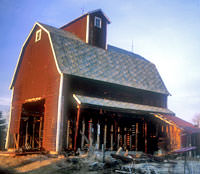
BEFORE: Corn crib/granary before its transformation into a strawbale greenhouse.

straw bale greenhouse -- after
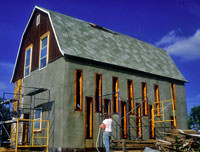
AFTER: Stawbale greenhouse at Inn Serendipity Farm and B&B; heating systems include a solar thermal system and B100 (100 percent biodiesel) furnace.

Straw bale greenhouse -- John Ivanko
John splitting bales for stacking for Inn Serendipity greenhouse.

 Straw bale greenhouse -- apply plaster
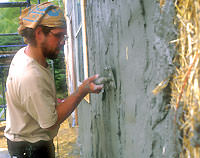
Applying heavy outside plaster to Inn Serendipity greenhouse. 

Straw bale greenhouse -- scratch coat 

Adding scratches to scratch coat for Inn Serendipity greenhouse. 

 Straw bale greenhouse -- inside
Matt Sterling of Native Earth Construction applying plaster on the inside of greenhouse.

Straw bale greenhouse
Watering down outside walls for proper curing of “brown coat.”

© All photos by John Ivanko and Lisa Kivirist

In traditional greenhouses, as much as 45 percent of the annual operation costs are associated with heating; successfully growing with little or no heating cost means more profit per vegetable or fruit crop sold, or, in our case, served up in breakfasts for our Inn Serendipity Bed & Breakfast guests.

Building with straw bales means that with a little help, even the most inexperienced homeowner can build a house or other functional structure out of straw bales while rekindling a connection to the environment and gaining the satisfaction of building something yourself.

Additionally, the organic nature of this medium offers both aesthetics and energy efficiency, with R-values ranging from R-35 to R-50. Straw-bale walls are remarkably strong, provide better fire resistance, help alleviate sick building syndrome usually associated with offices and use a renewable resource that’s often an agricultural waste product.

Top

Types of Straw Bale Construction
The two main types of straw-bale construction are post-and-beam infill and load bearing.

With post-and-beam infill construction, like the one we used on the granary, straw bales are inserted between supporting studs and other framing that supports the roof.

Load-bearing construction, more often challenged by zoning and commercial codes, means that the roof and windows are supported by the straw-bale walls.

Six Main Steps in Straw Bale Construction
There are six main steps in straw-bale construction:

  1. Pouring the foundation, framing and adding the roof.
    Although probably the most skill-intensive parts of the entire process, these aspects need not be particularly complex. For load-bearing construction, only the foundation needs to be done at this stage. Depending on the type of plaster selected, roof overhang is often important to protect and shield the plaster from the weather.
  2. Stacking bales.
    With an enthusiastic crowd of helpers, it’s amazing how fast a wall or building can go up. Bales are stacked in various methods or sandwiched between timber framing, sometimes requiring pins made from metal rebar to prevent bales from shifting.

    Additional detail work needs to be completed prior to the stacking of bales in places where moisture might possibly enter the wall; for example, where the straw bales meet the foundation, rigid foam and a layer of tar is applied before setting the bales. [For our building, we used about 400 straw bales with wheat-based straw, harvested about four miles from our farm.]

  3. Adding lath.
    Lath, which in straw-bale construction often means chicken-wire netting, is added to interior and exterior walls to allow plaster to adhere more readily.
  4. Stitching.
    Stitching involves using polytwine to stitch up the walls, thus compressing the loose straw and connecting the lath (and other elements) together.
  5. Plastering.
    Often the most messy, fulfilling and fun, plaster is usually applied in three layers of varying thickness to cover the bales and create a smooth–but often undulating–wall surface.

    The first thick coat is called the “scratch coat.” This coat is usually scored, or scratched, to allow the second coat (the “brown” coat) to adhere.

    The brown coat smoothes out the surface and fills in any major depressions.

    The final “finish coat” goes on very thin, can be colored and is often followed by a sponging technique to create texture.

    Specific recipes for each tend to depend on the purpose, structure and climate. Plaster can either be earthen based (mud, sand and lime) or Portland-cement based (sand and lime) and usually applied by hand with a hawk and trowel by lots of helpers. Because our greenhouse used the existing roof system lacking much of an overhang, we opted for a more costly and more durable cement-lime plaster on the outside and less expensive earthen plaster on the inside.

    To help bounce the sunlight inside the greenhouse, we painted the plaster white.

  6. Finishing the carpentry work.
    Adding windows, doors and vents and, in the case of load-bearing construction, the roof, make up this final stage.

Top

Truth Window: Rock Solid and Beautiful
Most straw-bale buildings feature a “truth window,” usually a transparent viewing window where no stucco has been applied to a section of the wall. Besides the truth window, various design elements can also be incorporated into the walls: light tubes made from wine bottles, tile mosaics, intricate wall sculptures and recessed cubbyholes.

Since there’s little food value in the straw, there’s a greater likelihood of getting mice in your farmhouse kitchen than a straw-bale building; plus, the rodents would need to gnaw through as much as two inches of plaster just to get to the bales.

Many people remain convinced of fire hazards associated with straw-bale construction despite the fact that as much as two inches of fireproof mud, sand and cement completely surround the bales, making it practically impossible to ignite them. Straw-bale buildings are healthier and safer than most conventionally constructed buildings.

In terms of cost, straw-bale buildings end up about the same per square foot as conventional buildings. Savings, however, come in reduced energy needs when operating the structure.

Our greenhouse, filled with papaya, and a banana and lime bush, costs about $600 a year to heat, the cost of which mostly results from our processing of biodiesel. Electricity for lighting and the furnace blowers is produced on site with a 10 kW Bergey wind turbine and solar electric system. Plus, it’s not a bad place to pass the Wisconsin winters.

About the Authors
Lisa Kivirist and John Ivanko are co-authors of ECOpreneuring, Rural Renaissance and Edible Earth. Drawing inspiration from their hobby farm, each book captures a slice of their journey to live and operate their Inn Serendipity business more sustainably.

Top

More Home & Barn

Straw-bale Building Resources

More Straw Bale Building: A Complete Guide to Designing and Building with Straw
, by Chris Magwood, Peter Mack and Tina Therrien (New Society, 2005)

International Strawbale Registry
A database of buildings constructed using straw bales.
www.sbregistry.greenbuilder.com 

The Last Straw
The International Quarterly Journal of Straw Bale and Natural Building
www.thelaststraw.org

Categories
News

National Pollinator Week 2008

Bats, bees, butterflies and hummingbirds.

Those are just a few of the pollinators being celebrated during the second annual National Pollinator Week, June 22-28, 2008.

Pollinator week raises awareness about the need to care for and help preseve the creatures that help pollinate our crops to help maintain thriving food sources.

The enormous success of National Pollinator Week 2007, lead to the U.S. Senate (S.Res. 580) and the U.S. Department of Agriculture officially declaring the 2008 celebration, according to the Pollinator Partnership.

You can help spread the pro-pollinator message by planning your own National Pollinator Week event in your state. Find more information at www.pollinator.org 


Celebrate Pollinator Week and Learn about Honey Harvesting

New Research!

More About Bees

Categories
News

Pollinator Week Events

More Event Info
Get the latest event info by visiting the Pollinator Partnership project events page.Back to main story

Arizona: Tucson
The Arizona Sonora Desert Museum (ASDM) will hold week-long Pollinator Week celebrations and will feature the new U.S. Postal Service pollinator stamp the evening of Saturday, June 30th.

Colorado: Crested Butte
David Inouye will be featured on the Sunday, June 24 episode of Nature Notes (4:30 p.m.) on KBUT radio, talking about conservation of pollinator species. The Denver Botanic Garden has added an interactive coloring book featuring native plants and pollinators to their website.

Delaware: Newark and Dover
Pollinator gardens will be officially opened in early June in Newark, at the Newark Center for Creative Learning (NCCL) and in Dover, at the Delaware Department of Agriculture (DDA). Events are planned in both gardens for Pollinator Week.

District of Columbia: Washington
Monday, June 25
~The National Coalition for Food and Agricultural Research (National C-FAR) Hill Seminar will feature Dr. May Berenbaum, internationally recognized entomologist, speaking on the pollinator-agriculture connection.

Wednesday, June 27
A reception featuring Dr. E.O. Wilson will be held at the USDA.

Friday, June 29
~ The U.S. Postal Service will hold a 1st Day of Issue Ceremony for the new Pollination Stamp Series. To be held at the USDA Office Building at 10 a.m.

The National Audubon Society will host pollinator events this week.

Florida: Tallahassee
The Mary Brogan Museum of Art and Science will host a day-long event on Tuesday, June 26th to celebrate Pollinator Week. The celebration will feature indoor and outdoor activities including a living bee hive, a display of beekeeping tools, lectures, and hands-on activities for children as well as adults. To attract media attention about threats to honey bee colonies and the importance of all pollinators in agriculture, a press conference will be held at 11 a.m. for local, regional, and state media.

Indiana: Statewide
By proclamation, Indiana’s Governor Mitchell Daniels, Jr. declared June 24-30, 2007 Pollinator Week in the State of Indiana, signed February 26, 2007.

Iowa: Ames
By proclamation, Iowa’s Governor Chester Culver declared June 24-30, 2007 Pollinator Week in the State of Iowa, signed February 20, 2007. The 9th International Pollination Symposium Plant-Pollinator Relationships – Diversity in Action will be held on the Iowa State University campus June 24-28, 2007.

Kansas
Renowned artist Stan Herd will create a one-acre crop art version of the dogface butterfly U.S. Postal Service stamp, one of four in the “Pollination” series designed for Pollinator Week. Stan Herd’s creations have been featured in numerous national publications such as National Geographic, Smithsonian, and Wall Street Journal.

Louisiana: Statewide
By proclamation, Louisiana’s Governor Kathleen Babineaux Blanco declared June 24-30, 2007 Pollinator Week in the State of Louisiana, signed March 15, 2007.

Maine: Statewide
By proclamation, Maine’s Governor John Baldacci declared June 24-30, 2007 Pollinator Week in the State of Maine, signed January 24, 2007.

Maryland: Baltimore (area)
USDA Beltsville Bee Laboratory will have an Open House.

The Maryland Cooperative Extension Service will hold an outdoor event in celebration of Pollinator Week entitled “Our World Survives because of Pollinators.” The event will take place at the Salisbury Zoo in Salisbury, MD on June 30th from 10 a.m. to 3 p.m. Contact Ginny Rosenkrantz, (410) 749-6141, or Michael Embrey, (410) 827-8056.

Michigan: Statewide
By proclamation, Michigan’s Governor Jennifer Granholm declared June 24-30, 2007 Pollinator Week in the State of Michigan, signed February, 2007.

Minnesota: Sherburne County
A living “Pollinator Exhibit” will be unveiled on the grounds of the Sherburne County History Center. Following a short program on the importance of pollinators, the local Postmaster, with a specially designed cancellation stamp, will cancel the new “Crops of the Americas” stamps for those attending. Cake and refreshments will be served.
June 27, 10 a.m. to noon, at the Sherburne History Center, 10775 27th Ave., Becker, MN 55308. Call (763) 241-1170, ext. 3, to RSVP.

New Jersey
There will be an EPA-IR-4 crop tour on June 27th. The tour will include stops at pollinator-dependent farms and other interesting, educational sites. For more information and to sign up as a participant, click here.

New Mexico: Albuquerque
The Rio Grande Biologic Garden will host Pollinator Week events Monday, June 25-Saturday, June 30, 10am-2pm. Take part in workshops, visit discovery stations, and attend mini-talks about how to create homes for pollinators in your backyard.

North Carolina: Macon County
“Pollinator Day — The Impact of the Individual,” will be held Saturday, June 16, from noon to 5 p.m., rain or shine at the Tassee Picnic Shelter, Little Tennessee River Greenway, Franklin, NC. Activities will include public education exhibits, outdoor activities, lectures, and hands-on projects. For more information, visit www.ncbartramtrail.org.

Ohio: Cleveland
During Pollinator Week, the Biodiversity Alliance will host a Summer Science Institute focusing on butterfly diversity and invasive plants. Participating teachers will visit the Cleveland Metroparks Zoo, the Cleveland Museum of Natural History, and the Cleveland Botanical Garden.

Virginia: Annandale
The Audubon Society of Northern Virginia will host an event on Sunday, June 24th to kick off Pollinator Week. Activities include a presentation about the natural history of bee pollination and tips to attract pollinators, a workshop on building houses for bees, a meadow restoration project during the week, and possible other activities including a lecture on hummingbirds and information about butterfly and moth gardens. For more information, (703) 256-6895.