Categories
News

Crop Insurance for Organic Farmers Addressed in Farm Bill

If you grow crops using organic methods, you’ll pay more for crop insurance — but if losses occur, you’ll receive compensation at the price of the conventional crop, not the higher organic price.

But a change may be possible. The 2007 Farm Bill currently contains provisions that offer hope for the more equitable treatment for organic farmers.

  • First, the House version of the 2007 Farm Bill includes significant support–more than $300 million–for organic agriculture.
  • And the bill also includes a major revision to the crop insurance rates required of organic farmers, which has been higher than for non-organics. This would be a big help in bringing down the price of organic foods.

OTA Executive Director Caren Wilcox described the inequities of the crop insurance system as “a key impediment to more farmers converting their land to organic production.”

According to the Organic Trade Association:

“In addition to the funding, the House of Representatives also directed the Federal Crop Insurance Corporation to provide equitable crop insurance to organic producers. Currently, organic producers pay a 5% surcharge, and if losses occur, they are paid at the conventional, not the organic, price. Non-organic farmers do not have to pay the 5% surcharge. Why do the organics? Do they have different droughts? Floods? They deal with pests, just without chemicals.”

Pilot Insurance Programs, Farm Bill and More

Categories
News

Horses Infected with EHV-1 in Florida

The Florida Division of Animal Industry is continuing an investigation into the outbreak of Equine Rhinopneumonitis, also called Equine Herpesvirus or EHV-1.

There are ten quarantined premises, seven in the Wellington area, one in Ocala, Florida, one in Jupiter, Florida, and one in Indiantown, Florida. Eight premises with confirmed cases are under state quarantine and two premises with suspect neurologic cases are under state quarantine.

EHV-1 is a virus that can be carried by horses that shows no outward clinical signs; once infected, animals are carriers for the rest of their lives. An EHV carrier may show neurological signs such as incoordination (specifically in the hind end), lower-leg swelling, dribbling of urine and failure to pass manure. The virus, which can be spread up to 35 feet via nasal discharge, is almost always deadly.

Thought to be brought to Florida by a shipment of horses from Europe that were quarantined at the Newburg, N.Y., USDA-quarantine facility on Nov. 29, the outbreak has had massive ramifications. Nine cases of Equine Herpes Virus – type 1 (EHV-1) have been confirmed with laboratory testing from horses, seven in the Wellington area, one in Ocala, Florida and one in Indiantown, Florida. Five deaths have been attributed to this disease, although only two of those cases could be confirmed by laboratory tests.

The disease outbreak caused the Winter Equestrian Festival to cancel the AGA National Championships and forced at least two barns to undergo quarantine. Veterinarians and equine facilities are on the alert in all affected areas.

At this time there are no restrictions on interstate travel of equines, but horse owners in questionable areas are encouraged to implement the following protective measures:

  • Take temperature of horse twice daily and maintain a log
  • Limit number of people exposed to animals
  • Utilize foot baths
  • Wash hands after handling each horse
  • Minimize shared equipment

Owners with sick horses should contact their private veterinarian to examine and treat their horses. Veterinarians suspecting EHV-1 with neurologic signs are advised to contact state officials and follow protocols for collecting and submitting appropriate samples for laboratory diagnosis

— HF editors

Categories
News

Good Tax-Time News for Farmers

The stress of tax time may be lessened for farm owners who prepare early. Plus, as you prepare for 2006, learn more about additional deductions and options available.  A recent report from Purdue University’s College of Agriculture, discusses several major tax provisions passed by lawmakers in recent years have raised the deductions that farmers can claim.

George Patrick, a Purdue University agricultural economist, says, “As a group, farmers have benefited from recent federal tax legislation.” Some deductions and changes Patrick says to watch for:

• An increase the deduction for machinery and equipment used in farm operation, as well as certain types of livestock and some land improvements like field tile or storage (Section 179 or the expensing option).
• A provision known as the “domestic production activities,” Patrick says, allows farmers who hire labor to claim a deduction on part of the net farm income they earn. This provision provides a deduction of 3 percent on qualified income. The deduction increases to 6 percent for the 2007 tax year and 9 percent for the 2010 tax year.

Patrick advises farmers to plan their tax strategies earlier rather than later. “Farmers need to sit down before the end of the tax year and figure out where they are in terms of their receipts to date and their expenses to date, because they can make changes until Dec. 31,” he says. “After that, it may be hard to accomplish some of the things they are trying to do.”

For information about the report, check out Purdue Extension paper 363, “Income Tax Management for Farmers in 2006,” or contact the Purdue Extension office toll-free at (888) 398-4636 (EXT INFO).

Categories
News

Keep Squirrels Away from Your Gardens

Cute but destructive squirrel!

Ground squirrels and chipmunks can be destructive when it comes to garden and landscape plants. Take the following steps to help prevent garden damage from these critters:

  • Put out some cracked corn to provide an appealing, alternative food source.
  • Sacrificial gardens strategically planted to lure squirrells from the garden you wish to protect it another option.
  • Make your yard less appealing to them by eliminating any sources of water–such as leaky hoses and standing water–and incidental food, such as seed from a bird feeder or open dishes of dog food.
  • Install fencing to help protect garden beds and individual plants; a layer of wire mesh with one-half inch openings underneath and on top of the bed can also help.
  • Construct a perimeter fence and attach a band of 24 inch wide band of sheet metal to the top of the fence. The same method can be used to squirrel-proof, post-mounted bird feeders. In place of sheet metal, you can use a cylinder of aluminum stove or vent pipe at least two feet long to wrap around the post.
  • Spray burrows and plants being damaged with cayenne pepper or tabasco. Ready to use taste repellents containing capsaicin, the active ingredient in peppers, can be purchased at garden and hardware stores.
  • Squirrel-sized ‘Have-a-Heart’ cage traps can be purchased at hardware stores. The best baits to use for ground squirrels and chipmunks are peanut butter, oats, bacon, and apple slices. The cage trap should be placed near the entrance holes of burrows or other areas in the yard frequented by the animals.

Source: College of Agriculture and Life Sciences, the University of Arizona

Categories
News

King Corn: The Movie

The "King Corn" movieFirst released in 2007, the movie King Corn is a feature documentary about two friends, Ian Cheney and Curt Ellis, who decide to plant and grow a crop of corn. They follow the corn they grow into the U.S. food system, as well as explore the impact on our health.

The movie takes a serious look at our farm and food systems, but contains humor and is presented in an entertaining way.

The friends start out their experience by learning about farming and planting genetically modified corn, designed for high yields and herbicide tolerance; they freely use pesticides as part of their farming practices.

Once they harvest their corn and take it market, they begin to have troubling questions about how we eat—and how we farm. The film covers the areas of corn impact from high fructose corn syrup, corn-fed meat and corn-based processed foods–to obesity and diabetes.

Visit www.kingcorn.net for information on purchasing a DVD.

Film Credits
Presented by Balcony Releasing; A Production of Mosaic Films Incorporated; A Film by Aaron Woolf, Curt Ellis and Ian Cheney; Co-Produced by Ian Cheney and Curt Ellis; Edited by Jeffrey K. Miller; Camera by Sam Cullman, Aaron Woolf and Ian Cheney; Original Music by The WoWz with Bo Ramsey and Spencer Chakedis; Produced and Directed by Aaron Woolf; King Corn is a co-production of Mosaic Films Incorporated and the Independent Television Service (ITVS), with funding provided by the Corporation for Public Broadcasting.

Categories
News

Truly Organic?

Most people purchase organic animal products with the belief that there are no hormones, antibiotics or genetically engineered feed with pesticides used in their production. Consumers are willing to pay significantly higher prices for products free from these additives.

Unfortunately, this standard is being called into question in the organic milk industry. The National Organics Standards Board (NOSB) passed recommendations in 2002 and 2003 that all animals brought into organic dairies be under organic management starting no later than the last three months of pregnancy.

Dean Foods, which sells milk under the Horizon label, has admitted to shareholder groups in a February 2006 meeting that they sell all calves born on their 4,000-head farm to save on the cost of feeding the calves organic feed during the first year of their life. Dean then purchases 1-year-old animals that have been fed non-organic feed and that have been given drugs to replenish their herd—sidestepping the organic rules set forth by the NOSB. A major risk in this practice of selling off animals is that the non-organic calves may have ingested feed exposed to BSE, which is allowed in conventional farming. These feedstuffs have been banned in organic farming as a firewall against the spread of BSE.

Some industry observers feel that the USDA has become too well-acquainted with giant agri-businesses, such as Dean Foods. Many large companies have acquired smaller companies and organic labels in an effort to get a hand in the booming organic industry. The NOSB would like to close the loopholes that allow this practice, reassuring consumers that the “organic” products they are purchasing truly are organic.

The Cornucopia Institute, an organic industry watchdog, allows concerned farmers and consumers to post their opinions at www.cornucopia.org

This story first appeared in the November/December 2006 Hobby Farms magazine.

Categories
News

Milk Carton Helps Welsh Farmer Find Love

See the Couple
The Calon Wen dairy has posted a picture of the couple on its website.

A farmer from North Wales, Great Britain, who placed a “looking for love” advertisement on a milk carton, hopes to marry a woman from the United States who answered his plea.

Geraint Evans used milk cartons to find his loveThe lovelorn dairy farmer, Geraint Evans, 28, wanted to find romance. Evans hadn’t had a girlfriend for almost five years because his long days at work often ended at 11 p.m., leaving no time for meeting women, according to reports from several Welsh newspapers.

So, he and a number of male and female North Wales farmers persuaded a dairy company to put their photographs on cartons with an email address where women or men who liked what they saw could get in touch.

2,000 Calon Wen Cartons
Geraint had his photo on 2,000 milk cartons produced by the Calon Wen (Welsh for Pure Heart) dairy at Groes, near Denbigh, North Wales, earlier this year. He was surprised when the first woman to get in touch was from the United States.
 
Laura Allison, 21, an interior design student, was traveling in the United Kingdom when she saw Geraint’s face on a pint of milk she bought near his Wrexham home; she apparently liked what she saw.

“When I got to the milk racks, all I could see was this handsome guy’s face staring out at me. I think I fell in love a little right there and then.” she’s quoted saying.

Wedding Bells?
Laura got in touch after they returned home—and since then the couple have exchanged hundreds of email messages, phone calls and letters and have visited each other.

Now the couple says they want to marry.

Geraint says, “I’ve met the girl of my dreams and I want us to marry as soon as she’s finished her course in America. We share the same sense of humor and we’re both adventurous. We must be or we’d never have met.”

Categories
News

Winter Weather Safety for You

Winterize More…

Get tips for:

Though some of us are still waiting for the real cold to arrive as the holiday rush surrounds us, it’s a good idea to be prepared for dropping temperatures and biting wind chill.

Knowing how to protect yourself as you complete your farm chores in the cold requires special precautions to avoid serious injuries.

According to the Centers for Disease Control and Prevention, the nation experiences an average of 689 deaths per year attributed to exposure to excessive cold.

The University Extension at the University of Iowa offers a publication that briefly reviews weather conditions, including winter storms, and gives tips on how to be prepared for bitter-cold temperatures. Some highlights:

  • In addition to exposure and frostbite, cold weather also presents risk of hypothermia.

    This serious medical condition develops when the core body temperature drops below 96°F. Most susceptible are elderly persons (due to low metabolism) and children (lack of insulating body fat).

    However, other people can develop hypothermia even in relatively mild conditions if they’re not dressed properly for the weather, they get wet or they’re caught in a sudden, strong wind. Alcohol consumption, chronic illness and certain medications also can decrease body temperature.

    Severe hypothermia can lead to shock. Emergency medical treatment is recommended.

    • Signs of hypothermia and frostbite:
      • Confusion, clumsiness, drowsiness, slurred speech, shallow breathing and uncontrollable shivering
      • Numbness in the extremities (ear lobes, nose, cheeks, fingers, toes, hands and feet)
    • What to do:

      • Avoid outdoor work during winter storms and severe cold
      • Dress in layers. Cotton socks worn under two pairs of wool socks and heavy, properly fitting boots can keep feet warm
      • Cover all exposed areas, including neck, face, fingers and wrists
      • Always wear a hat
      • Keep extra clothes, a blanket, a source of emergency heat and flares in all vehicles
  • Watch the Weather: To alert people to the dangers, the National Weather Service issues winter storm watches and warnings. Wind chill indicates how cold it really feels by combining air temperature with wind speed.

For more information on weather and other farm issues in your in your area, contact your local university extension.

Categories
Equipment

Tools of the Trade: Choosing a Hay Baler


By John & Sue Weaver


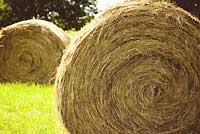
Bales of hay

Make Your Own Hay

Click here to read how>>

Manufacturer Spotlight

Massey Ferguson
www.masseyferguson.com
800-767-3221

New Holland
www.newholland.com/na
888-290-7377

John Deere
www.deere.com
800-537-8233

Hesston
www.hesston.com
800-767-3221

If you keep any sort of livestock, you probably feed baled hay.

Whether it’s cheaper to buy or bale your own depends on a slew of variables, including whether you have access to established hay ground, if you own haying equipment, and if you have the time and the physical wherewithal to do this heavy job yourself. However, you’ll invariably have more control over the finished product when you bale your own.

According to the National Agricultural Statistical Reporting Service, in 2002, American farmers harvested 151 million tons of hay. Nearly all of the hay produced in North America is baled, but this wasn’t always the case.

Long before balers, country folk hayed with scythes and pitchforks, a time-consuming, backbreaking task that was lightened somewhat with the invention of the horse-drawn sickle mower and stacker, along with grappling hook apparatus designed to lift cured hay into overhead hay mows.


Stationary balers were introduced in the mid 1800s. Workers forked loose hay into one end of these horse-powered units, while others hand-tied compressed bales as they exited the other end.

In 1903, Ummo F. Leubben of Nebraska invented the first modern baler. His small round baler (patented in 1910) revolutionized haying, making it a lower cost, far less labor-intensive operation.


In 1940, Leubben sold his rights to Allis-Chalmers, who redeveloped his early concept and in 1947, released their own Roto-Baler.


Balers Beware
Haying accidents can result in horrific injuries or death, so whichever baler you choose, always reduce unnecessary risk by conscientiously following these safety protocols.

  • Never, ever, under any circumstances, put your hands, feet or any other body part inside of a moving baler.
    • Don’t attempt adjustments or repairs, don’t dislodge clogs, don’t hand-feed or remove twine, or shove hay into a baler with your hands or feet. Parts such as flywheels, rollers and augers continue moving up to several minutes after their power source is disengaged, so don’t remove shields until all moving parts have stopped.
    • Always disengage the PTO, switch off the engine, and set the brake before dismounting from the tractor; before leaving it unattended, remove and pocket the key.
    • Don’t wear loose-fitting clothing when working around any farm machinery, tie back long hair and leave your jewelry at home.
  • Read the instruction manual from cover to cover and understand what you’ve read—and insist anyone else who works on or around the baler do so as well.
  • Make certain your baler is in top working order before you head for the field; most accidents occur during on-the-job breakdowns.
    • Remove accumulated debris from the chute.
    • Lubricate all moving parts according to manufacturers’ recommendations.
    • Inspect belts and chains for wear and damage.
    • Look for loose or missing nuts and screws.
    • Replace bent or missing pickup teeth.
    • Make certain knives are sharp and properly balanced, fire extinguishers are charged, twine and cutting mechanisms are working well, hydraulic hoses are clean and up to snuff, and (especially) that all guards are securely mounted and operational.
  • Before you commence haying, remove or plainly mark boulders, stumps, depressions and any other object or land feature that might damage or overturn your equipment.
  • Adapt your speed to field conditions. Excess speed spells baler blockages. So does baling damp hay. The more you stop to unplug the baler, the more likely someone will get hurt.
  • Slow down while turning, passing through gates, and baling at night or on hillsides.
  • To avoid entanglements, remove old twine before splicing it in two and remounting a new roll.
  • To test the knotting apparatus, make certain no one else is working on moving parts and that all power sources are disengaged, then slowly turn the flywheel by hand to observe knotter function in slow-motion.
  • Use a pitchfork to feed broken bales back through the baler, never your hands. Slowly ease the tractor into motion; sudden or jerky movements can tip wagon workers off balance.
  • Overlap bales to form a relatively stable stack. Stacked hay can easily shift, so secure all loads before transport. Don’t condone riding atop stacked loads. Slow down and avoid sharp turns. Watch out for power lines and low-slung tree limbs or doorways.
  • Above all, bar small children from baling and stacking operations.
    • Don’t allow them to climb on stacked wagons, haystacks, or mow-stored hay. Playing in hay is a world of fun, but even properly stacked hay can topple when climbed upon.

Top

Within three years, Allis-Chalmers marketed more than 23,000 Roto-Balers.

Top

Meanwhile, in 1936, a “man named Innes,” of Davenport, Iowa, pioneered an automatic, self-tying baler using knotters from a John Deere grain binder.

Building on this innovation, in 1937, Pennsylvanian Ed Nolt used knotters from the improved Innes baler to hand-build the first successful automatic pickup square baler. New Holland began marketing the wildly popular design in 1940.

In 1952, New Holland introduced a second Nolt invention: the New Holland 66 Hay Baler.

Farmers loved the 66; New Holland ultimately sold 84,000 of them. The New Holland 66 put up 14”- x 18”-bales, whereas the company’s larger New Holland 77 and competitors’ models spit out a heavier, bulkier 16”- x 18”-bundle—and with its wheels removed, the 66 was only four feet tall, making it more economical to ship. The New Holland 66 cost a mere $1,850 (the 77 model ran nearly $2,500). It was the forerunner of the neat, small balers we highlight here.

Like their predecessor, our comparison models process hay into easy-to-handle, stack and store 14”- x 18”-bales. All require 30 to 35 horsepower or larger tractors equipped with 540 rpm PTOs.

All can be fitted (at additional cost) with bale throwers, bale chute extensions, hydraulic pickup lifts and bale tensioners, and wagon hitch kits.

Most offer an optional quarter-turn bale chute that drops bales on their sides in the perfect position to be retrieved by automatic bale wagons. What differs is their basic design.

Top

Agco Corp.
Two of our balers, the New Holland Model 565 and John Deere’s Model 328, are configured in the traditional manner: The baler operates offset to the right side of the tractor with the hay wagon trailing behind the baler. However, Massey Ferguson’s 1835 baler and Hesston’s Model 4550 are built in a straight-line design that moves hay in a straight path from the windrow to the bale chute, thus preserving nutritious leaves that might otherwise be lost in the baling process.

Each design has its advocates, but most agree straight-line balers are easier to maneuver through gates and around small fields.

Agco Corporation, the company that manufactures Massey Ferguson and Hesston machinery, says straight-line design reduces strain on its baler frames, too.

While each has unique features unto itself, the Massey Ferguson 1835 and Hesston 4550 balers share a slew of stellar attributes, among them

  • Curved pickup teeth to nab hay other balers miss;
  • Centering augers that reduce windrow size to accommodate 61” pickup assemblies;
  • Dual-gauge pickup wheels to help reduce bounce and constant-velocity drive shafts.

Both incorporate a straight-line prepacker chamber that pre-forms each flake before sweeping it into the bale chamber, thus ensuring consistent bale density and uniform flake size.

Top

New Holland
The exclusive rotary Flow-Action®, chain-driven feeding system in New Holland’s Model 565 baler was recognized by the American Society of Agricultural Engineers for “excellence in engineering innovation and design for a feeding system that provides improved bale quality, in a variety of crops, with minimal adjustment and maintenance.”

The 565’s high-strength, long stroke, steel plunger runs on sealed ball-bearing rollers and white-iron slides for minimal maintenance and fewer adjustments while packing uniform, dense bales in all crop conditions. It boasts a category 3 driveline and New Holland’sexclusive Power-Pivot PTO.

John Deere
John Deere’s Model 328 is another high quality haying machine. It’s better features include 104 closely spaced pickup teeth and narrow-channel, flanged strippers that extend to the flare; a crank-raised pickup that permits infinite height adjustment within a 5” range; five-position, spring-loaded feeder forks to match feeding requirements to crop conditions; adjustable nine-position hay compressors; crank-adjustable top and bottom tensioners with t-rails to assure uniform tension; and John Deere’s unique, category 3, equal angle two-joint PTO.

About the Authors Based in Arkansas, John and Sue Weaver have been hobby farming and home buying for more than 20 years.

Top

This column first appeared in the July/August 2005 issue of Hobby Farms magazine. Subscribe to Hobby Farms today!

Categories
Equipment

Great Gardening Tools

By Amy Grisak

The right gardening tools

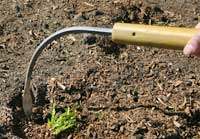
Amy Grisak, above, can’t do without her garden fork. And she calls the CobraHead tool, show below, one of her all-time favorites.

CobraHead -- one of the right gardening tools
Photos by Amy Grisak

Having the right tool for the job can mean the difference between delight and drudgery when it comes to gardening chores.

Thankfully, whether you prefer to stand and weed, or wallow right down in the dirt wrestling dandelions out of the ground, you can discover the ideal match to your gardening style.

Finding the perfect tool can take years of trial and error; or better yet, talk to fellow gardeners about their favorites. Most are more than happy to host an impromptu “show and tell” touting the positive attributes of their most functional implements.

Here are a few that are bound to make life much easier:

  1. Hand Trowel: The hand trowel is one of the most used tools in the garden, particularly during planting season when it becomes an extension of your arm during planting season. A hand trowel makes quick work of digging the holes, then replacing the dirt around the seedlings. It’s also handy when you need to carefully lift summer bulbs, such as gladiolus and calla lilies at the end of the season, and plant spring bulbs in the fall.
  2. CobraHead Tools: Ever wish you could take your fingernail and pluck out a tenacious weed? With the CobraHead you can, as well as cultivate, make furrows for planting, dig holes and much more. The curved steel neck is tipped with a wicked blade that stays remarkably sharp even with abusive treatment. And the best part is the blade doesn’t pull out of the molded handle no matter how hard you’re digging. CobraHead makes a small hand version for working on the ground, or a long-handled tool to be able to stand and work.
  3. Garden Fork: Whether you’re turning compost or digging potatoes, a sturdy spading fork will do the trick. A garden fork is shorter than a pitchfork with a ‘D’ handle at the end making it efficient in digging through heavy soil with its sturdy, flat tines.
  4. By-pass Pruners: By-pass pruners make a clean cut with one sharpened blade on the top passing over an unsharpened one on the bottom in a scissors-like fashion–unlike an anvil pruner that tends to crush stems. Look for a curved, ergonomic handle design to minimize wrist fatigue. Sharp by-pass pruners can just as easily snip fresh herbs for the evening meal, cut roses or other flowers, as trim tough branches on fruit trees and shrubs.
  5. 3-Pronged Cultivator: This metal claw makes quick work of shallow weeds, and is very effective in incorporating compost in the soil or preparing the soil for seedbeds. It’s available as a hand tool and a long-handled model depending on your gardening style. Look for one with a sturdy handle that won’t loosen with frequent use.
  6. Pointed Hoe: Square hoes do the trick hacking weeds out of wide rows, but for finesse work, the pointed hoe is a far more versatile tool. The pointed hoe is heart shaped, and you can use the point to dispatch weeds in between plants, as well as digging furrows, and covering seeds with the broad edge. It will also break through hard soil, and is an efficient cultivator.

Top


Amy Grisak is a freelance writer in Kalispell, Mont. She’s played in the garden for over 25 years.