Categories
Animals

Basic Farm Animal Husbandry Skills

Over the years I have learned that many folks who take on a farm are not always well informed or skilled in the basics of general animal husbandry.

Though we have many outstanding veterinary practitioners in America, many are either not accessible, unaffordable, or ill-trained in the care of large farm animals and exotic quadrapeds.

I’ve always felt strongly that when we take on the responsibility of raising and rearing any specie of farm animal, we take on burdens similar to having children.

Most families know how to monitor the general health and well-being of their children, monitoring behavior observation, eating and drinking habits, temperature, respiratory or digestive disorders, cuts, abrasions, and other forms of major and minor trauma.

General Rules
for Administration of
Veterinary Biologics

  • Read and follow label recommendations.
  • Use sanitary procedures and avoid contamination.
  • Carefully cleanse and disinfect the site of injection.
  • Sterilize instruments by boiling at least 5 minutes, or us another approved veterinary cold disinfectant.
  • Administer the full recommended dose.
  • Mix biologics only if the instructions specify to do so.
  • Do not save unused contents of multi-dose containers.
  • Check for expirations dates.

Most families also provide preventative vaccinations for protection from childhood diseases.

Guess what? Domestic farm animals are not much different than us.

However, certain skills are required of the animal caretaker that may require further education–the best is hands-on experience coupled with book or semi-technical learning.

My grandfather always taught me an important practice that I still follow: “If you take care of your animals, they will take care of you.” I can honestly attest to the truthfulness of this statement through my many decades of experiences.

Certain basic skills are necessary for any livestock owner to properly care for his herd, understand animal vital signs and prevent disease. By learning these basic skills, you will not only save animals, but reduce veterinary costs. The following skills will make you a better livestock husbandman:

  • Observation
  • Animal restraint
  • Taking and evaluating vital signs
  • Basic wound care
  • Ruminant hoof care
  • Administration of oral medicines
  • Administration of injectible vaccines, antibiotics, etc.

Observation

In today’s world of corporate, large-scale livestock operations and in confinement facilities, employees do not really observe the animals under their care.

They may look at them periodically, but to observe is more than a simple walk-by in a barn, pasture, dry lot or paddock.

Far too often, hired help just throws out the hay, puts grain in the feeders and checks the waterers without looking at each individual animal.

A good husbandman must have a sincere and desirous interest to care for his animals. For this reason, it is important to have the same person or persons oversee certain animals, flocks, pens, corrals or herds and spend time each day strictly observing their behavior.

If the caretaker knows his or her animals normal behavior, then the early stages of a health problem will be recognized and can be treated earlier, saving the possible loss of one or more animals, significant veterinary costs and a reduction in the earning ability of your herd.

Important animal characteristics to monitor on a daily basis are:

  • abnormal behavior
  • stance, movement, back and ear posture
  • nasal discharge
  • rubbing
  • fecal consistency (i.e. scours, blood in feces or internal parasite body parts)
  • tail carriage
  • body condition
  • hair quantity and quality
  • lameness and localized swelling.

Any abnormal conditions should direct the caretaker to take the vital signs of the abnormally behaving animal.

Livestock owners should also be familiar with common regional and local diseases and parasites that may affect their animals and monitor the various portals of entry such as nose, eyes, anus, udder, or injuries such as shearing cuts or tail-docking wounds.

Animal Restraint

To successfully manage livestock on any level, you must have a basic knowledge of animal psychology and behavior.

When catching and restraining animals for examination and treatment, stress must be minimized to the animal as well as to the handler.

Undue stress imposed on an animal can reduce the efficacy of health care and slow the healing process. If an animal has an unpleasant initial experience, additional treatments may be more difficult to carry out.

In general, when handling an animal, avoid excessive noise, rapid and jerky movements, hot shots or electric prods and night-time hours. Reducing the presence of unknown people and unfamiliar handling protocols will also minimize animal stress.

Most farm animals can be treated standing on their feet, but occasionally an animal may need to be cast (laid on its side) for treatment. If extra help is required, provide individuals with basic instructions on what you’re wanting to do and how you want them to respond and conduct themselves during that time.

Each of the large-animal domestic species has unique restraint tools and recommendations–become familiar with proper handling techniques and equipment.

Taking Vital Signs

Vital signs include the animal’s temperature, pulse and respiration rate.

1. Temperature

An animal’s temperature should always be taken via the rectum. (Novices occasionally insert the thermometer into the vaginal area in females, which is ineffective.) The rectum on females is always above the vulva and closest to the tail or dock of the animal.

Prior to inserting the thermometer into the animal, disinfect it with either isopropyl alcohol or Novalsan (a veterinary antiseptic agent) and coat with plenty of lubricant. The tissue in the rectum can be torn or perforated easily if lubricant isn’t used.

Normal Vital Signs for Common Farm Animals

Temperature
(± 1F)

Pulse
(Heart Rate) (rate/min)

Respiratory Rate,
Resting
(breaths/min)

Cattle101.5 (100.4-102.8)50 (40-70)30
Horse100.0 (99.1-100.8)45 (25-70)12
Sheep102.3 (100.9-103.8)75 (60-120)19
Goat102.3 (101.3-103.5)90 (70-135)15
Swine102.5 (101.6-103.6)60 (55-85)16

Various types of veterinary thermometers are available in a range of prices.

The traditional, older-style thermometer contains mercury at one end of a sealed glass tube; with the increase in temperature, the mercury expands along the column and readings are taken from the height of the column.

Using this type of thermometer has its risks, particularly with animals not used to being handled or restrained.

If an animal moves abruptly and inadequate lubricant was used, the thermometer can break and shattered glass and mercury can cause rectal trauma and damage.

A safer option is the smaller, less expensive, digital-probe veterinary thermometer. Always tie your thermometer to a string with a clip attached to the end so as not to lose it inside the rectum should the animal startle or move away.

2. Pulse or Heart Rate

To take the pulse or heart rate of animal, locate the pulse at the angle of the lower jaw bone, where it can be felt by pressing the artery against the bone. To calculate beats per minute, count the beats for 15 seconds and multiply by four.

3. Respiration

To take the respiration rate of an animal, count its number of breaths per minute by watching the flanks or by watching for nostril movements or flares. For normal temperature, pulse and respiration rates, see “Normal Values” sidebar. If your animal’s values are found to be higher or faster than normal, you have an indication that it is most likely ill.

Basic Wound Care

Despite even the most preventative and conscientious animal husbandry, wounds happen. Common wounds include lacerations, punctures, abrasions, bruises (contusions), burns or ruptured abscesses.

1. Lacerations

Lacerations are torn or ragged wounds generally caused by sharp objects such as metallic objects, glass, barbed wire fences, protruding fencing wire, baling type wire, etc. Lacerations often can be stitched by your veterinarian if found within 24 hours of the injury.

2. Punctures

Puncture wounds are holes or perforations due to piercing from nails, fence staples, wood splinters, etc. Puncture wounds can penetrate tissue more deeply than lacerations and debris deep within a wound is a concern. All internal dirt must be removed or infection may result. Puncture wounds may not bleed excessively but are very serious injuries.

3. Abrasions

Abrasions affect only the surface layers of the skin and are the result of rough surfaces, such as that of working corrals, stalls, trailers, halters, ropes, general tack, straps, etc., coming into contact with skin. Abrasions can be deep and require additional medical attention.

4. Bruises

A bruise is skin discoloration due to the release of blood from ruptured vessels following a traumatic injury or improper handling. The hair on domestic animals generally conceals bruising, but swelling can occur at the bruise site.

5. Burns

Livestock burns are commonly cause by chemicals, electricity, sunlight (with light-skinned animals) and heat. The magnitude of the burn can vary from mild redness to blistering, or actual destruction of the skin. Burns vary in severity and their treatment requirements.

Abscesses

An abscess is a localized accumulation of pus surrounded by a fibrous capsule and can occur nearly anywhere on the body. Abscesses and their origins can be very complicated, but many are caused by bacteria that spread to other areas of the body. When external, abscesses are more susceptible to rupturing; a ruptured abscess usually discharges its pus and heals. However, the wound may continue to release pus that can spread infection to other animals.

When treating a wound, proper restraint is critical in administering care, medications or the application of bandages.

Treating the Wound

The most important tool to treating animal injuries or wounds is the first-aid kit. When injury strikes and veterinary care isn’t feasible, you must be prepared to provide emergency veterinary medical care.

One way to prepare for these circumstances is to meet with your local large-animal veterinarian and get his or her recommendations for the development of an essential on-farm first-aid kit.

On-Farm First-Aid Kit

  • Veterinary small digital rectal thermometer
  • Veterinary lubricant
  • Halter and lead ropes or other appropriate animal specie restraint devices
  • Hobbles and/or twitch (for horses)
  • Pre-moistened towelettes
  • Cotton roll
  • Sterile saline solution
  • Isopropyl alcohol
  • Novalsan® disinfectant
  • Two empty (generic) spray bottles for possible needs
  • Fly spray repellent/wound treatment
  • Nutritional and/or anti-scour drench in pump bottle
  • Disposable syringes in 3,6, 12 and 60 ccs
  • Six (6), ½” x 18 gauge sterile, disposable needles
  • Six (6), 3/4″ x18 gauge sterile, disposable needles
  • Two (2), 3/4″ x16 gauge sterile, disposable needles
  • Gauze rolls
  • Package of sterile gauze pads
  • Two (2) gauze bandages
  • Two (2) rolls of elastic tape
  • Dose syringe
  • Balling gun and/or pill forceps
  • Dehorning tools (if applicable)
  • Electrolytes for newborns
  • Milk replacer for orphaned newborns
  • Bottle(s) and appropriate nipples for milk replacer
  • Antibiotic ointment or salve Optical (eye) antibacterial ointment or dust
  • Blood stopper, i.e. hemodust
  • Mineral oil
  • One (1) propylene glycol
  • Udder infusion antibiotic
  • Two (2) or more pairs of disposable, sterile surgical gloves
  • One (1) pair of stainless steel veterinary surgical scissors
  • One (1) each of veterinary forceps and hemostat
  • Injectable antibiotics Topical antibiotics (aerosol)
  • Obstetrical pullers
  • Stomach tubes
  • Bloat medicine
  • Foot trimming shears
  • Hoof knife and hoof pick (for horses)
  • Hair and/or wool trimming shears (electrical and/or manual)
  • Adequate supply of OB (obstetrical) gloves for the birthing season
  • Tincture of Iodine (7%)
  • Iodine spray (1%)
  • Heat lamp (for lambs, goat kids, and piglets)
  • Notebook and ballpoint pen

Another source for this information is your local Cooperative Extension County Agent, who usually has access to the expertise of the State Extension Veterinarian. For our recommendations, see “On-Farm First-Aid Kit” sidebar.

1. Halt Blood Loss

Once the animal is restrained, your primary objective should be to halt blood loss.

Blood-stop powder, or hemodust, will help stop blood loss in most minor wounds. Some wounds will need to be wrapped with absorbent material, such as gauze pads, and have pressure applied directly to it. It is important to stop blood loss as soon as possible.

2. Clean the Wound Location

It’s best to trim or clip any hair surrounding the wound.

The wound should be cleansed and free of debris, foreign materials and feces. Irrigate the wound with a clean, disposable syringe (without a needle) with saline solution, isopropyl alcohol or clean water.

Saline is the preferred solution for cleaning wounds since it will not interfere with other cell and tissue functions.

Once the wound is clean, evaluate it and classify it as a laceration, puncture or abrasion to determine your course of treatment.

3. Classify, Treat and Bandage the Wound

You can classify wounds based on their appearance: a laceration is a wound with torn and ragged edges; a puncture wound is a deep wound or hole in the skin, dermal tissue and other layers caused by a sharp object (nail, fence staple, piece of metal); abrasion: a wound in which the skin or other external surface is scraped, scratched, torn or otherwise exposed.

Most livestock supply stores and catalogues have various topical agents in the form of salves, aerosols, powders and injectibles.

Antibacterial products are essential because bacterial infections result from most wounds and post-wound treatment or non-treatment.

During the warmer months when flies are present, it is critical to apply a fly repellent near the wound to prevent flies from laying eggs inside the wound.

Once the wound is treated, apply antibacterial ointment and place clean cotton or a cotton gauze pad onto the wound.

Top with an elastic gauze (like Vetrap) bandage, but be sure not to wrap too tightly. Bandages should be checked at least twice daily and changed every other day.

Once the wound starts to heal, bandages can be changed less frequently, every two to three days.

Other treatments for the various wound types may involve administering a tetanus shot.

Systemic treatment with injectable antibiotics, such as penicillin, oxytetracycline and terramyacin, may also be necessary based on your vets assessment that the wound is (or could become) infected.

Your vet will check for infection by taking your animal’s temperature, checking to see if the site of the injury is sore and hot, and monitoring breathing and respiration rates.

If an infection is present, an animal normally has an elevated temperature and heart rate, as well as heat and soreness at the injury site. If you and your vet determine antibiotics are necessary, discuss proper dosage and length of treatment. If you are using a product from a previous incident, be sure it has not expired.

Hoof Care

Hoof care is one of the most important animal husbandry skills to learn and master.

Hoof injuries and improper hoof care can lead to early culling of farm animals, lameness, hoof injury and poor foot paring by the caretaker. It can also lead to a host of other health problems. Owners should learn basic foot and hoof structure of the animals they manage, as well as what a properly trimmed hoof looks like.

Hooves grow at different rates; this rate is determined largely by the environment in which the animal resides.

Animals in the West that are herded and moved over rock and sand, and that travel distances for forage and water, generally do not need much hoof care because of the constant wear on the feet. However, animals confined to barns, corrals or forage pastures will need more attention and more frequent trimming due to a lack of wear and tear from hard surfaces.

The most common hoofcare problem is simply lack of attention by livestock owners.

Without regular trimming, hooves grow excessively long and the toes curl up, making it difficult and uncomfortable for the animal to walk.

In some parts of the United States, professional hoof trimmers can be hired, but in areas where animal density and demand for such services are limited, the owner will have to do his/her own foot paring. Owners should develop a hoof-trimming calendar and schedule regular trimmings based on your animal’s needs—a rough estimate for ruminants is once every four weeks. However, in between trimmings, any sign of lameness should be examined closely.

Foot injuries caused by rock bruising, nail or wire punctures, or paring off too much of the foot are not serious. However, foot abscesses and contagious foot rot, evidenced by a foul odor, cheese-like substance and lameness, are conditions that require proper attention and quarantining of affected animals, as well as professional veterinary care.

All hoof wounds, whether caused by environmental conditions or by improper foot paring, should be treated with antibacterial and antifungal hoof dressings such as Koppertox, available at livestock supply stores. These dressings also provide a sealant for the hoof wound or trauma.

Oral Medicines

The administration of liquids, boluses (pills or oblets; large pills) or pastes must be done properly, or illness and even death can occur.

Before these can be given safely, the animal must be restrained adequately.

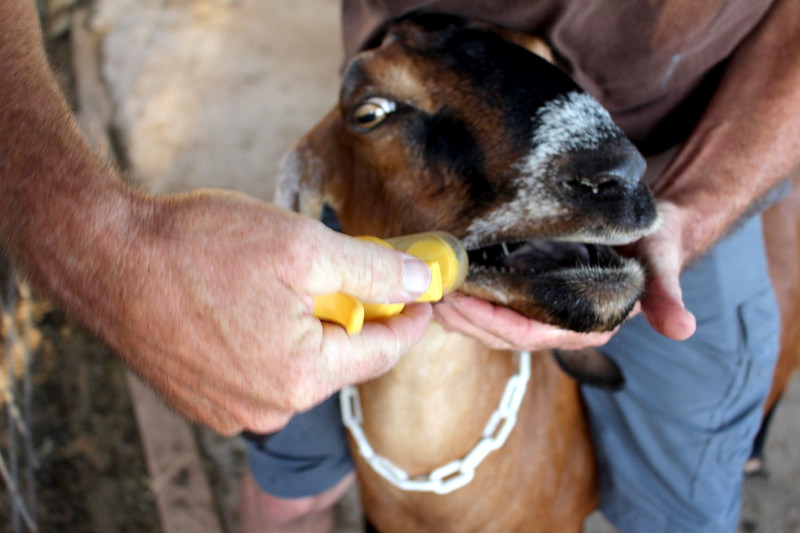
Both liquid drenches and boluses must be administered with the animal’s mouth opened and the drench gun or dose syringe placed over the top of the tongue while the head is level, not lifted or tipped. To open the mouth, stand alongside the animal and use your thumb and fingers on one hand to open it while you hold the instrument in the other hand.

To give oral products successfully, it’s best to deposit them far back in the mouth near the root of the tongue, where the swallowing reflex nerves are located.

1. Drenching

Drenching is the oral administration of a liquid medication. Regular drenching with anthelmintics (dewormers), bloat treatment agents and some anti-scour products are commonly performed with a drench gun or dose syringe. Automatic drenching guns with a reservoir back pack are available for those who dose a large number of animals.

2. Boluses

Boluses (pills or oblets) are more convenient than liquid products because they tend to have a longer storage life. Common bolus medications include Phenylbutazone (Bute) and sulfamethoxazole (SMZ).

Balling guns or pill forceps can be used to administer boluses. Because boluses are dry and more difficult for the animal to swallow, dip both the balling gun or pill forceps and the bolus into mineral oil, which acts as a lubricant, to ease administration and reduce the possibility of the animal spitting the bolus out or injuring its mouth with the dry bolus.

3. Pastes

Pastes are usually deworming agents given to the animal with a caulking-type gun. As with the other oral medical products, pastes must be administered on top of the tongue. Be sure to hold the animal securely until all of the paste has been swallowed.

Making Meds Easy

Getting your livestock to take medicines, either pill form or liquid, can be a bit tricky—especially if the animals are picky eaters. Here are some tips to get your animals to take their medicine a bit easier.

  • Put smaller pills in treats such as carrots, shredded wheat cereal or animal crackers.
  • If you are administering a small amount of liquid, a marshmallow is great at disguising the medicinal taste.
  • If you need to feed multiple pills to larger livestock, place them in a large syringe with some water, wait for them to dissolve, and administer the meds as you would a liquid. The water can be flavored with a powdered drink mix or juice, or you can use applesauce instead of water (the thicker sauce mixes with and disguises the medicine better).
  • Mix medicines with mint-flavored Maalox for easy administration of pills and powders to horses. An added benefit? The Maalox will coat the stomach, helping to prevent possible upset.
  • Fruits such as bananas and oranges are often used to mix with medicines to disguise their flavoring and to encourage the animal to ingest the meds.

Injectables

Before giving your animal any injectable product, you must receive training by your veterinarian or by a neighbor who is experienced and competent in administering injections.

Needle Size by Injection Type

Intramuscular Injection
1” to 1 ½” 18 – 20 gauge

Subcutaneous Injection
½” to 3/4” 18 – 20 gauge

Intravenous Injection
1” to 1 ½” 18 – 20 gauge

Multiple-injection, gun-type syringes single-use, disposable syringes can be used, depending on your needs. Both are available at livestock and veterinary supply retailers.

Multiple-injection type guns are preferred where large numbers of livestock are involved and repeated vaccinations or boosters must be given.

Syringes may be boiled for cleaning or sterilized using one of the cold veterinary disinfectants such as Novalsan.

Disposable syringes should be used once and discarded.

Needle size depends upon the type of injection and the location where it will be given. The two most common injection types are intramuscular (IM) and subcutaneous (SQ or SC), though knowledge of intravenous (IV) injections is also helpful.

Vaccines or other injections should always be given via the recommended method—an improper route can result in failure of the agent and a localized reaction. Needle length and gauge (diameter) are also important factors for successful vaccination.

1. Intramuscular

Intramuscular injections are picked up by the blood supply and spread to all body tissues fairly rapidly.

The best site to administer IM shots is in and around the heavy muscles of the animal’s neck. This site reduces potential muscular damage to the carcass (if for meat purposes) and minimizes possible nerve damage. Animals that are not destined for the meat market can be given IM injections in the rear quarters.

No more than 15 ccs should be given at any one site on the animal.

To avoid unintentional intravenous (IV) injection, pull back on the syringe plunger after you have inserted the needle to be sure no blood flows into the syringe. If blood appears, you have accidentally hit a vein. Pull the needle out completely and re-insert the needle in a new, clean site. You do not need to use a new needle.

2. Subcutaneous

With subcutaneous injections, a 3/4 or 1 inch needle of 18 to 20 gauge in diameter is advised. The loose skin located on the side of the neck, behind the elbow or in the armpit are good locations for subcutaneous injections.

These injections are given just under the skin by forming a tent or tepee of loose tissue, but not into the muscle tissue.

Subcutaneous-administered agents are not picked up by the blood supply as quickly as IM injections. As with the IM injection, pull back on the syringe plunger to make sure no blood appears in the syringe when administering a SQ shot. If blood appears, pull the needle out completely and re-insert it into a new site.

3. Intravenous

It is recommended that you learn how to administer an IV injection from a veterinarian or experienced livestock owner. The rapid injection of any medication can be lethal; all IV injections should be given slowly.

Intravenous injections are quickly spread to all body tissues.

This is critical in instances where an animal may need medications or fluids immediately because of sickness or dehydration. Cases of scours, milk fever (hypocalcemia), grass tetany (hypomagnesemia) and pregnancy toxemia (ketosis) usually require immediate IV fluids. When giving IV injections or medicinals, generally a 1 to 1½ inch, 16 to 18 gauge needle is recommended.

The best location to give large volume IV injections is in the jugular vein, located in the neck.

4. Intramammary Infusion

An intramammary infusion is an antibiotic used to treat mastitis in cows, goats, ewes and other animals. Infusions are sold in plastic tubes with smooth, plastic needles for insertion into the udder of the infected animal.

Teats should be cleaned and dipped in a germicidal product before and after treatment to avoid introducing more harmful organisms back into the udder.

5. Needle Choice

It’s important to use the correct gauge of needle.

Too large of needle diameter (the smaller number gauge, the larger the diameter) may result in a large wound that allows leakage of the medication, whereas too small a diameter slows down the administration of the injection.

If a needle is too long, it may bend or break inside the animal; too-short a needle will not get deep enough into the muscle tissue for intramuscular injections.

If any needles are bent or dropped on the ground, do not use them. The most commonly used needles and syringes are disposable; all discarded disposable syringes and needles should be placed securely in a sharps container rather than the trash can.

Contact your local veterinarian for recommended disposal of your sharps. Sometimes local human hospitals or veterinary clinics will take and discard them for you.

Finally, the use of animal drugs in farm and food animal production must be accepted as a responsibility rather than a right when trying to improve animal health.

Drugs should be used to enhance a health program, not as a substitute for good management. Disease prevention is based on good nutritional and environmental factors, sanitation and the use of a balanced herd or flock health program.

Use vaccines to prevent common diseases and occasionally segregate or cull infected animals.

Good husbandry practices improves the animal’s environment, prevents animal stress that leads to disease and generally reduces the need for drugs. Medications used as a supplement to good management must be chosen carefully with regard for the specific disease problem (causes, diagnosis and prevention). After medication selection, correct dosage and method of administration is key to animal health.

*This article is not a substitute for veterinary treatment by a licensed veterinarian.

This article first appeared in the January/February 2007 issue of Hobby Farms magazine.

Categories
Animals

Understanding Liver Flukes

By Dr. Aaron Tangeman

Q: My neighbors gave us their daughter’s pet sheep when they moved. One morning, we went out to do chores and found it dead. Its lower jaw appeared swollen. What could have happened to it?

A: If the sheep’s veterinary and medical care history weren’t made available to you, I can only offer a possibility for the sudden death of a sheep that otherwise seemed healthy.

Because of their grazing habits, animals are prone to ingesting and developing internal parasites. One parasite capable of causing sudden death in sheep is fasciola hepatica, also known as the common liver fluke. The leaf-shaped adult flukes can grow up to 30 mm long and 2-12 mm wide within the bile ducts.

Many species can be infected but the greatest economic impact for agricultural communities is often seen in cattle and sheep.

Infection by the common liver fluke, fasciolosis, can present in three forms:

  • Chronic, which is often fatal in sheep, but rarely in cattle which can develop resistance.
  • Subacute, which is mostly seen in sheep and is frequently fatal.
  • Acute, which must be differentiated from “black disease,” an infectious necrotic hepatitis caused by toxins produced by Clostridium novyi, type B.

Acute fasciolosis in sheep can cause death within six weeks of infection. Sheep may show a distended and painful abdomen, as well as anemia. Death can occur suddenly. Animals suffering subacute fasciolosis may survive significant liver damage slightly longer before succumbing to hemorrhage and anemia. Signs of chronic fasciolosis include: anemia, edema about the lower jaw (bottle jaw), decreased market weights, and unthriftiness. (Dairy cattle experience decreased milk production.) Chronic liver damage can compound over several years since sheep do not seem to develop a resistance to the infection.

Livestock producers properly instructed by their veterinarian in using the FAMACHA© system, originally designed to diagnose the presence of haemonchus contortus in sheep, can examine the lower eyelid of the sheep to determine the presence and severity of anemia. Grading eye color for the occurrence of anemia decreases the need for anthelmintics administration by limiting dosing only to animals demonstrating signs of infection. Diagnosis can be based upon fecal examination for the presence and egg count of a specific parasite. You should be aware that actual shedding of eggs may lag infection by up to 16 weeks.

The definitive diagnosis of fasciolosis is made by necropsy. Physical examination of the liver demonstrates adult flukes.

Consult your veterinarian to determine if your geographic location is at risk for fluke infestation. Management measures include providing clean food, pasture, and water sources. Consider raising a breed of sheep known for a better body score that may help withstand infection. Quarantine new arrivals to your farm.

Remember each “flukicide” is effective at differing stages of fluke development. Initially administer dewormers from two families of anthelmintics to new farm arrivals, in adequate dosages, to slow the development of resistance. You should avoid underdosing as it contributes to drug resistance.

Lastly, you may have to consider culling animals that require frequent treatment. 

Dr. Aaron Tangeman received his Doctorate of Veterinary Medicine from the Ohio State University in 1998 and practices in Northeast Ohio.

Top

Categories
Animals

Lowdown on Lowlines

By Carol Ekarius

lowline and angus
© Rhoda Peacher


In This Article …
The Genesis of the Breed
From Australia to North America
The Sale and Show
Sale Summary
Featured Farms
Log on for Lowlines


I went to the National Western Stock Show in January to get an up-close and personal look at Lowline cattle.

As I walked through rows and rows of pens trying to find where these diminutive cattle were awaiting their trip to the show or sale rings, I felt like I was wandering through a mastadon exhibition: The modern Angus, Herefords, Limousins, Gelbviehs and Piedmontese that were also in the stockyard pens that morning were giant animals, a far cry from what their ancestors looked like less than 60 years ago, when the paradigm of the American cattle industry moved to a bigger-is-better mindset. Bigger calves, bigger weaning weights, bigger bulls, bigger cows.


Lowdown on Lowlines
© Rhoda Peacher/Lazy G Lowlines

Bigger was the answer farmers and ranchers heard, yet what was the question? In spite of cattle getting larger and larger, the cattle industry has been a tough place for farmers and ranchers to make a living, and the competitionpoultry and porkhave continued to eat away at cattle’s once-dominant role in American agriculture and on Americans’ plates.

Over the last decade or so, some influential members of the industry started challenging the bigger-is-better assumption. They pointed to Lowline cattle as proof that smaller animals could increase profits and improve the lives of producers while at the same time meeting consumer demands for tender meat in smaller-sized cuts, produced in an environmentally friendly manner. My mission for the National Western Stock Show was to find out if Lowline cattle lived up to this promise—and what it means for American cattle production.

The Genesis of the Breed
In 1914, the government of New South Wales, Australia, formed an agricultural research center in Trangie, a small, valley town about 300 miles northwest of Sydney. One of the center’s earliest charges was to improve Australian cattle genetics. To accomplish that, they began importing top-quality Angus bulls and cows from Scotland, Canada and the United States, and breeding them to some of the best Angus lines already in Australia. They kept up their genetic work until 1963, when the emphasis at Trangie changed from straight genetic research to improving performance testing and recording. They closed the herd to outside bloodlines starting in 1964, and worked to develop improved methods for analyzing and recording such performance criteria as weight gain, structural measurements and objective visual assessments.

Sale Summary

  • 12 Bred, fullblood females:
    Average = $7,604
  • 2 Fullblood pairs (bred cows with a calf at their side): Average = $9,250
  • 1 Fullblood embryo flush:
    Average = $4,000
  • 29 Open, fullblood heifers: Average = $1,759
  • 10 3/4-blood females: Average = $1,845
  • 10 1/2-blood females: Average = $1,875
  • 9 Fullblood bulls: Average = $2,444
  • 5 Percentage bulls: Average = $1,610
  • 6 Embryo lots: Average = $3,050
  • 95 Lots: Average = $3,867

Top


In 1974, researchers at Trangie began a new project designed to evaluate selection and production criteria to better understand just how growth rate impacted herd profitability.

They grouped their herd into three subgroups, one made up of the largest and fastest growing members of their herd, one made up of the smallest and slowest growing, and one a mixed group to serve as a control group. They continued breeding these three, closed-herd subgroups over the next 19 years with a goal of determining whether the larger and faster-growing animals were more efficient converters of grass into meat and meat into farm profits, or if the smaller and slower-growing animals were. The high yearling-growth- rate cattle were named High lines, the low yearling-growth-rate cattle were named Low lines.


The researchers used detailed evaluations, which included weight gain, feed intake, protein conversion, reproductive performance, milk production, carcass yield and structural correctness, with performance of the High line and the Low line cattle recorded on an individual basis. The lines continued to grow apart with the selection process and to be recorded on an individual basis; after 15 years, the Low line cattle were around 30 percent smaller than the High lines. Feed conversion was fairly similar between the two groups in spite of their size differences, but on a straight grass diet, the Low lines were showing themselves to be quite profitable.


Featured Farms

Top

By the early 1990s, the New South Wales Department of Agriculture was ready to pull the plug on the experiment. They planned to send the animals to slaughter, but a handful of Australian cattle breeders intervened and purchased the Low line animals, which had developed into a recognizable breed they dubbed Lowline. They saw value in the small, docile and very well-conformed herd the researchers developed, and believed that they particularly offered smaller landowners a viable option for producing cattle.

Top

From Australia to North America
By 1995, Neil Effertz, a rancher whose family runs purebred cattle along the Missouri River near Bismarck, N.D., had been in the cattle business for more than a quarter century.

He was an influential cattleman and an early adopter of a number of breeds, including Charolais, Limousin, Salers, Chianina, Maine Anjou and Wagyu.

He also ran an auction company that specialized in selling registered cattle, running seed stock sales in 44 states and most Canadian provinces.

But he was one of the cattlemen who had begun questioning the conventional wisdom.

“Breeders looked at other breeds as their competition, the Angus breeders thought the Herefords or Charolais breeds were their competition and the Charolais breeders thought the Limousin or Salers were the competition, but their real competition was poultry and pork—you can’t get much poultry or pork from a bale of hay or an acre of grass,” he says. “We weren’t using our God-given competitive advantage in the American beef industry nor providing the consumers with what they wanted. Steaks were getting so large that they had to be cut paper thin to provide anything approaching a reasonable portion size and they weren’t consistently tender.


Consumers were becoming aware of environmental and humane issues with the way the beef industry was producing its product. They were becoming interested in grassfed and organic production, but the industry wasn’t responding, and profits at the farm and ranch level were falling.”

These thoughts were nagging at Effertz, but they didn’t really coalesce until he called a respected Canadian rancher, Henry BeGrand, who had been influential in Charolais circles. “I called him to tell him about a bull I had on an upcoming sale that I thought he’d be interested in,” says Effertz, “but he told me he wasn’t. He was moving to smaller cattle, these Lowlines from Australia, because he really believed they would be more profitable.”

The Lowline cattle, imported by BeGrand and a group of other Canadians, arrived in Canada on June 6, 1996, and two days later Effertz went to see them. He immediately made arrangements to buy and import a heifer to the United States as soon as she could clear customs, and to purchase the American rights to their embryo and pregnant recipient production.

“The numbers Henry showed me completely made sense. These cows required less labor and infrastructure, you could produce more pounds of retail product per acre because of a higher stocking rate and they have greater boneless retail yield of 25 to 30 percent because they have a 30 percent larger ribeye area per hundredweight than standard, larger-sized cattle.”


Log on for Lowlines

Top

Pippa, the first fullblood heifer in America, arrived in North Dakota in July of 1996, just in time for the Effertzs to show her at the Iowa State Fair; he has never regretted his decision to jump into the breed. Since then he has imported bulls, cows, embryos and semen, and he has helped grow the American Lowline Registry. He has worked with researchers at North Dakota State University to confirm feedlot performance of Lowline crossbred cattle—a step he believes is critical to gaining the greater cattle industry’s interest. In a Kansas feedlot for only 90 days, the Lowline halfblood steers, all out of first calf heifers, returned $925 per head to the ranch after feed cost, a figure any rancher would be impressed with, but Neil also thinks that meeting consumer demands means finishing on grass, and his purebred cattle perform superiorly there as well. “They are excellent for a grassfed, locker-beef business,” he says, “because of their high-quality finish, their extra tenderness off grass and their smaller size, which makes them more convenient for the home freezer business.”

Top

The Sale and Show
One of the important functions for breeds that participate at the National Western is the ability to host sanctioned sales and shows. Each year, the National Western hosts dozens of breed sales and shows. The sales accounted for about $6 million in livestock transactions this year and the shows provide a forum for breeders to evaluate stock through the eyes of experienced judges.

There was tremendous interest in the Lowline sale this year. The stands around the sale arena were full and buying was strong. The top-selling animals, both fullblood, bred heifers named LTL Sedalia (from Lone Tree Lowlines, Loveland, Colo.) and MCR Poison Ivy (from Muddy Creek Ranch, Wilsall, Mont.), opened the day’s bidding, each selling for $14,000. The audience had been anticipating these heifers, which already had significant wins in the show ring and came from bloodlines that have consistently produced top animals. According to Shari Schroeder, whose term as secretary/treasurer of the registry ended at the end of this year’s National Lowline Show and Sale, the average sale price of full-blood, bred females averaged $7,604.

They say first impressions matter and my first impression was great.

It was reinforced, however, the next morning as I listened to the judge of the Lowline show. (Judges at the National Western are hired directly by the National Western from a pool of judges around the country; breeders don’t have a say in who will judge their breed.) For the Lowline show this year, the National Western assigned Randy Daniel. Daniel and his family raise purebred Angus cattle at their Colbert, Ga., farm, and he has judged breeds ranging from Angus to Simmental in 38 states, Brazil and Argentina.

After the first few classes, Daniel made a remark that echoed the thoughts I’d had over the last 24 hours. “Coming up here, I didn’t really know what to expect,” he said. “Often when I’ve judged a newer breed, the quality of animals just isn’t there, or there are one or two clear winners and a lot of poorer-quality animals. But in these classes, we’ve seen really well-conformed animals and obviously serious breeders. This is a competition!”

The Perfect Small Farm and Ranch Beef Animal At the National Western, the more serious breeders are in attendance, but conformation doesn’t necessarily translate to good on-farm values.

I spoke with a few small-scale producers about the quality of their animals for production purposes. What did they really get out of using this breed instead of some other?

Shari Schroeder and her husband, Don Brown, didn’t grow up on farms, but started farming part-time shortly after they got married. Today they farm on 40 acres outside of Kansas City, their second place since starting out 25 years ago. They initially started a small beef herd of conventional Angus, but “because we work in the city, we needed animals that were really easy to care for,” says Schroeder, “and we were direct marketing, and we couldn’t get those animals to finish well on grass.”

They started looking for an alternative and found the Lowlines. “We started off with just a few head and then replaced all the standard Angus,” she says. “Then we about quadrupled our carrying capacity. We have definitely made more money since switching to the Lowlines, but what was even more critical to us was the fact that they are so easy to care for. Since we’re not on the farm every dayour jobs keep us away during the dayI appreciate the docile nature and good mothering ability of these cattle. I lost calves with my traditional cattle, even using low birth weight bulls, but I have never lost a Lowline calf. I need an animal that can calve unattended and take care of that calf alone; these cows do.”

I also spoke with John de Bruin, a Californian who purchased 168 acres when he retired from the aerospace industry. He first tried raising commodity beef, but soon recognized it as a losing proposition. “I quickly saw that if I really wanted to make money on a small ranchand in California, mine is a small ranchI needed to focus my business strategy on direct marketing and on reducing input costs. I am an engineer by training, so I started researching breeds that would fit with this model. I was looking for animals that would work well for marketing local, organic meat. I found them in the Lowline.

“They are early maturing animals, so you gain a time advantage,” says de Bruin about the traits that really attracted him to the breed.

“They have the high ratio of meat to bone and their meat is tender.

And they are small and gentle, which makes them a lot easier to work with.”

I left the Stock Show concluding that the Lowline breed offers something valuable to agriculture, particularly to smaller farmers and ranchers who want to produce organic or grass-finished meats for direct marketing to consumers. But the breed can also find a place with commercial cattleman in crossbreeding; that’s a must for the breed’s long-term value to agriculture.

About the Author
Carol Ekarius is an HF contributing editor and author of Hobby Farm: Living Your Rural Dream for Pleasure and Profit (BowTie Press, 2005).

Top

This article first appeared in the May/June 2008 issue of Hobby Farms magazine. Pick up a copy at your local newsstand or tack and feed store. Click Here to subscribe to HF.

Categories
Animals Farm Management Large Animals

How Do You Make Money Farming? Raise Meat Goats

If you’d like to turn a profit raising livestock, consider meat goats. Established goat entrepreneurs are struggling to provide America’s goat meat buyers with a ready supply of tasty, wholesome product. It’s a wide-open market and many more producers are needed. Sixty-three to 65 percent of the red meat consumed globally is goat meat.

Ethnic Groups Love Goat

Americans of Hispanic, Caribbean, Mediterranean, Eastern European, African, Middle Eastern and Southeastern Asian origin are clamoring for goat meat, as are a burgeoning number of health-conscious buyers who favor goat meat’s lean, high-protein goodness. However, American producers are so unable to meet those demands that a staggering amount of chevon (goat meat) is imported each year.

A case in point: Of the 16,097 metric tons of chevon exported from Australia in 2003 and 2004, 48.6 percent came to the United States and another 6 percent went to Canada. That’s a lot of goat meat!

Consider this: Cabrito, the tender flesh of 10- to 12-pound, milk-fed kids, is a delicacy among Hispanic consumers. America’s Hispanic community is more than 35 million strong; by 2025, Hispanics will make up 18 percent of our population. If current growth patterns continue, by 2050, one out of every four Americans will be Hispanic; yet already Hispanic demands for quality cabrito and chevon drastically exceed supply.

According to census figures, 16.8 percent of Florida’s population is Hispanic, yet 85 percent of dressed goat meat marketed in Florida is imported!

Muslim families also prefer goat meat. Chevon is the mainstay of religious feasts held prior to Ramadan, at ‘Id al-Fitr and at Id al-Adha, as well as at weddings and other family celebrations throughout the year. When it’s available, it’s enjoyed as everyday fare.

Americans of Caribbean descent prefer meat from mature goats for use in jerked dishes and curries; Jewish consumers buy milk-fed kids for Passover and Hanukkah; Asian buyers favor meat from older kids. The market is out there, but there are many more reasons to look into goats.

Getting Started With Goats

Feed

Goats are browsers, not grazers. Goats flourish on land that would starve a horse or a cow. They drool for blackberry canes, multiflora rose, kudzu, poison ivy and leafy spurge, and they rhapsodize over saplings, suckers and brush.

In an Australian study, the stomachs of free-ranging goats were found to contain approximately 72 percent browse and only 28 percent grass; goats pastured with grazing species (horses, cattle and sheep) don’t compete for choice grasses and open brushy areas for their pasturemates to dine on. For hundreds of years, farmers and ranchers have employed goats to clear rough land. You can, too.

Compared to most livestock ventures, entry-level commercial goat enterprise costs are modest indeed.

Breeds

Moderately-priced does of mixed meat breed ancestry are readily available. Breeds include:

Purebred or high-percentage meat breed bucks cost about the same as a registered bull.

Besides preferring browse to prime grass, six to eight goats flourish on the hay and concentrates needed to nourish a single cow or horse.

Housing

Goat housing is the essence of simplicity: Keep goats dry and out of drafts, and they thrive.

Existing farm fences can usually be goat-proofed with additional strands of barbed or electric wire. Goats are intelligent, friendly and just plain fun to have around. A passel of kids with access to climbing toys is good for more laughs than comedy TV!

Marketing Meat Goats

And there is more than one way to market meat goats.

  • Successful goat entrepreneurs produce organic chevon for restaurants and other discriminating, health-conscious consumers;
  • They sell commercial slaughter goats individually or as part of a chevon marketing co-op through their local sale barns or to goat brokers or meat processors, or
  • They direct market live goats to ethnic buyers from their own back doors.

For those who choose not to raise goats for slaughter, a strong demand exists for quality meat-breed show and breeding stock.

  • Some producers specialize in show wethers (the meat goat division is the fastest growing segment of many states’ 4-H programs);
  • Others show purebred bucks and percentage does (a commercial doe for commercial herd improvement; and
  • A select number in top-of-the-crop show and purebred breeding stock—among them Matt Gurn and his wife, Claudia Marcus-Gurn, of MAC Goats.

MAC Goats

Two years ago, when Claudia retired from her position as Accounting Supervisor at California’s famous Folsom Prison, the Gurns packed their worldly belongings, their Boer goats, and their livestock guardian dogs and their household pets (including Cash, the Folsom Prison cat), and set off cross-country for a new life in the Missouri Ozarks.

When asked why they chose this region, Claudia laughs. “Cheap land,” she says.

“And I grew up in the woods, so I wanted to live back on the deer trails again. We chose this place,” she adds, gesturing out the window at their beautiful river-bottom farm, “for a special reason. Matt and I are Christians and our faith is important to us. We’d looked at other properties but they didn’t suit us for one reason or another. Then we found this place. We liked it, but when I saw the aerial map of this property, I knew we’d been given a sign. From above, this property is shaped like a fish!”

Nestled in the wilderness of a lush, green valley under towering Ozark cliffs, MAC Goats is surrounded by the Mark Twain National Forest.

The nearby Eleven Point River, one of Missouri’s Ozark National Scenic Riverways, draws hundreds of thousands of tourists to the area each year. Their home was built in 1894, and though they’ve added on and renovated, the Gurns strive to preserve its original character. Its small, neat rooms are furnished with antiques and Claudia’s own artwork; awards from prestigious Boer goat shows are frosting on the cake.

“We weren’t the first Boer breeders in North America,” Claudia explains, “but we were one of the first in California. We already had Nubians, but when Boers came along, they simply swept us off our feet. We were blessed when we bought our foundation stock. We’ve always had outstanding bucks. Our first was Chieftain. He came from South Africa to Canada as an embryo. We showed Chieftain twice, winning two Grand Champions and two Best of Shows, along with 55 points toward his Ennoblement—that’s the highest honor a Boer goat can earn. Chieftain was the sweetest guy and he sired the nicest babies. He really got us off on the right foot.

“Chieftain sired Chief Forty-Five—we call him Chiefee—and Chiefee is still with us. He and his get helped us win the California Premier Breeder Award in 2001 and he’s collected 70 Ennoblement points. He’s the best, a real character; Chiefee is a gift from God. He’s my pal and loves to rest his chin on my shoulder. Once he won an award for most popular goat at a show, based on spectator applause. He and Chieftain sired so many of our does that we don’t use Chiefee much nowadays, but he’ll always be a part of life at MAC Goats.”

Meaty Myotonics

Myotonic goats (also called Fainting, Wooden Leg, Stiff, Nervous and Scare goats) are American as apple pie.

The breed’s origin traces back to the 1880s when a transient farm worker, John Tinsley, came to central Tennessee in the company of several strange goats. When startled, they stiffened and often toppled over onto their sides or backs.

Folks liked these animals. They were meatier than most goats and their peculiar condition kept them from scaling enclosures in the manner of everyday goats. When Tinsley moved on, his “fainting” goats stayed behind to found a dynasty of their own.

In the 1950s, a passel of Tennessee Fainting Goats was exported to the Texas hill country where they evolved as the Texas Wooden Leg goat.

The 1980s proved a parting of the ways for the two. One group of fanciers began selecting for meat qualities such as greater size, growth rate and reproductive efficiency; another for pronounced myotonia and reduced size.

Because of this divergence, today’s myotonic goats range in weight from about 60 to 200 pounds.

The latter are Tennessee Meat Goats, a trademarked breed of large, muscular myotonics pioneered by goat author Suzanne W. Gasparotto of Onion Creek Ranch in Lohn, Texas. By crossing and re-crossing her Tennessee Meat Goats on Boer and percentage Boer does, she developed a second trademarked breed, the TexMaster.

Success with Meat Goats

When asked how readers might emulate their success, Matt replies, “They need to learn everything they can before they buy. They should learn:

  • How to manage goats
  • Which vaccinations to give and how to give them
  • How to tell when a goat is sick
  • They need to understand how to feed them
  • And start small. That way they can continue learning as they expand.”

“Join e-mail lists,” Claudia adds. “I subscribe to 23 goat lists myself. Ask questions—goat people are so good about helping one another. If you want to sell breeding stock, you need to use popular bloodlines and expect to show. It’s costly, but wins prove you’re breeding good goats. And advertise! Produce a quality product and let people know that you are. Put up a Web site that encourages people to come back again and again. Our educational Web site draws hundreds of hits a day,” she continues. “People come to research a subject, then they see our MAC goats and often want to buy!”

What to Know About Slaughter Goats

If readers raise slaughter goats, do they need high-priced, pedigreed stock?

“Not at all,” Matt says. “No matter what you do, you need a good buck because he has an impact on every kid you raise. A really good buck may seem expensive, but when his kids sell for more money or are marketable sooner, that quickly brings down his initial cost. You want to buy from breeders who participate in performance testing or who track weight gains. We weigh our kids at birth and again when we wean them at three months. We post the results to our Web site. Recording weight gains shows breeders—and buyers—which bucks are siring quick-maturing kids. With an average buck you might market 5-month-old kids weighing 50 pounds. At the same age, kids by a better buck might weigh 60 pounds. You can market those kids sooner, and the sooner to market, the less you’ll feed them. Some of our kids weigh 90 pounds at three months! Over time these savings add up.

“Commercial producers don’t need registered stock. Most will use a good meat breed buck on mixed-breed does. What’s important in a commercial program is producing fast-growing, meaty kids tailored to supply a given market. To show a healthy profit, you’ve got to take care of your commercial breeding stock and keep it healthy, but not spend a lot of money doing it.

“And no matter what kind of goats you raise, registered or commercial, you need good does. They should have good udders, produce enough milk and want to take care of their kids. Does that produce twins work best for us since we don’t like to spend a lot of time bottle feeding, but a commercial producer might want triplets or quadruplets. Bottle-raised, the extra kids mean more meat to take to market.”

Looking Ahead

And what lies ahead for MAC Goats?

“Only the Lord knows for sure,” says Claudia, “but we plan to keep raising Boer goats. We’ll continue showing, too. Boer goats we’ve bred have won 101 Grand and Reserve Championships. In three months of showing, Hoss, our present herdsire, earned 105 points toward his Ennoblement and he’s passed visual inspection, so we’ll be showing some of his sons and daughters to finish his points. We consigned 30 of our best young goats to the Diamond Classic Sale coming and ended up with the two top-selling bucks for $2,200 a piece and the top-selling doe for $4,200. The doe, a 7-month-old Hoss daughter, had been shown four times, always at large breed shows, and had won her class every time, along with an Overall Grand Championship, a Junior Championship and a Reserve Championship. We sold her so someone else can start their herd or expand their show string with the kind of high-quality goats we were blessed with when we began. To us, that’s what this business is about.”

From show stock to meat market, the meat goat business is booming. Are there meat goats in your future?

This article first appeared in the Jan/Feb 2006 issue of Hobby Farms.

Categories
Animals

Which Farm Animal is Right For Me?

If the question: “What kind of farm animal is best for me?” has ever crossed your mind, you’ll want to read this!

It’s an online conversation between our forum visitors and Sue Weaver, Hobby Farms contributing editor.

Sue begins, “Goats immediately come to mind … miniature sheep are another option … The trick to either species is …” Read More>> 

So which animal is for you?

If you enjoy this conversation, you may also benefit from these articles on:

Lowline Cattle

Chickens

Angora Goats

Categories
Animals

Yaks And Water Buffalo: Alternative Bovines

Consider this. Yaks and water buffalo are domestic livestock, not exotics.

  • You don’t need special permits, expensive specialty fencing or elaborate handling facilities to raise them.
  • Both species thrive on marginal pasture and they require one-quarter to one-half the forage a beef cow eats.
  • Plus, they’re protective mothers that calve with ease; you needn’t pull calves when raising these bovines.
  • They’re parasite and disease resistant, they have wonderfully sound hooves and they’re remarkably long-lived.

Best of all, with proper training they’re docile, friendly beasts—and you can ride them!

Yaks

Yaks (Bos grunniens) were domesticated somewhere on the Qinghai-Tibetan Plateau of Tibet around 3000-2500 B.C., then they spread north and south throughout western China to Mongolia and beyond.

Why Raise Yaks?

There are 14.2 million domestic yaks in the world; 13.3 million of them still in Chinese territories. Smaller populations are found in pockets around the world, including North America.

Besides riding and packing with your yaks you can market yak meat (it’s dark red, very lean, and wonderfully succulent), skulls, horns and hides (yak robes fetch a very handsome price).

If you’d prefer not to raise them for slaughter, their rich milk (use it to make fancy yak-milk soaps) and cashmere-quality undercoat (each yak yields about a pound of crimpy, short-stapled, 14-16 micron fiber every spring and you can comb it out instead of shearing; raw fiber brings $4-5 per ounce) are in hot demand.

And yaks are beautiful.

  • They have long, dense outer hair coats set off by luxurious forelocks, horse-like tails and long skirts of hair that almost brush the ground.
  • Their handlebar horns set off regal, broad-nosed faces.
  • Thick, compact bodies, short legs and humped shoulders are also hallmarks of this interesting species.

Cows average 54 inches tall and weigh 500-800 pounds; bulls and steers are taller and weigh 1,200-1,500 pounds full-grown.

Did You Know … About Yaks?

  • Yaks are perfectly adapted to high altitudes, having larger lungs and heart than cattle found at lower altitudes, as well as greater capacity for transporting oxygen though their blood.
  • Bos grunniens means “grunting ox.” Neither yaks nor water buffalo moo like domestic cattle.
  • According to The Yak; Second Edition, about 1.3 million yaks are marketed in China annually. Chinese yaks also produce 226,000 tons of meat; 13,000 tons of fiber; 715,000 tons of milk; and 170,000 hides per year.
  • Read our yak breed profile included with all our with cattle breed profiles.

Water Buffalo

Water Buffalo
Mario Micklisch/Flickr

Worldwide there are 141 million water buffalo (Bubalus bubalus) of two types:

  • Swamp buffalo (the sturdy draft type associated with China and Southeast Asia) and
  • River or riverine buffalo (combination draft and dairy animals commonly encountered in India, Pakistan and Europe).

They have only one-tenth the number of sweat glands of cattle and their hair coats are correspondingly sparse; some mature buffalo have very little hair indeed.

What Do Buffalo Look Like

Buffalo are large, immensely strong animals.

Depending on type and breed (there are 12 recognized dairy breeds in India alone) they stand 46-60 inches tall and can weigh 2,000 pounds or more.

  • Swamp buffalo have thick bodies, short legs and crescent-shaped horns that sweep straight back from their skulls;
  • River buffalo have longer legs, more angular bodies and shorter horns that curl back and then upward into loose spirals.

Facts about Buffalo

Water buffalo were domesticated from the wild Asian water buffalo (Bubalus arnee) at least 5,000 years ago. Most are calm, quiet, and very easily handled and trained.

  • Buffalo aren’t fast (their average walking speed is two to three miles per hour) but they’re steady and unflappable, making them perfect riding and driving stock for people who take time to smell the roses.
  • An estimated 5 to 15 percent of the world’s milk supply is water buffalo milk. Due to its high butterfat and milk-solids content, much of it is used to craft exquisite cheese.
  • America imports 90,000 pounds of Italian mozzarella di bufala per year and large buffalo dairies in Vermont, Michigan and California are producing it too.
  • Meat from young buffaloes is very lean, lightly marbled, and when cooked, looks exactly like comparable cuts of beef. In blind taste tests conducted in Trinidad, Australia, Venezuela and Malaysia, buffalo steaks consistently rated higher than prime beef!

Did You Know … About Buffalo?

  • Read our water buffalo breed profile included with all our with cattle breed profiles.
  • American buffalo are actually bison and only distantly related to water buffalo. The Cape buffalo of Africa belongs to a different genus (Syncerus) than either bison or water buffalo. Neither Cape buffalo nor American buffalo have ever been domesticated.
  • Water buffalo are called carabao in the Philippines. The Philippine Carabao Center is developing a water buffalo capable of producing more than four gallons of milk per day. They also produced the world’s first cloned water buffalo in 2007.
  • Swamp buffalo have 48 chromosomes and riverine buffalo have 50 chromosomes; however, their genetic material is much alike and they are interfertile. Many North American water buffalo are mixtures of the two. Light-colored, chevron-shaped marks on the chest indicate swamp buffalo breeding.
  • The Chinese philosopher Lao Tzu is often depicted riding a water buffalo. The Hindu god of death, Yama, rides a buffalo as well.

Which Will It Be: Yak or Water Buffalo?

Depending on your needs and where you live, one or the other species might work out better on your farm.

  • Climate:Yaks take all the cold, blustery weather you can hand them (and they need only windbreaks to thrive); what they can’t abide is long spells of steamy, sizzling summer heat. Swamp buffalo are exactly the opposite; kept in the far North they require warm housing and their ears are still prone to freezing. River buffalo fall someplace in between; although snow and bitter cold are definitely not their element, they can thrive anywhere in the United States.
  • Dairy: River buffalo give large quantities of high-quality milk; yaks and swamp buffalo also produce yummy, high-butterfat milk but considerably less of it.
  • Fiber and pelts: Yaks win hands-down!
  • Availability: According to The Yak, Second Edition, in 2006 there were roughly 2,000 yaks and yak hybrids in North America and there are about 4,000 water buffalo in the United States.
  • Hybridization: Yaks are members of genus Bos, along with domestic cattle and bison, with which they can interbreed. First-generation hybrid males are sterile but females are fertile. Water buffalo can’t produce viable offspring when bred to members of genus Bos.

To learn more about these interesting, alternative bovines, check out their Hobby Farm Livestock Breed profiles and peruse these fine resources.

Categories
Equipment

Forget the Garage! Host a Barn Sale

Prepare for a Barn Sale!
© Karen K. Acevedo

Is “barn sale” a highfalutin’ name for a garden-variety yard sale? Certainly not! Country rummage sales are greater than outdated fashions and last year’s Christmas toys.

Who doesn’t love to stroll through an old barn, smelling the remnants of hay and livestock, scouring bargains and looking for the perfect addition to … your barn!

It’s really the perfect way to spend a Saturday, whether you’re buying or selling.

And since hobby farms have a multitude of products to offer, both old and new, consider throwing one yourself on that next picture-perfect fall day.

What Can You Expect From Your Barn Sale? 
Aside from typical yard-sale fare, a well-run barn sale can be the perfect venue to…

  • Showcase Your Farm
    If you raise dairy goats, hold your annual sale when kids are ready to wean.

    Offer shoppers tasty morsels of goat cheese, samples of goat milk, distribute a sheet of favorite goat-milk recipes, pass out farm flyers and business cards, post signs stating “Kids and breeding stock for sale,” and appoint helpers to give guided tours of your farm to point out the goats you wish to sell.

    If you grow heritage apples, schedule your sale at harvest time. Reserve a spot for an attractive display of luscious, tree-ripened, sweet-smelling apples. Offer samples. Hand out a flyer describing your heirloom apples; include their culinary uses, history and a few recipes. Tuck an apple or two into each shopper’s bag when you tally their purchases; you’ll be surprised how many return to buy your fruit!

    If you raise miniature horses, set up shop in springtime when foals are their cutest.

    Erect a round pen housing a gentle mare with a friendly, fuzzy foal that visitors must pass en route to the sale.

    Get Ready for Your Barn Sale!
    © Karen K. Acevedo

    Post a greeter to distribute chunks of carrot so they can hand-feed the mare, offer cart rides for kids, dispense registry brochures (and your sales list) and hold a drawing for a handsome, plush toy horse, allowing children to enter for free.

  • Market Farm-Fresh Edibles
    Because they’re exempt from food licensing requirements in most sections of the United States (we’ll talk about legalities in a moment), barn sales are great places to peddle excess garden produce, the fruits of your kids’ pumpkin patch or homemade jams, candies, pies and bread from your own country kitchen. Yum! Create charming displays with baskets, antique linens and straw bales to really make an impact with shoppers. 
  • Promote Your Favorite Country Cause
    Group barn sales are the perfect way to raise money for charities, organizations such as agricultural producers groups and country youth causes like 4-H or a junior saddle club. Sales can be stocked with donated items or goods accepted on consignment and everyone can take a turn helping out. Sell sloppy joes and sodas as a fundraiser. Chat with buyers at a booth stocked with literature espousing your cause. Many such sales are held as annual events and people drive long distances to support them.

Three Questions to Answer Before You Begin
So, you’d like to hold a barn sale to dispose of your family’s clutter and to hawk the glut of veggies your garden produces each year? Before you commit, ask yourself three questions:

  1. Do I have enough stuff to warrant holding a sale?
    The more you have to sell and the better you promote your barn sale, the more buyers you’re apt to attract. No one wants to drive eight miles to a sale comprised of a card table covered with baby clothes, so if you don’t have enough saleable merchandise of your own, consider hosting a multi-family sale at your farm (or theirs).
  2. Do I have enough time, energy and help to see this through?
    Hosting a major sale is never a stroll through the meadow; it’s rarely wise to tackle this project all on your own. At a bare minimum, recruit a crew of willing helpers to assist you on sale days and to help clean up at sale’s end.
  3. Do I have a safe, spacious place to hold a sale?
    This is where a barn sale beats a yard sale far and away—your covered sale won’t get rained out if the weatherman deals you a rotten hand.

Wide-open machinery structures are logical choices—they’re roomy and it’s easy to see what visitors are doing at all times. Heated rooms such as offices and riding arena lounges are ideal venues, too. Choose a location you can clear out to create an open area spacious enough to accommodate tables and displays, ample walkways, and a check-out area near the door where you and your helpers can comfortably congregate.

However, inviting the public into your barn is not without risk. Check with your insurance agent to make certain your homeowner’s policy covers barn-sale shoppers (most do), then choose a location with safety in mind. Remember, most shoppers aren’t farm savvy and they often allow their children to run amok. If your sale area is adjacent to interesting hazards such as livestock to harass, machinery to climb on or farm lagoons to topple into, make absolutely certain you have enough help to effectively police the grounds at all times.

Not to be forgotten: easily accessible parking for shoppers’ cars. Choose a roomy, mow-able area close to the sale itself and assign a helper to direct traffic and keep customers from parking in your yard.

What (and What Not) to Sell
Apart from farm-generated goods like garden produce and kitchen yummies, most of what you sell will be standard rummage-sale items. Where do you get these things? Take a look around.

The average American’s life is inundated with stuff. We buy stuff, we inherit stuff and we’re given stuff by our friends. Our stuff gets old, so we buy new stuff and simply shove our old stuff to the side. Our closets overflow with stuff, our kitchen counters are covered with stuff and there is so much stuff in our garages that we have to park our vehicles outside. And it all costs money to maintain.

Consider this: We pay good money to insure our stuff; we move to larger homes to accommodate it or build add-on rooms and rent storage lockers to store it; and it takes time and way too much effort to clean it and keep it maintained. So devote a day or two to digging through your closets, junk drawers and attic. Do you need two spare Super Shooters? That box of moldering, 60s-era horseshow trophies?

The black velvet painting of Elvis that great-aunt Tootie gave you for Christmas in 1975? Then clear out a space in your home and in your life by selling your clutter to somebody else, and smile all the way to the bank.

And rest assured somebody wants your cast-off stuff. The Elvis kitsch collector will droll over Aunt Tootie’s gauche painting, an antique dealer wants your trophies to market through his eBay store and two new families will enjoy Super Shooter cookies—and you get to pocket the dough.

What you shouldn’t sell are junky, broken or badly stained goods; potentially unsafe baby items such as vintage cribs, strollers, baby gates and car seats; outdated protective gear such as riding, cycling, rollerblading and hockey helmets; dangerous toys like lawn darts; and firearms of any sort. And don’t sell anything without its owner’s permission–even items left behind by your grownup kids.

9 Tips to Start Planning
If you answered all three qualifying questions in the affirmative, you’re ready to start planning your sale. While there are many ways to organize and hold a successful barn sale, these proven tips will help you do it with minimum fuss and expense.

  • CHECK INTO LOCAL LEGALITIES.
    In most towns and suburbs, and in some rural settings, you must obtain a sale permit and follow a set of rules. Regulations typically stipulate the number of sales you may host each year, what you’re permitted to sell, and when and where you may post your signs.
  • PICK THE PERFECT DATES.
    Avoid legal holidays such as Memorial Day, the Fourth of July and Labor Day weekends, and make certain your dates don’t conflict with major events in nearby towns (or coordinate if your farm is on a thoroughfare en route to the big event).

    Studies indicate the best days to hold a sale are Wednesday, Thursday, Friday and Saturday; for a two-day sale, choose Friday and Saturday. Sunday sales are said to be spotty at best. Schedule your event to coincide with times when people in your community get paid. The first weekend after the first of the month works extremely well.

  • SELECT AND PROCESS THE ITEMS YOU’LL SELL.
    Find a place in your home where things won’t be disturbed and divide it into two sections. Allot one for goods that are ready to sell and the other for items requiring your attention. As you finish preparing an item, label it and place it in a box on the ready-to-go side of your work area.
  • PRICE EVERYTHING AND PRICE IT WISELY.
    Purchase, computer-generate or handcraft legible labels to affix to every item you sell. Don’t rely on “make me an offer” techniques; many shoppers will leave rather than ask. Avoid easily switchable, color-coded labels (reds for 25¢, greens for 50¢, blues for $1 and so on). Place labels where shoppers can easily find them. Create large, easy-to-read labels for big items like sofas, TVs and major appliances.

    Price your merchandise to sell; if you don’t know what your items are worth, attend similar sales and scope out sellers’ prices or browse online auction Web sites like eBay. And if you like to deal, price things accordingly; most thrift-sale shoppers live to haggle.

    Consider pricing items in increments of 25¢ so you won’t need pennies and nickels for making change.

  • CLEAN AND REPAIR EVERY ITEM.
    Wash and iron (yes, iron!) each garment, size it (make a notation on its price tag) and place it on a hanger. Studies find buyers will pay considerably more for neat, clean articles of clothing than they will for wrinkled, poorly cared for items.

    Scour stubborn stains off cookware; de-grease tools and automotive items; and saddle soap used tack you plan to sell. If something is broken, repair it or affix a tag informing buyers of the fact (or simply plan to place it in a FREE pile).

  • ADVERTISE!
    Place classified ads in local newspapers. “Penny savers” and community flyers are often best bets. Mention your best items, but don’t list everything you plan to sell. Include dates, times and simple directions to your farm. Print or photocopy flyers to post on bulletin boards. Notify radio call-in programs. Phone your friends. Get the word out however you can.
  • CREATE ACCURATE, MEMORABLE DIRECTIONAL SIGNS.
    Make them big (11” x 17” or better) and use dark, wide lettering that motorists can read from the road. Use arrows and make certain they point in the proper direction. Avoid flimsy paper that folds in the wind and self-destructs when it rains. If you plan to host future sales, invest in signs you can reuse; wood and corrugated plastic signs are excellent choices. Affix attention-grabbers like Mylar streamers or helium-filled balloons.

    Know the law before posting signs on public right-of-ways. Don’t tack them to trees, utility poles or existing signage; it’s best to attach your signs to sturdy stakes you can pound in the ground.

    Use lots of signage—you can’t sell your goods if buyers can’t find you—and promptly remove it the final evening of your sale.

  • GET EVERYTHING READY THE DAY BEFORE YOU OPEN.
    Refrigerate snacks, sandwiches, and beverages for yourself and your helpers; cache them where they’re readily accessible. Place taste-test goodies and perishable sale items like jams, delicate garden produce or homemade bread in boxes so they can be easily transported to the sale in the morning. Make certain food display items such as crockpots, toaster ovens, and coolers are sparkling clean and ready to go to work.

    Stock your cash box, money apron or fanny pack with a calculator and an assortment of change. Recommended: two $10 bills, four $5 bills, twenty $1 bills, $10 in quarters and $5 in dimes (add $2 in nickels if you choose not to price in 10¢ increments). Decide in advance if you’ll accept checks and remember to apprise cashiers of your decision.

    Arrange for background music so shoppers can converse without whispering. Choose an easy-listening station or a CD, not acid rock, twangy country music or heavy metal.

    Put away or cover anything in your sales area you don’t want to sell; if display items such as tables, sawhorses, and clothes racks aren’t up for grabs, make signs to that effect and be sure to hang them.

    Provide easily accessible extension cords and a supply of batteries so shoppers can try appliances, battery-operated toys and electronics before buying (but be sure to remove test batteries before closing the sale).

    Categorize. Place all children’s clothing in one location, all books in another, and all shoes and other footwear together in a third. Make it easy for shoppers to locate the items they’ve come to buy.

    Avoid displaying merchandise on the floor; many shoppers can’t (or won’t) stoop or squat to view an item. If you don’t own enough tables, rent or borrow more. Or create temporary surfaces by placing sheets of plywood or wooden doors between a pair of saw horses or two sturdy trash cans. If surfaces are rough or dirty, drape them with pressed bed sheets, blankets or paper.

    Hang clothing according to type and size. Borrow clothes racks, stretch taut wire or chain between two solid objects, or fasten a pipe between a pair of step ladders and display additional items on the steps.
    Use your imagination, make things look nice. The more attractively your goods are displayed, the more likely they are to sell at good prices.

  • BE PREPARED TO DO BUSINESS WHEN THE DOORS OPEN (OR EVEN BEFORE).
    Have everyone and everything in place before you’re scheduled to open. Early-bird shoppers will be camped on your doorstep, so decide in advance if you’ll allow them to shop before business hours or not.

    Assign someone to guard the cash box; never leave it unattended. Pack a cell phone in your pocket, money apron or fanny pack to summon help in case of emergencies.

    Greet shoppers with a smile. Stay available, but don’t hover. Re-fold, re-stack and rearrange as needed.
    And most of all have fun!

Turn your clutter into money, show off your farm and meet new friends—and plan to hold a bigger, better barn sale next year.

Print these barn-sale tags!

About the Author: Sue Weaver is a freelance writer and hobby farmer who’s experienced her share of barn sales down in Arkansas.

Categories
Beginning Farmers

Hogs to Heaven

The land was played out and putrid. The bare ground resembled a moonscape–dotted with hog carcasses, broken machinery, and buildings just waiting for the right wind to bring them down. Years of accumulated hog waste filled enormous fetid lagoons.

Paradise it was not.

But Michael Bobo and his wife Sharon looked beyond the scarred surface and saw rolling hills that reminded them of their childhoods in central Tennessee.

Driveway Before

Driveway After
Photos courtesy Michael Bobo

They envisioned how the 415 acres, which had once reverberated under the squeals of 2,000 hogs, could be transformed into a peaceful sanctuary where their three young sons could grow up within the structured life of a working farm, unrestrained by the confines of city life.

Gambrel-style barn on reclaimed property

Photos courtesy Michael Bobo

Just a few weeks earlier they were driving through Calloway County, Ky., on their quest to find some farmland where they could settle down. Michael had been raised tending the cattle and hogs on his grandfather’s farm in Mt. Pleasant, Tenn.; although Sharon was a “city girl” from Nashville, she shared his love for open spaces, country living and animals. Was that too much to ask for–a piece of land with gentle contours and a bit of sky?

As they topped a hill, Sharon pointed to a shady glen in the valley below, complete with a tree-lined brook. “Why can’t we find a place like that?” she asked.

Perhaps it’s a good thing to wish out loud, because a few weeks later Michael drove her to look at yet another farm. When they topped the familiar hill, realization set in and Sharon asked excitedly, “Is it?”

Nodding, Michael pulled into the drive. However, there’s an old adage: Be careful what you wish for. As the dust under their tires settled, they stared in amazement at the scene before them. The idyllic glade was merely a forgotten corner.

The body of the farm was a wasteland. Literally. Two lagoons filled to the brim burbled with the stench from years of thousands of hogs living in close quarters. There was no grass, only dust and mud. Nothing looked square. The buildings, the gates, even the equipment, all seemed to list to the side as if they were as weary as the land.

Taking it all in, Michael was surprised by what happened next. “When we drove up and saw what a mess it was–” “And the smell!” Sharon adds.

Doug Sharp
Photo courtesy Michael Bobo

“I figured she wouldn’t want it.” Together they smile at the remembrance of the moment their lives changed forever. “But she did. We both did.”

Silk From a Sow’s Ear
There was filth and decay everywhere. The Bobo’s wondered if there was anything of substance on the place other than the land itself. Little did they know that one of the greatest fortunes to befall them was already there.

In times past, Doug Sharp had often forgone paychecks to aid the struggling hog operation. As the farm foreman, he had taken old equipment in lieu of pay, and even bought feed and medicine out of his own pocket. A graduate of California Polytechnic University, he wasn’t a simpleton who couldn’t do any better. He merely loved the animals and wanted to do what was best for them and right for him as a man. He stuck.

Guys like Doug Sharp are getting hard to find. Cowboys say these men “ride for the brand.” Their loyalty to a piece of ground and the guardianship of its livestock is unwavering. Flush or bust, they never fold. Even when the land changes ownership, they stay on–protective of what they love, hopeful that the change will be for the best. For Doug and the Bobos, it was a stroke of luck long overdue.

When the farm was sold, Doug wasn’t at all sure what that meant for him. The Bobos instantly liked this Marlboro Man who seemingly came with the farm, but Doug watched them warily as he ascertained their intentions.

When he came to the realization that their vision for and dedication to the farm mirrored his own, he eagerly shared his knowledge and wisdom, which quickly became invaluable. They officially hired him on as the farm manager and he is now a much-loved member of the family.

We’re From the Government and We’re Here to Help
Buying the farm was the easy part. But years of concentrated hog farming had rubbed out the topsoil and what lay underneath was washing away rapidly. The Bobos would have to act quickly and remain dedicated to their vision if they ever hoped to bring their dreams to fruition. Michael inquired at the local Natural Resources Conservation Service (NRCS) office about programs that could assist in restoring the land and he also turned to his technological ally—the Internet. Persistence and determination paid off, and funds were located through grants and cost-share programs to aid in the reclamation of the land. The lagoons were drained and much of the liquid was used to fertilize the barren fields.

Once they were emptied and all that remained was sludge, the pits were filled in. Trackhoes and bulldozers traversed the land, taking away diseased ground and restoring the natural contours.

A conservation program was implemented that lead to the development of grassed waterways, grade stabilization structures and construction of a one-acre pond for watering cattle. However, erosion and water control are pointless without roots to hold the soil in place.

Native grasses were reintroduced to the small pastures, large fields were sewn with fescue or orchard grass, and multiple species of pine, poplar and ash trees–approximately 20,000 of them–were planted. Operation Land Reclamation was complete.

Build It and They Will Come
Now it was time to let the wilting hog barns go to the pigsty in the sky and replace them with something fabulous. A 60’ x 84’-foot gambrel-style barn was built that incorporated four 12’ x 12’ stalls, a feed room, tack room, spacious office and a large workshop on the bottom floor. The loft “apartment,” grand as any house, sports granite countertops, beautiful woodwork, and 1,200 square feet of living space with three bedrooms, a kitchen, full bath and lots of room for the boys to romp. Antiques and western décor provide a warm, cozy ambiance and the 1940s black-and-white photography of western artist Harvey Caplin showcased throughout the home adds to the rustic feel. Enjoying crisp, fall days and summer nights is easy–just step onto the balcony that runs the width of the barn and look across the rolling hills, or wander down to the patio and toast some marshmallows over the stone fire pit.

Bobo Family enjoys its poniesLording over the front corner of the land is an enormous 35-foot tall windmill.  Trucked in from Texas, it sports 10-foot blades and an antique pump at its base.

Although it’s not functional yet, someday it will provide water for a broodmare field that is being sewn in orchard grass. Miles of black, wooden, post-and-plank fencing now encircles the farm and divides the fields. But what good is a fence without something to contain? For a farm to thrive, it must be utilized; if row cropping is not your dream, that means bringing in livestock.

Michael’s first choice was easy. A herd of 20 black Angus cattle was established, but the family also wanted to try something different. Perhaps it was the refrigerator magnet that jogged their memory …

Back to the Future
The lush, windswept terrain of Scotland was the perfect place for Michael to perform his two years of residency. After obtaining dual degrees in dentistry and medicine, he would soon become an oral/maxillofacial surgeon.

Scotland was engagingly unique and yet familiar. There was no language barrier, and the emerald swales reminded Michael and Sharon of home. While traveling through the countryside, they happened upon herds of long-horned, tousle-haired Scottish Highland cattle roaming freely about the landscape. Before heading back to the States, Sharon bought a refrigerator magnet in the shape of their beloved Scottish Highlands as a remembrance.

Fast-forward to 2003, barely a year after the Bobos had purchased their farm.  The last vestiges of the hog farm were gone and Angus cattle were grazing on the hillsides, yet a few things were missing. Having studied heavily about diversified farming, Michael was eager to introduce something unique to Western Kentucky.

In a burst of inspiration, Sharon pointed at the magnet and wondered, “What about some of these cattle?” Intrigued by the possibilities, Michael researched the breed, liked what he discovered, then set about locating herds in the United States.

It took some doing, but with serendipity–being what it is–he located some near Murfreesboro, Tenn., not far from their roots near Nashville. Six cows were brought home, a bull was later added and this past year, two calves were born.

A Name With Some Bite
A farm has to have a name. It’s not a law per se, but anything requiring as much work and dedication as a farm needs an identity all its own. You’d better choose wisely because that name will identify your property for everyone from the vet to the co-op; and if your operation is successful, it will remain with the land long after you’re gone. It’s a weighty proposition. That’s why the Bobos chose “Deeply Rooted Farms” as their moniker.

The name has multiple meanings for them–here is the land on which they plan to remain, entrenched in the soil where they and their sons will always be “deeply rooted.” Family time is important to the Bobos; since Michael’s profession keeps him away from home quite a bit, both he and Sharon hope that working together on the farm will keep the family close.

It also offers a wink and nod to Michael’s profession as an oral surgeon. Much of his work involves removing “deeply rooted” teeth; it is this profession that provides the income to make their vision a reality. Of course, his work isn’t just about digging out impacted wisdom teeth. There are a few times each year when Michael knows he can’t leave town. Sure, holiday car crashes and motorcycle races produce their share of broken teeth and smashed jaws, but it’s when the rodeo comes to town that Dr. Michael Bobo can be certain he’ll get a call.

Hosted by Murray State University’s rodeo team, there are several collegiate level competitions each year, and sprinkled in-between are Bull Busts and small rodeos put on by area stock contractors. Without fail, he’ll be called upon to repair the damage that results when man and large, hooved animals collide. Recently he was leaving the emergency room when an ambulance roared up with a badly injured cowboy. A bull had stepped on the man’s neck, not only crushing his jaw, but severing the arteries. He had nearly bled to death. Quickly, Michael went to work assisting the ER doctor, and because of his expertise in all things neck- and jaw-related, he was able to quickly tie off the arteries and save the young man’s life. Being in the right place at the right time appears to be a recurring theme in his life.

All Creatures Great and Small
During a springtime visit to Busch Gardens, Michael’s interest was piqued when he saw Clydesdale foals cavorting beside graceful mares; the proud geldings on the hitch team, resplendent in their gleaming harnesses, evoked his admiration for attention to detail. Michael’s soul was stirred and he could not shake them from his mind. Shortly thereafter, Sharon approached her husband to see what he was so intently researching on his computer. It was Clydesdales.  They’d gotten into his head and wouldn’t leave him alone.

Michael devoured every bit of information he could locate, surfing the Internet and telephoning people all over the country who shared his newfound enthusiasm.  As his interest grew, Michael realized what was missing from his farm. Horses.  He also became intrigued by the sport of driving, in which teams of horses are hitched together and driven through obstacle courses.

Soon Black Jack and Major, a pair of rare black Clydesdale geldings, were bought, followed by Chavez, a bay. Reasoning that hitching and driving aren’t something you can learn from a book, Michael arranged for he and Sharon to take a “vacation” at the Indiana farm of Cathy Zahm, a renowned draft horse trainer who offers clinics in working with draft horses. Under the tutelage of the savvy horsewoman, their interest blossomed and the Bobos now send their Clydesdales to driving competitions around the country; they hope to drive them in local parades in the future.

Although the boys love their parents’ Clydesdales, the horses are too large for the kids to really enjoy them. The Bobos want their sons to be comfortable around livestock, so they sought out two ponies on which the boys could learn about the hard knocks involved with handling horses. Dreamer and Foxy fit right in, running the huge Clydesdale geldings around like two old biddy aunts marshalling errant nephews. Now Christian, 6, and Clayton, 5, are learning to ride, and baby brother Carson, 3, won’t be far behind.

Besides Fred, the large rooster who guards the equipment sheds, the Bobos have also added a few burros. A standard gelding donkey helps keep coyotes at bay in the Scottish Highland’s pasture; to keep him company the Bobos got two miniature white jennies. After all, what is a farm without the sound of a cock crowing at dawn and the braying of “donkey song” at dusk? The wildlife has returned–deer bop in and out of the pastures, the resonant thrum of bullfrogs emanates from the pond, and large coveys of quail take wing when the family walks through the fields. For the Bobos of Deeply Rooted Farms in Calloway County, Ky., paradise lost is now found.

About the Author: H. M. Murrell is a freelance writer based in Murray, KY.

This article first appeared in the March/April 2007 issue of Hobby Farms magazine. Pick up a copy at your local bookstore or tack and feed store.

Categories
Animals

Belted Beauties: Belted Galloway Cattle

Dressed in black and white, admired and photographed by passing tourists, the famous stars of Aldermere Farm are nonetheless down-to-earth sorts who seem to savor the simple life: dining al fresco, feeling the winter sun on their backs, chewing their cuds.

OK, they’re beef cattle, not movie stars, but they really have garnered plenty of camera-toting fans.

In fact, Ron Howard, manager of this well-known Rockport, Maine, farm, believes Aldermere’s Belted Galloway cattle could possibly have the distinction of being the most-photographed bovines in the world.

Not surprising given their Panda-ish colors and striking patterns: black separated by a broad, white belt around the middle of their sturdy bodies.

Give them a backdrop of vivid spring greenery, golden summer grass, autumn leaves in flaming hues or winter’s austere white drifts, and you have one of the loveliest rural scenes imaginable. A scene—and a cattle breed—you likely won’t forget as long as you live.

Trish Smith, a Graham, Wash., hobby farmer who grew up in Ohio and often visited nearby Camden, Maine, with her family, certainly never forgot Aldermere and its Belted Galloways.

Established in 1953 by Albert Chatfield Jr., who bequeathed it to the Maine Coast Heritage Trust in 1999, Aldermere Farm preserves the oldest continuously operated herd of Belted Galloways in the United States.

At any time of year, a portion of the 75- to 100-head herd can be seen grazing lush pastures on either side of Russell Avenue.

Recently, after a poignant reunion to scatter her parents’ ashes off the Maine coast, Smith introduced her two grown daughters to the “Oreo” cattle she’d loved watching as a child.

“Someday I’m going to have some,” Smith vows as she eyes her 5-acre pasture back home, currently occupied by horses. “I’ve wanted these cattle ever since I first saw them as a kid.”

These belted beauties can’t help but have that kind of effect on people; however, Belted Galloways possess more than cute faces and pretty exteriors—something you’ll quickly discover if you take the time to get acquainted with them.

A Rare History

Born amongst the moors, rocky hills and woodlands of southwestern Scotland, the Belted Galloway breed developed during the 16th century in an ancient district known as Galloway.

Some sources think the name Galloway stems from the old Scottish word “Gallovid” which means “a Gaul,” a reference to the first people believed to reside there. In this rough and often rain-lashed area, a robust breed of Celtic cattle, usually polled (hornless) and possessing a shaggy black coat, had eked out an existence for hundreds of years.

Although no one knows for sure, these blocky Galloway cattle—thought to be the oldest of beef breeds—may have been crossed with imported Dutch Belted dairy cattle, also called Lakenvelders, to give us the Belted Galloway.

According to the U.S. Belted Galloway Society, the first Belties came to the United States in 1939, when Alice McLean of New York imported a bull and a dozen bred heifers from Great Britain.

Tragically, about 10 years later an unscrupulous herdsman butchered and sold off the rare cattle as black-market beef when she was away in England.

The next batch arrived in 1950, brought from Scotland to Hapwood Farm in Pennsylvania by Harry Prock, who went on to found the American Belted Galloway Breeders Association in 1951 with two more Beltie enthusiasts, Charles Wells of Michigan and H. Gordon Green of Quebec.

Coming to the United States

During the 1950s, a handful of other Beltie breeders joined the organization, including Aldermere’s Albert Chatfield Jr. and General James A. Van Fleet, who at the time operated Withlacoochee Farm in Florida. In 1964, they incorporated under the name Belted Galloway Society, Inc.

Bringing Belties in from their native Scotland was expensive, costing about $7,000 per animal, so few cattle raisers kept them, notes Jane Faul, a veteran Beltie breeder in Battletown, Ky., with some 30 years’ experience.

During the 1970s, she had stumbled upon a photograph of the striking breed accompanied by an article billing Belties as “the lazyman’s cattle” because of their self-sufficiency.

“I thought, ‘I can go for that,’” she recalls. “But at the point when I came in, if you wanted to get into Belties you had to spend three or four months on the phone trying to find someone who wanted to part with one. It took me five months to get five animals together, and I was lucky to find them.”

Only about 100 Belties had journeyed to North America when the bovine spongiform encephalopathy (BSE, also known as mad cow disease) outbreak in Great Britain put a stop to live imports in 1989. Even though breeders could still import semen and embryos for their breeding programs, Belties remained scarce.

The commercial beef industry’s emphasis on uniform cattle with large frames and rapid growth did little to help boost the breed’s numbers.

The American Livestock Breeds Conservancy’s 1994 book Taking Stock: The North American Livestock Census listed Belted Galloways in the “rare” category on their Conservation Priority List, meaning the breed had an estimated global population of less than 5,000 and fewer than 1,000 registrations in North America.

Thanks to the efforts of its enthusiastic supporters, though, the Beltie’s popularity—and population—has grown in recent years as more people discover this unique breed and its exceptional meat.

Today, Belted Galloways have moved up to the “Recovering” category of the ALBC’s Conservation Priority List, which means the organization estimates these cattle have exceeded the “Watch” category’s global population of 10,000 or less and fewer than 2,500 registrations in North America, but they still need to be monitored. What’s even more heartening: Faul thinks the breed’s worldwide population could be closer to 30,000.

The U.S. Belted Galloway Society itself currently has more than 10,000 active animals in its registry, and the organization that started with three individuals now stands at 1,000 Beltie-loving members strong.

All-season Cattle

Wisconsin, where winter temperatures plunge to 30 degrees F below zero and the average yearly snowfall varies from 30 to more than 100 inches across the state, demands that its inhabitants be hardy, especially those living outdoors year-round.

So when Michael Caldwell, MD, PhD, and his wife, Lorna, started thinking about raising organic, grassfed cattle on their Milladore, Wis., farm, they looked for a breed capable of weathering the rough winters without batting an eyelash.

Enter the Belted Galloway, with a dense, double coat—both beautiful and functional—consisting of a shaggy, weather-resistant outer layer and soft, insulating undercoat.

“Belties are so well insulated that when it snows, the snow on their backs doesn’t melt,” says Lorna. “We have a shelter for ours, but they prefer to take shelter in the woods; they don’t like being inside.”

Coastal Maine’s harsh winters pose no problem for the Aldermere’s Belties, either.

“While we have buildings and shelters where our young stock or pre-calving cows have access, they’re perfectly suited to doing well in the open,” explains Howard. “We just make sure they have a sheltered area away from the wind to rest and give them plenty of fresh water and hay throughout winter.”

Indeed, Scotland’s capricious climate has created an adaptable breed capable of toughing out all kinds of weather and difficult conditions, from torrential rains to sweltering summers. (They love a pond to cool off in, though.)

“Belties are unique in that they can do well even in hotter climates, as they won’t carry their extra hair through warmer weather,” Howard says.

Belted Galloways are Survivors

The moderately sized Belted Galloways have retained many of the survival traits bred out of the larger, more traditional cattle breeds, he stresses.

For example, long-lived Belties generally show good resistance to diseases, and the cows tend to to have an easy time come calving season. Thanks to the probable Dutch Belted dairy influence, Beltie cows are excellent milkers whose calves thrive on their rich, high-butterfat milk.

“Over the years, I’ve only had to pull maybe five calves,” Faul says. “And Belties are definitely good mothers—they’ll even run coyotes off.”

Beltie enthusiasts also praise these cattle as efficient grazers and feed converters (they’ll eat plants other cattle spurn, Howard notes), a trait that makes them an excellent choice for grass-based operations like the one at Caldwell Farms.

“We don’t feed our cattle grain at all,” Michael explains. “We use management-intensive grazing, and in the wintertime, we feed them haylage [fermented alfalfa, clovers and grasses], which we harvest during the summer and store in our silos.”

“The organic inspector couldn’t believe that these plump animals are getting no extra feedings of grain, they look so good,” Lorna adds. “It boils down to their genetics and being fed good-quality grass.”

The Beef on Belties

While many Beltie owners opt to keep these cattle as pasture ornaments or focus on preservation efforts, an increasing number of breeders raise them for what they were developed for so long ago in Scotland: beef production.

“Twenty years ago, people wouldn’t have considered putting one of their Belties in the freezer, but this breed lends itself extremely well to grassfed operations,” says Faul. And what about that beef? “It’s definitely good meat: lean and very flavorful, with a darker color than commercial beef.”

Protected by their weatherproof coats, Belties don’t need to lay down much back fat to stay warm during winter.

This translates to more beef—properly finished, Galloways and their crosses dress out at 60 to 62 percent of their live weight—and a meat product low in total fat as well as saturated fat, yet still juicy and packed with flavor.

For the Caldwells, Michael’s background in the medical field made it only natural that they would raise their Belties organically and humanely on pasture rather than use confinement methods favored by commercial beef producers.

With more consumers today concerned about the treatment of livestock and the safety of our food in light of E. coli scares and bacterial resistance to antibiotics, it also made good business sense for them to take this path. Right now, beef and other meat products are the fastest-growing segments of the organic-foods industry.

Organic farming, however, takes hard work and dedication; easy fixes like hormones to boost cattle growth or synthetic fertilizers to create lush pastures aren’t an option.

For instance, producing USDA-certified organic beef requires that the Caldwells tend the land where their Belted Galloways graze while keeping environmental sustainability in mind, shunning synthetic pesticides, fertilizers and other potentially hazardous agrichemicals.

Also, the cattle cannot receive any antibiotics or hormones during their entire lives. If one of their bovines becomes ill and requires antibiotics, the couple must pull it from organic production for treatment and finish raising the animal for sale as “natural” beef.

All of this demands documentation, including detailed records of each animal’s life history, plus the yearly inspection to maintain their certification.

Belties are Worth It

It’s clear the Caldwells believe the extra work is worth it and that their hearty, efficient Belted Galloways have been a gift to them, their organic farm and their customers.

“Our feeling is that we want to be comfortable with the products we sell,” says Michael. “We want to give our customers the best quality and the healthiest meat products. I couldn’t imagine raising feedlot cattle.”

If you don’t mind getting questions like “Why do you put those sheets on them every day?” or “How do you paint the white stripes around them?” you might want to consider adding these belted beauties to your hobby farm.

According to Howard, given regular handling, these medium-sized cattle are easy to work with, and they make great projects for kids to show (he does warn they can be skittish if left on their own).

Surprisingly, raisers often find Beltie bulls friendlier and calmer than the cows!

“The Belted Galloways are self promoters in that people are automatically drawn to them,” says Howard, who grew up from second grade onward at Aldermere while his father, Dwight Howard, worked as farm manager helping the Chatfields conserve this breed.

By the way, after he graduated from high school, Howard vowed he would never have anything to do with farming again, but by now you know how Belties are: Eight years ago, they called him back to the farm.

“Because these cattle are so distinctive and the quality of their meat is so consistently high, they’re perfect for the hobby farmer who wants beautiful, self-sufficient animals that can be easily marketed for their beef on a local scale,” Howard continues.

“I’ve sold some to farms that don’t even sell beef; they may just have a farm stand and want some Belties in the field to attract customers; they’re a traffic-stopper. If you were to design a marketing plan and a cow for your logo to attract customers, it would have to be the Belted Galloway.”