Categories
Animals

Belted Beauties: Belted Galloway Cattle

Dressed in black and white, admired and photographed by passing tourists, the famous stars of Aldermere Farm are nonetheless down-to-earth sorts who seem to savor the simple life: dining al fresco, feeling the winter sun on their backs, chewing their cuds.

OK, they’re beef cattle, not movie stars, but they really have garnered plenty of camera-toting fans.

In fact, Ron Howard, manager of this well-known Rockport, Maine, farm, believes Aldermere’s Belted Galloway cattle could possibly have the distinction of being the most-photographed bovines in the world.

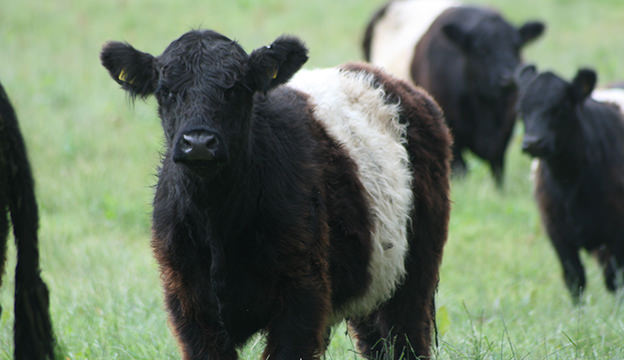
Not surprising given their Panda-ish colors and striking patterns: black separated by a broad, white belt around the middle of their sturdy bodies.

Give them a backdrop of vivid spring greenery, golden summer grass, autumn leaves in flaming hues or winter’s austere white drifts, and you have one of the loveliest rural scenes imaginable. A scene—and a cattle breed—you likely won’t forget as long as you live.

Trish Smith, a Graham, Wash., hobby farmer who grew up in Ohio and often visited nearby Camden, Maine, with her family, certainly never forgot Aldermere and its Belted Galloways.

Established in 1953 by Albert Chatfield Jr., who bequeathed it to the Maine Coast Heritage Trust in 1999, Aldermere Farm preserves the oldest continuously operated herd of Belted Galloways in the United States.

At any time of year, a portion of the 75- to 100-head herd can be seen grazing lush pastures on either side of Russell Avenue.

Recently, after a poignant reunion to scatter her parents’ ashes off the Maine coast, Smith introduced her two grown daughters to the “Oreo” cattle she’d loved watching as a child.

“Someday I’m going to have some,” Smith vows as she eyes her 5-acre pasture back home, currently occupied by horses. “I’ve wanted these cattle ever since I first saw them as a kid.”

These belted beauties can’t help but have that kind of effect on people; however, Belted Galloways possess more than cute faces and pretty exteriors—something you’ll quickly discover if you take the time to get acquainted with them.

A Rare History

Born amongst the moors, rocky hills and woodlands of southwestern Scotland, the Belted Galloway breed developed during the 16th century in an ancient district known as Galloway.

Some sources think the name Galloway stems from the old Scottish word “Gallovid” which means “a Gaul,” a reference to the first people believed to reside there. In this rough and often rain-lashed area, a robust breed of Celtic cattle, usually polled (hornless) and possessing a shaggy black coat, had eked out an existence for hundreds of years.

Although no one knows for sure, these blocky Galloway cattle—thought to be the oldest of beef breeds—may have been crossed with imported Dutch Belted dairy cattle, also called Lakenvelders, to give us the Belted Galloway.

According to the U.S. Belted Galloway Society, the first Belties came to the United States in 1939, when Alice McLean of New York imported a bull and a dozen bred heifers from Great Britain.

Tragically, about 10 years later an unscrupulous herdsman butchered and sold off the rare cattle as black-market beef when she was away in England.

The next batch arrived in 1950, brought from Scotland to Hapwood Farm in Pennsylvania by Harry Prock, who went on to found the American Belted Galloway Breeders Association in 1951 with two more Beltie enthusiasts, Charles Wells of Michigan and H. Gordon Green of Quebec.

Coming to the United States

During the 1950s, a handful of other Beltie breeders joined the organization, including Aldermere’s Albert Chatfield Jr. and General James A. Van Fleet, who at the time operated Withlacoochee Farm in Florida. In 1964, they incorporated under the name Belted Galloway Society, Inc.

Bringing Belties in from their native Scotland was expensive, costing about $7,000 per animal, so few cattle raisers kept them, notes Jane Faul, a veteran Beltie breeder in Battletown, Ky., with some 30 years’ experience.

During the 1970s, she had stumbled upon a photograph of the striking breed accompanied by an article billing Belties as “the lazyman’s cattle” because of their self-sufficiency.

“I thought, ‘I can go for that,’” she recalls. “But at the point when I came in, if you wanted to get into Belties you had to spend three or four months on the phone trying to find someone who wanted to part with one. It took me five months to get five animals together, and I was lucky to find them.”

Only about 100 Belties had journeyed to North America when the bovine spongiform encephalopathy (BSE, also known as mad cow disease) outbreak in Great Britain put a stop to live imports in 1989. Even though breeders could still import semen and embryos for their breeding programs, Belties remained scarce.

The commercial beef industry’s emphasis on uniform cattle with large frames and rapid growth did little to help boost the breed’s numbers.

The American Livestock Breeds Conservancy’s 1994 book Taking Stock: The North American Livestock Census listed Belted Galloways in the “rare” category on their Conservation Priority List, meaning the breed had an estimated global population of less than 5,000 and fewer than 1,000 registrations in North America.

Thanks to the efforts of its enthusiastic supporters, though, the Beltie’s popularity—and population—has grown in recent years as more people discover this unique breed and its exceptional meat.

Today, Belted Galloways have moved up to the “Recovering” category of the ALBC’s Conservation Priority List, which means the organization estimates these cattle have exceeded the “Watch” category’s global population of 10,000 or less and fewer than 2,500 registrations in North America, but they still need to be monitored. What’s even more heartening: Faul thinks the breed’s worldwide population could be closer to 30,000.

The U.S. Belted Galloway Society itself currently has more than 10,000 active animals in its registry, and the organization that started with three individuals now stands at 1,000 Beltie-loving members strong.

All-season Cattle

Wisconsin, where winter temperatures plunge to 30 degrees F below zero and the average yearly snowfall varies from 30 to more than 100 inches across the state, demands that its inhabitants be hardy, especially those living outdoors year-round.

So when Michael Caldwell, MD, PhD, and his wife, Lorna, started thinking about raising organic, grassfed cattle on their Milladore, Wis., farm, they looked for a breed capable of weathering the rough winters without batting an eyelash.

Enter the Belted Galloway, with a dense, double coat—both beautiful and functional—consisting of a shaggy, weather-resistant outer layer and soft, insulating undercoat.

“Belties are so well insulated that when it snows, the snow on their backs doesn’t melt,” says Lorna. “We have a shelter for ours, but they prefer to take shelter in the woods; they don’t like being inside.”

Coastal Maine’s harsh winters pose no problem for the Aldermere’s Belties, either.

“While we have buildings and shelters where our young stock or pre-calving cows have access, they’re perfectly suited to doing well in the open,” explains Howard. “We just make sure they have a sheltered area away from the wind to rest and give them plenty of fresh water and hay throughout winter.”

Indeed, Scotland’s capricious climate has created an adaptable breed capable of toughing out all kinds of weather and difficult conditions, from torrential rains to sweltering summers. (They love a pond to cool off in, though.)

“Belties are unique in that they can do well even in hotter climates, as they won’t carry their extra hair through warmer weather,” Howard says.

Belted Galloways are Survivors

The moderately sized Belted Galloways have retained many of the survival traits bred out of the larger, more traditional cattle breeds, he stresses.

For example, long-lived Belties generally show good resistance to diseases, and the cows tend to to have an easy time come calving season. Thanks to the probable Dutch Belted dairy influence, Beltie cows are excellent milkers whose calves thrive on their rich, high-butterfat milk.

“Over the years, I’ve only had to pull maybe five calves,” Faul says. “And Belties are definitely good mothers—they’ll even run coyotes off.”

Beltie enthusiasts also praise these cattle as efficient grazers and feed converters (they’ll eat plants other cattle spurn, Howard notes), a trait that makes them an excellent choice for grass-based operations like the one at Caldwell Farms.

“We don’t feed our cattle grain at all,” Michael explains. “We use management-intensive grazing, and in the wintertime, we feed them haylage [fermented alfalfa, clovers and grasses], which we harvest during the summer and store in our silos.”

“The organic inspector couldn’t believe that these plump animals are getting no extra feedings of grain, they look so good,” Lorna adds. “It boils down to their genetics and being fed good-quality grass.”

The Beef on Belties

While many Beltie owners opt to keep these cattle as pasture ornaments or focus on preservation efforts, an increasing number of breeders raise them for what they were developed for so long ago in Scotland: beef production.

“Twenty years ago, people wouldn’t have considered putting one of their Belties in the freezer, but this breed lends itself extremely well to grassfed operations,” says Faul. And what about that beef? “It’s definitely good meat: lean and very flavorful, with a darker color than commercial beef.”

Protected by their weatherproof coats, Belties don’t need to lay down much back fat to stay warm during winter.

This translates to more beef—properly finished, Galloways and their crosses dress out at 60 to 62 percent of their live weight—and a meat product low in total fat as well as saturated fat, yet still juicy and packed with flavor.

For the Caldwells, Michael’s background in the medical field made it only natural that they would raise their Belties organically and humanely on pasture rather than use confinement methods favored by commercial beef producers.

With more consumers today concerned about the treatment of livestock and the safety of our food in light of E. coli scares and bacterial resistance to antibiotics, it also made good business sense for them to take this path. Right now, beef and other meat products are the fastest-growing segments of the organic-foods industry.

Organic farming, however, takes hard work and dedication; easy fixes like hormones to boost cattle growth or synthetic fertilizers to create lush pastures aren’t an option.

For instance, producing USDA-certified organic beef requires that the Caldwells tend the land where their Belted Galloways graze while keeping environmental sustainability in mind, shunning synthetic pesticides, fertilizers and other potentially hazardous agrichemicals.

Also, the cattle cannot receive any antibiotics or hormones during their entire lives. If one of their bovines becomes ill and requires antibiotics, the couple must pull it from organic production for treatment and finish raising the animal for sale as “natural” beef.

All of this demands documentation, including detailed records of each animal’s life history, plus the yearly inspection to maintain their certification.

Belties are Worth It

It’s clear the Caldwells believe the extra work is worth it and that their hearty, efficient Belted Galloways have been a gift to them, their organic farm and their customers.

“Our feeling is that we want to be comfortable with the products we sell,” says Michael. “We want to give our customers the best quality and the healthiest meat products. I couldn’t imagine raising feedlot cattle.”

If you don’t mind getting questions like “Why do you put those sheets on them every day?” or “How do you paint the white stripes around them?” you might want to consider adding these belted beauties to your hobby farm.

According to Howard, given regular handling, these medium-sized cattle are easy to work with, and they make great projects for kids to show (he does warn they can be skittish if left on their own).

Surprisingly, raisers often find Beltie bulls friendlier and calmer than the cows!

“The Belted Galloways are self promoters in that people are automatically drawn to them,” says Howard, who grew up from second grade onward at Aldermere while his father, Dwight Howard, worked as farm manager helping the Chatfields conserve this breed.

By the way, after he graduated from high school, Howard vowed he would never have anything to do with farming again, but by now you know how Belties are: Eight years ago, they called him back to the farm.

“Because these cattle are so distinctive and the quality of their meat is so consistently high, they’re perfect for the hobby farmer who wants beautiful, self-sufficient animals that can be easily marketed for their beef on a local scale,” Howard continues.

“I’ve sold some to farms that don’t even sell beef; they may just have a farm stand and want some Belties in the field to attract customers; they’re a traffic-stopper. If you were to design a marketing plan and a cow for your logo to attract customers, it would have to be the Belted Galloway.”

Categories
Animals Large Animals

Berkshire Pigs Are Perfect Pork For Small Farms

Berkshire pigs are an excellent choice for farmers who want to raise heritage livestock with a taste consumers appreciate. Not so very long ago, almost every farm had a few pigs, which were often dubbed “the mortgage lifter” thanks to their easy profit potential.

But in recent decades, pigs moved from the farmstead to the factory farm, as small-scale farmers couldn’t possibly compete with corporate operations with 1,000 or more animals raised under one roof.

Small-scale farmers are once again finding that there are potential profits—and lots of excellent meat in keeping pigs: The trick is to keep niche breeds that produce higher-quality meat and to market directly to consumers (and chefs) who are interested in taste, humane treatment of animals and better stewardship of the environment.

One of the pig breeds that farmers are finding to work well for these consumers is the Berkshire. This pig is hardy, has good mothering capabilities and performs very well outdoors, especially when grazing on pasture. This pig breed’s meat is darker than commercial pork and far more flavorful than the pork found in your grocery-store freezer.

Berkshire Pig Breed Characteristics

Color:

Black with white points (legs, face and tail) and pink skin. Dark-colored skin reduces sunburn.

Body type:

Very deep-sided with a strong, uniform arch of back and muscular, firm build. Short neck and short, blocky legs with strong feet.

Head:

Relatively short snout. Seen from the side, the face has a slight dish-shape with a large jowl and an upturned nose. Ears are medium-sized and erect.

Size:

Medium to large animals, around 600 pounds at maturity.

Temperament:

Excellent disposition. Friendly and curious.

Production traits:

Good mothering ability with high milk production. Hardy, performs well in outdoor operations.

Berkshire pigs are black with white points.
WFIU Public Radio/Flickr

History of Berkshire Pigs

Berkshire pigs are one of the oldest identifiable breeds. These black pigs, with white “points” (white areas on their feet, snout and tail) were documented in the English “shire of Berks” more than 350 years ago and made their way to the United States in the early 1800s. In 1875, breeders formed the American Berkshire Association, making it the first breeders group and swine registry in the world.

Pigs come in two essential types—the lard type and the bacon type. As the name suggests, lard pigs produce higher concentrations of fat, which traditionally was rendered for cooking and the production of lubricants. These pigs are compact, with thick muscling, short legs and deep bodies.

Through the end of World War II, the market for lard (a key ingredient in products ranging from cosmetics to explosives to pharmaceuticals) was strong, but after the war, cheaper vegetable-based fats found their way into American diets and petrochemicals largely replaced lard for commercial and industrial uses. The declining market for lard caused demand for lard pigs to collapse and breeders began selecting for leaner hogs.

Initially the Berkshire pig breed thrived, thanks largely to its exceptionally tasty meat, but as the pork industry consolidated under the control of just a handful of large corporations in the 1980s and 1990s and efficiency of production became the name of the game, the Berkshire population plummeted. The “pork industry” simply wasn’t interested in Berkshires because they were slower growing, didn’t produce as much lean meat (which the industry believed was the only thing consumers would buy) and didn’t perform as well in confinement as the Duroc, Hampshire and Yorkshire pig breeds.

Despite these setbacks, some independent farmers who were members of the ABA kept breeding registered hogs.

“Berkshire producers didn’t open their books [to non-Berkshire bloodlines], they never changed and the breed is intact,” says Mike Telford, Marketing Director for the ABA’s Berkshire Meat Products program. “The breed has tremendous meat quality and today’s consumers, both nationally and internationally, are really seeking out high-quality meat products.”

Thanks to this consumer-driven demand for good meat, Berkshire numbers are again climbing and there is opportunity for small-scale producers to profit from these pigs.

Responding to the Consumer

Located in the lush hills of the south-central Missouri Ozarks, Greenwood Farms is a family affair that’s finding its niche raising “organic, naturally raised animals.”

Although Steve Atkinson is a dentist, he and wife, Holly, reared their children, Julie and David, on a farm in the 1980s. Steve Atkinson’s practice was the family’s main income source, but the farm was still a serious endeavor: Holly Atkinson milked a herd of 26 Jersey cows and sold the milk commercially.

When the kids grew up and went off to college, the Atkinson’s sold the farm to take some years off for travel, but in 2000 they began thinking of buying another farm to enjoy a rural retirement. Then, Julie, David and David’s wife Kindra, found that corporate life didn’t suit them, so the family banded together to create a small commercial farm.

“Our whole philosophy has been to engage in traditional family farming, but to find new niches,” Holly Atkinson says. “We have always been interested in heritage breeds and the older breeds of livestock. We don’t feel like bigger is necessarily better, or that ‘new and improved’ breeds are necessarily better.”

With a good bit of research to back up their decisions, they selected Berkshires as the hog for Greenwood Farms. (They also raise and direct-market rare breeds of cattle, horses, sheep and poultry.) Steve Atkinson loves to do research and he quickly discovered that the Berkshire is the top choice for pork in Japan.

“The Japanese are quite the gourmands when it comes to pork, so we took that as a good sign.”

Mike Telford also talks about the Japanese interest in Berkshire pork: “In Japan, you don’t have to educate consumers about Berkshires—just walking up and down the grocery store aisle you can see that they really understand what the product is and what the meat’s qualities are. Kurobuta, which is 100-percent Berkshire meat, is much prized by the Japanese; that preference goes back 300 years or more. Part of the preference is cultural; the Japanese have always preferred dark meat from black pigs because it is seen as healthy and healing [you wouldn’t go there and promote ‘the other white meat’].”

It’s All About Taste

What do the Japanese consumers already know about Berkshire quality that American consumers are just rediscovering? In a word, taste. Berkshires marble well so the meat is naturally juicy and flavorful with exceptional texture.

In fact, according to Telford, in tests for sensory qualities (or eating characteristics) performed by the National Pork Producers Association, Berkshires are the hands-down winners, coming in first overall and ranking above all the other breeds in 19 of the 24 tests NPPA performs in its assessment.

Chefs are becoming major promoters of Berkshires in the U.S. Tom Boyce, Chef de Cuisine at Wolfgang Puck’s flagship Beverly Hills restaurant, Spago, is one of the Berkshire’s fans.

“I love the richness of the Berkshire pork—and the fact that most farmers raising them are treating them better and doing a better job for the environment than the commodity-pork producers. They are raising them in an artisanal fashion.

“It is the only kind of pig we use here at Spago,” Boyce says. “And we have it on the menu at least a couple of times per month. The response is always excellent; everyone absolutely loves the flavor.”

For farmers, like the Atkinsons, who direct-market their products, the flavor really does help sell the meat to more than just five-star chefs.

“There are generally two kinds of pork on the market,” Holly Atkinson says. “One has no flavor and is watery, and the other has really thick fat on the outside, but no marbling in the middle, so it’s dry and course. With the Berkshires you get a nice edge of light fat and a little marbling, so it has good, juicy flavor throughout.”

The Atkinsons mainly sell their meat via the Internet. They have an email list of more 400 people and customers who come from near and far to purchase their tasty pork. One of their regulars lives in San Francisco and pays nearly as much for shipping as he does for the meat, but he wants the quality and is willing to pay.

“We get a good price from people who are seeking naturally raised products. We are doing brisk sales of our grassfed beef and lamb, but our pork market—which is still a small enterprise—is growing faster than our other enterprises.”

Small-Scale Swine

Interestingly enough, the Atkinsons truly started out on a small scale and continue with a slow and steady pace. They purchase six Berkshire feeder pigs (just-weaned piglets) at a time from a certified-Berkshire producer. They are growing their operation gradually as the market for their product grows. Sold by the pound, they have jumped through hoops to have their meat processed and labeled in a USDA-inspected custom packing plant.

Peggy Miller and her sister, Sally Grimes, are another family engaged in a small-scale swine operation.

“I actually got my first weaner pig as my 15th birthday present—just what every girl wants,” Miller says with a chuckle. She kept pigs through high school, mostly Spots and Yorkshires. As a young adult, Peggy got out of keeping pigs while she went to college, but after she graduated, her mother talked her into getting some again. That was 1987; she bought a bred-Berkshire gilt (a young female pig that has not yet had piglets) at the Oregon State Fair and has stuck with Berks ever since.

Today Miller and Grimes raise Berkshires (and Karakul sheep) year-round on a small plot of land right in Salem, Ore., the state’s capitol with a metro-area population of almost 300,000. Unlike the Atkinsons, they sell all their piglets as feeder pigs.

“I don’t grow my own feed, and I don’t have bulk storage, so I have to pay top-dollar for it,” Miller explains. “For the most part that makes it more profitable for me to sell pigs off the sow, rather than trying to raise them for meat. I sell to individuals who want to feed them out for family meat production and for 4-H projects.”

Berkshires really do make ideal animals for small-scale production.

“They are rugged and reliable animals,” Holly Atkinson says. “They take well to pasture life, getting a lot of their own feed from grazing and digging for acorns.”

The Atkinsons also feed some local, naturally raised corn and milk from three Jersey cows milked for family use and for making cheese.

Berkshire Breeding

Not only are they hardy and active foragers, Berkshire sows are also excellent mothers. With decades of breeding sows and farrowing out litters, Miller quickly attests to their mothering ability: “In all the years I have worked with them, I have only had one bad mother. Sometimes a gilt will be a little nervous the first time, but other than that they just lay down and have their babies. They are really calm. Sows are great milkers, so the piglets grow quickly.”

Berkshire litters tend to be a little smaller than some of the commercial crossbreds, but Miller says she averages eight to 10 piglets per litter, though she has had some sows farrow as many as 16.

“Personally, I don’t like huge litters,” she says. “I would rather have eight to 10 pigs that are big, uniform and healthy than 14 pigs with some runty ones that need nurse-maiding.”

Miller also explains that the Berkshires have a slightly longer gestation, which she feels is a benefit.

“The Berkshires go about 116 days, whereas the Yorkshires normally go 112 days. I think they come out more vigorous thanks to the extra time they spent in the womb.”

Thanks to their black coat, Berkshires offer another advantage: They don’t tend to get sunburned like light-colored pigs.

All in all, if you are looking for a good pig for a small-farm enterprise or you just want to eat your own pork like Grandpa used to raise, then the Berkshire might be the breed for you.

This article first appeared in the September/October 2006 issue of Hobby Farms magazine.

Categories
Homesteading

Spring Clean Your Gardens & Farm

maintainfarm, crops, homeSpring Clean Your Gardens & FarmHere’s a checklist to get you started on cleaning your gardens, barn and outbuildings—and get them ready for the growing season.spring cleanHere’s a checklist to get you started on cleaning your gardens, barn and outbuildings—and get them ready for the growing seasonHere’s a checklist to get you started on cleaning your gardens, barn and outbuildings—and get them ready for the growing season

By Amy Grisak

Spring clean your garden with these tips

More Spring Cleaning Help

Take advantage of a warm spring day to prepare for the busy season ahead. It’s time to pull on your boots, grab the broom and the rake, and make a fresh start.

You can complete many chores before the bulk of the spring work begins.

  • In the garden take out the old plants, amend the soil, and plan for the new season.
  • In the barn and outbuildings, you can spend a less-than-perfect weather day to clean and organize.

Here’s a list to get a jump on the game:

  1. Cut back perennials: A distinct advantage of leaving the stalks of last year’s perennials in the garden is to identify the plants in the spring, which can be very difficult to remember when the first, sometimes unidentifiable green, emerges very early. It also allows some varieties to reseed providing more blooms without effort. Cut back most perennials to the ground; they will produce new growth from the roots. A few varieties, such as lavender, simply need to be trimmed to remove old blooms and shape the plant to your preference.
  2. Burn off the weeds: The most fun way to weed is with a propane torch, as long as you are careful when you choose your day, and take care not to burn too much at one time. Before you burn, check with local regulations to make certain it is legal in your area. Pick a calm, cool day to ignite the weeds along ditches and fence lines immediately eliminating tall, dead grasses, and providing plenty of opportunity for new growth.
  3. Prune shrubs and fruits: Trim shrubs to their desired shape and size before the leaves begin to emerge in the spring. You can be fairly severe as long as they are dormant, and take into consideration the new growth during the season. Remove dead canes on blackberry and raspberry bushes, and cut them back to approximately four-feet tall to avoid them from becoming ungainly.
  4. Add compost: Has that compost pile been cooking all winter? This is a good time to flip it, and utilize the black gold at the bottom. Scatter it in perennial beds, as well as the vegetable garden, and incorporate the organic matter into the top inch of the soil. When you’re cleaning the old vegetables and flowers from the garden, chop up any plant debris (as long as it isn’t diseased), and add it to the pile to continue the recycling process.
  5. Wash plant containers: To prevent disease in your seedlings, thoroughly wash the containers you’ll use for plants during the summer. Mix a bucket of soapy water with a half cup bleach to scrub the pots. Hose off completely, and allow them to air dry.
  6. Sweep barn/outbuildings: When the weather is warm, fling open the doors and give the barn or outbuildings a good sweeping to knock out last year’s dirt. If there’s a particular concern with Hantavirus, a severe respiratory disease spread by mouse droppings, be sure to don a mask to reduce the chance of inhaling dust particles, and wear gloves. You can also spritz the area with a ten-percent bleach to water solution ( one and a half cups of bleach to a gallon of warm water) wetting the area and any droppings thoroughly before wiping them up with a damp towel.
  7. Let in the sunshine: While you’re sweeping and wiping down the outbuildings, you might as well give those windows a good washing. The trick to streak free windows is cleaning them on a cloudy day, and using a squeegee to finish them. Add a squirt of dishwashing liquid to a bucket of warm water, scrub the window thoroughly with a rag (cloth diapers work great), then pass over with the squeegee wiping off the blade after each pass. If any water is left from the edge of the squeegee, wipe it off immediately to prevent streaks.
  8. Organize shelves and cupboards: It never fails, when you need the insecticidal soap or fertilizer, you won’t have enough. Remove everything from the shelves and cupboards, wipe the off the tops, and take inventory of everything you have. If something is nearly empty, put it on your list to pick up at the farm store so you have it on hand when you need it.

Top


Amy Grisak is a freelance writer in Kalispell, Mont. She’s played in the garden for over 25 years.Crops & Gardening

Categories
Farm Management

Farming and Entrepreneurial Life

By Lisa Kivirist

During my stereotypical suburban upbringing a handful of decades ago, two words never entered my realm of career possibilities: “farmer” or “entrepreneur.”

I plugged away on the expected career track of getting a job requiring daily commutes to a cubicle. A paycheck was direct deposited in my bank account every two weeks.

While from the outside my life appeared “successful,” I felt empty inside and found no meaning or passion for what I was doing: creating advertising to sell more stuff.

How to decide what you want to do

In this article …

Learning What I Really Wanted

Others Join the Trend

Farmers Place in History

Qualities of an Entrepreneur

What is an Ecopreneur?

Evolve into an Ecopreneur

The Portfolio Perspective

A Shifting Mindset: Job & Passion

Managing Multiple Passions

Blending Family and Business

It’s Good for Kids

Farm Entrepreneurship 101

About the Author
Lisa Kivirist is the co-author with her husband, John Ivanko, of ECOpreneuring and Rural Renaissance and writes from her farm and B&B, Inn Serendipity, in Browntown, WI.

Flash forward a few years: After I chuck the corporate cubicle scene for my five-acre slice of paradise in rural Wisconsin, I jump full-force into the role of both farmer and entrepreneur, as well as juggling all the other hats that go with living the self-employed, country life.

Learning What I Really Wanted
I realized that, personally, I didn’t need a regular paycheck–or a job offered by corporate America. Give me rolling green hills and an acre garden, independence to follow my passions and flexibility to grow my own ideas and keep my financial needs low.

I realized that running my own business on a farm setting, blending operating a bed and breakfast with growing fruits and vegetables for a market garden and writing or speaking nationally on topics I care about, adds up to an off-the-chart level of fulfillment, no pantyhose required.

Top

Others Join the Trend
Turns out, I’m far from alone in choosing to take on the role of both farmer and entrepreneur. Net rural migration continues to rise as families like ours move to country settings seeking overall quality of life issues as well as the desire to start their own business.

Women constitute the largest and fastest growing group purchasing farms today, many of whom are considered “micro-farmers,” working with fewer than 50 acres and often growing foods organically.

Many also operate other small farm-based enterprises that cover categories from web-based technology to the arts or tourism, such as Inn Serendipity, the bed and breakfast we operate from our farm.

Farmers Place in History
In many ways, this entrepreneurial renaissance on the farm harkens back two centuries to Thomas Jefferson’s call for a nation of yeoman farmers, independent and self-reliant enterprises that fuel a vibrant national economy based on self-sufficiency within local communities.

While we may share Jefferson’s passion for agriculture-based enterprises, we’re not talking about grandpa’s farm business.

Thanks to the Internet and improved delivery services to rural areas, today’s farm-based entrepreneur possess inspiring potential to blend their passions with making a living while making a difference.

Top

Qualities of an Entrepreneur
Throughout history and still today, farmers exude all the key qualities of successful entrepreneurs.

Ironically, common stereotypes laud the Donald Trumps of the world as the master entrepreneurs, but a farmer could trump Trump any day in self-reliance, independence and creativity. 

How to become an Ecopreneur
Evolve into an Ecopreneur
With deeper missions than growth and greed, a fresh movement of entrepreneurs is evolving into a movement of “ecopreneurs.”

They passionately create businesses that reflect their desire to leave the world a better place and that redefine success not by bank account size but by life’s tangibles: health, wellness, meaningful work, vibrant community life and family.

Key qualifications of an ecopreneur include:

Work with Passion & Purpose
Ecopreneurs draw personal meaning and fulfillment from what they do on a daily basis, reaching far deeper than just a job with a paycheck and building their business around interests and passions that value improving the land and world around them.

From raising a flock of heirloom turkeys to painting watercolors of your barns, our farms gift us with a palette of possibilities to be passionate ecopreneurs.

Keep Lean and Green
Masters at creatively making do and using what’s at hand, ecopreneurs keep costs down by recycling and reusing. This value goes hand-in-hand with farming traditions of self-sufficiency.

We compost our B&B food scraps for free garden fertilizer and use both sides of a piece of paper for computer printouts.

Triple Bottom-line Focus
Ecopreneurs redefine wealth beyond just dollars and profit and instead place value on other lifestyle elements such as self-reliance, independence and a responsibility to future generations.

A triple bottom line doesn’t drop the idea that businesses should earn a profit.  Rather it adds the idea that business should do so in ways that take into account environmental and social impact as well as financial performance.

Ecopreneurs focus on quality of life, not financial surplus or accumulation of goods.

Contribute Locally
While we may live in a global, web-connected world, ecopreneurs realize the lasting wealth in a vibrant local community and keep as much of their purchasing dollars with other local business.

Commitment to one’s local community may evolve in different ways beyond traditional routes of joining local service clubs of chambers of commerce.  We host several free open houses annually on our farm, giving area residents an opportunity to experience how we run our farm on renewable energy or see our all-electric restored CitiCar which we use for local commuting, no fossil fuel needed.

Rather than inventing, mass producing and selling a new widget, farmers work with what supplies are already available in the barn and design their own unique way of solving a problem, whether it be efficiently getting water to the chickens or harvesting apples.

Not afraid to take a risk and try something different, farmers constantly experiment with innovative approaches.

What is an Ecopreneur?
A blooming segment of entrepreneurs are evolving into “ecopreneurs,” passionately creating businesses that go beyond building just profit, but reflect a desire to leave the world a better place and redefine success not by bank account size but by life’s tangibles: health, wellness, meaningful work, vibrant community life and family.

In our new book (co-written with my husband John Ivanko) ECOpreneuring: Putting Purpose and the Planet before Profits, we provide a detailed resource guide for this growing movement.

Given your love for the land and farming heritage, chances are you already an ecopreneur (see sidebar). By working in areas we are passionate about, we find meaning as ecopreneurs.

Top

The Portfolio Perspective
“My problem isn’t finding my passion – I have too many!” Does this sound like you?

From raising rabbits to radishes, many of us moved to the farm because of the diversified quality of life farm living offered.  No need to narrow things down to one interest area.

In fact, farm entrepreneurs thrive – both personally and profitably – when they take on a diversified livelihood.  Like nature, we thrive on interdependence. 

Think multidimensional: I call it a portfolio perspective.

Like a diversified stock portfolio, by having multiple income sources stemming from your passions, your livelihood provides multiple benefits to integrate and overlap these interests strategically, prompting our writing the ECOpreneuring book since few resources exist from such a perspective.

Top

A Shifting Mindset: Job & Passion
Such a shift fundamentally alters the conventional perspective of separating your “job” from your “leisure” activities, the traditional idea that your job earns you money to pay for your leisure interests.

What if you love llamas and helping people learn to cook healthy, seasonal meals?  Why not make both areas a part of your livelihood? Sell fiber on-line (a particularly good income source during the winter months) and teach on-farm hands-on workshops where participants harvest a bounty from your garden and learn to prepare one of your favorite recipes celebrating fresh flavors.

A portfolio perspective means looking at your life as multidimensional, not just one paycheck coming from one job but rather a range of income-generating sources.  If one project disappeared, you’ll still have others. 

Managing Multiple Passions
Nevertheless, like a garden midsummer, multiple passions can grow wildly to the point that they need a good prune.

Pruning our passions keeps entrepreneurs focused, working towards goals but doing so strategically. Start a strawberry U-pick, raise alpacas for fiber, write a novel and convert the chicken coop to a pottery studio.

Where to prune?  One approach is to remember income generation. Prioritize projects and endeavors that help the bottom line and make your business viable.

Still, don’t neglect the passions that save money, meaning you have to earn less income.  Growing your own food, repairing something instead of buying new, making your own holiday gifts instead of hitting the mall save money while still following your passions.

Top

Blending Family and Business
As the media declares the demise of quality family time due to our fast-paced modern world, we farm entrepreneurs know a secret to keeping families connected:  run a business together.

In the traditions of farming families of generations ago, farm-based businesses give everyone reasons to work together, communicate and rely on one another.

Instead of couples separately commuting to different jobs, husbands and wives grow closer through running a farm business together. 

No surprise, working together magnifies the need for strong spousal communication. First thing after sunrise, John and I have our “morning meetings,” where we discuss priorities and schedules of the day, the weather’s effect on the farm chore list, what’s for dinner, errands needed in town and whatever else comes up.

It’s Good for Kids
Farm businesses are a great training ground in basic life skills for kids.

When kids contribute to a family business they do more than just complete a round of chores; they become invested in the family and are exposed to the realities of economics.

Examples of Deductions
According to the IRS tax code, “ordinary and necessary expenses” are deductible.

A piece of advice: We track our business expenses with Quick Books and hire a local accountant to help us best take advantage of tax savings while double-checking that we’re managing our deductions properly.

How to find tax deductions as an entrepreneurRemember all business deductions must be recorded for verification.  Start getting in the habit of collecting a receipt for all your purchases.  After we enter our receipts into Quick Books, we file the receipt in envelopes organized by month.

Some key areas of deductions for small farm-based businesses include:

  • Home Office & Use of Premise for Business Purposes Only
    This is a key deduction, as your home office and other portions of your farm can be exclusively dedicated for business use, enabling you to deduct the corresponding portion of the square footage of the property as a business rental expense.

    Based on local fair market value, you can establish the rental rate for use of your personal property (i.e., a room in your home for a home office) and pay yourself rent for such use by the business.

    You’ll need to set up a simple rental agreement between you as the property owner and the business.

    In our case, about 24 percent of our home is used for a home office and two guest rooms (and bathrooms) for the bed and breakfast, resulting in $2,400 in annual rent.

    Rent is passive income, not subject to Social Security and Medicare payroll taxes.  We also reimburse ourselves for a percentage of utilities and related costs with using the portion of the house for business.

  • Supplies
    From office supplies like staples and stamps to animal feed, any out-of-pocket expenses associated with your business can be deducted. 
  • Use of Your Personal Vehicle for the Business
    You can reimburse yourself for miles associated with business use.  For example, when we drive to a farming conference or pick up office supplies, we reimburse ourselves at the IRS-specified rate. Keep a vehicle mileage log for each vehicle used for business purposes.

Virginia farmer Joel Salatin, author of many farming business books, explained why he never gave his kids an allowance:  “I don’t pay people for breathing.”

Instead, his children always had a role to play in the family’s business, Polyface Farm. Today, several of Joel’s children have matured into adults with their own families and have formally taken on managing aspects of this successful family-based venture. 

How We Involve Our Child
We’ve adopted the same idea with our six-year old son, Liam. He operates a small market stand when we have open houses or tour groups come to the farm and deposits his earnings into his bank account.

He’s listed as an author of our cookbook, Edible Earth:  Savoring the Good Life with Vegetarian Recipes from Inn Serendipity; he contributed his own chapter with his favorite recipes. 

We want to instill in Liam the entrepreneurial and self-reliant spirit, enabling him to direct his own life and income and not have to rely on a job if he doesn’t want to.

Top
 
Farm Entrepreneurship 101
Ready to take your hobby, your passion, to the next level of becoming a viable business?  Here are some basic steps to help you get started.

Remember, particularly at this initial stage, to not feel overwhelmed by the idea of running your own business.  Take baby steps, realizing a wealth of resources–from books to websites–are there to help.

The world of business can be supportive to entrepreneurial upstarts, but keep in mind it is complex and changing; you’ll want to obtain guidance on current issues from your accountant and attorney.

  1. Write Your Business Plan
    Start putting your thoughts on paper.  While business plans vary in formality, the basic idea remains: Take the time to strategically develop your vision for the business. You’ll end up with a document on paper that you can reference and adapt as you move along.

    A piece of advice: Write your business plan in the winter.  With the season-based farm lifestyle, the slower winter months offer an ideal downtime during which to reflect, brainstorm and peck away at the computer creating your plan.

    Trying to focus on strategic thinking smack in the middle of garden harvest processing will lead to stress and neglect on all fronts.

    The Small Business Administration website www.sba.gov provides general information on business plans and can direct you to your state’s SBA office for specific resources in your area.

  2. Select Your Structure
    Choose a business structure based on how much personal liability protection you need. Generally, a corporation best protects the personal assets of the officers, stockholders and employees of the business; having a corporation reduces the risk that your house, personal property or bank accounts would be jeopardized if there were ever a court judgment against the business. If you decide to select and set up a corporation, be sure to obtain professional legal advice.
  3. Track Deductions
    One key financial benefit to starting a small business is the many legitimate deductions available to your business. A business is taxed after expenses are deducted, so managing deductions effectively means your reported earnings will be reduced and you’ll owe less in taxes. A few examples of deductions>>

Top

Market Creatively
With a dose of creativity, marketing your business doesn’t need to eat away at your bottom line. 

Small Business Tool Kit
Your bookshelves probably already stand packed with hobby farm how-to books on everything from poultry to produce. Check out some of these business guides to help boost your entrepreneurial side:

ECOpreneuring: Putting Purpose and the Planet Before Profits by Lisa Kivirist & John Ivanko

Nolo Press Books and website  offers a range of small business books and resources.

Deduct it! Lower Your Small Business Taxes by Stephen Fishman

Working for Yourself, Law & Takes for Independent Contractors, Freelancers & Consultants by Stephen Fishman

The Corporate Minutes Book by Anthony Mancuso

Related Articles

The key is to understand your target market: Who is the person buying your product or service and what is the most effective way to get the message out.  The better you know your market, the more effectively you can reach them with your message.

When we first started our B&B, we paid rather large fees to be included in standard B&B directory guides.  These guidebook listings tended to attract guests simply looking for a night’s B&B lodging.

When we started focusing more on our passions of organic gardening and renewable energy, we also began to donate room nights to like-minded nonprofit organizations for fund-raising events and taught food preservation workshops at our area food co-op. Not only did we eliminate the need to spend money on advertising but we also attracted the ideal guest, someone interested in and sharing our conservation and land stewardship passions.

Top

Profit Through Conservation
Being green can save green.  Reduce your expenses by employing energy conservation measures that improve your bottom line while helping reduce your impact on the earth.

For example, replace standard incandescent light bulbs with compact fluorescents, which use about 75 percent less energy and last up to 10 times longer, saving around thirty dollars or more in electricity costs over each bulb’s lifetime.

Embrace Failure & Innovate
This article provides an overview of some core small business concepts, but the key to your success remains keeping a positive attitude toward failure and remembering to innovate and try new ideas.

A perk of farm-based businesses is that you can try out various business ideas for a relatively low investment cost, a pack of seeds, for example. We planted a small field of sunflowers thinking we could sell them to the Chicago market two hours away.

Turns out, we didn’t have large and cool enough transport systems to get them to the city – plus we weren’t savvy enough with organic flower growing techniques to keep the bugs at bay.  No problem, as we had just invested a few packets of seeds and we could readily learn from the experience and move on.

Wear your farmer and entrepreneur hats simultaneously with pride, knowing you are part of this growing movement of small-scale businesses growing in rural areas across the country.  Experiment and innovate as you craft a livelihood that both earns you income while fostering that independent agrarian spirit and commitment to leaving your land, this world, a better place.

Top

Categories
News

Still Time to Complete the 2007 Ag Census

It’s not too late to make sure you and your farm are counted!

If you received a Census of Agriculture form, you’re required by law to complete the census, according to the USDA’s National Agricultural Statistics Service (NASS).

The cool thing about this year’s Ag Census: it’s focusing on smaller farms.

This is your way to help influence decisions related to the future of American agriculture.

How Does the Ag Census Data Help?
Some of the ways the data is used:

  • Companies and cooperatives use it to determine locations of facilities that will serve agricultural producers.
  • Organizations use it to help make decisions about grants and funding allocations.
  • Community planners use it to target needed services to rural residents.
  • Legislators use it when shaping farm policies and programs.
  • Farmers and ranchers can use the data to help make informed decisions about the future of their operations.

What’s On the Ag Census
The Census is described as the only source of uniform, comprehensive agricultural data for every county in the nation. It’s conducted every five years.

Census questions cover topics like:

  • How farmers use their land.
  • Characteristics of the people who operate the farm.
  • Production practices and trends.
  • Income and expenditures.

Past Ag Census Data
Curious about past data? Find results from 2002, 1997, 1992 and more at the
Ag Census website, left side.

Complete the 2007 Ag CensusHow Do I Complete My Census?

You’ve got your form, but what now? 

This year, you can submit your census form online.

Completed forms may also returned by mail using the envelope you received with your form.

Data from the Census will be compiled and reports releases beginning in February 2009.

“More than two million responses have already been received,” says Agriculture Secretary Ed Schafer. “I thank those who have … However, a good number of producers have not been heard from, so I’m encouraging everyone to help make this the most accurate Census of Agriculture on record.”

More Information
Visit the
Ag Census website or call toll-free 888-424-7828.

Categories
News

Farm Visits: A Way to Spend Travel Time

LocalHarvest’s Erin Barnett reminisces about the joy of visiting farms while traveling, and offers some resources for you to do the same.

Farm Visits: A Way to Spend Travel Time
Over spring break when I was a senior in college, some friends and I drove from Minnesota to the West Coast.

Patriotic BarnAlong the way we stopped and spent two days with one of the guy’s relatives on a farm in Idaho. They had been dairy farmers, his people, but at the time of our visit they were retired and the cows had been sold. Still, the place was a real farm, and we got to work a little, walk a lot, and eat great food. We brushed two huge dusty draft horses until our arms were sore.

We helped fix some fences and climbed into the hayloft and generally had a good time. The snowcapped mountains in the distance and the wildflowers in the yard made the place feel nothing short of magical after five months of Midwestern winter. I liked the life there.

Farm Fields in SummerI had already been bitten by the farming bug, but if I hadn’t been, those days in Idaho might have done it. Though I did not grow up to be a farmer, I still make a point of spending as much time on other people’s farms as I can.

For me, it beats a Holiday Inn hands down. Next to t he scenery and the food, the work itself is always the best part. It makes me feel whole.

If your summer isn’t yet booked up, maybe it is a good year to spend some time on a farm! Many farmers open their doors to travelers, who can expect all sorts of different accommodations and experiences.

If you are looking for something to give you the flavor of farm life but feel mostly like a vacation, you could spend a weekend at a farm offering ‘farm vacations’ (think: simple B&B meets working farm).

If you are up for a farm-stay that might be more intensive in terms of either time or work, you could look into arranging a farm internship, which can vary in length from a week to a year.

The Internet is a good place to start researching what is available near home or somewhere you have been wanting to visit. You can start with a Google search on ‘farm vacation.’ Several states and Canadian provinces also have websites listing such opportunities. Here are three to get you started: Pennsylvania, California and Maine. This time next year, look for an “agritourism” search feature on LocalHarvest itself!

If you are interested in something a little less vacation-oriented, check out the WWOOF – USA website. WWOOF (World-Wide Opportunities on Organic Farms) is an international organization connecting travelers with organic farms. You might also look into Organic Volunteers, a WWOOF-offshoot.

One day back at that farm in Idaho so many years ago, my friend and I planted saplings in the yard. The spirit of the place inspired us to make up a little song to sing to each tree as we put it in its hole. No awe-inspiring lyrics here, but somehow it fit the sentiment of the afternoon perfectly. To the tune of “Row, Row, Row Your Boat”, it went like this:

Grow, grow, grow little tree
Tall and strong and green
Plant your roots deep in the earth
and have a happy life.

Fifteen years later that funny song still comes to me when I am planting seedlings in my garden. Farm vacations can make a deep impression.

~ Erin Barnett

Republished with permission of LocalHarvest Newsletter
May 14, 2007
 

Categories
News

Food 911

Have you seen the “No Farms, No Food” bumper sticker? Following the flurry of disease outbreaks and the discovery of dangerous organisms in spinach, beef, strawberries and onions in fast food, some might think the sticker should read, “No Local Farms, No Safe Food.”

With such reported incidents on the rise, it’s not surprising that some groups and organizations are more strongly advocating the benefits of locally grown food.

According to a recent article in The Philadelphia Inquirer, reporter Harold Brubaker wrote that one of the main challenges in boosting produce food safety along the entire supply chain is identifying and monitoring the variety of paths that the food can take from the farm to the consumer.

According to Don Scaffner, a professor of food science at Rutgers University, the process is “hugely complicated.”  He describes the system as being more “like a web than a chain.”

Brubaker reported that most supply chains or “webs” start at the farm. The process may include a shipper, a packer, a repacker or processor, a distributor, a retailer or a restaurant. As the food travels from place to place, workers must maintain proper temperatures and meet other requirements. This process, which can take just a few days or more than a week, takes place before the food item ends up on a plate in front of a consumer.

(Read another food safety-related story by Brubaker.)

In light of recent reports – from Jamba Juice smoothies to Taco Bell produce – advising consumers to avoid certain products, it’s easy to comprehend the urgency of the food-safety issue.

The Jamba Juice scare resulted in FDA announcing that Cleugh’s Frozen Foods Inc., Salinas, CA, a wholly-owned subsidiary of SunOpta Inc., was voluntarily recalling frozen strawberries sold exclusively to Jamba Juice for use in smoothies sold in stores in Arizona, Nevada and Southern California between November 25, 2006 and December 1, 2006. Cleugh’s took this action because it was concerned that they may have been contaminated with Listeria monocytogenes, stated the FDA.

Although the massive populations of cities around the world could never be entirely sustained on locally grown food, the answer for some is to grow their own food or support local growers. Perhaps locally grown food, with a focus on organic guidelines and sustainability is a step toward greater food safety.

Groups like Local Harvest and the National Sustainable Agriculture Information Service (ATTRA) support efforts to raise awareness about using food grown locally and thinking more about the food we eat.

According to ATTRA, the future of sustainable agriculture has never looked more promising — or more challenging. On the one hand, the number of acres in organic production continues to rise, sales of organic foods are growing at 20 to 25 percent a year and the USDA has enlarged its commitment to sustainability. On the other hand, crop subsidies to factory farms continue to grow, and large seed and chemical companies are lobbying hard for genetically modified plants and other organisms that require agricultural chemicals. Still, more crop producers are shifting toward more sustainable practices, and more beef and dairy producers moving toward pasture-based production.

Although the supply chain for U.S. produce is regulated by the USDA and operates under the guidance of “good agricultural practices,” rather than specific regulations, the USDA has measures in place to inform consumers and keep the food supply safe. In partnership with food producers and industry, the USDA has in place organizations, regulations and educational activities whose purpose it to prevent food contamination. Some of these organizations include:

Centers for Disease Control

Food safety and inspection service of the USDA

Other government-supported food safety organizations

Categories
News

Heirloom Tomato Seeds Top Choices

Heirloom Seeds Popular
Cherokee purple heirloom tomato
 photo courtesy Gary Ibsen

What’s a “Black” Tomato
Heirloom tomato grower Gary Ibsen explains the “Black” tomato:


  • They’re not really black, but include a range of dark colors: deep purple, dusky deep brown, smoky mahogany with dark green shoulders and bluish-brown.
  • The depth of colors seems to be encouraged by a higher acid and mineral content in the soil.
  • “Black” tomatoes are native to early 19th century Southern Ukraine and originally from a small region of the Crimean Peninsula. 

Beat the winter doldrums by checking out these top heirloom tomato seed favorites and making your own list of seeds you’d like to plant this growing season.

Top Heirloom Tomato Favorites
TomatoFest® Garden Seeds lists the “Top 10” favorite heirloom tomatoes:

  • Paul Robeson (purple/black)
  • Cherokee Purple (purple/black)
  • Brandywine (pink)
  • Amana Orange (orange),
  • Marvel Stripe (red/yellow striped)
  • Julia Child (pink)
  • Black Zebra (green/purple striped)
  • Black Cherry (purple/black)
  • Kellogg’s Breakfast (orange)
  • Aussie (red)

TomatoFest obtained the data from surveys of tomato seed sales to home gardeners and commercial tomato farmers, and a review of heirloom tomato sales to retailers and restaurants.

“Black” tomatoes are fast becoming the new “red” tomato,” said Gary Ibsen, TomatoFest® Garden Seeds owner and grower of 600 varieties of certified organic, heirloom tomatoes in California.

“This is exciting news,” Ibsen says, “because it shows that consumers are being more adventurous in selecting the dark colored varieties of heirloom tomatoes that only a few years ago were next to impossible to find in the marketplace.”

About Carmel TomatoFest®
Founded and operated by Gary Ibsen in 1991, the Carmel TomatoFest has revitalized the appreciation and desire for true heirloom tomatoes.

Cooking With HeirloomsUsing Your Heirloom Tomatoes
Don’t fret over what to do with an abudance of heirloom tomatoes and other tasty heirloom delights. Check out Cooking with Heirlooms, by Karen Keb Acevedo.

The 2008 NatureSweet Carmel TomatoFest takes place at Quail Lodge Resort, Carmel, California on September 14.

Net proceeds from the festivities will be donated to regional and national youth-focused charities; 831-625-6041; www.tomatofest.com

Categories
News

USDA drops mandatory NAIS proposal

Due in large part to input and involvement from small farmers, rural advocacy organizations and others opposed to the large-scale government program, the USDA now reports that it is dropping the possibility of making the National Animal Identification System (NAIS) mandatory.

NAIS is a United States Department of Agriculture (USDA) program administered by the Animal and Plant Health Inspection Service. Its stated goal is to provide animal health officials with the capabilities to identify all livestock and premises that have had direct contact with a disease of concern within 48 hours after discovery. NAIS is a three-part program consisting of 1) premises identification for all U.S. farms; 2) animal identification via tagging, microchipping, etc.; and 3) animal tracking. As part of the process, standards and tagging devices for all livestock breeds are being developed, as are integrated databases to access to livestock information.

On October 31, 2006, the USDA held the NAIS Community Outreach Event in Kansas City, Mo., where Bruce I. Knight, Under Secretary for Marketing and Regulatory Programs, announced that NAIS would remain voluntary. “We’re making it crystal clear that NAIS is voluntary—no if’s, and’s or but’s,” he said. “Farmers can choose to register their premises. They can choose to participate in individual animal or group identification. And they can opt to be part of tracking. Or not.”

However, with this announcement, Knight reiterated their belief that “choosing not to participate may limit marketing opportunities in the future.” Knight explained that as NAIS matures and becomes more accepted in the marketplace, consumers will respond and begin seeking out—and paying a premium for–poultry and livestock whose history is readily available. “That’s because more information means greater security.”

Matt John of Shady Lane Poultry in Winchester, Ky., is a small poultry producer who is not entirely optimistic about the USDA’s latest announcement. “Although in the latest version of NAIS guidelines, the USDA is declaring the program to be completely voluntary, I suspect many states will take steps to make it mandatory at the state level,” he says. “Other programs such as the National Poultry Improvement Plan (NPIP) and Scrapie monitoring are currently voluntary at the federal level, but most states have laws requiring participation for intra- and inter-state commerce.”

Further, he states “I can envision the USDA requiring participation in NAIS to have livestock or poultry processed under USDA inspection, participate in NPIP or other animal health programs, or receive federal agriculture loans, grants, CRP payments, crop or livestock subsidies etc.  All of these are activities that farmers choose to participate in; however many farms depend on one or more of these programs to stay in business. Small farmers are going to need to become even more self-sufficient and constantly work to develop markets for value-added, specialty products that don’t require government assistance to turn a profit.”

Those speaking out on behalf of small farmers and small farmers themselves have been opposed to NAIS because of the large financial obstacles. Those opposed have stated that a mandatory NAIS could jeopardize farmers’ privacy and their ability to earn a living. – HF editors

Categories
News

Online Farming Course

If you’re a new farmer and you want to learn more about diversifying or expanding your farm enterprise, consider enrolling in a new 9-week, online farming course beginning Wednesday, March 19, 2008.

The NY Beginning Farmer Project has developed a 9-week online course.

The course will benefit participants from a diversity of backgrounds, from those just exploring a new idea to those seeking to diversify or expand existing farm operations.

More Learning Options…

Here’s more about the course:

  • Course Content
    Drawn from a stand-alone, publicly accessible website, while the course (and all its activities, forums, and homework assignments) is housed in a virtual “classroom” that can only be entered by registered participants.
  • Lesson Plan
    Similar to other new farmer trainings and curricula, starting with an assessment of goals and resources, moving through marketing, enterprise selection and environmental stewardship practices, and ending with taking a hard look at profit potential and business planning. The final week ends May 21 with a quiz and review.
  • Discussion and Feedback
    Participants interact with each other through discussion forums, post questions for the instructors, collect resources relevant to each lesson, and complete activities like helping a fictional new farmer make decisions about his business.
  • Topics Covered
    Goals, skills and resources, marketing, evaluating land, equipment and facilities, choosing an enterprise, land stewardship, profitability, regulations, taxes and legal issues.
  • Real-life Advice
    Opportunities to interact with agricultural entrepreneurs from around the state, to get feedback and offer input on other ideas and issues.
  • Course Size
    Limited–so call soon to reserve a spot.
  • Cost:
    $200 with $50 due at registration.

The NY Beginning Farmer Project was funded by the NY Farm Viability Institute and Cornell Cooperative Extension.