Categories
Crops & Gardening Farm & Garden Farm Management Homesteading

This Family Lives & Loves Off-Grid Homesteading In Vermont

Love led Teri Page to her off-grid life. “I wasn’t really on a track to be a homesteader at all,” she says. “And then I met my (now) husband … some of his experiences had led him to be interested in farming and homesteading, and he was going to Aprovecho, a sustainable-living skills education center in Oregon. They needed a gardener, and I wanted to live with him,” she says.

“It comes down to what you’ll do when you’re young and in love.”

More than two decades, two kids and three states later, Page has embraced all aspects of living off the grid. 

In Oregon, the couple rented a cabin that, while rustic, was connected to the power grid and afforded them running water and electric power. Page, a trained marine biologist with little experience growing or raising food, fell in love with homesteading.

She established gardens filled with fresh fruits and vegetables, built a greenhouse and a livestock shed, and raised chickens, pigs and milk goats. She also learned how to preserve foods and cook from scratch—skills she never developed in her self-described “conventional suburban” upbringing. 

“I went to Aprovecho and was immersed in this whole homesteading lifestyle,” she says. “By the end, I was completely hooked. It just kept going and going and going, because that’s the thing about homesteading: Once you find one thing, it naturally leads you into the next.

“You grow a bunch of food so you have to learn how to cook it and preserve it. And then you have vegetables so it makes sense to have eggs, too. Then you … want to look at how your meat is raised and so it cascaded into this full-blown lifestyle.”

Page began blogging about her homesteading experience at Homestead Honey, covering topics ranging from cooking in a solar oven to living without running water and composting toilets. She covered fun stuff like making beeswax candles, choosing the best apples for hard cider and foraging. She also published several books on the topic, including Creating Your Off-Grid Homestead and Building a Homestead Root Cellar.

In 2012, 13 years after moving to Oregon, the couple made the decision to take on a new project in a new place. “It really was sort of heartbreaking. The fruits of our labor were just starting to bear when we were leaving,” she says. “We had these like huge cherry trees that were just starting to produce. We had a beautiful goat herd that we’d built up to the right size [and] a precise milking schedule. And we left all that behind in Oregon.”

Rather than dwell on the work that went into creating her first homestead, Page focused on the new opportunities that laid ahead. “I have a really unique capacity to continue moving forward and not dwell on the past,” she says. “Maybe it’s just part of like the karmic circle. Someday, I will finally get to enjoy the fruits off of my own fruit trees. But in the meantime, other people are getting to enjoy the things that I’ve planted along the way.

“That feels good.”

The couple purchased land in Missouri and built a house that wasn’t connected to the power grid. The decision to go off-grid was practical. There was electric service in the area, but accessing it on their land was expensive. Living off the grid also aligned with Page’s values. 

“Solar off-grid living was something we were always interested in. It became more possible because the restrictions of that particular piece of land,” she says. “And a lot of the energy [in Missouri] is not what I would consider clean energy. So we had this opportunity to [make a financially sound] and practical decision that matched our values and how we wanted to live.

“At the end of the day, to be able to go through a storm and not lose power and have your own electricity and never have an electric bill—those are things about being off grid that I really, really love.”

off-grid family root cellar

Growing Pains

Despite honing her homesteading skills in Oregon (and being married to a carpenter), Page admits that she underestimated what it would take to start a new homestead. 

“We had a distorted sense of our abilities and how long it would take to do everything,” she says. 

The couple lived in a tent, and later, a pop-up trailer, while building a 350-square-foot home. Page cooked in an improvised outdoor kitchen with a propane stove and solar oven; she used water from a catchment system and worked out an arrangement with a neighbor to freeze ice jugs that she put in coolers to store food because there was no refrigerator. And she juggled those tasks with homeschooling her children, reestablishing gardens, planning fruit trees and building a barn. 

While Page knew how to garden, the conditions and climate in Missouri were much different from what she was used to in Oregon. And the learning curve made proved extra challenging.

The shorter season meant learning how to work with cold frames and adjusting planting times to accommodate different frost dates in a new growing zone. Page purchased seeds from local companies that already tested plants in the Missouri climate and asked questions of friends and neighbors.

“Learning how to garden in a new growing zone is definitely a big endeavor,” she says. “You have to ask a lot of questions and be willing to make a few mistakes and get better as you go.”

Despite their best efforts, things didn’t always go as planned. The goats ate poisonous plants and died. Page leased an electric car but worried about the solar panels keeping the batteries charged in the winter so she shuttled back and forth to public charging stations before trading the electric car for a hybrid. And their goal of building a larger home for their growing, active family never materialized.


Read more: Curious about solar? Here are some sun-powered basics.


Cultivating Knowledge

One of the biggest lessons Page has learned about homesteading is the importance of not thinking about off-grid living in terms of absolutes and remaining flexible and adjusting when things weren’t working. It’s a lesson that served her well when she and Brian packed up their family and moved again, this time to Vermont in 2018.

Several factors prompted the move. Friends were leaving Missouri. Their kids were growing up and wanted to live in a less rural location to accommodate more social activities. And there was a perfect piece of land for sale in The Green Mountain State. 

“It’s off-grid living 2.0,” she says. “We’re starting again from scratch and building and doing it all again. We’re older and maybe a lot wiser.”

The family is currently living in an off-grid yurt and building a home. Instead of a straw bale, cob or earth-ship home often favored for off-grid living, the couple is building a conventional stick-built home with a concrete foundation and timber framing. They’re still being thoughtful about the materials, though, sourcing lumber from local, family-owned mills and looking for opportunities to reduce waste and minimize their environmental footprint. 

Since moving to the grid, Page has considered connecting to the grid. Most of the electricity in Vermont is generated from renewable sources, making it a more attractive decision to connect to municipal power sources. But the decision came down to the budget.

Instead of spending $20,000 to connect to the grid, Page plans to expand their current solar array and remain off the grid.

“Off grid is such an interesting term because you could have an off-grid house that has a $50,000 photovoltaic system with wind backup. And nothing about the house would look different than a conventional house,” she says. “Or you could live in the middle of nowhere with a few solar panels and carry water from a creek. There’s such a huge spectrum of what it can look like.”

off-grid family kids

Changing Seasons

Moving to Vermont has also enabled Page to make different decisions about what she grows and raises at home. She still has a garden and raises laying hens, but she admits that it’s more convenient (and sometimes not that much more expensive) to purchase from local farmers. 

“In Missouri, I actually had a lot more motivation to do some things like raise our own meat because I couldn’t get those things locally at all,” she says. “Vermont is an agricultural state and has such a high level of quality local food that you can get virtually anything you need here.” 

Page found farmers that specialize in certain products. Her aim: to find a balance of what she can source from local, organic farms and what she wants to grow in her own garden. She had a milking cow in Missouri but now sources raw milk from a dairy she passes on her route to work. She grows fewer carrots, turnips, beets, potatoes and other root vegetables and supplements supplies with bulk purchases from a local grower. And she sources meat chickens from a neighboring homestead.

“I’m gardening by hand,” she says. “I don’t have machinery or helpers. It’s just me and a bunch of weeds. So I’m doing a lot of manual labor. If I had many more hours in the day and some people to help me, I would probably grow everything myself. But I’m not there and probably won’t ever be there, [so] I’m definitely doing a cost-benefit analysis all the time.” 

Just because her homestead has changed doesn’t mean that Page has lost her passion for off-grid living. “I dream big, and I have a lot of crazy ideas,” she says. “I feel like having years and years of experience and a foundational and skill set has allowed us to leap into homesteading.

“This is more than just like a hobby. I mean, this is kind of the defining lifestyle…. Every part of my adult life has been living this homesteading lifestyle.” 

This article originally appeared in the September/October 2022 issue of Hobby Farms magazine.

Categories
Beginning Farmers Farm & Garden Homesteading

Autumn Is For Apples At Oren Wooden’s Apple House

The Wooden family of Oren Wooden’s Apple House near Pikeville, Tennesse, could teach a master class on expanding your productive season through direct farm sales. Many decades ago (over seven to be exact), Wooden’s apple orchard took root. The decision to plant apple trees seemed a natural fit for Henry and Orene Wooden. The couple had an extensive agricultural background when they decided to plant their first trees and go into business selling apples from home. 

Later, observing a need to expand the business to provide for multiple family members, generations of the Wooden family are intricately entwined in the business in a variety of roles. Today’s business finds third-generation Wooden family members Mark and Sandy (Wooden) Burnett and Labron “Chubby” and Carole (Wooden) Smith at the helm of the Apple House, which bears the name of Sandy and Carole’s late father, Oren. Along with other family members, they also oversee its expanded enterprises. 

Here is how one family moved beyond selling apples, and later peaches, into a business that supports multiple families and a host of employees all while remaining committed to their vision of providing a quality product.

Delicious Desserts & Café 

While selling apples was the family’s first avenue to success, their next venture was selling fried apple pies. “We sold them from inside our Apple House. And it went so well that it was overwhelming,” Sandy says. 

A former supervisor of Mark’s from a previous job, Doyle Mack Argo, who had experience in the foodservice area, helped them to get off on the right foot. Soon, they were building off of the success of the fried apple pies with more apple-themed desserts, such as apple dumplings, added to the menu. 

When a niece expressed an interest in running a new family enterprise, it didn’t take long for the next step. They added the Oren’s Orchard Café, a family-style restaurant offering meat and vegetable plates.

It was readily apparent that their decision was a hit. 

Before the addition of the eatery, customers mainly bought desserts from the Apple House for takeout. The inclusion of the café has allowed the business to move beyond that. 

“People wanted to come and eat a meal here, then enjoy their dessert on-site,” Mark says. With a selection of tasty offerings, it’s no coincidence that the café has become so popular that it now also accepts Thanksgiving carryout food orders. It’s also expanded to include a food truck. 

Success in selling apples and apple desserts along with the contributions of the café has led to the ability to grow the overall operation with the addition of a new packing shed and cooler. 

apples Oren Wooden's Apple House Beyond Good Food

However, physical additions to the business aren’t the only added attractions. “People are looking for entertainment now,” Mark says. In response to customer demand, this past fall the family added a fall festival to their lineup that brought new customers to their business. 

“We had a sunflower patch, apple picking, pumpkin painting, hayrides, face stickers, balloon animals and more,” says Shania Kate, Mark and Sandy’s daughter. 

“People absolutely loved the experience of apple picking because they have never done that before,” Mark says. The family also included 22 local vendors, offering a variety of product spaces, to set up at the festival.

Because so many people came out to the festival, looking to the future they hope to expand the agritourism portion of their business. To date, they have had a physical presence at other nearby festivals in addition to hosting visitors at a Christmas-themed event on-site.

For the fall season, the family also grows and offers butternut squash, pumpkins, cabbage, peppers, tomatoes and more. And while they are best known locally for the apples they sell from the Apple House, they also have an outstanding reputation with wholesalers on the packing side.

Moreover, as part of the experience, customers looking for “No. 2” apples are welcome to come to the packing shed to select apples for making their apple sauce, apple butter, etc.


Read more: Check out these 5 tools for harvesting hard-to-reach apples!


Getting the Word Out

However, good products and events are only successful if people know about them. For their marketing strategy—whether getting the word out about everyday offerings or for certain events—the family’s go-to tool is social media. 

“The biggest one we use is Facebook,” Shania Kate says. “We try to update it every week with information such as what we are picking and the menu at the café.” The family also makes use of print media, where feasible, and Instagram.

Quality Products

Whether from a wholesale or retail perspective, any marketing strategy requires thought on how to best package your product. 

Apples are picked and put straight into bins in the orchard. From there, the bins go into a large cooler directly beside the packing shed. Then the apples are moved from the cooler, as needed, to the packing shed where they are packed into boxes and shipped.

“This process keeps them from getting overripe,” Mark says. 

As for packaging for retail sales, apples are offered in a bushel box and peck and half-peck bags. 

“If a customer wants two or more varieties in a bag, we do offer that,” Mark says. “We do anything to take care of the customer. Fruit does have an expiration date, so we try to keep everything fresh, moving and of good quality.”

apples Oren Wooden's Apple House

Overcoming Obstacles

Like most farming enterprises, this type of business does have its challenges. Finding workers outside of the family is one of those. 

“We would really like to add more hayrides and a pumpkin patch,” Mark says. “But before we do that, we have to have, for example, a reliable person to drive the tractor and watch the kids.” 

Crop failure is also a reality. “We didn’t have a lot of apples last year,” Mark says. “We had a big freeze, and we had to pull a lot of apples from the North. If we need something we get it from North Carolina because it’s closer.

“The product was good but, just coming from a long way, the price was terrible. But we got through it.” 

While sourcing apples is not something the family wanted to do, it was necessary to maintain and support other parts of their business. In these types of situations, Mark advises being honest about what caused, in their case, the shortage to occur and where the apples came from to replace those that were lost.

As well, the COVID-19 pandemic has been a challenge that has been difficult to predict. “Our peak season is October right on through Halloween,” Mark says. “We used to have groups come out during the week and, especially with the groups of elderly people, they got kind of scared to come out and be around a lot of people. We understand, but these group visits are the bulk of our business.”


Read more: Make some dehydrated apple slices!


Looking to Improve 

One area the family would like to improve on is the payment methods they accept on the retail side of their business. “The younger generation calls us old-fashioned,” Sandy says. “We have always only taken cash or check. We did get an ATM several years ago before all of these other payment methods became popular.” 

In response to this growing acceptance of other payment methods, the family has considered adding some type of credit card machine but adds that there is an expense to doing so as far as credit card companies charge fees for their use. While Sandy acknowledges that some businesses pass this added expense on to the customer, they haven’t yet fully decided whether or not they will move forward with adding this particular payment method.

Advice for Others

Before taking on any business such as theirs, Shania Kate and Mark suggest the following:

  • It’s important to stay current. Research is just as important when you begin as it is when you are looking to grow and expand your business. 
  • Due to ease of setup, use social media for the bulk of your marketing.
  • Keep your business logs and safety records up to date.
  • Offer additional product lines such as honey, crafts and produce from other established local growers.
  • Put yourself out there. Get acquainted with your neighbors, other farms and people in the community. Your local chamber of commerce will also help. “A good community will help you with anything,” Shania Kate says.

By taking a page from the business plan of Oren Wooden’s Apple House, you can expand the foot traffic and direct farm sales of your small-farm operation. 

This article originally appeared in the September/October 2022 issue of Hobby Farms magazine.

Categories
Beginning Farmers Crops & Gardening Farm & Garden Urban Farming

Flowers, Succulent Pumpkins Star At Midtown Bramble & Bloom

“I’ve always been a gardener. But I was getting married during the pandemic and decided I could grow the flowers for my own wedding,” says Marisa Mender-Franklin, owner of the Midtown Bramble & Bloom micro flower farm in Midtown, Memphis. “I just loved it so much I wanted to keep growing at that scale.”

After successfully scaling up her flower-growing endeavors, Mender-Franklin has expanded the operation to specialize in delicately-arranged bouquets. She also runs flower-focused workshops for the community.

We spoke to Mender-Franklin about how flowers connect people to special moments and the enduring appeal of dahlias. We also got the scoop on making seasonal succulent pumpkins.

Growing with the Community

Mender-Franklin says that securing enough land to grow on was an initial problem to overcome when launching Midtown Bramble & Bloom.

“I grow in the middle of the city, so having access to enough space to grow is an issue,” she says. “At my own home, I just have a little patch in the front yard. So I’ve had to get really creative in where I’m growing.”

Mender-Franklin’s solution has involved recruiting her neighbors. “I’m currently growing in seven yards and empty lots,” she says.


Read more: You can take action now on lead in urban gardens and farm soil.


Everybody Loves Tulips & Dahlias

When it comes to the most popular blooms in Mender-Franklin’s collection, she says that tulips are a guaranteed winner during the spring. “Dahlias are always a favorite in the fall, too,” she adds.

Crafting Succulent Pumpkins

After Mender-Franklin noticed succulent pumpkins popping up on her social media feeds, she decided to try her own hand at crafting them.

“They’re really fun,” she says of the idea of using a pumpkin as a decorative vessel for flowers. “We have pumpkins and succulents, so it was an easy way to transition into the fall.”

Mender-Franklin adds that she’s currently brainstorming ways to waterproof the pumpkins for the upcoming harsher weather, while also running succulent pumpkin community workshops.


Read more: It’s time to celebrate pumpkins!


Flowers Build Community

“For me, it’s the community aspect of it that I find most rewarding,” says Mender-Franklin of her farming adventure. “People use flowers during really important parts of their life and to build a connection with other people. So I feel like I get to be a part of important moments in their lives.”

Follow Midtown Bramble & Bloom at Instagram.

Categories
Equipment Farm & Garden Homesteading Permaculture

Solar Power Basics, From Financing To Installation (& More)

In this age of green—or greener—energy, we’re inundated with ads pushing solar panels, solar panel installation services, and sometimes even “Free Solar Power!” We may love the idea of converting our homes to solar. Actually accomplishing that, however, can seem a little daunting.

Nevertheless, transitioning to solar energy is decidedly worth investigating. “Solar is a wonderful choice for many people, for many reasons. It’s great for the environment, and it can also help homeowners save money,” Clean Energy States Alliance (CESA) Executive Director Warren Leon says.

There have been incredible advances in solar technology over the last several years. As a result, today’s solar power systems can last 25 years or longer. Furthermore, the cost to switch to solar power has gone down by two-thirds in under a decade.

“Since going solar is a big financial decision that will impact your home’s value and your utility bills for years to come, it’s important to do your homework about the companies you are thinking about working with,” Leon continues.

Getting Started

Before considering different solar options and financing, you should know your current energy costs and usage rates. Knowing these will help you to estimate your potential savings with solar power.

How much you could save partly depends on how much sun exposure your property gets. And, if you remain connected to the local power grid—as many solar-powered homes do—you might also be subject to certain fixed costs from the utility company.

However, this varies from state to state.

If your household uses lots of electricity, you might not be able to generate enough power on your own to cover everything you use. In that case, some of your power would come from solar, and any additional electricity needed would come from your utility company.

But, if your household requires less energy to operate, you could supply all of your own power and generate excess that you then sell back to the utility company. (Again, energy buy-back programs vary, so you’ll need to find out what your local utility company’s policy is.)

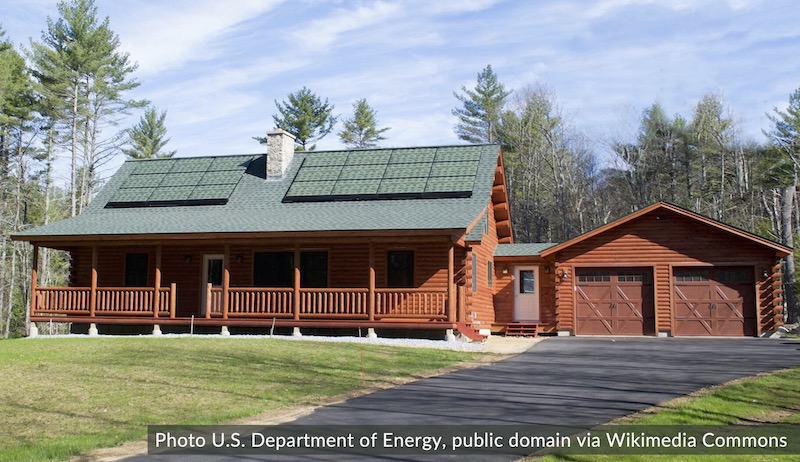
solar power panels
U.S. Dept. of Energy

Financing Solar Setups

A few of the most common ways to pay for adding solar include:

Cash

If you can afford to purchase a solar system outright with cash, you’ll own the equipment, reap any associated energy cost savings, and directly benefit from any applicable state and federal tax credits and incentives. (Just make sure that your long-term savings square with the up-front cost to buy and install that solar equipment.)

Loan

Depending on your credit, both secured and unsecured loans may be available to cover your solar costs. As with mortgage loans, interest rates and terms can vary greatly from lender to lender. Like the cash option, if you pay via loan, you own the equipment and can directly reap the benefits.

Solar Lease

There are solar installation companies that will cover all of the upfront costs for you. In exchange, you agree to cover monthly lease payments for what can be 15 years or even longer. Be aware that solar leases often include “escalator” clauses, meaning your lease payments will go up in the ensuing years to cover inflation and rising energy costs.

Also, unlike with the cash or loan options, you don’t own the solar equipment and you typically won’t reap any tax credits or benefits. But you do get the solar power you generate, as well as any applicable credits from excess power you may put back into the local power grid.

Just make sure the monthly energy savings you anticipate will be worth springing for the solar lease payments.

Power Purchase Agreement (PPA)

PPAs are similar to solar leases in that you don’t pay for equipment or installation upfront and you typically won’t reap any tax credits or benefits. In this case, you aren’t leasing the equipment. Rather, you’re paying the installer for the solar power generated.

If you need extra power, you purchase that from the utility company. And if you use less power than you generate, you’d get any applicable credits from the excess power you put back into the local power grid.

Like solar leases, PPAs may also include escalator clauses, so read the fine print carefully. Also, when weighing PPAs as an option, compare how much you pay per kilowatt hour now versus how much you’d be paying for solar energy per kilowatt hour.

For greater detail, see CESA’s “A Homeowner’s Guide to Solar Financing: Leases, Loans, and PPAs.” Other useful resources include George Washington University Solar Institute and the U.S. Department of Energy SunShot Initiative.


Read more: Read more about bringing solar power to your farm.


Choosing a Contractor

Not sure where to start? Your state may provide a list of solar power installers. Interview as many of them as possible. “Get multiple quotes and make sure you understand the different financing options available to you,” Leon recommends.

Reputable installers should be willing to complete a Solar Energy Industries Association (SEIA) solar purchase disclosure form for you. At minimum, they should also provide references, proof of their qualifications, current liability and workers’ compensation insurance policies, and detailed cost estimates.

These estimates should include total expenses, solar specs—like the system’s size and kilowatt-generating capabilities—and equipment warranty information.

Categories
Podcast

Episode 40: Arwen Donahue


Arwen Donahue Hobby Farms Presents: Growing Good

This episode features Arwen Donahue, her life on a Kentucky farm and her new book, Landings: A Crooked Creek Farm Year.

Arwen tells us about her and her husband, David Wagoner’s, Three Springs Farm. You’ll hear about how they searched for their niche and revived themselves from burnout in small-scale farming, from 18 years of having a vegetable CSA to growing food for a local restaurant group. Learn about some of the foragable goodies on Arwen’s farm and how you can incorporate foraged items into a CSA.

Arwen discloses the struggles of writing and illustrating a book while farming and also the beauty in combining a farming life and a creative life. Listen to her read a page from Landings and explain how this book depicting drawings and daily journal entries of the farm came into being.

Categories
Animals Chicken Coops & Housing Chickens 101 Farm & Garden Flock Talk Health & Nutrition Poultry Poultry Equipment

Protect Your Chickens Against These Common Predators

The benefits of free-ranging a flock are vast and varied, with the overall outcome that birds kept outdoors 24/7—or at least for most of the day—are more active and healthier than their coop-kept counterparts. If you choose to completely free-range your fowl, they must have the ability to shelter under structures. Chickens without access to safe housing are most at risk of falling prey to predators. 

Predation Patterns

Chickens have a lot of predators, but the primary threats your chickens face will depend on what part of the country they call home. Hawks and other birds of prey, raccoons, foxes, weasels, opossums, coyotes, skunks, rodents and bears are just a few of the animals that consider your birds a tasty treaty.

It’s important to remember that domestic dogs and cats—whether your own or a neighbor’s—also pose a very real threat to free-range flocks. 

It can be helpful to ascertain what predators put your chickens most at risk to determine the best course of protection. Local feed stores and other chicken owners in your area can offer insight into regional predators at threat to your chickens. If your birds are already under attack, noting the time of day they go missing, as well as where on the bird’s body the injuries can be found, can help to narrow down the instigator. 

Birds of Prey 

Birds of prey can be found all over North America. But how they threaten free-range chickens can differ by species.

Hawks and falcons will attempt to take birds during the day. Owls often attack at night. Hawks are persistent predators, killing just one or two chickens at a time, but returning repeatedly to an unprotected flock. Hawks typically decapitate chickens, eating the breast meat and the entrails. Owls can leave behind a pile of feathers and other inedible parts, but if it’s chicks they’re killing, they may take the entire bird.

Once birds of prey have found your flock easy pickings, it can be difficult to rein them in. Many of these birds are federally protected, so shooting them or shooting at them to scare them away isn’t an option without threat of a hefty fine or even jail time.

Instead, use these tips to protect your flock from flying threats.

Undercover

Let your chickens range where cover, such as bushes, trees or buildings they can get under, is readily available. Chickens often see attacks coming and will run and hide.

If your birds have an area in which they frequently pass their time, consider installing netting—or even a solid roof—over the open area to limit their accessibility to hawks and owls

Goodnight

Put poultry to bed early. Owls hunt at night, so corral your flock in their coop before dusk.

chickens chicken predators
Richard Pratt/Shutterstock
Spooky Decor

Consider using scare tactics such as hanging reflective tape, old pie tins, CDs or shiny pinwheels so they spin and create bright flashes of light, deterring birds of prey. (Don’t use mirrors, as these could start a fire.) Note that each of these tactics might not work on all birds that threaten your chickens

Decoys such as scarecrows can also keep birds of prey guessing. These must be moved often or the birds will become accustomed to—and not intimidated by—them 

Loud & Proud

Use various noisy solutions such as wind chimes or a radio to make even the most persistent hawk pause. It’s important that (like the decoys) the sound be changed every so often so the birds don’t get used to it.

Utilize a chicken saddle designed to confuse aerial predators. This piece of equipment isn’t uncomfortable for your bird and won’t scare flockmates, but it will give aerial attackers pause.


Read more: Got rats in the chicken run? Here’s how to get and keep rodents out.


Coyotes 

Coyotes are active around-the-clock, but those that live closer to urban areas tend to be most active at night. A canine species that can weigh up to 50 pounds, coyotes are found throughout North America. They’re extremely capable of digging and jumping. They’ve been known to scale fences well over 6 feet in height. Though coyotes can hunt in packs, they normally hunt alone when searching for smaller prey. 

Ways to thwart coyotes from feasting on your feathered friends include the following. 

Guards

Utilize trained livestock guardian animals such as dogs, donkeys or llamas, to protect your flock, both when free ranging and when in a coop. (The key word here is “trained.”)

Seals & Upkeep

Keep chicken feed tightly sealed. Coyotes are omnivores and will eat everything from insects and plants to roadkill and livestock. Coyotes are attracted to smell, so removing chicken feed in the evening (from either coop or field) can be key to not attracting unwanted coyote attention.

Install “coyote rollers” on the tops of fences to prevent access to your flock. These contraptions roll when the coyote tries to push off of them, thwarting his efforts to get inside

If coyote attacks are your No. 1 concern (and not attacks from above), eliminate bushes and other areas where a coyote can hide while stalking prey. 

Dig In: Digging is a coyote’s preferred method of entry. To prevent access, install hardware cloth 2 feet under fences.

Light It Up

Place solar-powered visual deterrents around chicken perimeters. When activated, these emit bright red, flashing lights to scare predators away from your chickens.

Foxes

There’s a lot of truth behind the saying “sly as a fox.” Fox attacks can be very difficult to prevent: They can dig under fences and squeeze through small holes, removing chickens with little to no evidence—even during the day. 

If you’re unsure how the fox is getting access to your coop at night (or if you’re unsure of exactly what’s stealing your chickens), it can be worthwhile to set up a trail camera to see exactly how—and who—is getting in at night.

  • Use heavy-duty fencing if you know you have foxes in your areas. Chicken wire is often not sturdy enough to keep them out.
  • Install motion-detection lights around the coop.
  • Walk fencelines around where your chickens stay at irregular times to keep foxes on edge. Also, check for holes and fence weak points.
  • Remove places where a fox can hide near the coop. The lack of cover will make them less confident. (Again, only remove these areas if hawks aren’t your primary concern.)
  • Consider getting a rooster, which is protective of its flock and will sound the alarm if a fox (or other predator) is in sight.
  • Add a few guinea hens to your flock. Fiercely territorial, these fowl will fight anything that challenges their authority.
chickens chicken predators
Irina Kozorog/Shutterstock

Minks, Weasels, Ferrets & Badgers

Found in pockets all over North America, each of these Mustelidae can wreak havoc on backyard flocks. All can squeeze through tiny openings in fencing and coops, and often will kill multiple birds in one break in. Frustratingly, though, they won’t eat everything they kill. 

Badgers in particular are skilled at digging and climbing, so it’s imperative you put your flock up at night and protect them from attacks that come from above and below. If badgers live in your area, try these solutions.

  • Remove food from the coop at night to eliminate the easy-meal temptation. 
  • Use strong materials to design and secure the door. (Badgers are strong!)
  • Opt for strong fencing and install it underground (about 10 inches deep).
  • Utilize electric fence or electrified poultry netting to deter invasions.
  • Consider spraying mint, citronella, eucalyptus or hot pepper scents around where your chickens congregate. These critters detest strong smells.
  • Have a pup? Put a bed he’s laid on outside the coop enclosure to discourage nighttime visitors.

Read more: Build this DIY weasel box to keep your hens safe.


Raccoons

The ultimate “team player,” raccoons are notoriously wily, often teaming up with others of their ilk to coordinate a chicken attack. Raccoons have five long digits with a claw at the end of each, making them particularly dexterous and deadly to chickens as they can easily open and hold locks and latches.

Raccoons are quite lazy by nature. They’re attracted to food but will find the easiest way possible to obtain it. Eggs and baby chicks are particularly vulnerable. To protect your flock, consider the following. 

  • Gather eggs twice daily.
  • Put chicks outside only when they’re ready to avoid enticing raccoons to a quick meal.
  • Using a more-complicated lock than a simple sliding bolt or latch to prevent unwanted entry into runs and coops.

Skunks 

Skunks are known for their egg-sucking abilities. They’re also notorious for snatching eggs and chicks, and often injure any adult chickens that obstruct their rampage. In addition to their lethalness, their distinct odor makes for one more reason to keep them at bay.

To keep your flock safe, consider the following points.

  • Installing hardware cloth around the chicken coop to keep them from taking up residence under structures.
  • Trap the skunks and relocate them if local laws allow.
  • Place rags soaked in ammonia around the yard in or on metal containers—such as old coffee cans or cookie sheets—to prevent the ammonia from seeping into the ground. 
  • Sprinkle cayenne pepper around the fence lines, coop and anywhere else where your chickens spend time. Skunks can’t stand the smell.

Any animal that is hungry enough will work diligently to circumvent any deterrent you install to keep your flock safe. Knowing the predators in your area and preparing for their favored mode of entry will go a long way to helping keep your chickens safe. 


More Information

Order Chicks in Fall for Spring Eggs

Springtime is synonymous with babies. As temperatures rise, days get longer and animals get frisky. Broody hens spend more time sitting on their eggs, and cheeping chicks start showing up in feed-supply stores. It’s no surprise that spring is also the season when most people start their flocks. But a growing number of chicken-keepers are adding fall flocks to their farms.

Next spring, when other flock-raisers are just setting up their brooders and welcoming new chicks to the farm, the chicks you purchased this fall will already be laying eggs. You might also get more eggs from fall-hatched chicks.

The reason: Chicks purchased in the spring don’t start laying until the fall. Just as their reproductive systems kick into high gear, the days get shorter. This sends the signal that it’s time to slow down egg production through the winter.

In contrast, chicks hatched in the fall shift into maximum production in the spring, laying almost one egg per day (depending on the breed). If you get chicks in the fall, they’re maturing through the early part of the winter and might put off laying a little bit longer.

But when they start laying in the spring, the prime laying season, they are going to be ready to go. 

Adding chicks in the fall can also prevent you from keeping the coop lit for sustained egg production. Staggering your new additions in your flock by adding some chicks in the spring and some in the fall typically will provide year-round production without the added light source.

This article originally appeared in the September/October 2022 issue of Hobby Farms magazine.

Categories
Animals Farm & Garden Large Animals

Video: Security Tips Heading Into Sheep Breeding Season

Fall is here and sheep breeders are turning attention to the breeding season. Selling lambs is their main source of income and the success of those sales begins now. Below are answers you need to know to ensure the best outcome of your breeding operation.

What are the best months for breeding?

August through December are the typical months for ruminants to breed. Some particular sheep can breed all year around, but most sheep and goats breed during these months.

How old does the ewe need to be?

Most ewes begin to cycle and can be bred after 9 months old. However the recommendation is to wait a year before breeding. Some particular breeds grow faster than others and may be ready for pregnancy. But it is always going to be a greater risk to breed the ewe before they are a yearling.


Read more: Here’s how to evaluate your sheep’s body condition before breeding season.


How do I know when they’ve been bred?

The best way to track breeding is with a breeding harness. These have a crayon substance that leaves residue on the ewes to show when mounting has occurred. 

How do I use a breeding harness?

The harness is strapped onto the chest of the ram and fastened in the back between his shoulder blades. The crayon is placed in a holder of the center of the harness. The crayon should be changed out every 15 days.

Why does the crayon color need to be changed?

Every ewe cycles 15 to 17 days. Changing the color of the marker allows you to know which cycle she was bred. If the ewe gets marked multiple times with multiple colors, she is struggling to get pregnant. If she does not get marked a second time, you can be sure she is pregnant.

What if the ewe is not getting marked?

You need to troubleshoot the problem. If it is all ewes, you should consider the ram is not doing his job or the chalk marker is not working. If it is just one ewe, you need to make sure she has proper nutrition and is fit to breed. 

When will the lambs arrive?

Once you can narrow down the dates of conception through marking and recording which day she appears bred, you will need to plan 152 days before the lambs arrive. Plan ahead if you will be out of town a week or two during lambing season. It is best to avoid breeding sheep through those dates. 

Categories
Beginning Farmers Crops & Gardening Farm & Garden Homesteading

Celebrating Joys Of Pumpkins On National Pumpkin Day

It’s time to celebrate! Oct. 26 is National Pumpkin Day, a perfect opportunity to stop and appreciate the multifaceted fun of growing, eating, carving and even painting pumpkins.

I won’t claim to be an expert at growing pumpkins since I’ve never attempted to raise one of those behemoth pumpkins weighing hundreds (or even thousands) of pounds. The growing season on my northern Wisconsin farm is simply too short.

But I’ve grown smaller pumpkins for the last three years, favoring varieties like Early Prince Hybrid (think “classic carving pumpkin”) and Casperita (adorable miniature white pumpkins). I plant several raised beds with pumpkin plants and encourage the vines to climb a welded wire fence.

It’s fun to see the Casperita vines grow higher and higher, dotting the fence line with little white pumpkins.


Read more: Hand-pollinate your pumpkins and other squash for better success!


Pumpkin Growing Basics

Once they’re established, pumpkin plants grow rapidly. I find it satisfying to watch them grow with seemingly endless vigor during the peak of summer. Even small pumpkins can grow noticeably from one day to the next.

But pumpkins shouldn’t be left to grow unaided. They need at least 1 inch of water per week, so diligent care is the key to success.

Weeding the beds early on is a good strategy. I have, however, found that once the pumpkin plants take off, their gigantic leaves produce such deep shade that weeds generally aren’t too problematic.

After the pumpkins have matured, harvesting is a delight. The stems can be thick and prickly. Durable gloves and pruning shears simplify the process of separating fruit from plant.

Pumpkins are so beautiful that’s it’s tempting to just place them around your house and yard to enjoy their appearance. (There’s a Casperita pumpkin sitting next to me on my desk.) But think of all the delicious meals you can prepare with pumpkins! Pumpkin pie, pumpkin bread, roasted pumpkin seeds … the tasty possibilities go on and on.


Read more: These 3 unique pumpkin varieties bring unusual fall flair to the garden.


All the Pumpkins!

Then again, why not eat some pumpkins and decorate with others? If you have lots of pumpkins and want to enjoy some throughout autumn, you can cure them for around two weeks. This involves storing them in a warm location (around 80 to 85 degrees F) to dry out their skin.

Once they’re cured, pumpkins can last for months and are perfect for decorating.

If you’re handy with a carving knife, the possibilities are endless. Start by cutting off the top and removing the innards of the pumpkin, including the seeds. You’ll be left with a hollow fruit perfect for carving intricate designs into the skin.

Of course, if your artistic skills exceed your prowess with a knife, you can paint your pumpkins instead. I enjoyed entering a pumpkin painting contest last year. While I didn’t win, it was a pleasure to paint a pumpkin I grew myself.

I plan to enter again this year.

The point of this ambling National Pumpkin Day essay is simple. It’s to highlight the pleasures of growing pumpkins and convince you to give them a try in 2023. True, pumpkins can take up a lot of garden space, but the rewards (as I’ve hopefully expounded on in great detail) are worth the commitment.

Have fun!

Categories
Animals Beginning Farmers Chickens 101 Farm & Garden Flock Talk Poultry

Chicken Chat: Escaped Chickens Evade Numerous Threats

In a locked-down world, my flock of 20 was untrammeled. It’s difficult to capture their adventures and old-fashion fun, like two-stepping/tearing up the front landscaping, kicking dirt on the steps to the house or a recent flock favorite, “peck and ditch.”

(That’s when Gigi climbs a full story of stairs, flock looking on, to peck on the sliding-glass door.)

As the person working from home turns his or her head, the flock can be heard squawking as Gigi makes her getaway, hopping back down stair after stair, presumably thinking, “Got ’em!” and smiling comb to comb. Daily adventures have been in store, so long as it isn’t raining.

A hen has to look her best, as I’m sure you know.

chicken chickens

A Bit of Background on Our Chickens

Before detailing any more of my flock’s escapades, a bit of background of how this came to be. I promised my daughter we would get chickens when we moved from a cookie-cutter neighborhood to 20 acres just down the road in rural, central New Jersey. I started to make good on my promise in December 2020, with a Christmas gift of a large chicken coop and the accouterments under the tree.

I liken it to Tiger King, not knowing the entertainment and success it would bring. 

A large shed-turned-coop with a run 20 birds deep was in the works, complete with evaporative misters to beat the heat, a shade sail and, of course, plenty of roosts, feeders and waters. Plus, there was what looked to be a bus stop, under which some birds would gather (wing-to-wing when it was raining), looking forward, not showing any personality or chatting, just patiently waiting. 


Read more: This handmade chicken home is one cool coop!


In hindsight, they were just like us in the neighborhood, only getting an occasional taste of the country and not living freely. But in our haste, the coop and run were too close to the house and what is to be a backyard. This led to the unforeseeable event that changed the flock’s life as they know it. 

Fire up the chainsaw to cut down some small trees and the skid steer and tractor to roll and drag the coop in 100 degrees—yippee!

Everyone was too busy but my willing daughter and me. It’s mind over matter to move this coop for the chickens, I tell her.

chicken chickens

Back to the Story & Backyard

There are gaps between the coop and run, which we were too busy to fix with an upcoming wedding, and—you guessed it—the chickens were about the property. 

This tale is about Gigi (Dominique), one of the first birds we raised from a baby. Now she is the head hen or at least a tight-fisted lieutenant. That’s not just a title. I have seen her earn it. With a raptor above, Gigi stepped out first, running like a Tyrannosaurus Rex to lead Vanna to cover.

An example of pressure under fire, Gigi has earned her stripes for sure.

It was my fiancé’s birthday when a guest slid the back door open just a tad too far. It took just a heartbeat for a German Shorthaired Pointer nicknamed “Daddy Long Legs” to tear down the stairs full throttle and turn the corner. He had eyes for Cici and Gigi who were in his fence. 

Gigi jumped through a square in the woven wire fence meant to control the beast—or she tried at least. CiCi made it to safety through a crack in the corner.

Now only Gigi was left inside, with the dog coming for her in full bound. It was pressure under fire, but she was no spring chicken, in size or mind. Two steps back and one leap forward, she had to believe to get through the woven wire square.

That day, Gigi out bested Daddy Long Legs, the best of the best, two tail feathers too close. Phew! —Nicole Vecchio

Nicole Vecchio and her chickens live near Jobstown, New Jersey.

Categories
Animals Farm & Garden Large Animals News

At In Loving Swineness, Feral Pigs Clear Weeds From Local Farms

Christal and Frank Ellard are anything but ordinary. For years the couple has been involved in both agriculture and rescue. Combined, the pair has raised countless children (in addition to their four biological kids). Frank is retired military and learned a lot during his time serving.  

When Christal became involved in a local rescue of feral mini pigs, their lives took a dramatic turn. The Ellards had raised poultry for years—everything from Seramas to Cornish Crosses. They were not new to livestock, so it only made sense that they would help capture these pigs.

However, this move quickly grew a rescue from the ground up, and In Loving Swineness was born! Christal found that pigs smaller than large meat hogs can still offer invaluable uses to their keepers. As feral animals, these pigs are highly destructive—a huge issue when dealing with feral populations. They will destroy lands and wreak havoc on farms everywhere.

But Christal realized this troublesome trait can actually be put to use for beneficial outcomes. 


Read more: Pigs will upcycle almost anything into nutritious food!


Cogongrass & Kudzu  

For decades, northwest Florida has battled cogongrass and kudzu, two pernicious invasive plant species.

Cogongrass is a major noxious weed that chokes out other native plant species. Due to its high silica content, native wildlife cannot eat it. With cogongrass replacing edible native plants it could potentially wipe out entire food systems.

Kudzu is a more well-known weed and, for its part, can be eaten. 

The primary treatment for both? Toxic herbicides. But Christal quickly discovered her rescue pigs did an amazing job of quickly ridding areas of these invasive weeds, no chemical necessary. 

Though not as efficient grazers as ruminants, pigs will eat grass—not cogongrass, of course, but they’ll chow down on some kudzu. But by rooting around (a trait feral hogs aren’t typically celebrated for), pigs will clear the land around them of both of these invasive grasses.

Christal has found that pigs can clear land in as little as a week’s time. And by using rescue hogs to clear land, Christal effectively eliminated the need for chemicals typically used to kill Cogongrass.

In Loving Swineness
courtesy of In Loving Swineness

The land does not need to clear the herbicide from the ground, clearing the way for immediate planting! 

In addition to foraging, the Ellards’ pigs are also fed produce not fit for human consumption, donated by local produce companies. This helps reduce the local waste system of their area! 

In Loving Swineness works by finding individuals who need their land cleared of invasive grass and weeds. Then, they move the pigs to the land. In Loving Swineness pigs are entirely portable, with electric fencing, portable buildings and a camper for Christal and Frank to live in.

The pigs will take a month to a couple of months to do the job, depending on the size of the area.


Read more : Here are the whens, whys and hows of pasturing pigs


Rescue in Crisis 

This system has not been without hiccups. Escaped pigs, wrecks and hurricanes are only a few of the problems In Loving Swineness has faced.

Recently, while moving to a new property, their horse trailer containing half of their pigs was rear-ended, completely totaling it. This may just be the straw that breaks the camel’s back for In Loving Swineness. The non-profit was already stretched thin with resources and labor, and now Christal is debating shutting down the rescue. They have even begun rehoming hogs with the help of others.  

 You can follow their journey on Facebook or Instagram.