Categories
Animals Chicken Coops & Housing Chickens 101 Farm & Garden Poultry Poultry Equipment

Smart Devices Make Keeping Chickens Easier

I always get questions about my favorite devices and what I use most on my hobby farm. I find the smart devices I use for chickens to be the biggest time saver.

Out of all of my farm animals, chickens take up the most time during the day. There’s feeding, watering and egg collecting. And every night I go outside to close the coop door so predators can’t get in. Like many hobby farmers, I have a day job too, so I set up a few smart devices to pick up a bit of my workload with the chickens.

Some of these are common smart devices you wouldn’t think to use for the chicken coop, but they have features built in that make them very useful. They’ve made my life a bit easier, so they might help you, too.

Wi-Fi Chicken Coop Door

You know that feeling when you’re about to sit down for the evening after a long day outside or at work and you feel like you forgot something?  It might not become apparent until 3 am, but that’s when you sit up, wide awake after realizing you forgot to close the chicken coop door.

On my hobby farm, forgetting to close the door can mean I lose my entire flock in one night. Once I had a mink sneak in out of nowhere. Another time it was a raccoon.

But what I worry about most are rats, especially if I have pullets in the chicken coop. I used to have a reminder on my phone to remember to close the door, but I knew there had to be a better way.

As it turns out, there was. A Wi-Fi chicken coop door has been a lifesaver for me and my chickens.

A Wi-Fi chicken coop door is an automatic coop door, but this door connects to a module that looks a lot like a gate control panel. It connects to your home’s Wi-Fi network and you can operate it via an app on your phone. Once it’s installed it lets you open and close your chicken coop door via the app or the Internet.

You can schedule your door opening and closing at the same time every day.

If something forces the door open at night, you can get a text message letting you know. There are some types of Wi-Fi chicken doors that will monitor what’s going on around the door too. These will keep track of light, temperature and more.


Read more: An automatic chicken door is a keeper’s dream.


Wi-Fi Smart Feeder

I’ve always had a smart feeder for my cats. I love how these devices will drop kibble into the bowl at set times during the day. You can control a smart feeder using an app, and my feeder also has a camera so I can see my cats as they eat.

How does this apply to chickens? I recently had an issue where I wanted to feed my older chicks after they moved into a section of the chicken coop. But I was heading out multiple times a day to check their food and water.

Anytime I went near that section of the chicken pen I had other chickens clamouring to get to their food. The most determined hens often managed to find a way around the fencing I had set up so the chicks wouldn’t get as much food as they needed.

One of the easiest fixes for this issue is a smart feeder just like I use for my cats. I placed one of these smart devices inside the chicken coop where the young chickens were and plugged it into power. Then I set a schedule so it dropped food in the bowl every hour.

The chicks now always have access to food, and because it has a camera I can also see the chicks eat and know when a hen gets into that area. Because I’m not walking in the coop as often, the older chickens are none the wiser.

Automatic Smart Water Station

This is a bit of a DIY, but it’s very simple. I wanted to give my chickens better access to fresh, cold water, especially on hot days. To make sure the chickens always have fresh water, I set up a hose system that’s connected to a smart water timer.

You connect your smart water timer to your faucet, set a schedule via an app, and your water will turn off and on all day. I have a hose connected to the small bucket with water cups, and I know it only takes 2 minutes to fill it up. I don’t want to waste any water, so I’ve set the intervals on the water timer to fill every hour for one minute.

Now the chickens get cold water every hour, and because of the intervals I’ve set up, I’ve never had the water overflow or waste.


Read more: No matter the season, make sure your chickens always have fresh water.


Smart Devices Keep Your Chickens Happy

These are just a few ways you can use smart devices to manage your day-to-day care and maintenance of your chickens. I still seem to go out to my chicken coop just as often. But now I’m more focused on spending time with my birds and less focused on tasks.

Categories
Crops & Gardening Farm & Garden Homesteading Urban Farming

Getting The Most From A Fall Raised Bed Garden

Although I have a large, fenced in garden, I wanted to give it—and myself!—a rest this fall. Of course, I also still wanted access to the freshest, home-grown carrots, lettuce, beets and other cool-weather crops.

To that end, I just put in a new raised bed made from reclaimed pallet wood. (For the sake of food safety, I made sure to use only heat-treated wood and finished it with plain flaxseed oil.) The raised bed is close to my house and rain barrels, so I shouldn’t have to work as hard to care for it.

The 16-square-foot space is also small enough that I won’t need to spend hours weeding or cultivating.


Read more: Disassemble pallet wood to save money and resources on your raised bed project! 


Initial Prep

That’s not to say that putting a fall garden in a new raised bed is effortless. Several factors can influence the quality and quantity of produce I’ll be able to coax out of the small space. First, I located it in a spot that gets at least six hours of sun daily.

As important, I’ve taken real pains to keep nibbling critters out. Before I filled the 1-foot-deep bed, I put down a thick layer of cardboard. Then I used landscaping pins to secure two sections of hardware cloth. This should keep burrowing animals from accessing the garden from below.

To facilitate drainage, next I filled the bottom 5 inches with dead tree branches and dried-out plant stems. (I’d been saving these to shred and add to my compost pile, but I had plenty of extra material.) Then I added a few loads of plain garden soil. After that, I mixed in a couple loads of finished compost.

Although it’s not always easy, I’m no longer relying on peat moss. So, I filled the remaining few inches of my raised bed with a peat-free mix.

The recipe comes from Briana Bosch, owner of Colorado-based Blossom & Branch Farm. It includes four parts Foxfarm Coco Loco Potting Mix, one-and-one-half parts compressed coconut coir fiber, and one-half parts green sand.


Read more: Say goodbye to peat moss with these alternatives.


Choosing My Veggies

Plenty of veggies can tolerate fall’s cooler temperatures. Some of these include beets, broccoli, cabbage, carrots, cauliflower, chard, kale, lettuce, peas, and spinach. And, with fewer insect pests around, fall is a good time to grow some of the trickier ones.

For instance, in the spring, the flea beetles invariably find my broccoli. I’ve had better luck with this particular crop during the fall.

Since the first average frost in my area is still a few months away, time-to-maturity wasn’t too big a factor. I would have enough time to grow most any fall crop. However, I focused on growing vegetables I actually like—especially super-sweet carrots and sugar snap peas.

I also chose many cut-and-come-again types, so I can enjoy ongoing harvests of spinach, kale, Swiss chard and assorted lettuces.

Arranging the Space

In deciding what-goes-where, I turned to one of the gardening classics on my bookshelf—Mel Bartholomew’s Square Foot Gardening. The original work is more than 40 years old, but it’s had real staying power.

The author suggests dividing four-by-four beds like mine into 16 1-foot-square sections. Then, he recommends intensively planting each section with specific numbers of plants. In part, the different plants’ growth habits and mature sizes dictate their total number and arrangement per square.

Once filled in, each block of mature plants should be able to shade out potentially competing weeds. This further reduces the need for maintenance.

Since mature broccoli, cabbage and cauliflower plants require more space, these are strictly one-per-square, according to Bartholomew. But, in the case of carrots, radishes and even beets? He suggests planting 16 of these per square—in four rows of four evenly spaced plants.

raised garden bed fall cool weather winter overwinter

120 Plants

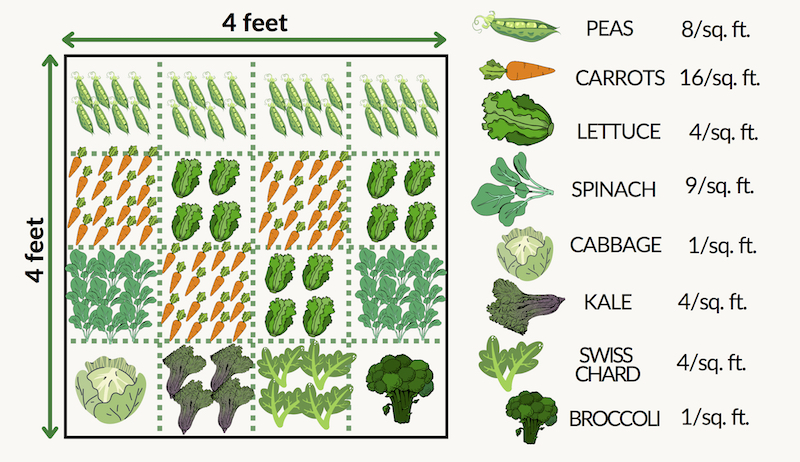
To maximize the fall harvest, I planted my 16 blocks in peas, carrots, lettuce, spinach, cabbage, kale, chard and broccoli. (See accompanying image above.) I added a trellis just behind my raised bed to accommodate the sugar snap peas. With proper support, these vines can reach up to 8 feet high.

At eight pea plants per square and four squares in all, that’s 32 pea plants—and a lot of potential peas!

I also allotted three squares for carrots. At 16 carrots per square, that’s 48 carrots. (Not to mention my ability to succession plant more carrots upon harvest.)

The cut-and-come-again portion of the garden includes 12 lettuces, 18 spinach plants, four kale plants, and four Swiss chard plants. (Three squares contain four lettuce plants each. Two squares include nine spinach plants each. And there are two squares which include four kale and four Swiss chard plants, respectively.)

There is also one square for a single cabbage and another for a single broccoli plant. In all, the space fits an impressive 120 plants.

That said, though, I won’t harvest much if deer, birds or rabbits get to my raised bed before it’s established. The fix? I added a few extra supports and topped the whole thing with heavy netting.

Categories
Podcast

Episode 36: Demetra Markis


Hobby Farms Presents: Growing Good Demetra Markis


Farmer Demetra Markis joins Hobby Farms Presents: Growing Good for a chat about her farm, Milleflora Farm, where she and her partner grow medicinal herbs for natural medicine clients and a small vegetable harvest to share with neighbors. Demetra talks about this farming endeavor, as well as sharing about her community grazing efforts, where she and neighbors graze sheep to reduce tall, dry grass that can contribute to wildfires in her home state of California.

Demetra digs into participating in community-level farming, as well as discussing tried-and-true flock protection against predators—all the predators, actually, including mountain lions. And as an experienced community acupuncturist and licensed herbalist, she discusses some of her experience growing medicinal herbs. She also shares the pleasure of enjoying olive oil made from homegrown olives. 

Plus, we cover biointensive growing, a particularly helpful technique for areas like California with constraints on land and resources. 

Milleflora Farm

Categories
Animals Chickens 101 Farm & Garden Health & Nutrition Poultry

Beyond Poultry Keeping: Online Poultry-Science Certification

Recently, I shared several options for flock keepers wishing to further their knowledge in order to better serve their local chicken community. Degrees and specialty certification offered by universities provide opportunities for poultry enthusiasts to work with researchers, professors and other industry experts. They can learn new skills and explore different fields within the world of poultry science. 

These programs are perfect if you have the ability to attend on-campus classes. Many of you, however, cannot spare time away from work, family and other obligations. Others simply do not live near a school offering these studies.

For those who would like to enhance their understanding of all things poultry, online certification is worth considering. 


Read more: Go beyond poultry-keeping basics with a certificate in poultry science!


Poultry Health Certification

The University of Minnesota’s Poultry Health Certification is designed specifically for aspiring poultry professionals as well as for those already working in the industry. It is ideal if you seek to focus on poultry health and diseases that affect your flocks.

The coursework features a completely online format with an emphasis on adaptability. Take one course per semester or register for more, depending on your own personal schedule. Applications are accepted on a rolling basis, so you can apply for the program at any time.

Poultry Management Certification

Presented by Ridgewater College, this 20-credit online certification covers such topics as:

  • poultry nutrition needs
  • environmental management for poultry production
  • poultry health management

The program is offered via an educational partnership with Iowa State University, home to the US Department of Agriculture’s Animal and Plant Health Inspection Services. Applications are accepted for either a fall or spring start to your studies.


Read more: Keep both eyes peeled when processing poultry.


Poultry Meat Production Certification

Texas A & M University (TAMU) plans on reopening its Poultry Meat Certification program in December, once migration to a new online learning-management system is complete. This certification program features such courses as:

  • Breeder & Hatchery Management
  • Animal Waste Management
  • Poultry Meat Production
  • General Avian Sciences

Course are all taught by members of TAMU’s Poultry Science faculty. The program is fully online. If you raise meat birds—and even if you don’t—you definitely won’t want to miss this opportunity to take this unique, informative program.

Categories
Beginning Farmers Crops & Gardening Equipment Farm & Garden Farm Management Homesteading Urban Farming

Grow An Overwintered Garden With These Crops

The summer garden receives a lot of attention. However, with just a little planning and care, your plot of land can provide you with more food as well as food that is exceptionally delicious.

Those who have tasted carrots, spinach or brassicas touched by the sweetening hand of cold temperatures can attest. It’s simply a matter of knowing what to plant when and how.

Slowed Down & Different

Managing an overwintering garden is different from a summer garden. Due to low temperature and sunlight levels, weed and insect pressures are either nonexistent or greatly reduced. These same elements also mean less water evaporation. Moisture will stay in the ground, so you won’t need to water frequently either.

However, these conditions could also lead to mold or mildew issues. Watch out for signs of fungus.

The vegetables in an overwintering garden (let’s say beginning in October and through March) will reach different stages of maturity at different times depending on planting time and plant type. Think of cabbages, leeks and root crops (not potatoes but carrots, storage radishes, rutabagas, turnips, etc.) as being in a “root cellar,” so to speak.

They have done their growing and are simply out there waiting to be harvested, holding for months. 

Lettuce, cutting greens, kale, salad radishes and scallions that have already reached a harvestable size can be picked immediately. But they’ll also continue their growth (albeit slowly due to dwindling daylight) and can be harvested over a period of time as well.

If these same crops have been recently planted/transplanted when cold weather arrives and aren’t yet mature, they’ll maintain themselves and resume noticeable growth after the turn of the calendar. They’ll provide your late-winter harvests of these crops.

Note that it’s desirable to have any crops that began the winter fully mature completely harvested by the end of February for two reasons: 

  1. Many crops, from carrots and leeks to spinach and lettuce, will be stimulated to go to seed or bolt by the increasing daylight hours and temperatures of the oncoming spring. Even if the plants have admirably survived the winter in excellent condition, they’ll soon lose their edibility. Make sure to harvest them before they do.
  2. It’s time to use the ground they were occupying for the next crops—the late winter/early spring seedings of lettuce, radishes and scallions.

Read more: Keep the garden growing this winter with a cold frame.


Providing Protection

Winter weather isn’t the same from one year to the next. The need to shelter your crops will vary.

In mild years, it could be wholly unnecessary. In other years, particularly cold weather may compel you to provide cover. Don’t worry. You won’t need complicated protection.

With root crops, it could be as simple as a little extra dirt pulled over their shoulders (depending on how long they are to stay in the ground). Or you could line up straw bales on either side of your leek row, with some loose pieces on top for cover. (See “Hot Beds & Cold Frames,” below, for more information on setups that protect from the cold.)

Different plants also tolerate different extremes of cold, sometimes dependent on variety. For example, cabbage and Brussels sprouts can stand out in the early snows without harm. Salad radishes and lettuce, however, will always benefit from at least a little protection. 

It’s also true that the healthier your crops are and the more carbohydrates/sugars they produce as part of their growth, the colder the temperatures they can withstand. Sugars are plant antifreeze! So provide soil fertility to enhance their survival.

And note that you can harvest several crops frozen, including scallions, leeks and spinach. After thawing, they maintain their quality and are still of great use. Additionally, mâche, kale and some lettuces can freeze through and thaw out in the field, apparently sufficiently undamaged and able to keep going.

We’ve already referred to many crops with a talent for surviving cold weather. So let’s take a closer look at some of the best candidates for the overwintering garden.

Brussels Sprouts: Holiday Favorite

Don’t miss the sweetening effect of the cold with Brussels sprouts. Harvest no sprouts prior to at least a couple of frosts. Though Igor is a green variety capable of withstanding harder freezes, those who desire sprouts into January may want to “see red.” 

The red sprout varieties Rubine and especially Redarling can maintain sprout quality for months with only modest protection. Brussels sprouts require many days to reach maturity. Start them early (in late spring or early summer) so they’ll reach full maturity as winter begins.

For a slightly different crop, try the unique, cold-hardy and trademarked Kalettes. They grow little florets where their sprouts should be!

Cabbage: Generous & Dependable

Though savoys (with their crinkly, toothsome, nutritious leaves) are the choicest cabbages when is comes to overwintering, green and red options also fair well (but require protection).

For a savoy, choose from January King, Deadon or Winterfurst. Dottenfelder Storage, European Storage and Storage No. 4 are good green options. Ruby Perfection and Mammoth Red Rock are the reds of choice.


Read more: Grow some cabbage, a smart crop to keep around.


Chinese Cabbage: A Little Something Different

Chinese cabbage is a nice, surprising addition to a winter menu.

Not really built for cold weather, all varieties are not created equal. But try Suzuko starting out. With protection, heads are viable through December.

Carrots: Digging for Gold

Sow several successions of carrots from late July to mid-August for an extended harvest. Ideally, you should grow them inside a structure (cold frame or greenhouse) and covered with straw or a row cover.

overwinter garden

This isn’t strictly to protect the crop, but rather to make harvesting easier. Try digging a carrot out of frozen ground and you’ll see the wisdom! Choose from varieties Snow Man (white-fleshed); Yellowstone (yellow); and Naval, Napoli and Merida (orange).

Greens (Kale, Lettuce & Spinach): Love Those Leaves!

The leaves of many different plants lend themselves well to winter production, whether they have been planted for late autumn/early winter harvesting or planted after the turn of the calendar for late winter and early spring.

If you prefer chicory, endive, escarole, radicchio or arugula, certainly give these varieties a place. 

Additionally, two greens of particular importance to the winter gardener (and ones you won’t want to miss) are mâche and claytonia. These winter annuals don’t hold through the coldest periods but grow through them amazingly well.

The most popular greens—kale, lettuce and spinach—call for layered protection and special variety selection. For frost-sweetened kale, the tender and mild Siberian types are perhaps the hardiest. (Improved Dwarf Siberian works especially well, thanks to its size.)

overwinter garden

However, many standout varieties exist amongst the other kale types. These include the curly Winterbor and Vates, and the flat-with-ruffles (and very hardy) Beedy’s Camden and Judy’s Kale. 

For lettuce, leaf lettuces tend to do well planted thickly and harvested at baby size. (Tango and Red Tinged Winter are favorites.) However, other options for heading-lettuce lovers include:

  • Romaines: Winter Density, Winter Wonderland and (red) Rouge d’Hiver
  • Butterheads: Winter Marvel and North Pole
  • Jack Ice (crisphead) 

I’ve also found that Gildenstern—a crisphead/mini-iceberg that makes no claims of overwintering successfully—did so very well and provided tasty mini-heads in March. And for spinach, Space, Tyee, Giant Winter and Winter Bloomsdale are the best winter-hardy varieties.

Leeks: Soup Staple

Blau Gruener Winter, Bleu de Solaize, Ifra and Siegfried Frost are some of the finest overwintering leeks.

Start these early in the spring, essentially at the same time as your summer-season leeks. They have slower growth and very good field-holding capacity, and so are not ready for harvesting until late autumn arrives. With rich flavor and nutrition, they make great additions to winter meals.

Pea Shoots: Surprise!

Do your ground and yourself a real favor with this selection. Gardeners typically grow Austrian Winter peas as a nitrogen-fixing cover crop. But they also offer a sweetly green, pea flavor.

Especially cold-hardy, these plants make a welcome addition to a salad or cooked dish such as a stir-fry. 

Normally sown in early spring where winters are cold, production as a protected food crop in these same areas requires planting in late summer. You can begin shoot harvesting once they reach 6 to
8 inches in height. 

Capable of surviving 10 degrees Fahrenheit handily, winter pea shoots require protection at colder temperatures with whatever combination of frost blankets, cold frames and/or protective mulch your weather dictates. 

Once temperatures reach 40 degrees and upward in the spring, you have several options for this great crop. You can either put it under in typical cover crop fashion or allow it to produce its small pink flowers as an aesthetically pleasing display and/or an early nectar source for bees. They will grow either trellised or sprawling.

Salad Radishes & Turnips: Riot of Roots

In addition to storage radishes and turnips, their small, tender counterparts can overwinter as well. Turnips Hakurei and Zuercher are excellent picked as minis (very small, tops and all) and at a standard salad size. Zuercher will also maintain its quality if left to grow to storage size. 

Though your average salad radish will bring in a crop (when well protected), watermelon/red-meat types are more winter-hardy. Sometimes classed as storage radishes, when pulled at 2 12-inch diameters they are tender and sweet for fresh eating.

Try Starburst, Beauty Heart or Chinese Red Meat—wonderfully attractive!

Scallions: Enlivening Allium

While some scallions lack patience, others will wait to be harvested.

overwinter garden

Varieties that excel at this, such as White Spear Bunching and Evergreen Hardy White, can be ready in two months and hold for four—quite a harvest window.

Sprouting Broccoli: A Real Treat

If you want broccoli that will survive winter and into early spring, make it purple and sprouting. Bonarda and Purple Sprouting can survive unprotected as temperatures go down to 20 degrees.

(Purple Sprouting is hardier still and can survive the teens as well.) 

You’ll need to provide protection through the colder periods. But the effort pays off when they resume growth and production in March and April.

Expanding productivity to more months of the year is like adding space to your vegetable garden. What will you do with more space? 


More Information

Hot Beds & Cold Frames

Crops require shelter from cold temperatures (and the wind) to different extents. This can be done with different means, from simple to complex. Systems can have more than one layer of protection, and some can generate their own heat.

To protect crops, you might use the following.

  • straw or (chopped) leaf mulch to cover, with or without bales as sides
  • old blankets or bed sheets to cover, held up with stakes
  • old windows to cover, letting in light to heat up the area on sunny days and held up with bales (i.e., a simply constructed cold frame)
  • hoop system with row cover 
  • low tunnel constructed of hoops and plastic sheeting, with or without frost blankets
  • cold frame constructed of wood
  • an unheated greenhouse
  • hot bed—a growing frame warmed by heat generated from decomposing organic matter, ranging from animal bedding/manure, leaves and forest waste to wool, seaweed and cotton clothing
  • low tunnel, cold frame or hot bed inside a greenhouse

Note: Any system that generates heat from decomposition or the sun will have to be monitored for overheating as well as for maintaining a sufficiently warm temperature. 

This article originally appeared in the July/August 2022 issue of Hobby Farms magazine.

Categories
Crops & Gardening Equipment Farm & Garden Homesteading

3 Ways To Gather Leaves For Mulch & Compost

I was reading recently about the benefits maple leaves offer to soil. They contain important nutrients (including calcium) but relatively little lignin. This means they break down faster than lignin-heavy leaves like those from oak trees. There are many, many sugar maples on my farm. So I’m planning to gather their fallen leaves this fall and shred them for quicker decomposing. I’ll then use them for mulch and compost in my orchard.

I’ll even throw in some ash leaves (which are also good for this purpose) but aim to avoid walnut leaves (which can be toxic to other plants). That won’t be hard. There are only three walnut trees on my farm.

The question is, what’s the best way to gather leaves for shredding, mulching and composting? Since I have no intention of picking them up one by one (farmers are busy folks!), I’ll need tools (like these) to speed me up.

Intrigued by the notion of using your farm’s leaves as a source of mulch and nutrients for garden beds and orchards? Here are three ways to effectively gather large quantities of leaves.


Read more: Read about how to plant an orchard of fruit and nuts trees.


Rake Them by Hand

The simplest (and perhaps tidiest) way for me to gather fallen maple leaves is to rake them by hand into large piles. From there, I can haul them to a leaf shredder (or bring the leaf shredder to the piles) and reap an abundance of quality leaf mulch and composting material.

Raking by hand is a good way to extract every stubborn leaf from among grass blades. This is valuable if you want a perfectly manicured and tidy lawn.

Raking, however, takes time and effort. So if you don’t mind a few leaves getting left behind, you might want to explore mechanical means.

Use a Leaf Sweeper to Gather Leaves Mechanically

A leaf sweeper is a wheeled device used to scoop and gather fallen leaves. Small models are pushed by hand (similar to a hand-pushed reel mower). Larger models can be towed behind a lawn tractor or ATV.

In my experience, leaf sweepers are effective at removing the freshest leaves from a lawn. However, they can struggle to pick up leaves that have worked their way down into the grass. This can be challenging if you’re looking for a perfectly manicured lawn.

If your goal is to quickly gather up a bunch of leaves to use for mulch and compost, though, a leaf sweeper can do the job just fine.


Read more: Save some money and use your trees as fence posts!


Gather Them from the Perimeter of a Deer Fence

No, I’m not joking. The black plastic deer fence that surrounds three sides of my orchard runs among mature maple trees and young saplings, with a sizable number of large trees inside the fence. Every autumn when the leaves fall, the wind blows large volumes of leaves up against the perimeter fence. This blocks them, preventing them from blowing any further.

By the time all the leaves have dropped, the accumulation along the fence is surprisingly deep. It’s a ready and convenient source right inside my orchard. If my deer fence can double as a passive leaf-gathering device, I might as well take advantage!

It’s hard to imagine anything faster and easier than wind and a fence working together to gather leaves while I tackle other projects.

I’m looking forward to gathering maple leaves this fall to make mulch and compost. But I’m definitely not in any hurry to get started. Summer flies by in the north woods, and I’m not ready for it to end yet!

Categories
Animals Farm & Garden Large Animals

Raising Beef: Advice From An Experienced Cattle Farmer

Glenn Wagner’s farm has adjoined my family’s for decades. His father, Jack, raised beef cattle. But Glenn’s inspiration to farm came from something outside of agriculture.

“I started back in high school when I needed some money to take those girls out,” he says, with a laugh. “I can’t remember when I didn’t farm.” Wagner’s first farming venture came with feeder pigs.

“That was my passion when I was 15 or 16 years old,” he says. “I got in the hog business.” 

Producer Pivot

At the time, Tennessee was a large pig-producing state. Wagner expanded his operation by building a large farrowing house. Later, when the hog market left the state, Wagner began raising bred Holstein dairy heifers.

After two decades, as that market evolved, too, Wagner also left behind this enterprise. 

Next, he added Bermuda grass, selling hay along with chopping silage and rotationally grazing it first for his dairy heifers and later for his beef herd. Wagner was highly successful at raising Bermuda grass, at one time he was a leading producer in the Southeast, but the Bermuda grass stem maggot brought this chapter to a close.

As he transitioned from one enterprise to the next, Wagner took stock of the fact that he still had paddocks set up for rotational grazing. It was then that he decided to focus on raising beef cattle.

Wagner’s goal, with any of his farming operations, has extended beyond his passion for agriculture. 

“If you’ve got acreage, you’ve got to keep it mowed,” he says. “It’s a job to keep it from growing up. You can get trapped in a place where you’ve got to do all of the work. My goal was to make [my farm] produce the maximum so that I could afford to have help.”

Wagner transitioned to raising beef cattle. He steadily worked toward his goal with the knowledge and skills acquired from his dairy heifer enterprise in genetics, feeding, nutrition and raising healthy cattle. 

Wagner now has two herds, with one calving in the spring and the other in the fall. He sells his fall calves in the spring while his spring calves go into his stocker herd. 

beef cattle

When & Where to Buy

As mentioned, some of Wagner’s stocker calves are produced from his herd. The majority, though, he purchases. He recently expanded his operation and currently keeps some 280 calves. 

Because of the lack of grass availability due to his cow-calf and other farming operations, he purchases his stocker calves in October from a weekly sale. These are the cheapest calves. He finds good availability because the farmers selling them don’t want to carry them through the winter. 

Wagner acknowledges that there are different schools of thought as to the best weight and time of year to purchase feeder calves. Unlike their lighter counterparts, heavier calves, such as those in the 600-to-700-pound range, can be difficult to put more weight on. On the other hand, younger calves just weaned and small can quickly become unhealthy. 

As for the best time of year to buy calves, it can be more favorable to purchase calves in the spring rather than the fall due to the availability of grass.

The calves that Wagner buys in October will weigh between 400 and 450 pounds. If he’s still buying in November, those calves will be from 500 to 550 pounds. He’ll have 30 to 40 of his spring calves of the same weight that he puts in with those that he purchases. 

This strategy allows the calves to be a uniform weight, around 750 to 800 pounds, at the time of sale. As an aside, calves raised for the freezer are heavier still. Though larger calves will also work, the ideal weight for a freezer beef is 1,200 pounds.


Read more: Learn how to choose cattle for your own homegrown beef.


Recommended Calves

As for color, Wagner prefers black calves. “You can buy nonblack cattle cheaper, and they grow off good,” he says. “But when they come in the stockyard, they put them in a different pen. The Angus people have a good product, but they also have good marketing. So the [black] calves will bring more per pound.

“Buyers want a whole group of black cattle.”

OK, you have decided the ideal weight, time of year, and sale (or sales) at which you will buy your calves before bringing them home. Now it is time to begin thinking about their health care needs. 

“When you bring feeder calves in from the stockyard you need to have somewhere to doctor them and put the sick ones,” Wagner says. 

Stress and exposure to other cattle at the stockyard often sets up disease processes. Wagner says that it takes about a five-week period to get them “straightened out.” His favorite time to raise them is after that five-week period has passed. Then, the calves are at their healthiest and they begin to gain about 2 1⁄2 to 3 pounds per day. 

What to Buy (& Why)

Many of the calves Wagner buys are bulls. Though not always, he says that on average bulls are 10 to 15 cents cheaper than steers. To get the numbers he needs, Wagner buys bulls and steers. Bulls can be focused more on reproduction than eating, tend to be more aggressive, can potentially breed any heifers you are feeding out and aren’t accepted by feedlots.

Therefore, they must be castrated. If you don’t have the time or are uncomfortable with this process, buy steers. 

Though Wagner doesn’t have many, heifers are also an option. “Heifers don’t convert feed as well because they cycle,” he says. They don’t put the weight on like a steer. Nor do they, generally speaking, cut out as well at the slaughterhouse. 

“But you buy them cheaper, and you sell them cheaper,” he says. Availability can also make it more feasible to put together a group of heifers. “Heifers will also run around when they cycle. If you are going to raise heifers, you need to raise only heifers. If you mix them, they can run the weight off [of all of the calves in the group],” Wagner says.

Once home, the process of working the beef cattle begins. “The first thing we do is vaccinate and castrate,” Wagner says. He uses an intranasal vaccine against IBR, BVD and PI3.

beef cattle

Feeding for Weight Gain

Wagner feeds corn that he raises on his farm, corn gluten or whatever protein source that is readily available. “It’s been difficult to get corn gluten or soybean meal or distiller’s grain,” he says.

Feeding a 14 percent ration is what puts the gain on the calves. “You have to get them accustomed to eating corn [gluten],” he says. “It doesn’t smell as good as the distiller’s grain, but it has some molasses in it. Once they get accustomed to eating it, they do well.” 

Considering feed options, Wagner says that soybean meal has the disadvantage of being expensive and you have to be careful of overfeeding corn. Otherwise, he feeds his calves at about 1 1⁄2 percent of their body weight.


Read more: Read more about feeding and considerations for dedicated facilities.


Assessing Your Needs

Weight, vaccines, sex of calf and other considerations aside, your needs and resources from grass and space to finances will all play roles in determining the number of calves you should buy. 

Handling facilities, such as a chute and head gate, are key for the calves’ and farmers’ safety. A sorting area to separate sick or varying sizes of calves is also nice. Otherwise, something as simple as feed and water troughs or buckets and electric fencing is all that is necessary. 

Wagner recommends keeping new calves in a small pen and not letting out into a pasture until they become settled and are familiar with their new surroundings. It’s only when you reach larger numbers that you’ll begin to need feed bunks, etc.  

On a smaller scale, if you’re seeking only to fill the family freezer and perhaps sell beef to family and friends, feeding out two calves (they’ll grow out better together) is a better option over raising only one. 

Larger numbers require other considerations. Wagner advises considering preconditioning the calves or placing them in a graded feeder calf sale to boost your profits. 

“If you took five calves to the preconditioned sale, they would put them in a group that would be sold as a lot. You would get paid the same as anybody else,” he says. Beef cattle that can eat out of the bunk, have been vaccinated, etc. are worth more money. If choosing to raise your calves for slaughter, Wagner also advises, due to demand, scheduling your appointment with the slaughterhouse very early in the process. 

Advice for Selling

As for selling calves, Wagner says that stockyard, preconditioned and grade sales are best for smaller numbers of calves. 

Preconditioned sales usually generate greater income and require you to guarantee that such requirements as a specified feeding program, vaccinations, etc. have been met. On the other hand, there are no such guarantees at grade sales. 

Instead, state graders assess calves as being “choice,” also known as “No. 1s,” or “good,” also called “No. 2s.” Calves not fitting into either of those categories are known as “odd lots” or “culls.”

Different types of calves will also sell better at different sales. For example, calves with more ear from a higher percentage of Brahman blood will sell better at sales in those is parts of the country seeking calves with higher heat tolerance. For larger numbers of calves, as in a tractor-trailer load, there is the option of video sales where calves are sold at the stockyard but are loaded out directly from the farm.

But, Wagner acknowledges, it’s hard to get that big.  

Wagner’s biggest piece of advice is that raising calves for beef cattle requires a good body of knowledge about their health, especially if those calves are brought in from a sale as opposed to raised at home. 

“You’ll get in trouble if you start buying calves, and don’t know about the health issues they can have,” he says. “They can get sick and die.” 

Vaccinating, monitoring them, etc. are key to success. To get this, Wagner strongly advises seeking the advice of your county extension agent along with visiting similar successful operations to gain their valuable insight. You should also establish a good relationship with your local large animal veterinarian.  

This article originally appeared in the July/August 2022 issue of Hobby Farms magazine.

Categories
Animals Farm & Garden Large Animals Video

Video: What’s The Deal With The Hay Shortage Crisis?

The farming community is realizing the effects of the current hay shortage. Reasons include the widespread drought, with rising costs of fertilizer and fuel as main factors in the crisis.

Now is the time to find hay and get your farm stocked for the foreseeable future. Follow these action steps to best survive the crisis. 


Read more: Can you cut hay with a brush hog?


Know Where to Look 

Keep an eye on social media platforms, including Facebook Marketplace, Craigslist and local farming group pages for good, local hay at affordable prices.

Inquire at local feed stores. (The big-box farm stores aren’t the best places to look.)

Just drive around and see what’s in the fields of nearby farms. Call other ranchers in your area and get on their list, or get their contact for who supplies them. Staying close to home will help with your fuel costs, too.

Know What You Need

Using apps and websites with hay calculators will help you predict usage for your farm. The hay calculator allows you to enter the type and quantity of livestock you own, what kind of hay you are feeding currently and how long you project to feed.

The calculations will tell you how many bales you will need for that amount of time. Feed according to the calculator. Do not overfeed and waste the stockpile.


Read more: New to hay? Here’s everything you need to know about feeding livestock roughage.


Know How to Store Properly

Always store high, dry and ventilated. Hay racks, bale bags and feed bins all work to not only keep the food secure and free from rotting, but also eliminate waste. If your livestock is permitted to graze on the entire bale, they will pick out what they want and stomp on the rest.

Use these tools to save your hay and your money.

Hobby farmers need to pay attention and prepare for food shortages—not just for themselves, but also for their animals. Buying early, storing responsibly and feeding properly will keep you from facing a crisis during the widespread hay shortage. 

Categories
Farm & Garden Food Recipes

Recipe: BBQ Burger With Fried Egg

These hearty burgers will steal the show whether you prepare them on the grill at your next cookout or opt to skillet cook them in the kitchen. They are loaded with caramelized onions and sweet, smoky barbecue sauce. Finally, top off your burger with a fried egg cooked with garlic and butter for a memorable summer meal. 

You have a lot of options with this recipe. First, use any type of your favorite beef. I use grass-fed beef here, but ground chuck or a combination of your favorites blended together will also work well. 

Cook the burgers, onions and eggs all to your desired doneness. I’ve provided few tips in the recipe preparation. I prefer a thick sweet and smoky barbecue sauce for this recipe, but don’t let that hold you back from something bold and spicy.

You can truly make these burgers all your own. 

Yield: 3 burgers

Ingredients

  • 2 tablespoons unsalted butter
  • 1 medium yellow onion, sliced
  • 1 pound ground beef
  • 12 teaspoon fine sea salt
  • 14 teaspoon ground black pepper
  • 5 tablespoons barbecue sauce
  • 3 large eggs
  • 1 garlic clove, minced
  • lettuce
  • tomato slices
  • 3 buns

Read more: Raise beef cattle to meet your family’s meat needs!


Preparation

Melt 1 tablespoon of butter in a medium skillet over medium-high heat. Add the onions. Stir and cook for one minute as they begin to brown. Reduce the heat to medium-low, and let the onions cook to your desired tenderness, stirring occasionally for even browning.

For firmer sautéed onions, cook for 20 minutes. For fully caramelized onions, continue to cook for 40 minutes until softened and jamlike. 

While the onions cook, prepare the burgers. Make three patties with the ground beef. Place on the grill or in a skillet over medium-high heat. Sprinkle with 14 teaspoon of fine sea salt and 14 teaspoon ground black pepper. Cook to your desired doneness.

Just before removing them from the grill or skillet, brush each burger with 1 tablespoon of barbecue sauce. 

Stir the remaining 2 tablespoons of barbecue sauce and 14 teaspoon of salt into the onions once they’re done cooking. 

Melt the remaining tablespoon of butter in a large skillet over medium-high heat. Add the three eggs. Once the whites have set, add the garlic in the space around the eggs. Move the eggs around the skillet as the eggs cook to your desired doneness. Allow the garlic to cook into the browned edges of sunny-side up eggs or flip the eggs into the garlic for over-easy, medium or hard eggs. 

Split the buns and place a piece of lettuce and one to two slices of tomato on the bottom portion of the bun. Top with the burgers, then divide the caramelized onions over each burger.

Add an egg and cover your burger with the top of the bun. Serve right away. 

This article originally appeared in the July/August 2022 issue of Chickens magazine.

Categories
Animals Chickens 101 Farm & Garden Poultry

Beyond Poultry Keeping: Learn More In A University Poultry Science Program  

Have you kept poultry for most of your life? Or maybe you only recently discovered the joys of owning your own flock. Regardless, you know it doesn’t take long for people to develop a special connection with chickens.

You truly enjoy being in their midst and watching their antics. You also do all you can to make their lives comfortable and carefree.

Tending to your birds fills you with a content peace. You feel it all the way in your soul. In fact, there are times when you wonder, is anything else you can do to help improve poultry keeping, for yourself and for others?  

The answer to that question is a resounding yes! There are certifications you can earn that will expand your personal understanding of poultry. The education will also allow you to share your experience and skills with other chicken keepers, helping them improve their flocks.

Over the course of the next few weeks, I will discuss different poultry-certification programs available in the United States. It’s my hope that this series will inspire and offer direction to any individuals yearning to more fully immerse themselves in poultry science. 


Read more: Check out these 7 cool science facts about chicken eggs!


Poultry Science Degrees 

Across America, many universities offer undergraduate and graduate degrees in poultry science. These are usually specialized fields of study within the pre-veterinary and veterinary-science programs. Those who pursue a specialized poultry-science degree often go on to become avian or poultry veterinarians, university extension-office specialists or poultry-industry advisors.

Achieving this goal can take anywhere from two to nine years. (It can, however, take longer, depending on how many courses you take each semester.) If you decide your interests involve earning a degree in poultry science, the first thing to do is to look up your closest land-grant institution.

Land-grant universities and colleges are located in every U.S. state (and in some U.S. territories). They focus on agriculture and mechanical arts. Check your local college or university’s degree offerings on their web site. Then email or call the department offering your desired degree to find out about enrollment requirements, tuition rates and other questions you may have.

Arrange for a visit. This will give you the opportunity to tour the facilities and meet some of the professors. You’ll also familiarize yourself with what may be your second home for the next few years. 


Read more: Can egg shape predict a chick’s sex?


On-Campus Poultry-Science Certifications 

Some universities even offer certification programs geared towards current and aspiring poultry-industry professionals. This includes:

  • veterinarians
  • feed manufacturers
  • poultry production farm employees
  • small-flock, hobby and microflock farmers

These certification programs provide students with both classroom coursework and hands-on learning opportunities. They also allow them to work with professors, researchers and other industry professionals.

For instance, students earning the Poultry Science Business Certificate offered by the University of North Georgia at Gainesville must complete a poultry-science internship in order to complete the program. Some universities offer students the opportunity to transfer into degree-earning programs or other certification programs upon completing their poultry-science certification.

Michigan State University, for example, encourages students earning their Livestocks Industry Certificate to transfer into their undergraduate program. Those earning a Poultry Management Certificate from Willmar, Minnesota’s Ridgewater College, however, can transfer to the University of Minnesota to earn a graduate poultry health certificate.

Want to further your poultry education but aren’t quite sure about enrolling in an undergraduate or graduate program? An on-campus poultry-science certification may be the perfect option. Contact your local land-grant university to see if they offer certification programs for local industry professionals.

If not, ask if they can refer you to a nearby program.