Categories
Crops & Gardening Farm & Garden Homesteading Permaculture

When & How Should You Harvest Your Herbs?

As many people move toward supporting their health, herbal plants grow more and more popular. Farmers and gardeners, in turn, can leverage a great opportunity to provide an incredibly abundant resource to their communities by growing plants that have therapeutic properties. 

Although many herbs are quite easy to grow, timing the harvest just right can be a bit tricky. And a lot of post-harvest tasks need close attention in order to preserve the potency of the medicinal compounds present in these incredible plants. 

Why It Matters

Finding the best time to harvest an herbal plant is all about trying to capture the most abundant amounts of the compounds, called phytochemicals or herbal constituents, which are present in herbs.

It’s good to keep things flexible. There are no hard and fast rules, but following some helpful guidelines will help you capture the peak potency of a plant that will translate into vibrant herbal remedies. 


Read more: Craft your own herbal salves for gifts or use around the home.


Learn as You Go

There are so many varieties of herbal plants, all with very different characteristics. And each one may be a bit different in the harvest timing and technique. Beyond that, various segments of the plant may be used differently in traditional healing methods, such as the leaf, roots, blossoms or even the entire plant. 

Every plant will have its unique growing patterns and life cycles that will affect the time of harvest. Folk tradition and herbal farming techniques provide a good foundation. But never underestimate the value of simply observing and interacting with plants and learning as you go.

Harvesting Leaves & Aerial Parts

Many leaves can be harvested throughout the growing season as needed, for recipes and remedies. This is especially true for culinary herbs and aromatic tea plants.

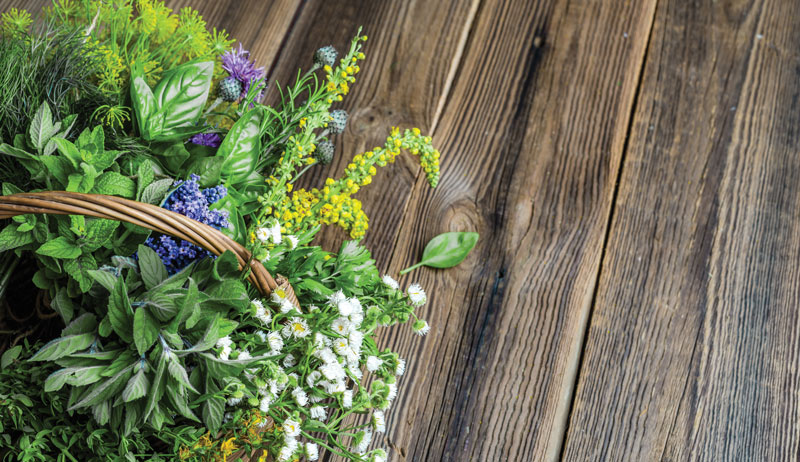
Common kitchen herbs such as lemon balm, peppermint, thyme, oregano and sage can be harvested a little at a time whenever you may want to make some broth (or when someone has a sore throat). Sometimes the best time to harvest may be when you are feeling inspired, or have a little extra time or vodka to make a tincture, syrup or some other fun herbal recipe.

Often the best time to harvest leafy, aromatic herbs is the morning or evening on a warm sunny day, preferably not after rain. The extra moisture can reduce the potency of some herbs and could potentially lead to mold issues in the drying process. 

Abundant heat and a touch of drought can increase the aroma of some plants. You can gather certain herbs successively over time. And cutting down the flowering branches can extend their season before they go to seed.

Basil is a good example, where keeping the flowering stalks cut back can generate more leafy growth for a longer period of time. 

Once the growing season winds to an end, or there is a seasonal transition in the life cycle of the plant, it can be helpful to cut back perennial plants almost entirely. Plants that get woody, such as lavender or oregano, benefit from harvesting the entire aerial (above­ground) portion of the plant. 

Aerial parts often include the flower right along with the leaves, just as blossoms are coming on or forming in the plant. This often represents the height of the aromatic compounds or other healing phytochemicals in the plant. This can happen in spring, summer or fall depending on their particular life cycle.

Harvesting Blossoms

When a grower desires the flower plant part, harvesting may take place over a period of a few weeks or months. Naturally, harvesting usually occurs as the plant begins to set flowers. 

Morning is a great time for gathering blossoms, as some tend to close as the sun sets and the day ends. Most plants flower in succession, so not all blossoms will be ready at once. You will often observe unique flowering cycles with blossoms appearing on different stalks or branches at different rates, even on the same plant. 

It’s nice to try to share the blossoms with the pollinators or tune in to when pollinators might visit flowers. You can harvest some blossoms (herbs such as chamomile or calendula, for example) by hand or with a small raking tool such as a blueberry picker. Others, such as lavender, you will need to cut at the stem and in different ways depending on future usage. 

Some flowering herbs, such as sage or rosemary, you can gathered right along with the leaves to later mix together for herbal tea or other remedies. If flowers feel a bit sticky and resinous, consider this a sign of their potency. 


Read more: Craft homegrown herbal products to use around the house and sell for profit!


Harvesting Seeds 

For aromatic seed plants such as coriander and fennel, it can be a little tricky to catch the seeds when they are ripe enough, fully formed and at the height of their aromatic possibilities–but before they start falling off.

A lot of herbal seeds come from the Apiaceae or “umbel” family. Pollinators love the blossoms of these aromatic plants, and they’re usually quite easy to grow. When they reach the end of their natural cycle of flowering and fruiting, you can gather the seeds to be enjoyed later or replanted. 

It’s possible to capture the seeds as they ripen and fall by putting a paper or mesh bag over the seed heads as they ripen. To share the blossoms with the pollinators, wait until the flowers begin to dry up a bit before putting the bags on. A good way to check if they are almost ready is to simply taste and feel the seeds and see if they are fully formed and aromatic. 

With some medicinal seed heads, optimal harvesting goals will be entirely different, such as milky oat tops, where you are actually trying to catch them in a specific stage before they are fully formed and are still juicy with a milky white latex.

Roots

Root harvests traditionally occur toward the end of fall or very early spring, as the plant either goes dormant or comes back to life. It has been said that some roots will possess different energetic qualities depending on the seasonal pattern when harvested. 

For example, some would say fall dandelion roots would be more moistening and spring roots would be more drying. There is certainly a lot to say about learning folk tradition regarding harvest times for roots of herbs, as they’ll all be a little different. 

A lot of herbal roots are usually grown for a few years in a row, and it may take several seasons to establish a good root crop. Some roots you may harvest entirely, taking the life of the plant. Other roots you can harvest while leaving some in the soil to continue to grow.

Harvesting your own herbs for health and healing is such a rewarding experience. Taking a few extra steps to match peak potency with the time of harvest will help you create effective medicinal recipes from garden herbs. 

Learning a bit about herbal life cycles, which part of the plant to harvest, how to prepare, dry and/or mix herbs may take a little time. But it is worth the end result.

Many herbal plants are perennial, and you get to know their patterns year after year. Exactly when they flower, when they go to seed or when they go dormant will vary a little in each location. Tasting, smelling and observing closely will give you clues to when the time seems right. 

By following along with the patterns of nature and plant cycles, you will gain a satisfying and fruitful harvesting journey. 


More Information

Know Your Herbs

While most herbs share a common love for well-drained soil and full sun, they have varying preferences and requirements. Below you’ll find a list of common herbs, along with brief growing notes that may prove helpful when planting.

  • Basil: rich, well-drained soil; full sun
  • Bee Balm: average, well-drained soil; full sun
  • Borage: less fertile, dry soil; full sun
  • Calendula: rich, well-drained loam; full sun
  • Chamomile: well-drained, moist soil;
    full sun to part shade
  • Cilantro: well-drained, fairly rich soil;
    full sun
  • Comfrey: average soil; full sun
  • Echinacea: average, well-drained soil, only water during severe drought; full sun
  • Hyssop: ordinary soil (rich soil will produce luxurious growth, but less flavor and aroma); partial shade
  • Nasturtium: ordinary garden soil; rich soils makes for few blooms; full sun or partial shade
  • Lavender: dry, well-drained soil; full sun
  • Lovage: rich, well-drained soil; full sun to part shade
  • Mint: moist, rich, well-drained soil; prefers partial shade but will grow in full sun
  • Oregano: dry, well-drained, alkaline soil, not too rich; full sun
  • Parsley: moderately rich, well-drained soil; full sun to partial shade
  • Pineapple Sage: light, sandy,
    well-drained soil; full sun
  • Rosemary: alkaline, well-drained soil;
    full sun to partial shade
  • Sage: light, sandy, well-drained soil;
    full sun to light shade
  • Summer Savory: dry, sandy soil,
    with added organic matter; full sun
  • Thyme: poor, well-drained, rocky, alkaline soil; full sun (rich soil makes less flavorful leaves)
  • Yarrow: average, well-drained soil; tolerates poor soil and drought; full sun

– Jan Berry

This article originally appeared in the May/June 2022 issue of Hobby Farms magazine.

Categories
Animals Farm & Garden

Mischievous Yearlings, Bloomy Rind Cheeses Star At Garden Dairy Alpine Goats

“I remember as a small child, I’ve always been interested in goats,” says Wendy Gardner. “It’s just my thing.”

Gardner’s early interest in goats has bloomed into Garden Dairy Alpine Goats, a venture situated 6,000 feet up in the mountains in southwestern Montana. Housing a herd that includes Cherry Glen, Rancho-Snowfall and Strawberry Fields foundation bloodlines (among many others), Gardner’s goats help produce a line of French-inspired cheeses headed up by Brie, Valencay and Wasabi Tomme delicacies.

Taking a moment out from farm duties, we spoke to Gardner about the mischievous nature of the herd and the character of her yearlings. We also got into the joys of bloomy rind cheeses.

An Early Interest in Goats

Looking back on her interest in goats, Gardner recalls writing a paper in the fourth grade about wanting to start a farm.

“I was going to get a farm and get these animals, then get more animals,” she says. “It’s just always been goats for me!”


Read more: Sheep and goats have bring year-round value to the small farm!


The Intelligence of the Herd

At one point in life, Gardner used to train dogs. Based on that experience, she estimates that goats are “smarter than a Border Collie.”

Although she adds that her goats “learn from each other which is troublesome—they’re definitely a herd animal and they teach each other things.”

Mischief & Shenanigans

When it comes to the sort of daily mischief that Gardner’s goats manage to get up to, she reels off a seemingly endless list.

“We have to have all the latches secured ’cause they will work at the gates,” she says. “Anything new, like if you’re working on a fence, they will check out what you’re doing and your tools and run away with your tools or clips you’re putting the fence up with.”

Recently, the goats have also discovered a way to get into smart phones. “They have dialed my phone when it’s in my back pocket!” says Gardner with a laugh.


Read more: There are so many reasons to get goats!


Getting into Herd Dynamics

“I have a pretty big herd,” says Gardner when asked if there are any mischief-making ringleaders on the farm. “The yearlings are really the teenagers of the group—they’re always a handful. They’re very athletic and big like an adult goat, but essentially babies.”

“Then the babies themselves that are a couple of months right now, they’re so curious,” she continues. “It’s like a little gang of baby goats that are always stirring up trouble.”

The Joys of High Altitude Cheese

Gardner says that living 6,000 feet up in the mountains is a great location for cheese-making. “It’s perfect ’cause most of this cheese is French cheese, and they’d make it in the summertime up in the Alps,” she explains. “They’re probably even higher than I am.”

Talking about her favorite cheeses to produce, Gardner selects bloomy rind cheeses like Brie. “It’s really the cheese of a busy person,” she says. “You bring the milk in, then you put the cultures in, but then you have the whole day. It’s a real farm cheese—you’re always busy on the farm.”

Follow Garden Dairy Alpine Goats at Instagram.

Categories
Beginning Farmers Crops & Gardening Farm & Garden Permaculture Projects Uncategorized

Spot Insects To Help Lost Ladybug Project Researchers

You might have a sprawling farm or just a modest herb garden. Either way, you’ve likely got at least a few kinds of ladybugs. Whether yours are rare, native species or the much more common invasive types, entomologists  from Lost Ladybug Project would like to hear from you.

Since 2000, the folks behind The Lost Ladybug Project have actively collected ladybug observations from the general public. They’re trying to keep tabs on the nearly 500 different ladybug species that live in North America. Thanks to photographs and brief notes from Lost Ladybug Project participants, researchers now know which native ladybugs have lost ground. They also are better able to track the spread of invasive species like the Asian multicolored lady beetle (Harmonia axyridis).

Case in point? One used to be able to find nine-spotted lady beetles throughout the U.S. and southern Canada. These days, however, seeing a nine-spotted lady beetle is much rarer. (Some entomologists suspect the European seven-spotted lady beetle displaced our native nine-spotted one.)

Interestingly, a Lost Ladybug Project participant’s submission led to the nine-spotted lady beetle’s rediscovery in the eastern U.S.

Who’s Who?

When you think “ladybugs” or “lady beetles,” you probably imagine lipstick-red insects with a smattering of black dots. Actually, ladybugs’ colors and markings can vary a lot between species—and even within the same species.

Some are yellow with black spots. A few types are primarily black or brown with red, yellow or orange spots. Many come in various shades of red or orange.

There is even a whitish-gray variety, aptly named the ashy gray lady beetle. It’s one of our native ladybugs. Other notable natives include the eye-spotted lady beetle, the cream-spotted ladybird, the spotless lady beetle, and the three-banded lady beetle.

Of course, plenty of ladybugs do have an orangey-red shell and varying numbers of black spots. The ones you likely see most often are non-native Asian multicolored lady beetles. The U.S. Department of Agriculture introduced these to the U.S. on multiple occasions as a natural aphid control.

The Asian multicolored lady beetle now thrives here and may be outcompeting some of our native ladybugs.


Read more: Keep an eye out for these spring-emerging beneficial insects!


Little Bug, Big Benefits

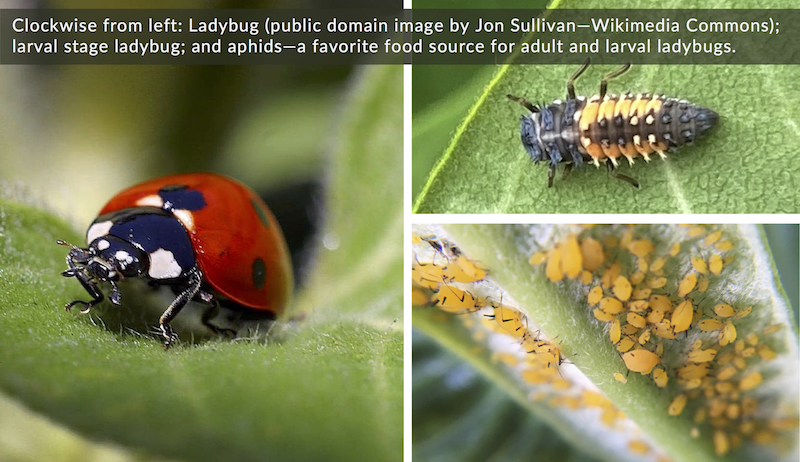
Regardless of species, ladybugs will pull their weight in the garden. In particular, these beneficial, predatory insects target soft-bodied pests like aphids and spider mites. They’ll also gobble up larval stage asparagus beetles, Colorado potato beetles, bean beetles and many more.

There are a few ways you can naturally boost the number of ladybugs in your landscape. First, avoid the use of pesticides if you can, since these don’t discriminate between insect pests and their natural predators.

And, because pollen is another important food source for ladybugs, be sure to include pollen-rich plants in the garden. Ladybugs are especially drawn to plants with clusters of small flowers—think yarrow, dill, fennel and anise. Feverfew and common milkweed are other good bets.

Mix these into your perennial flower beds or add some near your annual veggie crops to attract more ladybugs.


Read more: Check out these 5 tips for luring ladybugs to your garden.


Get Involved

Summarizing multiple research studies during a 2020 presentation, “Ladybugs in the Garden: The Lost Ladybug Project in Action,” Cornell University Department of Entomology Professor John Losey noted, “Overall, 41 percent of the total insect species saw a decline over the past decade. These weren’t just minor declines. These are some major declines to the point where we’re worried about … significant groups potentially going extinct.”

Ladybugs are some of the insects in real trouble. Fortunately, participating in the Lost Ladybug Project is easy. You can start by taking time out to look under leaves and along stems for ladybugs, ladybug larvae and clusters of slightly pointy, orange ladybug eggs.

Whenever you happen to see a ladybug—either a native or non-native species—simply snap a good photo. The project accepts .jpg files that are less than two megabytes.

Along with photo submissions, you’ll also provide the Lost Ladybug Project with the ladybug’s location, some details about its immediate environment, and the date you saw it. Finally, you should also offer your best guess at what kind of ladybug you photographed. (Don’t worry! The Lost Ladybug Project offers online resources to help with ladybug species identification. DiscoverLife’s ladybug identification tool is also very helpful.)

Categories
Farm & Garden News

The Asian Longhorned Tick: An Update

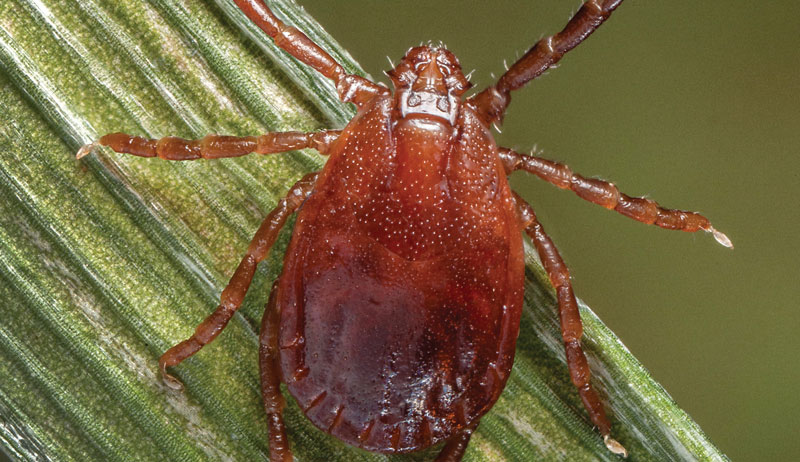
The Asian longhorned tick, Haemaphysalis longicornis, is the newest tick species identified in the United States. Native to East Asia, this tick has spread globally and was officially identified in New Jersey in 2017. However, based on collected samples, it’s now thought this tick has been in the U.S. since 2010 or earlier. 

Spreading Fast

This tick is an indiscriminate ectoparasite. It has been found on humans, pets, livestock and wildlife, and is rapidly spreading across the country. Reports mostly come out of southern New England, the mid-Atlantic and along the Appalachian corridor of West Virginia, Virginia and North Carolina/Tennessee.

As of December 2021, the Animal and Plant Health Inspection Service of the USDA identified the tick in 17 states. The states with the most reports are Virginia, West Virginia and North Carolina.

Reports in 2021 show that the tick has now crossed the Mississippi River and has spread to the western borders of Missouri and Arkansas.


Read more: Check out these 3 natural techniques for repelling ticks.


Parthenogenesis Problem

One unique characteristic of this tick as compared to most other tick species: the female’s ability to reproduce without a male. This form of asexual reproduction, called parthenogenesis, means that it takes only one female tick to establish a new population in a given area.

This greatly increases the rate at which this tick spreads. 

Potential for Disease

The Asian longhorned tick is a vector for numerous human diseases in countries where it’s been endemic for a long time. No human diseases have yet been reported as transmitted or carried by this tick in the U.S. Public health professionals, however, remain concerned at its potential vector ability. 

The most impactful livestock update regarding this tick is its confirmed ability to transmit the cattle disease theileriosis (pronounced TYE-LEER-EE-OSIS), caused by the protozoan blood parasite Theileriosis orientalis. Infected cattle become anemic, lethargic and weak, and there is no known cure. Infected herds can experience significant economic losses.

Positive cases have been reported in herds in Virginia and West Virginia. The presence of T. orientalis-positive Asian longhorned ticks have been confirmed in these locations. This disease isn’t transmissible to humans. 


Read more: Remove invasive honeysuckle to reduce tick populations.


Prevention Techniques

Preventative measures remain the best source of action to take against this tick, but effective implementation presents a challenge. Keeping pasture grasses mowed short may help prevent tick infestations to an extent, as can preventing your animals from grazing in or near wooded areas.

Inspecting cattle routinely for ticks and removing any that you find can be time and labor intensive but may be one of the best protective measures. Utilizing pesticide-impregnated ear tags or strategically placed backrubs/squeeze spots for animals to dose themselves as they pass by may also help.

If you find any ticks on your cattle, closely inspect yourself, family members and pets as well. 

APHIS-USDA continues to be the best resource for current updates on this tick and its developments across the country. Farmers in impacted states and neighboring areas are encouraged to remain vigilant for this tick and take precautionary measures where they can. If you live in an area with these ticks and suspect theileriosis in your herd, contact your veterinarian.

This article originally appeared in the May/June 2022 issue of Hobby Farms magazine.
Categories
Animals Chicken Coops & Housing Farm & Garden Flock Talk Health & Nutrition Poultry

Chickens & Fireworks: Flock Dangers & What You Can Do

Mark and Donna consider themselves patriotic Americans. They put flags out in their yard on Memorial Day and Veterans Day, and they always attend the local fireworks display on Independence Day. They enjoy lighting sparklers with their grandchildren and waving them around to make designs in the twilight of each July Fourth evening.

Mark and Donna don’t, however, enjoy when their neighbors set off fireworks. “The sound scares the [edited] out of our hens,” Mark complained. “It takes them almost a month to calm down and start laying again.”

Chickens & Fireworks

Most people know that animals easily spook at the sound of fireworks. Just Google the words “fireworks” and “animals” and you’ll get pages and pages of links to sites discussing the terror that fireworks instill in pets and wildlife. The Thunderworks company pretty much based their business on selling anxiety-reducing pet “shirts” for use during fireworks and thunderstorms.

I can’t find much information online regarding chickens’ (or livestock’s, for that matter) reaction to fireworks, however. We know our birds do indeed suffer stress due to such conditions as overcrowding and overheating and that any type of change—a new coop, a new flock member, a new pecking order, you name it—triggers anxiety for our chickens.

I know from personal experience that my hens’ egg production drops after every major thunderstorm. It takes them about a week to rebound. It was a reasonable assumption that chickens would also react negatively to the sound of fireworks … but I needed to double check.

“Egg production in hens can definitely be affected by fireworks,” stated Dr. Michael Hoffman, DVM, an Army veterinarian with years of experience dealing with poultry. When I asked if chickens could die of fright, Dr. Hoffman noted that he was unfamiliar with any research or studies indicating so but that he supposed it was possible.

Great.


Read more: Prevent stress for happy, healthy chickens.


Fireworks Fiasco

Fortunately, we’ve never had to deal with our birds’ reaction to fireworks. Small livestock farms and military combat veterans surround our property. Nobody in our area sets off fireworks out of consideration for both groups.

Well … until this year. At about 8 PM on July 4th, a deafening boom shook our house and sent our cats scrambling for safety under our bed. Outside, our ducks jumped about and flapped in a panic and our chickens charged for their coops.

Explosions continued, one every half hour, until past 1 AM.

The fireworks were so deafening that they felt as if they were being set off just outside our bedroom window. I could only imagine what the nearby veterans—our next-door neighbor to the north and our neighbor across the road—must have felt. My husband, Jae, an Army veteran, was none too pleased.

We discovered early the next morning, after failing to coax our chickens out of their coops, that our brand-new next-door neighbors to the south spent the night setting off the fireworks. For reasons I still don’t quite understand, they set up their fireworks in their backyard near our shared property line, just yards from our bedroom window.

When they started setting off fireworks on the 5th, once again sending our poor cats scrambling, I decided to pay them a neighborly visit. As I suspected, they wondered why nobody else in our area set off fireworks and grew quite contrite when I explained about the combat vets and the farm animals (and the location of our bedroom).


Read more: Ease chicken stress with these hen-calming techniques.


What to Do

If your birds suffer due to nearby neighbors setting off fireworks, consider the following options:

  •  Talk to your neighbors. They might not know that fireworks adversely affect animals and, hopefully, upon learning that they unintentionally frightened your flock, they’ll cease fire… literally.
  • Contact your municipality. Your village, town or city may have ordinances that restrict or prohibit fireworks or loud noise. If your fireworks-loving neighbor violated any of these, take note and contact your local authorities.
  • Check your state’s regulations. Many states have laws specifically pertaining to the harassment of livestock with fireworks. Michigan state law, for example, prohibits a person from discharging or using fireworks to intentionally harass, scare or injure livestock and delineates days and times for discharging fireworks. If your neighbor violates state law with their fireworks, contact your closest state trooper station for assistance.
  • If possible, temporarily sound-insulate your coop in preparation for Independence Day. Surround your coop with stacked hay or straw bales, taking care not to stack the bales to such a height that they become unstable. The bales may not keep out all the explosive noise but they will filter and reduce the scary sounds, thereby reducing the stress caused to your flock. Once the 4th has come and gone, you can use the hay or straw as litter and bedding.

It’s been half a month since Independence Day, and only one of our hens has resumed laying. Fortunately, I remain secure in the knowledge that our new neighbors will respect the silence our area observes on the 4th (and other firework-friendly holidays and events).

I can only hope the same can be said for Mark and Donna.

Categories
Crops & Gardening Farm & Garden

All About Blackberries (Excerpt: “The Berry Grower”)

The following excerpt is from Blake Cothron’s new book, The Berry Grower: Small Scale Organic Fruit Production in the 21st Century.  (New Society Publishers, May 2022) and is reprinted with permission from the publisher.

blackberries
New Society Publishers

The king of berries stands tall and strong on the micro farm, and easily puts out an encouragingly high yield of luscious, plump, juicy fruit when well grown. Cultivars vary a lot these days and are very specific in terms of growth habit, ripening time, berry quality, etc., so choose very carefully.

Blackberries thrive in hot and humid summer conditions. Certain cultivars and subspecies, especially raspberry/blackberry hybrids are best adapted to the cooler conditions of the PNW and coastal California, and some are adapted to low-chill areas and even subtropical conditions. Many species grow wild across the USA. In the Eastern USA most wild blackberries are small-fruited, fairly low quality and seedy, but still har­vested on a very small scale (and make great blackberry cobblers!). In the PNW many of the wild ‘Himalayan’ blackberries and wild hybrids are large and quite luscious.


Read more: Blackberries & raspberries are popular and easy to grow!


Types of Modern Blackberries

First let’s start with the three main types of blackberries. They are differenti­ated by their starkly pronounced, varying growth habits. Here’s some lingo to learn:

Trailing

These are the true “blackberry vines.” They vary in vigor and size but the most vigorous can grow 9 to 12 feet ( 2. 7-3.6 meters) long or more in a single growing season. They are productive but need careful management and a stout trellis system because single vines and fruit load can weigh 50 pounds or more. Not the best choice for the micro farm or small backyard, but can be utilized if necessary. These need lots of space, 8 feet (2-4 meters) or more between plants, and careful pruning and training to keep them in bounds and productive.

Semi-Trailing

These have more vertical “spine” to them and make thicker, more sturdy canes that stand erect more like a raspberry-straight and tall. However, the upper half of the plants eventually vine somewhat, and the growth is very vigorous. ‘Semi-Erect’ seems to be a somewhat syn­onymous term for this type, but may also be its own category, with semi­erect cultivars having less trailing top portions and slightly less vigor. Otherwise not a lot of important differences apparently exist between the two, except that the University of Kentucky claims differences in yield estimates.

Easier to manage and generally less vigorous than trailing blackber­ries, makes them preferable when the option is available. They require stout trellising. Modern breeding (except in the PNW) is focused pri­marily on developing semi-trailing/semi-erect or erect cultivars. They need about 6 feet (1.8 meters) between plants. Semi-trailing plants are considered the highest yielding types, with 9000 pounds per acre possible.

Erect

These are the sturdiest and most shrub-like of all. The stems are rigid, thick and almost woody. They have medium vigor. Erect blackberries are a great choice for the micro farm and backyard grower. Trellis growing is best, but they can be adapted to non-trellis growing. For the backyard grower, large ringed metal tomato cages will suffice. They will not safely free-stand with no trellis; winds and storms will topple them over, or just the weight of the plant itself. These compact plants need only about 4 to 5 feet (1.2 to 1.5 meters) between plants.

For market growers, I recommend planting erect or semi-erect, thornless cultivars only. They are more compact, easier to grow and support, and still produce excellent yields and berry quality.

That’s not all, there’s also:

Thorny

Self-explanatory; however, blackberries can be very thorny, with sharp, reticulated thorns. Most market growers are not going to want to grow thorny blackberries. However, if you live in a very heavy deer ­pressure area and lack fencing, these can be capable of repelling most deer. The larger ones make excellent security hedges. And they often are higher-yielding than thornless blackberries. Many commercial growers still grow thorny blackberries for their high quality and excellent yields. Just wear gloves and be prepared to get pricked and scratched when pruning and harvesting.

Thornless

Zero thorns. What a horticultural achievement! In former days, thornless cultivars were considered inferior in taste and quality to thorny cultivars and they were inferior, being somewhat sour and seedy. That situation has changed with modern breeding in the last 25 years, and many newer cultivars are as good or better than the thorny cultivars, though perhaps not quite as productive. Much easier to manage, prune and harvest. Semi-thornless cultivars also exist.

Yet there’s more. Blackberries also are divided into the two following fruit­ing habits:

Floricane

These blackberries produce flowers (and thus fruit) only on year-old canes. Meaning, year one: plants produce canes. Year two: those canes flower and fruit. This cycle continues, with every year new canes growing and maturing, and the following year they flower and fruit. (Then that cane dies and is replaced by the new ones growing around it, which will flower and fruit next season.) The mix of primocanes and floricanes assures production every year. Until recently this was the only type of blackberry available.

Pros

Reliable, productive, and dependable harvests where adapted and by far most cultivars are floricane producers.

Cons

Extreme winter weather and winter deer browsing can damage or destroy susceptible plantings. Pruning and training is required.

Primocane

Welcome to the new frontier in blackberries. Another horti­cultural achievement thanks to the University of Arkansas blackberry breeders. Year one: Canes emerge in spring, grow a certain height, around 4 to 5 feet’ (1.2 to 1.5 meters), then flower and yield a crop. Year Two: If you pruned off the top growth that fruited in year one and allowed the canes to overwinter, you can harvest an early summer (floricane) crop, after which the cane is finished fruiting and dies. In late summer the new primocane crop ripens from canes that emerged in spring. Two crops possible per year. There are thorny and several thornless primocane cul­tivars available, with new ones currently being released by University of Arkansas.

Pros

Potentially no winter kill or deer browsing in winter: you just mow all the vines down after harvest. They will return in spring and yield a crop that same summer on the primocanes. Repeat. You will “only” get one harvest per season (late summer/early autumn) that way. Or, you can overwinter the canes and have two picking seasons (spring and late summer) from both the primocanes and the floricanes. The recent cultivars produce very large, tasty fruit.

Cons

Hot, very dry summer conditions destroy pri­mocane flowers, thus it diminishes or eliminates any harvest of primo­cane berries. This occurred with ours in the summer of 2019. Primocane blackberries do not set fruit properly in extreme or intense heat (90+ degrees F, 32+ degrees C). The mid-late summer flowering of the primocanes may prove an issue for that reason and also SWD flies can target late ripening berries. So, be careful when considering primocane blackberries if your late sum­mers’ temperatures are often 90+ degrees F (32+ degrees C) or SWD pressure is intense.

So, now if you read that a blackberry cultivar is semi-erect, thornless, and floricane producing, you should know exactly what that means.

Categories
Crops & Gardening Farm & Garden

Building A Grape Vine Trellis Requires Planning & Supplies

Last winter, I decided to purchase a trio of Somerset Seedless Grape plants, in hopes of growing cold-hardy yet tasty seedless grapes on my northern Wisconsin farm. So far, I’m delighted with the results. The plants arrived in good order, they’ve leafed out with vigor, and the vines are growing nicely. Now I just have to figure out an appropriate DIY grape trellis design to support and guide the grapes.


Read more: Try growing these 5 plants in 2022!


Trellis Time

I probably should have started with the trellises. But you know how it goes. Farm life is busy, so when the bare-root grapes arrived, I dutifully took the time to plant them but skipped the more time-consuming step of building a trellis.

It would be a little while before they needed it, right?

Yes, but now that the grapes are growing (quickly), it’s time to figure out the grape vine trellis. And I’m diving into the construction process.

The hectic busyness of spring has given way to the steady beat of summer. The garden is planted, the grass isn’t growing quite so fast, and hay season is only now getting underway. So there’s more time to spend on improvement projects like building grape trellises.

Best-Laid Plans

At first, I planned to use some old fence posts I had on hand and string a few lines of rope or wire between them to support the grapes. But after doing some research, I reconsidered.

My posts measured 6 feet long. Burying them to a depth of 2 feet would have left only 4 feet above the ground. According to specifications from the nursery, my Somerset grapes will grow 4 to six 6 tall. My fence posts ideally need to be longer—perhaps 8 or 9 feet long, so I can bury the bottom 2 or 3 feet and leave 6 feet above ground.

Then there’s the wire question. To properly support the vines, I intend to buy 9-gauge galvanized wire, which is sturdy and durable. As far as stringing it goes, the simplest approach would be to wrap the wire around the end posts in the fence line and secure it to the line posts using fencing staples.

My farm has some old grape vines left over from a previous owner. The original trellises were constructed in this manner.


Read more: Trellis plants to grow more in less space.


Upgrade!

But simply wrapping either end of a wire around end posts doesn’t make tightening the wire very easy. And since wires inevitably need to be tightened, I’m tempted to take a little fancier approach.

Adding turnbuckles to the mix would allow me to tighten wires without removing them from the posts. This is bound to be beneficial once the trellis wire supports the weight of thriving grape vines. And eyehooks screwed into the posts might give better performance (and a better appearance) than wrapping wires around posts.

In short … I’m going to have to purchase some supplies before I can finish my grape trellis. But I’ve determined the dimensions, dug the fence post holes, and given each of my grape plants a little stake to climb while they wait for the full trellis to be completed. They need to grow up a bit anyway before I start pruning and training them to grow vines horizontally along the trellis wires, which will set the stage for tidy growth and an easy-to-manage grape harvest.

What fun that will be?!

Categories
Animals Breeds Farm & Garden Large Animals

How To Prevent Selenium Deficiency In Sheep

Sheep owners need to understand causes, symptoms, prevention and treatment of selenium deficiency before any signs of the disease present. Selenium deficiency is a quick and fatal condition.

Selenium is an essential element for sheep, as it protects cells from damage. It also works as a powerhouse provider for the metabolic, reproductive and immune systems.

Deficiency can be caused by soil conditions, pasture crops and weather patterns. Sandy, acidic or granite-heavy soils predispose ruminant animals to selenium deficiencies. Clover pastures and heavily fertilized pastures often present problems, too, because they have such rapid growth. This robs the area of important trace minerals such as selenium.

Heavy rainfall (450 to 500+ mm per year) can also cause the issue.

If your area falls into any of these categories, you should take preventative measures and always stay on the lookout for common symptoms.


Read more: Minerals are important, but be careful when providing them to livestock.


Symptoms of Selenium Deficiency

Symptoms of selenium deficiency can be non-specific and manifest as a number of other issues. Once you notice these behaviors and signs, always consider selenium deficiency:

  • Scouring
  • Lameness
  • Sudden death
  • Poor growth
  • Poor wool production
  • Infertility
  • Muscle stiffness 
  • Arching back

White muscle disease is a common disease associated with the deficiency. There are a few different types of the disease depending on the age of the lamb. All, however, are fatal when signs start to manifest.


Read more: Do your sheep receive the right amount of daily vitamins & minerals?


What You Should Do

Before treating your herd for selenium deficiency, you need to test blood samples through your vet. As with many mineral supplements, excessive amounts can also be toxic. 

Preventing selenium deficiency is the No. 1 way to protect your flock. Drenches, pellets, licks and pasture treatment are all very effective ways to address the threat of selenium deficiency. 

Being aware of and familiar with selenium deficiency causes, symptoms and treatment is a critical part of responsible sheep ownership. 

Categories
Animals Farm & Garden Large Animals

Keeping Pig Breeding Stock: Consider The Boar & Sow 

Keeping a pig is so natural to homesteading that it’s hard to imagine farming without one. All-year our hard work is producing so many spare nutrients that just beg to be turned into bacon, sausage and pork chops. From watermelon vines to waste hay, from cabbage leaves to canning scraps, from tomato skins to table leavings—just about every aspect of homesteading seems to generate some kind of organic matter that will make a perfect meal for a pig! 

 But there’s a hitch: For the homesteader whose farm-raised nutrient stream varies with the cycles of the year, making sure there is a pig on the premises at the right times can be a challenge. You can’t just pick up a piglet off the shelf at the local Piggly Wiggly. 

Whatever your local source of baby pigs may be, it may not be ready when you are. Unless, of course, you keep your own breeding sow and boar, to provide you with piglets on a regular basis.   

Keeping breeding stock is one way to make sure the farm always has pigs when it has pig food available. But the homesteader or small farmer definitely needs to do some accounting before adding a mama and daddy pig to the payroll.   

Pork Chops or Piglets? 

We think almost any smallholding produces enough spare nutrients of various kinds to support at least one pig per year. Consider the following, which come on pretty regularly throughout the spring, summer and fall on most farms:

  • weeds
  • orchard trimmings
  • grass
  • windfall fruits
  • canning waste
  • table scraps
  • forage gleanings

If you keep a dairy animal—whether goat, cow or sheep—you usually end up with some surplus milk, buttermilk or whey to boost the protein in the pig bucket. These farm-produced nutrients can go most or all of the way to providing all the food a pig needs to go from weaning to slaughter weight in six to 10 months.   

But add a sow to the mix, let alone a boar, and they’ll burn through those calories almost as fast as you can haul them to the barn. You can end up with a caloric deficit before ever you add a single pig for the freezer. 

Maintaining breeding stock means you have mouths to feed—adult mouths, with big appetites—12 months of the year. You won’t eat these animals for a long time, but they do need constant feed in order to keep going. 

So much for turning this summer’s garden surplus into next winter’s bacon! Unless you have a whole lot of surplus, all your waste goes to fueling your piglet-makers, not your baconers. 


Read more: Interested in spring piglets? Here’s how to find and purchase some of your own.


Extra Mouths 

Of course, you can always buy feed for the extra appetites. But recent experience taught all of us that our sources of purchased calories—whether pet food, baby formula or even our own groceries—are not necessarily as reliable as we’ve come to expect. 

Even when feed is available, prices have been going up—and up and up. So it’s good, when we add more mouths to the farm, to make sure we know how we’ll feed them (and what that’s going to cost) and whether we like the rate of exchange. 

Remember also that parent pigs mean lots of baby pigs, even as many as a dozen or more at a time. And pigs have a short gestation period. A breeding pair could produce three litters of piglets a year, 36 or more in just 12 months! You want to have a good idea ahead of time how you’re going to manage and utilize that many little mini pork chops. 

Whether you sell piglets or harvest them for the table, you’ll have to feed them in the interim. While they start out tiny, they’ll grow very fast, and their appetites grow with them. Keeping them fed can be a real drain on the farm’s resources, whether caloric or monetary. 


Read more: Learn what it means to pasture pigs and how you can get started.


The Off-Season 

Then there’s logistics, of course. Lots of folks like keeping a pig or two over the growing season, fattening it out during the warmer months and harvesting when the weather gets cool and the garden slows down for the winter. 

Livestock is easy to keep while the weather is pleasant and water lines running. But breeding stock are on the farm year-round, meaning year-round chores. If your winters are on the cold side, it can be a real task making sure the animals have water in sub-freezing weather.  

Do you love to take a break in winter and want to make sure your chore list is light at that time? Remember that breeding stock don’t go to Florida when the snow flies. 

So when is it a good idea to keep a farrowing sow and a boar on the homestead? Well, when a lot of spare calories are produced for all or at least a good part of the year, using breeding stock to convert that energy into pork works wonderfully. 

Truck gardeners and CSA owners are high on this list. The nature of their work produces so much extra food for so much of the year. If you raise a lot of meat birds for much of the year, cooked offal is prime pig calories, extremely high in protein. 

And a small cidery or brewery would provide similar surplus calories on a regular basis. 

So, the short answer: Before you add breeding stock to the farm, do a little accounting first.  

Categories
Beginning Farmers Farm & Garden Farm Management

Record-Keeping Is Essential For Farm Operations

This time of year, there is so much excitement on the farm. The air fills with the warmth of summer, the fragrance of new mown hay and the buzzing cacophony of bees. Colors of ripening raspberries, plums and cherries abound throughout the garden. It is important to remember during these busy weeks to take a few moments to keep your summer records. Yes, farm record-keeping … I know. Not as exciting as harvesting those first carrots and enjoying your fresh salad, or watching the rake turn the rows of hay. 

But without solid record-keeping, homesteaders and farmers are hard pressed to improve their farm operations from year to year and really make a difference in their winter decision-making. 

Why Is Record-Keeping Important?

Record-keeping can help find solutions for farm crop issues you encounter, such as when the cucumber beetles show up on your squash. You records will remind you of the timing of cherry harvests to make sure you have adequate labor ready in the future. You can even record simple musings and ideas for new farm builds (like a chicken house or new sheep management system). 

When we take records as they occur, we leave ourselves the opportunity to follow up on this data when we have more time to schedule our crop plans, research our solutions and innovate our ideas! 

 There are many ways to keep records and a whole lots of fancy software. My experience has shown me that the simplest systems are the best. Here are my six favorite ways of keeping simple and effective records and how I use these to make highly effective plans for the next year. 


Read more: Check out these homestead planners to get your growing organized!


Photos & Videos 

Taking photos and videos of your farm operations is a useful way of record-keeping.

A photo or video can show you a precise problem, such as the caterpillar munching the leaves on the tree. It also locates the photo on your property or, if you are a landscape designer, on any property on which you work. And it will stamp the visual record with the date! 

Keep in mind these important tips for using photos and videos:

  •  Keep it short and sweet, and show or say what is that you want to keep a record of. For instance, “Here is my Sweet Sixteen apple. It was planted two years ago and right now it is completely invested with a caterpillar”. You can add more information if you know the type of caterpillar or what you think you want to do to manage in the future. But a minimum you know which tree and what you are seeing and when and where it is occurring.
  • Use photos or video as a way to jog your memory. Even if sometimes what you are recording is a well-known phenomena on your farm, a reminder can be invaluable. Perhaps in your busy winter planning you forget simple items to have on hand (like BTK sprays) or simple action plans (like pruning away small invested limps into your tractor bucket). Your records will remind you.  
  • Use the favorite button and folders in your phone to organize your content. Try simple broad folder like “Farm Records 2022.” Take a few choice photos or videos every day or so from March to November, and in January you’ll have 100 to 300 video/photos to review while making super solid plans. 

Farm Journal

The farm journal is a great way to take quick notes and jot down ideas in an orderly way. I just put the date and write my idea or make a note. 

I take time at the end of every week to do this, writing only on the left-hand page of my farm journal. The right-hand page, I keep free to use for elaborating upon my ideas and notes in the winter. This keeps my creative juices flowing when I read over data points and notes.

Thus, I can proceed to make designs and plans on the adjacent page. 


Read more: Check out these 4 tips for keeping a good farm journal.


Work Log

A farm work log is a simple and important form of record-keeping. You can use a calendar notebook or a calendar app and simply record who worked and how long they worked and what they did. 

If you have employees, you absolutely need a work log. I would encourage homesteaders to do this as well, but they could combine it with their farm journal. 

Excel Map

I use Excel map charts to organize my crop plans and design my annual and perennial plant guilds. I won’t go into detail here, as this is a larger discussion.

But if you are using Excel to map your gardens, orchards and paddocks (or other maps), you can update these over the course of the season to reflect not just what you planned to do, but also what you actually did! 

Seeding Records

This is a very important type of record and it deserves it own notebook or Word document. Simply record what you seeded or transplanted, and where. 

Which seeder, seed plate and depth settings were used? Which varieties did you plant in how many rows, and where in your gardens (block, plot, bed numbers)? 

This is very important and very useful, especially when combined with a simple column to note how the crop did from particular plantings. 

Sale /Harvest Records

If you sell produce, you should always record what was sold and where. Record the quantity, quality, venue, sale amount and total sales. 

I make my own sale record sheets and print them. These I put in a spiral-bound folder with laminate sheets to protect them. 

Grow on,
Zach