Plenty of gardeners are rethinking the carbon footprint of all of their gardening practices—including the kinds of soilless mixes they use. Indeed, from a product’s ingredients and processing to its cumulative shipping distance, not all soilless mixes are created equal. In particular, many growers are doing their best to reduce or eliminate their reliance on peat.
“This desire to transition away from peat is happening so rapidly that the research and development into alternatives hasn’t had the full opportunity to catch up with that demand,” says Dr. Brian E. Jackson. A professor at North Carolina State University’s Department of Horticultural Science, Jackson develops both traditional and new growing media.
In part, researchers and manufacturers first must identify high-performing growing media ingredients available on a large scale. Then they must also determine the stability of certain ingredients over time and see how growing plants respond.
Despite the current industry lag, Jackson notes, “Solutions are on the way.”
Researchers are making headway with some regionally available materials. “There materials that are in the South or the Northeast that can be used to formulate mixes,” Jackson says. “In the Northeast, you may have some seafood compost or you may have more use of rice hulls down in the Delta of Mississippi.”
States such as Louisiana also have bagasse—a waste product from the sugar cane industry—which shows potential. “That material is marvelous, but it breaks down really quickly,” Jackson says. “So, don’t formulate a growing media with that and expect to grow plants that have birthdays in containers.
“Think more about [using it for] short-term crops.”
The Big Three
At the national level, Jackson suggests coconut, bark and wood fibers will top soilless growing media ingredients, by volume.
“I think coconut will remain one of the main constituents in peat-free materials,” he says. “And pine or other bark—either composted or processed in different ways—will have an ever-growing role in peat-free mixes.”
Researchers are also investigating using wood fibers or waste wood from forest byproducts. “Wood is extremely malleable,” Jackson says. “It can be engineered and modified … into so many different sizes of particles.”
He continues, “If you want to process wood chips into a granular material similar to perlite, for example, for great aeration, you can. Or there’s different ways that we now know how to manufacture wood fiber to create a really wooly, true fiber that holds a lot of water. There’s a blank canvas of what wood can offer, and that’s something that’s kind of new for us.”
Wish you had access to a green (or greener) soilless growing mix right now? “Look locally,” Jackson suggests. “There could easily be local producers of soil products at individuals’ local garden centers that do indeed have reliable, peat-free mixes.”
And, although we may lack Jackson’s scientific instruments and heavy equipment, we can still run our own soilless growing media experiments. “If it’s for fun or on a small, trial basis, you can try to formulate your own mix,” he says.
Start by looking carefully at the traditional mix you typically use. “One of the things that we do is we’ll reverse engineer it,” Jackson says. “We’ll take that product and run it through a sieve. We’ll fraction out all the different particle sizes and look at those different fractions. We can determine pretty accurately how much perlite was in it, how much bark was in it, how much peat, or other things.”
He continues, “Then, if you have a sawdust pile or bark or other things, you can take that material and screen some into a wheelbarrow or whatever else and kind of mimic those same particle sizes.”
You’ll also want to try to mimic the traditional mix’s ratio of different particle sizes. “Maybe you have 30 percent big, coarse particles and 50 percent fine [particles,]” Jackson suggests. “You can just screen things of different sizes and reconstruct something that’s similar to what you’re used to using.”
Testing, Testing …
Ideally, the soilless growing mix you make should possess the same—or similar—air-porosity and water-retention properties as the traditional mix. “An easy way to [test] that is to get your [traditional] product that you’ve always used and put it into a gallon pot,” Jackson advises. “Then, irrigate it two or three times and let it drain. Pick the pot up and get an idea of how heavy it is.”
Follow those same steps with your DIY mix. “Compare it to the traditional potting mix,” he continues. “If one is much heavier than the other, then you already know you’ve created something that’s not similar.”
Jackson adds, “If the one that you’ve created is half the weight, go back and add more of those fine particles to it that we [previously] sieved out. Maybe increase that by double, mix it again, wet it, and see if the weight then is similar to what you’re used to.”
Getting started with livestock on a homestead can be overwhelming. So many different breeds of animals fit in well. It really boils down to a few aspects that you want on your farm, especially with poultry varieties. Some breeds of chicken are specific to egg-laying, while others are more useful for their meat.
In this article, I’ll cover dual-purpose breeds—breeds that are sufficient in egg and meat production both.
Good characteristics to look at while including your homestead and coop situations include heat and cold toleration, mothering capabilities, brooding, free-range adaptability, disease hardiness and predator wariness. If you plan on free-ranging, certain breeds are better at it than others. It’s all about your unique situation and what breeds you feel will work best.
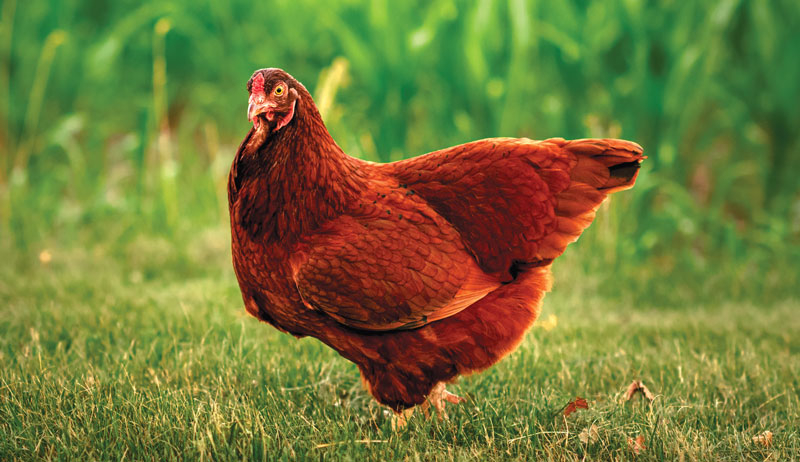
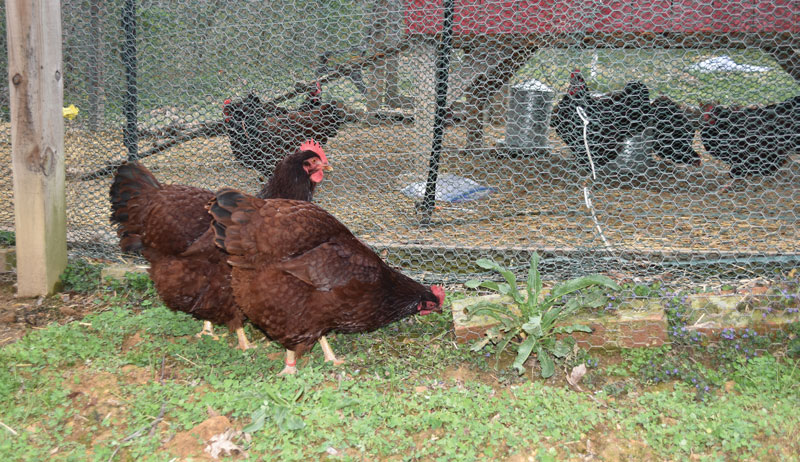
Rhode Island Red
First on my list is the heritage Rhode Island Red. The RIR is a very well-known breed throughout the world, but it originated in the state of Rhode Island, hence the name. This dual-purpose breed is best known for its deep brown-red coloring, and it can have a rose or single comb. While it does well in cold and hot climates, the rose comb is suggested in regions with harsh winters, due to frostbite concerns with single-comb breeds.
RIR hens lay an astounding 200 to 300 large brown eggs a year, will go broody and have great parenting characteristics. As a meat bird, it’ll yield 5 to 8 pounds of meat. It’s known as a very hardy breed that’s great at keeping predator awareness while free-ranging.
Note: The heritage version shouldn’t be confused with industrial RIRs because this breed has been used for many years in the egg industry. Through selective breeding, industry birds are great egg layers but yield very little meat. The industrial type has also lost the deep colored plumage.
Buckeye
When I first started my farm seriously, I came across this breed accidentally. I bought chicks thinking that they were Rhode Island Reds. Come to find out, they were great for my homestead, too.
The Buckeye is the only American Poultry Association-accepted breed that was developed by a woman, Nettie Metcalf. Its name is reflective of Ohio, where she developed it. This breed also has a deep red-brown plumage, but its body type is quite different from the Rhode Island Red. The Buckeye’s body reflects more of a Cornish type.
This dual-purpose breed lays 150 to 200 eggs per year. It does take seven to nine months for these hens to start laying, but once they start, they make very good layers. Hens also stand out as being exceptionally protective of their chicks and will happily brood their own chicks.
Known for being a great broiler bird, Buckeye meat yields can range from 4 to 9 pounds. They also have great free-ranging capabilities, are friendly and can tolerate cold weather exceptionally.
While this breed isn’t dual-purpose, it does deserve a mention here. The Campine is a vigorous forager, and hens lay 200-plus large, white eggs each year. The breed isn’t known for its broodiness, so be aware that if you get this breed, you’ll need to incubate eggs.
Personally, having a flock of Golden and Silver, their predator awareness was astounding. They also do well in confinement and are hardy in many ranging temperatures. They do exceptionally well in the cold and are very friendly.
Crèvecoeur
If you are looking for a dual-purpose breed that really stands out ornamentally, look no further than a Crèvecoeur. This solid-black bird with short legs hails from France and is known for having a crest and beard. However, its distinctive V-shaped comb is what really makes it stand out.
Its name translates to “broken heart,” but having it on your homestead will be fulfilling. Hens lay 150-plus medium-to-large white eggs a year, and meat yields can be from 5 to 8 pounds.
This active and friendly breed is not known for being broody or for raising its own chicks. If you’re looking at keeping your flock penned, this breed does exceptionally well in confinement. Besides the broodiness and mothering capabilities, this breed is vulnerable to predators because of the crest obstructing its vision.
It also doesn’t do well with temperature extremes and needs to be kept in a temperate climate.
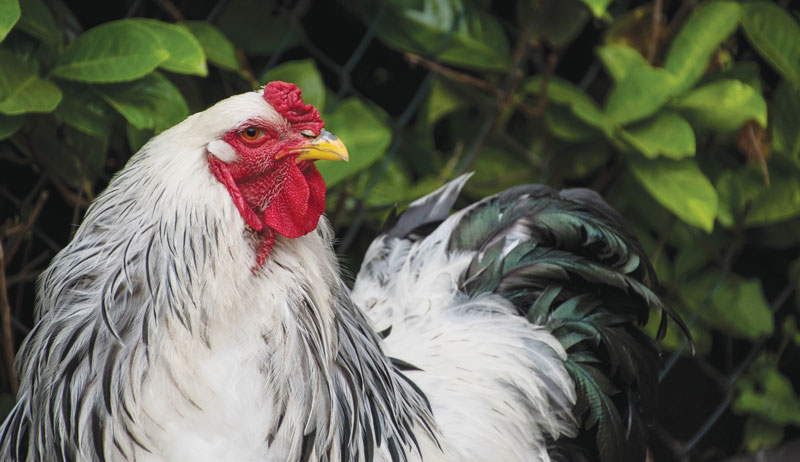
Brahma
This breed was the principal American meat bird from the 1850s until 1930 (when the age of the broiler chicken began). The Brahma is one of the largest chicken breeds available today.
Brita Seifert/Shutterstock
This dual-purpose breed is calm and friendly but can be intimidating given how big it can get. This fowl is best kept in a colder environment. Keeping it in warmer climates isn’t ideal, but it can adapt.
Hens lay nearly 140 large brown eggs a year and are considered exceptional winter layers. Brahmas do go broody and will care lovingly for the chicks. However, because of the size of the hen, chicks should be looked after closely the first few days after hatching to avoid being trampled.
The Brahma can yield 8 to 12 pounds of meat! At one point in time, the Brahma was in competition with capons because of how tender its meat was up until 12 to 13 months of age.
Because of the breed’s size, perches need to be kept right around 12 inches off the ground. This is also another breed that does very well in confinement due to its docile personality.
Jersey Giant
The Jersey Giant competes with the Brahma for size. These two breeds are the largest breeds of chicken available. The Jersey Giant was originally developed in Burlington, New Jersey, with the intention of replacing the turkey on American holiday tables. This big breed can yield 8 to 13 pounds of meat.
Jersey Giant hens lay 180-plus large brown eggs a year and do go broody with wonderful mothering skills. However, her large size can easily smash eggs.
Very affectionate to their caregivers, they don’t quarrel often and do well in warm and cold climates but tend to do better in colder environments. The cold mostly comes down to the combs. This breed does well free-ranging and has exceptional foraging skills and predator awareness.
This breed is named after a French town, and the name translates to “the arrow.” The breed has a very distinctive V-shaped comb much like the Crèvecoeur. This dual-purpose breed yields 4 to 7 pounds of meat and lays 200-plus medium white eggs each year. It also has an exceptionally high-yielding breast in reference to its size.
This breed needs a more temperate climate to live. It can do well in heat or cold but not in the extremes of either.
La Flèche are known for their good flying tendencies. While they have great foraging capabilities, they are known to fly over fences that stand in their way. If you plan on penning this breed, you’ll need a lot of foraging material and boredom busters to keep them happy and healthy. This breed is also known for tree roosting when left to free-range.
They are not setters. Plan on using an incubator if you want chicks of this breed.
Holland
The Holland is another breed out of New Jersey. Its plumage resembles a Plymouth Rock or a Dominique. This breed can yield 5 to 7 pounds of meat, and hens lay 150-plus large, white eggs each year.
This friendly, docile breed is known for being a great bird for the homestead. Its foraging capabilities and predator awareness are known as being one of the best. It does well in hot or cold climates, but its comb is prone to frostbite. Hens will go broody and raise their own chicks.
According to Suzanne Holland, who raises and breeds Barred Hollands on her Holland Farm in Louisiana, in the mid 1930s, commercial egg producers convinced the market that brown eggs were dirty. “White eggs became the ‘in’ color for eggs,” she says. “That put small farmers in a bad spot and not able to compete. Meat birds only lay brown eggs. Farmers needed a dual purpose bird for economic and space reasons.”
A professor from Rutgers University began working on a breed to help the small farmer compete and stay in business: a meat bird that laid white eggs. “Originally, there was a White Holland and a Barred Holland,” Holland says. “The white is now extinct. The original starting breed was never disclosed by the professor, only that it came from Holland, thus the name.
“The barred Holland breed is made up from the origin breed, bred with White Leghorns, Barred Plymouth Rocks, Australorps and Brown Leghorns.”
Icelandic
If you’re looking for a smaller chicken breed that packs a punch, look no further than the Icelandic. This cold-hardy breed does absolutely excellent in harsh climates and is known for its adept skill of foraging, brooding and predator evading. The Norse even kept these birds and took them along on discovery voyages, landing this breed the nickname “Viking chicken.”
While a small breed, yielding only 1 to 3 pounds of meat, it’s known for the flavor of its meat. Hens will lay 150-plus large white eggs a year, and their mothering skills have been proven to be amazing.
Rhode Island White
The Rhode Island White is a great dual-purpose bird that has good free-ranging capabilities and tolerates warmer climates well. While this breed loves to forage, they’ll stay close to home while doing so, squawking a lot more than your average breed of chicken.
Steven Johnson/ Flickr/CC BY 2.0
RIWs will yield 5 to 7 pounds of meat and lay upward of 250 large, white eggs each year. The breed doesn’t do well in confinement. The rose-comb variety does extremely well in cold temperatures. They are also not sitters or very good caretakers to chicks, so that is one quality you’ll have to keep in mind if you decide to choose this breed.
Silverudds Blue
This breed, though not currently accepted by the American Poultry Association, deserves an honorable mention. I personally have had this friendly, docile breed on my homestead, and it’s a fantastic breed to keep. It was formerly known as the “Isbar,” but has been renamed to honor their creator, Martin Silverudd.
Their foraging capability is the best that I have personally witnessed. They are mostly used as egg layers and lay 150-plus green-shaded eggs per year. You can harvest them, but you’ll only get 3 to 4 pounds of meat yield.
Hens do go broody and will raise their own chicks depending on which lines you get.
Many other chicken breeds do well on a homestead, but in my opinion, the ones I’ve highlighted in this article will do best. Many of these heritage chicken breeds are at risk of going extinct because homesteads started to die out with the rise of commercial facilities for egg layers and broilers. Heritage chicken breeds are slow growers compared to the industrial breeds, but that slow growing is worth it in terms of meat and eggs.
No matter what climate or situations affect your homestead, one of these chicken breeds will fit in perfectly.
This article originally appeared in the May/June 2022 issue of Chickens magazine.
Aaron De La Cerda is on this episode of Hobby Farms Presents: Growing Good to talk about the Acta Non Verba Youth Urban Farm Project, fruit gleaning, growing cannabis as a teenager, and why he prefers to be a “lazy” farmer.
You’ll learn about how a life decision he was asked to make in third grade led to him being known as “the plant person” among his family and friends and shaped his career and life trajectory. Aaron talks about growing up with a family full of educators and how this, plus his green thumb and an interest in social justice eventually brought him to nonprofit urban farming work. Hear about his work with unhoused folks, helping the shelter with a garden, and plotting out fruit gleaning opportunities in Merced, California.
Then, get up to speed with the work of Acta Non Verba Youth Urban Farm Project and its kids and family programs. Hear about the community farm at the Oakland A’s baseball stadium, as well as two other urban farms, and the wild growth of ANV’s Beet Box CSA program.
Finally, get Aaron’s advice—hat tip to Masanobu Fukuoka’s book One-Straw Revolution—for hands-off, natural-systems farming, consider the current crisis of “local” food, and hear Aaron’s thoughts on the role and future of urban farming. (Spoiler alert: It isn’t to feed the whole city’s population.)
Living smack in the middle of two of Michigan’s largest forest regions means that my husband and I must be extra vigilant to keep our flocks safe from predators. You don’t need to live in the wilderness, however, to want to ensure your birds’ safety. Whether you keep urban backyard birds or a large rural flock, here are four ways to protect your chickens.
Secure Housing
The best way to protect your chickens is to provide them with as sturdy and impregnable a henhouse as possible. Because of location, you may not have the ability to sink foundational posts in concrete or dig a protective apron around your coop and run.
You can, however, take such precautions as covering gaps with quarter-inch hardware mesh. This will prevent even the slimmest weasel, raccoon and rat from slipping through. Regularly inspect the structure and effect repairs as needed, and use carabiners to prevent nimble-pawed predators from accessing your nest box and pop door.
It may not be your chickens that are attracting local predators. If you keep your pet’s food bowl or your household trash bin outside, the scent coming from these may draw uninvited guests. Even wild-bird feeders are fair game for agile climbers like raccoons.
Once on your property, hungry predators may discover your flock’s existence. To minimize this risk of notice, feed your household pets inside. Purchase an animal-proof trash bin (and keep it inside a shed or garage if possible), and bring your wild-bird feeders in at dusk.
If you have a grill, keep it covered and clean it frequently to keep pests out. Most importantly, store your chicken feed in airtight containers well away from your coop.
Live Traps
In locations with a high percentage of feral animals (for example, rats in New York City or, in our case, raccoons and opossum in the Michigan wilderness), it may simply not be possible to predator-proof your property. In these situations, live trapping may be a feasible option.
Live traps can be purchased or rented, then baited (canned cat food is our bait of choice) and set out in your yard, near your deck, by your shed, or anywhere else you have witnessed wild animals.
Once you have trapped a predator, you can contact Animal Services or your local fish and wildlife office to have them take the animal. Another option is to release the animal in a forest or park at some distance from your home. You can also contract a commercial critter-control company to handle the trapping and removal for you.
If you’re a poultry keeper with a large free-ranging flock, a livestock guardian dog (LGD) may be a great option to protect your chickens. An LGD bonds with its flock at a very early age and is meticulously trained and supervised to protect it from predators.
Usually the mere presence of an LGD is enough to keep wild animals away. Those curious, hungry or brazen enough to approach quickly find themselves confronted by a growling, snarling, barking LGD displaying aggressive behavior.
An LGD will physically fight a predator if the dog deems it necessary.
An LGD is not cheap. These are specific breeds of dogs, such as a Great Pyrenees or an Anatolian Shepherd, and an LGD pup requires continual training and guidance for the first two years of its life. Given the potential decimation of a flock, however, an LGD may be a valuable investment.
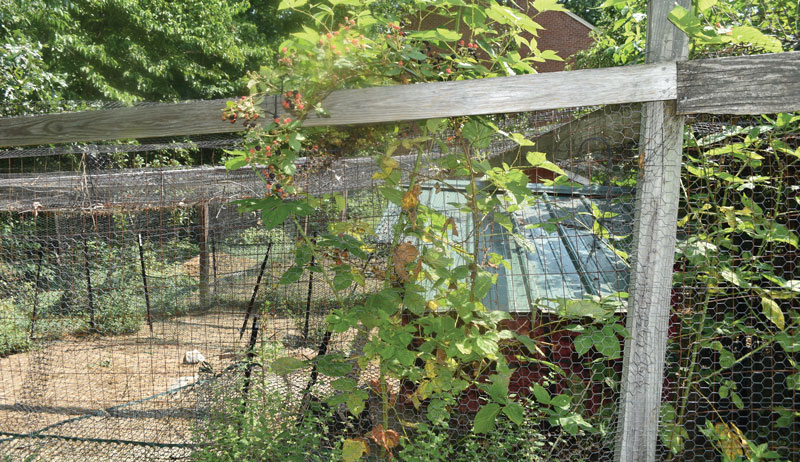
To be honest, my wife Elaine and I didn’t plan to raise wild blackberry vines in our two chicken runs. What began as a single plant popping up randomly in a chicken run has grown into a veritable thicket of viny plants that now thrive in both of the runs where we raise heritage Rhode Island Reds.
Several years ago, our annually broody hen Mary established her nest in one of the coops. When that happens, we sometimes turn one henhouse into a chick nursery, moving the other hens and roosters into the second one. The previous year, one of the chicks had somehow found its way out of the chicken run and into our yard, causing Mary to sound the distress call. This, in turn, sent me and Elaine bolting into the backyard.
We reunited Mary with her offspring and immediately proceeded to chick-proof the perimeter by establishing green plastic fencing all along the inside perimeter. The fencing possesses very small openings that not even day-old chicks can squeeze through. At the upper end of the run, the fencing was several feet from the outer perimeter.
That was where the first blackberry vine began to grow.
Berry Good Ideas
Like many other members of the Rubus genus, the blackberry species sends forth canes their first year. Then the spring and summer of the second year, blackberry vines produce berries that turn green, then red and finally black when they become ripe.
By that second year, the blackberry plant vines were growing profusely inside the fencing and had even begun to spread throughout the upper third of the chicken run. In effect, they had escaped and started to flourish outside the green fencing. We even had to cut the vines back from the henhouse as their thorns scratched us when it was time to clean it.
Elaine and I are enthusiastic gathers of various wild edibles, and we have an annual summer goal of picking 10 gallons of wild raspberries, dewberries, wineberries and, of course, blackberries. So we were quite thrilled that we had another source of this wild fruit that isn’t only tasty in such treats as pies, cobblers, muffins and pancakes but also a true health food.
Blackberries are high in vitamins A, C and K; serve as an antioxidant; and provide fiber, too.
Bruce Ingram
Poultry Perks
The lush growth of the blackberry thicket also presented two other benefits—these to our chickens. The run’s henhouse often becomes rather hot in the summertime, but because of the abundance of vines and their leaves, quite a bit of shade now exists over the structure. Rubber netting covers the top of both runs, and the vines inched their way through the netting and seemed to grow even more vibrantly—a type of trellis effect.
Delicious Delights
In southwest Virginia where we live, blackberries are ripe for about three weeks in July. Our thicket’s second benefit was to provide a healthy source of food for our chickens during that time. Every day when Elaine and I would enter the run to pick berries, our chickens would gather under us, no doubt hoping they would be the beneficiaries of dropped or dislodged fruit.
Indeed, every morning every chicken would leave the run and immediately head to their blackberry vines on the odd chance that fruit had fallen overnight. Many times, our birds found quite a few berries had dropped from their vines. During the course of July days, when we would gather eggs, we would also shake the vines to give the chickens “their vitamins.”
For several weeks after we stopped picking berries, our chickens—not as peculiar as Elaine and I are when it comes to the ripeness of fruit—would eagerly consume dry, shriveled blackberries when they fell.
All in all, our blackberry vines provided treats to our birds for some five weeks, and cooling shade throughout the late spring, summer and early fall. If you don’t want to chance wild blackberries appearing randomly in your run, consider buying some domestic plants. Just fence the young plants so your chickens won’t be tempted to dig around them.
Before I cover other plants that can flourish in runs, chicken enthusiasts should first know that some flora should never be allowed to become established. Indeed, contrary to what many readers might believe, some plants are able to easily establish themselves in a chicken run with no help from us humans.
Two good examples of this are curly dock (Rumex crispus) and ground ivy.
Curly Dock
In fact, curly dock is perhaps one of the worst plants to grow anywhere near chickens. This invasive—native to Africa, Asia and Europe—features leaves that are toxic to horses, sheep and cattle and produces great amounts of seeds toxic to chickens as well.
Folks can identify dock by the curly, wavy green leaves that can grow as long as a foot. When dock becomes older in late summer and early fall, it will send up a flower stalk that will soon be covered with scores of seeds. Don’t let the plant grow that old because of the poisonous nature of the seeds.
Unfortunately, curly dock is very difficult to remove. If you try to just pull it up, the long taproots—which are reputed to grow over a yard long—will just break off and soon regenerate. A glyphosate-based herbicide will kill dock and its taproot, but spraying chemicals on plants in a chicken run is never a good idea.
The best approach is to use a shovel to dig deep and remove the entire plant.
Ground Ivy
Another insidious plant that can appear in runs is ground ivy (Glechoma hederacea), also sometimes called hen penny. This scourge features scalloped leaves about an inch wide and attractive purple flowers. Joanne Yousten, a soil conservationist for the United States Department of Agriculture, told me that ground ivy is almost impossible to remove from a yard once it becomes established.
I have certainly found that to be true. Ground ivy first appeared in our yard about five years ago and now blankets almost the entire lot.
Of course, this European invasive found its way into the chicken run, and our birds won’t eat the plants despite the nickname of hen penny. They will scratch around it, but as I learned one summer, a small patch of the stuff survived the best efforts of our chickens to eliminate it. I finally pulled up the ground ivy and hurled it into the forest that borders the run.
One last warning: Don’t leave this plant where you’ve pulled it up. I’ve had plants “re-root” themselves after a rain.
Bruce Ingram
Plants You Do Want
One of the premier plants that you can grow within your run is lemon balm. And like our wild blackberry plants, I learned this by accident.
Our garden borders the second of our two runs, and Elaine and I planted a single balm slip as a way of providing an excellent pollinator for our tomato, squash and other vegetables. That one lemon balm plant quickly grew and spread, so much so that plants made their way through the fencing separating the garden and chicken run.
Lemon Balm
It was then that I did some research and found that not only was lemon balm an excellent pollinator, but it also is reputed to repel insects (think flies) and rodents.
Lemon balm leaves are also presumed to serve as stress relievers for chickens. Just scatter the leaves in nesting boxes.
Our lemon balm grows best amid the fencing between the garden and chicken run, but we’ve also seen it appear on its own when we’ve planted clover in our runs. (Read “Grow In-Run Clover” sidebar, below.). Although chickens will scratch around lemon balm, they don’t seem very interested in the leaves.
Other Plants to Liven up a Run
Other plants that have similar qualities to balm in terms of discouraging pests include lavender, dill and catnip.
The typical chicken run features barren ground, and chickens moving about scratching and searching for plants and other food they are unlikely to find unless some grasshopper or other insect happens to blunder into the enclosure. You can change the entire ambiance of the place with some creative fencing and knowing what type of plants you can establish.
More Information
Grow In-Run Clover
From my experience, when chickens forage in our yard, they target clover the most. When my wife Elaine and I first started raising chickens, we tried planting clover seeds in our run, but our birds immediately ate the sprouts as soon as they appeared.
Undeterred by this failure, we devised a solution that involves periodically fencing off approximately 5-yard-long, 3-yard-wide sections of our run with the aforementioned green fencing.
After we finish fencing, we wait for a forecast of rain. The day before predicted precipitation, we use a rake to loosen soil, next broadcast clover seeds, then cover them with a thin layer of soil.
Young growth usually appears in a week to 10 days, and we allow our clover patch to grow for about a month more before removing the fencing. Of course, the chickens usually decimate the patch in a week or so. But meanwhile, we have moved the fencing to another section of the run to begin the process anew.
Outside of Runs
Chickens possess an amazing ability to quickly decide whether a plant is edible or not. They also have no trouble remembering where these plants thrive.
For example, both my runs reside on a slight decline that over the years has resulted in manure washing downhill where it has accumulated at the lower ends. This has resulted in some very rich soil where chickweed, dandelions and broadleaf plantain now grow in great profusion for much of the spring, summer and early fall.
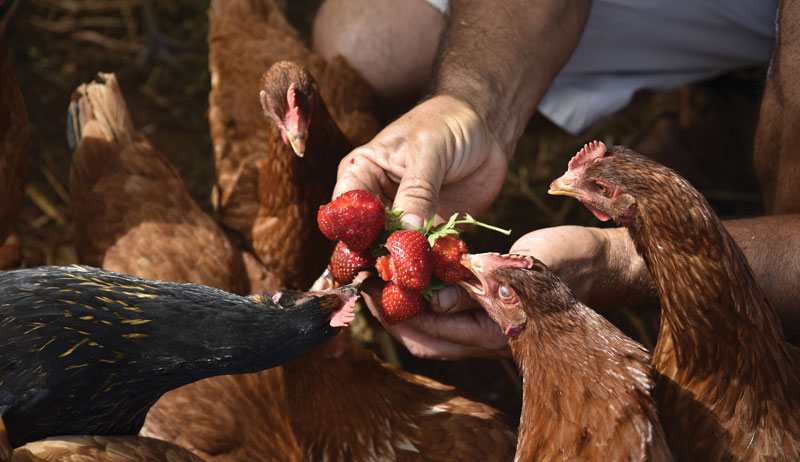
Every time we let our birds out to forage, they quickly head for this trio of plants. And on days when we don’t let them outside, Elaine and I will often pick up handfuls of these plants and either toss them into the runs or poke them through the fencing so that our chooks can engage in a flurry of feeding activity.
Also of note is that chickweed, dandelions and plantain are outstanding—and nutritional—plants for us humans to include in salads or egg dishes. Of course, we don’t consume any plant that grows adjacent to the run, but ones that thrive nearby are certainly fair game.
This article originally appeared in the May/June 2022 issue of Chickens magazine.
Feeding our chickens treats—in small amounts—of fruits, vegetables, kitchen scraps and other “human food” can provide them with valuable environmental enrichment while supplementing a diet of commercially available formulated feed. While many common foods may seem nutritious or safe to consume for humans, they may be harmful or deadly for our feathered friends.
This article focuses on common foods toxic to chickens. We’ll also look at what to do when one of your birds eats something toxic, as well as nontoxic alternatives.
Toxin vs. Toxicants
A toxicant is a substance, either naturally occurring or human-made, that is injurious in some way to a living organism. Toxins, on the other hand, are toxicants specifically produced by an organism (animal, plant, fungus, etc.).
This means that we have to consider the food itself when making decisions about feeding chickens, as well as the environmental factors and additives affecting the food.
Different toxicants affect different biological systems of chickens in various ways and by various mechanisms, so “poisoning” isn’t always going to look the same.
It’s not possible to know if a particular toxicant is affecting a bird from clinical signs alone. But checking on your flock frequently and making note of changes in a bird’s behavior may help catch a problem before it’s too late.
Some common clinical signs of poisoning include:
increased mortality
loss of appetite
weakness
loss of motor control
depression and isolation from the flock
convulsions
respiratory changes or distress
paralysis
diarrhea
Further complicating the list is the reality that the clinical signs listed can also be associated with infectious disease and diet.
The bottom line: As soon as you notice a change to the health and wellbeing of one or more birds in your flock, contact your veterinarian. Additionally, provide supportive care for the affected member(s) of the flock by isolating them in a safe, warm place with easy access to food and water.
Rachael Martin/Shutterstock
Toxic but Tasty
A lot of foods that we eat and consider healthy—avocado and almonds, for example—contain compounds that are toxic to chickens. Processed foods may appear to not have any toxic ingredients but often contain harmful or lethal levels of salt.
Sometimes only parts of food that we discard when cooking—stems, leaves, shells and pits—are toxic to chickens while the rest are fine.
The list of individual foods that are toxic to chickens is too long to list here individually, so below we broke foods up by the type of toxicant they contain.
Persin
Persin is present in the fruit, skin and pit of avocados. You’ll also find it in the leaves and bark of avocado trees. Many bird species, including chickens, are very sensitive to persin. Don’t allow your birds access to any part of the plant.
Clinical signs of persin poisoning in chickens include increased heart rate, disordered plumage, difficulty breathing, general weakness and apathy. High doses can cause signs and death in 12 to 24 hours.
Aflatoxins
These are found in contaminated commercial feed, old peanuts, unshelled nuts and visibly molded foods.
This group of toxins is produced by molds (mycotoxins), particularly by Aspergillus spp. and some species of Penicillium. Commercially available feed ingredients, such as corn and soybeans, as well as finished feedstuff in storage can be contaminated with one of these molds.
Nuts are also common sources of aflatoxins, particularly peanuts as they age or mold. Aflatoxins are toxic to humans as well as chickens. Contaminated feed can transmit aflatoxins to eggs and chicken meat, so monitoring what we feed our chickens for signs of potential aflatoxin presence is very important.
Feed with visible mold should always be avoided, but mycotoxins can be present even without obvious mold growth. Feeding fresh feed stored in a dry area can help avoid aflatoxicosis.
Fortunately, the USDA tests foods that may contain aflatoxins, including grains, peanuts and peanut products. Still, checking foods and commercial feed for signs of mold before feeding your flock is an important measure in avoiding aflatoxicosis.
Signs of aflatoxicosis include loss of appetite, loss of motor control, convulsions, depression and death.
There are many types of “-cides” including insecticides, herbicides and rodenticides used in food production and in residential settings that can cause toxicosis in chickens.
Produce can contain amounts of these compounds on their surfaces. Therefore, thoroughly wash these foods before feeding them to your birds, especially if you are feeding them the peel. In addition, chickens should be kept away from areas recently treated with pesticides.
There are a number of rodenticides used for rodent control including anticoagulant rodenticides, bromethalin and vitamin D. For example, chickens might directly ingest rodenticide baits resulting in poisoning.
Use appropriate bait stations to avoid direct access to baits by birds.
While clinical signs vary depending on the compound used, weakness, diarrhea, convulsions, loss of motor control and respiratory distress can occur in cases of pesticide poisoning.
Clinical signs of rodenticide poisoning might not appear right away. Anticoagulant rodenticides can cause weakness and loss of appetite but can also cause death without clinical signs. Other types of rodenticides may cause seizures, loss of motor control, partial paralysis, behavioral changes and hypercalcemia (increased levels of calcium in blood).
Amygdalin (cyanide)
The pits of stone fruits—including apricots, peaches, plums and cherries, as well as apple seeds, elderberries and almonds (which is itself a kernel of the almond fruit)—contain amygdalin, a cyanogenic glycoside. Amygdalin breaks down into hydrogen cyanide when digested and can lead to cyanide poisoning.
Chickens that have ingested a lethal dose of amygdalin-containing food will typically die within 15 to 30 minutes. Therefore, carefully remove all parts of the pit or seeds when feeding these fruits to your chickens and ensure your chickens don’t have access to the cyanogenic scraps of these foods.
Salt
This is found in processed foods, canned foods and human prepared foods.
The recommended level of salt in a poultry diet is 0.2 percent by weight, or around 1 milligram per day depending on the weight of your bird. This amount of salt is already accounted for in commercial feed.
Even small increases in salt can cause salt poisoning. So take care when feeding prepared foods to your birds.
Processed foods—such as frozen foods, snack mixes, chips, ready-to-eat foods from the grocery (salad with dressing for example), and canned foods—contain enough salt to cause salt poisoning. Clinical signs of salt poisoning include excess thirst, diarrhea and weakness.
If you suspect salt poisoning, remove water and feed sources and gradually replace them with increasing amounts of fresh water from a non-contaminated source over a few hours. Immediate unrestricted access to fresh water may cause brain damage.
Ensuring your flock always has access to fresh water can help prevent hypernatremia. This is especially important on very hot days when water evaporates more quickly and on cold days when water may freeze.
Solanine
Solanine and solaninelike compounds are present in the plant stems, leaves and flowers of nightshade family fruits and vegetables. Green or spoiled potatoes and green tomatoes also contain solanine.
Ripe tomato fruit and ripe potatoes are safe.
Eggplant and pepper fruits don’t contain solanine and are safe to eat. Additionally, red pepper can provide some benefits in terms of egg quality and yolk color. (Don’t worry. Chickens don’t taste the spicy capsaicin like humans do.)
If you do decide to feed your chickens any of these nightshade family fruits, remove any stems or leaves from the fruit.
For potatoes, peel to ensure the potato is not spoiled or green and to remove the solanine-containing peel. Then remove any sprouts (“eyes”). Solanine affects the nervous system and gastrointestinal tract of chickens, causing loss of motor function, GI distress, respiratory distress and in some cases death.
Oxalates
Several edible plants—including spinach, rhubarb leaves and starfruit—contain soluble calcium oxalates. Some ornamental plants that chickens may ingest, such as shamrock, also contain these oxalates.
Ingestion of parts of these plants can cause hypocalcemia (low levels of calcium in blood) and severe kidney damage, similar to the effects of ethylene glycol poisoning (main ingredient in antifreeze). Clinical signs of oxalate toxicosis include weakness, increased salivation, GI distress and tremors.
Onions, garlic, leeks & shallots
Onions and other Allium spp. plants contain organosulfoxides that can cause toxicosis in many animal species. Ingestion of onions and related plants may result in damage to red blood cells and anemia. Easting these can result in weakness but also may result in death without significant clinical signs.
Phytohemagglutinin
PHA is a lectin present in raw beans, especially raw red and white kidney beans. In chickens, PHA can affect the development of a young bird’s immune system and reduce immune response if fed later in life.
PHA can also cause damage to the pancreas, kidneys, liver and other organs of chickens.
PHA can be destroyed and beans made safe to eat by appropriate cooking methods. (Slow cookers don’t get hot enough to destroy PHA). Canned beans have been cooked enough to break down PHA but often contain high levels of salt, which can cause salt poisoning as discussed.
Clinical signs of PHA poisoning aren’t well described in birds. But the negative effects of PHA on the immune system may result in higher levels of disease and death, as well as reduced egg production and GI distress.
Caffeine
While many of us consider our feathered friends’ close companions or family members, refrain from sharing our caffeine and chocolate treats with them. Caffeinated beverages and caffeine-containing solids, including coffee grounds and tea leaves, are toxic to chickens.
Consumption of caffeine causes heart, lung and nervous system problems that can lead to death in high enough doses. Chocolate contains caffeine as well as theobromine, a compound related to caffeine that affects chickens in a similar way.
Dark chocolate contains higher concentrations of caffeine and theobromine.
In addition to not feeding chickens these foods, chickens should be kept away from areas where coffee grounds are used as fertilizer or insect repellent. We should also take care to avoid contaminating chicken feed with coffee grounds.
Chickens that consume caffeine display clinical signs such as restlessness, elevated heart rate, vomiting and seizures soon after consumption. At high enough doses, caffeine consumption can cause death.
Alcohol
Ethyl alcohol is lethal to chickens in very small quantities. Even a small amount in a low alcohol-by-volume beverage can cause significant damage to several vital organs and death.
Nicotine
Nicotine comes in many forms—cigarettes, secondhand smoke, smokeless tobacco, vape liquids, tobacco-less nicotine pouches and smoking cessation products. All forms of nicotine, not just tobacco, are toxic to chickens.
Nicotine users should ensure they don’t leave cigarette butts, vape liquid, smokeless tobacco or nicotine-containing products in chicken enclosures or in places that chickens forage.
In addition to ingestion, birds have complex respiratory systems that make them very sensitive to toxins in the air, making secondhand smoke a significant concern. Nicotine poisoning can cause vomiting, tremors, seizures, increased salivation, elevated heart rate and death at high enough doses.
This list isn’t exhaustive by any means, but many of the most dangerous foods are listed. When in doubt about a certain food, hold off on feeding it to your chickens until you can confirm with your veterinarian that it is safe.
In cases of confirmed or suspected exposure of chickens to a toxic food, contact your local veterinarian or one of the two animal poison control centers (petpoisonhelpline.com or .aspca.org). As discussed in this column, time is often of the essence when toxic foods are ingested. Getting help as soon as possible will go a long way to keeping your chickens happy and healthy.
This article originally appeared in the May/June 2022 issue of Chickens magazine and was written by Joseph Gendreau, Dr. Chelsea Sykes, Dr. Maurice Pitesky and Dr. Robert Poppenga, all from the UC Davis School of Veterinary Medicine.
As the mercury rises and summer swings to full tilt, now’s a good time to think about how ambient heat and humidity can affect the health of our farm animals. Let’s review the signs of heat stress in livestock.
Ruminants
Because the rumen in cattle, sheep and goats is a giant fermentation vat, it generates a lot of heat. Acting as an innate furnace, this is an obvious advantage in the winter but can be a burden in the summer.
For this reason, ruminant livestock (especially cattle) can experience even mild heat stress in temperatures that humans would consider relatively comfortable–upper 70s and 80s F. An additional factor is that cattle do not sweat as much as humans do and lack other means to shed excess body heat.
As humidity increases, this makes things worse.
Researchers with the USDA’s Agricultural Research Service (ARS) have determined that respiratory rate is a good indicator of the level of heat index cattle are experiencing. Normal bovine respiratory rates should typically be under 90 breaths per minute (bpm). Breathing rates above this signify:
alert for heat stress (90 to 110 bpm)
danger of heat stress (110 to 130 bpm)
an emergency situation (above 130 bpm).
This is a very handy method to quickly assess your animals.
Other clinical signs of heat stress in ruminants include:
changes in behavior, such as agitation and reluctance to lay down
drooling
foaming at the mouth
open-mouth breathing (extreme situations)
More chronic indications of heat stress in a livestock herd include decreased weight gain due to decreased dry matter intake, decreased milk production and shorter gestation lengths in pregnant animals.
Horses and other equines have a much better aptitude for sweating as compared to their ruminant counterparts. However, as humidity increases, the effectiveness of sweat in cooling the body decreases until becoming mostly ineffectual in extreme heat and humidity (e.g., 95 degrees F and 90 percent humidity).
If horses cannot cool down rapidly in such conditions, their large muscles quickly overheat.
A horse in heat stress will have an increased respiratory rate, like ruminants, and paradoxically may actually have dry skin. Mucous membranes will also be dry and the horse may exhibit neurological signs such as stumbling and weakness. This can quickly devolve into seizures and severe physical harm and death if veterinary care is not initiated immediately.
Pigs are particularly prone to heat stress due to their short statures, large muscles and thick subcutaneous fat. They also lack the ability to sweat and instead utilize panting to dissipate heat like a dog does. However, panting can only help so much. Overheated pigs, like other livestock, will not eat as much or stop eating altogether.
As heat stress continues, they will open-mouth breathe and you may see red splotches on light skinned pigs. Over-heated pigs may begin to vocalize more than normal and become stiff-legged or develop muscle tremors and not want to move at all.
So what should farmers do for their animals in the summer? Providing adequate shade is a huge help, as is the obvious: provide plenty of clean, fresh water.
Another rule is to avoid working animals—that means don’t excessively ride horses, don’t vaccinate cattle, don’t castrate lambs, don’t shear alpacas—in high heat and humidity. If you must process animals, try to do so in the early morning or in a location with shade and ample air circulation.
If you’re tight on garden space, you’ll be delighted to know there are bushels of healing plants that you can grow in pots. And even if you have heaps of soil, you’ll be pleased to learn about the habitats you can create with containers. By choosing the appropriate planter, soil and location, you can extend the growing season or simulate a drier or wetter environment, expanding the range of plants you can grow.
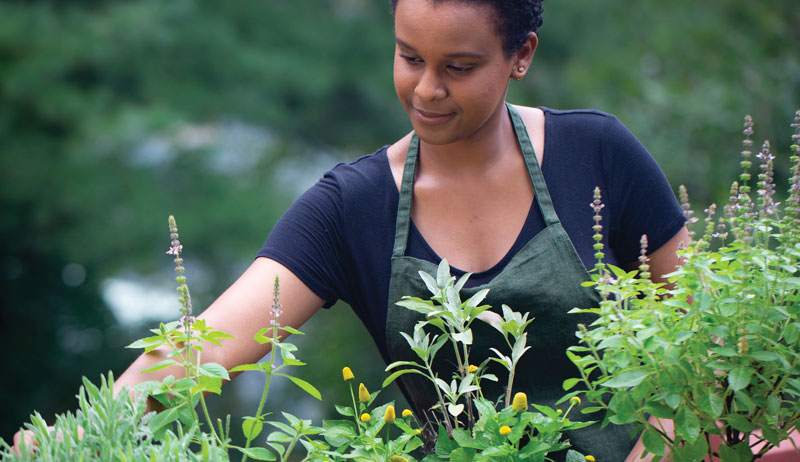
If you adorn your deck or porch with potted flowers every spring, there’s a multitude of splashy herbs that can stand in for bedding plants. Herbs with edible flowers, such as calendula, pineapple sage, anise hyssop, chives, heart’s-ease and nasturtium, brighten up planters and can add contrast to leafy culinary herbs such as parsley, basil or sage. I’m partial to the gray foliage of artichoke and the silvery lavender and thyme cultivars. The classic Mediterranean culinary herbs—basil, thyme, sage, parsley, chives, rosemary and lavender—happily hop into most any container. Place them in the front or back door to make them easy to reach for when you’re cooking. Mint, stinging nettles, bee balm, horsetail, calamus and jiaogulan are just a few plants that can overtake their surroundings in the garden; rein in these spreading botanicals with a container.
A Tour of Containers
When selecting a planter, consider its size, shape, and construction. Larger vessels hold in moisture and need to be watered less frequently. In contrast, smaller containers sometimes need to be watered daily. You’ll also want to think about how heavy it will be when filled with soil. Shallow, broad pots provide a homey environment for low-growing, spreading herbs like gotu kola, sweet violet, and thyme. Taller planters offer easy access to plants when mobility is a consideration.
Bathtubs, Washtubs & Sinks
Retired tubs and sinks are some of the greenest options available, as they’re destined for the landfill. They are long-lived, resistant to cracking from temperature fluctuations, and can provide a sizeable growing area that holds moisture quite effectively. Know that cast-iron tubs covered with porcelain glazes manufactured before 1995 can contain lead. Reproduction washtubs are a fun option, and many come with a stand putting the plants in easy reach.
Plastic nursery pots and food-grade buckets are lightweight, affordable and sometimes free. The downside of plastic vessels includes their shorter life span and environmental toll. However, landscapers and nurseries often throw out plastic pots, so reuse helps keep them out of landfills. There is a possibility that chemicals, some of which are endocrine disruptors, might leach from the plastic into the soil and enter the plants via their roots, but I haven’t found any studies researching this topic.
Terra-Cotta Pots
Terra-cotta, or clay, pots wick away moisture quickly, so plants in terra-cotta pots need to be watered frequently. Unglazed terra-cotta will crack and break if left outdoors and filled with soil during freezing temperatures.
Glazed Ceramic Planters
Offered in a variety of colors and textures, glazed ceramic pots retain more moisture than terra-cotta pots and are less likely to crack during the winter. But they are heavy, expensive, and I suspect some of the glazes may contain lead; however, I haven’t been able to verify this, despite extensive research.
These natural pots are compostable and made from peat, manure, or pulp by-products. They typically last one season or less. Many people prefer using these over plastic because they are biodegradable, but unfortunately most are manufactured overseas and carry the environmental impact of transportation.
Wooden Containers
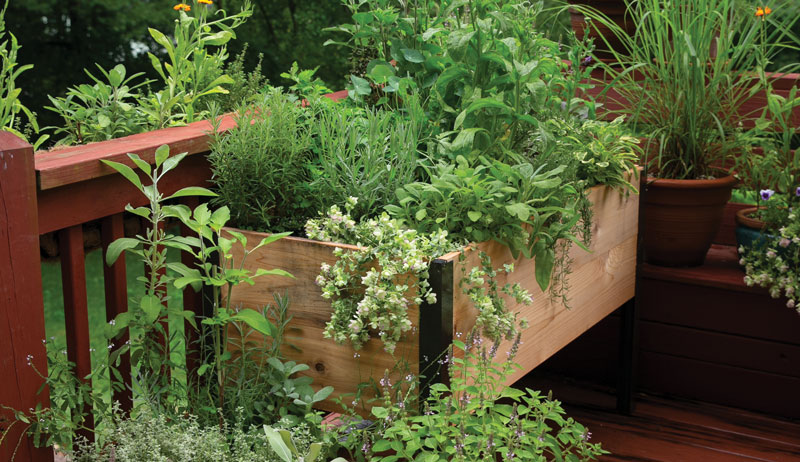
Wine and whiskey barrels offer charm, a considerable planting area, and superior water retention due to their size. Tall wooden planters (like the one pictured here) also fall into this category; these offer easy access for folks in wheelchairs or with limited mobility. Avoid pressure-treated wood as it contains toxins that leak into the soil.
Infusing fruit with alcohol is a delicious way to preserve the flavors of the season, as well as experiment with new flavor combinations. In this recipe, we’ll make a blueberry infused vodka, but there are countless options for fruit-flavored libations.
For the most part, all you need to infuse your own fruity flavored liquors are fresh fruit, alcohol of choice and a couple weeks (or months) of time for it to infuse. I prefer to use a mid-level, mid-priced alcohol for infusing with.
When making infused alcohol flavors, such as the following recipe for blueberry infused vodka, I generally stick to a rule of 1 cup of fruit for every 2 cups of alcohol.
Yield: 1 pint
Ingredients
1 cup fresh blueberries
2 cups vodka of choice (as needed)
Preparation
Wash and strain blueberries, and discard any bruised or flawed berries. Add blueberries to a clean pint jar.
Pour vodka over berries until the jar is filled. Wipe the rim of the jar with a clean towel. Then add the canning lid and tightly screw on the ring.
Keep your blueberry infusing vodka at room temperature and out of direct sunlight. We store ours in the cupboard with the rest of our liquor. As it infuses, the fruit will lose color or become pale. The alcohol will become colorful.
Allow the fruit to infuse with the alcohol for at least two weeks. The longer it infuses, the more flavor it will have.
Once infused, you can either leave the fruit in the alcohol, or strain it out. Your choice.
If you don’t want any bit of fruit in the infusion, you can strain it through cheesecloth or a coffee filter to get a cleaner end-product. Feel free to store the infused liquor in the refrigerator if you prefer a chilled spirit.
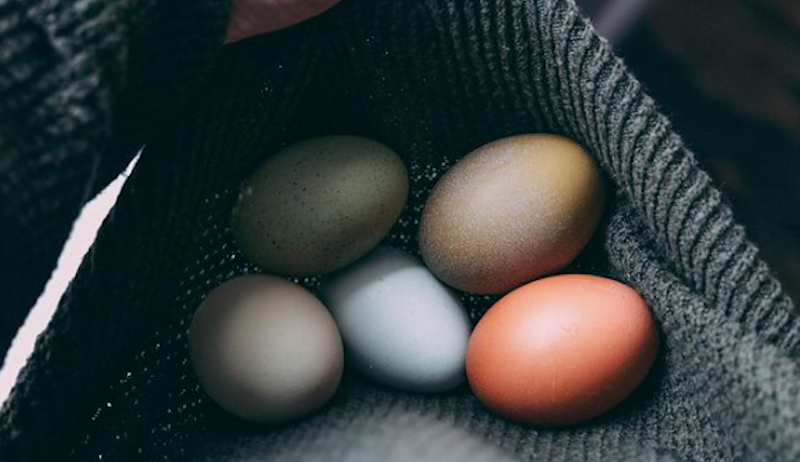
“We are fortunate to have some beautiful olives,” says self-described “crazy chicken lady” Britt, who runs Spring Road Farms in the Canadian province of Alberta alongside “resident handyman” Chad. “The depth of that color is beautiful.”
Chickens play a central role at Spring Road Farms, founded around six years ago. Originally situated on 7 acres of land, the venture will soon move to a larger 34-acre plot of forested land in the mountain foothills.
Taking a minute out from finalizing moving plans, Britt spoke to us about chicken behavior and her family’s deep farming roots. We also covered how their rescue pup, Rosco, gets along with the poultry ranks.
“My parents come from ranching and western roots,” says Britt. Her farming history, it turns out, spans generations of family. “My dad was a bareback and bull rider and is a large animal veterinarian. My mom grew up on a 45,000-acre cattle ranch.”
Those early farming roots subsequently expanded during the first stages of the COVID-19 pandemic. During this time, Britt and her family hatched out their first 20 chickens.
The next step in the Spring Road Farms journey: expanding over to a markedly larger plot of land.
“There are currently several grizzlies roaming the area of our farm. So being aware and cautious is very important,” says Britt. “We are looking forward to this next step in developing our farm and expanding the roots of our family.
“We aim to lean on the fruits of our labour and community to provide what we need.”
Britt says that chickens were chosen as an integral part of the venture due to being “a good entry-level species.” She adds that once they realized how unique and eye-catching the peep’s eggs were, they started an Instagram account focused on documenting their bounty.
Alongside the chickens, a 6-year-old rescue dog named Rosco forms a key part of the fabric of the farm.
“He is very social and was eager to befriend the chickens but quickly learned they weren’t as eager to befriend him,” says Britt, summing up their dynamic. “He is a great protector and is mostly interested in the treats the chickens get.”
Reflecting on her farm and family journey so far, Britt says that she takes joy from being able to “do it all together and seeing how we are able to bring our dreams to life. We are never bored. And the reward of growing and raising your own food is worth all the blood, sweat and tears.”