Categories
Animals Farm & Garden Health & Nutrition Poultry

Your Avian Influenza Concerns Addressed

Ever since the mainstream media finally began letting the general public know about the avian influenza (HPAI) epidemic, my social media and email have been flooded with questions from friends, family, and followers who raise poultry, know someone who does, or are simply very concerned about how this epidemic will affect the birds and other animals in their area.

Many of these people shared similar worries. So I’m addressing the 10 questions I received most frequently in the hopes of addressing any concerns you as readers may have.

Should I Euthanize/Sell My Chickens?

There is absolutely no need to get rid of your chicken flock because of HPAI. Domestic fowl can indeed contract this illness from wild birds. But you can take steps to help keep your chickens safe and healthy.

The US Department of Agriculture’s Animal and Plant Health Inspection Service (APHIS) offers plenty of biosecurity resources online to help you defend your flock.

Should I Kill Any Wild Birds I See in My Chicken Run?


The Federal Migratory Bird Treaty Act specifically prohibits the killing, capturing, selling, trading and transport of protected migratory bird species without prior authorization by the U.S. Fish and Wildlife Service. This includes disturbing wild bird nests, collecting feathers and eggs, and much more.

Federal law aside, killing wild birds in a manner that does not adversely affect your chickens is very difficult, not to mention time consuming. The best approach—which is unfortunately a costly one—is to prevent wild birds’ access to your chicken runs. Enclose your runs with quarter-inch mesh. The holes in any larger-gauge hardware mesh may not prevent small birds from getting through.

Should I Allow My Flock to Free Range?

If wild birds fly over or visit your property, it’s a strong possibility that wild-bird droppings can be found in your yard.

Avian influenza is transmitted primarily through the droppings, saliva and other bodily secretions of infected birds. So it would be in your flock’s best interest to keep your chickens confined rather than chance infection via free ranging.

Should I Allow My Pets to Roam Outdoors?

Many people wrote in concerned for their pets’ health during this crisis. According to the American Veterinary Medical Association,  it is uncommon for dogs and cats to contract HPAI. But it is indeed possible, especially if they come into direct contact with—or eat—an infected bird.

If you feel that your companion animal may have contracted avian influenza, isolate your pet at once and contact your veterinarian or your state veterinarian.


Read more: HPAI could strike your community this year. Here’s what to do.


Turkey/Duck Hunting Season Just Started. Should I Still Hunt?

Domestic turkeys are highly susceptible to avian influenza. Minnesota actually has had a surveillance program for AI in domestic turkeys for years.

But HPAI has never been found in wild turkeys.

Waterfowl, both domestic and wild, appear to be resistant to avian influenza, according to Dr. R.M. Fulton, DVM, a Diplomate of the American College of Poultry Veterinarians. Dr. Fulton notes that waterfowl may not become sick with avian influenza but do serve as a reservoir for the disease.

If you choose to hunt, avoid hunting waterfowl. And, to be safe, leave your hunting dogs at home.

I Found a Dead Bird in My Yard. What Should I Do?

Should you find a dead wild bird on your property, do not touch it. Mark its position, then contact either your state veterinarian, your state’s veterinary diagnostic lab (Google “veterinary diagnostic lab” and your state’s name), or the USDA at 866-536-7593.

Make sure that your pets stay inside until the dead bird has been collected for analysis.


My Neighbor Put out Bird Feeders. Should I Ask Him to Take Them Down?

This really depends on how well you get along with—and how close you live to—your neighbor. If avian influenza has been confirmed in your area (ie., your county or town) and you raise a backyard flock in a suburban setting (1/4-acre to 1/2-acre lots), you may wish to explain to your neighbor that the wild birds gathering at their feeder pose a health threat to your microflock.

Be aware that, even if your neighbor is amenable to your request, wild birds being fed by someone in another part of town may still fly over your yard. If you live in a rural zone, with acres of land between homesteads, your request might raise eyebrows or result in laughter … or worse.

Always bear in mind that you can only control what happens in your own yard (or try to).


Read more: Biosecurity helps keep hens healthy.


My Bluebirds Are Back! Can I Put out My Nestboxes?

As much as it pains me to say it, putting out birdhouses of any kind during this avian influenza epidemic is not a good idea, especially if you keep chickens. Birdhouses invite wild birds to settle on your property for an extended period. This means that there’s an increased probability of interaction between your birds and the wild ones.

Additionally, some species of wild birds—bluebirds, wrens, tree swallows and house sparrows—will fight for nestboxes. House sparrows will kill for it.

Given the 100 percent HPAI mortality rate for birds, birdhouses may very well turn into final resting places.

I Think My Chickens Are Sick. What Should I Do?

If your chickens exhibit diarrhea, signs of respiratory distress or unusual nervous reactions—or if you have found one or more of them dead—do not handle your birds or their feeders, waterers, nestboxes or eggs. Leave the entire flock (including the chickens that appear perfectly healthy) as is and contact either your state veterinarian or your state’s veterinary diagnostic.

If you are not following biosecurity measures (designated clothing and footwear for your poultry areas), be sure to remove your shoes before entering your home. Change your clothing immediately and disinfect your hands. Understand that if one of your sick or dead birds tests positive for avian influenza, your entire flock may need to be euthanized.

Can I Catch HPAI From My Chickens/Wild Birds?

It is considered rare for avian influenza to cross over to humans. To date, there has been no known case of HPAI H5 (the current strain) in humans in the United States.

According to Dr. Fulton, in order for the disease to cross over to humans, an HPAI strain has to have very specific receptors: alpha 2,3 sialosaccharide (extremely rare) and alpha 2,6 sialosaccharide (rare). Without these receptors present, HPAI cannot cross over.

Should a human manage to contract HPAI, the virus may cause conjunctivitis (pink eye) and such seasonal flu symptoms such as fever, coughing, sneezing and muscle aches. The known and more severe cases of human HPAI H5 infection in other countries resulted from direct physical contact with infected birds or visiting/working at a live poultry market.

In other words, as long as you practice proper biosecurity and thoroughly wash your hands after working with your flock or handling wild-bird feeders, your chances of contracting HPAI are extremely low.

Categories
Podcast

Episode 28: Cheryl Browne


On this episode of “Hobby Farms Presents: Growing Good,” host Lisa Munniksma talks with permaculturalist, urban farming educator and New York City garden designer, Cheryl Browne. A co-founder of the Black Permaculture Network, Browne helps people bring the outdoors in through her business, Urban Permie, connecting them with opportunities to experience nature and connect with more natural living.

Learn about what herbs you can grow indoors to enhance wellness in your life, how an effective permaculture lifestyle requires a generational mindset and what you can do to build a food forest of your own. Plus, hear about Cheryl’s tropical property in Costa Rica and her longterm goal of building a tropical fruit forest and much more!

Urban Permie

Cheryl Browne on Instagram

Black Permaculture Network

Categories
Animals Chickens 101 Farm & Garden Health & Nutrition Poultry Poultry Equipment

How To Try To Revive A Chick With Health Concerns

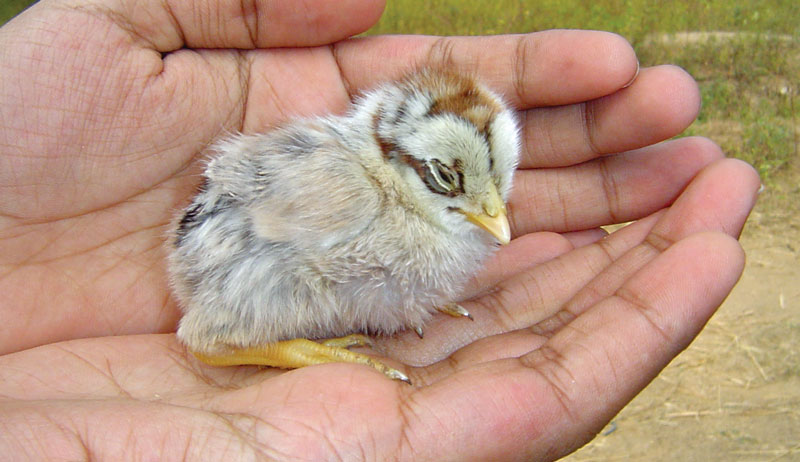
Chickens are relatively inexpensive, easy to care for and small compared to other livestock. This makes them perfect for backyard and urban chicken-keepers. Whether you get your birds through the mail or hatch them on site, it’s an exciting day when your new chicks arrive. 

Despite their small size and potential fragility, chicks tend to be hardy when provided with the right environment. However, sometimes a chick arrives weak and/or experiencing health concerns. Though this doesn’t mean you’re going to lose it, some loss is to be expected.

Use the common tips on the following pages to help revive those weak chicks.

Signs of a Potential Problem

Dana Zook is the northwest area livestock specialist for the Oklahoma Cooperative Extension Service, covering 14 counties. About six years ago, she began helping a lot of backyard chicken people. All her expertise, however, has been in the field and not through formal training.

She advises that a chick with good health should be bright-eyed, dry and fluffy, moving around and interested in their surroundings.

Depression

It’s not good if you have chicks that are depressed. “It’s kind of a humanizing word, but we use it a lot if you have sick animals,” Zook says.

“They’re just kind of lying there, not moving. If you have a chick off by itself, just lying there, this should always be a concern. They don’t have high energy, so they don’t want to move. They don’t care about eating. They don’t care about being warm or anything.”

Physical Inspection

Look at the vent to see if it’s dirty or if it or other parts of the chick’s body has a lot of manure stuck to it. Chicks should be relatively clean, so if there’s manure on them, it could be a sign of a problem with the chick or its environment.

Another area Zook advises you should look at carefully is the navel. Any issues with the navel could signal a serious problem.

chick chicks health
Moira McGhee

What Might Cause Weakness

If you purchase your chicks from someone else, you generally won’t know how the eggs were handled, what the hatching environment was like or how the chicks were cared for before being sent to you. This can make it difficult to know what might have caused a chick to arrive weakened.

Reputation Matters

The very first thing Zook tells people, whether they want to get eggs or chicks, is to get them from a reputable source. “Sick chicks early on can be indicative of a dirty environment either in the incubation stage, hatching stage or mailing stage,” she says.

“Getting chicks or eggs from a reputable person that’s NPIP [National Poultry Improvement Plan]-certified is important for keeping some diseases under control. It also keeps everyone on the same page as far as what’s going on in the industry from a health standpoint.”

Cleanliness Concerns

When you’re hatching your own eggs, the most important thing to provide is a clean environment before, during and after the hatching process. Weakness in a chick can stem from being hatched into a dirty environment that harbored bacteria.


Read more: Curious about hatching chicks with an incubator? Here are some tips for starting out.


Warmth Is Key

A primary requirement for newly hatched chicks is warmth. Without it, they might become weak and eventually die. Temperature regulation can be a real problem.

Baby chicks can’t regulate their own temperature. “A lot of people are surprised by that,” Zook says. “It’s important to educate yourself on the proper brooder temperature.

“If you have eggs in an incubator and they’re just about ready to hatch, understand the importance of temperature and humidity during this time. Have a thermometer so you can monitor temperature. It needs to be between 90 to 95 degrees for about a week after chicks hatch because they just have no way to keep themselves warm.”

Warm It Up

Janet Garman of Timber Creek Farm ( @timbercreekfarmer on Instagram) in Maryland has raised chickens of various breeds, including some rare breeds, for over 12 years. She’s written two books on chicken-keeping geared toward the first-time chicken owner, including Chickens From Scratch and 50 Do It Yourself Projects for Keeping Chickens.

She agrees that the primary health need of a chick after hatching is warmth.

“If hatched by a broody [hen], the chick will nestle under the momma while the other eggs hatch,” she says. “When hatched in an incubator, the best practice is to leave the chick in the incubator until most eggs have hatched. This prevents humidity levels from dropping and causing shrink-wrapped chicks.”

Cozy Brooder

Before removing chicks from the incubator, begin to warm the brooder. Garman prefers the warming plates that look like tables for chicks to huddle under. “The radiant heat is gentle and there’s little chance of them overheating because they can walk out of the warm area,” she says. 

If your chick becomes chilled due to lack of heat in the brooder, warm it immediately. Some chicken-keepers will use their body heat and tuck the chick into their shirt to improve the bird’s health.

“The important thing is to gradually raise the body temperature of the chick before attempting to give food or water,” Garman says. “A warm towel fresh from the dryer can help warm the chick, too. Keep a close eye on the chick as this is a critical time.”

Food or Boost

If a chick is warm but won’t eat, its health will decline as it grows weak from lack of food. Do your best to help it find the food and water. New chicks won’t know it’s there or even what it is.

Zook suggests feeding and watering them in something easy for them to use to start with, such as lids, trays and similar items. These work well for the first few days. Then you should switch them with proper equipment that’s easily cleaned and more functional.

chick chicks health
Moira McGhee
Use a Syringe

When a chick knows where the food is but still refuses to eat, chicks have a reflex response to their beak being tapped lightly with a syringe.

“Only offer food if the chick’s body temperature is warm,” Garman says. “You can then try a syringe of mushy soft food to see if it will eat. But don’t push food into the chick’s throat as it may not be able to swallow.”

Body Boost

Besides encouraging the weak chick to eat, you can also give it things to provide a temporary boost of energy. A short-term boost could be what it needs to bounce back and start eating.

Chicken keepers have found various items to provide this boost that worked for them in the past. Garman has had luck with some unusual substances. But she emphasizes that these weren’t based on veterinary advice and were purely anecdotal based on her own unique experience.

Short-term mixtures of protein and tasty carbohydrates such as molasses can deliver energy. “A few drops of molasses in a mixture of soft cat food or soaked chick feed might interest the little one,” Garman says.

“Fermented feed also provides higher nutrient availability. The caution with using canned cat food is that it should only be a once or twice remedy. It’s not recommended to feed cat food to chickens on a regular basis, as the protein levels in cat food are very high.” 

A Last Resort

Use of any unconventional treatment can vary. It comes with risks, but when you have a dying chick in your hands, sometimes a last-ditch effort can bring it around.

“I don’t give this as advice or as a cure,” Garman says. “The reason I say it is because when we have an ailing chick, we feel like we need to do something. The first thing has to be to warm the chick. If it comes around enough, giving it a few bites of a high-protein/high-carbohydrate mixture might put it on the road to recovery.”

Prevention Is the Preference

There aren’t any guaranteed methods of reviving weak chicks. What works on one might not work on another. Taking appropriate steps to prevent problems that might lead to weakness is always preferred over trying to revive chicks once they’ve become weak. 

Keep It Clean

Zook again emphasizes the importance of providing a clean environment when they’re hatched. It’s especially important after hatching because there’s going to be lots of manure. This can transmit diseases.

“Chicks eat lots of things,” she says. “They’re always pecking at different things, and they’ll take in some bacteria if you’re not keeping the environment clean. The water also must be cleaned out every day to keep manure out of it.”


Read more: What’s the best chick bedding? Well … it depends.


Bedding Options

A simple way to help keep the environment clean is to use a bedding source that’s really easy to change. Zook suggests using paper towels for the first three days. It’s something the chicks can safely stand on and it’s super easy to change out.

Puppy pads are also really good for the same reason. Newspapers aren’t ideal because chicks can slip on it and potentially cause leg issues.

Brooder Guard

One thing you can do to prevent them from getting too cold is having a brooder guard for the first couple of days.

“It’s very simple and keeps chicks closer to the heat source,” Zook says. “It kind of trains them. You can buy a brooder guard. But you can also just make a cardboard cutout that makes a smaller area and keeps the chicks a little closer.”

Sometimes Nothing Can Be Done

Setting up your chicks for success isn’t always possible when receiving them through the mail. Baby birds usually withstand traveling by mail just fine. But they can become infected during the mailing process or the temperature could drop too low during transit due to extreme weather or shipping delays.

You might be able to revive birds that arrive in a weakened state. Sometimes, however, nothing can be done.

“It’s important to remember that chicks are rather fragile beings,” Garman says. “They often thrive. But some aren’t strong enough to live. It’s a sad fact of chicken-keeping.

“Not to say that I don’t do what I can to help the weaker chicks get back on their feet. But some aren’t going to survive. If a chick won’t stay warm and swallow, forcing food and water will usually make things worse.

“The chick can easily aspirate and die from pneumonia.”

A Sad Fact of Farming

Like all livestock, sometimes chickens die. It’s a reality that chicken-keepers must prepare themselves for.

“You’re always going to have a percentage that just doesn’t do well,” Zook says. “You can look for indicators, but sometimes there’s not anything that tells you what’s wrong. This may be especially true if a majority of your chicks are doing fine and there’s just one that’s not.

“The reality is it might not live.”

For the most part, our chickens enjoy good health and long lives, starting in their chick days. Our flocks thrive and survive under our care. But a newborn chick with health problems—who isn’t standing, won’t eat and is weak—has a poor prognosis for survival.

Keeping it warm and safe from the pecking of flock members is a sweet, caring thing to do. And it may be all you can do. 

“I tend to be a realist and while I do mourn any loss of life,” Garman says. “I also realize that this is the way things are on a farm, and I try to keep it in perspective.”

This article originally appeared in the March/April 2022 issue of Chickens magazine.

Categories
Animals Farm & Garden Flock Talk Health & Nutrition Poultry Video

Video: How To Clip Your Chickens’ Wings

Clipping your chicken’s wings is an easy, annual chore that will help keep your chickens safe and out of trouble. It will also stop them from getting into, and possibly destroying, your gardens. 

Why Fly?

First, you might want to ask yourself why your chickens keep escaping from their designated area. Your chickens might not have enough space to explore and they simply need a bigger run. Or, they could be on the hunt for more food, or a fresh green area to scratch and find bugs or some tasty leaves to enjoy.

Try providing your chickens with enough food and space to keep them content. 

Sometimes, even chickens that are provided plenty of food and space will still try to jump their fence and seek adventure. Chickens are curious creatures and when they get bored, they’ll want to explore new areas.

But when we simply clip the feathers on one of our chickens’ wings, we can prevent this.


Read more: Chickens can develop bad habits, and it’s up to you to train them right.


Clipping Keeps Things Calm

The only equipment that we need for this chore is a pair of sharp scissors and perhaps a helper. The job will be a bit easier with a second set of hands to hold the chicken while you work, or to help to catch the chicken if it tries to escape!

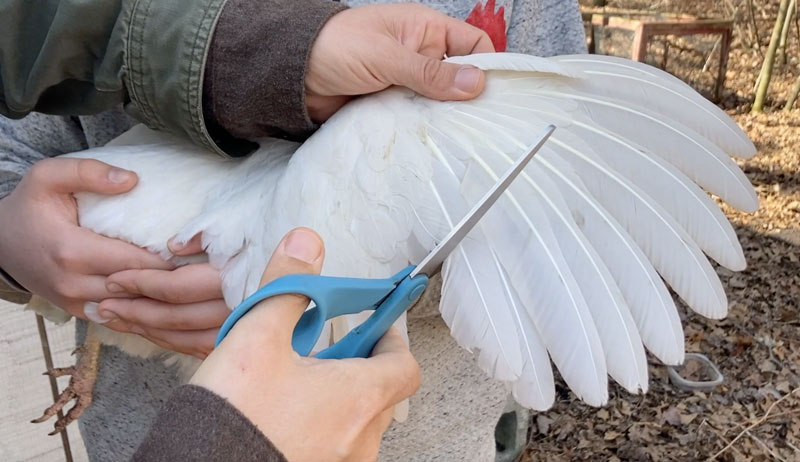
You’ll be trimming the larger, primary feathers on one of their wings. This causes the chicken’s flight to be off balance, making it far more difficult for them to fly over fences and other barriers. 

Snipping Is a Snap

It’s easier to clip chickens’ wings at dusk, after the birds have roosted for the night. You can just pick them up, trim the feathers and set them right back onto their roost. 

Simply fan the wing out to expose the feathers. Then cut along the primary feathers in a straight line, following the natural angle of the wing. Watch the video for a demonstration of the technique.

Chickens’ feathers are made of keratin, the same material as human hair and fingernails. Trimming their feather doesn’t hurt the chickens at all, so don’t worry!

A quick trim of their primary wing feathers and the chicken is ready to head back into the run with the rest of the birds.

Categories
Beginning Farmers Equipment Farm & Garden

4 Features To Consider When Buying Bungee Cords

I’m a fan of bungee cords. But then again, who isn’t? These simple stretchy cables can be put to use in many different ways, so it’s no surprise I have dozens around my farm.

If you haven’t had the good fortune to use bungee cords in the past, let’s take a moment to define what they are. A typical all-purpose bungee cord is an elastic cable or strap with a metal J hook or S hook installed on each end, though there’s another key variation we’ll address in a moment. Basically, you can think of a bungee cord as a broken rubber band with hooks on either end.

The elastic nature of a bungee cord is its greatest strength. You can stretch a bungee cord to a longer length (perhaps 25, 50 or even 75 percent more than its original length), and the bungee cord’s desire to return to its standard length creates tension you can use to tie down loads, secure objects together and more.

Hay bales, corral panels, loads of brush, potted trees.… I’ve transported all these and more using bungee cords to hold everything in place.

You’re probably convinced by now you need to invest in some bungee cords. But what features should you look for when shopping? Here are a few questions to keep in mind.

  1. How long is the bungee cord?

The length of a bungee cord is arguably the most important consideration. They can only stretch so far, so an 8-inch bungee cord isn’t going to stretch across a 4-foot-wide trailer.

Aim to use a bungee cord that’s somewhat (but not dramatically) shorter than the length you wish to span, so the bungee cord can stretch and provide suitable tension.

Unless you’re going to use bungeesfor one specific task only, you might want to have a variety of lengths on hand to cover all your possible projects and needs.


Read more: Baling hay? Is a square or round baler the right choice for your farm?


  1. How far can the bungee cord stretch?

Closely related to the length of a bungee cord is how far it can stretch. As we mentioned earlier, bungee cords can stretch significant distances, sometimes even doubling in length. When shopping for cords, see if the manufacturer lists how far they can safely stretch.

Of course, just because a 20-inch bungee cord can double in length doesn’t mean you should always stretch it to its limit. The tension in such cases will be high. If you need a bungee cord to span a 24-inch gap, an 18-inch or 20-inch bungee cord will be easier (and safer) to install and remove than a 14-inch bungee cord stretched practically to its breaking point.

  1. Is the bungee cord UV resistant?

Will your bungee cords spend a lot of time out in the sun? Maybe you’re tying down tarps and need to leave the cords in place for extended periods of time.

If you’re concerned about UV rays damaging the bungees, invest in cords that are UV resistant.

  1. Do you need ball bungee cords?

Ball bungee cords are a key variation you may want to consider. Ball bungee cords feature an elastic loop with the ends attached to a ball, making them perfect for tying down tarps, canopies, etc. The idea is to insert the loop of elastic through a grommet, wrap the elastic around part of the item you’re covering, and then loop the end over the ball.

Tie down enough grommets with ball bungees, and the tarp or canopy won’t easily leave its place.


Read more: Consider these 6 features when choosing safety glasses.


No matter which type of bungee cord you choose, safety should always be paramount. When a bungee cord is stretched and placed under tension, there’s always a chance it could break loose and cause injury. Be sure to wear safety glasses when using bungees, and don’t try to stretch them beyond their means.

Lastly, have fun! Because let’s face it, bungee cords are fun to use.

Categories
Animals Farm & Garden Large Animals

Documents Your Sheep Breeder Should Provide At Sale

Buying animals from a sheep breeder is a vulnerable situation that involves a lot of trust between the breeder and the seller. Between paying deposits before seeing the animal, trusting the animal is healthy and hoping it’s exactly what you are expecting, there can be several concerns that pop up. 

Any good sheep breeder should be prepared to give you everything you need at the time of the sale. Make sure you leave the sale with the following documents.

Registry Papers

These show the sheep is registered with the organization you want them to be a part of. This will also show the lineage of the sheep, so you can make sure there was no inbreeding.

Transfer Papers

These papers show the sheep will leave the place where they are registered and move to your farm. Both sheperds will need to sign these at the time of the sale.

When you send this paper to your registry, you will receive a new pedigree paper showing your ownership.


Read more: Sheep are, quite possibly, the ultimate small-farm ruminant.


Ear Tags

Scrapies tags should come from the original sheep owner. All sheep must have these ear tags per federal USDA law. Farm tags are optional and will most likely be included, unless you bought a lamb and made a specific request not to have a farm tag.

Medical Records

There are many things you can vaccinate a sheep against. All sheep need CDT (overeating disease) and tetanus shots. Vaccination happens between 6-8 weeks of age, so make sure you know if these have been given or not.

Medical records should also indicate if the lamb has been on any antibiotics. Older sheep will most likely not have all medical records from their lifetime. However, you will want to know when they have been wormed or treated with antibiotics in the last year.

Sales Receipt

Always make sure you obtain a sales receipt at the sale for your records. Many registries require these for transfers. 

Any reliable sheep breeder should be prepared to give you these documents, but make sure you ask ahead of time to make things run smoother. Other helpful documents for breeders to include for buyers are vaccination schedules, list of the sheep’s current diet, general facts for the breed, and a list of books or resources the seller deems trustworthy. 

Categories
Animals Farm & Garden Large Animals

The When, Where & Hows Of Pastured Pigs

Spring is here, and we’ll soon be over our heads in grass!  And we want to make the most of every bit of it, using our skills—and our animals—to put pasture to the best use on our farms and homesteads. 

Ruminants are out there turning grass into milk and meat already, but what about the pigs?  Let’s find the best ways we can use pigs to increase food (and fertility and sustainability) for the whole farm.

As omnivores, pigs can find a lot to eat on a diversified small farm or homestead.  In fact, if you let them, they’ll eat almost everything. So keeping them under control is the first step to managing pigs to benefit the whole farm.

Pasture Means Plants

It used to be common to see pigs pastured (or “pastured”) outside in large permanent pens or paddocks. We still see it sometimes here in Appalachia. It’s easy to spot, because the whole area will be completely bare of living plants. 

Bare soil in dry weather, churned mud in wet—a pig lot of this kind can’t supplement the pig’s diet. Nothing’s growing! And manure  dropped here doesn’t get taken up by plants or the soil. It ends up washing into the nearest stream or smelling up the neighborhood.

Good pasture practices and modern portable fencing have gone a long way to changing all that. With reels of polytwine and some step-in posts, we can use one or two strands of hot fence to hold adult pigs where we want them, for how long we want them there. 

Piglets are better controlled with electric netting.  In either case, paddock shifts can be made relatively easily.


Read more: You can use pigs to improve your soil and your landscape.


All in the Timing

Periods of fast growth—typically spring and fall here in Appalachia—can be ideal times for running the pigs across the pasture. 

When pastured pigs move quickly over an area of grass, weeds or brush, they can find food without devastating the landscape. Meanwhile, manure lands where it will be incorporated into the living soil.  Forage recovers quickly, allowing for more passes in a season. 

Running pigs directly after ruminants can be an especially good system. The ruminants get first choice of forage, while pigs following them can utilize even the ruminant manure.

Late fall, after most or all growth has stopped, can be a good time for a little pig pressure, too. After that all-grass steer moves to the freezer and you’re thinking about tidying up the pasture (all those tall, woody perennial weed stems look so  raggedy!) you might consider letting the pig do the job for you. 

Much of this plant matter has food value for a pig. In any case, that big, lumbering body is going to knock over a lot of what it doesn’t eat.

Of course, there are times when pig impact is not what we are looking for on our pastures.  When forage grows slowly, you may need to reserve grazing for the animals who need it most—the ruminants.  For these periods of high demand/low production, it may be time to bring the pasture to the pigs.  

Keeping soil impacts season-appropriate is vital.  Wet soil is easily churned up by a rooting pig. Any spot where pigs choose to wallow grows compacted and swampy. 

In any wet season, holding pigs off the pasture until soil firms up should take priority. 

Read more: Proper strategy makes planning and planting hog pastures easier and more efficient.


Cut & Carry

But wet weather doesn’t have to mean that your pastured pigs can’t be ‘grass-fed’!  Cutting plants and bringing them to the pig pen is a quick chore for us (and is only seasonal in any case). Moreover it lets us make more efficient use of what grows. 

We can mow areas of less choice or most abundant forage. On our farm that would be large patches of Japanese knotweed and  jewelweed (summer), or amaranth (it’s even called ‘pig weed’ around here’), and ragweed (fall), to name just a few. We then carry these plants to the pig pen, which works on weed control, pasture improvement and bacon-building all at the same time.

In the end, the choice to pasture or pen a pig isn’t a one-time decision.  Pig-rearing practices should vary with the fluctuation of season, forages and other pig food sources.  Nature never stops changing, and the homesteader should always be alert to make the most of what her farm can offer.  

Categories
Beginning Farmers Crops & Gardening Equipment Farm & Garden Farm Management Homesteading Permaculture

Operation Cycles For Market Garden Crop Succession

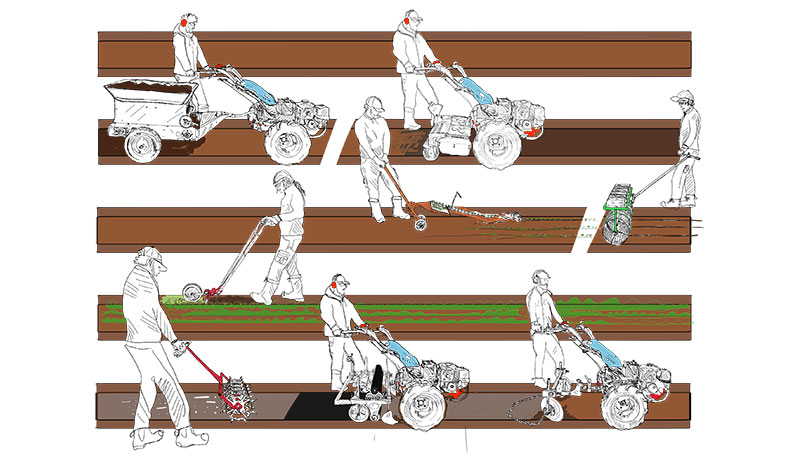
As a market grower, I have a string of in-season tasks to perform when moving from one crop succession to the next.  These operation cycles—such as bed reforming, seeding/planting, weed management and mulching management—should be assisted by the correct techniques, tools, equipment and supplies. 

An operation cycle should be understood as a series of tasks, supplies and equipment that mesh well within your crop planning. They also need to be completed within the timing needed for successful crop production.   

(See the image above for an illustration of the following 10 steps.)

1. Seasonal Application of Compost

I do this with a compost spreader, and/or I’ll mow and incorporate the cover crop with a flail mower and rear-tine tiller.  

2. Pre-Weeding

Pre-weeding occurs immediately following a compost application with handheld or mechanized tine weeders. 

3. Final Bed Preparation

I’ll prepare the final bed with a power harrow, which mixes in compost and firms the bed top without major tilling. 


Read more: The rotary plow is a powerfully multifunctional tool.


4. Row Management

I use Johnny’s seedbed roller to firms and mark straight rows. Next I’ll follow the task by seeding with a single-row push seeder (like Jang or Earthway) and/or a Paperpot transplanter for efficient crop succession. 

5. Weeding Paths & Bed tops

In market gardens, this task is commonly performed with hand tools rather than cultivation implements. Wheel hoes are commonly used to maintain paths, and collinear and stirrup hoes usually manage between rows.   

6. Reforming the Bed

Do this seasonally with a power ridger to improve the soil structure.   


Read more: Check out these tips for measuring and spacing raised garden beds.


7. Forming & Mulching

Form and mulch your bed tops with a bed shaper and mulch layer.  This reduces weed pressure, increases soil warmth for warm-loving crops like tomatoes, and holds moisture. Other mulching techniques include zipper beds and in-situ mulches.  

8. Dibbling

Dibble and transplant into mulch using a dibbler. 

9. Crop Protection & Irrigation

These two tasks are essential to market growing system. Row cover keeps unwanted pests out, and irrigation is important for crop productivity in dry seasons. 

10. Harvest, Processing & Storage  

Finally, I harvest and transport crops on a utility trailer for washing. Then I put them into the cold storage to await market day.  Grow on, 

Zach 

Zach’s upcoming book The Two-wheel Tractor Handbook will be out in fall 2022!

Categories
Farm & Garden Food Recipes

Recipe: Delectable Homemade Maple Sugar Candies

For the last six years, we have tapped the large silver maple tree in our backyard. We lived in our home for seven years before attempting to tap our trees. We always assumed that to make homemade maple syrup, we’d need numerous trees to collect sap from.

But our one large silver maple has a big enough circumference that we are able to install three spiles to collect from. From these three taps, we collect enough sap to boil down syrup to last us the entire year. Usually we can make enough to share with friends and family, too.  

The spring of 2020 was our personal best year for sap collection. The temperatures were perfect—below freezing overnight and above freezing during the day for about six weeks.

With our excess syrup, we decided to experiment. That’s when we first made these delicious and delicate maple candies.  

Since our homemade syrup is so coveted, we only make a small batch of candies. However, you can also make this recipe with purchased 100 percent pure grade A or grade B maple syrup.

The grade B syrup is darker and will offer more of a maple flavor. 


Read more: Start sugaring your own maple syrup!


Supplies & Ingredients 

  • 2 cups 100 percent pure grade A or grade B maple syrup 
  • Stainless steel pot with tall sides (I use a 5-quart pot) 
  • Candy thermometer 
  • Spatula 
  • Small silicone candy molds or a parchment paper lined cookie sheet  

maple candy candies

Directions 

In a large, tall-sided pot, bring the maple syrup to a boil. Boil until the candy thermometer reads 237 degrees F, stirring occasionally.

Once it reaches 237 degree F, remove from heat and cool to 175 degrees F, then quickly begin stirring until the syrup lightens in color. This will take a couple minutes.

As soon as it turns, quickly spoon the syrup into the candy molds, or pour it over a lined cookie sheet. The syrup will quickly harden, so time is of the essence.  

Once completely cooled, you can carefully remove candies from the molds. If using a cookie sheet, you can break up the cooled candy to bite-sized pieces and enjoy them that way.

Maple sugar candies should be stored in an airtight container. Enjoy within two months. 

Side Notes 

Make sure you test your candy thermometer for accuracy before beginning this project. 

For any hardened maple left over in the pan, you can stir and break up the mixture to create a crumble. This crumble can be used in coffee, tea, on top of ice cream, over muffins or pretty much anything your heart desires.  

Be careful not to splatter any hot syrup on yourself, as it’s incredibly hot.  

Do not leave the pot of boiling syrup unattended. It could boil over or burn. 

The goal candy temperature will change depending on altitude. Generally, you’ll want to reach 27 degrees F above boiling point of water where you located. 

Categories
Animals Beginning Farmers Farm & Garden Flock Talk Poultry

Mastering Turkey Massages With Gentile Acres

In February of 2020, Carol and Anthony Gentile of Tennessee’s Gentile Acres visited a local supermarket and gaped at the empty produce shelves they saw. “I recall seeing an elderly man sadly picking through the few potatoes that were left. And I remember thinking, wow, we are so reliant on what others produce for us!” says Carol.

Picking up on the food shortages and supply chain issues that the start of the COVID-19 pandemic heralded, the Gentiles decided to embrace the idea of self-sufficiency.

“We made the decision to sacrifice our mundane and stressful routine of work and paying bills and a rather unfulfilled life in exchange for big pay checks to a slower pace and a more modest lifestyle and a much happier and fulfilled life,” explains Carol of the decision to found Gentile Acres. “Our hearts are full!”

We spoke to Carol Gentile about focusing a homestead around turkeys and adding artichokes to your garden. We also got insider tips on the art of the turkey massage.

Happiness Is Being Surrounded by Turkeys

“Life hack: For true happiness, get a turkey!” says Gentile.

Forming a key part of Gentile Acres, the resident turkeys enjoy free run of the homestead’s 25 acres of land. “They enjoy eating all the bugs and fresh raspberries that grow on the property,” says Gentile.

“We go for daily walks with our birds. This was when we learned our turkeys were a lot like our dogs! They would follow us everywhere. We have special whistles for them to come for treats.”


Read more: Considering raising turkeys? Here’s how to get started!


Coming to Grips with Turkey Massages

Noticing that some of their turkeys possessed more affection than others, Gentile says she started to grant them turkey massages.

“They’ve learned to come to our feet and open their wings for some quick loving,” she says before adding a disclaimer: “Just be careful putting your face close to turkeys. No matter how loving they can be, they are known to strike at the eyes. We call them sour patch kids!”

Turkey Massage Pro Tips

“The best way to give a turkey massage is scratching and massaging right under their wings, back and thighs,” explains Gentile. “The closer you get to their back end, the more they will love you. Don’t be afraid to get a little rough. Some like it rough!”

Just know that turkey massages can grow addictive. “Once you start turkey massages you can never stop!” says Gentile. “They will follow you around and spread their wings squawking at you until you oblige.”


Read more: Mix up the poultry in your flock!


Adding Artichokes to Your Garden

If you take a look through Gentile Acres’s Instagram account, you’ll notice some particularly striking artichokes starring in the feed.

“Artichokes were once thought to be in the cactus family because of their beautiful flowers. But they’re actually a part of the thistle family,” says Gentile. “They are pretty much a no-to-minimal maintenance plant.”

When it comes to maximizing artichoke production, Gentile suggests giving them plenty of space to grow and also starting seeds off with a few cold nights for germination.

“They are so beautiful,” she adds. “I would purposely let some go to flower just to admire their beauty. They are large purple thistle-like flowers—garden magic at its finest!”

Growing into the Farming Life

“I never imagined myself—a city girl—to be cleaning chicken poop, playing in the dirt, ethically raising and harvesting our own meat, seed saving, canning and preserving, making our own soaps, farming and becoming more and more self reliant,” reflects Gentile as she looks back at the Gentile Acres journey so far.

“The relationship we share with our animals and the fruits and vegetables we grow is a truly intimate and rewarding experience,” she continues. “This is real life. This is what it means to be alive, to be connected to the earth and to the animals through love and respect. It is life … liberty. And this is happiness.”

Follow Gentile Acres at Instagram.