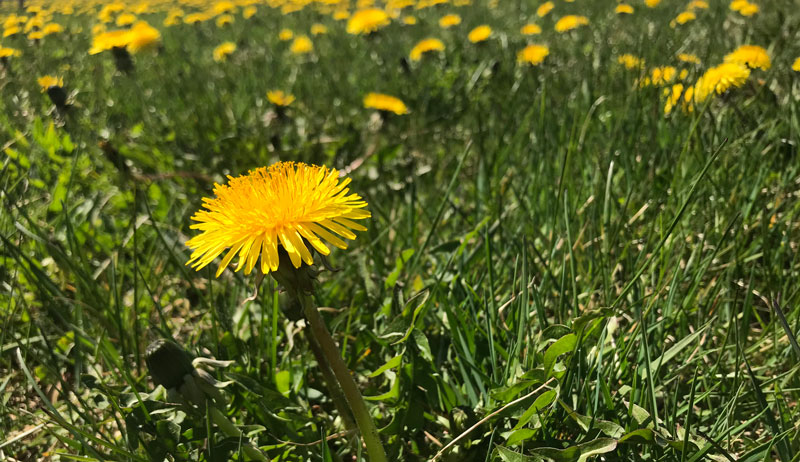
Although some landscapers and lawncare companies may beg to differ, dandelion is far more than just a pesky weed. This herb is a nutritious edible. It’s useful in the herbalist’s apothecary and, since it grows wild everywhere, it doesn’t take up any of your precious garden space!
The dandelion gets it common name from the French “dent de lion,” meaning tooth of the lion. The name describes the herb’s deeply jagged leaves. The bristled yellow flower is also reminiscent of a lion’s mane, further supporting this creative descriptor.
You can find the common dandelion, Taraxacum officinale, across most of North America. But the species is actually native to Europe and Asia and was introduced to this continent sometime in the early to mid-1600s. The flowers were widely cultivated by European settlers as a food crop as well as for medicinal applications.
Dandelion in the Kitchen
All parts of the dandelion plant are edible. Dandelions are rich in vitamins A, C and K and are a great source of iron, calcium, magnesium and B vitamins.
The young leaves possess a bitter flavor, and you can add them raw to salads or cook and eat them like spinach. Chop older and larger leaves to add to soups, or try including them in nutritious green smoothies.
Dandelion flowers can be enjoyed raw as well, but are exceptionally delicious when battered and fried! Using a tempura batter will give your dandelion fritters a light texture and crisp crunch without overpowering the flower’s delicate flavor.
Dandelion wine is a popular use for these golden flowers, too. It does take up to two weeks for the fermentation process and another 6 months for the wine to age. But the vintner’s patience is rewarded with a surprisingly sweet and decadent adult beverage.
Dandelion’s specific epithet, officinale, indicates the herb’s long use as a medicinal plant. Its use has been documented by the ancient Greece, Egyptians and has been utilized in traditional Chinese medicine for over a thousand years.
Dandelion is packed full of anti-oxidants and has been used internally for a wide range of ailments such as high blood pressure, inflammations and high cholesterol. Also a diuretic, the herb some suggest dandelion use as a tea in weight loss regimens.
Often times, medicinal applications call for use of dandelion roots, although once can certainly find value in the leaf as well. Dandelion root extract is a well-known tonic to support liver health.
The herb can also be used topically, when crafted into a salve or lotion, to heal minor cuts and scratches. Some also use it to relive itching caused by dry, irritated skin conditions.
Dandelions are perennial plants that prefer full sun and well-drained soil. They will, however, do just fine in partial sun and poor-quality soil. Dandelions will easily reseed themselves. But since their seeds get dispersed by the wind, it is nearly impossible to control their spread.
If you’d like to grow dandelions from seed, plant them four to six weeks before your last frost date. The seeds can also be sown any time in the fall or late winter of the previous year. Plant at a depth of approximately 1/4 inch. Then lightly cover the seeds, as they require sunlight to germinate.
The recommended spacing between plants is around 6 inches, but this is only crucial if you plan to harvest your dandelions for leaves or roots. The plants will need this space to fully develop.
You’ll find a number of dandelion cultivars available for the home garden. Some possess striking white or pink flowers, while others are grown for their substantial leaves.
Even if you decide that growing dandelions in the garden isn’t right for you, be sure to take the time to appreciate the beauty of these very beneficial wildflowers!
Amber from Spoiled Rotten Ranch grew up on a hobby farm. “We had ducks, chickens, sheep, goats, horses and quail,” she recalls. “Most of my best childhood memories are with the animals, hanging in the dirt.”
Discovering a grounded feeling from being around animals all day, Amber decided that she wanted to carry on that tradition in later life. So she started Spoiled Rotten Ranch. This southern California-based farm that began with the introduction of three goats.
We spoke to Amber about the Spoiled Rotten Ranch’s resident barnyard clown and how befriending crows can be beneficial to your poultry. We also got into the #tongueouttuesday social media trend.
When it comes to the personalities of the animals living at the Spoiled Rotten Ranch, Amber describes their rescue donkey Pico as the barnyard’s in-house joker.
“Pico is always up to something,” she explains. “He loves to bite on everything like a puppy. And he rears up on his hind legs to eat the low branches and loves to be the center of attention.
“He will try to bite my hammer when I’m doing repair work. He’s opened gates and he also wedged himself into a corner and couldn’t get out until I came to help. The list goes on!”
The Spoiled Rotten Ranch’s Instagram account regularly takes part in the popular #tongueouttuesday (or #tot) hashtag challenge. “I love the candid tongue out photos,” says Amber. “They make me smile. And I started to see that other people find humor in them too. So now it’s just our thing that I like to keep going.”
Amber adds that one of her goals is to “put a smile on as many faces as possible” and that tongue out Tuesdays have become “a great day to share our goofy sides.”
Crows are one of the more curious additions to the Spoiled Rotten Ranch. Amber describes them as “incredible birds” that are “extremely intelligent and misunderstood by a lot of people.”
At Spoiled Rotten Ranch, the visiting crows have become flock protectors. “They drive off hawks and falcons on a daily basis and have alerted us multiple times of coyotes on our property,” says Amber. “They hover above the coyotes and caw loudly enough that we have been able to run outside in time to save our flock.”
“Crows never forget a face,” she adds. “If you’re lucky enough to gain the trust of a crow, you’ve gained an amazing friend. We have a murder of crows that visit us daily and keep watch over our coop.”
Just like when growing up on a hobby farm as a child, Amber finds that being surrounded by animals all day at the Spoiled Rotten Ranch brings her an immense sense of wellbeing.
“Animals give us unconditional love,” she explains. “We have rescued broken-down, abused animals, and the best feeling is being able to give them a home.
“Our barn is therapy. If I ever have a bad day, I head out to the animals and brush a goat, hold a chicken, lead a horse or just sit in their company. They have a way of healing your heart and leaving you with a smile.”
Summing up the spirit of Spoiled Rotten Ranch, Amber adds, “Giving love and being loved is definitely the most rewarding part about having our little farm.”
I left last season’s bumper crop of birdhouse gourds out in the field to cure. Periodically, I ventured into the cold to turn each one, affording them equal exposure to the elements and the sun. With every freeze and thaw, more of their outer skins sloughed away.
As they naturally dried, they also became much more lightweight.
Before I knew it, they were ready to bring inside for their next transformation. In just a few steps, some of these gourds would be ready to house area birds. Whether you’ve grown your own supply or you get gourds from another grower, you can follow these instructions to turn a birdhouse gourd into a proper birdhouse.
The Right Gourd for a Birdhouse
The typical birdhouse (or bottle) gourd has a small top chamber and a larger bottom chamber. These two chambers are joined together by a narrow “neck.” For best results, you should choose a birdhouse gourd with a bottom chamber that’s at least 8 to 10 inches wide. (This is the section of your gourd that will accommodate nesting birds and their young.)
Your gourd should also be completely dried and cured. In other words? Its water content has had time to evaporate completely. The gourd’s outer layers of skin also should have fallen away to reveal its hard, inner shell.
If your gourd still has some of its exterior layers, you’ll need to remove these and carefully clean your gourd. Although Mother Nature did most of my cleaning work for me, I lightly scrubbed the surface of the gourd with dampened steel wool. (See image Step 1 in the image below.)
This removes any residual flaky patches and can help to even out very dark spots.
In my case, I happen to like a natural-looking birdhouse—dark splotches and all. But you can lighten surface stains by sanding them with fine-grit sandpaper. Laying your gourd out in bright sunlight will also serve to sun-bleach its exterior.
The Hole Story
In part, the size of the entrance hole in your gourd birdhouse dictates which types of cavity-nesting birds come calling. Hoping to attract black-capped chickadees, I used a 1 1/4-inch drill bit. (Many wrens also like this size.)
Want to attract purple martins or swallows? They prefer larger entryways. You’ll want to use a 2-inch bit for martins and a 1 1/2-inch bit for swallows.
Before I drilled the entrance hole, I held my gourd up by its stem to see how it wants to hang. I noticed that one side of the gourd’s lower cavity naturally faced up and forward. Working with the gourd’s tendency to hang this way, I chose this side to locate the entrance. You’ll want to drill your own entrance slightly above the center line on one side of your birdhouse gourd’s lower chamber. (See image Step 2, above.)
At this point, it’s simple to remove the seeds and remaining debris from inside the gourd. However, this is optional. I chose to remove this stuff, because I’ll be planting the saved seeds. (See image Step 3.)
It’s worth noting that most birds are perfectly willing to do this clean-up on their own.
For Steps 4 and 5, you’ll need a 1/8-inch drill bit. First, with the entrance hole facing you, note the location of the sides of the birdhouse. On both the left and right side, measure at least 1 inch below the top of the gourd. Drill one hole on the left side and another on the right. (See image Step 4.)
Along the bottom of the gourd, drill a series of three to five drainage holes. (See image Step 5.)
Next, straighten out an old coat hanger and snip a couple of inches of excess off of both ends. Then, feed the wire into one of the two holes that you drilled into the gourd’s top chamber. Continue pushing the wire so that it passes through the gourd and out of opposite hole. (See image Steps 6 and 7.)
Taking care not to break or crack the top of the gourd in the process, bend the wire ends together so that they form a hook or loop.
Finishing Touches
To help protect it, I chose to seal my birdhouse with clear acrylic spray. (See image Step 8.) You may want choose to prime and paint your gourd birdhouse instead—particularly if you intend to attract purple martins. (Purple martins seem to like clusters of cavity nests that are painted white.)
If you intend to house chickadees, hang your gourd birdhouse in a wooded area near a clearing. For martins and swallows, place birdhouses high up in the open.
Chickens are easily a gateway animal to homesteading. Most people starting farms begin with chickens, because they produce meat and eggs and are relatively easy to keep and breed.
Their expense is minimal compared to many other forms of livestock. And they provide numerous opportunities for profit.
Jake and Becky from White House on the Hill (YouTube and website) are well into their sixth year of hatching eggs and raising assorted fowl. They have over 50 birds in their main flock and over 25 in their bantam flock.
Their farm comprises 30 different breeds. In order to build his farm, Jake often uses Ebay to purchase and sell eggs. Below, he gives us four great reasons why he chooses to purchase eggs this way.
Jake is known for raising rare breeds of chickens, ducks and birds. As with any animal, rare and pure bred fowl bring exponentially more profit.
For buyers looking for these rare birds, Ebay is a great platform to buy eggs from anywhere in the world to start your desired flock.
White House on the Hill
Availability
Given the access to so many breeders, you can generally find eggs at all times during the year. Most birds don’t lay eggs for 12 months.
However, looking on Ebay opens up the resources exponentially. You can always find eggs from great farms.
Price
Eggs are more affordable to buy and ship than purchasing chicks. The market determines the prices.
If buyers clamor for a certain breed, it will cost more. But if you can find a chicken keeper who produces lots of eggs for what you want, it will most likely be less expensive than purchasing locally.
After purchasing eggs from all over the world, Jake trusts the sellers on Ebay. He has a few stories where he did not receive the eggs in the time allotted. Ebay, however, protected his purchase.
“Ebay does refund your money if you do not receive the eggs within six months of the sale,” explains Jake. That gives him confidence to bid on the site.
Jake has great tips on how to feel safe about your purchase. “Start by reading the reviews,” Jake recommends. “Ratings of 5 stars are great. Avoid new sellers with 1-2 stars or with little or no ratings.”
There are many great sellers on Ebay who have been in the business for a long time. You will know that from the amount of reviews.
“Look up the farm name,” he adds. Many sellers will have a farm name you can google and check out their website. This step always instills confidence for Jake when he can see their personal site.
Finally, he suggests, “Look at the pictures (they use for advertising) to make sure they are not stolen.” This step ensures it is not a scammer. A quick way to do this is to Google the breed you are shopping for to make sure it is not an image that pops up quickly in an image search.
White House on the Hill
Once your sale is complete and your eggs arrive, Jake recommends you:
Open the package and unwrap each egg inspecting for any damage.
Let the eggs “rest” for 12-24 hours. The pointy side should be down or on its side, depending on how it will lay in the incubator.
If everything looks correct, begin the incubation process.
White House on the Hill on YouTube is an excellent resource for watching Jake’s process of researching, buying, preparing, incubating and raising birds from eggs. Also check out his site, where he also sells eggs if you are looking for any breeds he has started raising.
Have you ever wondered about growing grain but were discouraged by visions of combines and gravity wagons? Don’t be. Though typically produced by large-scale field production, grain crops can be grown successfully on a much smaller scale.
The key is identifying the right crop(s) for your homestead.
A Grain, By Any Other Name
Cereal grain crops are members of the grass (Poaceae) family that are cultivated for their seed in large quantities as dietary staples. These dry grains include corn, wheat, rice, sorghum and more. However, other seed crops of similar importance aren’t members of the grass family.
Pulses (also dry beans or dry grain legumes) are bean (Fabaceae) family members and include cowpeas, favas, garbanzos, soybeans and numerous others.
You’ll also find grain crops termed pseudocereals or broadleafs. The three principle ones are buckwheat (family Polygonaceae), quinoa and amaranth (the latter two both of the Amaranthaceae family).
Though not strict cereal grains, the value of these two groups as foodstuffs and as plants that fill agricultural niches different from those of the true grains are why they’re certainly deserving of attention on the homestead and are included here.
Jennifer Princ/Shutterstock
Why Try?
Grains produce some of the greatest quantities of calories and protein possible in the garden. Grains (except corn) will withstand low soil fertility levels better than vegetables. This is valuable if it allows you to successfully produce foodstuffs while working to improve the quality of your soil.
At the same time, they’ll improve your quality of eating. Freshly ground grain is a truly superior product.
Different grains have various agricultural benefits to their characters. Pulses will add nitrogen to the soil. True cereals return much of what they took from the soil to it as soil-building biomass.
Another important aspect of grains is they can feed your livestock as well as your family, and not just with their seed. Corn and sorghum leaves are frequently used as cattle fodder.
Additionally, grain storability matters. While other harvests from the homestead need suitably preservation (via canning, dehydrating, etc.), you can store properly harvested grain simply for a comparatively long time.
Finally, there are many situations when grain crops need not replace produce production on your homestead. Rather, you can use them to complement and enhance it.
Utilizing intercropping—corn, beans and squash, for example—and double cropping (following an early vegetable crop with pulses or buckwheat; planting a late summer vegetable after you have harvested overwintered barley, rye or wheat; etc.) are excellent ways to add yield to each square foot and variety to your overall harvest.
Let’s start at the beginning. You will hear that grain crops can be broadcast planted. But for the homestead, you’ll want neat rows.
Weed control, intercropping, harvesting—many aspects of grain production are made easier when you drill seed into a block of closely spaced rows. A hand seeder used for vegetable seeds will work very well. You must, however, select—and make note of!—the plates you use.
Beet/chard/spinach plate(s) are the right place to begin, using seed size as your guide.
Weed Control
When growing grains in a small space, controlling the weeds that can affect your final yield becomes all-important. In addition to row cultivation, you can use management practices to reduce weed pressure. For example, grow grain crops that germinate and grow quickly (such as buckwheat and corn) where weed issues may occur. They will better outcompete them.
Slow-growing crops, such as wheat, are less able to compete. So only plant these into areas with in-hand weed population. This is where alternating vegetable and grain crops (such as a winter crop planted to follow a well-managed vegetable plot) is particularly effective.
Rye offers a special use in weed control, too. The grain has an allelopathic ability to mitigate weed germination and growth, and you can use it as a green manure to clear the way for other crops.
Additionally, self-sufficiency pioneer Will Bonsall mulches his grain crops with chopped leaves, radical though it may sound!
Varieties
You need to examine grain varieties closely before choosing so you select ones suitable for your climate and needs. Plus, you need to get your timing correct.
Early planting is good for cereal grains—often the earlier, the better. (They’re hardy seeds, much more so than most vegetables.) They are very day-length sensitive, meaning that once the days begin to shorten they’ll want to produce seed, and the larger they have grown by this point the better positioned they’ll be.
Some quinoas and other amaranths are affected by day length as well. Both are very hardy and should also be planted as soon as possible.
Additionally, as with vegetables, you need to consider the days-to-maturity factor. This will often impact any pulse planting you may do, as DTMs will vary greatly with variety. Pulses also need warmed soil when planted, making early planting challenging.
Important Terms
As you sift through the world of grain growing, you’ll encounter words you may not know but will need to understand. For example, open-pollinated refers to seeds that will produce plants that produce seed roughly identical to the originals. Therefore, you can save seed from such plants to grow another crop.
This is not the case with hybridseed.
Tillers are lateral shoots at the base of a stem which can root and send up stems of their own, each with grain. Grasses will tiller, which influences the spacing of your plants as you balance the yield tradeoff of closer spacing/more individual plants/few tillers and wider spacing/fewer individual plants/more tillers.
Lodging is when the stalks of a standing crop fall over. It’s very important as it can make the job of harvesting difficult to impossible. However, it’s more easily dealt with when harvesting by hand as long as the quality of the seed has not been compromised by its proximity to the ground (i.e., made damp or overly dirty).
The hull is the outer covering of a seed, while threshing is the separation of seed from plant. Tenacious hulls can add to the challenge of getting grains ready to eat. Those of barley and oats are notably stubborn—which is why there are hull-less varieties—and buckwheat hulls are challenging also.
Conversely, sorghum and quinoa hulls are easily removed, while amaranths have none. Nor are all grains threshed with the same ease, with wheat—though not all of its ancient brethren—and rye being the easiest.
Watch for all of these words as you further examine grains and varieties.
kostrez/Shutterstock
A Sundry of Seeds
How much grain do you have to grow? Well, to give you an idea, you can reasonably expect to harvest one bushel of wheat from a 10-by-109-foot plot. And a bushel of wheat will make about 50 single-pound loaves of bread.
But that is just wheat. What other grains should you raise?
Corn or Maize (Zea mays)
If you want to ease your way into the world of grains, corn production is the way to go. The culturing of dent corn is (not surprisingly) like that of sweet corn. You are simply harvesting at a different stage of growth.
It offers generous yields when compared to other grains, and harvesting and processing ears of corn is also quite easy by comparison. Corn requires more fertile soil than the crops that follow, so bear that in mind.
The first grain most Westerners think of, wheat is a crop that grows (and threshes!) without much fuss. And it offers choices.
Wheat can be hard (high gluten) or soft (high starch), red or white, winter or spring, bearded or not, allowing you to select what you need. Other species of wheat that have their own characters (and often perform more reliably in low-input systems) include spelt (T. spelta), einkorn (T. monococcum), emmer (T. dicoccum) and Khorasan (T. turanicum).
Pulses (Fabaceae family, from a number of different genera)
Pulses are richer in protein than true grains and also contain substantial amounts of carbohydrates and calories. They grow best when given ample moisture. Though they don’t yield as heavily, pulse pods offer easier harvesting than grains.
Pseudocereals
Buckwheat (Fagopyrum esculentum), amaranth (Amaranthus spp.) and quinoa (Chenopodium quinoa) all offer easy threshing, and more. Amaranth plants possess edible leaves. Quinoa is high in protein, while buckwheat is noted as an exceptionally nutritious grain and is especially high in lysine, an essential amino acid.
But they have their drawbacks, too.Buckwheat stems are quite brittle by harvest time and can perform their own version of lodging. Quinoa seeds are coated in saponin, making them unpalatable until washed. And collectively the seeds of pseudocereals don’t ripen on the plant all at once but in a staggered fashion, making your harvest time more subjective.
Sorghum (Sorghum bicolor)
Though somewhat lesser known, grain sorghum (often called milo) is especially worthwhile for the homesteader. Almost equal to corn in nutrient value (and with a similar plant appearance, though lacking ears), it will out produce it in dry climates. However, sorghum will struggle in humid conditions.
Yellow endosperm varieties are best for human, chicken and cattle consumption. Chickens also appreciate the grain harvested from sweet sorghum, the varieties from which sorghum syrup is squeezed from the canes.
Oats (Avena sativa)
Oats have the highest protein content of the true grains and are fairly equivalent with wheat in all-around nutrition. Liked by a multitude of animals (cattle, horses, sheep, rabbits and chickens), oats—as noted by Gene Logsdon, author of Small-Scale Grain Raising—offer a great way to prevent yourself from planting an unsuccessfully early vegetable garden!
Rye (Secale cereale)
While not high-yielding or particularly nutritious, rye germinates and grows well in very cool weather and is less demanding of soil nutrients than other grains.
Barley (Hordeum vulgare)
Highly adaptable, you can find a barley to grow almost anywhere. Available in many varieties of six-row and two-row (seed rows in the grain head) types, the intended use for your barley will influence the variety you grow. It can be grown for excellent animal feed as well as for human consumption for which it can be eaten whole, ground into flour or malted.
True cereals, pulses and pseudocereals dovetail together in crop rotations as well as the human diet, promoting soil and human health. Extremely versatile, they offer a harvested food for this year and seed for the next, all in one motion.
Whether ground for flour, soaked as porridge or used whole in soup, you should give homegrown grains a seat at the table and a plot in the garden.
More Information
Germ of an Idea
Grain crops are for more than flour. Many have a variety of uses.
Sweeping Clean
Sorghum can be divided into a third category commonly known as broomcorn (and is either S. bicolor or S. vulgare). The seeds are edible, but more commonly, stalk and seeds are a popular autumn decoration. And stripping the plant of seeds leaves you with the beginnings of a broom!
Flashy Forms
Though grain varieties grown for food can be fairly attractive in their own right, you can try varieties that provide even greater eye candy and are still edible. Days to maturity permitting, try Utrecht Blue wheat, Glass Gem corn and Cherry Vanilla quinoa, just to name a few.
Get Hopping … with Popping!
Yes, growing grains can mean growing popcorn. And note that for something different (and tasty), many people will also pop barley, sorghum, buckwheat and quinoa.
Sprout Party
You need not consume your grains as flour alone. Several seeds, including wheat, its related species and a variety of beans, are used to produce sprouts, most popularly for salads.
But don’t keep them to yourself. Sprouted barley, oats and wheat are often fed to animals, providing them more nutrition than the grain alone (as is the case for humans).
Bee Food
Flowering buckwheat and quinoa are very appealing to honeybees and native pollinators (including butterflies), another incentive to grow them.
Back to Earth-ers
Grains as cover crops and green manures for protecting soil that would otherwise be exposed to weathering and being returned to the soil (with an accumulation of nutrients and biomass) are roles buckwheat, oats and rye often step into. For these plantings, your harvest isn’t grain but health for the soil.
Straw Poll?
You will respond positively! Grain is only a portion of the harvest from the true cereals. There is also straw, but beware. Some varieties are intended to not produce a significant straw harvest. Straw can be used as garden mulch, livestock fodder and bedding, even for …
Straw Craft!
Many nations have traditional crafts that utilize straw. Whether it’s the British wheat braid, the German oat straw stars and snowflakes for Christmas, or the Swedish Yule goat, straw crafting is worth a look.
Read More
For more extensive, in-depth reading about grain growing,
check out the following books:
Small-Scale Grain Raisingby Gene Logsdon, especially if you’re interested in slightly larger small-scale and/or have animals as part of your homestead equation
Let’s face it—we don’t always use precisely the right names when referring to common farm tools. We often say shovel when we mean spade and vice versa. Or we invent our own colloquial terms. I sometimes refer to my pruning loppers as choppers because they’re so good at chopping through plants and tree branches.
Speaking of pruning loppers … what exactly are they? And how are they different from pruning shears. Are they one and the same?
If you’ve ever asked these questions, then read on. We’re going to explain the definitions of pruning shears and pruning loppers. Even better, we’re going to explore their pros and cons so you know which will suit your pruning needs.
Pruning shears and pruning loppers are distinctly different tools with a common goal: pruning plants.
Perhaps you’re removing sucker branches from an apple tree, or shortening vigorous limbs on a pear tree. Or maybe you’re cutting down intrusive sapling trees on the edges of your farm fields. For all these needs and more, pruning shears and pruning loppers are great tools.
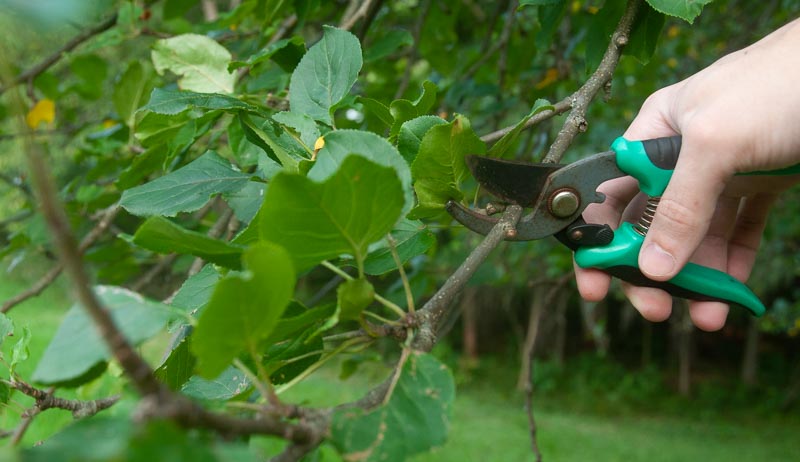
The blades of pruning shears and pruning loppers are similar. Bypass types use scissor-like action, with a primary cutting blade slicing past a lower jaw for a clean cut. Anvil types utilize a more aggressive approach, with a cutting blade that presses against an anvil for more of a crushing cut.
Where pruning shears and pruning loppers differ is in size. Pruning shears (also known as plain pruners) feature small blades and short handles. They’re meant to be held in one hand and operated by squeezing the handles together.
Pruning loppers, in contrast, feature larger blades and lengthy handles—usually around 1 1/2 to 2 1/2 feet long, give or take. You need both hands to operate them effectively.
What are advantages of pruning shears vs. loppers?
Having used both pruning shears and loppers extensively, I have some thoughts on the pros and cons of each.
One of the main advantages offered by pruning shears is their one-handed operation. I find this fast and convenient for making lots of quick cuts (say, when removing dead stems from perennial plants or removing suckers from a fruit tree). It frees up one hand for gathering the branches and stems as I cut them, saving me from picking them up later.
Pruning shears are also less tiresome to use than pruning shears. And they can easily operate within a crowded tangle of branches, where pruning loppers might lack enough room to open and close properly.
But pruning shears are really only suitable for pruning thin branches and stems—no more than 1/2 to 3/4 inch or so.
For heavy-duty pruning of branches up to 2 inches thick, you need loppers. Their large blades open wide, and their long handles afford more leverage for cutting through tough wood.
The two-handed operation of loppers is less convenient when making lots of quick cuts, because you have to let the cut-off branches and stems fall where they may. But the power you gain makes loppers a great choice for removing larger limbs from trees.
Do I need pruning shears or loppers?
You might wonder whether you’re better off with a pair of pruning shears or loppers. Why not get both? They excel in different areas and can save time and effort when put to appropriate use. So if you have both on hand, you’ll always have the right tool for the right job.
Bovines have an amazing ability to turn relatively undigestable grass, hay and other roughage into nutrients and energy. But they can’t claim all the credit. Their rumen—the enormous (50-gallon) fermentation vat that breaks down what they eat—houses billions of bacteria, yeast and protozoa.
These microbes are the real workhorses of digestion, using unique chemical reactions to turn tough cellulose into volatile fatty acids that the cow uses for energy. Talk about teamwork!
When a cow becomes sick, these precious rumen microbes can get sick, too, and even die.Understandably, this has a negative impact on the cow’s digestion.
Ruminal Transplant
One remedy to help a sick cow get back on track is a ruminal transplant. This is where new, healthy microbes from another cow are given to the sick one. This happens with the help of an animal called a fistulated cow.
Rumen fistulation is a relatively simple surgery. A healthy animal, typically a large dairy cow, received local anesthetic. Then a rubber portal roughly the size of a dinner plate is inserted into her left flank with a cap.
Once inserted, this fistula is permanent and painless and allows for direct access to fresh rumen contents. Simply remove the fistula’s cap, don a long plastic glove and reach in. Immediately, you’ll note the tropical atmosphere. After all, you’re now reaching inside a living creature.
You’ll also notice how dynamic the rumen is. It regularly contracts and churns its contents, sort of like a slow-moving washing machine. Reaching in, you’ll soon encounter half-digested, soggy grass and hay. This is chock-full of precious microbes.
To help a sick cow, you can remove large handfuls of rumen contents. Place this sloppy soup into a plastic bag, keep it warm and quickly transfer it via stomach tube to the sick animal. This transplant of healthy microbes will settle into their new home and quickly repopulate the barren sick rumen. In this way, it helps get the sick cow back to a normal digestive balance.
So where do you find a fistulated cow? Veterinary schools certainly have one. If you live near a large animal veterinary clinic, they may have one, too. Some very large dairies also have one.
Calling your local dairy vet or agricultural extension agent can help you locate one.
Fistulated cows tend to live a relatively cushy life. They aren’t bred or milked. Eating is their primarily job. And if you’re wondering if such a cow ever runs out of rumen contents, your arm is your gauge.
Finding yourself digging deep? Just offer her more hay. Her rumen levels should be up by the next morning. And as for accidentally spreading “bad” gut microbes, it’s all in numbers. The vast majority of gut microbes in a healthy cow are good, keeping the bad ones in check.
Another amazing thing about fistulated cows is that their ingesta can be used to help other ruminant species, too. Goats and sheep in need of some microbial boosts for their guts can take a dose or two from a fistulated cow. Sick alpacas and llamas can benefit as well. One fistulated cow in a geographical area often ends up helping animals from different counties and sometimes even different states.
Holey cow!
This article originally appeared in the January/February 2022 issue of Hobby Farms magazine.
Whether you’re just toying with the idea of starting your own cow herd or you’re actually ready to buy a bull, picking the right one for the job can seem a bit daunting when you first crack open the bull catalog. The array of numbers and similar looking animals can seem overwhelming if you don’t have any clue of what to look at first or how to decipher the abbreviations.
In this article, we’ll sit down with a local rancher (and my brother-in-law), Kordell Krispense, to discuss a few of the traits he considers to be most important when scouting for his next herd bull.
Consider Your Herd Needs When Buying a Bull
Before you begin looking for a potential new bull, you’ll want to have already planned out which direction it is that you want your herd to grow towards. What are your priorities? Do you want to focus more on the carcass traits (such as quality of marbling in the meat, size of the ribeye area, etc.) or the overall growth of the animals, their maternal traits, etc.?
This will play an important part in deciding what bull will suit your herd the best. Today we’ll do a quick rundown of a few traits covered in bull catalogs and the abbreviations used.
Calving Ease Direct (CED)
When looking for a bull to use with his own herd, the first trait Kordell studies among the prospective bulls is the calving ease direct (CED is the abbreviation used in the catalogs). This refers to how many unassisted births from first-calf heifers the bull has been able to produce.
This trait is especially important if you’re buying a bull with the intention of breeding it to the heifers in your herd and not cows. Since they’ve never had a calf before, a heifer’s birthing canal hasn’t been stretched yet. If the bull produces larger calves, it can make for a much harder (and even dangerous) delivery.
This is why you look for a bull that produces smaller calves when planning to breed to heifers.
This would be the bull’s actual weight when he was born. This will help give an indication of what his calves will weigh. If he was a larger calf, he could produce larger offspring.
Docility (DOC)
It is important that the bull you consider buying is calm and easy to handle. The docility number in the catalog predicts the difference in temperament between the bull’s offspring and the offspring of other bulls.
The way each animal is scored is based off of how they behave as they enter, are contained in, and exit a chute. This is generally recorded around the time that they were a weanling or yearling.
Carcass Weight (CW)
Carcass weight would refer to the approximate weight of the bull’s offspring’s hot carcass. Hot carcass weight (HCW) is the weight of a carcass (unchilled) after removal of the head, hide and internal organs.
Carcass Traits (CT) and Ribeye Area (RE)
Carcass traits covers different things including:
quality of the marbling in the meat
size of the ribeye area (mentioned below)
different characteristics of each bull
The RE trait specifically expresses the difference in size of the rib-eye area of the bull’s offspring as compared to the offspring of other bulls.
Heifer Pregnancy (HP)
The last trait Kordell specifically pointed out was heifer pregnancy. This is a way that the buyer can select a bull that has generally produced daughters that became pregnant as first-calf heifers during a normal breeding season.
After you’ve looked through the catalog thoroughly and decided there is a bull that interests you, it’s time to head to the sale. Make sure you allow for plenty of time before the start of the sale to walk through the pens and look at any prospective bulls.
When you walk into the pen of a bull, check his docility and watch how he responds to you. Does he get snorty and have an attitude? Does he act aggressive?
Look closely at the bull’s feet. He should have a nice, thick foot. Watch out for long, curled toes or crooked feet. Poor foot confirmation and issues can be passed on to other offspring and lead to future problems and even lameness.
As basic as it might sound, look at the bull’s overall eye appeal. Numbers are important, but his looks can matter too. He should have two good eyes (check for any spots), a nice square butt, heavy shoulders, straight legs and a flat back.
Take your time and do the research before you jump into buying a bull. They require a big commitment in maintenance and upkeep. You’ll also need a place to keep them and equipment to treat (such as a chute and working facilities) or move them (like a stock trailer).
Up a broad “holler” in eastern Ohio, tucked into the foothills of the Appalachian Mountains, an old farm returns a life of active farming. Established perennial crops such as grapevines and fruit trees send up new growth.
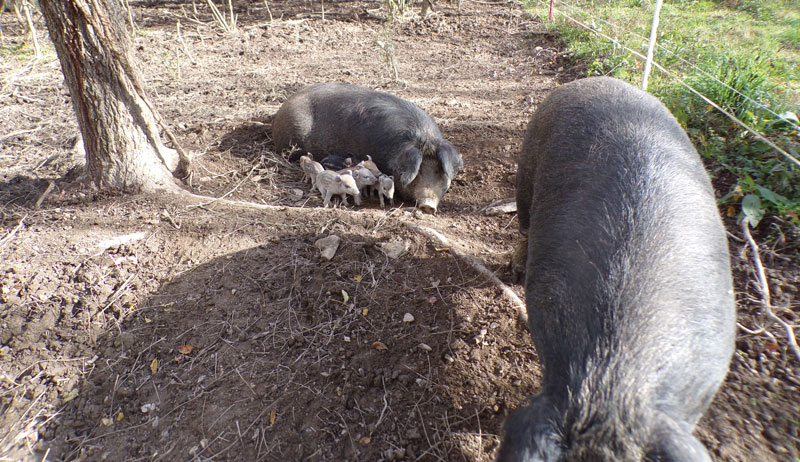
Mangalitsa and Red Wattle/Hampshire-cross hogs root under oak and black walnut trees. Jersey and Kerry cows draw a pattern of grazed paddocks over long-neglected pastures. Katahdin sheep and Nubian goats browse invasive shrubs. Hens forage for insects and spread manure piles.
The Pié family Dave and Anna and their three small children— tend the animals and cultivate an orchard, vineyard and garden. They even school at home.
And they’ve been here less than two years.
Literal Dreams
How do two, young, successful, upwardly-mobile professionals with a house in Philadelphia, Pennsylvania, and a small-but-growing family suddenly find themselves on 73 acres in Appalachia with nine cows, about 15 pigs, a growing flock of sheep and goats, and goodness-knows-how-many chickens, ducks and turkeys?
A dream. Not a daydream, but a genuine, see-it-in-your-sleep dream.
“My father died in March of 2019,” Dave says. A dedicated work-before-play, savings-in-the-bank financial advisor from St. Clairesville, Ohio, Dave’s father seldom allowed himself time off, looking forward always to a comfortable retirement. Lung cancer got him first. At age 63, he was gone.
“I knew at his funeral that something needed to change,” Dave says. “I thought, ‘We’re out of here.’”
But back in Philadelphia, their successful careers kept them busy. Things went on much as usual. Until one night, there came the dream. In the midst of a deep sleep, Dave heard his father say to him, “Spend less time pushing the plow and more time blooming.” Build happiness into your daily life now, the dream seemed to be saying. Don’t put it off for a future that might never come.
The young family began making plans to return to Ohio.
Headed Home
As we sat together on the patio behind their century-old farmhouse, Dave and Anna’s three daughters—Gemma, 4; Loretta, 2; and Eva, not yet 1—play in the grass next to a paddock of pastured chickens.
Sheep and cows graze nearby. Loretta brings her father a small frog.
Dave’s career as head distiller for New Liberty Distillery in Pennsylvania might seem a long way from cows and chickens. But it was probably the gateway drug that began turning this biochemist into a farmer.
After all, making hooch is just a form of “agricultural processing,” Dave says. And his job of sourcing grains from local small farms put agriculture on his radar. He began to see the smaller, artisanal farms he worked with as a new way to relate to the natural world.
From Dream to Reality
Interest piqued, he started reading books and watching documentaries on food, farming life and farm legislation. Dave learned more about just what we eat, where it really comes from and who pays. He read Joel Salatin’s Everything I Want to Do is Illegal. He watched Food, Inc.
Hunting deer and butchering his own game when he was in high school had given him familiarity and comfort with the idea of natural food sources. Now his investigations made him wonder about the safety and security of his family’s commercial food diet. All of these experiences initiated a train of thought that came to fruition in that moment at his father’s wake when Dave realized: “We’re out of here.”
Anna was ready and willing. Unlike Dave, she had grown up in the country. “Not on a real farm,” she says, but a rural household with livestock—goats, chickens, horses. She loved the animals and her surroundings, but had a nagging sense even then that something was not right.
“It was a lot of work,” she says. Hauling hay and grain, cleaning stalls, moving animals: “It seemed inefficient.” But she thought of the setting with love and wanted her children to grow up surrounded with living things and the freedom to wander. Furthermore, she was growing bored with life in the city.
“Everything costs money,” she says,“concerts, games, plays.” Dave’s suggestion was music to her ears.
By November of the same year, they’d settled in Ohio, breaking ground for a different kind of farm.
Shawn & Beth Dougherty
Something Different
Much reading and many documentaries had begun to form a new picture in their minds. Mixed farming (livestock and crops, especially perennial crops that lend themselves to fermentation, things such as apples and grapes) with animals and plants managed as an integrated whole, are a significant part of the Piés’ vision for their life. They plan to build a farm that fits into its surroundings. “We want to use what is here,” Dave says. “Good stewards don’t fight the land.”
Anna adds firmly: “There should be no waste.”
Her experiences as a child come to her assistance now. While she loved her outdoor childhood, she also remembered some things that seemed less than ideal.
“I remember that the chickens wasted a lot of feed,” she says. Limiting her own birds’ access to commercial feed—by keeping them on rotated paddocks and providing a limited daily feeding—has resulted in less waste and more efficient foraging. Large animals underwent a similar rethinking.
“My family used to spend a lot of time hauling hay,” she says. “It seemed like a lot of unnecessary work.” Now the Piés’ rotationally grazed animals spread their own manure, and waste hay and forage end up on the pasture, not in the barn.
The sense a farming life should not be drudgery stayed with her, too. Often when not working, she and Dave and the children wander the farm just enjoying their land. What do they find to do?
“We catch bugs, play in the creek, fish the pond (and) look at flowers. Last spring, we went to the back pasture and flew kites.” Not even the view goes to waste!
The Piés spent the first winter prepping the land for expansion of the existing orchard and small vineyard. They did what the season allowed them to do. In March, the pandemic, and resulting shortages, encouraged them to bring the farm even further into focus. They began adding animals.
Mixed farming was always part of their life vision. Not just Anna’s love of livestock was in play here, but a conviction about natural forces. Ecosystems depend on their animal populations for many services such as:
pruning forages
transhumation (moving fertility from place to place)
crushing tough plant fibers
driving seeds into the earth
The Piés envisioned a farming philosophy where, by combining the advantages of perennial plants and foraging animals, life—all life: plant, animal and human—would thrive.
Learn from Failure
Not everything was a success! Every farm has its stories, some funny, some tragic. There was the lamb they succeeded in bonding to a reluctant mother, only to have it get trapped in a manger the next day. Before the Piés discovered the problem the tiny animal was dead.
“What made it worse was that we had seen it get into that spot once before.” Anna says. “That taught us an important lesson: What an animal will do once, it will do again. Don’t give it a second chance to get into the same trouble.”
The heritage Mangalitsa pigs were a good fit for the Piés’ silvopasture program and reproduced readily. Soon there were pigs to sell—until there weren’t.
“One day, just a week before the young pigs were going to ship, I went up the hill to move their fence, and they were gone,” Dave says. “Six half-grown Mangas—just like that.”
He had gotten out of the habit of making sure the single strand of polytwine that enclosed the pigs’ paddock was delivering the appropriate charge. Unnoticed, the ground wire came loose, and with the fence compromised, a single strand of white string was all that restrained the livestock. It wasn’t long before the pigs figured out the fence wasn’t hot and vamoosed.
The thought of the eight months of purchased feed the pigs represented, now unrecoverable, was more than discouraging. The family searched for hours, but the pigs had vanished. They gave up hope of seeing their livestock again, but, a week later, neighbors called with the news that the prodigal pigs were in their front yard.
The Pié family turned out en masse. Six hours spent convincing the pigs to load up in the trailer could not put a damper on Dave’s jubilation: “I learned how to load pigs,” he says.
Homegrown Economics
The temporary loss of the Mangas drove home a significant principle both ecological and economic. Too great a dependence on purchased inputs compromises the viability of farming and, by extension, their hard-won life.
The Piés began fermenting their pigs’ food to increase nutrient availability and palatability and saw their feed consumption cut in half.
They sold more pigs, to bring the animals’ feed requirements in better balance with their value to the farm.
The principle can be extended. Knowing that the shortfall in most forages is in protein content, the Piés plan to use their dairy herd to produce farm-sourced protein for all their livestock.
Grass is free. Cows turn it into milk for nothing. And because milk is a favorite food for pigs, chickens, dogs and cats, feeding milk to the farm’s omnivores and carnivores leverages grass to feed everyone: free grass, free milk, free food.
It’s win-win-win.
Shawn & Beth Dougherty
Paying the Bills
The Piés may have moved quickly once the decision to relocate had been made, but they were well placed to make the shift. Not having any debt was their most significant advantage.
“We always scrimped to pay down any loans,” Anna says, and Dave agrees: “We live simply.” Buying a farmhouse much in need of remodeling was completely in character. Their pickup, more than 20 years old, would never win a beauty contest, but it runs reliably.
These people do not self-identify as their belongings.
Starting even before their marriage, they made smart investments, with an emphasis on rental properties. This and online consulting work meant that the couple could start their farming life with a modest but secure income. They wanted to build their farm the way nature would do it. Keeping their living expenses moderate and tying them to a stable off-farm income was key.
Life rule No. 1: Don’t put yourself in a position where you have to choose between sticking to good farming principles or paying the bills. When it’s a choice between economics and ecology, in the short run, economics wins every time.
It isn’t just food security that drives the Piés. Dave’s researches into federal farm policy aren’t forgotten. “Bucking the system” appeals to these independent thinkers. And knowing that their family eats the best food there is ranks only a little above the knowledge that because they raise their own food they have choices.
Those who feed themselves can, to at least an extent, call their own shots. In the wake of national shortages of all kinds, and with governmental mandates coming as thick as locusts in the seventeenth year, increasing the farm’s independence just makes sense.
Assisi Farms, as Dave and Anna have named their new home place (after a medieval Italian saint who honored animals as his brothers and sisters), is only beginning to express the Piés’ plans for it. Dave’s professional experience will be used to start an on-farm distillery.
They already grow fruit. Anyone can have alcoholic yeasts for free. They’re also beginning to make plans with friends who have expertise in large animal butchery and gourmet cooking: maybe a restaurant or an event venue.
Other facets of the farm, they hope, will also begin to generate a surplus, which can be turned into cash profit. But nothing will convince the Piés to compromise the farm’s ecological balance.
“We’re not in this to make a million,” Dave says firmly. Anna nods in agreement. They had money back in city. Today, they’re sure there’s more real wealth in good neighbors, a strong community and healthy soil. They haven’t forgotten Dave’s fathers’ words: “Spend less time pushing a plow and more time blooming.”
The Piés and their farming life are blooming.
More Information
Make It Count
It used to be common to see hogs raised as a side hustle to orchard or vineyard, and the Piés plan to resurrect this model. Operations such as vineyards, cideries and distilleries seasonally produce large amounts of fruit or grain wastes—pomace, mash or must.
Such “waste” resources are often just dumped or composted. By feeding these spare nutrients to pigs, farmers can secure a second harvest—pork—off a single resource.
Favorites
On Dave and Anna Pié’s Assisi Farm in eastern Ohio, the favorite livestock is cattle. “I never thought I’d be raising cows,” Dave says, but the efficiency of these large herbivores won him over.
Cows combine a host of desirable traits: They eat what the farm wants to grow, while their grazing style is suited to reclaiming neglected pasture.
And then there’s the milk! The daily harvest of sweet, raw milk delights the family and supplements the diets of almost all the animals on the farm.
This article originally appeared in the January/February 2022 issue of Hobby Farms magazine.
Early last year I shared a recipe for fermented pickled onions. They are incredibly simple to make and full of flavor. However, I always keep another version of pickled onions on hand and it’s actually one of the most requested preserves in my household.
The two pickled onion recipes are quite similar, however this recipe is made with a vinegar brine instead of a salt water brine. Therefore, there is no fermentation involved this time, and the two recipes have completely different flavor outcomes.
2 cups red onions, peeled, thinly sliced (1 large red onion)
5 whole black peppercorns
2 whole bay leaves
Brine
1 cup apple cider vinegar
1 cup water
1 tbsp canning salt
Preparation
Prep the ingredients. Add the onion slices and seasonings into a clean pint canning jar. Pack the jar full of onions slices well, but stay mindful not to smash or break the onions.
Heat the brine ingredients and simmer until the salt has dissolved. Pour the brine over the sliced onions until they are submerged. Add a clean canning jar lid and tightly screw on the ring. Allow the jar to cool on the counter to room temperature, then transfer to the refrigerator.
These onions will be ready to eat just as soon as they are cooled. For best flavor and texture, enjoy within 2 months. Store continuously in the refrigerator.
We enjoy these pickled onions on tacos, in salads, on sandwiches, as a garnish for deviled eggs and so much more. They add a nice acidic note to any meal. You’ll be surprised at all the ways you can incorporate them. We easily go through a pint a week.
Add in additional herbs for different flavors, such as thyme, garlic or hot peppers.