Fall calving season for some of the heifers is just getting started. And there’s already one little heifer I’ve had the pleasure of scratching behind the ears. “Snickers”, as she was affectionately dubbed, is a small, black Angus heifer that was adopted onto a first-time heifer that lost her own calf.
It’s not the most pleasant way to start off the calving season. But it’s a very real part of life that ranchers know they might have to deal with each calving season.
Getting Ready
If you’ve been following along with our articles, last month we covered several things that you should get in order to prepare for a successful calving season such as:
a head gate and other facilities (in working order)
a calf puller
rope and other tools
bagged colostrum
a drench bag with a tube
There are many reasons why a cow might lose a calf. But today we’re going to look at what a successful calving would look like.
Like humans, the gestational period of a cow is 9 months. As cows get closer to calving, they will start to display physical signs of the changes happening in their body. A couple of changes you might be able to spot include the cow’s udder starting to fill in and (as the time gets closer to calve) the muscles on either side of the tail will begin to relax.
When the day finally arrives for the cow to give birth, she might start appearing uncomfortable and wander around restlessly. If you feed and count your cows each evening, your count might come up short.
She’ll probably be off in a corner of the pasture or near a windbreak, seeking a peaceful spot to calve.
At Time of Delivery
As the calf enters the birth canal, the cow will begin straining to push. Around this time, the “water bag” will break and you might see a rush of fluid come out. Between the contractions and pushing from the cow, the calf should soon make its appearance into the world.
Following along with the calf, a second sac should appear. This will be the amniotic sac that enclosed the calf. Once the calf is on the ground, a good cow should have the placenta or afterbirth licked off its nose (and then the rest of the body) in order to avoid suffocation. She should also get the calf standing upright.
The newborn should start nursing with the first 10-15 minutes of standing up to get nutrients and warmth from the colostrum.
With an experienced cow, the birthing process shouldn’t take much more than an hour. A first-time heifer might doddle around and act like she doesn’t know what to do. While this is understandable (with it being her first calving), heifers should be watched more closely around calving season in case you need to intervene and help them along.
If you’re approaching your first calving season and feeling a little unsure of how it all might play out, there are a few practical things you can do.
If you know of any farmers or ranchers nearby that also have cow/calf herds, call and see if they would let you come check cows with them a time or two. You might not see an actual birth in process. But they will be able to point out signs of an impending calving and odd little things you might not know of.
Keep your vet’s number handy. Stay connected to a close friend that might be able to run over and help you pull a calf if needed. And say a prayer!
It might get a little hectic, but you’ll come out on the other side of calving season just fine!
In order to go about transitioning a farm to include more perennial plants—from fruit trees to medicinal herbs, berry bushes to hardy edible roots—you need to understand what does well in your environment and what has potential in your market.
You can glean much of this knowledge from resource books, online databases or fellow farmers and friends. Decisions on what exactly to grow, however, must include in-situ (on your land, in your specific soils, environment and context) trials.
Thus, nothing “out there” is ever exactly as it might be “in here.”
Zach Loeks
You must trial the ideal designs and plant recommendations for “out there” on your property first. This way you’ll come to understand their potential for production planting and care as well as marketing a new perennial crop. You’ll find this especially true of perennials, with a much higher upfront investment cost than annuals.
So there is inherently much higher risk associated with transitions from annual to perennial agriculture.
One solution for this obstacle? Introduce the concept of index guilds to farms as a low-cost, low-risk, transition-ready process for making good decisions surrounding including perennials on annual farms.
An index guild is a planting of three or more perennial plants in order to test suitability to the following:
Your local conditions such as climate, soil, ecology, hardiness and soil preferences
Each other as good neighbor plants that partition space, resources and allies
Each other as companions that help to serve different functions (such as fixing nitrogen, providing shade, mining soil nutrients and more) for each other and the guild as a whole
Symbiosis—biologically evolved relationships with each other (it’s best to research plant symbiosis in advance)
You as the steward and your community— provision of useful, edible products and ecosystem services like creating a micro-climate
Q: What is Its Purpose?
A: To Spread
The purpose of an index guild is to spread successful plants.Potential plants are brought into the property and planted as a guild. Then successful plants are spread throughout property or into farm or community.
For instance, an old apricot tree on a farm can testify to the longevity of the variety. You can use it for plant material to plant more apricot trees from suckers. Doing this can also highly impact the overall success against disease, and climate conditions like drought.
courtesy of Zach Loeks
Consider the index guild spreading image above. The small 25-square-foot red spot, blue spot and yellow spot represent different index guilds. After some changes and swapping of plants over a few years, you will have succeeded to the point that they are now being propagated into the larger red, blue and yellow areas of this yard to form larger edible ecosystems.
To plant an index guild correctly, you should follow a few key requirements. These guidelines ensure your plantings serve their roles to trial site-suitability.
Choose plants from different layers of a wild ecosystem—ground covers, bushes, shrubs, trees—to make a proper guild. (see article on guild design, ecosystem design…)
Plant near your home for easy observation and care. We are not trialing neglect here. If a plant dies, it should do so due to unfitness for the climate or soil. If a plant isn’t delicious, you should be able to look out and observe that no one picks it.
Plant appropriately (see article on how to plant a tree). Survival and success should trace back to best management practices.
Protect against rodents appropriately with tree guards and the like.
Use mulch to create a well-defined area to make the index guild distinct from other plantings.
Use wooden stakes and metal laser-etched tags to ensure your plant data is safe. Survival and success of a plant may take years, and your memory won’t serve—especially if you plant more than a few plants in more than a few index guilds.
Use a spreadsheet to organize your plant data. On our farm, we assign plant ID numbers, listed on metal tags, to make sure each plant has a unique identifier number.
Next time, we’ll look at practical ways to use an index guild, maintenance tips and real-world examples of success.
“I think a lot of people think there is always a pivotal moment where someone decides that they want to homestead. But for me it was more of a natural progression,” says Natalie Green, who runs Handmade On The Homestead in Henrico, Virginia.
In Green’s case, the decision to begin homesteading involved being diagnosed with an autoimmune disorder and wanting to “pay attention to what was in my food.”
At first, Green experimented with growing “a few flowers and herbs” in a small backyard garden before she moved on to dabbling with “three illegal backyard chickens” living in a chicken coop sourced from Craigslist. After relocating to an abode with an acre of growing space, Green was able to expand her homesteading efforts.
She then added a farm stand and a line of hand-crafted soaps to the venture.
We spoke to Green about how to productively use smaller plots of land and dwelling with ducks. We also got into the joys of growing and preserving peppers.
“So many people assume that you need several acres to keep goats and pigs but there is so much that one acre can provide you with,” explains Green, talking about how she successfully maximizes her farming space.
“In 2021 I decided that I really wanted to produce as much food as possible on our homestead and set a goal not to purchase any meat,” she continues. “While we don’t consume meat with every meal, it was one of the more expensive items on our grocery list, especially when seeking out high quality meats. But we were able to make it through the entire year without purchasing any meat!
“We harvested and processed everything right here on our land and received beef, deer and fish from a few neighbors.”
Ducks are a vital part of the fabric of Handmade On The Homestead. Green says that they’re “extremely adorable as babies,” adding “they are little balls of fluff and don’t fly as young as chickens do. So they are a lot easier to handle.”
However, Green adds that ducks are markedly more fragile than chickens when they’re young and harder to hatch at home. They also require “close monitoring of humidity during incubation to ensure a healthy and successful round of ducklings is hatched.”
On a daily basis, Green says that getting to watch her ducks wander around the property and splash in puddles is a joy.
“[They] are much more respectful of my plants than the chickens,” she adds.
When it comes to 2021’s most successful crops, Green plumps for her peppers. “I had sweet peppers, hot peppers and mystery peppers that I forgot to label in many different sizes and colors,” she recalls.
“The biggest benefit of all of the peppers was being able to make homemade hot sauces and salsa,” she adds. “I find that a lot of condiments have extra additives. Being able to use peppers to make those things is a great way to avoid unnecessary ingredients.”
Looking over her garden, Green says that utilizing the leaves from brassicas is one of her favorite ways to stretch produce further.
“I think many people overlook them,” she says. “But they are just as tasty as the broccoli or cauliflower that you may be growing. I enjoy eating them on flatbreads with a few home-cured bacon crumbles.”
“Being able to steward the land and animals that provide for me is an amazing feeling,” says Green, reflecting on her homesteading journey to date. “Watching all of the little pieces of this symbiotic relationship that is created between everything on the homestead makes it hard not to feel like you’ve really accomplished something major when you sit down and take it all in.”
It’s been several years since Jessica Walliser’s work, Attracting Beneficial Bugs to Your Garden, first came out. Since then—and after conducting hundreds of gardening talks—the author and horticulturalist has revised and updated her original book.
The new Attracting Beneficial Bugs to Your Garden is slated for release February 1, 2022. It provides more detail and nuance about the interconnected roles insects play in our garden ecosystems. And it covers what we can do to better understand and support these insects, too.
Extra Expertise
Walliser spoke with several accomplished entomologists for the new edition. “There’s so much research being done and that has been done on native plants and their ability to support pollinators,” she says. “But there hasn’t been a ton of research done on how native plants might better support predatory beneficial insects.”
Native plants provide much-needed pollen and nectar for native bees and butterflies. Many also serve as host plants for the larval (caterpillar) stage of moths and butterflies.
But, when it comes to beneficial predatory insects like ladybugs, soldier beetles and praying mantids? “A lot of these predatory insects at one stage of their lifecycle need to eat pollen and nectar,” Walliser notes. “They’re not just exclusively eating other bugs. They also need the carbohydrates in pollen and nectar.
“So, I thought, ‘Is the nectar of native plants more fit, so to speak, for them to eat, or does it really matter? And are there other ways that these native plants can help support beneficial predatory insects?’”
To find answers, Walliser consulted Dr. Douglas Tallamy of the University of Delaware’s Department of Entomology And Wildlife Ecology. “There’s an interview now included that’s several pages long where he talks about those connections,” she says. “I really felt that—even after all the research that I had done on this book—they were connections that I had missed on the first go-round.”
Walliser also connected with Dr. Daniel Herms. “He started The Ohio State University Phenology Network, which is where they look at the synchronization of events in the plant world, how they connect with the insect world, and how that is getting thrown off,” she explains.
Many specific plant-and-insect pairings have evolved over time, but recent changes in climate have contributed to some plant-and-insect mismatches. For example, warmer temperatures may cause certain plants to develop earlier—before some insects that normally feed on them have hatched.
Such missed connections can wreak havoc on insect populations and disrupt the natural food web.
“That interview [with Herms] presents some really good hard evidence about how the temperatures have advanced and how the development of plants have advanced by several days over the last few years,” Walliser continues. “All of those things can be very impactful to people and might convince them to make some changes.”
“I don’t garden for myself anymore, and I think there are millions of other gardeners who either have already made that transition themselves or are in the process of making the change,” Walliser says. “If millions of us start viewing our yards as important ecosystems for so many creatures other than us, our ability to make a positive impact is tremendous.”
Case in point? To strengthen their local ecosystems, many gardeners are now abandoning traditional fall cleanup. (Beneficial bugs like lacewings and ladybugs hunker down amongst the spent stems and fallen leaves in order to make it through winter.)
“It’s okay to leave everything standing,” Walliser says. “You should leave everything standing for the winter.”
Gardeners are also thinking differently about each of the insects they encounter in their landscapes. “The vast majority of insects that you come across in your garden are having a positive impact on it,” she says. “They’re not all malignant creatures out to do you in…. [Over] the last 10 years, gardeners have really embraced that.
“Instead of seeing a bug, freaking out, and spraying it no matter what, they’re taking the time to do the research.”
Sometimes that’s as simple as pulling up a chair and observing the goings-on in the garden. “Don’t just look at the big, beautiful flowers, but instead look what’s crawling up the stems of those flowers or on the leaves,” Walliser says. “Rather than squish that colony of aphids, pay attention to it. See who’s coming to eat them, who’s laying eggs in them, and who’s helping you to control them….
“That really brings a greater understanding to the whole ecosystem approach of gardening.”
Every issue of Hobby Farms magazine, our editors search for items that are useful to hobby farmers, whether they’re heavier equipment such as tractor attachments, useful tools, innovative helper items or accessories for livestock management. So have a look at the things we found that can help your farm run better or keep you and your animals safer this winter.
GoBob Hay Monster
GoBob Hay Monster (pictured above) prevents cattle from dragging hay out of the container and grinding it into the mud, wasting up to 30 percent of each bale. Price varies by retailers.
Safe Paw Ice Melter
Safe Paw Ice Melter is completely salt-free and uses a two-way, timed-release action to melt winter ice by breaking up surface tension, then destabilizes it to speed up melting. This product prevents ice from sticking for up to three days. Price varies by retailer.
Simple Pump Deep Well Hand Pump
Hand pumps installed alongside an existing electrical pump inside a well will ensure you have water even if you don’t have power. The Simple Pump Deep Well Hand Pump fits almost all deep wells (up to 325 feet). Freezeproof, it allows for pumping water into a pressure tank, so water can be used inside and outside the home. $1,400 to $3,625.
Kobalt 50-1,000-Volt Multimeter
Before frigid winter temps really come on, check water-trough heating elements with a multimeter to avoid frozen waterers. The Kobalt 50-1,000-Volt Multimeter can measure AC/DC voltage, diode, continuity and batteries. It has an automatic self-test and visual and audible indication. $29.98.
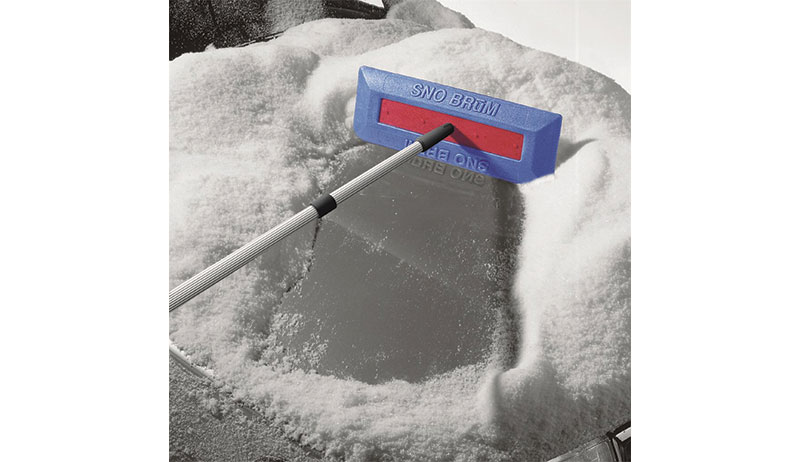
SNO BRUM
Sweep snow off car and equipment windshields, windows and hoods without harming the finish with a SNO BRUM. The molded-foam head is nonabrasive and freeze-
resistant. The handle extends from 27 to 46 inches. $16.25.
Toro 60V Power Max Two-Stage Snow Blower
The Toro 60V Power Max Two-Stage Snow Blower is the only battery-powered unit designed with three battery ports. With two batteries on board, the e26 clears 30 spaces on one charge. With a third battery port on board, you can harness the power of three 7 1⁄2-amp-hour 60-volt Flex-Force batteries to easily clear 45 cars in up to 10 inches of snow. Price varies by retailers.
Foot Warmer
Perfect for winter work in garages, basements and workshops, the Foot Warmer mat warms feet and legs while drawing only 90 watts of electricity. A built-in thermostat maintains the perfect heat level. $69.95.
Avalanche 500 Wheeled Roof Rake
Removing winter snow from roofs is imperative in some particularly snowy areas of the country. The Avalanche 500 Wheeled Roof Rake rolls through snow removal rapidly, while wheels protect the roof and reduce back strain. $139.
My friend Tamara and her husband, Bill, have kept a small flock of Orpingtons and Wyandottes for six years now. That’s just about the same length of time they’ve kept their small flock of children.
Tamara’s sons, Thomas and Calvin, have known hens their entire lives. The boys help feed the girls and collect their eggs. And they often hang out in their backyard, watching the chickens’ antics.
Being imaginative little boys, they come up with the wildest stories from time to time. Tamara therefore didn’t believe Thomas when he ran in and breathlessly announced that their largest Buff Orpington hen, Goldie, was crowing.
To Tamara’s shock, Goldie was indeed vocalizing as if she were a rooster. To Tamara’s horror, this wasn’t the only male trait that the Orpington hen had begun to manifest. “I had to buy hen aprons for the rest of the girls!” she wailed to me. “Goldie’s tearing up their backs with her talons! They don’t have any feathers left. And she’s a hen, doing this!”
Tamara told me that she inspected Goldie to make absolutely positive she was indeed a hen and not a rooster, even though she’s had Goldie for almost two years now.
“She’s definitely a girl!” she informed me. “What’s wrong with her?”
What’s Normal
Every flock, regardless of size, follows a social hierarchy called a “pecking order.” The term, which actually derives from observed avian behavior, describes how rank is established—literally—within a group of chickens.
The head, or alpha, female will often show dominance over the other hens in her flock by pecking at them. She will also crow to solidify her place as their protector, especially in the absence of males in the flock. This kind of behavior is perfectly normal in an all-female flock.
Just keep an eye on your alpha to ensure that she remains a protective mother hen and does not devolve into an abusive, intimidating bully.
Every now and then, a female may take on the physical traits of a male. She may grow taller, heavier and wider through the chest. Her comb and wattles may become larger, fuller and redder.
Her shank buds may even grow hard, sharply pointed spurs.
Although she hatched as a pullet, your hen has now become a rooster. These physiological changes—called spontaneous sex reversal—are hormonal in nature and usually linked to damage to the hen’s left ovary.
Should the left ovary sustain injury or damage by a cyst, a physical accident, or bacterial or viral infection, the vestigial right ovary regenerates into an organ called an ovotestis. Unlike an ovary, an ovotestis serves as a testicle and releases the male sex hormone androgen. This causes the hen to develop male physical traits.
According to the University of Kentucky’s Dr. Jacquie Jacob, there have even been reports of hens who have developed ovotestes actually producing semen. That makes these gender-switched chickens capable of fathering offspring.
These birds remain genetically female but phenotypically male, expressing very noticeably male characteristics.
It seemed to me that something had affected Goldie’s left ovary, causing the Orpington hen to spontaneously transform into a rooster … at least in appearance and behavior. Since Tamara and her family do not live in a zone where roosters are prohibited, the question of keeping Goldie—or explaining to her town’s ordinance director that Goldie was indeed genetically female—was not at issue.
I advised Tamara to teach Thomas and Cal to treat Goldie like an overprotective, ornery Orpington rooster. They should tread lightly around Goldie—and the rest of the flock—until the bird’s androgen levels stabilized and until Goldie wasn’t acting like a hormonal, randy teenager.
Goldie’s days as an egg layer were most likely over. But now Tamara and her family could look forward to getting to know and love their “new” rooster.
While 2020 and 2021 presented their own set of unique obstacles, navigating unexpected challenges is not new to small farmers. These challenges create barriers when you’re just starting out and still manage to throw you off course after you think you have it all figured out.
While the stumbling blocks aren’t likely to go away—as more people follow their passions to produce food—facing the unexpected now seems a little less impossible and a lot more manageable thanks to those who have paved the trail ahead of us.
Passing It Forward
“[Today], there are so many more resources around for new farmers,” says Hiu Newcomb, who—with her husband, Tony—began farming part-time on rented land in 1960 in Fairfax County, Virginia. “In the ’50s, ’60s and ’70s, there were no sustainable agriculture programs.”
This mission led to the current-day Potomac Vegetable Farms, which sell vegetables from two farmsteads, through a CSA and at local farmers markets.
Potomac Vegetable Farms
The farm grew with trial, error and the occasional success. And as it did, the Newcombs found the help they needed in their community. Soon they became the kind of resource to others that they lacked when they were starting out.
“Our job is to be mentors for the younger people,” Hiu Newcomb says. “It’s important for us to be integrated. It’s much more rewarding.”
Words of Wisdom
Her top advice for others follows a similar message. “Don’t farm alone. You can burn out pretty fast doing all the farm work yourself or with [only one] partner.”
She admits that their biggest challenge was money. They couldn’t afford to buy land at first and hiring help was challenging. But by collaborating with other farmers and working with interns and students eager to learn, you can find ways to get the help you need early on.
Community Concerns
Newcomb also notes the importance of creating a community of other farmers near you. “It’s more fun when you have someone to commiserate with, to ask, to share,” she says. Over the years, the Newcombs have hosted potlucks, farm games and talent nights.
These always led to conversation and learning from each other.
Newcomb says that when it comes to those ready to make an investment in land “don’t be isolated, if possible. Don’t buy land that isn’t good land.” She adds that finding quality, affordable land near people is getting more difficult due to the cost. But being near others increases the opportunity for community.
She also warns that you don’t want to spend 20 years building up your soil. It has to have potential from the start to lead to success and long-term sustainability.
Formal Education
Katie Hassemer, owner of Moon Chaser Acres in Beechwood, Wisconsin, takes full advantage of all the resources now available to new farmers. Hassemer works full-time as a farmers market director in Milwaukee while also seeking success on a sustainable farm on 22 acres with some help from her boyfriend, Steve. She sells direct to consumers as she works to develop the land.
Moon Chaser Acres
“I am so grateful for the experience I had with the farmer training program at the University of Vermont,” she says of the intensive 6-month program. “It gave me such a solid background on how to plan, grow and market sustainably-grown produce.”
After that, she worked on certified organic farms in Wisconsin for three seasons.
Once she made the decision to own her own farm, Hassemer took a business plan writing course with Wisconsin Women’s Business Initiative Corporation. All of this—combined with conferences, workshops and a farmer mentorship program from the Midwest Organic & Sustainable Education Service—enabled her to take steps to slowly build a successful farm.
Organizational Operations
Staying organized is key. Keeping notes has been valuable, and Hassemer integrates easy-to-use technology to do so.
“I use Google Keep all the time to take notes in the field,” she says. “I’m keeping track of varieties planted, dates, quantities, bed feet and locations, as well as spacing, germination success and harvest information.”
Hassemer also focuses on building success with current and future Moon Chaser Acres customers through newsletters and consistent social media posts even as the farm grows to full production. “I’m making connections, getting the Moon Chaser Acres name out there and keeping folks updated on what I am doing with my farm so when I do have more produce for sale, I have an audience already engaged,” she says.
She points out that she has to work to find ways to use the age-old challenge of not having enough time to her advantage.
“One big thing this year that I’m letting soak in from conversations with my farmer mentor is that if I don’t have the time to do everything this season, then focus on the things that will set me up for success next year and beyond,” she says. “With farming, oftentimes you have one time in a season to do something. And if you don’t get to it, you just have to note it and wait another year to try to do it differently.”
For example, she didn’t get the currants or gooseberries pruned this year. And she missed the harvest window for elderflower and some garlic scapes. “I’m just allowing some kindness toward myself on these things,” she says.
“For most things, I know what I need to do. But I just need to find the time to do it.”
Online Learning
Keegan Clifford also credits the valuable resources available to new farmers and gardeners for his education and success. His hobby garden in Middletown, Maryland, is an endeavor that now supports four local families. It also pleases numerous social media fans who enjoy seeing his bountiful harvests on Instagram.
Keegan Clifford
Clifford’s love of gardening began during his time growing up in Trinidad and Tobago, watching his great-grandfather grow yams, cassava, bananas and cocoa. As an adult in the United States, gardening has been a stress reliever for him. But he needed to better understand how to make his now 15 raised beds productive.
During his hours spent browsing the Internet to become a better gardener, he found Charles Dowding’s YouTube channel. Growing food in Somerset, England, Dowding practices no-dig, companion and succession planting, all things that Clifford now implements in his garden.
“Watching and reading [Dowding’s] content has helped me to understand gardening on another level,” Clifford says. “I’ve increased my yield by maximizing space. And it has helped me to extend my growing season well into winter.”
It wasn’t long after he started growing produce for himself that coworkers became interested in purchasing food from him. He admits that transitioning to supporting others beyond himself was an honor. But it also created pressure to keep his hobby garden successful.
This pressure made him a better gardener and one who encourages others to keep learning.
Just Keep Learning
Seeking opportunities for education and understanding the bigger picture are essentials to success. It also helps to make things easier on yourself as you learn.
Clifford started with self-pollinating vegetables because they’re easier for producing a harvest. He also emphasizes that gardening is about much more than your plants. The soil, weather, insects and a healthy ecosystem also play an equally important role.
Take advantage of what you have to work with in terms of all of these factors.
“We live on a vast, large planet,” he says. “Why not try greens that thrive in extreme heat? Or lettuce that can survive a winter vortex? Or heirloom corn that matures in less than three months?
“Basically, make the best out of your experience.”
Farming in the City
Samantha Foxx started Mother’s Finest Family Urban Farms in Winston-Salem, North Carolina, after enrolling in a class teaching the processes and principles of urban farming. The class focused on how to find success running a farm as a business. And it immediately sparked her entrepreneurial spirit.
Today, she manages the 2 1⁄2-acre urban farm along with an additional 5 acres of leased farming land off-site.
Mother’s Finest Family Urban Farms
Foxx is a successful farmer who also understands the big picture of land, plants, animals and our ecosystem working together. If you ask her what part of her farm delivers the most personal success, she admits that she loves doing anything on the farm specifically related to her girls.
“And by girls, I mean my bees,” she says. Much of her efforts in farming are centered around bee education and beekeeping.
Find Your Focus
Foxx encourages others to find their focus, a center point that allows you to create goals for your farm. For her, that focus is self-
empowerment and self-sustainability. And her beekeeping is a big part of that.
While her farm supports her family and others through the foods she sells, her full homesteading approach to success really began to develop throughout the pandemic and remains her focus. Her farming goes beyond simply growing food to food preservation and value-added products.
Beekeeping and farming take time. And there is always something to learn. To stick with it, it needs to be something you enjoy and something you can see yourself doing for years to come.
“I could be out in the dirt or in my beehive no matter my age,” Foxx says. “I’ll be out there for as long as I’m physically able.”
It’s also important to understand how you define success. “On harder days, I think if you get back out and try again even after failing, that is success,” she says.
Everyone starts their journey with farming in a different spot, with a different level of education on the subject, and a different set of tools and resources. “Start where you are,” Foxx says.
Her farm began with modest success growing in a few pots on her front porch. That has evolved into a farm business success story of managing goats, bees and chickens, and serving her community at farmers markets and through CSA boxes.
Community Involvement
Maggie Keith brings the value of community and education full circle with her emphasis on cooking and interest in how customers use their products. Keith is a fourth generation steward of Foxhollow Farm in Crestwood, Kentucky.
Their biodynamic family farm has found success raising AGA-certified 100-percent grass-fed and -finished beef.
Kendra Farris Photography
It’s All About the Flavor
“Focus on flavor,” Keith says. “In 2006, when I was developing our business plan and our herd, I held focus groups to taste and experience the flavor of our grass-fed beef. I learned right away that the flavor is what made us stand out.
“I am very passionate about building the soil and the happiness of the animals. But it boils down to taste.”
Developing that flavor begins with raising the right animals. “Be sure you have the right genetics for your specific farmland,” she says. “The size of the animal, the color of the hideand the breed need to be specific to your piece of land.
“The right combination is where you will get the most flavor and the most yield.”
Talk Amongst Yourselves
Keith also encourages other farmers to share their stories. “People want to know their farmers,” she says. “They want to learn from you, see what it takes to raise the food they eat, and know why you do what you do.”
She does this in a few different ways. First, she regularly invites people to her farm so they can see the process firsthand and learn from their success. As the cattle graze across 700 acres of farmland, visitors are greeted with the raised-bed kitchen garden that Keith maintains. The garden is full of heirloom vegetables grown using permaculture techniques and planted according to the biodynamic calendar.
Keith is also the co-host of the television show, The Farmer and The Foodie, with food writer Lindsey McClave, who develops recipes using local foods, including those from Foxhollow Farm. This opportunity for outreach, storytelling and culinary education has resulted in nationwide orders for their beef. It’s also fostered a supportive network of other farmers and customers.
This network has been important to Keith, and something she suggests others seek out.
“Have a handful of farmer friends to learn with and from,” she says. “We are all in this together. We all want to grow food that is the best tasting and healthiest for our community.”
It’s important to keep growing and to keep learning.
More Information
Top Tips
Hiu Newcomb
Don’t farm alone.
Do not be isolated, if possible.
Don’t buy land that isn’t good land.
Katie Hassemer
When you run out of time to do everything this season, start focusing on what will set you up for success the next season and beyond.
Keep detailed notes on your process each season.
Build a following and share your story before you have produce to sell.
Keegan Clifford
Always seek opportunities for education.
Understand all facets of gardening: plants, soil, weather, insects and a healthy ecosystem.
Don’t be afraid to try something new.
Samantha Foxx
Start where you are.
Success can be defined as simply trying again.
Find a focus that drives the goals for your farm.
Choose something you can see yourself enjoying for years to come.
Maggie Keith
Focus on flavor.
Choose animals with the right genetics for your farmland.
Share your story.
This article originally appeared in the November/December 2021 issue of Hobby Farms magazine.
Grafting apple trees has always been in the back of my mind as a skill I’d like to learn. I even gave it a try with some bud grafts on an apple tree a few years back. But I wasn’t equipped with the right tools. The buds didn’t survive.
But 2022 is going to be different. This is the year I’m going to conquer grafting apple trees once and for all. This time around, I’m heading into the project with a clear goal and a suitable array of tools and supplies.
Surely this is a recipe for success?
The Details of My Farm
Let me fill you in on the details. On my farm, there are a couple of very old apple trees that might be pushing 100 years old. The farm itself was settled more than a century ago. So if the apple orchard was an early planting, ages of ~100 years would make sense.
There used to be two other old apple trees. A storm felled one, however, and the passing of time claimed another, leaving two stalwarts behind. Of the surviving pair, one is a Duchess of Oldenburg still producing apples despite the fact its crown is gradually dying back. The other has a massive trunk but only one surviving branch.
It hasn’t produced apples in many years. I’m afraid it’s close to fading away.
I’ve always been interested in preserving the genetics of these old trees by means of grafting. If I can take viable scion shoots from the old trees and graft them onto new rootstock, I can create genetic clones that will carry on the legacies of the farm’s original apple trees.
To me, that’s a very exciting thought.
In mid-December, a massive thunderstorm with strong winds blew down a bevy of conifers across my farm. But I was relieved to find the elderly apple trees survived. Since they escaped this close call, I’m determined to propagate successful clones in 2022.
This is where my new grafting tools and supplies come into play.
Leading the way is a specialized hand tool designed for making perfect grafting cuts. Interchangeable blades allow the tool to slice through apple tree shoots exactly as needed to create four different types of grafts—primarily different variations of whip and tongue grafts, but also bud grafts.
This is a big positive. Successful whip and tongue grafts require the cambium layers of the scion and stock to line up perfectly, which means the two cuts must match each other as closely as possible.
This can be tricky to achieve with pruning shears and a knife. So I’m optimistic my new four-way grafting tool will deliver the precision needed for successful grafts.
But the grafting tool is only part of the equation. I also have grafting wax (to seal the cuts and prevent them from drying out), grafting tape (to hold everything in place while the bonding between cambium layers takes place) and a book about grafting (to learn the techniques in greater detail).
I’ve long been a proponent of having the right tool for every job. So I’m excited to tackle propagating new versions of old apple trees with my new grafting supplies. Wish me luck!
The American Aberdeen cattle breed was originally developed at the Trangie Research Centre in New South Wales, Australia. Animal scientists began with a herd of registered champion Angus cattle purchased in 1929. This herd was carefully selected for high quality and moderate frame.
The end result? A breed that is efficient on grass, moderate in size, black, polled and the purest of Angus genetics.
American Aberdeens are easy calving, good-natured cattle. They also boast high feed efficiency and maintain themselves well on grass.
Additionally, the meat delivers excellent taste, texture and tenderness beef characteristics, with exceptional rib-eye area per 100 pounds of body weight. This translates to very high-yielding, high-quality and high-value beef carcasses.
American Aberdeens also make a perfect choice for small-acreage farmers. Their more moderate size also makes them easy to handle and minimizes equipment requirements.
Because of their efficient conversion of grass to meat, they thrive on smaller amounts of feed, whether grass or hay. This feed efficiency adds a savings value to the farm. Moreover, this allows a farmer to stock more American Aberdeens in the same area that would support traditional cattle.
Additionally, they may offer potential tax advantages of an agricultural-based property and business.
Naturally polled cattle, American Aberdeens possess a docile nature. This makes them an ideal choice for those new to or less experienced with cattle. They also excel as show animals or in 4-H youth programs.
Mature American Aberdeen bulls generally fall into the range of 45 to 48 inches measured at the hip and weigh from 1,300 to 1,600 pounds. And mature cows generally measure from 42 to 46 inches at the hip, and weigh between 900 to 1,100 pounds.
There’s no doubt that an animal death on a farm can be emotional. Not knowing why an animal died makes it even harder. But you can sometimes learn more information via a necropsy, the term for an autopsy conducted on an animal. A necropsy, conducted on-farm by a veterinarian or at a state lab or university, can help determine cause of death.
Here are the top five reasons for having a necropsy done if an animal dies on your farm.
Definitive Diagnosis
Although not a guarantee, having your vet or area diagnostic lab do a necropsy greatly increases the chance of determining cause of death.
This is of huge importance if you’re dealing with the possibility of a contagious disease like influenza in swine or poultry, shipping fever in beef cattle, herpes virus in horses … the list is really, really long.
Basically, if your animal(s) died of a bacterial, viral, fungal or protozoal infection, getting a diagnosis will help you immediately protect other animals on your farm. You’ll also stay aware of how to prevent the same infection in the future.
One huge benefit to a necropsy? The ability to directly take internal samples and have them submitted to a pathologist for microscopic evaluation (called histopathology).
Histopathology is the keystone to diagnosis when you need a look at the cellular level. For example, it can help differentiate between a benign or metastatic tumor. A vet can also culture samples for bacterial/fungal growth and analyze for viral causes.
Learning Opportunity
From an emotional standpoint, many find it difficult to watch a necropsy. And some folks just don’t have the stomach for it. But if you are offered the opportunity to observe a necropsy, it’s absolutely a worthwhile experience.
You will surely learn a lot about the internal anatomy of the animal. But in addition the pathology you see may greatly impact how you think about clinical signs. For example, it can be shocking to see the extent of lung consolidation in a calf with shipping fever even if the calf had clinical signs over a relatively short amount of time.
Sometimes during necropsies, we find other issues not directly implicated in the cause of death. But these conditions may have still had an impact on the animal’s health—or not at all.
We call these discoveries incidental findings. Common examples include finding parasites in the intestines, liver abscesses, gastric ulcers and small tumors. These findings can sometimes give you a clue about the underlying health of the other animals on your farm, too.
Insurance
In some cases of animal death, you’ll need a necropsy for insurance purposes.
Logistically, you’ll need a well-lit, well-ventilated, level area free of debris for an on-site necropsy. But space requirements obviously vary, depending on the species.
If you prefer to take the animal to a diagnostic lab for necropsy, know the times and dates of operation ahead of time. Many federal labs do not conduct necropsies on the weekends or federal holidays.
I would always recommend calling your local/state lab prior to driving out.
One last item to note: Necropsies are not free. Either your vet will charge for time and expertise or the lab will. However, since this is considered a public health service, the fees are typically reasonable. But fees can also vary, again depending on the species and specific samples requested.