Well, it’s almost the end of 2021. Did you get to every project on your list for the year? What do you want to do around the homestead in 2022? If you’ve got a pond on your farm (or you’re planning to add one to your homestead), I’ve got a simple, inexpensive farm pond project here that you may want to consider for the coming year.
Here on my Texas farm, my pond isn’t at risk of freezing right now. Depending on where you homestead, though, your water might not be accessible at the moment. But it’s never too early to gather supplies and think ahead to what you’ll do when things warm up.
This farm pond project is simple, but its purpose is pretty important. What we’re building here is a basic fish habitat to provide dedicated spaces for smaller prey fish, such as minnows, in the pond habitat. By enjoying cover, these fish can establish a population that will, in time, sustain the larger predator fish.
If you’ve ever tossed a Christmas tree into a fishing hole come January, this operates on the same principle. When prey fish have a place to thrive, you get a stronger predator fish population. And considering these breeds are the ones we go fishing for, that’s a big benefit.
But unlike a Christmas tree, this artificial structure won’t break down and need to be replaced annually.
You don’t need much to build a DIY fish habitat. You may even have the necessary parts laying around.
length of drain pipe
irrigation poly tubing
cinderblock
concrete
Constructing these artificial trees couldn’t be easier. First, you’ll want to cut the drain pipe to the length you desire. For my pond, a few feet was enough to effectively submerge the trees. But you can make that call based on your own pond’s characteristics.
Then, for ease with the next steps, go ahead and set the drain pipe into the cinderblock with concrete so that it stands upright, like a tree.
Next, just drill holes in the drain pipe to fit the poly tubing. I was using 1/2-inch poly tubing, so a 3/4-inch spade bit did the trick. Just make sure you drill holes roughly opposite each other on the drain pipe so you can thread the tubing through.
Cut your irrigation tubing to 3 or 4 feet lengths, then thread them through the drain pipe to create “limbs.” Once all your limbs are in place, you can strategically place the artificial tree into your pond so little fish will have space to hide and thrive.
When Carli Pritchett’s grandfather passed away, his wife would engage in the ritual of bringing him flowers. When the COVID-19 pandemic hit and stores began to close, Pritchett noticed how “it seemed nonessential to go to the stores for just flowers. I decided I would grow them so she wouldn’t have to worry about going to the store anymore.” Pritchett’s initial decision has now expanded into Petals And Posies Flower Farm, a vibrant venture situated in Enumclaw, Washington, where weekly bouquet subscriptions are supplemented by wedding work.
We spoke to Pritchett about the romantic nature of dahlias and the shortage of healthy tulip bulbs. We also touched on the way farming life can help to cultivate kindness.
Recounting her interest in farming, Pritchett points to deep roots in the field.
“Papa started one of the very first custom soil companies ever back in the 1970s. Eventually I took over for him once his health started failing him in 2012,” she explains. “I had worked there since I was 15, only taking a break from the family business to study earth science education at Boise State University. Once I graduated it was back to the dirt factory.”
“The most popular flowers on the farm this last year were easily the dahlias,” says Pritchett as she looks back over 2021. “I started with 110 and this coming season I will have over 1,000.”
Getting into the details of dahlias, Pritchett adds that they’re “fun to grow because they all look so different and they’re very romantic!” Along with the dahlias’ ability to pair well with “almost any other flower in the field,” Pritchett says they’re also “hardy and forgiving” to work with.
Looking forward, Pritchett picks tulips as the flowers she’s most excited about growing in 2022. Despite a number of bulb farms in the Netherlands suffering “catastrophic crop failures this season,” Pritchett was able to navigate the bulb shortage.
“I was able to buy thousands of specialty bulbs from Holland,” she explains. “Some tulips grow to look like peonies, roses and even ice cream cones!”
Along with an abundance of blooms, Petals And Posies Flower Farm also counts a Scottish Highland cow named Merida as one of its residents.
“She is a seasoned lady,” says Pritchett. “She picked up on the farm routines quite quickly and wasn’t phased by the loud dump trucks bringing in soil. And she wasn’t bothered by my being in the pastures fixing the fence. You could tell she has been around for a while and is quite wise.”
Pritchett adds that Scottish Highland cattle are something of a family tradition and recalls visiting a great uncle’s nearby 40-acre ranch and witnessing the herd looking “magical with their long hair and giant horns.”
“The absolute most rewarding part of doing all of this is seeing my kids discover what farm life is really like and learning what’s important in life,” says Pritchett, weighing up the benefits of a farming environment. “I love providing a wholesome life for my family. Farm life cultivates kindness and appreciation—and the kids have picked up on that at such a young age.”
Follow Petals And Posies Flower Farm at Instagram.
I’d heard the sickening “thwump” sound and turned just in time to see a dazed mourning dove flying away. She’d flown into one of the large salvaged windows which make up my new greenhouse. Turns out, when the light’s at just the right angle, my greenhouse becomes a veritable house of mirrors.
I’d unwittingly created a potential deathtrap for some of the very creatures I work hard to help. This would not do.
“The latest scientific estimates suggest that annual bird kills at windows range from 365 million to 988 million per year in the U.S., 16 million to 42 million in Canada, and billions worldwide,” Klem writes. “Even the lowest U.S. estimate is equivalent to the avian death toll from 1,215 Exxon Valdez oil spill disasters.”
Greenery & Glass
According to Klem, multiple researchers have concluded that the overall number of bird-window collisions increases in areas with combinations of greenery and glass. “Increased casualties occur at buildings with nearby vegetation in the form of trees and shrubbery that attract birds to the danger zone near windows,” he writes.
My greenhouse is positioned in the middle of my back yard—and surrounded by trees, pollinator gardens and other greenery. With so much vegetation around to be reflected by so many windows, my local birds wouldn’t stand a chance.
Sadly, even when we think a bird has managed to survive a window collision, they frequently don’t. Some do fly off—only to perch in some out-of-the-way spot while they try to recover. Unfortunately, many of these recovering birds are picked off by outdoor cats and other predators.
Still other post-collision birds leave the scene with internal bleeding, broken bones, brain injuries and other serious issues. They, too, aren’t likely to thrive long-term.
Susan Brackney/Wikimedia Commons
Bird’s Eye View
The main problem with most windows is that birds just don’t see them. With a certain amount and angle of available light, a window might look completely transparent. As the light shifts, that same window can perfectly reflect the sky, trees and other natural elements.
In either case, a bird is not likely to perceive this solid pane of glass as an obstacle.
When it comes to effectively preventing bird-window strikes, affixing a few hawk silhouettes inside your windows won’t do much good. Neither will relying on the natural accumulation of a little grime.
Instead, the outsides of your windows—in their entirety—must include some patterned visual elements. “Patterns that effectively deter bird strikes must uniformly cover the surface of the window, and the elements making up the pattern must follow the 2 x 4 rule,” Klem notes.
After much trial-and-error, researchers have determined that birds will see—and steer clear of—horizontal patterns or rows occurring at two-inch intervals. Birds will also avoid vertical patterns or columns spaced 3 or 4 inches apart.
“Effective deterrent patterns can be applied to existing windows with soap, tempera paint, tape, films and cords, strings or ribbons,” Klem adds.
There are a few bird-friendly businesses offering their own fixes. For instance, BirdSavers sells finished window paracord products and also offers DIY instructions. And both CollidEscape and Feather Friendly sell specialty films or tapes intended to be applied to your windows’ exteriors.
(Although these products are visible from the outside, they won’t really obscure your view from the inside looking out.)
To solve my own window-collision issue, I opted for CollidEscape’s three-quarter-inch tape in white. With a squeegee, bucket of hot water, clean rags and glass cleaner in tow, I headed to the greenhouse.
We’d had a string of unseasonably warm afternoons—temperatures were just above 40 degrees. That meant I’d be able to get the windows squeaky clean and make sure the tape really stuck.
I added vertical stripes to the outside of each window, spacing the stripes four inches apart. I’ve noticed that plenty of light can still penetrate the striping, and, from inside the greenhouse, my view is unobstructed. The tape itself should last about 10 years.
Best of all, I’m much less likely to hear that awful thwump—and I’ll be saving countless birds in the process.
Ideally, we should all be blessed to have one great spouse. In our chicken-raising careers, we should all be fortunate to have one great rooster, too. So I’ve been doubly blessed to have Elaine as the perfect wife for 42 1/2 years and Don as the perfect rooster for the past six.
Not Always a Blessed Event
Of course, owning a roo is not always a good thing. Elaine and I certainly learned so when we first started raising chooks. These happened to be industrial Rhode Island Reds purchased at a local farm-supply store.
Hybrid Reds, as is typically true with industrial birds, have had the broodiness trait bred out of them. And, at least from our experience, one of the results has been hyper-aggressive roosters.
Even though our industrial Red hens weren’t likely to ever raise chicks, we still wanted the experience of having a rooster as flock leader. Thus, we methodically culled five of the six cockerels we received in a straight-run purchase. This left only Little Jerry, who we deemed as the bravest and brightest of the sextet.
Jerry acted acceptably until he was about 18 months old. Then he became a terror, attacking Elaine whenever she turned her back on him and rushing me whenever I entered the run. My wife became so afraid of Jerry that she hesitated to even gather eggs.
Then the inevitable happened. Jerry lost his fear of me, biting me on the hand and trying to spur me at the same time. The next day, Little Jerry became Sunday dinner and served as workday lunches for three more days.
Only One Option
Every year, I receive emails from folks wanting tips on how to rehabilitate aggressive industrial roosters. These are males that have bitten, spurred and chased their owners and children. And, just as bad, these roos have endlessly tormented their hens.
I’ve tried all kinds of rehab tactics: holding roosters and gently bending their heads downward to show who is dominant, stomping my foot at them, staring them down, not showing fear, and on and on. None of these tactics have worked with multiple roosters.
And practically nothing does work except culling them from the flock.
Of course, even heritage roosters can act thuggishly. For example, after we gave up on industrial birds, we decided to try raising purebred Rhode Island Reds and Buff Orpingtons.
Our first Buff flock leader was a ruffian named Oscar. He terrorized us and his hens, even attempting to mate with them when the ladies were trying to lay an egg. He literally tried to pull them out of the nesting box by their necks.
He was quickly removed from the flock.
Bruce Ingram
Why a Rooster Can Be Right
After the Oscar debacle, we decided to just go with raising heritage Reds. We’ve had some wonderful roos, with the aforementioned Don (named for Don Draper, the debonair Madison Avenue character in the television show Mad Men) the best of them all. He checks off all the superlatives of why chicken enthusiasts should desire to have a rooster as protector of home and henhouse.
First, Don serves as a fabulous guardian. If anyone walks or drives down our driveway, Don will explode with paroxysms of crowing, letting the interloper know who is master of this domain. If that villain should perchance dare to approach our two runs, Don will stalk toward the fence, give the scoundrel the evil eye and erupt into more crowing.
Second, the ideal roo would give his life for his hens. Without fail every winter, some species of hawk will pay a visit to our runs. During such events, I’ve witnessed cowardly roosters run into their coop with the hens, cowering in the inner recesses.
Not Don, though. He always holds down the proverbial fort against these aerial invaders. Don endlessly emits the alarm call until I come charging out of the house to see what the threat is.
Third, a flock rooster should always be on duty. Like many flock fans, we like to let our birds roam around the yard several times a week. Although Elaine and I always supervise these outings, Don is on the job outside the run, too.
For example, we have two side-by-side runs, each with six to eight heritage Rhode Island Red hens. Each flock has its own flock rooster, too: Don and some other younger roo or cockerel.
On one of those foraging expeditions, I was working inside while Elaine was outside with the two flocks. After a while, Elaine called for me to come help her. “Don won’t stay with his flock,” she said in an exasperated tone. “He keeps running nonstop back and forth between the two flocks.”
I came outside to try to ascertain why this was happening. Don was scurrying hither and yon from the front yard—where his flock foraged—to the backyard where the other assemblage congregated. It was then that I realized what I think was going on inside of Don’s chicken head.
“He feels that all the hens in both flocks are his,” I told Elaine. “He can’t figure out which flock needs him the most. And he definitely doesn’t recognize Friday [a cockerel at the time] as a proper flock leader. I’m afraid he’s going to keep running back and forth until all of them go back inside for the day.”
And Don did, until the flocks returned to their respective coops. It was just one more sublime reason why our boy is the ideal rooster.
Another crucial trait of a dominant male is to be gentle toward his owners and his hens. Don has never shown any aggressiveness toward us and allows us to pick him up for examinations. We can carry him back to the henhouse if he is dallying when it’s time to lead the hens homeward.
Similarly, Don has never attacked his hens if they refuse his mating overtures.
Consider Heritage Birds
But all that mating has resulted in generations of chicks, too. And if you are tired of owning industrial birds that can’t ever produce offspring, or become exhausted from having to deal with raising chicks, monitoring a heat lamp, and basically being the mama hen yourself, consider a heritage rooster and his harem of hens.
The rooster will take care of things on his end, for sure.
Bruce Ingram
Changing of the Guard
A sports maxim exists that states: “Father Time is undefeated.” Thus is the case with all virile roosters, and, sadly, Don as well. Last spring, at the age of 5, Don performed his reproductive duties. But of the 22 eggs his hens brooded, only two hatched.
Eventually, Elaine and I realized that the problem was that Don was no longer as viable as he once was. We had to remove Don from his flock and put Friday, a very virile 18-month-old stud, with the hens.
The proverbial baton had been passed, and Friday is now the alpha male in our backyard. However, Don will continue to live out his life in comfort.
Friday, so named because he hatched on that day of the week, shares the same aforementioned positive traits as Don. This is why we kept him over other cockerels.
Don Jr. fell out of favor because, well, he acted cowardly. Fleeing from a hawk perched on a coop support is one thing. But being scared of a butterfly that blundered into the run is not a résumé builder.
Giving the alarm call at a winged creature that weighs maybe an ounce is unacceptable.
Another young roo, Bobby, looked to have potential. But he allowed himself to be bullied by cockerels the same size or smaller than he was.
Then there was the young roo that we culled before he even earned a name. He suffered from some kind of respiratory problem that caused him to frequently wheeze. You don’t want that trait passed down to the next generation.
Rooster Reasoning
People give all kinds of reasons for not having a rooster. They crow too much during the day. They wake everybody up too early in the morning. They’re so big and they eat so much, and on and on.
I counter that I love the sounds of crowing in the morning. It says all is well in rural America and the day to come will be grand.
And, yes, roosters eat a great deal more than any hen does. But they repay us and their hens with protection and progeny. Give roosters a try, and find out for yourself how much they can add to your flock and your backyard.
More Information
Worth the Investment
Possessing a rooster will add a touch of panache, glamour, class, whatever you want to call it, to your flock.
Let’s face it. We all love our hens. And they do have unique personality traits. Some even have some physical traits where we can identify them individually. But for sheer personality and aplomb, nothing beats a rooster.
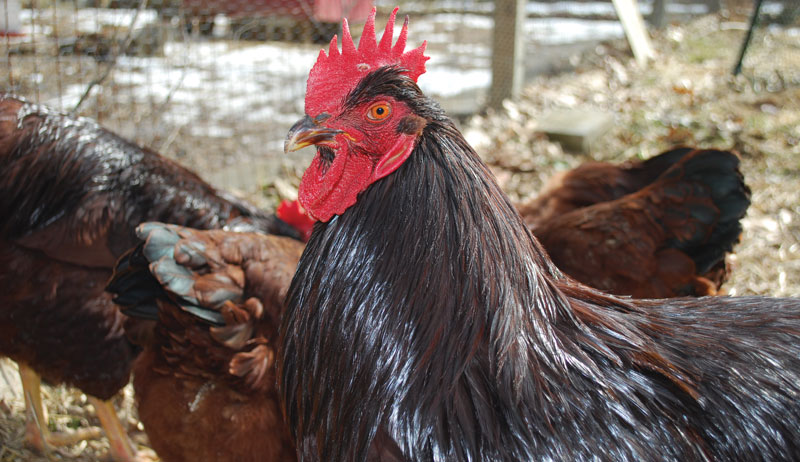
Weighing in at close to 9 pounds, strutting erectly wherever he ventures, sporting a deep mahogany-red body color, flaunting iridescent greenish-black feathers and wearing a ruff that glistens in the sun, our rooster, Don, dominated the surroundings for most of his adult life.
Showtime Antics
Another reason to possess a male is to watch an amorous roo do the three-step shuffle around a hen (this is chicken foreplay) before mounting a hen and lowering his vent to hers so as to emit sperm.
Granted, for most of his life, Don has wanted to mate some two dozen times per day. That’s typical of all healthy roosters. So you can view showtime just about every hour of every day. It’s also a reason why you should have at least seven or eight hens in a flock with a rooster. Otherwise, the ladies’ backs may become de-feathered.
This article originally appeared in the November/December 2021 issue of Chickens magazine.
Alinee “shiny” Flanary shares with you her top three tips to improve your farmers market sales in this episode.
She talks about what it was like to go from “zero to farmer” when she jumped into a farmer incubator program a few years ago. Now managing her Scrapberry Farm, as part of the Raceme Farm Collective, growing primarily herbs for medicine making. Hear about the microfarms and the individuals—including the strengths, skills and challenges they bring with them—comprising the collective.
You’ll also learn about shiny’s Come Thru Market, a BIPOC farmers market in Portland that has grown by leaps and bounds since its launch in 2019. She tells us about how it’s changed and now serves a whole community of farmers and shoppers, plus the market’s exciting plans for expanding its farmer training program, in cooperation with Zenger Farm, thanks to a big grant. (You’ll also learn how to ask for—and get—$50,000 when you really need it.)
The season of giving may have already arrived, but let’s face it. We flock keepers tend to be overwhelmingly busy caring for our chickens, keeping tabs on our own households, and working our paying jobs.
There’s a very good chance that we haven’t finished our holiday shopping yet.
There’s a very good chance that we haven’t started our holiday shopping yet. For those of us who are up to our necks in to-dos—and for those of us who simply procrastinate as long as possible—here’s my annual gift guide for the chicken lover in your life.
Joie Big Boiley
Yes, you can boil an egg in the microwave. With the Joie Big Boiley, you can safely soft or hard cook up to four eggs without having an explosive disaster all over your oven’s interior. Simply add water to the fill line, pierce each egg with the provided egg-piercing tool, place the eggs pierced side up into the egg cups, screw the lid on, and cook—four minutes for soft boiled, 10 minutes for hard boiled.
I’ll admit, anxieties arose regarding piercing the eggs. But the process was remarkably easy. And the eggs came out perfectly cooked.
With its white body and orange handles, the Big Boiley even resembles an egg. At approximately $12 each, it’s the ideal gift for anyone who adores egg-salad sandwiches … or has trouble boiling eggs on the stove. Available on Amazon.com.
What poultry keeper doesn’t have at least one chicken kitchen gadget (yes, that’s quite a tongue twister!)? I thought I had them all… until I saw these Chicken Measuring Spoons at Bits and Pieces.
A sweet ceramic hen seems to be carrying four chicks on her back, just like real hens do. In this case, however, the chicks are actually measuring spoons, from one-quarter teaspoon to one tablespoon in size.
Any baking enthusiast will appreciate having measuring spoons at the ready versus having to root around for them in a drawer. The whimsical chicken design makes this gift all the more charming. Approximately $25.
Fried Egg Blanket
The second I saw this at The Apollo Box, I knew I’d finally found the perfect chicken gift for my college-age son. He’s impossible to buy for, mainly because he spends all his earnings on whatever he wants instead of on stuff like mortgage, car payments and utilities.
The blanket is a throw blanket shaped like an actual fried egg, with the yolk slightly raised from the white. Available in three sizes, the fried egg blanket makes a perfect dorm-room conversation piece… and is perfect for quick naps on the couch at home. Prices vary according to size.
Contrary to what the name implies, these are actually candies, not fried eggs that were cooked to death. Fruity in flavor and fun to look at, these gummy fried eggs make the perfect stocking stuffer, white elephant gift, or snack for your Christmas movie marathon. Available by the pound from Nuts.com.
Personalized Throw Pillow
Add a touch of the chicken life to your living room with this adorable decorative pillow by Gear Lit. The ultimate customized chicken gift, this pillow can be personalized with your choice of 20 different backgrounds, four different phrases and 16 different chicken breeds for up to six birds. You can even add your layers’ names to boot!
The pillow comes in two sizes—16 x 16 and 18 x 18. And the pillow cover is machine washable. Prefer something somewhat more understated? GearLit also offers a personalized door mat.
Deviled Egg Socks
For the handsome devil in your life, these egg socks say it all! These poly-cotton crew socks feature an eye-catching deviled-egg design printed all over each sock. There’s even an egg with a forked tail and devil’s horns, should anyone question the kind of eggs these are.
The socks fit men’s shoe sizes 6 through 12.5 and come in your choice of charcoal or turquoise. Perfect to wear to a formal occasion for just the right touch of levity. Approximately $12 per pair at HotSox.com.
Various species of pine are commonly used as Christmas trees and holiday decorations, but this sturdy tree is useful for so much more! All species of pine are coniferous tree, meaning they bear their seeds within cones, from the genus Pinus. There are nearly 130 distinct species worldwide, and they can be found throughout the northern hemisphere.
Pine is one of the most extensively used timber trees, producing a soft wood that is prized for its lumber and pulp. It is a fast-growing tree that thrives when grown in the densely-populated style of timber plantations.
Aside from its uses in construction and as holiday décor, this tree is also enjoyed by chefs and herbalists for a wide variety of purposes. From a classic ingredient in pesto to a cold-busting herbal brew, the noble conifer has so much to offer!
Pine in the Kitchen
The seeds of all pine are edible, but few of them are large enough (or easy enough) to extract to be worth considering for your recipes. The pine nuts commonly available at the grocery store are typically harvested from pinyon pine trees, Pinus edulis. In Europe, the typical source for these flavorful little seeds is the stone pine, P. pinea.
Adding 1/4 cup or so of these seeds to your pesto recipe will give your sauce that delicate nutty taste. Try toasting them before adding them to the recipe for a deeper, more pronounced flavor.
Consider using pine needles to infuse a resinous, woodsy flavor to your dishes. One way to do this is to simply harvest fresh young needles, steep them in olive oil and then use this flavorful oil to add a citrusy flavor and woody aroma to your meal.
The flavor goes quite well with fish, chicken and other meats. Another great way to include this piney goodness in your food is to just add needles right into the cooking process! Try laying a piece of salmon onto a bed of fresh pine needles before wrapping it in aluminum foil and baking it in the oven. Yum!
Historically, people around the world have used various parts of the pine tree—including the needles, inner bark and resin—for similar conditions. Internally, the tree has been utilized to treat cold and flu symptoms such as cough and sore throat. And the plant is applied topically for sore muscles, joint pain and arthritis.
The easiest way to harness this herb’s healing benefits is with a soothing pine needle tea. Finely chop about 1/2 cup of fresh needles and steep them in 3 cups of boiling water. Use a reusable tea bag or stainless-steel tea ball. Once brewed, add lemon juice and honey to taste and enjoy.
Pine trees are quite widespread throughout the northern hemisphere and should be easy to find. As with any other plant, make sure to properly ID your tree before harvesting any parts of the plant.
If you’d like to grow your own pine tree, that are very easy to cultivate! They prefer sandy, well-drained soil and will thrive in full sun to partial shade areas. Although you certainly can grow a tree from seed, it is much easier to start with a healthy sapling from your local nursery.
Pine are fast-growing trees. Many will easily grow 1 to 2 feet per year, with some species growing even more quickly. Be sure to plant your tree in an area with plenty of space to grow. They can live well over 100 years. One specimen of P. longaeva, a tree known as ‘Methusula,’ is believed to be around 4,800 years old!
If spring, summer and fall are the busy seasons on a farm, then winter tends to be a quiet time. With fewer outdoor projects in need of attention, you’ll likely find yourself spending more time indoors, especially on cold and snowy days.
But just because you’re indoors doesn’t mean you can’t stay busy with farming projects! The following five tasks can be accomplished indoors (if not in your house, then in a garage or toolshed). And they will help you stay productive this winter.
Sharpen Your Tools
Worn-down tools are a sign of jobs well done. But, of course, worn tools don’t perform as well.
Are your pruning loppers dull from a productive summer? Blades on your lawn mower showing signs of their age? Is your pocket knife struggling to cut open hay bales?
Maybe it’s time to sharpen your tools.
Sharpening cutting blades requires special skills and specific tools, such as files, a sharpening stone and/or a bench grinder. But learning a useful new skill is always enjoyable, especially if you find yourself with free time during the quiet winter months. Breathing new life into worn-down tools is a productive and satisfying way to spend the offseason.
During the peak of summer and autumn farming projects, organizing tools can fall by the wayside. If you’re heading into winter with tools piled haphazardly on tables or scattered throughout various outbuildings, now is the time to restore order.
You’ll appreciate the time you spent organizing when spring rolls around and everything is exactly where you need it.
Plan Your Garden & Order Seeds
On the coldest of winter days, when even the thought of organizing a toolshed is unappealing, why not curl up in a warm room with a stack of seed catalogs by your side?
It’s hard to beat a chilly afternoon spent planning out which garden plants you’ll grow once temperatures warm up.
Start by calculating how much garden space you have available. (Geometric raised beds make this easy.) Then create a map or chart putting the numbers down on paper.
Once you’ve established these parameters, pour through the catalogs comparing plant varieties and prices until you’ve filled up your garden space with an enticing selection of vegetables, herbs, flowers and more.
Now get your orders placed! Your careful pre-planning will help ensure you plant everything on time in the spring.
Want to get an early start on the next gardening season? Ordering seeds in advance isn’t the only way. You can also start growing seedlings indoors!
It’s not hard to find seed-starting kits with everything you need to give seedlings a head start before outdoor temperatures climb suitably high.
One tricky part is ensuring your seedlings get enough light. A sunny, south-facing window might be all you need if you live in a region with at least 12 hours (if not 14-16 hours) of daylight in late winter. Otherwise, you may need grow lights to make sure your seedlings start off strong.
Perform Seasonal Machinery Maintenance
If you have enough garage and/or barn space to store your farm machinery indoors, the winter months can be a perfect time to perform routine maintenance.
Whether you’re changing tractor fluids or replacing broken tines on a hay rake, getting your machines in tip-top shape during the winter serves two purposes.
One, it keeps you busy during a quiet time of year.
Two, it preps the machines for spring and ensures ideal maintenance tasks don’t get overlooked (or pushed aside) during the busy rush of spring.
With all these indoor farm tasks to tackle, winter will be over before you know it!
Hay is a stable roughage for almost—if not all—hobby farmers with four-legged livestock. We rely on it during the winter when grass is gone or covered with snow and throughout the rest of the year when our animals may have limited access to pasture for various reasons.
At first blush, hay is not complicated. It’s cut and dried plant matter, after all. But herein lies the secret. The type of plant and when it was cut can make for drastically different nutrient profiles.
Let’s take a deeper look into this all-around roughage.
Types of Hay
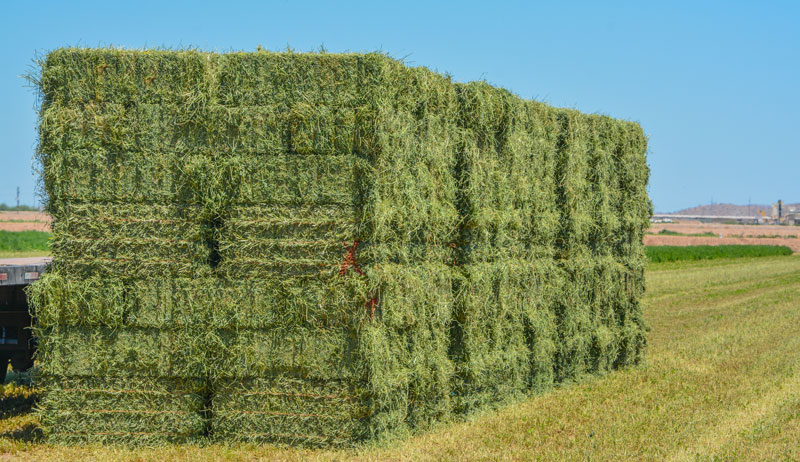
The two most commonly encountered types of livestock hay in the U.S. are grass and legume hays. And several specific types exist within these two classifications. There is also mixed hay, which, true to its name, is a mix of both grass and legume types.
Grass Hays
Grass hays are true grasses. These include (among others):
timothy grass
orchard grass
brome
Bermuda
Sudan
fescue
The types of grass hay you’re most likely to encounter depend on where you and your livestock are in the country. Grass species fall into cool-weather and warm-weather types, describing which conditions they grow best in.
For example, if you’re farther north, you may typically see timothy grass hay. Timothy is a cool weather grass. Contrast this with more southern locales, where brome or Bermudas grass (both warm weather grasses) tend to grow.
Legume Hay
Legume hay is made from a different type of plant than simple grass. Botanically speaking, legumes are nitrogen-fixers. Symbiotic bacteria within their root systems utilize environmental nitrogen for growth, benefitting both the bacteria and the plant. Grass does not do this.
Common types of legume hay include alfalfa, clover and lespedeza (among others).
Nutritionally, there are a few large differences between grass and legume hays. Generally, legumes are higher in calcium and protein content as compared to grass hays, and are typically higher in overall caloric content. For this reason, legume hay like alfalfa is a great option to feed young growing animals. Same goes for adults that have higher energy requirements, such as pregnant animals and seniors with lower body condition scores due to health issues.
Alternatively, if you have over-conditioned animals (a nice way of saying fat animals), you may consider cutting their calories by feeding only grass hay.
Because of their general nutritional superiority, legume hays also tend to be more expensive than grass hays. Knowing the pros and cons of each type of hay impacts both your animals and your pocket book.
In many parts of the U.S., the growing season occurs over several months through late spring into early fall. This means that a field of crop grown for hay can be cut up to three or four times during a single season.
This creates further choice in what you purchase: first-cutting versus second-cutting versus third-cutting, etc.
How young or old a plant is when cut also impacts its nutritional content, as based on leaf to stem ratio. Generally, the more leaves within a certain hay cutting, the more nutritious it is. When you evaluate whether to purchase a certain type of hay, ask about what cutting it is and look for leaves.
Based on your animals’ requirements, this can help you make a choice on what to buy.
Of course, all of this is to say that you can’t be totally sure of your hay’s nutritional value just by looking at its leaves, knowing what cut it is and its type. Laboratory analysis of your hay is a fantastic way to really understand what you’re feeding your animals.
To grab an adequate sample of your hay to submit for analysis, you need a tool called a hay corer, also called a hay probe. Many small operations don’t have one. Contact your local extension agent to grab one on loan.
Refer to the National Forage Testing Association for details on how and where to send your sample. Their website contains a wealth of information, including useful and easy to understand infographics.
Once you’ve mailed in a sample, results in terms of percentages will be returned. But terms like dry matter and acid detergent fiber can seem bizarre, intimidating and unhelpful. So talk to your extension agent and veterinarian about what they mean in relation to your herd’s nutritional requirements.
In this way, a little homework can reap a large payoff in understanding exactly what you’re feeding your animals.
When it comes to growing vegetables on your land, you can find numerous approaches to managing the plot, financing its cultivation and reaping returns in both money and yield. You can always run a homestead or farm as an individual or family. But you can also do so as a cooperative or community.
When it comes down to it, many financial and social structures exist to help projects flourish. But good organization of the landscape is essential. The division of your land into garden plots, triads, beds and spots can help create a layout conducive to different forms of social organization.
In this article and the next, I want to explore both the community garden concept and the current popular model of land organization. These we’ll compare to the typical market garden organization.
We’ll also look at some of the underlying questions community gardeners could ask themselves to better manage their patches of growing soil.
Most community gardens have a large space of anywhere between .25 to .5 to 1 acre of cultivated land. Some very old and large community gardens are actually many acres in size. However, most garden plots are about 5 by 10 or 10 by 10 feet in size. More advanced growers may even find plots up to 600 square feet.
Regardless of size, though, community gardens are often divided into plots, with alleys and paths leading between them.
On the other hand, a typical market garden is organized by larger plots subdivided into beds. Our particular style of market garden design also divides plots into triads of three beds each. Somewhere between three to six triads make up a plot (depending on your scale of operation).
The big difference is that community gardens leave bed making, bed architecture and overall layout of beds within plots up to individual gardeners. For a market garden, on the other hand, this is a very specific determination executed, most often, by a single grower.
So a community garden’s diversity of gardening strategies can prevent some of benefits that market gardeners enjoy.
In community gardens, individuals will have an island-like plot amidst a network of paths, with adjacent island-like plots. Everyone grows what they like. Management is often left to the individual, save some places where the entire piece of land is plowed and tilled each year.
This model prevents a lot of the regenerative benefits of new land management strategies that professional growers typically employ. But moving toward a Permabed system could help community garden’s grow more with less.
What are the benefits of Permabeds, or permanent raised garden beds? And how can a community garden benefit from the Permabed model?
First of all, a raised Permabed is never destroyed at the end of the year. The bed remains raised at approximately 6 inches above the ground, with an overall width of about 3 to 4 feet, including the path (for smaller plots, like a community gardener or home garden).
The raised bed reduces compaction and improves soil life. This preserves micro-organisms like beneficial fungi and bacteria. The permanent model also means the land is more stable from year to year. And better organization allows crop rotation and a reduction of disease.
Community gardens that choose to divide their entire plot into 50- or 100-foot long raised beds at 4-foot widths would gain a lot in overall soil health. But they would also achieve wonders for efficiency of irrigation and disease management.
And these are just a few of the benefits Permabeds can bring to land health in community gardens. In my next article, we’ll look at some of the management benefits a good organization strategy brings to shared growing spaces. We’ll also dig into how you, too, can apply Permabed system design to your community garden.