Categories
Food Recipes

Recipe: Wild Green Cakes (From The Forager Chef’s Book of Flora)

This excerpt is from Alan Bergo’s new book The Forager Chef’s Book of Flora: Recipes and Techniques for Edible Plants from Garden, Field, and Forest (Chelsea Green Publishing, June 2021) and is reprinted with permission from the publisher.

forager chef's book flora
Chelsea Green

Makes roughly 10 cakes

There’s a reason this is the first recipe in this book. It’s a hybrid of a recipe by French Chef Jacques Chibois and one outlined by Sam Thayer in his third book, Incredible Wild Edibles, and it’s a statement on the culinary dichotomy of these two chefs, since wild plants are high-quality ingredients sought after by chefs, but also available to anyone who takes the time to get outside and learn about them. Many different species of plants can be used, and no two batches I’ve ever made have been exactly the same. My favorite part of this recipe is how the greens continue cooking on the inside of the cake, almost as if they’re cooked under pressure, retaining a bright green color, with a tender bite that eats almost like meat. The cakes are meant to be a mild side dish—a different way to get your greens. If you want to jazz them up, consider serving them with a yogurt-, tomato-, or mayonnaise-based sauce. Sometimes I add cooked onions, seeds or other alliums and herbs if I have them, so think of this recipe as a blank slate you can make your own. Breakfast, brunch, lunch, dinner or as an appetizer: I’d struggle to think of a meal that wouldn’t welcome a few green cakes.

  • 2 packed cups (455 g) blanched and shocked wild greens, or a mix of spinach, parsley and kale
  • 2 large eggs
  • 1/4 cup (30 g) flour or flour equivalent
  • Kosher salt, to taste
  • Fresh-ground black pepper, to taste
  • Fresh-grated nutmeg or your favorite spice mix, to taste (optional)
  • Cooking oil, such as lard or grapeseed oil, as needed for cooking the cakes
  • Fresh lemon wedges, for serving (optional)

Squeeze the greens dry very well. Chop the greens fine and mix with the eggs and flour. Season the mixture with salt, pepper and nutmeg to taste; it should be well seasoned. Ideally, you’ll now let the batter rest for 30 minutes or so before cooking, but it can be cooked straightaway if needed. Cook a small piece of the mixture to test the seasoning and adjust to your taste. Shape 1/4 cup (2 ounces / 55 g) into cakes with your hands, then fry on medium-high until browned on both sides. If your cakes seem loose or wet, mix another spoonful of flour into the batter. The cakes are sturdy and reheat well, so I usually make them in large batches. Serve with lemon wedges.

Variations

  • Using different grain flours and seasonings can give you different themes. For example, Latin American–flavored cakes made from quickweed and fine cornmeal, scented
    with cumin, are great used to scoop up
    guacamole—a bit like fried plantains. By the same token, chard or wild beet green cakes bound with buckwheat or millet flour would be at home with Eastern European flavors such as sauerkraut and pork sausage. Middle Eastern–inspired cakes could be made with malva or violet leaves, seasoned with baharat spice mix, bound with ground wheat flour, and served with tahini sauce.
  • Nutmeg is traditional here, but other spices, especially seeds from the carrot family, are really good in nutmeg’s place.
  • Play around with combinations of bitter and “sweet” greens. Horseradish greens can be unpalatable for some people, but mixed with other greens (1 part to 3 parts) they can add a nice depth.
  • Use the cakes as vehicles for dips, sauces, and salsas.
  • After the cakes are cooked, they’re great in a lot of places you’d use a meat patty or ground meat.

Like The Forager Chef’s Book of Flora? Click here to check out more foraging tips, tricks, recipes and more! 


Categories
Crops & Gardening Farm & Garden Homesteading

Daylilies, A Common Garden Flower, Are Edible & Sweet

When most people think of foraging, they imagine gathering plants in the wild. But several dozen ornamental garden plants have delicious, nutritious, edible parts that even most gardeners don’t know about.

You’ll find one of these, the daylily, in most any garden in late spring. You can grow daylilies to sell as an edible product at market, too.

Daylilies Are an Edible Delight

On a trip to rural Quebec, our agritourism host found a local forager at my request. Sebastien Royer had learned from his grandmother how to forage wild edible plants. And from his father’s hunter friends, he’d learned to identify edible mushrooms. 

We were wrapping up a pleasant morning spent poking around the woods when he pointed to the orange daylilies in front of the farmhouse. I told him I knew they were edible and had eaten the flowers, greens and tubers of daylilies.

But he said that wasn’t what he meant. 

With that, he plucked a fully open, orange flower and pinched the stem end off. He held that end of the flower to his mouth and sucked out the nectar—sweet (literally!).

Even when you think you know everything about a plant, someone from another region can surprise you. And daylilies are full of delicious surprises. 


Read more: You can—and should—forage sunchokes for a delicious, tuberous treat.


About Growing Daylilies

Daylilies (Hemerocallis fulva) are common as weeds in home gardens. Older gardeners often call them “ditch lilies” because they can be found on old homesteads and along random roadsides.

They are hardy perennials also known as “pass-along” plants. Gardeners frequently share them by digging up a clutch in any season and passing them along to other gardeners. 

Daylilies transplant easily, multiply quickly and are found in most garden centers. So if you don’t already have them, you can get them.

They can survive in shade, but in full sun, you’ll have lots more flowers. Thousands of varieties exist, but a few of the flashy ones can cause indigestion. So stick to the common, orange-flowered daylily.

Enjoy Daylilies in the Spring

Like many garden plants, daylilies go dormant for the winter. The leafy shoots come up tender and sweet in the spring. Snip them off just above ground level while they are no more than 3 to 5 inches tall.

At this point, they’re tender enough to eat raw in salads but also tasty stir-fried with butter and garlic.

When the shoots get taller than about 5 inches, they become too tough to enjoy. 

By late spring, finger-sized flower buds will poke out. Whether young, small and green or big, orange and about to open, you can eat them. Some say they taste a bit like green beans. 


Read more: Don’t be afraid to forage hedgehog mushrooms!


Daylilies in the Kitchen

I pop a few these succulent, crunchy gems in my mouth when I find them in a garden (after nipping off the attachment to the stem). They can also be stir-fried, tossed in soups or pickled. The petals of open flowers are also edible on daylilies. 

Remove the pistil, stamens and stem first. The petals can be dried in the oven on its lowest setting or in a dehydrator. Crumble the dried petals and sprinkle over pasta or a side dish for a touch of bright, appetizing color. 

In late fall, when the leaves have died to the ground, dig up a few plants and harvest the tubers until spring. (Plus, you can divide the plants.)

Treat the tubers like other root crops. Slather with oil, salt and pepper, and roast at 450 degrees F until tender. 

 This article originally appeared in the May/June 2021 issue of Hobby Farms magazine.

Categories
Equipment Farm & Garden Video

The Parts Of A Sprayer Explained (Video)

I recently picked up a used three-point sprayer at a farm auction, which I was pleasantly surprised to find was in pretty good condition. I did have to replace a few parts, though.

While doing that, though, I realized that, for a fairly simple piece of equipment, a sprayer does include a handful of moving parts. And knowing what those parts are can make both maintenance and use a whole lot easier.

In the video above, we take a look at the following parts to a sprayer.

Tank

This is the most obvious part, of course, because it’s the bulk of a sprayer. In the tank, you put whatever material you plan to apply. This could be fertilizer, herbicide, a natural product or even just water.


Read more: Check out this video to learn how to calibrate a sprayer.


Carriage

I call this “the bones of the operation.” It’s the structure upon which the tank is carried. On my sprayer, the carriage actually hooks to the three-point hitch, though you can find other models.

Pump

You’ll see a few different kinds of sprayer pumps, including an electric one that runs off your vehicle. In the video, we look at a roller pump, which works off the tractor’s PTO. The pump serves to pump liquid from the bottom of your tank to the system.

T

The sprayer pump moves liquid up to the T, which is essentially collection of parts. Attached to the T, you’ll see:

  • pressure gauge
  • pressure regulator
  • bypass hose
  • on/off valve
  • diverter valve

Check out the video for a discussion of how this closed-loop system works, as well as a demonstration.


Read more: Want more like this in your inbox? Sign up for our email newsletter!


Boom

You can find booms in a variety of designs for different agricultural demands. The boom on my sprayer will do about 10 feet width, which is right for my needs. It’s a few hoses, constructed in a T shape, that lead to fittings equipped with a nozzle and strainer. (Note: Various nozzles exist for different uses.)


Categories
Equipment

Tips For Mowing & Reclaiming An Overgrown Field

Usually, mowing a lawn or a field is a pretty straightforward task. The grass isn’t too tall, you’ve memorized the obstacles to avoid (if any), and you can pretty much execute the task from muscle memory.

It’s simply a matter of firing up an appropriate mower (riding mower, brush hog, string trimmer, reel mower, etc.). Then you just put in the time needed to complete the task.

But every now and then, a more formidable mowing project arises. Perhaps you’ve bought an old farm where the fields have been neglected. Or perhaps you’re looking to reclaim a corner of the back 40 where you let wild blackberries grow for a few years.

There are many reasons why mowing an overgrown field would be necessary. But doing so requires patience, the right machinery and a careful approach.

Before Mowing, Walk the Overgrown Field

Before you fire up a mower and plunge deep into unexplored territory, you should walk the field first. Try to cover the ground in a systematic manner, looking for items and obstacles buried under layers of dead grass.

Tree stumps, boulders, abandoned farm implements—you never know what might be out there when you’re mowing an overgrown field. Mark any items you find (T-posts work great) so you won’t forget their location.


Read more: T-posts are incredibly versatile on a farm, so make sure you have plenty on hand.


Consider Starting with a String Trimmer

Now it’s time to consider the type of mower you should utilize for the preliminary cutting. If the area isn’t very large, a powerful string trimmer mower can be a great choice—if you do hit an object, you’ll break the string instead of a blade.

But this is impractical for large fields, or areas where the grass is thick enough to tangle and choke the string trimmer, You’ll also be stymied by all but the smallest woody growth.

So if trees have taken root, you’ll need a bigger mower.

Tips for Handling the Job with a Riding Mower

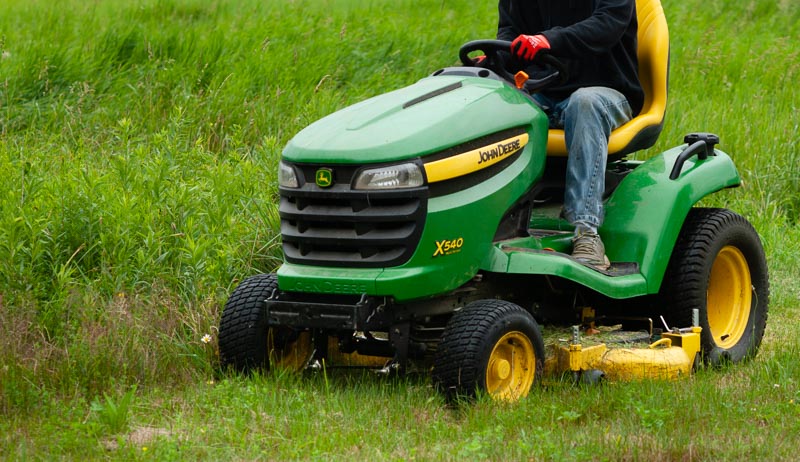
If the area you’re tackling is primarily filled with grass and weeds (as opposed to woody growth), a riding mower might be your best choice. With the deck raised up as high as it will go, a riding mower can slice through some pretty tall grass.

It might not look pretty when you’re done. But if you rake away the clippings, you can mow the area again with a lower deck setting for better results.

To avoid choking a riding mower with too much grass, don’t mow with the whole swath of the deck at once. Start at the edge of the untamed field and cut just half a swath at a time. Drive slowly while discharging the grass into an area you’ve already mowed.

This will limit the amount of grass being fed to the blades. It will also provide you with an opportunity to feel out the territory as you drive.

Plus, by mowing only half a swath of field at once, there’s a good chance your front wheel (the one plunging through the wilderness) will bump up against objects hidden in overgrown grass before the mower deck. This will save you from the screech of blades grinding on an unseen rock.


Read more: These 10 tips will help ensure your mowing is on track.


For Heavy-duty Work, Use a Brush Hog

For the most imposing overgrown fields, a brush hog mounted on a utility tractor might be your best bet. Tall weeds and even some sapling trees bow before the power of these mighty brush-clearing beasts.

You might not get the appearance of a manicured lawn when you use a brush hog. But that’s not the point for your first spin around the field.

Once a brush hog has done the hard work, you’ll have a much better idea of how to proceed with tidying up the job. You’ll be able to see small stumps, low rocks and other obstacles more clearly with the grass and brush mowed down.

These can be removed by man or machine. Then, you can hit the field again with a more refined mower (such as a riding mower), further enhancing its appearance.

Congratulations! You’ve successfully mowed an overgrown field. Perhaps you’ve extended your lawn. Or maybe you’ve done the prep work for digging up a new garden.

With the right tools, anything is possible.

Categories
Animals Large Animals

Miniature Mediterranean Donkeys Make Great Companions

Miniature Mediterranean Donkeys make wonderful pets and companions. Rumor is that they are stubborn. But, in reality, they have much more self-preservation than a horse—and without the flight instinct.

When you ask them to do something new, they will need to sniff it, touch it, maybe put a foot on it before they comply. They are extremely intelligent and eager to please, once you have established a bond and earned their trust.

Miniature donkeys, however, are not livestock guardians. 

The History of Miniature Mediterranean Donkeys

Miniature Mediterranean Donkeys originated on the Italian islands of Sardinia and Sicily. There, they were used as beasts of burden, to pull carts and to turn mills. First imported to the U.S. in 1929, the current registered population is approximately 77,000. 

They have a “cross” and a dark dorsal stripe on their backs and a shoulder stripe that comes down over their shoulders. They tend to be very healthy and sturdy and don’t experience many of the birthing or dental problems that other miniature breeds do.


Read more: Meet Angela Silvera, a trainer known as “The Donkey Listener.”


Caring for Miniature Mediterranean Donkeys

Miniature Mediterranean Donkeys have a typical lifespan of 30 to 35 years. The average height is 30 to 35 inches; weight, 250 to 400 pounds.

Donkeys get fat very easily if they are overfed. Generally, just grass hay and salt/minerals are all they need. A diet of no more than 8 to 12 percent protein is sufficient.

They need regular hoof trims at 10 to 12 week intervals depending on weather and feeding conditions. They need shelter from the wind, rain and snow, but handle the cold pretty well.

Donkeys make great therapy animals, mounts for small children, and hiking and backpacking companions. People also show them in conformation, in-hand and driving events and use them in parades and the sport of pack burro racing.

— Kim Winton, Ph.D., American Donkey Association president, owner of AssN9 Ranch

This article originally appeared in the May/June 2021 issue of Hobby Farms magazine.

Categories
Beginning Farmers Farm & Garden

The Living Soil Handbook: A Book for No-Till Growers

Title: The Living Soil Handbook: The No-Till Grower’s Guide to Ecological Market-Gardening

Author: Jesse Frost

Cover Price: $29.95

Publication Date:  July 13, 2021

Publisher: Chelsea Green Publishing

Chelsea Green

If you’re into no-till market gardening, you’re most likely familiar with Jesse Frost (better known as Farmer Jesse). And you should be. Among other things, Jesse is a farmer, writer (sometimes for Hobby Farms) and host of the “No-Till Market Garden Podcast.” 

He’s now also the author of The Living Soil Handbook, his forthcoming, highly-anticipated book on no-till farming. And, after reading it, I can say that all of the anticipation was justified.  Perhaps even inadequate. 

The book promises to be indispensable for new and experienced no-till growers, or even those who are just no-till curious.


Read more: Can no-till and organic co-exist? Yes! Click to learn more.


Why No Till?

So, why read a book about no-till farming at all? Jesse has some answers. 

As he explains, no-till farming is fundamentally about improving your farm’s ecological health, starting with the soil itself. The more we understand soil science (which we’re really only beginning to), the more it becomes clear that traumatic soil disturbance disrupts the biology at work underground.

This, in turn, impacts the health of your crops and your farm.   

A Collaborative Project

Part of what makes no-till market gardening so exciting today is its collaborative spirit.  Although indigenous people practiced many of the tenets of no-till farming for thousands of years, modern agriculture has largely overlooked these principles. 

Today, no-till market gardeners are in constant process of trial and error to create new growing methods for their farms.

The Living Soil Handbook fully embodies this collaborative feeling.  Throughout the book Jesse draws on the experiences of other no-till farmers, many of whom he’s interviewed on his podcast. 

Beyond that, he’s also not shy about detailing his own failures (and successes) trialing various no-till strategies. All of this adds up to create a book that introduces you to no-till market gardening as it really is: fluid, experimental and collaborative.


Read more: Here’s how you can switch to a no-till garden today.


A Scientific Grounding

Another thing that makes The Living Soil Handbook unique is the amount of science it draws on. But not the dry kind of science that makes you want to skip the rest of the chapter. 

Rather, Jesse is adept at mentioning the scientific literature without being heavy-handed. This kind of scientific grounding feels fitting for a book on no-till growing. 

The case for no-till principles is, after all, a scientific one: that minimal soil disturbance is better for soil health than more disruptive practices.

Altogether, the scientific background that Jesse provides throughout the book feels like its building to an important (but subtle) point: Knowing and caring about the why and how of farming is actually extremely important. 

And it is, in fact, part of what separates the good growers from the mediocre ones.

Detailed Roadmap 

There are many things to like about the book. The illustrations by Hannah Crabtree (Jesse’s wife) are, for instance, near the top of the list. 

But, perhaps the book’s largest offering is the amount of detail it provides on specific no-till practices. Reading this book will, in short, provide you with an incredibly detailed map to no-till growing.  

As Jesse acknowledges, though, not everything that he’s worked out in the book will apply directly to your farm. In fact, it probably won’t. 

Soil types vary, as do climatic conditions, market-demand and just about everything else on a farm.  But what the Living Soil Handbook will do is provide you with a place to begin and a well-informed understanding of where you might go from there.

Buy the book. Your farm (or garden) will thank you.


Categories
Podcast

Episode 9: Nate Kleinman

Farmer, seed developer and activist Nate Kleinman talks with Growing Good host Lisa Munniksma about his work in the food system and advice for growing some unusual perennial crops. Hear about Experimental Farm Network’s development of perennial staple crops to adapt to various growing conditions—and about how you as a citizen scientist farmer can take part in developing these seeds. Learn about seed rematriation and the work of relationship building behind that effort. And find out how the Cooperative Gardens Commission started, including a small history lesson on the phrase victory gardens, and how this organization grew by leaps and bounds in the early days of the pandemic.

Be sure to listen to the end for advice on how to grow passionfruit, or maypop, even if you don’t live in a subtropical environment. Nate also tells us his favorite crop to grow. (Hint: It’s the fourth most widely grown grain in the US, yet most of us have never planted it.)

Experimental Farm Network

EFN Seeds

Maypop Passionfruit Improvement Project

Cooperative Gardens Commission

Indigenous Seed Keepers Network

Categories
Crops & Gardening Farm & Garden

From The Herb Garden: Yarrow Is Beautiful & Beneficial

Yarrow is native to most of the Northern Hemisphere and has been introduced into Australia and other areas where it has widely been used to feed livestock. Commonly found on roadsides and open fields, this herbaceous perennial can also be spotted in landscape designs, as border plants along walkways and in medicinal herb gardens.

We learn much about this useful plant by studying its name. The Latin binomial for yarrow is Achillea millefolium. The genus, Achillea, comes from the Greek character Achilles and story of how he would use this herb to treat the battle wounds of his soldiers.

In fact, the herb’s leaf is considered both antiseptic and styptic. These traits that would confirm the herb’s beneficial qualities referred to in the Achilles legend.

Yarrow was used in a similar manner during the American Civil War. On battlefields, it earned the nickname “woundwort.” 

The specific epithet, millefolium, which means “a thousand leaves,” accurately describes the feather-like appearance of yarrow’s leaf. In fact, in some Spanish-speaking areas of the world, the herb is known as “plumajillo.” This translates to “little feather.”

In the Landscape

The herb makes a wonderful addition to any garden or landscape. The typical wild yarrow boasts full white flowers during peak summer months. These blooms are born upon erect, narrow stems that reach up to 3 feet or more in height. 

There are numerous cultivars available from local nurseries. They offer a wide range of available blossom colors including pinks, reds, yellows and oranges. Many of these strikingly colorful yarrow varieties have even been recipients of the Royal Horticultural Society’s Award of Garden Merit. 

Incorporate yarrow into your landscape anywhere you need a burst of color. Utilize its tall, narrow stems as a vertical element to add balance and form to your garden beds.


Read more: You should also consider comfrey for your herb garden. Here’s why.


In the Apothecary

As mentioned above, yarrow has a history of topical use for treating wounds. Consider crafting a salve from your harvest to use on cuts, scratches, bruises and other abrasions. 

(Learn more about how to craft an herbal salve in my book, The Artisan Herbalist.)

Simply chew up a yarrow leaf and use it as a natural band-aid if you need a little first aid in the garden! The masticated leaf will help stop bleeding and disinfect your wound.

A tea brewed from the flowers and leaves of yarrow is useful in relieving digestive complaints. It may also work as a sleep aid. Try blending with chamomile flowers for a sleepy-time tea! 

In the Kitchen

Although not popular as a vegetable, yarrow is certainly edible. Some folks describe its flavor as grassy. But others may find it too astringent to be palatable.

You can add it to salads or cook in stir fry. Most commonly, though, you’ll find it in herbal tea.

Before the widespread use of hops, yarrow was included in the blend of herbs used to flavor beer. In the Middle Ages, this herb blend and the resulting beverage, was known as gruit.

While not as common as it once was, gruit is making a bit of a comeback. You may even find it offered at a local microbrewery.  


Read more: Home brewing your own beer is the perfect hobby for staying in.


Growing Yarrow

Yarrow is quite drought tolerant. Once established in your garden, it will thrive for years.

A perennial herb, yarrow spreads by underground rhizomes. Bunches should be split every few years to encourage healthy growth.

If growing yarrow from seeds, remember that germination rates are highest in warm temperatures, around 70 degrees F. The seeds also need light, so lightly cover them with 1/4 inch of soil or less when planting.

And keep the seedbed moist. Yarrow prefers well-drained soil and full sun, but it will do fine in partial shade as well. 

Butterflies and other beneficial insects certainly love yarrow. And once you try adding some to your garden, I’m sure you’ll love it too!

Categories
Beginning Farmers Equipment Farm & Garden Homesteading Urban Farming

A New Breed Of Yard Shoes Focuses On Productivity

The other day, after a day of rigorous gardening, my wife looked at me and asked, “Is this how most people do yard work?” I don’t really know the answer to that, but as I looked at the both of us, caked head to toe in mud, sweat, feathers and plant debris, I understood her point.

We garden hard.

And for us, as with many folks, fashion is the last thing on our minds as we head out to tend to our plot of land. But we do consider a few things when getting dressed to play in the dirt.

Like, we need durable pants and disposable shirts. We put a lot of stock in hardy work gloves. And a cheap farm store hat with a breathable back? So necessary.

Footwear Matters in the Garden, Too

But what about shoes? I’ve personally struggled over the years with determining what to shove my toes into while doing outside work. In my more suburban days, I, like many, kept a pair of retired tennis shoes handy for mowing and weeding the lawn.

But as more and more of my lush, green lawn gave way to vegetable beds and flower gardens, the green-tinted tennies struggled to keep up. Mud soaked through the fabric, for starters, leaving my feet soggy and sore. Stomping on shovels feels dicey in sneakers, too.

And, once subjected to serious yard work, those old shoes actively started falling apart.

Workwear for your Feet

Of course, the issue of work shoes isn’t unaddressed by myriad products. When I lived on and worked our family farm, durable rubber rain boots kept me (mostly) dry during mud seasons in the muddy hog yard.

I’ve walked pastures in cowboy boots. And I love my leather work boots so much that I’ve considered ordering a backup pair, just in case. (I’ve replaced them once already.)

And while I haven’t personally gone the route of garden clogs, I know they’re plenty popular.


Read more: Mind your hands with the right gardening gloves for your needs.


What Are Yard Shoes?

So I’m not gardening barefoot for lack of options. But recently, I was contacted by a representative from a company called Kujo Yardwear about an interesting new option they call “yard shoes.”

Full disclosure: They sent me a pair to try out. And, because I’m a creature of habit, they sat unused for a few months as I tromped around our yard in my rubber boots.

But the other day, like many days this summer, it was really hot. And I dreaded the idea of unbreathable rubber rubbing against my calves all day. So I pulled out the Kujos, laced them up and took them out for a day of gardening hard.

Yard Shoes: A Brief Review

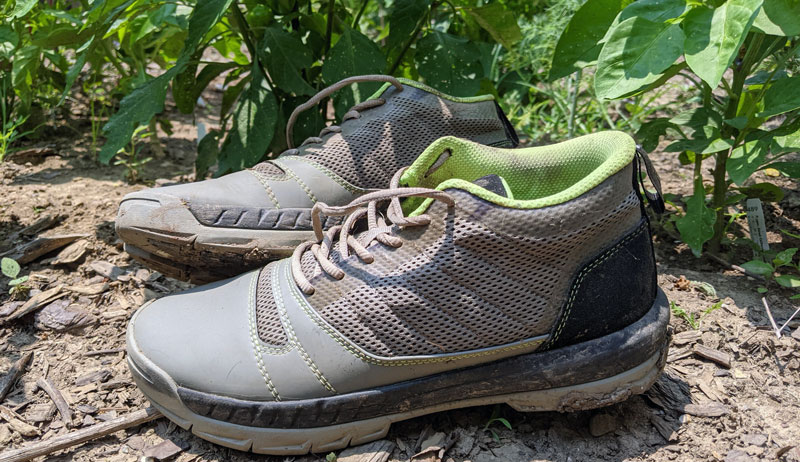
Kujo’s yard shoes aren’t exactly revolutionary, but they are a good idea. They’re built like tennis shoes, with a breathable top. But the toecap is a heavy rubber or plastic, and the sole feels sturdy like a boot.

“It’s a unique hybrid shoe built specifically for the yard’s terrain,” says Kelsey Martin, Kujo’s Chief Marketing Officer (and sister to founder, Shawn Langton). “Lightweight, breathable, comfortable, water-resistant and nonslip.”

Putting these claims to the test, I headed out to perform the following tasks:

  • Pull beets and garlic
  • Clean chicken coop and run
  • Reset garden fence line
  • Dig out a small tree stump
  • Relocate a bunch of Black-eyed Susans
  • Hand-till and seed a patch of garden for future lawn space

Like I said: We garden hard. The Kujos kept up through it all, too, even stomping on a shovel repeatedly throughout the day. And longevity is actually a part of the company’s stated aim for their product.

“For longer days and lots of steps, the comfort is a noticeable improvement … because of our cushioned EVA midsole on top of our rubber outsole,” says Martin. “This makes our shoes more akin to the anti-fatigue wear of a running shoe.”

The lace-up shoes offer a snug fit, which does come with an unavoidable downside: They don’t slip off and on with the ease of a rubber boot. (The bootstraps help, though.) So if you’re in and out of the house all day and disinclined to tracking in mud or chicken muck, pulling them off and on can get old.

My other complaint is the neon green detailing on the gray shoes, but that’s just an aesthetic preference. I’m more of an earth tones guy, so were this not a review product, I probably would have opted for the solid black design.

My garden isn’t a catwalk, though, so the color doesn’t really matter. (But I might change shoes before heading to the farm supply store.)


Read more: Pounding fence posts? Tilling by hand? For many tasks, hand tools get the job done best.


Farm-Ready Footwear

Kujo’s marketing seems pretty focused on the weekend yard warrior. And I’m sure they’re great for mowing grass, whacking weeds and annoying neighbors with a deafening leaf blower.

But as a gardener with farming experience behind me, I’d say Kujo’s yard shoes (and, I assume, similar products put out by other brands) can stand up to a number of rural demands. Martin says this is by design.

“Shoes are another tool for the farm that can help things get done more efficiently,” she explains. “Investing in proper footwear affects how hard you can work, how long you can work, and how well you can work.

“Small and hobby farmers have a lot on their plates, which is why they can’t afford to be handicapped by the elements or fatigue when there are options out there designed specifically for them.”

I’m inclined to agree. And next time I have a long day of outside work ahead of me, I might invest the extra two minutes in putting on yard shoes over jumping into rubber boots.

Categories
Farm & Garden Farm Management Homesteading Urban Farming

Annexation & Your Small Farm: What Now?

Running a small farm is challenging enough from day to day without the added headache of an annexation fight. But sometimes the nearest municipality does come knocking. There are many ways annexation—being absorbed from outside the city limits into the city proper—might affect you.

Fortunately, whether you live on a small farm or an informal homestead on a rural lot, you do have recourse against annexation plans.

Annexation May Limit Land Uses

According to Jennifer Dempsey, annexation can undermine the viability of farm operations in several ways. Dempsey is director of the Farmland Information Center and she serves as Senior Advisor with American Farmland Trust.

“City and town zoning codes may prohibit or limit certain agricultural uses,” she says. “Even when existing operations are grandfathered in, they sometimes aren’t permitted to expand or alter their activities.”

For example, after annexation, the city might allow your farm animals to stay. However, that doesn’t necessarily mean you can replace them—or add more—in the future.

“Annexation may also attract new neighbors, who may object to normal agricultural activities,” Dempsey says.


Read more: Small farms need a farm plan, too, so here are some tips for getting organized.


New Services Can Mean Bigger Bills

Successful annexation can also mean higher land valuation—and higher property taxes. “The tax rate may be higher because more developed communities often offer more services and impose a higher tax rate to help pay for them,” she adds.

Some cities may require annexed homeowners with septic systems to connect to sewer lines at their own expense. They may also bear responsibility for ongoing maintenance of pumping stations and other related fees.

What’s more, if the city extends services like sewer and trash pick-up to your area, this can lure would-be developers. Dempsey continues, “This can drive up surrounding land values, which can make it difficult to expand an operation.”

Political Remedies Do Exist

Richard Klein has helped people with annexation issues since the 1970s. He is also founder and president of Community and Environmental Defense Services.  “Most people think that the way that you win these battles is with a lawyer trying to kill it,” he says. “And that only works about five to 10 percent of the time.”

Political rather than legal remedies tend to work better. “It’s a lot more likely that you’ll stop a bad annexation by convincing a large number of voters who live in the annexing jurisdiction to come out against it,” he says. He suggests several methods for mobilizing voters who wish to oppose flawed annexations that may negatively affect quality of life.


Read more: Keep these things in mind when you put your small farm up for sale.


Don’t Forget the Power of Petitions

“With an annexation battle, the goal is to demonstrate to elected officials that there are lots of voters who live in their district who are going to look upon the elected official as being a good guy if he opposes the annexation,” Klein says.

To that end, he contacts registered voters living within the targeted annexation area via first-class mail and invites them to sign a petition. (If you can’t easily obtain a registered voter list from your state, consider purchasing the list from a commercial vendor.)

He also contacts neighborhood associations and other potential allies that may share concerns about an annexation’s potential negative effects. (Think higher property taxes, school overcrowding, and increased traffic congestion, for instance.)

“This varies from state to state, but most require that at least half of the property owners must agree to annexation,” he notes.

Just be sure to use a suitable petition platform. “A lot of people use … Change.org or iPetitions,” Klein says. “The trouble with those is that you can’t get the street address or phone number or email address for your petition signers. And you get a lot of people signing who don’t live in the jurisdiction.”

With platforms like Survey Monkey, you can download petition signers’ names, addresses, phone numbers and email addresses for all your petition signers.

Still, some jurisdictions require physical signatures, rather than online entries. Check the regulations in your area before you set up your own petition.

Be Proactive

If you live in certain U.S. states, you may have more power than you think. Sixteen states have “agricultural district programs”—a kind of farmland protection tool. (See the Farmland Information Center’s publication, Farms Under Threat: The State of the States, to learn more.)

“Districts allow landowners to form special areas where agriculture is encouraged and protected,” Dempsey says. “Limits on annexation is one provision included in district programs in California, Kentucky and Minnesota. Agricultural landowners in the other [district program states] could work with … lawmakers to expand the set of protections offered.”

Perhaps the best idea? Learn all you can from your local land-use officials well before potential annexation. “[Farmers and ranchers] can ask if their community and the neighboring city/municipality have up-to-date comprehensive plans,” Dempsey suggests. “Then find out which areas are planned for future growth and which are targeted for protection.”

Informing yourself can strengthen your potential negotiating power. “[You] might be able to propose local measures to limit nearby municipalities’ ability to annex land without landowner approval,” Dempsey concludes.