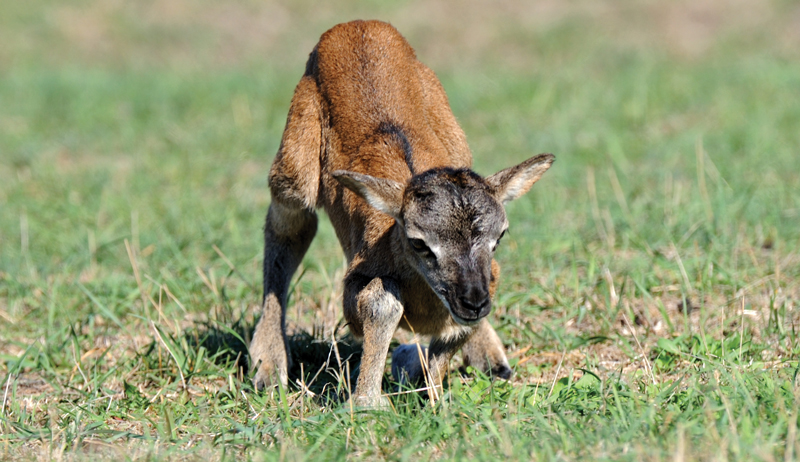
Six years ago, Candace Rice purchased Zeus as an addition for her small farm in Silex, Missouri. The then 6-month old Angora goat joined her herd of horses and donkeys. Not long after bringing the kid home, she noticed that his urine had tinges of red and brown mixed in.
She called her veterinarian, who first thought the condition was a urinary tract infection or a urinary calculi (solid particles were in the urinary system). The first step was bloodwork and antibiotics.
But when Zeus didn’t improve and the test results were inconclusive, Rice knew she needed additional help. So she reached out to a university veterinary center.
“If you don’t seem to be getting anywhere with your local vet, get to your nearest university veterinary center as soon as possible,” she says.
Additional bloodwork and bone marrow aspiration, a procedure that draws out the soft spongy tissue inside the bones, revealed Zeus has an auto-immune disorder called autoimmune hemolytic anemia. The disease is rare for a goat.
“The auto-immune disorder kills most of his red blood cells before they get to his bloodstream,” she says. “What we thought was blood in his urine was actually the pigment of destroyed red blood cells.”
“A disorder in which red blood cells are destroyed faster than they can be made. The destruction of red blood cells is called hemolysis. Red blood cells carry oxygen to all parts of your body. If you have a lower than normal amount of red blood cells, you have anemia. When you have anemia, your blood can’t bring enough oxygen to all your tissues and organs. Without enough oxygen, your body can’t work as well as it should.”
Treatment
The vet prescribed prednisone, a corticosteroid that is used in people and other animals to treat conditions ranging from blood disorders to arthritis, allergies, immune system disorders, breathing problems and more.
“Now that he’s on prednisone, he rarely has an episode of pigment in his urine. And we haven’t been able to pin down a cause when it does happen,” Rice says. “The last time was when we sheared him in the spring. So, possibly stress brings it on. But he had no reaction (no urinary pigment) when we sheared him this fall.”
One of the big challenges to caring for Zeus is that not much research has focused on hemolytic anemia in goats and it’s difficult to pinpoint the exact cause.
An episode may be triggered by ulcers, blood disorders, certain types of toxins, a lack of certain trace elements, vitamin B12 deficiencies, autoimmune disorders and chronic disease.
Rice describes Zeus generally as a hard keeper. The medication instructions direct to give it with food, but there are days he turns his nose up at all food. She keeps a variety of grains in the feed room and has options ranging from straight oats and straight barley to rolled options of both, prepared grain and timothy pellets. And she even offers split peas (which are high in iron), sugar beets and sunflower seeds.
“There’s a lot of back and forth when he turns his nose up at his regular ration,” she said.
Because goats are grazers and her pastures are mostly grass, she trims oak and willow branches from around the property or cattails by the lake and brings them back. Select herbs from the garden are also occasionally on the menu.
Rice sees caring for the goat as a labor love and admits that one of the biggest challenges is the lack of research on the rare disease. Although it can be difficult caring for a goat with a rare disease, she says the best approach is monitoring his condition.
“As with any animal, closely observing behavior so you know what’s normal and what isn’t—from changes in appetite to quantity and quality of urination and defecation—is key,” she said.
Whether you’re frying eggs and bacon on the stove top or baking a crispy batch of cornbread, cast iron cookware performs better for a tastier dish. And the metal’s durability makes for a great heirloom piece or thrift store find. But caring for a cast iron pan requires a few extra steps, and first up, you’ll want to season it.
This important step protects the metal against rust and deteriorating damage. Season your cast iron pan right, and every time you cook with it, you’ll build a lasting surface.
In this video, we walk you through the steps to cleaning a worn cast iron pan and seasoning it. It’s not difficult at all to return cast iron cookware to perfect usability!
The No-Till Organic Vegetable Farm by Daniel Mays is different from other no-till books that have come out recently. Whereas other books have focused in on the practices used to minimize tillage, Mays has larger ambitions. Although Mays’ book certainly outlines various no-till strategies, it also aims to provide a complete guide to running a no-till vegetable farm.
The No-Till Moment
In many ways, the book feels right for the moment. At a time when no-till, organic vegetable farming is becoming increasingly popular, Mays’ book provides an important perspective: No-till methods can enable real financial stability on a vegetable farm.
As Mays describes, “the goal of this book is to show that no-till farming on a few acres is not only possible—it can be at once economically, socially and ecologically enriching.”
Throughout the book, Mays provides details about his own farm’s finances, something farmers are typically reluctant to do.
“I began the farm with a loan of $180,000 and an interest rate of 3.8 percent. Four years later, the farm grossed over $250,000 in a season. Today the farm sells about $300,000 of food each year from 2.5 acres of vegetables and about the same size of pasture.” Mays also provides detailed cash-flow budgets from Frith Farm (his own operation), and spreadsheets detailing the expected startup costs for similar operations.
More Than Money
The No-Till Organic Vegetable Farm covers much more than just farm finances, however. The book touches upon all the various aspects of starting and running a farm. In many ways, it feels like a comprehensive manual. Although reading The No-Till Organic Vegetable Farm won’t turn the uninitiated farmer into Eliot Coleman overnight, it certainly won’t hurt either.
Individual chapters describe topics ranging from finding capital to crop planning, implementing irrigation systems, harvesting and marketing. For the new gardener, the book promises to provide invaluable information about the basics of plant and soil health.
And for the seasoned grower, there’s no shortage of technical detail about refining farm systems and developing no-till practices.
Wealth of Knowledge
The book’s ambitions are truly encyclopedic. In a section on drainage, Mays dives into the particulars of constructing a French drain, complete with a diagram. And in a chapter on farm infrastructure, Mays gives advice on how large an electric panel a vegetable farm needs. (He decides on 200 amps, which is probably not bad advice).
In the same chapter, Mays advocates learning basic construction and electrical skills, and tackling wiring projects on the farm oneself. And although there is no chapter in the book on the basics of wiring, it almost wouldn’t feel out of place if there was.
The book is undoubtedly rooted in the importance of no-till practices, though. And Mays returns to this point throughout. As he writes at one point, “the best approach to caring for the soil is usually to stop messing with it.”
In short, The No-Till Organic Vegetable Farm is an invaluable resource that will help farmers and gardeners hone their craft. It offers a compelling and detailed guide to implementing no-till practices, and to designing a farm that is both ecologically and financially sustainable.
“I’ve always had a love for animals and being outside and the hard work and reward that comes from farming,” says Caitlyn Blom, a co-founder of Honey Blom Farms in Knoxville, Tennessee, that she runs alongside her wife, Ciara Blom.
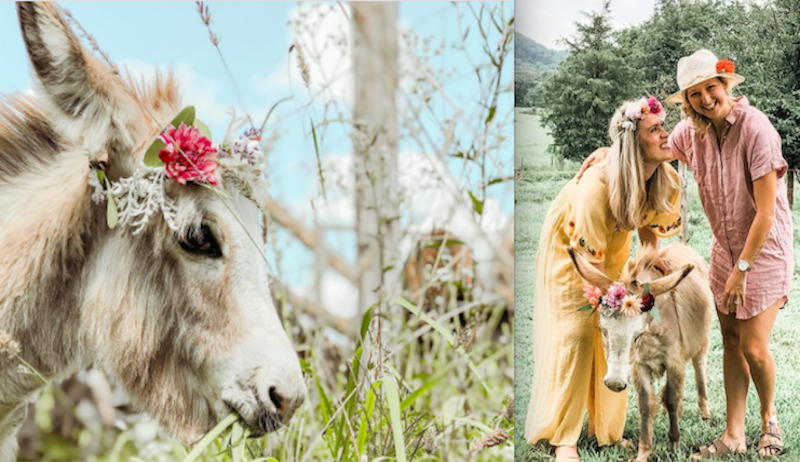
Since launching the farm in the spring of 2018, the venture has gained a reputation for its resident miniature-donkeys and miniature-Nubian dwarf goats—both of which have become eye-catching stars of the venture’s social media accounts.
We spoke to Blom about the roots of Honey Blom Farms and why miniature-donkeys make for such great livestock guardians. We also got the scoop on a little something called goat glamping.
Blom says that her interest in farming goes back around a decade or so ago, when her family had “a small farm that was really driven by my love for animals and gardening.”
After the family farm venture was sold, Blom says that she knew she “always wanted to have a farm again one day—but I didn’t think it would be this quickly!”
Miniature donkeys play a key role at Honey Blom Farms, primarily by acting as livestock guardians on the premises.
“When our family had a farm we had a donkey who was a guard for our cows,” recalls Blom. “Donkeys are just terrific guard animals and such unique equine in themselves. So two of our mini donkeys were the first animals on the farm because I knew I wanted them as guardian animals for our goats and chickens.”
Since the days of those initial two miniature donkeys, Honey Blom Farms has now started its own breeding program.
If you check out the Honey Blom Farms Instagram account, you’ll notice a few mentions of the hashtag GoatGlamping. The concept will involve guests staying at the farm in a plush renovated 1968 camper van and getting to frolic with the resident goats.
Blom says that they plan to launch goat glamping in early 2021.
Clara is one of the star goats at Honey Blom Farms. “She has no fear and is certainly the most outgoing goat,” says Blom. “She’s the first to greet the people that come to visit.”
She adds that Clara was bottle fed “so I think that led to her being extra attention needing” and that “if she could live in the house, I think she would!”
“Farming’s a lot of hard work and there’s so much grit and poop and tears and stress that goes into it,” says Blom when asked about the most rewarding part of the farming lifestyle. “But at the end of the day, being able to create your own food source and caring for your animals and the sense of joy that comes around that is the best feeling.”
The neighbors’ leaf pile looked even bigger than usual this year. And, so, it pained me even more to watch it ignite. Like many in my county, they regularly burn their yard waste.
The wet leaves produce extra-heavy smoke. (They also release loads of carbon monoxide and some known carcinogens, too!)
Other folks bag their leaves. Some bags head to landfills. Others are composted elsewhere. For my part, I used to remove every last stalk and fallen leaf to compost in my own bins.
But, when it comes to the overall health of our landscapes and the productivity of our gardens, none of these practices is exactly ideal.
Turns out, those leaves and plant stalks do a lot more good when left in place—or when they’re only slightly rearranged during garden cleanup. Taking this more relaxed approach helps to provide crucial habitat for overwintering pollinators, mammals and even amphibians.
It also works in our favor by insulating perennial plants’ roots and enriching the soil for next season.
“Depending on where you live, you can easily have 30 to 40 different native [bee] species in your garden,” says Matthew Shepherd, Director of Communications and Outreach for The Xerces Society for Invertebrate Conservation. “People don’t always realize there’s this level of diversity, because, when we think of bees, we think of honeybees or bumblebees.”
But in North America, there are more than 3,600 native bee species. “They’re all facing the same problems with pesticides and lack of habitat,” Shepherd notes.
Many native bees actually live inside hollow plant stems, so leaving these standing can be hugely helpful to these valuable pollinators. “If your stems are 18 inches to two feet tall, you could probably get away with that without your neighbors complaining too much,” he says.
As for taller plants?
“You don’t necessarily have to leave the entire stem,” Shepherd says. You can simply trim these down to the 2-foot level and then loosely pile the cut stalks in an out-of-the-way spot. This enables any native bee occupants to safely remain there all winter and emerge during warm weather.
“They need a full year of stability in their nest,” he explains. “For some of those bees, they won’t be adults until May or June or July. So, if you’re taking those stems out in spring, you’re doing away with any benefit you might’ve created.”
Susan Brackney
Leaving the Leaves
As with native bees, Shepherd notes, “There are also dozens of butterfly species that are threatened, declining or rare across the country.” Many of these, including some swallowtails and luna moths, overwinter amongst fallen leaves. So, when you remove the leaves—or shred them—you’re doing away with some of next spring’s butterflies.
“With the leaves, the idea is you can leave them in the back of your flower border or at the base of a hedge row or wherever to allow them to rot down,” Shepherd says. “They provide the longer-term cover for the beetles and the caterpillars and other things that might be sheltering in there or they just break down and help the organic matter in your soil.”
He adds, “We’re not saying you have to keep all the leaves. And you don’t have to leave them everywhere. It’s perfectly fine if your grass needs to be raked. Then rake it, but take the leaves, and, if you can put them in a corner somewhere, that’s great.”
If you do pile your leaves inside flower beds during garden cleanup, be sure to leave a little space around the crowns of any delicate perennials to avoid smothering them.
Wondering what the neighbors will think? There are some things you can do to counterbalance the less-than-tidy look.
First, telegraph that the garden cleanup moves you’ve made are intentional by trimming any tall grass along the outer edge of your planting beds. Likewise, neaten any bricks, blocks or other hardscaping features you may have put in place to help delineate the perimeter of your gardens.
You might also install bird feeders, pretty stones or even a solar-heated birdbath to add extra interest inside your overwintering gardens. And, if you chose to trim back extra-tall stalks, consider arranging some of these in a tent- or teepee-like fashion. This can add still more visual interest and provide windbreaks for birds and other small creatures.
Want to go the extra mile? The Wild Seed Project offers an attractive, free “Leave the Leaves” sign. Have it color-printed and laminated—or place it in a protective frame—to display outside for any curious passersby.
As a kid, it took me a while to understand which things didn’t belong in the house: muddy shoes, frogs, birds’ nests, bicycles, etc. I’m still working on not bringing birds’ nests and my bicycle into the house, but I clearly see the virtue of keeping certain things out. The same goes for the chicken coop: Not everything belongs in there.
I realize that some chicken-keepers are repurposing a shed as a coop, so it naturally has room for other things besides chickens. And there seems to be some kind of Murphy’s Law that stuff will fill the amount of space available.
But if you’re starting from scratch and building a chicken coop, my general advice is that the coop should only be big enough to function as the windproof and waterproof box that the chickens sleep in. Setting this as a goal means you will have a chicken coop that demands less time, materials and money to build. It’ll also demand less of your time for maintenance.
And by keeping lots of things outside the chicken coop, you also save lots of time, money and hassle in other ways.
Waterers
I almost never have to top up our chicken waterer. Every time it rains, it fills up from a short gutter and downspout mounted under the coop’s roof. In seven years of chicken-keeping, I’ve only had to top it up for lack of rain maybe twice a year.
But if that kind of waterer were inside the chicken coop, there would be heck to pay. Chickens don’t like waterbeds or watery bedding either.
Putting the waterer inside the coop means you won’t be getting free water and more free time. Instead, you’ll be like an overworked and underpaid waiter, topping up everyone’s water when you might rather be doing something else that doesn’t require putting on muck boots.
If you already have your waterer sitting in the chicken coop or you’re just getting started, here’s a shopping list from top to bottom:
a short section of rain gutter with screws
a flexible plastic downspout
a 5-gallon bucket holder (you can get these from most farm-supply stores)
a 5-gallon bucket with lid, three poultry nipples and an 1 1⁄32-inch bit
First, mount the bucket holder so the bottom of the bucket will be at about head height for the chickens. Drill holes in the bottom of the bucket for the poultry nipples: insert nipples.
Drop the bucket in the holder. Mark and cut an opening for the downspout in the lid. Secure the lid to the bucket. Hang the downspout from the roof. Attach the flexible downspout between the bucket lid and the downspout.
Do a rain dance. Invite the chickens to dance, too. That can’t hurt.
Frank Hyman
Feeders
I haven’t figured out a way for Mother Nature to keep the chicken feeder filled. I have to do that myself. But it takes less time and trouble to refill it when it’s in the pen/run rather than in the chicken coop.
And the feeder and waterer aren’t in the way when I need to clean out the coop either—bonus points!
Most chicken feeders have a tray or saucer that holds the food, leaving it susceptible to rain and vermin. A better way to feed them in the pen is to mount a 5-gallon bucket on one of the fence posts.
While you’re getting one bucket holder from the farm-supply store for the waterer, get a second one for the feeder. Then it’s just a matter of drilling a couple holes in the bottom of the bucket from which to suspend eyebolts.
Drill a hole in the end of a few champagne corks so you can screw one over the end of each eyebolt. (It’s good to have extras to replace old corks that fall apart over time.) Then hang the bucket in the holder, fill it with about 25 pounds of organic chicken feed pellets—this system works best with pellets—and snap on the lid.
I only pinch the lid closed in two places: It makes it easier to remove but still keeps out rainwater.
If you have lots of chickens, you may want to use more than one feed bucket (ditto for waterers). You can also use bigger containers—such as storage totes resting on several cinderblocks—if you have a chicken population explosion.
We installed an automatic coop door that lets us sleep in. But after I installed it, I saw that it had several thin wires exposed inside the chicken coop. I think most chickens would ignore them, but it’s difficult to second-guess which one will think the thin, colorful wires might be something edible.
So I scared up a scrap piece of plywood and cut it to fit. I screwed it into place to cover the wires so we don’t have any electrocutions or electrical fires.
Yes, something like that would be unlikely, but unlikely events that would be tragic if they ever did happen are called “black swans.” So add that to your list of things you don’t want in the coop: “black swans!”
Shatterproof Bulbs Covered in Teflon
Some people want their chickens to keep up egg production over the winter. If that isn’t an economic necessity for you, consider forgoing that option for several reasons.
All female animals have a limited number of eggs they can produce. So any extra production over the winter just shortens the actual laying portion of a hens’ life.
Exposed wiring could attract chicken interest (as explained earlier).
A drop of water on a hot bulb—or flapping wings or an inquisitive peck—could leave your coop floor covered with broken bits of sharp glass shards.
If you cleverly bought a shatterproof bulb, it may be covered with Teflon, which will off-gas and poison chickens.
Heating Lamps
Even at minus 30 or minus 40 degrees F, chickens will be fine in a coop that’s dry and blocks the wind. I mean, come on: They have down coats! And like many animals—but not humans—they don’t lose body heat from their feet.
Humans evolved in balmy Africa, so our extremities are focused on getting rid of excess heat from our feet, hands and head. But some animals—such as birds, cats and dogs—have countercurrent circulation. Blood returning from cold extremities sucks the warmth from blood vessels coming from the heart and return that heat to the heart, so it isn’t lost.
Plus, you don’t want to be like the chicken keepers in Wheat Ridge, Colorado, whose heat lamps set three coops and houses on fire one winter a few years back causing more than $60,000 in property loss and 11 dead birds.
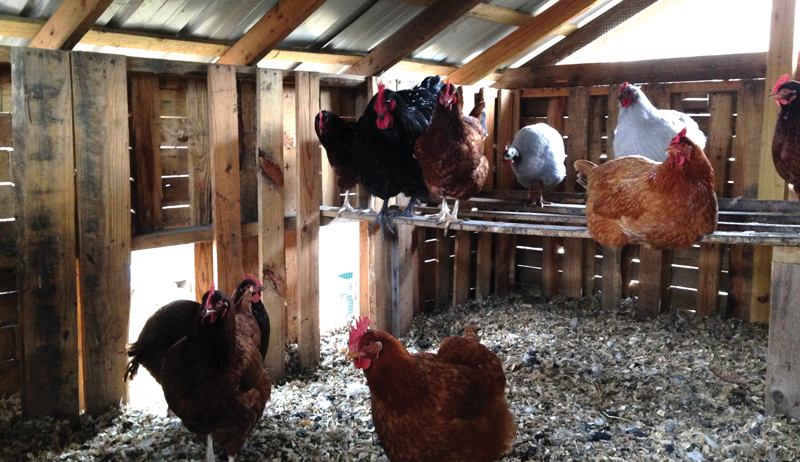
Pine shavings work great as bedding in the coop. Cedar shaving look pretty similar but should be avoided as they can cause respiratory problems.
Not every chicken exposed to cedar shavings will show any problems. But then, not every smoker gets cancer.
Given the availability of alternatives (pine shavings, tree leaves, coffee chaff, pine needles, etc.), there’s no good reason to expose your chickens to cedar dust.
Nest Boxes
Would you rather have to put on muck boots every time you went to gather eggs? I didn’t think so. That’s just one reason to forgo putting the nest boxes inside the coop.
A couple other reasons: With the nest boxes inside the coop, they are more time-consuming to clean out and hens may roost on top of the boxes, creating one more surface to clean.
You’ll save time and hassle by mounting your nest box on the outside wall of the coop.
Specifically on a wall that is outside of the pen. My wife, Chris, was so certain she wanted this that she also insisted on a flagstone path from the back door to the nest box. She can gather eggs while still in her slippers!
Frank Hyman
Henkeepers
Yes, my advice is that henkeepers should stay out of the coop! The exceptions are if you’re leaning into it for cleaning or making some adjustments to the roosting bars or something.
This just goes back to what I said at the beginning: The coop should just be the box your chickens sleep in. There’s no real need for it to be bigger than that. Making it big enough for people just boosts the costs and maintenance.
So there are the eight things that should stay out of the coop. Now if I can just figure out a better place than the dining room for my bicycle.
This article originally appeared in the November/December 2020 issue of Chickens magazine.
The holiday season once again has arrived. This year’s festivities may be most memorable for the socially distant way people are celebrating … and shopping.
Never mind Cyber Monday: All sorts of special online deals have been dazzling gift buyers since Halloween. My husband, Jae, happily trotted into my work area on Saturday to inform me that equipment he must absolutely have for his photo studio has been heavily discounted for the holidays. I nodded absently, commenting that he should add it to his list and I’ll check it out on Black Friday.
Wrong answer. “Black Friday has become Black November! Haven’t you been noticing all the deals??? All the emails? You need to get this for me NOW! Ummm … please?”
Truth is I had indeed noted the uptick in emails being filtered off to my Promotions email folder. I had also ignored the entire lot (sorry, vendors!). I have now shopped for my husband (shhhh! it’s a surprise!) and for my youngest son, with the family elders next on the list. But before I get to them, I must share my top five favorites from the many poultry-related gifts I’ve discovered online.
Call them Bawk Friday deals!
When the Wrapping Is the Gift
Forget about what’s inside the box. How about what’s on the box? This adorable gift wrap features more than two dozen different breeds of birds illustrated in full color and ready to pock … errrr, perk up any gift!
Available in baby blue or teal, each sheet measures 700 mm by 500 mm (roughly 28 inches by 20 inches). Sheets are sold individually or in sets of two, four or eight.
Your loved ones will easily identify which gift came from you.
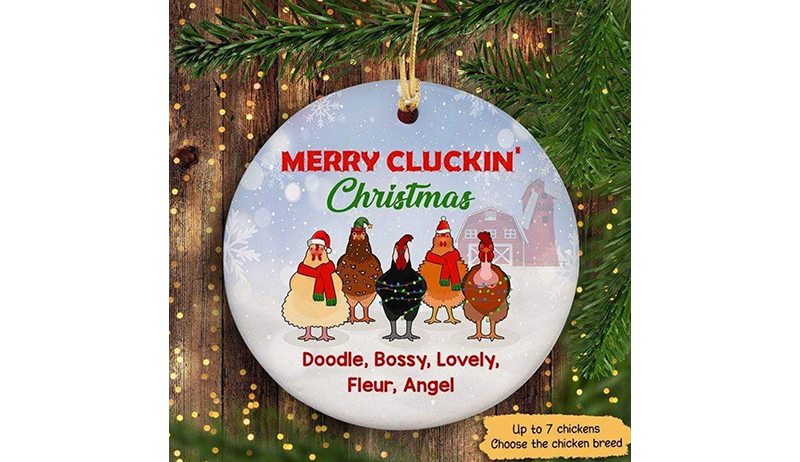
This ceramic holiday ornament from Trending Custom is one of my favorite poultry-related gifts. This 3-inch ceramic circle features a snowy barnyard in the background with the message “Merry Cluckin’ Christmas” in festive letters across the top. The foreground features up to seven chickens, each decked out with either a festive scarf, Santa hat or Christmas lights.
Buyers not only select how many chickens appear on the ornament but also choose from 15 different chicken illustrations, including a White Crested Black Polish, a White Silkie, a Barred Rock, a Turken and more. Customization includes the names of the featured chickens.
It’s the perfect gift for a flock-keeping friend … or a way to remember your birds as the years go by.
I’ll Drink to That!
Many of us may not readily admit this, but we might just prefer our chickens to other people. Chickens don’t hog the bathroom, cut us off in traffic, leave the stove a mess, or drone on endlessly about perceived slights.
Our love of chickens may already raise some eyebrows … which is why this etched tumbler makes an ideal gift for us!
This double-walled, insulated cup keeps beverages at the temperature you want and does so with style! Choose from 14 different colors, including teal, coral and light blue.
Whatever the color, your stainless-steel cup will be emblazoned with the silhouette of a hen and the phrase: “Chickens. Because humans are annoying.” Available in 30- and 20-ounce sizes.
Raising chickens is an everyday occupation. You rise early to release them. You’re home at sundown to lock them up. You muck out soiled litter, scrub and sanitize feeders and waterers, haul 50-pound sacks of feed, perform maintenance on the coop, collect and pack eggs, and are continually vigilant for predators and parasites.
And nobody knows this because, from the street, your home looks like any other house in suburbia.
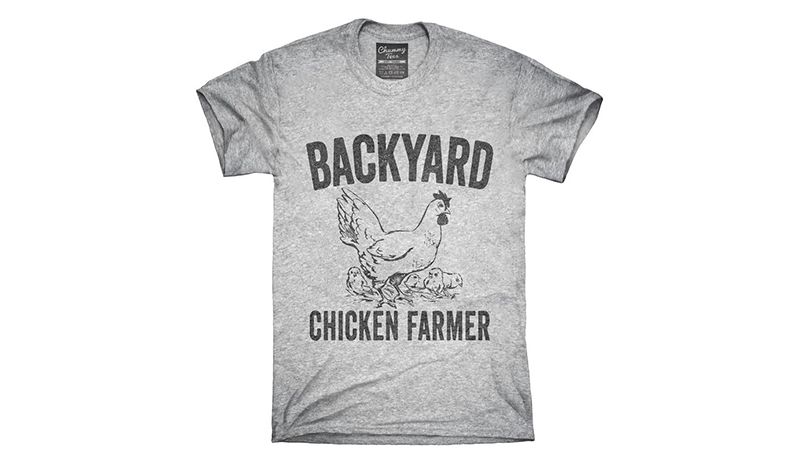
The UPS courier has no clue you tend chickens in your backyard. Neither do the newspaper carrier, the take-out delivery driver, that new couple across the street … nobody! It’s time to let the world—or at least your neighborhood—know who you are with Chummy Tees’ Backyard Chicken Farmer T-shirt. Available in a variety of sizes and also as a hoodie and a tank top, you can proclaim your calling in comfortable style.
Do the Math
Jae and I learned about chicken math our very first week as flock owners. The same holds true for our friends Bill, Carol, Jeremy, Rachel … well, pretty much everyone we know.
We say we’re going to start out with only three chickens. By the end of the week, we’ve got six or eight (in our case, 34). Gosh darn it, how can we resist those fluffy little birds? It’s nigh impossible!
That’s why, when it comes to poultry-related gifts, this sign by Bigtime Signs is perfect for the chicken lover in your life. Measuring 9 by 12 inches, it proclaims your proficiency at chicken math. Hang it on your coop, on your run fence, on your gate, pretty much anywhere.
Like many things in 2020, Thanksgiving Day will look a bit different this year. COVID-19 has turned the world upside down, changing the course of traditional celebrations.
But the core of Thanksgiving—giving thanks—remains unaltered. And since we can never spend too much time counting our blessings, let me start the ball rolling by sharing four farming-related successes I’m thankful for in 2020. Feel free to follow along and share your own list online!
I’m thankful for…
Growing an Abundance of Pumpkins
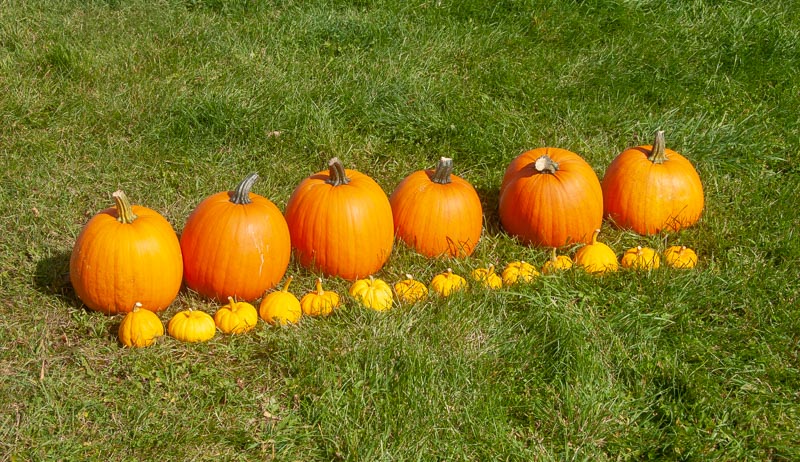
One of my goals for 2020 was to grow pumpkins inside my orchard deer fence, encouraging the vines to climb the welded wire and grow vertically rather than horizontally. I’m happy to report the project was a resounding success.
Planting three different varieties in raised beds, I was delighted to see my pumpkins grow at a rapid rate—they clearly appreciated the rich compost soil and daily watering I provided.
Seemingly every day the leaves grew larger, the vines longer, and—eventually—the pumpkins riper. When all was said and done, I harvested a couple dozen miniature pumpkins and half a dozen medium-sized pumpkins.
Suffice to say, I plan to repeat and even expand my planting in 2021, adding more pumpkins and even some watermelons to the mix. I’m certainly thankful for this farming success!
Another of my major goals for 2020 was to plant two parallel rows of flowering crabapple trees (four trees per row) to serve as a beautiful entrance to my orchard. My vision was clear, but wet ground proved to be a stumbling block.
I planned on planting the two rows on a mild slope, but the ground at the bottom of the slope refused to drain as well as I’d hoped, delaying planting while I pondered my options.
In the end, I planted the bottommost trees about 8 inches above ground level, surrounding their root balls with an abundance of top soil hauled in from elsewhere on my farm. The result was better than I anticipated, creating a win-win situation where my trees can enjoy dry feet while maintaining the two parallel rows I’d envisioned.
Producing 2,200 Bales of Hay
Last year was a down year for hay production of my farm, so I was glad to see the 2020 crop bounce back in a big way. Even though wet weather during the summer made it challenging to find three-day windows for baling, by the time all the fields were cut, ~2,200 small square bales were stacked in the barn.
Not only that, hay season went by with a minimum of equipment malfunctions—only one shear pin gave out. You can’t ask for a smoother run than that!
While spreading some grass clippings along the edge of the farm woodlands, I happened upon an undiscovered patch of daylilies tucked away in the shade of young chokecherry and ash trees. The patch was large—approximately 6 feet across—and while the daylilies weren’t really thriving in their shaded location, they took off as soon as I transplanted a few to my orchard.
Growing in full sun, they flowered steadily, adding a touch of red and orange to the green of the trees. I’m excited to transplant more daylilies in 2021!
In August 2019, Mya and her grandpa came up with a plan to sell the eggs that the hens on the ranch where they live were producing.
This sparked her to create her own company: Mya B.’s Egg Company. For short, she calls it “What’s Crackin’ Egg Co.”
Bootstrapping
Mya began by using her Tooth Fairy money to buy blank egg cartons. She then spent time painting and decorating them. Mya purchased an order booklet and helped her mom create a Facebook page to find her first egg customers.
Within the week, she had a full customer schedule and started collecting those eggs for her clients. She phoned each new customer on her own, asking how many eggs they’d like per week. She inquired if they would they like to purchase on a one-time buy or a monthly plan.
Mya B.’s Egg Company found a lot of support from her new customers. One created vinyl-label egg carton stickers.
Her grandma began sewing bags to deliver the eggs in. (It helped with keeping them from being accidentally dropped.) The eggs sold out each and every week.
Mya spent her egg money on special treats for the chickens and took them fresh produce each day. She created informational videos about eggs that she shared on her Facebook page.
Rising Above Tragedy
Unfortunately, at the end of October, a grizzly bear damaged the coop and her flock. This was a difficult time for Mya. But she was resilient and spent the winter planning to rebuild her company from the ground up.
After receiving Chickens magazine from her grandma, Mya researched the different breeds of chickens so she could restock her flock. She studied all of the different products that would help keep her hens happy and healthy.
In March, Mya had her 8th birthday, and she got her most-wanted items:
a chicken harness for walking her birds
two swings for her coop (one inside and one outside)
a rollaway nesting box
treat holders
a few feed items
Her new Plymouth Rock chicks arrived on March 31. Mya chose them because of their docile and friendly nature.
She repainted and revamped the old petting zoo barn at the ranch and created a beautiful coop for her hens. One of the new features she added was chicken dust, after reading an article in Chickens about feather health.
She decided it would be a good idea to dig in a tire and fill it with dust for her birds.
She has a ladder-style roosting bar that her dad built, and she spends hours each day with her birds, holding them, giving them treats and making sure they have everything they need!
This article originally appeared in the November/December 2020 issue of Chickens magazine.
Congratulations, you’re having kids! Or rather, your doe is pregnant.
Given a female goat’s gestation length ranges between 147 and 155 days—an average of five months—a lot of things can and do happen in that time period, not to mention the actual birth at the end.
Here’s what to expect when your goat is expecting.
Pregnancy
When it comes to breeding during certain months of the year—typical with some farm animals, such as sheep—goats are typically not picky. Females are most fertile when the days are shorter, but this can range from August to March.
That means that kidding season can begin at the start of the new year and continue until late summer.
A doe will frequently ovulate more than one egg, making it more common for goats to give birth to twins and triplets than a single kid. Once bred, confirmation of goat pregnancy can occur as early as 17 days gestation with the use of a transrectal ultrasound probe. Accuracy of pregnancy detection, however, improves later in the gestational development of your goat.
External transabdominal ultrasound is most accurate during the second half of gestation, when the fetus is large enough to detect through the body wall. Many goat producers choose to ultrasound their does between 45 and 90 days. This is a good window to count the number of goat fetuses present and then sort the does based on their pregnancy needs.
Kevin Carvalho/Shutterstock
Healthy Does
Before breeding, a doe should be in good body condition. On a scale of 1 to 5, a doe should have a body condition score (BCS) between 2.5 and 3 at breeding, meaning her backbone is not prominent and her ribs are barely felt.
Keeping a doe at a BCS of 3 during pregnancy is ideal. Watch her weight carefully and manage her diet. Later in pregnancy the goat fetuses grow quickly, placing heavy demands on the mother’s body stores of fat and daily calorie intake.
Knowing whether a doe is carrying a single versus multiple kids helps manage her dietary intake during gestation.
A goat in good health at the start of gestation has the best chance of a healthy pregnancy and kidding. In early gestation, assess the doe’s parasite burden and deworm if necessary.
Make sure she’s up to date on tetanus and clostridial vaccines. The most common combination vaccine is referred to as “CD&T,” which stands for clostridium Types C and D and tetanus. If you know your geographical area is endemic for bacterial pathogens such as chlamydia and campylobacter—two primary causes of infectious abortions in goats—vaccinate your doe for these at this time as well, and booster if necessary.
During pregnancy, a goat should receive high-quality forage as well as free access to a mineral and salt source and water. You may need a concentrate supplement in the last month or two of gestation.
Assess her BCS every two to three weeks during pregnancy to make sure her body condition remains ideal.
In addition to paying close attention to diet, stress reduction in a pregnant doe is very important, particularly in the last month of gestation. This means avoiding activities such as:
Abortion can occur at any time during gestation, although most are seen in the last two months. The normal abortion rate in goats is around 5 percent.
Most causes of abortion are infectious and primarily bacterial. However, there are some viral causes as well. Early vaccination can help prevent some of these bacterial causes — for example against the bacteria chlamydia and campylobacter.
Stress is also a common cause of abortion in goats. Heat stress in the summer months can result in fetal loss. Other herd stressors, such as predator attacks and severe weather (storms, flooding, etc.), can also have negative impacts on gestation.
The best two preventions against abortions in does are ensuring a low stress environment on the farm and instituting robust biosecurity measures. Keep pregnant goats away from cattle and hogs, and don’t allow contact with goats from other farms.
If a doe aborts, keep her away from others who haven’t kidded yet. Try to keep feed off the ground and away from urine- and feces-contaminated areas in the pen or field.
Submit any aborted fetus and tissue (such as placenta) to a laboratory with the capability of running abortion diagnostics, including bacteriology and virology testing. This may be a university laboratory. Contact your veterinarian or extension agent for the best place and methods to send samples in your area.
Also be aware of the zoonotic potential of some infectious agents that cause goat abortion. Always wear gloves and wash your hands after handling aborted tissues.
Other Issues
Goats are unique in that they occasionally experience a hormonal imbalance that causes pseudopregnancy. When this occurs, a doe’s body thinks she’s pregnant when she’s not, incredibly to the point where the doe will have an enlarged abdomen with a uterus full of fluid as well as udder development!
The cause of this imbalance is not entirely understood. Although not common, it may occur in the same individual only once, or multiple times.
An injection of prostaglandin by your vet will re-balance the reproductive hormones and treat this condition without further harm to the animal. When the uterus expels the excess fluid, the colloquial term is “cloudburst.”
The biggest danger for a goat entering the last few weeks of pregnancy is a condition called pregnancy toxicosis. Seen most commonly in thin does carrying multiple kids, this condition occurs when the doe can’t consume enough calories to support the growing fetuses.
This causes an emergency shift in her metabolism. The liver begins mobilizing fatty acids to produce more glucose. If the liver can’t produce enough glucose, it begins to make energy in the form of ketones, resulting in ketosis.
Over time, this becomes toxic.
Early signs of pregnancy toxicosis in a goat are depression and inappetence. If you notice a heavily pregnant doe not eating, act fast. This condition progresses rapidly, and the doe can quickly develop severe neurological signs, including:
incoordination
circling
teeth grinding
tremors
recumbency
death
Measuring ketones in the urine is diagnostic, although clinical signs warrant quick treatment without waiting for further tests.
Treatment has to be immediate and extreme. Primarily, the fetus(es) must be removed, as they are the drain on the doe’s glucose stores. This can be done by C-section or pregnancy induction with steroids, depending on how late in gestation this condition occurs.
If caught early and the fetus is mature enough for birth, mother and kids may survive. More commonly, the kids are premature and do not live.
Other supportive care for the doe includes IV dextrose and B vitamins. Oral supplementation with propylene glycol can also help support the liver. Transfaunation of rumen fluids from another healthy goat or cow can help, too.
Force-feeding yogurt with live active cultures and electrolytes may also be needed to stimulate digestion and get the doe eating again.
Malachi Jacobs/Shutterstock
Prepping for Birth
Conveniently, many does give birth during the day. Reliable signs that show she is getting close to kidding include:
filling of the udders
relaxing of the pelvic muscles
an enlarged vulva (which may show mucous discharge)
There are three stages of birth. The first stage occurs when the doe isolates herself from the rest of the herd. She may look uncomfortable or restless. This stage can last up to 12 hours as the doe prepares herself for the next stage.
Delivery Day
The second stage is the actual delivery, which begins with active contractions as the fetus moves into the birth canal. In goats, this occurs over the course of one to two hours.
Check frequently on the doe at this point. If she isn’t making progress over the course of an hour, you’ll need to intervene to see if anything is wrong.
Remember that she is very likely delivering twins or triplets. Resting between births is normal and necessary.
If the doe is straining and not making progress, this is called dystocia, the medical term for “difficult birth.” This is the time for intervention.
Many experienced goat producers can fix common obstetrical issues themselves. But newer goat owners may feel anxious that they will harm the doe.
The three key points in helping with a birth are:
lubrication
cleanliness
gentleness
Of course, having small hands helps as well. Keeping those key aspects in mind, you may be able to help the doe yourself.
Otherwise, a call to your veterinarian is in order.
In goats, a forward-facing presentation of the kid—two front feet followed by a nose—is preferred. However, it’s normal if hind feet show first.
Fetal malalignment is the most common cause of dystocia. That means that the fetus is not in the proper position to fit efficiently through the birth canal. This could be as simple as having one forearm pushed back so that the shoulders lock against the pelvis. But delivery could be more complicated due to a true breach presentation or a tangle of limbs from different fetuses.
Another cause of dystocia is incomplete cervical dilation. Sometimes, a doe needs extra time to properly dilate. However, if re-checked after 30 minutes of active contractions with no change, this is a specific condition called “ringwomb” that is considered heritable. Remove such a doe from the breeding program.
If the cervix will not dilate, a C-section must be done. This surgery can be done on the farm with a local anesthetic. An incision into the flank and through the uterus results in the removal of the kid(s).
Having extra help during a C-section is always useful to attend to drying off and stimulating the neonates to breathe while the doe’s uterus and body wall are sutured back together. Barring other complications, most does recover from this surgery very well.
Placenta Passing
The third stage of birth is passing the placenta. Typically goats pass all placentas within six hours of the last birth, but it can take 12 to 18 hours and still be considered normal. Any longer than this and the doe is at risk of uterine infection.
Another unique aspect of goats is the presence of lochia. This is a nonodorous, reddish-brown discharge from the vulva for up to three weeks postpartum.
This is completely normal.
Kyslynskahal/Shutterstock
Neonatal Period
Once born, normal, healthy goat kids will attempt to stand within a few minutes and attempt to nurse within an hour. The doe should show interest in her kids and lick them vigorously to clean and dry them, stimulating them to breathe and stand.
Feeding Time
Making sure kids nurse as soon as possible is imperative to their overall survival.
The doe’s initial milk is special. Called colostrum, it is full of antibodies that the kid must consume to support its underdeveloped immune system. These antibodies are large molecules, and the kid’s immature digestive system can only absorb them for a limited amount of time.
It’s a race to consume enough colostrum soon enough so that the kid’s immune system gets the boost it needs until it can develop antibodies on its own.
If a kid does not adequately nurse in the first eight hours or so, or if the doe doesn’t produce high-quality colostrum, the kid is at risk of failure of passive transfer. This results in an immune compromised kid that is highly susceptible to severe infections in its umbilicus, joints or blood, called sepsis.
Kids with failure of passive transfer benefit from a plasma transfusion of antibodies. They also need TLC for the first few weeks, until their own bodies are strong enough to start producing antibodies on their own.
Next Steps
Shortly after birth, in addition to making sure the kids are nursing, dip the umbilicus with dilute iodine or chlorhexidine. Protect the doe and kids from rain and cold weather for the first few days.
Newborn kids have no fat stores and are susceptible to hypoglycemia and hypothermia.
Closely monitor the new family for the first few days. Uterine prolapse can occur in weak does about 12 hours post-delivery. This is caused by low blood calcium and requires manual correction.
As with assisting in birth, cleanliness, lubrication and gentleness are key in pushing a prolapsed uterus back in place. Many veterinarians prefer to place temporary sutures in the vulvar opening to prevent re-prolapse.
Once healed, the prognosis is usually good.
If the doe delivered multiple kids, make sure that each kid is growing and eating. With triplets in particular, you may have one kid may be the “runt.” Does have only two nipples and it’s easy for the smallest of three kids to get pushed to the side by larger, more robust siblings.
Occasionally, a smaller kid may require supplemental care via bottle-feeding. However, most does are good mothers and can successfully raise multiple kids to weaning.
While there’s certainly a lot to keep in mind during a doe’s pregnancy and the resulting goat delivery, it’s all worth it when those wide-eyed kids start scampering around the yard. Mind your doe’s health and stay ready to help during and after delivery.
You’ll soon experience the gift of new life in the goat yard!
This article appeared in Hobby Farm‘s Best of Goats 1012020 annual, a specialty publication produced by the editors and writers of Hobby Farms magazine. You can purchase this volume, Hobby Farms back issues as well as special editions such asBest of Hobby Farms and Living off the Grid by following this link.