Categories
Crops & Gardening

Mini Cucumbers: 3 Varieties to Grow in Your Garden

Mini cucumbers are perfect for small spaces and small bites when a large cucumber is just too much. Here are three varieties to consider growing.

What Makes Cucumbers Miniature vs. Full Size?

So, you might wonder, what exactly miniature cucumber varieties are. Well, these particular varieties are not just large cucumber varieties picked early in their development. Instead, they’re varieties whose fruits maintain a miniature stature, even when the fruits are mature.

Perfect for containers and small-space gardens, miniature cucumber varieties are among my favorite cucumbers to grow. They’re also a favorite of my son, who enjoys picking them straight from the vines and crunching away on these little garden snacks. They make great pickles, too, if you can manage to save some for the kitchen instead of eating them straight off the vine.


Also Read: How to Grow Cucumbers?


Mini cucumbers are just a few inches long at maturity, and most are only an inch or so wide. Some cultivars have smooth skin while others have skin that’s pimpled and spined. But regardless of their rind’s appearance, these tiny cukes are productive and delicious.

How to Grow Mini Cucumbers

Thankfully, there’s nothing special required to grow miniature cucumbers. Sow seeds outdoors in spring, after the danger of frost has passed; there’s no need to start the seeds indoors under grow lights unless you live in a gardening zone with an extremely short growing season. Seeds should be sown about an inch deep and eight to ten inches apart. Alternatively, you can plant the seeds of miniature cucumbers in containers, putting three to five seeds per 24-inch diameter pot.

The vines can be left to ramble across the ground, but you might find that trellising them or encouraging the vines to grow up a fence or arbor, makes for easier harvesting and blemish-free fruits.

Keep the vines well watered, especially when the fruit set begins. And don’t worry if the initial flowers don’t develop fruits; cucumbers produce separate male and female flowers on the same vine. The male flowers tend to be formed a few days to a few weeks before the female flowers arrive. This ensures there’s plenty of pollen around to pollinate the female flowers.

Keep the vines of your miniature cucumber varieties harvested on a regular basis because the more you harvest, the more fruits the vines will produce.


Also Read: 6 Ways a Farmer Can Market Cucumbers


Three Favorite Miniature Cucumber Varieties

If you’d like to include a few miniature cucumber plants in your garden, here are some of the cultivars I recommend. All produce small-sized fruits on beautiful, lush vines.

1. Picolino Cucumber

This sweet little cuke starts producing just 45-50 days after planting the seeds. The fruits reach only 4 inches long and are packed with flavor. They produce early and keep on chugging along for many weeks. It’s also resistant to many viruses and other pathogens.

2. Excelsior Cucumber

This super-productive miniature cucumber bears so many fruits, our family can hardly keep up. Topping out at about 4 inches long, each fruit is dark green and evenly colored. Grow them up a trellis just to see the way the fruits hang off the vine; one is produced at nearly every leaf node!

3. Mini Munch

Quite possibly the cutest of the mini cucumbers, Mini Munch cucumbers are seedless and tasty. Best when picked between 3 and 4 inches long, the crispiness of this variety is superb. The vines are very vigorous and prolific.

This article about growing mini cucumbers was written for Hobby Farms magazine. Click here to subscribe.

Categories
Animals

Raising Goats: A Comprehensive Guide to Their Care

Raising goats is easy and fun but also requires daily, monthly and even annual chores. If you are interested in raising goats for pleasure or purpose this is a must-read to understand what is involved with their care.

Raising Goats  – Daily Chores

When raising goats, the daily chores may vary depending on the breeds you raise, the season and whether you have milk goats. But some chores need to be done routinely regardless of why you have goats.

Fresh Water

Goats need access to fresh water 24/7. This is especially important during the hot summer months and when does (female goats) are pregnant or lactating.

Water buckets should be emptied and rinsed thoroughly before refilling twice daily. This job is usually performed first thing in the morning and then again in the evening after the goats return to the barn for the night.

Grain Please

Goats require a little grain in the morning before you let them out to pasture. As a general rule of thumb, give each goat one-half cup to about a cup of grain daily. (More for lactating does and less for castrated males called wethers.)

Milking goats should be fed grain twice daily while the goat is being milked.

Hay Time

If raising goats for the first time, one of the things you will quickly discover is that goats need hay. Based on the season and whether or not your goats are allowed daily access to green pasture, will depend on how much hay should be fed.

Feed a little hay to goats daily before letting them out in the pasture to avoid overeating and causing bloat (a serious condition that can be fatal.). Feed goats their regular amount of hay upon returning to the barn in the evening.

During the cold winter months, or when goats are not allowed access to pasture, feed a generous amount of hay twice daily.

Dairy Equipment

Dairy equipment must be cleaned after every milking. This may sound extreme, but if raising goats for dairy purposes, it is a must to ensure milk is not contaminated with harmful bacteria.

After each use, all milk equipment must be rinsed in lukewarm water (not hot), scrubbed, rinsed, dipped in dairy acid cleaner and rinsed again.

Raising Goats – Monthly Tasks

Monthly tasks can be easy to forget, so it’s best to have a routine day or add it to your calendar so you don’t forget these important tasks.

Cleaning Day

If you are new to raising goats, it may surprise you how dirty their stalls can get in just one month. Cleaning out the stalls each month will not only cut down on the chances of your herd contracting external and internal parasites, but it will also help reduce dust, supporting a healthy respiratory system.

Take a Look Around

Goats are curious creatures that seem to thrive on adventure. However, those adventures may not always be in the goat’s best interest. Notorious for finding weak spots in the fence, butting open gates and doors, and even chewing on barn walls, goats have a knack for finding the weak spot in your carefully maintained barn and pasture.

When raising goats, you will quickly learn that to keep your herd safe and confined, you’ll need to stay on top of any weak spots in their housing. Check the perimeter of the pasture for weak spots in the fencing or torn fencing a goat could get caught on, and make any necessary repairs.

After the monthly stall cleaning, it’s also a good idea to look around for weak spots, double-check gate latches (both pasture and stalls), and look for any hardware (such as wire, nails, screws, etc.) that your goats could ingest or injure themselves on. Make repairs as needed, and be sure to remove any sharp objects to prevent injuries.

Hoof Trimming

Hoof trimming is another routine chore of raising goats. Hooves should be checked once a month to ensure they are staying healthy and not becoming overgrown. This is also a good time to check out the goat’s feet to ensure there are no sores or hoof rot.

Not all goats will need their hooves trimmed monthly, while others may require a trim every two weeks. Even if your goats are allowed access to pasture and do not require a monthly trim, be sure to check them anyway to avoid hooves from becoming overgrown and keep your goat in the habit of having their feet handled.

Raising Goats – Checkup Time

Goats can be prone to disease and parasites, so it’s a good idea to check them monthly for a routine checkup. Check each member of your herd’s coat for external parasites, ticks and thinning fur. Also, check each goat’s weight and mouth. If a goat is losing weight or seems injured or sick, call a vet right away.

Annual Checks

When raising goats, it’s easy to fall into the everyday humdrum and forget about all the annual to-do lists. But just because these jobs only need to be performed once a year doesn’t make them less important.

Vaccine Time

Just like cats and dogs are vaccinated against certain diseases, goats should be too. While there are several optional shots available for goats, there are two shots that all goat owners should consider.

Rabies Vaccine: Rabies is a concern for goat owners all across the U. S., but this disease is most prevalent in California, New York, North Carolina, Pennsylvania, Texas and Virginia. Vaccinating your goats against rabies is not a legal requirement, but if you live in an area prone to this disease, a vaccine may save your goat’s life. Rabies vaccines must be administered annually by a veterinarian.

Tetanus Shot: Tetanus is caused by a bacteria known as Clostridium tetini entering a goat’s bloodstream through a wound or cut in the goat’s flesh. Tetanus is a painful and often fatal disease. Baby goats should receive their first vaccine at five to six weeks of age. Vaccinate adult goats annually.

Breeding Time

Whether raising goats for milk or selling them as companion animals, breeding your herd is an annual job. Female goats are usually ready to breed in late August through early January.

Does go into heat every twenty-one days, so if you miss the first one, don’t sweat it. In another three weeks, your doe will be ready to breed again.

Storing Hay

If you have a barn or shed to store it in, stocking up on a year’s worth of hay will save you time and money and prevent the need to venture out on cold, snowy days to buy hay.

Purchase hay in the late summer/early fall for the best prices and freshest quality.

Raising goats may require a lot of work, but for those who are drawn to these delightful creatures, the results of a happy, thriving herd are well worth the effort.

This article about raising goats was written for Hobby Farms magazine. Click here to subscribe.

Categories
Poultry

Rooster Care Tips for a Backyard Flock

Rooster care is often overlooked, as the hens are the ones laying all the eggs. But today we are going to turn our attention to the protector of the flock as we discuss aging rooster care, health concerns for roosters of all ages, and how you can help your rooster live his best life into his golden years. 

How Long Do Roosters Live?

Unfortunately, chickens don’t live as long as many of us backyard chicken keepers wish they did. It’s hard to believe that in just a few short years from raising them as chicks, our flocks are entering their golden years. With the average lifespan of a laying hen between four and eight years (depending on the breed) and roosters averaging five to seven years, our flocks sadly age faster than we would like.

Top 5 Rooster Care Health Concerns

When researching rooster care, one of the most surprising bits of information you will probably learn is that roosters are more prone to some health concerns than hens are.

1. Low Testosterone Levels

As they age, roosters experience lowering testosterone levels. While most roosters will remain somewhat fertile their entire lives, having a backup rooster on hand may be a good idea if you want to breed.

There is no known treatment for this condition.

2. Kidney Failure

One of the most difficult parts of rooster care is ensuring they don’t receive too much calcium in their diet. Since the high amounts of calcium in layer feed are formatted to fit the dietary needs of a laying hen, not a rooster, preventing this condition can be tricky.

Hens need the layer feed to lay healthy eggs and most roosters refuse to eat separately from the rest of the flock, so there isn’t a lot you can do to remedy the situation. However, offering your rooster dandelion greens free choice is thought to support kidney health.

The combination of high calcium levels and a rooster’s low water intake can result in his kidneys failing later in life. Encouraging your rooster to drink more by providing a stress-free environment with multiple water sources will keep him hydrated and help improve kidney health. Refresh water twice daily for optimal results.

3. External Parasites

Performing routine monthly checkups to look for external parasites is an essential part of rooster care. Since they are so busy looking out for danger and tending to the needs of their ladies, roosters rarely have time to care for their own needs, including dustbathing and preening.

Their lack of self-care puts roosters at a disadvantage for contracting external parasites such as mites, lice and scaly leg mites. If left untreated, these parasites can cause harm to your rooster’s feathers and overall health. Parasites can also spread to the hens, so be sure to check them regularly too.

Prevent external parasite infestations by treating roosters routinely with an all-natural bug repellent made for chickens.

Also allow your boy(s) a spa day several times a month, where he can be away from the ladies to ensure he takes a dust bath. Roosters need some time to relax and recharge just like we humans, so give him the break he deserves.

4. Frostbite

Rooster care in winter in northern climates is especially tricky as they are more susceptible to frostbite than hens are.

Roosters often refuse to tuck their heads underneath their wings, so they always have an eye out for danger. This behavior can cause frostbite and, in severe cases, gangrene.

If a rooster’s frostbitten comb or wattles start to turn black or green, take it to a qualified veterinarian immediately for treatment. If you’re not lucky enough to have a vet who treats chickens in your area, humanely dispatch the rooster to prevent an agonizing death.

5. Spur Issues

Trimming and filing spurs is another routine part of rooster care. As roosters age, their spurs grow longer and become more tough to trim. Take care to trim and file the spurs regularly to ensure they don’t curl and grow into the back of the rooster’s legs.

2 Top Rooster Behavior Issues

1. Bullying

If housed with other roosters, older males are susceptible to being severely bullied. While this may seem cruel, younger, more fertile roosters will see the older males as a threat.

This threat is not just for the right to breed and be top bid, but also as a threat to flock security, as weaker flock members are more likely to attract the attention of predators.

Prevent your older males from being bullied by housing them separately from younger roosters.

2. Aggression

Some roosters will start to show aggressive tendencies as they age. If your rooster normally has a more aggressive personality, there is no need for concern.

However, if an old rooster suddenly begins to act aggressively (outside of ordinary spring breeding behavior), it may be a sign that something is wrong.

Cancer, organ failure, poor eyesight and even arthritis can trigger something in a rooster that makes him act aggressively toward humans and even his hens. If a rooster acts aggressively toward his flockmates, confine him to a safe area away from the rest of the flock to prevent injuries.

If your elderly rooster begins to show signs of aggression, do not rehome him. If possible, take him to a qualified vet to have him checked out. Depending on the diagnosis, treatment may not be possible and your vet may recommend euthanasia. Rooster care can also mean making some tough choices when deciding what is best for our feathered friends, so don’t be afraid to end his suffering if it’s in his best interest.

When a vet is not accessible, butchering the older rooster or giving him to someone who is willing to do the butchering is the best option to prevent needless suffering.

5 Tips for Healthy Rooster Care

Just like hens, rooster care should be based on preventive care versus treatment. Check out the tips below if you want to help your rooster live a longer, healthier life.

1. Protecting your rooster from a predator attack is hands down the best way to help your rooster live a long, happy life.

2. Avoid excessive amounts of stress by keeping only one rooster per flock.

3. Even though they may not be as fertile, older roosters still enjoy having a flock to look out for. Failing to provide older males with an adequate number of ladies could cause them to become depressed.

4. Supplement your rooster’s diet with herbs, prebiotics and probiotics, and rotational pasture (when possible) to keep his digestive tract and immune system healthy and strong.

5. Keep hen numbers manageable to prevent overbreeding (about five to ten females per rooster).

Rooster care is different than caring for a flock of all layers, but it isn’t difficult. With a proper diet, protection from predators, and some practical knowledge, you can help your favorite rooster live a long, healthy, happy life.

This story about rooster care was written for Chickens magazine. Click here to subscribe.

Categories
Farm & Garden Sponsored

Cool Season Crops: Growing Tips


Plucking a bright red, plump, and juicy tomato off the vine with the warm summer sun beating down on the back of your neck is the type of pleasant act most folks associate with gardening. There is no question that warm weather crops like sweet corn, tomatoes, peppers, and watermelon are some of our favorite and most recognizable types of produce that we love to harvest out of our gardens. However, the other half or more of the veggies we love to grow are known as cool-season crops.

What Are Cool Seasons Crops

Cool-season crops prefer to grow in temperatures less than 70°F. What? Yes, so many of the veggies we love to cook with and consume should be harvested out of the garden when many other warm-season crops are just getting going in the garden. The best thing about these cool-season crops is if you prepare, plan and plant at the correct time, you can produce two crops per year by planting in spring and again for the fall.

Popular Cool Season Vegetables

Preparing For Planting

Preparing your planting projects is always important, but timing your seed purchasing, thorough garden cleanup, soil enhancement, and crop rotations are all critical preparations needed to pull off a successful multi-crop gardening system. Remember, gardening is meant to be fun and relaxing, not a chore. Do not bite off more than you can maintain. Start small and build up from there as things work well and fall into place. Cool-season planting means you will be outdoors in early spring, often during inclement weather. Be prepared to work quickly but efficiently.

Planning Your Garden

Once you have cleaned the garden fully and added ample amounts of aged manure or gobs of leaf compost all nicely blended in, then concentrate on starting seeds. Cool-season crops can be started indoors, or seeds can be directly sowed. Plan ahead. Most veggies will be started indoors about 4  weeks prior to when you will plant them out, with an additional 5-6 days for hardening off.  Again, the temperature range for cool-season crops to perform well is between 40° and 70°F. Most cool-season veggie varieties can handle light frosts but do plan to have some floating row covers to slip over young plants if hard frosts threaten.

Planting Cool Season Crops

Root-type and leafy cool-season crops like beets, radish, turnips, lettuce, and spinach are best direct sowed into the garden. Note: I leave carrots out of this group. Although carrots have the ability to germinate at colder temperatures, they are painfully slow to do so, which I find more stressful than helpful. I wait for warmer weather to direct sow my carrot seeds. They and I are much happier that way.

These other root crops mentioned, beets, radish, and turnips must be thinned well after they form their second set of true leaves. If they are not adequately spaced, what happens?  You get all leaves and no roots! You can still use the greens for culinary purposes, but that is not the main point with root crops. All leaves with no root can also happen if these are sowed too late and temperatures get too warm. Other cool-season crops like broccoli, cauliflower, cabbage, kale, kohlrabi, chard, Brussels sprouts, and even peas can be started indoors in Jiffy-7s, which are simple to use peat-based starter wafers that quickly absorb water to fully “inflate” in order to plant seeds into them.  Top Tip: Before transplanting into the garden, with a utility knife, I carefully score (make an “X”) in the bottom of the mesh that holds the Jiffy together. This assures that all the roots will eventually grow freely out of that mesh bag.

Cool-weather can arrive sooner than we wish in the northeast and Midwest, but that means that all of these cool-season crops can be grown twice! In early spring and a repeat planting can be made starting in late summer for a fall harvest.  Check your local weather stats for first average frost dates and count backward to know when to start more seeds indoors to plant out for your fall crops. In USDA zone 5, planting is typically started from Mid-August to September. Prepare, plan and re-plant.

Jung Seed Company has over 800 seed varieties available! View our color catalog online or browse our website for all of your gardening favorites. To receive info on new products, exclusive deals, and specials, be sure to sign up for our weekly email.


Categories
Poultry

Chicken Names: 65 of Our Favorites

Chicken names can only mean one thing—you can’t eat them. Haha! At some point, chickens were relegated to the world of farm commodities. Flocks of poultry were kept to provide meat and eggs and little else. Times have certainly changed. Today, chickens are an endearing—often spoiled—part of the homestead, and each has its own distinct personality. To us, nothing seems more obvious for chickens than distinct labels: names.

The methods for picking chicken names for your egg-laying pets are countless. (If you need help, naming a bird, here are our tips.) Some draw on the birds’ physical features or idiosyncratic habits with names such as Mr. Feathers or Peepers, while others turn to pop-culture icons, such as the Kardashian sisters, for inspiration. Still, others opt for tongue-in-cheek descriptions of their chickens’ future destinies: Lo Mein, Parmesan and Curry, to name a few. Then who can resist the pun-tastic names playing on words related to all things chicken: Cluck Norris, Sir Clucks-a-Lot, Princess Lay-a, Yolko Ono … the list of eye-rolling names continues to grow.

Chicken names are novelties and can elicit a chuckle out of skeptics who scoff at the idea of making the flock part of the family. In the oh-so-practical world of farming, naming chickens gives farmers a chance to have a little fun.

If you’re adding chicks to your flock and are starting to think about names, we’d like to offer a little help. We asked our readers to share some of the funniest chicken names they’ve come up with. Perhaps it will help get your brain churning.

For the Silkie in Your Life

  • Mr. Fluffy Pants
  • The Fluffer Butters
    (for a whole gang of Silkies)
  • Princess Fluffy Butt
  • Cosmo Kramer

For Pop-Culture Junkies

  • Lindsey LoHen
  • Mrs. Burns
    (wife of Mr. Burns on The Simpsons)
  • Roo-Paul
    (a Showgirl)
  • Cher
    (another Showgirl)
  • Betty White
  • Lucille Ball
  • Chick Norris
    (a Buff Orpington)
  • Bruce Lee
    (Australorp/Easter Egger cross)
  • Elvis and Priscilla
    (a bantam couple)
  • Edward Scissor Beak
  • Conan O’Brien
  • SharkWeek
  • Benjie
    (A Speckled Sussex that looked exactly like Benjamin Franklin when she was little.)

favorite chicken names

  • Miss Selena Gomez
  • Snookie
    (a Jersey Giant)
  • LaFonda
    (She just looked like a LaFonda.)

Chicken Names If Rhyming Is Your Thing

  • Hewy, Dewy, and Louie
  • Helen the Felon
  • Fatty and Patty
  • Pickle Tickle

Chicken Names for a  Rooster

  • Fabio
    (He has long blonde feathers.)
  • President Fitzgerald Grant
  • Obi and Kenobi
  • Wooster

favorite chicken names

  • Rock the Cock
  • John HanCock

For the Punny Among Us

  • Tyrannosaurus Pecks
  • Heidi Plume
  • Sir Cluckington von Coopenheimer
  • Larry Bird
  • Annie Yolkley
  • Eggdar Allan Poe
  • Dixie Chick
  • Mary Poopins
  • Chickstina Eggpera
  • Foodie Favorites
  • Bok Bok Choy
  • Baked, Broiled, Fried, Stew, Noodle and Soup
  • Chicken Fingers
  • Barbecue, Garlic and Teriyaki
    (all Ameraucanas)
  • K, F, and C
    (three brown hens)
  • Dinner!

Chicken Names: Inspiration From Kids

  • Pink Sparkle Moon
    (And there’s no shortened version—we have to say the whole name every time!)
  • Twilight Diamond Sparkle
  • Gooey, Gross, and Monster
  • Harry Potter
  • Peter Pan
  • Nausea

And there’s a lot more where those came from. Tell us more of your favorite chicken names in the comments below.

This article about chicken names was written for Chickens magazine. Click here to subscribe.

Categories
Poultry

Can Ducks and Chickens Eat the Same Food?

Can ducks and chickens eat the same food? This is a question you may have if you raise both chickens and ducks that share living quarters. The short answer is yes, rest assured that they can eat the same feed. Although commercial waterfowl feed is available in some areas, it can be hard to find, and if you let your chickens and ducks roam freely together, providing different feed for each won’t work, as both will happily eat anything you put in the feeders.

Beware Of Too Much Protein

There are feeds on the market labeled for mixed flocks, but most are formulated for meat birds. These formulas are higher in protein and encourage fast growth—exactly what you don’t want when you’re raising ducks as pets or layers. Ducks that grow too fast can develop leg and foot problems, so be sure to read the label and steer clear of anything labeled for broilers or meat ducks if you’re raising a flock for eggs.

Too much protein can also lead to a condition in ducks called angel wing in which their wings start to curve away from their bodies rendering them unable to fly. While it’s merely a cosmetic issue in domestic ducks that can’t fly anyway, in wild ducks the condition can mean a death sentence because they’re unable to migrate or escape predators. (Adding some raw oats to the feed can help lower the protein levels and prevent this condition.)

What To Feed A Mixed Flock?

A mixed flock can be fed regular chicken layer feed. Ducks do require slightly higher levels of niacin than chickens, so adding some brewer’s yeast is a good idea. Brewer’s yeast (up to a 2.5 percent) can help ducks’ bones grow correctly and is beneficial to chickens, as well. Ducks will self-regulate their eating just like chickens, so feed can be left out all day for them to eat as much or as little as they need.

If your flock free-ranges, your ducks will eat all kinds of bugs, grass and weeds to help supplement their diet, which can result in a lower feed bill. If your flock is penned up, a few handfuls of greens in their water tub is a great way to amuse ducks and give them some added nutrient-rich treats. Ducks also need free-choice grit and calcium just like chickens do.

Can Ducks and Chickens Eat the Same Food: A Caution About Feeding Ducklings

Ducklings can be fed regular chick feed, but it should not be medicated. Because they aren’t as susceptible to coccidiosis as baby chicks, they don’t need the Amprolium that’s in the medicated feed. However, brooding ducklings with baby chicks isn’t a good idea. Not only do ducklings grow much faster than chicks, they splash around and make a huge water mess, which can lead to wet, chilled chicks.

Additionally, ducklings should only be on chick starter feed for the first two weeks (in contrast to eight weeks for chicks), and then switched to the lower-protein grower feed until they are about 18 weeks old. At 18 weeks, they can switch to the layer feed and be integrated into a flock of adult ducks or chickens.

This article about can ducks and chickens eat the same food was written for Chickens magazine. Click here to subscribe.

Categories
Equipment

ATV Attachments: 21 Options for Farming

ATV attachments are important since ATVs and UTVs with more powerful engines and more robust frames and drive trains are proving capable farm tools. Their lower cost and maneuverability often give them an edge over their larger counterparts in some situations. Perhaps you’ve discovered the value of a winch on your quad, but there are plenty of other attachments and implements that give these four-wheel wonders unexpected versatility. Here are 21 to consider…

Snow ATV Attachments

Playing in the snow or just going for a winter’s drive down a quiet trail can be delightful, so why not enjoy the task of removing snow with your quad? Here are some attachments and other accessories to help.

#1 Tire Chains

Off-road tires are great for trails and a little mud, but tire chains give your vehicle extra bite when working on dirt, snow or ice. They’re relatively inexpensive, are available for nearly every tire size, come in a variety of patterns and install quickly.

#2 Blades

Snow removal blades come in two varieties: V-shaped and straight. V-blade attachments push snow from the center to both sides for a balanced push, while straight blades can be slanted to push all the snow to one side or the other. If your quad lacks hydraulics, look for a model with an electric winch to raise and lower the blade. Numerous blades in various sizes are manufactured to fit vehicles of various size, including ATVs and 1-ton trucks.

#3 Snow Throwers

If just pushing snow around isn’t good enough for you, consider a full-blown snow thrower with an auger feed. With its own air-cooled engine for power, it makes short work of making a trail out to the barn and woodpile, clearing driveways, or even throwing snow off the pond for ice fishing or a game of hockey.

Hay ATV Attachments

Draft horse attachments for cutting, raking and hauling hay are still being manufactured, and older ones in working condition often show up at farm auctions. Replace the harness with a drawbar and hitch it up to your quad, and you have the means to harvest your own hay.

#4 Sickle-Bar Mowers

Wheel-driven sickle-bar mowers that are originally designed for horse farming adapt well to ATVs and UTVs. There are several companies that manufacture them, but if you keep your eyes open, you may find one at a farm auction.

These are easy to find for quads: Just look for yard rakes. They often show up at auctions, but you’ll be bidding against people who just want to use them for yard ornaments.

#5 Hay Dolly

Like an ant moving several times its weight, a quad can easily lift and move a 1,000-pound bale of hay on a two-wheel dolly. The less expensive units use a hand winch or come-along to lift the bale, while the powered lifts use an electric winch or hydraulic cylinders. The quick and maneuverable quad hay dolly may be become your go-to hay mover even if you have a full-sized tractor.

Cultivation ATV Attachments

Many attachments can be pulled behind just about any vehicle—the key is to find an implement that matches your vehicle while staying within the power limits of your quad. Working at high-power output and slow speeds is a recipe for overheating and can be stressful to the drive train, so don’t attempt to substitute your vehicle for a tractor unless it’s up to the job.

#6 Plow

Plowing is one of the most horsepower-intensive tasks you will ask of your quad, and the long, sustained pulls will test the cooling system and transmission. They typically use an electric winch to raise and lower the plow, and may require additional weight to match the vehicle to the task.

#7 Tiller

There are several manufacturers of tillers for ATVs and UTVs. These pull-behind units have their own power supply, which takes a lot of the load off of the vehicle. Even so, working for hours at slow speed means less cooling airflow over the engine, so you need a vehicle with an external oil cooler. What better way to till a large garden than to sit in the shade of a UTV cab with a cold drink and your favorite music?

#8 Harrow

Finish off the ground preparation with a harrow for a smooth, even surface ready for planting. (Harrows are also great for preparing arenas for shows.) Tight maneuverability and a light footprint make quads an ideal workhorse for these tasks.

#9 Cultivator

For shallow soil preparation and the creation of evenly spaced rows, a cultivator is the tool of choice. Even a small quad can pull an old-fashioned walk-behind cultivator, but equipment designed for quads is much faster and more efficient, though much more expensive.

#10 Disk

Pulling a disk can be one of the toughest jobs a quad can do because this operation usually takes place after plowing to break up large clumps of dirt or sod and to fill in the furrows. Large wheels with tractor tread and high ground clearance make the going easier. Make sure the disk is appropriate size for your quad’s weight and power.

Pasture & Woodlot ATV Attachments

Large-scale land maintenance takes brute strength. Mowing, brush clearing and heavy lifting are typically tasks for 150-plus horsepower tractors and crawlers, but with some clever attachments, ATVs and UTVs are very capable tools for mowing, brush clearing, pulling, and lifting on the hobby or small-scale farm.

#11 Brush Cutter

Some heavy-duty brush hogs available for ATVs and UTVs will take down small saplings and heavy brush. They’re available with their own gas motors, so you just attach them behind your vehicle and you’re ready to go. If you have hydraulics, there is also a front-mounted brush mower.

#12 Log Arch

Your vehicle can be indispensable for moving logs out of the woods. Whether you have a sawmill or just need firewood from a woodlot thinning, log arches save wear on the machine and avoid making ruts in the ground by lifting the log onto its own axles for an easier pull. A well-designed arch automatically lifts a log as it’s pulled and drops the log to provide drag when going downhill.

#13 Power Loader

If you have a heavy load to move but don’t have a front-end loader, you can attach a power loader, which uses an electric winch to lift up to 250 pounds off the ground and set the load in the front carrier. This makes it a perfect tool for taking mineral blocks, sacks of feed or a bale of hay out to the feedlot or for lifting sandbags when you need more front weight. The power loader fully retracts out of the way, allowing the vehicle to be used for other tasks without removing it.

#14 Auger

There are several options for drilling holes in the ground. The simplest one is a bracket that holds a one-person gas-powered earth auger and lowers it straight down into the ground with a winch. Auger diameters range from 3 to 12 inches, though the larger ones may not do well in hard or rocky soil. The stability of the vehicle takes a lot of stress out of drilling post holes, and you can disconnect the auger and use it manually, if you’d like.

#15 Livestock Feeder

You may already be delivering feed in a trailer behind your vehicle, but to speed up the chore, a power feeder might be just the ticket. Mounted on its own wheels, it can carry around 500 pounds and features a 12-volt electric auger that dispenses the feed without requiring the operator to leave the vehicle.

#16 Sprayer

Sprayers are typically self-contained units that have their own power and pump. Boom sprayers direct the spray down in a line behind the vehicle and are best suited to ground application over open areas. Wand sprayers position the spray directly where needed and are well-suited to brush and tree work. Large sprayers are trailer-mounted, while smaller ones sit on the front and/or rear carrying racks.

#17 Dry-Material Spreader

A dry material spreader can save a lot of time when seeding and fertilizing wildlife plots or lawns or spreading salt on sidewalks to melt the ice. These typically attach to the quad with a pin or ball hitch, and models are available with electric spreaders or with a dispersal mechanism driven by the wheels. Hopper sizes range from 85 to 600 pounds.

ATV Attachments for Moving Dirt

Moving dirt is one of the most demanding jobs for a quad. This is another application where the high power/slow speed can overheat an engine, unless it’s liquid-cooled or equipped with an oil cooler. You might also consider adding extra weights to the vehicle.

#18 Tumblebug

The tumblebug dirt mover dates back to the days of horse-drawn equipment and the building of the railroads. Although it’s not as common as it was a hundred years ago, it’s an inexpensive tool that allows you to scoop up a load of dirt or manure, transport it and dump it—all without leaving the seat of your vehicle.

#19 Rear Blades

The simplest dirt-moving tool is a straight blade that mounts to the back of the vehicle. Although it’s compact and maneuverable in tight places, it tends to dig in, especially with an ATV that has a short wheelbase.

#20 Graders

A dolly-mounted grader blade naturally cuts into the hills and fills the valleys for overall smoothing larger areas, such as driveways, yards and arenas. The unit attaches to a trailer hitch, so it can be pulled by a variety of vehicles.

#21 Backhoe

One of the most complex and expensive attachments for an ATV or UTV is a backhoe. Whfile not heavy enough for most commercial work, it’s a viable tool for digging electric or water lines, foundation for sheds, planting trees or landscape work. Some attach directly to the vehicle—which means you’ll need a front counterweight—while others have their own wheels. Most models contain their own motor and pump to meet the demand for high flow rates and pressure. Once on the job site, stabilizing outriggers support the weight and hold the backhoe steady.

ATV Attachments: Considerations

Is your quad up to the job? Using an ATV or UTV to push, pull, carry or haul can be an ideal solution for hobby farms, but it’s important to understand the limitations. These vehicles are much lighter than the tractors that traditionally do many of these tasks, and air-cooled engines are not well-suited to working under a load at low speeds. Here are a few things to consider when looking at farming with a quad.

  • Four-wheel drive gives more traction and can get you out of tough spots.
  • Shaft drives are much more robust than chain drive.
  • The quad needs at least a 400-cc engine, depending on the application. Check with the implement manufacturer about power requirements.
  • External oil coolers are critical for engine cooling at low speeds.
  • Disk brakes give more positive stopping power than drum brakes.
  • A receiver hitch is a versatile attachment that is either welded or bolted to the frame so that the quad can pull without causing any damage.

ATVs and UTVs are relatively inexpensive and versatile tools for hobby farms, maintaining food plots or managing woodlots. Of course, you can always go out and just have fun with it, as well—or better yet, have the fun of off-roading while you work.

This article about ATV attachments was written for Hobby Farms magazine. Click here to subscribe.

Categories
Equipment

Tire Ballast: Pros & Cons Of 5 Different Liquids

Tire ballast to improve your tractor’s stability is important when covering different farm terrain. Adding liquid ballast to your tractor tires is an option that can significantly improve performance in so many respects.

You will increase traction and lower your tractor’s center of gravity (a plus for negotiating sloping terrain). Also, you’ll also be able to counterbalance the weight of heavy implements, improving performance and safety.

But with so many types of liquid ballast to choose from, it’s hard to know which offers the best solution for your specific needs. Let’s explore the pros and cons of five common liquid ballasts:

#1 Water

Pros: Adding water is certainly the simplest way to gain tire ballast. It’s inexpensive, readily available and safe to use.

Cons: At 8 pounds per gallon, water isn’t as heavy as other options. It also freezes at a relatively warm temperature (32 degrees F), which introduces the risk of expanding ice separating the tire from the wheel rim. As a result, water isn’t suitable ballast in areas with cold winter weather. The last thing you need is frozen tractor tires when you’re ready to plow the driveway or snowblow you fields.


Read more: Here are 5 ways to counterbalance your tractor.


#2 Antifreeze

Pros: By definition, antifreeze is designed to resist freezing. A 50/50 antifreeze/water mixture will remain liquid at much colder temperatures than straight water—down to approximately -35°F. A higher 70/30 mixture of antifreeze/water can perform even better in colder temperatures, but don’t assume straight antifreeze will serve best of all. Antifreeze needs to be mixed with water to perform—left by itself, antifreeze will freeze at a little less than 0°F.

Cons: Antifreeze is more expensive than water, and ethylene glycol antifreeze is very toxic. Consider using propylene glycol antifreeze instead, which is somewhat safer.


Also Read: Tractor Talk: Tires, Ballast & Fuel Stabilizers


#3 Calcium Chloride

Pros: Calcium chloride has historically been a go-to choice for several reasons. When mixed with water, the solution can withstand temperatures down to -50°F or -60°F. It’s also inexpensive and weighs about 40 percent more than straight water.

Cons: Calcium chloride is famously corrosive and can cause significant damage to wheel rims. Inner tubes can help alleviate the issue, but calcium chloride can also be hazardous to handle, making it a less desirable choice than in the past.

#4 Beet juice

Pros: An increasingly popular option, beet juice is heavier than water (weighing about 11 pounds per gallon) and resists freezing down to -35 degrees F. Even better, it’s not corrosive or toxic, avoiding the major cons associated with other liquid tire ballasts.

Cons: Really the only disadvantage to beet juice is the price. It’s a more expensive solution.

#4 Windshield washer fluid

Pros: A relatively inexpensive solution, windshield washer fluid freezes at a much lower temperature than water—typically -20 degrees F or less, depending on the formula.

Cons: Windshield washer fluid isn’t any heavier than water, so as far as ballast goes it’s not an improvement in warm-weather locations. In addition, many windshield washer fluids contain methanol, a highly toxic alcohol. It goes without saying windshield washer fluid shouldn’t be ingested. And care should also be taken to avoid breathing vapors or allowing the fluid to come into contact with your skin or eyes.

This article about liquid tire ballast for tractors was written for Hobby Farms magazine. Click here to subscribe.

Categories
Animals

Goat Stanchion: How to Make a Simple & Sturdy Stand

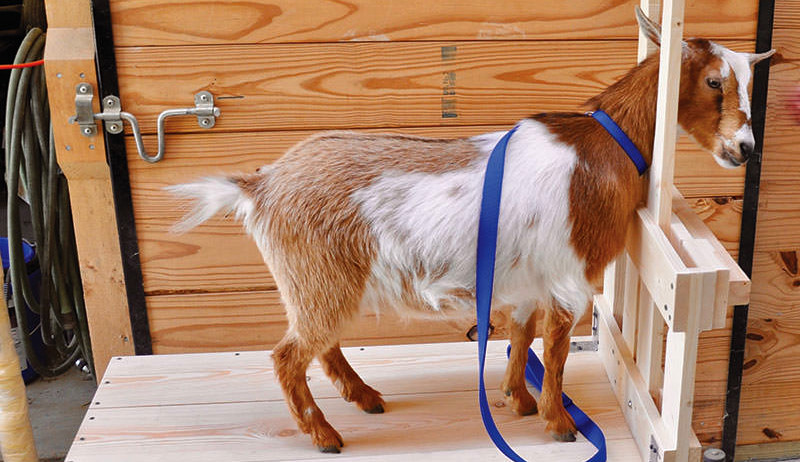
A goat stanchion is an important piece of equipment for dairy goat owners, particularly when the goats are being milked. A stanchion restrains the goats, making hoof trimming, clipping and medicating them easier, but it’s almost essential when the milking time rolls around: When a doe is on a stand, her udder is easily accessible.

Steel or aluminum stanchions are readily available from commercial suppliers, but they can be expensive. Alternatively, you can make your own durable, sturdy milking stand from lumber for less. It takes just a few tools and about a day of effort. The goat stanchion featured here was designed for standard-size goats, but I also use it for my smaller Nigerian Dwarf goats.

Tool, Cut & Hardware Lists

Tools

  • electric drill
  • 1⁄8-inch drill bit
  • 11⁄32-inch drill bit
  • 13⁄16-inch drill bit
  • Phillips drill bit
  • hammer or pneumatic finish nailer
  • jigsaw
  • sander and sandpaper
  • saw
  • square
  • tape measure

Cuts

When purchasing lumber for building this goat-milking stanchion, nonpressure-treated lumber is recommended to avoid possible milk contamination from chemicals used to pressure-treat lumber.

  • (1) 8-foot 2-by-4 (See note on A leg length in Step 1.)
  • (3) 10 foot 1-by-4s
  • (1) 6-foot 2-by-2
  • (1) 10-foot 1-by-8

Hardware

When assembling the various portions of the goat stanchion, it’s important to tack the pieces together first (using the 1-inch finishing nails) to make sure the assembly is correct and square. After verifying everything is assembled correctly, use the 1⁄8-inch drill bit to predrill holes for the screws near the spots used to tack the lumber together. Then use the 2-inch exterior deck screws to screw everything together and finalize the construction of each section.

  • (1) box 1-inch finish nails (for tacking)
  • (1) box 2-inch exterior deck screws
  • (4) 3-inch exterior deck screws
  • (1) 1⁄4-inch-by-#20-by-2½-inch, slotted, round head bolt
  • (1) 1⁄4-inch-by-#20 hex nut
  • (2) 1⁄4-inch flat washers
  • (1) 4-inch hook-and-eye latch

    Also Read: Miniature Dairy Goats Are Perfect For Small Farms!


Step 1

Cut lumber to the sizes described below. Note: The legs of the goat stanchion can be made a different length depending on your breed. I built this stand for Nigerian Dwarf goats and wanted the legs to be long so my small goats would be higher. I later shortened the legs to 12 inches instead of 21 inches because my goats had trouble getting on the stand when they were pregnant. Lesson learned: Starting with a shorter leg length (12 inches for dwarf or 14 inches for standard breeds) is more reasonable, or you could also shorten the legs later.

A (legs): 2-by-4 cut into (4) 21-inch pieces
B (end pieces): 1-by-4 cut into (2) 20½-inch pieces
C (sidepieces), J1 and J2 (neckpieces): 1-by-4 cut into (4) 36-inch pieces
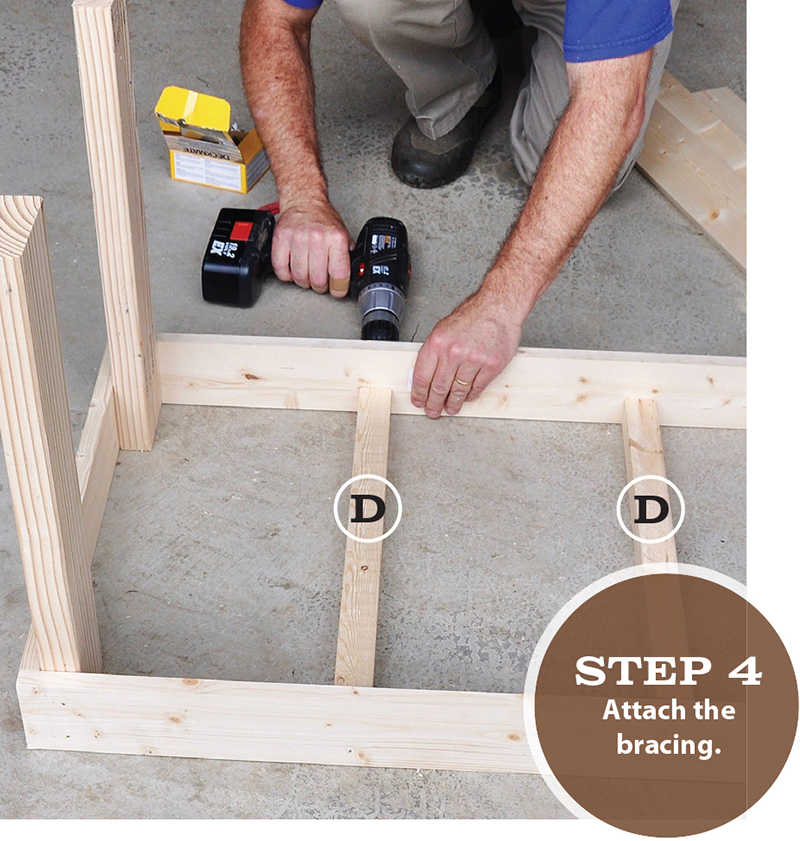
D (bracings): 2-by-2 cut into (3) 20½-inch pieces
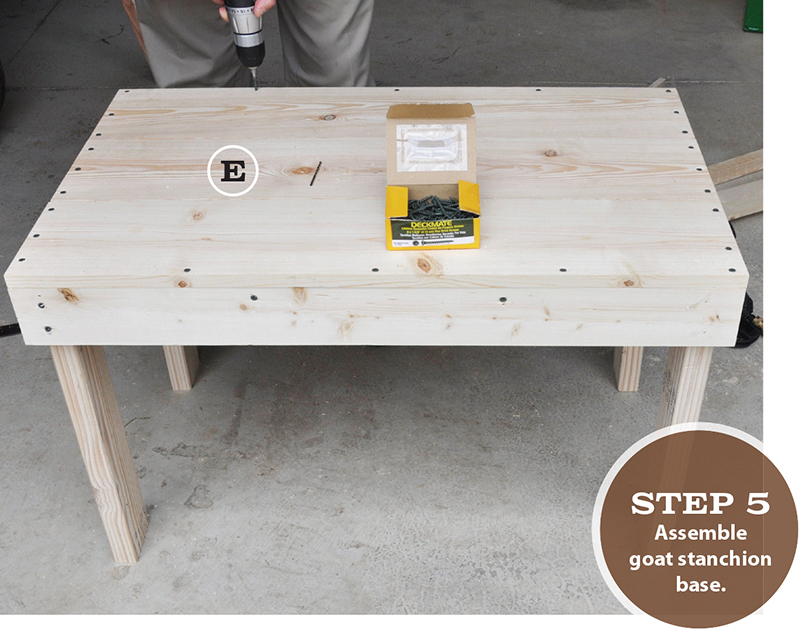
E (deckings): 1-by-8 cut into (3) 36-inch pieces
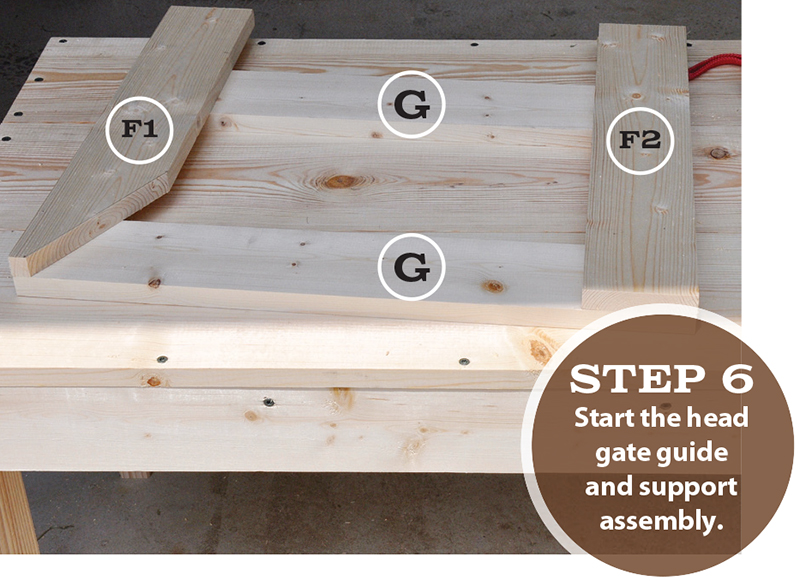
F1 and F2 (head gate guides): 1-by-4 cut into (2) 18½-inch pieces
G (head gate supports): 1-by-4 cut into (4) 21½-inch pieces
H (head gate feeder supports): 1-by-4 cut into (2) 4½-inch pieces

Step 2

making a goat stanchion step 2

In this step, we’ll put the legs and endpieces together. Tack two A legs and one B endpiece together so that the legs are even with the top of the endpiece and square to each other as shown in Step 2 photo. Repeat the process for the other two legs and endpiece.

Step 3

making a goat stanchion step 3

Tack C sidepieces to leg-and-endpiece assemblies.

Step 4

making a goat stanchion step 4

Tack two D bracings to the sidepieces with centerlines spaced 12 inches apart.


Also Read: Breed Profile – Angora Goats


Step 5

making a goat stanchion step 5

Tack three E deckings to the top of the assembly as shown in the Step 5 photo. Make sure the assembly is square, then predrill holes using the 1⁄8-inch drill bit near all tacking locations. Use the 2-inch deck screws to screw the assembly together.

Step 6

Take the head gate guide labeled F1 and measure at the top from one corner over and mark at 3 inches. Then measure down the side from the same corner to 5½ inches and mark again. Draw a line from the first mark to the second and cut this angle with your saw.

making a goat stanchion step 6

Take both head gate guide pieces and position two head gate supports across, with the top G piece even and bottom G piece 4 inches from the ends of F1 and F2 as shown in Step 6. Tack in place with finish nails.

Step 7

Turn the assembly over, and tack the remaining two G pieces in the same location as the first two so that the F1 and F2 pieces are between the G pieces as shown in Step 7. Predrill holes and use the 2-inch deck screws to screw the assembly together from both sides. Avoid hitting screws coming from the first side when screwing together the second side.

making a goat stanchion step 7

Create the neck hole in J1 and J2 neckpieces by using the jigsaw to cut starting 4 inches down from the top and ending 17 inches from the top. Cut each to a depth of 1½ inches, and curve the cut at the top and bottom as shown in the Step 7 photo.

Measure from the inside corner of J1 across 3 inches and make a mark. Then measure down from the same corner 4½ inches, and make a mark. Draw a line connecting the two marks, and cut this angle in J1.

Sand all corners and surfaces of the neckpieces, particularly J1, as this is the movable portion of the head gate and will need to move freely.

Step 8

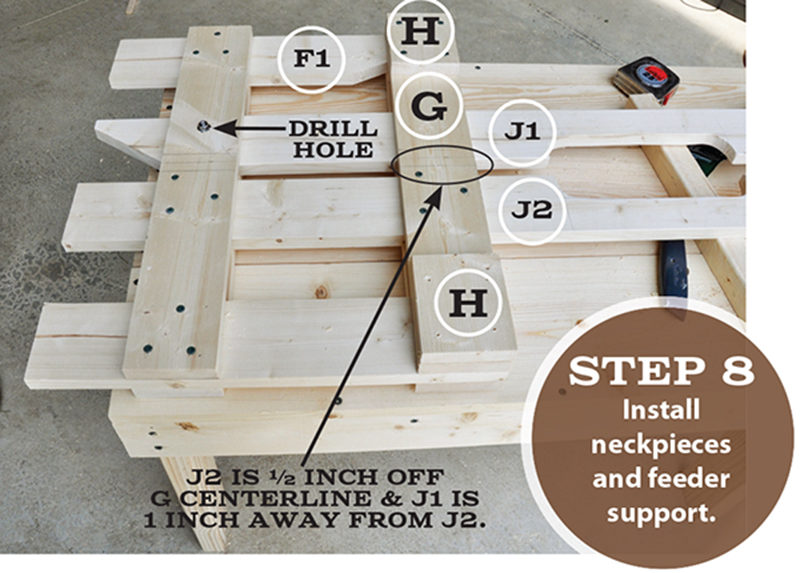
Position J2 between the G pieces, and align it vertically 1⁄2-inch off the centerline of G pieces and 4 inches below the bottom. Tack in place. Position J1 between G pieces and align it vertically 1 inch away from J2 and 4 inches below the bottom G piece as shown in Step 8. Verify J1 has been sanded sufficiently to allow it to freely move within the head gate and that the angles on F1 and J1 are in the right orientation.

making a goat stanchion step step 8

Use the 11⁄32-inch drill bit to drill a hole through the lower G pieces and J1. Switch to the 13⁄16-inch bit, and countersink the hole on each side to a depth of 1⁄4 inches to allow the slotted round bolt and hex nut to recess within the assembly. Place one 1⁄4-inch washer on the round bolt, insert through the drilled hole, place another washer on the bolt, add the hex nut and tighten.

Place H feeder supports on the upper G piece aligned with the end of G, and tack in place. Make sure the assembly is correct, and square and then drill starter holes (using the 1⁄8-inch bit) near the locations where the assembly is tacked together. Screw the assembly together with the 2-inch deck screws.

Step 9

making a goat stanchion step 9

Place the remaining D bracing centered over H as shown in Step 9. Predrill holes and screw in place with the 3-inch deck screws. Adding the bracing this way allows a removable feeder to be placed in the head gate. Inexpensive removable plastic feeders can be purchased at ­animal-supply stores and used to feed the goats grain while they are being milked.

Step 10

making a goat stanchion step 10

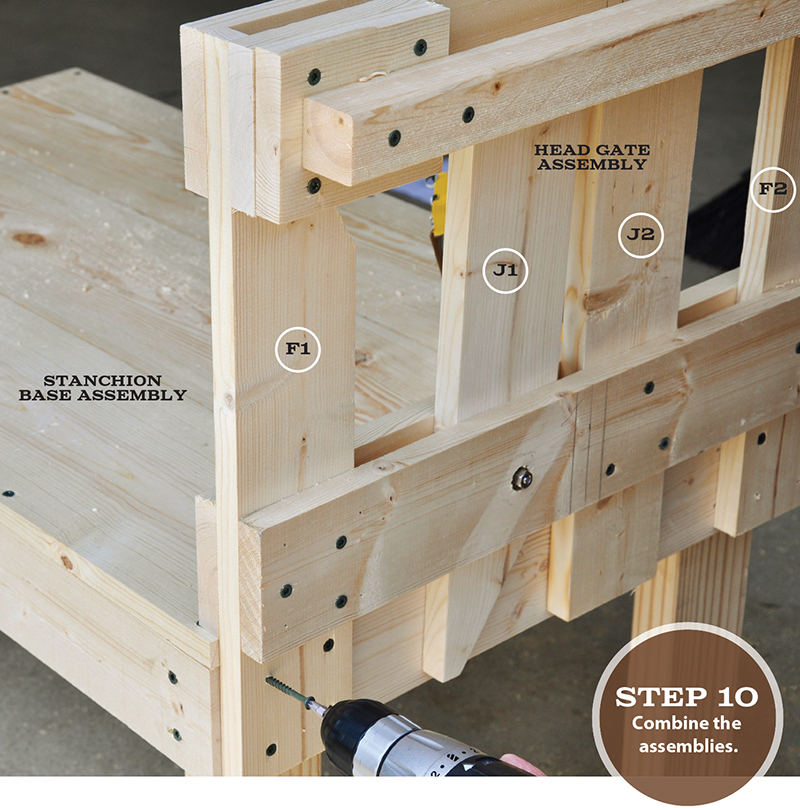
Sand all surfaces of the goat stanchion so that they are smooth, and round all corners so they are not sharp. Place the head gate assembly (with the feeder support bracing facing away from the stanchion base) so that the bottom of G sits on top of E. Attach the head gate assembly to the stanchion assembly by predrilling holes and then using the 2-inch deck screws to screw F1, J2 and F2 to the stanchion base. (Do not screw through J1.)

Step 11

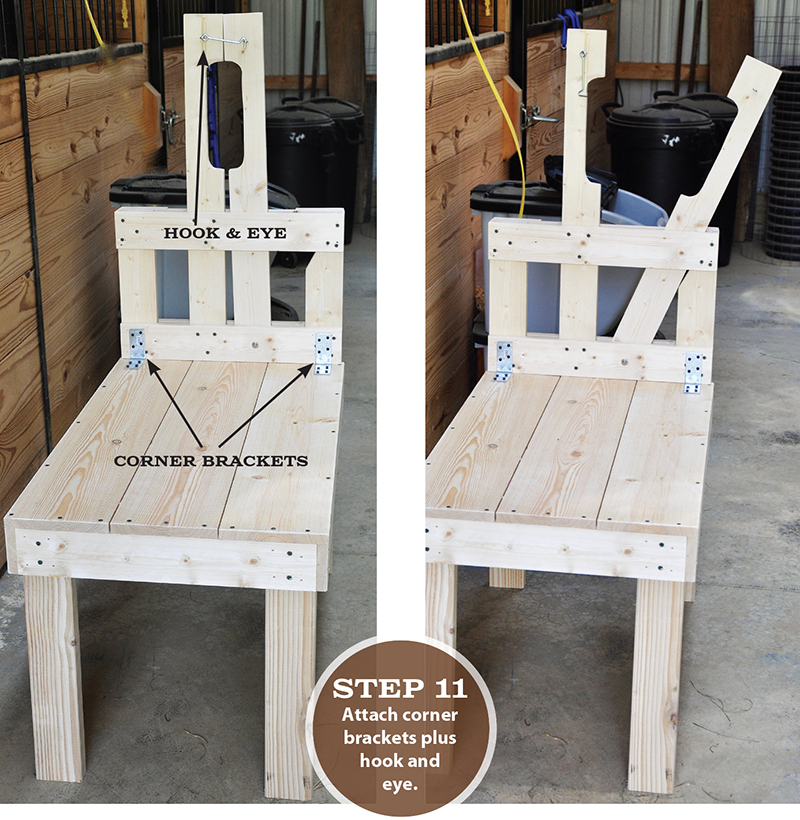
Attach the two corner brackets and the hook-and-eye as shown in step 11. Extra eyes can be added so that the tops of the J1 and J2 do not touch when the hook and eye are closed, if goats with thicker necks will be using the stand.

making a goat stanchion step 11

Now that you have a completed goat stanchion, you just need to add an animal! If you are looking for a strong, long-lasting goat-milking stanchion, this design provides just that. The stanchion shown in this article was built in 2010, and it’s still going strong today!

goat in a stanchion being given a treat

This article about how to make a goat stanchion was written for Hobby Farms magazine. Click here to subscribe.

Categories
Homesteading

Lilac Flowers: 4 Ways to Capture Their Essence

Lilac flowers in bloom have an intoxicating fragrance that’s almost impossible to save beyond spring. Let’s face it, products made with a synthetic lilac fragrance just don’t smell like the real thing and they are also made from toxic chemicals. Here are four ways to keep spring lilacs around a bit longer…

Now that lilacs are in bloom
She has a bowl of lilacs in her room
And twists one in her fingers while she talks.
—T.S. Eliot, Portrait of a Lady


Also Read: DIY Rose Water Facial Toner


#1 Lilac Fritters

Lilacs (Syringa spp.) are in the olive family. Native to the rocky hill slopes of Eastern Europe, the shrubs generally grow between 4 and 5 feet high, though they can grow as tall as 20 feet. The flowers are edible, but with their floral, astringent and slightly bitter flavor, they generally work best as edible garnishes.

However, lilac blossoms are delightful in fritters, made similarly to the more traditional elderflower fritters. Here’s a recipe, adapted it from an old-fashioned elderflower fritter batter, to wow your friends and family.

Ingredients

  • 3/4 cups flour
  • 2 eggs
  • 1/2 cup milk
  • 1 T. sugar
  • 1/2 tsp. salt
  • 10-12 lilac blossoms with leaves removed, washed and patted dry
  • oil for frying I use sunflower oil, as it is light and has no flavor
  • confectioner’s sugar for dusting

Preparation

In a large, shallow bowl, whisk the flour, eggs, milk, sugar and salt into a thin batter.

In a deep frying pan over medium-high heat, heat oil until a drop of water sizzles when it hits the oil.

Dip the flower blossom into the batter and remove it. Holding over the bowl of batter, shake off the excess batter. Place the batter-covered flowerhead into the oil. Turn if necessary, so all sides are brown. Once a golden brown color, remove and place on a dish covered with a paper towel to absorb the excess oil.

Dust with powdered sugar, or drizzle with honey. Serve while warm.

#2 Lilac Facial Toner

Medicinally, lilac leaves and flowers have traditionally been considered a tonic, a febrifuge (meaning they can help lower a fever), a vermifuge (to expel worms and parasites), an antiperiodic (preventing the return of a disease) and it has been used in the treatment of malaria.

Externally, lilac is beneficial for the skin and can be used in the same way as aloe vera. To make a simple facial spray, simply fill a jar with lilac blossoms, and pour very hot water over them. Allow the lilacs to steep in the water for 30 minutes, and then strain into a bottle. Apply to the face after washing using a cotton pad, or transfer into a spray bottle and mist the face and neck. It should last about 2 weeks if kept refrigerated.

You can make a slightly more involved, but still very easy, lilac facial toner with lilac blossoms and witch hazel. Organic witch hazel has a low alcohol content (usually 14 percent), so it’s not too drying and has no other added ingredients. The bit of alcohol helps to preserve the solution and helps prevent it from getting moldy.

What You’ll Need:

  • 16-ounce mason or other types of jar with a cover
  • lilac blossoms
  • witch hazel to fill the jar

Preparation

Allow lilac blossoms to dry overnight on a paper towel, to let most of the moisture to evaporate. They will be slightly wilted.

Cut or chop wilted lilac blooms into small pieces and put into your ason jar. You may include flowers, stems and leaves. Cover plant matter completely with witch hazel.

Cover the jar, and label it with the date and contents. Allow to infuse for 2 weeks, occasionally giving the jar a gentle shake to mix the contents. After two weeks, strain into a bottle and label. Compost the solid plant matter.

Apply lilac facial toner to your face after washing using a cotton pad or soft cloth. Keep refrigerated if desired, though the alcohol in the witch hazel acts as a preservative.

#3 Lovely Lilac Oil

Pick lilac flowers and allow them to dry overnight on a paper towel. Do not wash the flowers, as this can result in the oil becoming rancid. If there is any unwanted organic matter, simply shake the blossoms to get it off.

Place wilted lilac blossoms in a jar, and cover them with the oil of your choice. Make sure the flowers are completely covered with oil; push down with a spoon or chopstick if necessary. Cover and label the jar with contents and date. Allow the oil to infuse in a warm place for four to six weeks.

Strain flowers from oil, bottle, and use as a facial, body or massage oil.

#4 Lilac Infused Honey

Remove individual flowers from the lilac flowerhead, and place them in a jar. Cover with honey and infuse overnight. No need to strain, as lilacs are edible. Enjoy on fruit, toast or in tea.

This article about lilac flowers was written for Hobby Farms magazine. Click here to subscribe.