Categories
Chickens 101 Poultry

How Long Do Chickens Live & Produce Eggs

How long do chickens live is a common question and one that’s, mistakenly, been driven by commercial egg farms. Here’s how long your chickens can live and be productive.

How Long Do Chickens Live? Commerical Farm vs. Backyard Birds

A common misconception that some new backyard flock owners have is that hens are only useful until they are 3 years old. Once they’ve reached this landmark age, their production plummets and their value zeroes out.

When your hens have reached the end of their prime laying days, some say it’s best to euthanize them or use them for soup.

As shocking as this misbelief may be, it’s easy to understand where it comes from. Most commercial egg farms keep their layers until the hens reach 2 to 3 years of age. Once their laying stock reaches this age, commercial farms generally dispose of their hens, refreshing their flocks with pullets just past point-of-lay.

Because of this commercial practice, those new to chicken-keeping often assume it’s also standard operating procedure for backyard flocks. They couldn’t be more wrong.

Small Flock Facts

Hens may live in backyard flocks for 6 to 8 years (or more!), and most flocks will produce eggs for 3 to 4 years. “The level of egg production, egg size and shell quality [however] decrease each year,” writes Sandra Stuttgen, associate professor with the University of Wisconsin Division of Extension, in “Life Cycle of a Laying Hen.” “Most commercial layers are kept for 2 to 3 years as their egg production decreases after this time. To keep a small flock producing, owners should plan to retire old hens and add young hens (pullets) every 2 to 3 years.”

In “Factors Affecting Egg Production In Backyard Chicken Flocks,” the authors note that the laying cycle of a chicken flock usually covers a span of about 12 months. “Egg production begins when the birds reach about 18 to 22 weeks of age, depending on the breed and season,” they write. “Flock production rises sharply and reaches a peak of about 90%, 6 to 8 weeks later. Production then gradually declines to about 65% after 12 months of lay.”

The decline in productivity varies greatly from bird to bird. The researchers state that good layers will lay for about 50 to 60 weeks and then have a rest period (when they molt). Poorer layers and older hens will molt more often and lay less consistently.

While it’s true that a hen’s egg production begins to decline after age 3, it’s by no means over. With a proper diet, plenty of fresh water, sufficient natural light and a safe living environment, a layer can continue to produce eggs for 5 to 10 years. She may only lay an egg every couple of weeks, but she’ll sing her egg song as proudly and loudly as the yearlings.

how-long-do-chickens-live
An old hen may not be a prime layer anymore, but she’ll still have a use around the farm.
LDC/STOCK.ADOBE.COM

Lifespan Factors

Many factors affect the lifespan of a chicken. Poor nutrition plays a key role in a hen’s longevity. If not fed a layer ration specifically formulated with the percentages of protein and calcium needed for proper egg production, a hen will draw these building-block nutrients from her own body’s reservoirs, directly impacting her health.

Similarly, continual egg production can negatively impact the lifespan of chickens. Even if fed a nutritious layer ration, daily or near-daily production exhausts and depletes a hen, causing caged-layer fatigue. Allowing laying hens to rest and recuperate during the shorter daylight months can help extend their lives.

Other factors that affect a hen’s lifespan include a safe, clean living environment; poultry illness and parasites; the presence of predators; and the type of chicken she is. Production hybrids will typically have a shorter lifespan than dual-purpose and heritage-breed chickens.

Extending the life of laying hens promotes their well-being and contributes to sustainable egg production. Here are several ways to ensure a longer and healthier life for these birds.

Meat Birds

The age of chickens used for meat can vary from 6 weeks to 1½ years old. Chickens labeled as:

Broiler-fryers are young, tender chickens about 7 weeks old;

Roasters are older chickens, about 3 to 5 months old;

Capons are male chickens about 16 weeks to 8 months old;

Stewing/Baking Hens are mature laying hens 10 months to 1½ years old.

Source: USDA

Proper Nutrition: Laying hens require a diet tailored to their needs. Adequate calcium is crucial for strong eggshells, so consider providing crushed oyster shells or calcium supplements.

Clean Water: Clean and fresh water is essential for digestion and overall health. Ensure water containers are free from contaminants and regularly cleaned to prevent disease transmission.

Adequate Space: Overcrowding can lead to stress and aggression among hens. Providing ample space in the coop and run allows hens to move freely, stretch their wings, and prevents injuries.

Predator Protection: Secure the coop and run with sturdy fencing, and use hardware cloth to deter predators. Lock hens inside the coop at night to protect them from nocturnal threats.

Regular Veterinary Care: Establish a relationship with an avian veterinarian who can perform routine check-ups, administer vaccinations and offer guidance on health management.

Clean Environment: Regularly clean the coop, remove droppings and replace bedding material to prevent the buildup of harmful bacteria and parasites. Good ventilation is also crucial for air quality.

Social Interaction: Chickens are social animals and thrive on interaction with their flock. Ensure they have companionship to reduce stress and boredom.

Enrichment: Provide objects for hens to peck at and scratch, such as hanging vegetables or straw bales. This stimulates mental and physical activity, reducing the risk of feather pecking and cannibalism.

Egg Collection: Collect eggs daily to discourage broodiness and egg-eating. Leaving eggs in the nest can lead to problems such as broken eggs and hens going broody, which can negatively affect their health.

How Long Can Hens Live?

Given a safe, clean and stress-free living environment, with winters off to rest and replenish their bodies, and plenty of nutritious food and clean water, hens can live as long as 8 to 10 years … and quite possibly longer. According to the Guinness Book of Records, the record for the world’s oldest chicken is held by Muffy, an American Game bantam who died at the age of 22. I’ve had several that lived longer than 7 and even 10 years. One of our hens had two daughters at the ripe old age of 6! By providing excellent care, protection, and attention to these factors, you can help your backyard chickens live longer, healthier lives and enjoy the benefits of egg production and companionship for many years.

This article about how long to chickens live was written for the January/February 2024 issue of Hobby Farms magazine. Click here to subscribe.

Categories
Chickens 101 Health & Nutrition Poultry Uncategorized

Impacted Crop: How to Identify & Treat in Chickens

Impacted crop is a common emergency that all chicken keepers should know how to identify and treat early. Secondary problems, such as sour crop, or even death can result when the condition is left untreated.

The crop helps chickens avoid spending all day out in the open foraging for food. Think of the crop as a “holding tank” for everything your chickens eat. Thanks to the crop, chickens can quickly gorge themselves on a great deal of food, and then go hide somewhere safe to digest it all over the next few hours. This, in turn, limits their exposure to potential predators. The problem with crops is that when a chicken eats too many things, she just can’t digest, and it gets blocked, or impacted.

What is the Crop?

The crop is a small muscle pouch located on the right side of the breast, in the center below the neck. The purpose of the crop is to hold food until it can be digested in the proventriculus (stomach) and gizzard. As the chicken eats, the crop grows larger, until it’s about the size of a golf ball or a bit larger. Once the crop is full, the chicken stops eating and usually goes somewhere safe to rest and digest her meal. It typically takes two to four hours for the crop to empty entirely.

When the digestive system is working as it should, a chicken’s crop will be very full and distended at the end of the day. She’ll digest her food overnight, and the crop will be completely empty and flat the next morning.

an-impacted-crop
A chicken’s crop is located on the middle right side of their breast. Crops are usually full at the end of the day, as the birds go in to roost, but if it’s still full first thing in the morning, then your bird has likely developed an impaction. (Photo by Heather Levin)

What Causes Impacted Crop

Chickens will eat a wide variety of things, especially if they’re allowed to free-range. However, we run into problems when they eat things they can’t digest!

Chickens that eat the following can develop an impaction.

  • long, fibrous grass or hay
  • string, rope or twist ties
  • feathers
  • bedding or litter (including wood chips, sand or shavings)
  • plastic or metal trash
  • hard, indigestible fruit skins (such as banana peels or avocado skins)

Chickens that are kept in a run and then suddenly allowed to free-range can also develop an impaction by suddenly gorging themselves on long grasses and other natural fibers in the yard.

So how do you know your chicken has an impacted crop? Look for the following symptoms.

  • reduced appetite
  • lethargy or depression
  • weight loss
  • hard, distended crop visible early in the morning

How to Find a Crop

To find a chicken’s crop, choose a bird that you know has eaten recently. You’ll have the most success finding the crop if you do it late in the day when it’s sure to be full of food.

Pick up your chicken with her tail toward you and her beak facing away from you. Hold her like you would a football, and use your hand to gently feel the center right side of her breast. The crop will feel like a firm or doughy ball.

It’s important to familiarize yourself with the location of the crop and its typical size and texture before you have to deal with an impaction.

How to Test For Impaction

The only sure way to know if your chicken has an impacted crop is to feel the crop first thing in the morning, before your chickens eat or drink anything.

A chicken’s crop is at varying stages of fullness throughout the day. However, the crop empties completely overnight, while the chicken sleeps. So, every healthy chicken should have a flat, empty crop when they come out of the coop first thing in the morning.

To test for impaction, go out to the coop first thing in the morning and feel your chicken’s crop. A chicken with a hard, full crop in the morning is suffering from an impaction.

an-impacted-crop
When a chicken’s crop is empty, its breast will look flat and smooth. Birds with a very full crop will have a breast that is more rounded and bulges out.
(Photo by Heather Levin)

Treating Impacted Crop

There are several things you can do to treat mild to moderate cases of impacted crop. Mild impactions are when the crop is the size of a baseball or smaller.

1. Isolate & Withhold Food: One strategy to treat a mild case of impacted crop is to put the bird in isolation and withhold food for 24 to 48 hours. Make sure your chicken has access to plenty of fresh, clean water during this time. The more water you can get her to drink, the more it will help get matter moving through the crop. Her isolation cage or area should also be warm and stress-free.

2. Use Herbs: You can also give her a calming, cooled herbal tea in place of water to help her relax while she’s in isolation. Herbs such as chamomile, lemon balm, catnip and lavender all work well.

Chamomile is especially good to give impacted birds because it’s an excellent digestive aid and helps ease cramping and bloating. It’s also a mucilage, which might help get the items in the crop moving. Other mucilaginous herbs include marshmallow, fennel, and fenugreek. Given as a tea, these herbs might help get the fibrous material in the crop moving again. Adding turmeric to your chicken’s water while she’s going through treatment can help prevent sour crop, a secondary condition that often piggybacks on an impaction. Sour crop is caused when the contents of the crop start to ferment, and an overgrowth of Candida yeast develops. Numerous studies, including“Anti-Candida Activity of Curcumin: A Systematic Review ” (bit.ly/3PzWUTs) in Current Drug Discovery Technologies (Vol. 18, No. 3, 2021), have found that turmeric is an effective natural treatment for Candida overgrowths.

3. Massage the Crop: If your chicken still has an impacted crop after 24 to 48 hours of isolation and fasting, try massaging the crop.

To do this you’ll need a syringe or eye dropper, olive or vegetable oil, and lukewarm water. First, mix 1 tablespoon of oil with ¼ cup of lukewarm water and mix. Quickly fill the syringe or dropper with up to 10 milliliters of the oil and water mixture, and slowly dribble it into your chicken’s beak. This might be a two-person job, as you’ll have to hold the bird and open her beak by hand to do this.

If your chicken starts coughing, stop immediately and give her a minute to rest and catch her breath. Once you’ve gotten the oil and water mixture down the esophagus, gently massage the crop from top to bottom for three minutes.

Do this entire process several times throughout the day.

4. Try Epsom Salt: You can also try to flush the chicken’s crop with Epsom salt. If you try this treatment, use the recipe developed by Gail Damerow in The Chicken Health Handbook.

Mix 1 teaspoon of Epsom salt with ½ cup of water, and dribble into the chicken’s mouth twice daily for up to three days.

5. Transition to Soft Food: Once you notice your chicken’s crop is smaller or softer, reintroduce foods slowly. Opt for soft, easy-to-digest foods such as scrambled or hard-boiled eggs, yogurt, fermented feed or soft, cooked vegetables.

Once you notice that the crop is emptying out completely every night, you can reintroduce her back to the flock.

If the impaction has not cleared up after several days of treatment, your next option is to take the chicken to a poultry vet to clear the crop manually or surgically remove the items impacting the crop. These procedures should be done by a licensed vet, as it’s very easy to injure or kill your chicken attempting either of them at home.

Although impaction is a serious condition, regular crop checks and paying attention to your chickens’ behavior can help you spot it early and take action while it can still be treated.

This article about impacted crop was written for the January/February 2024 issue of Hobby Farms magazine. Click here to subscribe.

Categories
Poultry Sponsored

Everything You Need to Know Before Buying Chicks

Baby Chick Checklist

Getting You And Your Baby Chicks Started Off Right

You’ve decided to enter the wonderful world of raising your own chickens as either layers or broilers. Maybe it’s been a while since you started your last batch of chicks, or you might be new to the game altogether. Either way, with a little forethought and a few supplies, you will be hearing little “cheeps” in no time.

The first thing you need to decide is which breed you’d like to raise. Are you looking for hearty breeds—like Golden Comets—for brown egg production? Or, a nice broiler bird, such as the White Plymouth Rock? Maybe you want something more fashionable like the Silkie? Don’t worry—while there are many different breeds, they all share similar needs in the beginning.

During the hatching process when a baby chick is pipping out of the eggshell, it pulls the remaining egg yolk into its body, giving it a food supply lasting a day or two. This is what allows them to be shipped safely through mail. It’s also why we can spend more time creating their new environment instead of worrying about getting them to eat as soon as they arrive.

Helpful housing tips:

  • Keep chicks in a draft-free environment, but make sure they have adequate ventilation.
  • Plan on one square foot of floor space per chick until they reach 12 weeks of age.
  • There are many options for bedding but stay away from fine sawdust because chicks may inadvertently eat it.
  • To help clean up when the birds are away, first place a couple of layers of newspaper on the floor, followed by approximately four inches of bedding—try paper towels at first if the newspaper proves too slippery for the chicks at first.
  • Along with making clean up easier, the paper barrier helps discourage the chicks from eating the bedding.
  • Keep the bedding dry to reduce the risk of disease. If wet spots do occur, add dry bedding rather than removing the wet to keep molds and other hazards from being released into the air.

Next, you need a plan to keep the birds warm. If you don’t have access to a commercial brooder, heat lamps make a great substitute. Position the lamps so the temperature at “bird-level” is between 90 – 95 degrees when they first arrive. Raise the lamp each week just enough to lower the temperature by five degrees. In about a month, you will reach 70 degrees. At that point, the chicks are fine to go into almost any environment.

Be careful not to place the lamp too close to the walls: If the chicks get too cold, they may pile on top of each other and suffocate the birds on the bottom while trying to get closer to the heat.

Place the heat lamp towards an edge or end of the pen with the birds equally spread between the light and the rest of the pen You can use a chick guard—or cardboard fence—for the first ten days to keep the birds closer to the heat, feed, and water. Use 15 watts of light per 200 square feet of floor space, keeping it on 24 hours a day for the first week, 16 hours a day for weeks two through six, and 13 hours a day for weeks six through 12.

In terms of feed and water, you can pick up feeders and waters at your local farm supply store or order online. For water, avoid bowls since they can spill, and chicks can fall in and drown. For feed, utilize a chick starter feed, like Homestead Chick Starter/Grower—this feed is formulated for optimal development of the digestive tract and other internal organ systems. Additionally, you don’t need to offer grit when supplying Homestead Chick Starter/Grower. Additionally, if you want to keep your new birds hydrated when they first arrive home, feel free to add an electrolyte, found at your feed store, to their water.

As you’re getting started if you run into any specific problems, there are all kinds of resources online and through Hubbard Feeds to help you out. Visit the Hubbard Feeds website to learn more about Poultry care and nutrition: https://www.hubbardfeeds.com/species/backyard-poultry.

Categories
Animals Chickens 101 Farm & Garden Flock Talk Health & Nutrition Poultry

What To Do With Baby Chicks After Easter

What to do with baby chicks after Easter is a yearly question as spring brings baby chicks and Easter…and sometimes, the two turn up together. Although many breeders and farm-supply stores halt the purchase of peeps just before the spring holidays, not everyone respects the philosophy that chicks—and ducklings and baby bunnies—are not gifts to be given on Easter.

As a result, there are always well-meaning relatives who arrive for Easter brunch with a basket of peeping baby poultry in tow. 

Should a kind-hearted but misguided soul present your family with a gift of Easter chicks, follow these five steps to ensure these infants’ health and well-being. 

1. Shelter 

Active babies need a safe place to roam and call home, even temporarily. Find a large cardboard box, a storage tote or a high-sided basket to serve as a brooder. Line the bottom with an old towel or rags. If you have pine shavings or straw, use these.

Never use newsprint, as its slick surface can lead to leg development issues. Place this makeshift brooder in the warmest, least drafty part of your house. If you have a portable heater of any sort, set it as close as possible to the brooder, since newborn chicks require a constant temperature of 95°F their first week.

Be sure to keep your pets away from the brooder.  


Read more: Check out these brooder tips for baby chicks!


2. Nourishment 

Use your most shallow saucer to offer the chicks water. Use pea gravel or marbles in the dish to help prevent accidental drownings. As for food, mash-up unseasoned hard-boiled eggs and serve them in a shallow container.

Newly hatched chicks can go up to two to three days without eating, but older chicks will require food a couple of times per day. Finely chopped oatmeal can be mixed in with the mashed egg to extend the food.  

3. Rehoming 

If you are unable or unwilling to keep the chicks, you’ll need to find them a new home as swiftly as possible to avoid the expense of outfitting a proper brooder. If your neighborhood or town has a community bulletin board—actual or virtual—post about the chicks there and include a photo.

Contact your local feed shop or farm supply store to see if they can recommend nearby farms that might be interested in adopting the chicks. Petting farms and animal sanctuaries are other options to consider. Check with your friends, too. You never know if one or more of them might be thinking about starting a backyard flock.  


Read more: Here’s how you can warm your baby chicks without using heat lamps.


5. When All Options Fail 

If you cannot find anyone to adopt your Easter chicks, don’t despair. Call your local Humane Society. Some locations will take in chicks. Others may have a database of organizations, farms and individuals who can accept the birds.

You may also consider taking a long drive around your closest rural or agricultural areas, looking for small farms with Fresh Eggs signs. Approach these flock owners and explain your situation. With luck, your chicks will have a new home soon.  

6. Your Own Microflock 

The gift of backyard chicks might be fortuitous if you already keep chickens or are looking at starting a flock of your own. You’ll still need to outfit a brooder correctly for your Easter peeps, but the time and energy you would have spent trying to find them a home can now be spent on raising your little ones and watching them grow. 

This article about what to do with chicks after easter was written for Chickens magazine online. Click here to subscribe. 

Categories
Recipes

How to Make Deviled Eggs: A Classic Recipe

How to make deviled eggs is popular at Easter to use up dyed eggs and year-round. Here’s how to make this yummy, classic recipe.

Ingredients

  • 6 large eggs, hard-boiled
  • 3 T. mayonnaise
  • 1 tsp. sugar
  • 1/2 tsp. salt
  • 1 tsp. Dijon-style mustard
  • 1 tsp. wine vinegar
  • dash pepper
  • 1 to 3 T. chopped chives, to taste
  • paprika

Preparation

Place eggs in enough cold water to cover completely. Bring to a rolling boil over high heat, then reduce heat to medium-low and cook for 12 minutes. Drain and cover with cold water, replacing with more cold water after five minutes. When completely cool, carefully remove shells from eggs. Halve eggs lengthwise with a sharp, lightly oiled knife. Leaving whites intact, remove yolks and place in a medium bowl.

Mash the yolks with a fork and add mayonnaise, sugar, salt, mustard, vinegar and pepper. Mix together well. Add chives (optional) or set the chives aside for garnish.

The prettiest deviled eggs are made with the filling piped into the egg-white halves, but you can also spoon it in. Carefully pipe or spoon the mixture into the egg whites, mounding it slightly. Sprinkle the top with paprika and garnish with chives. Chill before serving.

Makes 12 servings.

Variations are the perfect way to personalize deviled eggs for any occasion and taste. You can replace the mayo with any flavor of creamy salad dressing, sour cream or even horseradish sauce. You can add different herbs, shredded cheeses or meats, particularly seafood, such as crabmeat or minced shrimp. Finely diced veggies also make a fun variation on the standard deviled egg. For extra spice, use finely diced hot peppers with a bit of chili powder, and garnish with a sliced olive or cilantro. The possibilities are endless.

This story about how to make deviled eggs was written for Hobby Farms magazine online. Click here to subscribe.

Categories
Food Recipes

Dyeing Easter Eggs With Natural Dyes

Dyeing Easter eggs with natural dye sources from the pantry and root cellar results in eggs that are beautiful in their earthiness and charm and peace of mind that the eggs are safe to eat.

The patterns for dyeing Easter eggs presented here were created with natural dyes and using a resist print using herb leaves, rubber bands and wax.

Dyeing Easter Eggs  Materials For Different Colors

  • Red cabbage: blue
  • Onion skins: orange or deep rust
  • Beets: pink
  • Coffee: beige
  • Turmeric: yellow
  • Paprika: muddy rose

Other Materials

  • 1 teaspoon white vinegar per dye bath to help set the color
  • soy wax
  • various-sized craft brushes
  • small tin for melting wax
  • rubber bands (various widths)
  • fresh herbs
  • tulle
  • string

Step 1: Cook the Eggs

Place the eggs in a single layer in a large pot. Cover with cool water by 1 inch, and bring to a rolling boil.

Turn off the heat and leave covered for 12 minutes.

Drain the water and fill the pot with cold water to cool the eggs as quickly as possible. When cool, refrigerate until ready to dye.

Step 2: Make the Dye Baths

dyeing-easter-eggs

Cabbage, Onion Skins & Beets

Thinly slice red cabbage, crush onion skins and grate beets.

Place one cup of your chosen ingredient with one cup of water in a medium saucepan. Do this with each ingredient separately to make three separate natural dyes.

Bring to a boil, cover, lower the heat, and simmer for 30 minutes. Allow to cool in the pot.

Strain into a glass, pressing on the material to extract as much dye as possible. Add one teaspoon of white vinegar to each of your natural dyes. Cover and refrigerate.

Coffee

Make a very strong cup of coffee. Cool. Add one teaspoon of white vinegar. Cover and refrigerate.

Turmeric & Paprika

Mix one tablespoon of ground turmeric or paprika with one cup of boiling water. Stir to saturate the powder. Let steep for 30 minutes and strain through a fine mesh strainer. Add one teaspoon of white vinegar to each dye bath. Cover and refrigerate.

Step 3: Gather Resist Materials

dyeing-easter-eggs

Wax

Soy wax is available at the craft store. Beeswax is also a good option because it melts at a lower temperature and is easier to remove from the egg.

Melt in a small tin. Aluminum mini pie tins and washed-out tunas are perfect. Set the tin in a skillet of simmering water, creating a double boiler to melt the wax into liquid form. Stay close, as you don’t want to overheat it.

Use small craft brushes to make lines, circles and dots on both white eggs and eggs that have already been dyed. Applying wax will preserve the color you cover.

You can repeat the waxing and coloring to produce several colors on an egg, going from light to dark to make a checkered egg using first white natural egg, then turmeric, then cabbage, then onion skin. (Be careful because the turmeric yellow can get a bit lost in the process.)

When the wax is cool, lower the egg into the dye bath. Cover and refrigerate for two to 24 hours. The longer the soak, the darker the color.

When the egg has achieved the color you desire, chip off as much wax as you can with a fingernail, then rinse under hot tap water, rubbing with your hands to remove the remaining wax.

Rubber Bands

Stretch the rubber bands around the eggs in various positions. Lower them into the dye bath and let them soak, covered and refrigerated, long enough to achieve the desired color. Pat dry on paper towels, then remove the bands to reveal the pattern.

Herbs

Cut fresh sprigs of herb leaves (parsley, thyme and rosemary were used here) and lay them on an 8-inch square of tulle. Lay the egg on top and gather up the sides so the herbs are in close contact with the egg. Twist until tight, and tie with a string.

Lower into the dye bath and let sit in the refrigerator for several hours to get a rich color. Remove the netting and herbs, pat dry on paper towels and admire.

Step 4: Eat Your Eggs

To eat the resulting eggs, be sure to refrigerate them at all stages and not keep them out for more than a few minutes while making the patterns.

If you are not patterning your eggs, you can cook them directly in the dye bath.

Display your dyed Easter eggs in a basket or wooden bowl on the breakfast table and enjoy with your meal, or use them to make recipes such as deviled eggs.

This article was written for Hobby Farms magazine online. Click here to subscribe.

Categories
Uncategorized

Growing Good Podcast #74: Black Girl Country Living podcast host Hillarie Maddox

TITLE SPONSOR: Sow Right Seeds

PREMIER SPONSOR: Home Fresh® Poultry Feeds (Kent Nutrition Group)

Hear about Hillarie’s upbringing visiting her family members’ original homesteads in South Dakota and how her life came full circle, back to the land herself on Whidbey Island, in Washington. She talks about how she and her husband are balancing their differing interests in landscaping versus gardening on their property, ultimately arriving at a food forest approach.

Learn about Heavy Nettle Collective, a diverse group of farmers, creatives and healers who are growing food, producing local events and building community together. This group has formed organically and changes in response to the needs of the people coming together — having grown from 5 to 20 — and they are slowly bringing the group into a more formal structure.

While everyone contributes their own strengths to the collective, some of Hillarie’s gifts are facilitating community and wellness. Since launching her wellness experiences through an REI business incubator program, Hillarie has been offering nature immersion, movement and breathwork to reconnect people to themselves and the world around them.

Hillarie offers a thoughtful definition of the concept of community and illustrates how that looks in her own life. Get her best advice for how to actually build the community that so many people talk about wanting.

Hillarie Maddox on Instagram

Hillarie Maddox on Substack

Black Girl Country Living podcast

Categories
Recipes

Easter Dessert Recipes: 4 Sweet Ideas

Easter dessert recipes can be filled with all the cuteness of live animals without all the fuss and long-term care. Here are four options that are sure to please.

1. Chocolate Easter Chicks and Bunnies

Sure you can buy chocolate Easter chicks and bunnies, but it’s more fun and can be more healthy to make them yourself. All you need is a silicone or plastic mold shaped like chicks or bunnies and some melted chocolate. Pour the melted chocolate into the mold and let it harden in the fridge. If you use this recipe, the candy will start to soften at room temperature because of the coconut oil, but it is a much healthier option.

2. Marshmallow Easter Chicks

Making your own marshmallows is one of the easiest sweet hacks ever, better even if you make strawberry marshmallows. To make marshmallow chicks, use a chick-shaped cookie cutter to cut out shapes once your marshmallows have been set. Homemade marshmallows can be stickier than commercial types, so dust your cookie cutter with coconut flour, homemade powdered sugar or Fair Trade cocoa before you plunge it into your marshmallow canvas. Be sure to use a sharp, stainless-steel cutter, as well. If you can only find plastic, depress the cutter firmly before you pull it away. After they’re cut, roll your marshmallow chicks in coconut flour or flakes, cocoa, powdered sugar or cinnamon. Let this yummy Easter dessert recipe air-dry overnight.

3. Easter Cake Pops

Hippety hop cookie pops! On the blog????

A photo posted by @bakerella on

Okay, there’s probably no way to make these cake pops healthy, but they are cute. If you’re torn between the adorableness of a live baby bunny and these, I say make these. You can get the live bunny when you have all the equipment you need and your child is prepared to care for it. A good book on raising rabbits would be the perfect gift to go along with these cake pops.

4. Soaked-Flour Easter Biscuits

4 Sweet Ways to Celebrate Easter - Photo by Tessa Zundel (HobbyFarms.com)

Despite all the sugary Easter dessert recipes, one of my favorite treats is a humble sweet biscuit. Presoaking the flour makes the grains easier to digest. We cut the biscuits into chicks and drizzled with a raw honey and cinnamon glaze. Sometimes our chicks end up looking more like squashed turkeys, but they help us celebrate this special time of year.

This recipe is prepared over the course of two days, but don’t be intimidated. It’s very simple and will make your finished product so much easier on your gut.

Ingredients

Group 1

  • 3½ cups flour
  • 1 tsp. sea salt
  • 1½ cups whole milk
  • 2 T. apple cider vinegar

Group 2

  • 3 cups flour
  • 1¼ cups of water
  • 2 T. apple cider vinegar or whey
  • 1/4 tsp. yeast

Group 3

  • 1/4 cup sugar or sucanat
  • 1 tsp. sea salt
  • 2 T. butter
  • 2 tsp. yeast
  • 2 cups raisins, sultanas, currants or cacao nibs (optional)

Preparation

Mix all ingredients in Group 1 together until well combined. Cover and let sit on your counter overnight.

Mix all ingredients in Group 2 in a mixer for 5 minutes. Let it rest to soak up some of the moisture, then mix for 1 more minute. Cover and let sit on your counter overnight.

The next day, mix the ingredients in Group 3. The optional ingredients listed will make your biscuit taste more like a Hot Cross Bun, a traditional treat this time of year. You can also increase the sugar by 1/4 cup if you want a sweeter biscuit.

Combine all three groups of batter in a mixer, and knead for 8 to 10 minutes. The dough will be wet, but it should clear the sides of your bowl. Add a bit more flour if the dough is too wet, but don’t add too much or you’ll end up with bricks instead of biscuits. Roll dough into a ball, cover, and and let it rise for 1½ hours or until doubled in size.

The dough will still be sticky after rising, so wet your hands to begin shaping the dough. Experiment with different ways to form chicks, but remember that this dough will rise a bit more as it bakes and your chick will double in size.

After you’ve formed your shapes, add raisins for eyes and cacao nibs or slivered almonds for beaks. Bake at 350 degrees F for 35 minutes or until golden brown.

While the biscuits are baking, make the cinnamon-honey glaze. Heat 1 cup of raw honey to just below 110 degrees. Mix with 1 to 3 tablespoons cinnamon. Immediately after you remove the biscuits from the oven, drizzle the glaze overtop. Another option is to top the biscuits with homemade frosting, such as our vanilla honey spread.

What special treats will you be serving up this Easter?

This article about Easter dessert recipes was written for Hobby Farms magazine online. Click here to subscribe.

Categories
Recipes

Easter Kulich Recipe With Tin Cans

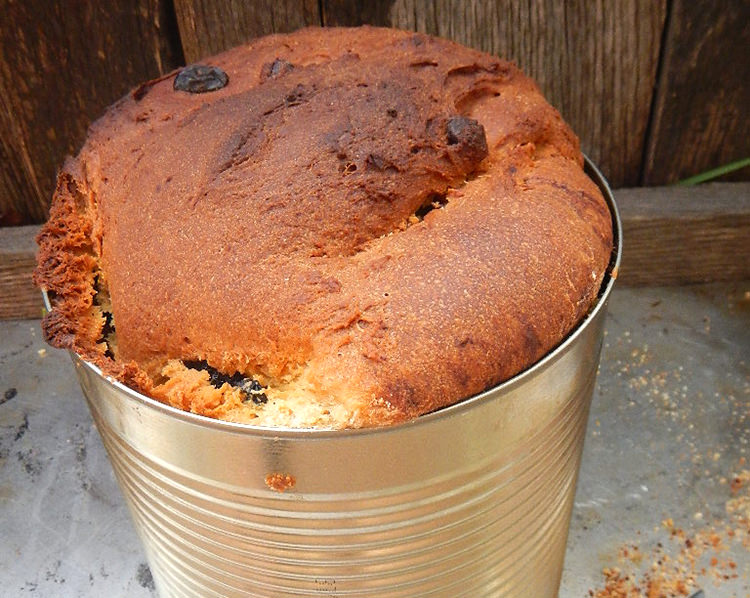
Easter kulich or Pascha bread is a rich egg bread reminiscent of challah and panettone. Kulich is made by Russian, Ukrainian and other Slavic families every spring to celebrate Easter. As a young missionary in Russia, I was fortunate enough to have my Ukrainian missionary companion, Aelita Zaetz, make me kulich for breakfast. Alas, as a mom, now I’m in charge of making it.

It’s been a fun kitchen project every spring for the kids and me to pop into the kitchen and begin the process of making our sweet bread for the Easter celebration. This recipe is more involved than any other yeast bread I’ve made because it has three—yes, three!—rise cycles. The texture and flavor are worth it, and we usually do other fun spring and Easter activities while we wait for the bread’s next step. If you’ve ever loaded a slow cooker or bathed a toddler, you can probably handle making this bread.

Easter Kulich Ingredients

Bread

  • 2 sticks butter (You can also substitute coconut oil.)
  • 2 cups whole milk
  • 6 farm-fresh eggs, room temperature
  • 1 T. yeast
  • 1¾ cups sugar
  • 2 tsp. vanilla extract
  • 1 tsp. sea salt
  • 8-9 cups flour, divided
  • 1/2 cup sour cream, cultured cream, crème fraiche or yogurt
  • 1/2 cup dried cherries
  • 1/2 cup raisins
  • 1/2 cup cranberries
  • 1/2 cup pistachios
  • 1/2 cup chocolate chips

Glaze

Easter Kulich Preparation

In a saucepan over medium heat, melt butter. Add milk and heat until just warm. Remove from heat and whisk in eggs, yeast, sugar and vanilla.

In the bowl of your mixer (or any large bowl), whisk together salt and 4 cups flour. Add butter mixture to flour mixture. Switch to the dough hook of your mixer or a sturdy spoon. Add in sour cream. This mixture will be wet and thick. Cover it and allow it to soak and rise about two hours in a warm place. You can use your dehydrator set at about 90 degrees F or your oven with the light. Your dough will probably double in size the first rise, so give it space.

Put the dough back into your mixer bowl if you removed it, and mix in the remaining flour 1 cup at a time. The dough should still be soft, but it should clear the sides of the bowl. If you stick your finger into the dough, it will be squishy but won’t cling to you the way it did before. If you add too much flour, the final product will be a little dry, but it will still be edible. After you’ve made it a few times, you’ll know exactly how wet you like it. Mix in the remaining ingredients, or any other preferred add-ins. Cover and let rise another two hours in a warm place. It will double in size or more.

Divide dough evenly and place into paper molds (see “Using Tin Cans As Molds” below). Be gentle and don’t bang your dough around, but make sure you don’t have any air bubbles trapped inside. Let rise in a warm place for another two hours but don’t cover it this time—a cover might interfere with the lovely top that will form on your kulich.

Bake at 350°F for 30 to 35, or until golden brown on top. Using a cake tester or a thin knife, check the center for doneness, especially if your kulich ends up particularly tall.

Once cooled, remove from molds and mix up the glaze. Pour the glaze over the top and let it drip down the sides. To make it look traditional, add some colored sprinkles. The glaze is a lovely combination of sweet and tart.

We don’t usually add the glaze if we’ve put in chocolate chips (not a traditional ingredient at all!) just because that ends up a little too sweet for us. You can fashion an “XB” on the top, if you’d like to be completely authentic. “XB” stands for “Christ is Risen in Russian (pronounced Chreestose voskres).

Using Tin Cans As Molds

You can bake up your Easter kulich in the paper molds used for panettone, which can be found on Amazon and in specialty markets. They’re easy to use and, when the bread is baked and cooled, you can simply rip them off and discard them. This recipe will bake up three paper-molded, medium-sized kulich.

As poor missionaries, we couldn’t get quite as fancy as paper molds, but Aelita showed me how to use tin cans to achieve the same result. Take any size tin can you’ve saved and wash it thoroughly. If you have rogue sharp edges, flatten them by rolling over them in one direction with your can opener. You can also gently bang them flat with a hammer.

Remove any paper labeling. Dry and generously butter the inside of the can, all up the sides. Fill each can only halfway with dough and let it rise. We always use a #10 can size (a 2-pound coffee can) because we like the novelty of having such a tall bread, but I invariably end up overfilling that size and it poofs out the top, lopping over in a very undignified manner. Aelita’s never did that. I fare much better with a more medium-sized tin can, about 4 inches diameter and 6 inches high. However, we’ve even baked them in the small tomato-paste cans, but they do cook a bit faster to so you have to check on them.

A tin can bakes about like a regular bread pan but a little slower than a paper mold, so be sure to watch all your kulich as it bakes. A general rule of thumb is that once you can smell the kulich throughout your house, you have about another 5 minutes until it’s done.

To remove your bread from the can, allow it to cool completely and then use a knife to clear the bread from the sides. Turn it over and gently tap the bottom of the can until the bread slides out. Needless to say, don’t use a can with a lip because it will mess up the shape of your bread. Use caution as you’re going around the sides of the can that you don’t accidentally cut through into the side of the bread. This is more often a problem with the taller cans than the smaller ones; just make sure you use the longest knife possible to remove your bread for #10 cans.

This story about Easter kulich was written for Hobby Farms magazine online. Click here to subscribe.

Categories
Animals Poultry

Ducks vs. Chickens: Pros & Cons for Both

Ducks vs. chickens? It’s a common question and debate when you’re thinking about backyard birds. The obvious choice for many is chickens. But maybe you’re also considering ducks. Both birds can be fun, beneficial and productive backyard companions.

Which one is right for you will depend on several factors, though you might also consider keeping both. 

For the Garden

If you want working birds for your gardens, both types can be beneficial in similar but different ways. Ducks are excellent eaters of slugs and grasshoppers, while chickens will keep the tick population down and snatch up Japanese beetles with a vengeance. 

Ducks create ready-to-use fertilizer for your garden. Their manure can be instantly applied to the garden safely, as its waterlike consistency quickly breaks down and is absorbed by the soil. Chicken excrement is also fantastic for your plants, but it needs to be kept composting for about 6 months to a year before it can safely be added to a vegetable bed or flower pot.

In these ways, both ducks vs. chickens can be beneficial in flower and veggie beds. But chickens may do more damage than they’re worth, depending on what you are growing. While ducks’ flat feet and tendency to sit on everything can be a danger to small seedlings in spring, they’re relatively harmless to mature plants. 

Chickens, however, will scratch everything, dust bathe everywhere and can often be caught jumping and flapping to reach the very best tomatoes on the vine. Where chickens excel is in the aeration of compost piles and garden cleanup at the end of the season, when they can clear unwanted seeds and scraps from the soil.

chickens ducks
petra urbath/EyeEm/Adobe Stock

Eggs

If eggs are what you’re after, with ducks vs. chickens, both can be excellent providers. When I say egg, you think chicken. But ducks are great, reliable egg producers as well. Some breeds even outlay their chicken counterparts. 

Duck eggs are highly nutritious and better for baking than chicken eggs. They also keep longer and, because of their unique protein makeup, can be eaten by many who otherwise have egg allergies. Duck eggs are also bigger, richer and creamier than those of a chicken. And if you intend to sell them, duck eggs will go for a higher price. If you really love eggs, keep both to take full advantage of what each has to offer.

Or maybe you simply want to keep birds because you love the birds. In which case, both ducks and chickens can be fabulous companions with their own weird little personalities and behavioral characteristics. Both can be extremely friendly pets when handled often and are always fun to watch.

Whatever your reason for wanting birds there are a few things you should know about ducks vs. chickens and their specific needs, before choosing one, the other or both.


Read more: Fresh duck eggs can provide your farm with a supplemental income.


Habitat

One of the main differences between ducks vs. chickens that you need to consider is their space and how they occupy it. Chickens (some breeds more so than others and especially bantam breeds) tend to acclimate well to being penned in smaller spaces. Ducks, for the most part, enjoy a degree of freedom. 

While I always recommend free-ranging any type of farm bird you keep, if space is an issue and free-ranging isn’t a viable option, chickens are probably the better choice. If you have even a small yard for your birds to forage in, ducks may be back on the table.

Ducks love green grass and dandelion leaves and will appreciate any natural space you allow them to wander. Chickens, on the other hand, can happily occupy themselves scratching in the dirt for days.

That said, if you’re able to free-range, it’s worth noting that while most chickens will stick relatively close to home, even when let free, many duck breeds tend to travel farther to forage. If you’re surrounded by woodland or open fields, your ducks will enjoy little adventures. If you have close neighbors who don’t appreciate feathered pets as much as you do, you may want to reconsider or consider fencing.

Regardless, in the ducks vs. chickens debate, both can be easily trained to return home at the end of the day so that they can be safely locked away for the night. Both types of birds will also enjoy and appreciate small structures or brushy areas under which to hide and relax in relative safety as well as to escape extreme heat, snow or wind. 

Health & Behavior

By and large, ducks tend to be healthier than chickens, more resistant to disease, hardier and less fragile. Chickens are susceptible to a wide range of issues from mites to internal parasites to crop issues. They are also much more likely to become egg-bound or fall victim to the aggression of their own flock.

While ducks aren’t immune to these ailments, they tend to fare better than their chicken friends. Though with both species, if you keep males in your flock, it’s essential to maintain healthy ratios to avoid mating injuries. 

Both ducks and chickens have a pecking order, but you’ll notice infighting much more in chickens than in ducks, and the injuries can be worse. Roosters have spurs, sharp beaks and long toenails. Duck squabbles look much more like an innocent round of neck wrestling.

And while I have known a few chickens to eat their own, I have never seen such behavior in ducks. 


Read more: Ducks can bring real value to the backyard!


Feeding

The feeding situation for ducks vs. chickens isn’t much different as adults, but what to feed baby ducks is important to know. Each can be fed with generic pelleted feed along with fresh veggies, dried bug treats and various kitchen scraps. While each has their own, slightly differing, specific nutritional needs, proper formulated food for ducks and chickens is easily found at any feed-supply store.

If you choose to house them together, many feed pellet blends will meet the needs of both and can be fed communally. 

The biggest difference in the feeding of ducks and chickens is in the water. While chickens simply require available fresh water, ducks will need it deep enough to fully submerge their beaks, as this is how they clean their nostrils and keep their nasal passages clear. Ducks will also muddy water much quicker than chickens, thus increasing the frequency with which you must change out their waterers. 

Housing

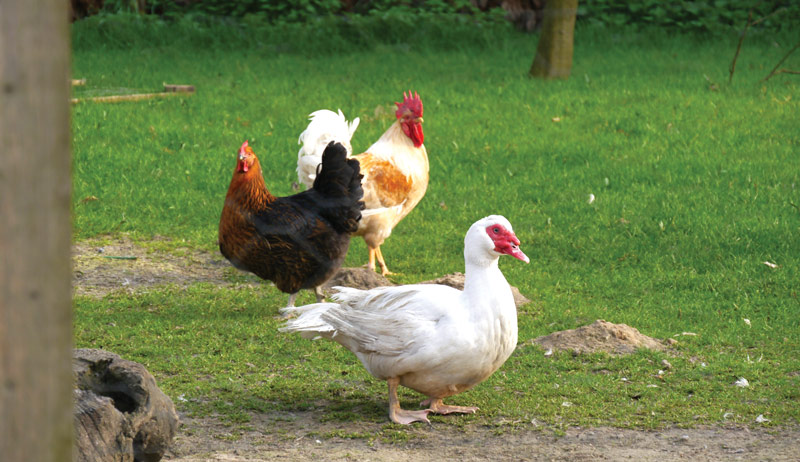
While ducks and chickens can be housed together, there are some specific needs for each. Chickens roost at night and require perches in a well-ventilated, but draft-free coop, shed or barn. Ducks, on the other hand (except for the Muscovy), will sleep on the ground wherever they are, with little regard for weather, cover or bedding. That said, they should still be provided, at minimum, a three-sided shelter with a roof where they can hide from the elements, should they choose to.

Chickens require nesting boxes where they should reliably lay their eggs throughout the day. Ducks will lay, mostly in the morning, and wherever they happen to be, or in a communal nest if someone starts it. They’re also known to hide their eggs, so if you provide them with straw bedding, it doesn’t hurt to dig around a bit.

Ducks also require more frequent tidying. Chickens will scratch and move bedding around, rifle through their straw or wood shavings and otherwise aerate their space. Ducks have very wet poop, fling water everywhere and then sit in it, creating a stinky, mushy situation that needs to be scooped up relatively frequently.

Keeping the two together can reduce this somewhat, especially if your chicken count is higher than your duck count. But any time ducks are involved, there will be more mess and you’ll have to retain dry areas for the chickens, who greatly dislike having wet toes.

Housing the two together is relatively easy. A small coop that has perches for chickens and sufficient floor space for ducks will happily be shared. A secure attached run with 24/7 access gives the ducks the option of sleeping outdoors, too. Water should be kept in runs and not in the coop itself. This will cut down on the mess that ducks make and the humidity in the coop which can have negative effects on chickens, particularly in winter. 

chickens ducks
Anika Wilson

Noise

Neither ducks or chickens are particularly noisy creatures. However, where noise level is concerned, it’s the males that are quieter amongst ducks, while the opposite is true in chickens. If eggs aren’t a consideration for you, male ducks are the quietest of all the backyard birds. Their soft little rasps don’t reach great volumes and you can keep a flock of entirely male ducks, so long as there is no female present, as adorable lawn ornaments and outdoor companions. 

When considering noise in chickens you really want to limit the number of roosters in your flock. One will crow occasionally. Add another, and he’ll want to match the other. Add a third, and you’ll hear conversations all day. 

Both ducks and chickens will “chat” amongst themselves almost constantly, with the female ducks being slightly louder than all the others. This is somewhat dependent on breed, however. Muscovies, for instance, tend to be very quiet birds, while bantam ducks such as call ducks (which can also fly) tend to be louder and chattier creatures. Ducks will also occasionally chat throughout the night, especially when startled, while chickens are all but comatose once perched for the evening.

Whatever your reason for getting chickens or ducks, whichever type you choose, it’s worth looking into individual breeds to ascertain what is right for your situation. Some chickens are hardier in cold temperatures than others. Some duck breeds lay eggs more frequently. Some birds are homebodies, while others may travel a little farther. 

There are also different sizes amongst breeds from bantam varieties to extra-large breeds. Some make better mothers or lay various colored eggs. Some breeds of chickens are known to be friendlier if you’re looking for pets, where others are better free-rangers because of their skittishness and heightened awareness. 

At the end of the day, chickens and ducks are equally joyful creatures to have around, easy to source and relatively easy to keep. They aren’t expensive to feed, house or care for and can be a great source of delicious eggs. 


More Information

Water Needs

In terms of their natural habitat, ducks do love water. That doesn’t, however, mean you need a pond to keep them. They’ll be happy with a kiddie pool filled fresh daily, a small meandering creek in your backyard or even just a big puddle to play in.

While they can live without water, I recommend providing water deep enough for them to float. There is nothing more joyful than a duck in a fresh pool.

Though water for swimming is good exercise, it isn’t essential for growing ducks. “Pools or small ponds can become soiled quickly, and if not flushed often, the rank water can be detrimental,” writes David R. Laatsch, an interim University of Wisconsin Extension agricultural educator, in Care of Ducks. “Ducks will stay clean and healthy with adequately adjusted drip-type watering systems and wire floors. Fresh drinking water is essential for top performance.”

This article about ducks vs. chickens originally appeared in the March/April 2023 issue of Chickens magazine. Click here to subscribe.