Categories
Crops & Gardening Equipment

Infographic: Pick Your Gardening Tool

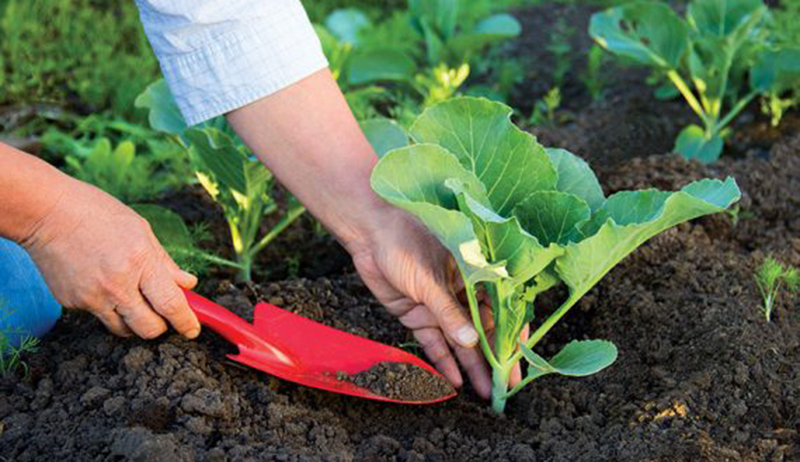
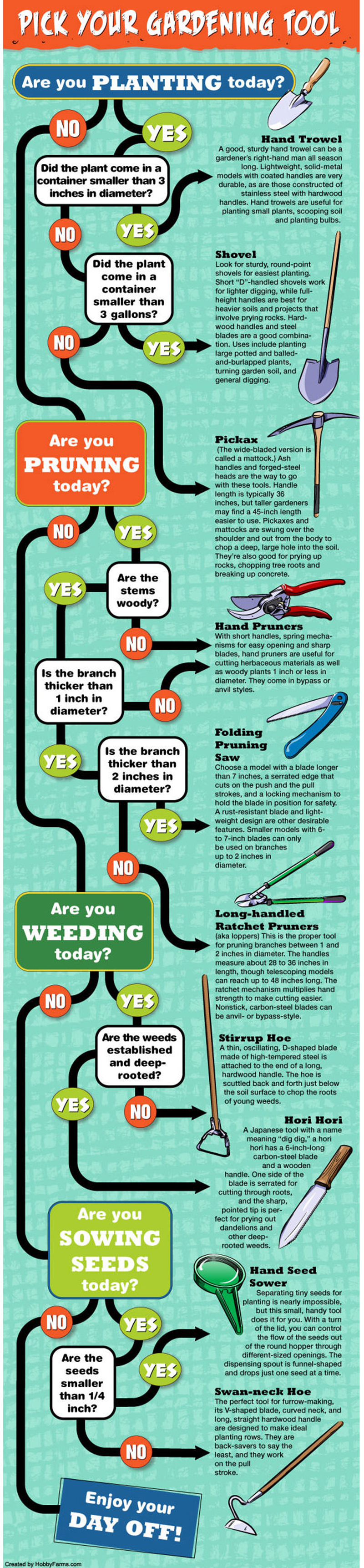
Gardening chores can be therapeutic or a complete disaster depending on what tools you have on hand. As every seasoned gardener knows, using the appropriate tools for a given task can make gardening more efficient and can limit the amount of stress on your body. Not sure what implements to use for today’s gardening tasks? Use the flowchart below to identify your helper.

gardening tools

Categories
Homesteading

Infographic: Measurement Chart for Produce Preservation

If the goal of your hobby farm is to feed your family, stringent planning is required. First, you need to know how many fruits and vegetables you’ll need to harvest in order to prepare your family’s favorite foods—like pies, picklessalsa or applesauce. Then you can calculate how much to plant in the garden.

To make your garden planning a little easier, use the harvesting chart below to calculate how much produce you’ll need to put by to preserve your favorite products.

Infographic: Produce Measurement Chart
                              Click to view larger image

Categories
Equipment

Broken Down in Yellowstone

Tour group at Yellowstone National Park
Photo courtesy Jim Ruen
Our Yellowstone tour group takes a break outside our minibus.

You never know when a little mechanical training will come in handy. Back when I was a young man just out of high school, I joined the U.S. Army. When I chose the training I would undergo after basic infantry training, I selected mechanics. I spent two months in Missouri learning wheeled-vehicle maintenance followed by two months in Oklahoma working on track vehicles.

Then the Army found out I could type (thanks to Miss Boyer and a high school typing class) and assigned me to a data-processing center. I never touched a wrench to a track vehicle again … until two weeks ago.

With our son and daughter both home from college, my wife and I recognized this was a unique opportunity to take a family vacation the week after Christmas. We had always wanted to see Yellowstone National Park in the winter and headed west.

The classic way to see the park in the winter is a tour in a Bombardier snow coach, a 12-passenger minibus with skies on the front and tracks on the rear. Built in the 1970s, the cramped but rugged units are a bit worse for wear and scheduled for replacement. We were excited to have the chance to experience plowing through several feet of fresh snow in one of these rigs, going where other vehicles, even those on tracks, simply couldn’t go.

The excitement intensified about 8 hours into the 10-hour ride. We had been stopping at scenic sites in the park, watching coyote, bison, elk, trumpeter swan and even river otter in the snow and open waters. Then the noise started. A rhythmic thumping on one side of the bus grew in volume. One of the rubber track pads had begun to split.

Next week: The Fix!

<< More Shop Talk >>


Categories
News

CO2 Could Increase Tomato Growth

Two red tomatoes on vine
Courtesy Hemera/Thinkstock
Scientists at Fresno State have found evidence that applications of carbon dioxide gas could improve tomato growth in greenhouses.

Specially equipped greenhouses hosted a first-of-its-kind agricultural experiment on the Fresno State Agricultural Laboratory campus farm when carbon dioxide gas was applied to tomato plants to determine whether production could be enhanced.

Leading the work is Florence Cassel Sharma, a soil and plant scientist conducting research for the Center for Irrigation Technology. Cassel Sharma recently received the Far West Region 2011 Outstanding Partnership Award presented by the Federal Laboratory Consortium.

“The main goal of this project is to provide efficient and simple techniques for recycling CO2 emissions in agricultural fields to enhance crop productivity and water-use efficiency,” Cassel Sharma says.

Primary producers of CO2 in California are the transportation sector, power and cement plants, and oil refineries, Cassel Sharma notes. Although CO2 has different industrial applications (carbonation, food preservation and packaging), commercial uses of the compound are relatively small compared to the amount produced.

“A novel use of these emissions could be found in the agricultural sector since CO2 is the primary component of photosynthesis and, therefore, plant growth,” Cassel Sharma says. “Application of CO2 around the crop canopy could enhance photosynthesis and thus increase crop productivity and water-use efficiency.”

Previous CIT studies indicate that CO2 enrichment of open-field crops has a good chance of success, according Dr. Dave Goorahoo, PhD, an assistant plant science professor at Fresno State and a co-investigator on the project. Increased yields were observed on tomatoes, bell peppers and strawberries, he says.

In the most recent study, conducted during the 2011 summer growing season, researchers applied CO2 and irrigation water at different levels in open-top chambers that resemble greenhouses. CIT research associate Shawn Ashkan, also working on the project, designed and supervised the construction of the chambers and CO2 delivery system.

Plants were sampled regularly during the growing season and measured for leaf area, nutrient content and weight. Photosynthesis measurements were taken for each CO2 and irrigation treatment. Tomatoes from the different treatment groups were harvested in September 2011. Yields were measured along with plant and root biomass. Similar treatments will be applied during the second year of the project, in summer 2012. Results will be released following second-year analysis.

Funding for this research was provided by the California State University Agricultural Research Institute.

Categories
Urban Farming

After Closing Massive Landfill, Mexico Looks to Convert Waste to Energy

Mexico closes landfill

iStockphoto/Thinkstock

Landfills harbor solid waste, the third largest source of anthropogenic methane emissions.

The same day the 927-acre Bordo Poniente Landfill in Mexico City, Mexico, stopped receiving solid waste, on December 19, 2011, Mexico City Mayor Marcelo Ebrard decided he would like a developer to close the landfill while also capturing its methane gas in order to produce energy.

“Closing Mexico City’s Bordo Poniente Landfill is one of the most important environmental actions for the entire country. If it can be done here, it can be replicated elsewhere even if the solution is a complex one. When there is a very high level of complexity, but a common objective and a successful outcome, we build confidence in our ability to take on other important objectives,” says Ebrard.

Working closely with the Clinton Climate Initiative, Cities program and partner C40 Cities Climate Leadership Group, the project is hoped to be seen as an example to international waste management and greenhouse-emission reduction around.

According to The Boston Globe, construction waste will be recycled into building material. All operations will cease by the end of 2011. Cemex SAB has agreed to buy 3,000 tons of landfill waste daily to turn into energy.

Mexico City government states that there will be a reduction of a minimum of 2 million tons of carbon dioxide per year. Also in the works is a project to catch the methane gas produced at the dump and turn it into energy. Government Undersecretary Juan Jose Garcia Ochoa says that, three years ago, Mexico City recycled only 6 percent of its garbage. That number is now close to 60 percent. The landfill has accepted more than 76 million tons of trash.

Landfills harbor solid waste, the third largest source of anthropogenic methane emissions, which is 23 times greater than C02. As much as one quarter of Mexico City’s total emissions could be reduced by capturing the landfill’s methane. It could also generate enough power for about 35,000 homes in the city in the first few years. Employment and economic benefits will also come from creating short- and long-term local jobs for contractors, service providers and construction labor, operations and maintenance of the landfill gas capture system.

Paying for this project will be energy sales and GHG reduction sales and financial resources from the Mexican federal government and private investors.

C40 Cities Climate Leadership Group is a network of large and engaged cities from around the world committed to implementing meaningful and sustainable climate-related actions locally that will help address climate change globally. For more information, visit C40 here.

The Clinton Climate Initiative addresses the major sources of greenhouse gas emissions and the people, policies and practices that impact them. Visit CCI here.

Categories
Animals

Wool It Be – Part 1

Sheep
Photo by Sue Weaver
Grace, the spokeslamb, says we goats look funny. Hmph!

Yesterday, the little girl lambs came to visit Uzzi and me. They giggled and nudged one another and then Grace, the spokeslamb asked, “You goats look funny. Why don’t you have wool?”

Uzzi and I looked at each other. “Only sheep have wool,” Uzzi told them.

“Bandit the llama has wool,” she countered. “And Mama says Angora goats have wool.”

We didn’t know what to say, so we looked it up. Here are some things we learned.

Llamas and Angora goats have fiber, but it’s not like the fiber from sheep. Wool has a unique outer covering, called the cuticle, that makes it stick together. Inside, a cable-like structure imparts strength. A wool fiber is so springy and elastic it can be bent more than 30,000 times without harm. Stretched, its crimp allows it to spring back into shape.

The first sheep, called mouflons, didn’t have wool. They were like some of today’s hair sheep, but they did have a wooly winter undercoat that they scratched out on bushes and rocks each spring. Ancient people gathered it and wove it into crude fabric. Almost as soon as sheep were domesticated about 9,000 years ago, humans began selecting for wool. Archaeologists at a dig near Sarab, Iran, found a figurine of a woolly sheep carbon dated to 4000 B.C.!

At first, people worked fleece by hand by rolling tufts of fleece along their thighs, adding more fiber as needed to create a length of yarn. Later, the drop spindle was invented. All wool was spun on hand-held spindles until the spinning wheel was invented in the 13th century A.D.

The weaving of woolen fabric was already well-established in Britain at the time of the Roman conquest in 43 A.D. According to the Doomsday Survey conducted in 1066, there were more sheep in England than all other livestock species combined. By 1300, there were an estimated 15 million sheep in the British Isles.

Rich British citizens preferred fine woolen goods produced in Flanders so in 1326, Edward III ruled that only “kings, queens, earls, barons, knights, ladies and others who spend £40 a year of their rents” could purchase cloth woven outside the British Isles.

Queen Elizabeth I (1533-1603) ordered everyone over the age of 6 to wear “a cap of wool, knit and dressed in England” to Sunday church services. (Elizabeth, however, wore silk.)

Wool was medieval England’s major export. Medieval abbeys grew rich through the sale of wool. Gloucester Abbey kept a flock of 10,000 Cotswold sheep, and Winchcombe Abbey kept 8,000 Cotswold sheep.

Wealthy 17th-century wool merchants in the Cotswolds and East Anglia built lavish estates and donated money to build huge churches. Brasses in their churches depict wool merchants with their feet on woolsacks and surrounded by shorn sheep. Inscribed on one merchant’s grave: “I praise God and ever shall—it is the sheep hath paid for all”.

And then sheep came to America. We’ll talk about that next week!

« More Mondays with Martok »

Categories
Urban Farming

Jellybean Bandit

corgi

Photo by Audrey Pavia

Bandit, my roommate’s Corgi, proved his herding instinct this week.

Having one Corgi in the house is a blast, so having two should be double the fun, right? Well, usually it is. But Jellybean Bandit, my roommate’s Pembroke, seems to always be in trouble.

Bandit loves people. When you pet him, he gets so excited that he emits high-pitched yelps of joy the entire time your hands are on him. But he has issues with other dogs. He’s gotten into a couple of fights with Nigel in the house, and is now only allowed to be with Nigel when they are outside. My other roommate’s Rat Terrier, Olivia, can’t be around Bandit at all. Bandit wants to eat her.

Bandit also gets into trouble regularly for harassing the chickens. He’s decided he doesn’t want them on the back lawn, and when he’s outside, he chases them whenever they go to the grass to scrounge for bugs.

Bandit has also figured out a way to get out of the backyard. My next-door neighbor has found him wandering around his yard three times now. We can’t figure out how he’s doing it.

So as sweet as Bandit is, he can be high-maintenance. His mom Michelle loves him, but all this stuff drives her crazy. His smarts, energy and boldness are often his detriment.

But the other day, I got a glimpse of what I believe is a powerful and amazing herding instinct in this little dog — and the reason behind his intense personality.

It happened last week. I had led Milagro into his stall, and just as I slid the halter off his head, Milagro whirled around and bolted out the door. He began cantering around the back area, gleeful at his escape.

“Milagro!” I shouted angrily. “Get back in your stall!”

It was clear my renegade Spanish Mustang had no intention of listening to me, so I began to swing the lead rope, hoping to drive him back into his stall. This sometimes works, but not today. This time, he ran around defiantly, refusing to go into the open gate.

And then Bandit showed up. Like a well-trained, experienced herding dog, Bandit became my wingman. He began driving Milagro, staying close enough to push the horse, but far enough away to avoid a kick. When Milagro tried to run past his open stall gate, Bandit swung wide and cut him off, pushing Milagro inside. I ran up and closed the gate.

I was so proud of Bandit. I gushed over him, and the smile on his little face was unmistakable. Not only did he get to show the world his hidden talents, he also gave me a brief sensation of what it’s like to work in tandem with a herding dog. It was pretty amazing.

Now when Bandit gets into trouble, I am much more understanding. I know it’s only because he needs a job. Had he been born 100 years ago in Wales, he’d be doing exactly what he was bred to do.

Read more of City Stock »

Categories
News

New Farmers Get Hands-on Business Training

Beginning Farmer Institute
Courtesy Erin Schneider
The Beginning Farmer Institute brings new farmers together to learn valuable skills, such as communication skills, risk management and financial planning.

This month, first-time farmers from across the U.S. will converge in Minneapolis for the second session of the Beginning Farmer Institute, a learner-centered program sponsored by the National Farmers Union, Farm Credit, United Soybean Board, and Sustainable Agriculture Research and Education. This meeting follows in the footsteps of the program’s inaugural session held in September 2010 in Washington, D.C., which introduced new farmers to concepts that can’t be learned in the field.

Participants of BFI meet throughout the year to discuss topics, such as financial planning, USDA farm programs, risk management and communication skills, which they and NFU have identified as important.

“The learning process is cumulative, building on previous topics, in order to give participants a well-rounded knowledge of the ins and outs of today’s agriculture,” says Maria Miller, NFU’s education director.

Although the participants come from a cross section of agricultural backgrounds—from commodity crops to livestock to urban farms—they came out of the first BFI session energized and ready to apply the knowledge they’d gained.

“I work on a small, chemical-free farm in a New England city, but that doesn’t mean that I cannot relate to farmers from other backgrounds and learn from their experiences,” says Tess Brown-Lavoie, who farms a less-than-1-acre plot on the west end of Providence, R.I. “Fundamentally, we’re all trying to feed people, and so learning about other people’s methods and practices helped me to understand more about the politics of my own business.”

Erin Schneider agrees. In contrast to Brown-Lavoie’s small acreage, she owns a 59-acre farm and operates a 10-member CSA outside Madison, Wis. She gleaned information from the institute that she can put to work in her operation. “On a personal level, it gave me more confidence in asking for loans from the Farm Service Agency or bank,” she says.

Each BFI session is taught by seasoned agriculture professionals, who have real-world experience with their given topic, but the support of other beginning farmers is what really made the difference, according to the participants.

“You can learn from everybody,” Schneider says. “As long as you are open to that, you can ask questions along the way.”

In fact, at the end of the first session, many participants committed to assembling financial plans in time for the January meeting for a peer-review session.
 
“The BFI was very useful on many fronts,” Brown-Lavoie says. “We gained exposure to institutions and vocabularies that are important in advocating for useful farm policy and learning necessary business skills.”

Each year, the BFI will welcome a new group of farmers. According to Miller, the program is likely to adapt to the needs of the participants as well as changes implemented by the 2012 Farm Bill. Nonetheless, NFU anticipates the program will influence a new generation of farmers.

“The increasing demand for locally grown food represents a change in the way consumers view agriculture,” Miller says. “We hope the first participants in the Beginning Farmer Institute will become positive role models in their respective communities.”

Applications and information on the next institute will be available later this month on the NFU website.


Categories
Urban Farming

California Farm Academy Aims to Produce Next Generation of Farm Entrepreneurs

Land-Based Learning logo

Photo courtesy of www.landbasedlearning.org

A proper background in the farming business is sometimes all what separates a successful enterprise from a failed one.

To encourage aspiring entrepreneurial farmers, the non-profit organization Center for Land-Based Learning’s California Farm Academy will offer beginners a course on specialty crop production at its headquarters in Winters, Calif., that will be split into two sessions, starting February 16, 2012 and another tentatively planned for November.

The program, which includes partners such as Sierra Orchards, Farm Fresh To You/Capay Organic and UC Davis Russell Ranch, will cover subjects from production to marketing.

Professionals already in the business will help lead the course’s topics, such as direct and wholesale marketing, pest management and farm equipment operation.

“We offer a hands-on, interactive learning environment in which you will build the knowledge and skills you’ll need to become a successful farmer,” said Farm Academy Director Jennifer Taylor.

In fact, the hands-on segment means students will get to practice the skills learned during the course at various sites, including the Farm Fresh To You/Capay Organic farm and a greenhouse. Another added bonus: The California Farm Academy will give graduates a chance to lease 1/4- to 1/2 acre of land through the school for three years.

The 22-week program, priced at $1,950, is designed for those with busy schedules, with courses offered in the evening and on weekends for a total of seven to 10 hours of class and training time per week. The cost includes printed materials, machinery, tools and supplies.

The coursework load will be substantial, with students graded on participation, extra reading assignments and tests. In addition, participants will work on two long-term projects, a business plan and independent study project. Both have as their goal to place students in a scenario of a real-life business.

The California Farm Academy training program was conceived to spur young people to go into an industry in which, according to the organization, the average Californian farmer business owner is 58 years old. These entrepreneurs produce crops valued at $20 billion per year, it says, and the business is in need of the next generation of farmers.

The California Department of Food and Agriculture 2010 Specialty Crop Block Grant Program funds the California Farm Academy.

The California Farm Academy is just one of the Center for Land-Based Learning’s courses. Its Slews Program, for instance, is created for high-school students and teaches them about restoring and protecting habitats.

The organization focuses on educating young people on sustainable agriculture, which can lead to employment in the agriculture, environment or food-system areas.

Click here for more information on the California Farm Academy. Registrations for the course close on Dec. 9, 2011.

Categories
Animals

3 Common Goat Myths

White and gray goat laying down
Photo by Rachael Brugger
Don’t believe everything you hear about goats. They can be delightful additions to your hobby farm.

Goats sometimes get a bad rap. People who have never kept goats often believe and pass along negative stereotypes about the species, such as goats stink or eat everything in sight. If these ideas have kept you from raising goats on your farm, read below to find out if what you’ve heard is fact or fiction.

Myth No. 1: Goats stink.
Only bucks have a powerful odor, particularly during the fall breeding season. Unless they’ve recently been with a buck, the females do not give off a strong smell.

Myth No. 2: Goats eat tin cans (and everything else).
“Goats are picky eaters that want clean, wholesome hay, and they’ll turn up their noses at forage a cow or horse would snarf right down,” says Nubian goat breeder Sue MacDougall. “Goats use their mouths to explore their world. They’ll examine a tin can and perhaps eat the tree-based paper label, but would never eat the can.”

Myth No. 3: Goat milk tastes bad.
Naturally homogenized whole goat milk may seem richer than cow’s milk, but it only develops a strong, unpleasant taste when the doe has been feeding on onions or another strong plant (same goes for cows).

About the Author: Cherie Langlois is a freelance writer and hobby farmer based in Washington