Categories
 Courtesy iStockphoto/Thinkstock USDA scientists found the nutritional value of new broccoli cultivars has stayed consistent over a 50-year time span. |
Research performed by USDA scientists and published recently in the journal Crop Science has demonstrated that mineral levels in new varieties of broccoli have not declined since 1975. The broccoli contains the same levels of calcium, copper, iron, magnesium, potassium and other minerals that have made the vegetable a healthy staple of American diets for decades.
“This research provides data on the nutritional content of broccoli for breeders to consider as they further improve this important vegetable,” said Edward B. Knipling, administrator of the Agricultural Research Service, USDA’s principal intramural scientific research agency.
Scientists evaluated the mineral content of 14 broccoli cultivars released over a span of more than 50 years. The broccoli cultivars were grown in two field trials in 2008 and 2009, and the florets were harvested for testing.
“Our studies show that not much has changed in terms of mineral content in the last 35 years in a crop that has undergone significant improvement from a quality standpoint and that was not widely consumed in the United States before the 1960s,” says Mark Farnham, research leader at the U.S. Vegetable Laboratory in Charleston, S.C.
Broccoli florets in the study were tested for levels of calcium, copper, iron, potassium, magnesium, manganese, molybdenum, sodium, phosphorous, sulfur and zinc. Results indicated significant cultivar differences in floret concentrations of calcium, copper, iron, magnesium, sodium, phosphorous and zinc, but not of potassium, manganese, molybdenum or sulfur. There was no clear relationship between mineral concentration and release year.
“For broccoli cultivars grown during the past 35 years, when hybrids became the standard cultivar, evidence indicates that mineral concentrations remain unchanged,” Farnham says. “As broccoli breeders continue to improve this crop in the future, data from this study can serve as a very useful guide in helping breeders understand the variation in mineral concentrations they should expect among their breeding stocks and also provide a realistic baseline that should be maintained as other characteristics are manipulated in the future.”
Categories
Of Mice and Men
 Check your outbuildings—and even your farm equipment—for mouse nests. |
I appreciate mice and their place in the ecosystem. I just wish they didn’t want my place, too. I try to mouse-proof the house, but every year a few get in. Outbuildings are often more of a problem. Without daily use, it’s easy for mice to make inroads, enlarging a pinhole, storing food and building a nest.
I try to stop them before they go too far because I actually admire them. I really hate to throw out a completed nest or a hard-won food supply, especially as winter approaches. I do it, but I don’t enjoy it. That may sound ridiculous, but bare with me.
Most people seem to hate mice. I think it’s because they are so much like us. They spoil perfectly good food, clothes or whatever they get into. They take advantage of whatever resource is at their disposal, whether it is earned or found, and leave messes wherever they’ve been. Generally speaking, they are everything we were in the hunter-gatherer stage and, frankly, are how too many of us are today.
What does this have to do with tools? The other day we got our first heavy snowfall. I retrieved my ATV and snowblade from the hoop house, but I hadn’t gone far before recognizing a familiar aroma. I removed the seat, and there over the battery was a well-built mouse nest. I cleaned it out with compressed air and finished the job. The next morning I checked the ATV. The hardworking critters had already rebuilt half a nest. Out it went, and the seat stayed off. I hope that will discourage the critters, but we’ll see. Like mankind, mice are stubborn and often don’t learn from their mistakes.
Whether you like mice or not, remember to check your outbuildings and exposed vehicles. You, too, may have guests.
Categories
Butterfly Farming Checklist
 Courtesy Comstock/Thinkstock Butterfly farming requires both time and knowledge, so make sure you’re equipped with both before starting your venture. |
1. Temperature- and humidity-controlled location.
This might be a room in your home strictly dedicated to raising butterflies.
2. Pesticide-free host plants.
Host plants will serve as the butterflies’ source of food. It’s important to have both the knowledge and space to grow them.
3. Supplies for raising butterflies from egg to adult.
Supplies will include caterpillar-raising containers, disinfectant, breeder cages, adult cages, netted tent or greenhouse for host plants, microscope, clip-on lights, ice packs, insulated shipping boxes, permits (if applicable) and start-up stock.
4. Computer and Internet service.
If you want to promote your butterfly-farming business, these tools are invaluable.
5. Knowledge.
Courses in raising butterflies are offered through the Association for Butterflies and come highly recommended to ensure business success. Raising butterflies can differ widely between people and locations, and simply following the advice or anecdotes of a fellow farmer is not enough.
6. Time.
Believe it or not, butterfly-farming can be an all-consuming venture. The season begins in early spring and lasts through late fall (not to mention the time needed for starting and maintaining host plants). Summer vacations will become a thing of the past; because in order to make this a successful business, you’ll want to raise during peak season. While you might think you could simply hire a neighbor to care for them in your absence, as mentioned, butterfly-farming requires knowledge. The last thing you want is to return from your vacation to find out that your business venture has died (literally).
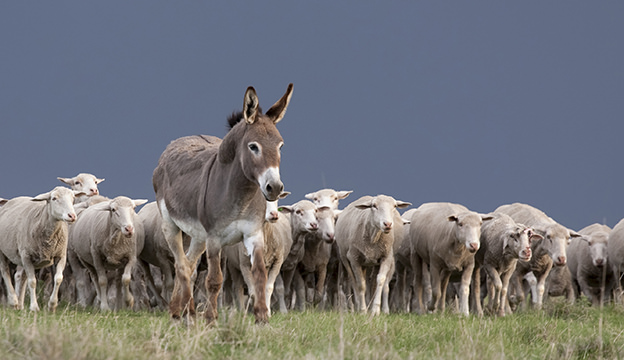
Protecting your livestock from predators, such as coyotes, foxes and even bears, can be a daunting task. Luckily, there are other animals you can keep on the farm to help. Depending on your protection needs, a guardian dog, donkey or llama can help keep predatory animals away from your flock or herd. Find the best guardian animal for your farm using the flow chart below.

Categories
6 Holiday Hazards to Avoid
 Courtesy iStockphoto/Thinkstock Feed your animals extra roughage during the winter months so they can generate heat more easily. A holiday treat is OK, too, as long as it contains safe ingredients. |
Whether you celebrate Christmas, Hanukkah, Kwanzaa or another holiday on your farm, it’s important to get an early start thinking about the season’s impact on our livestock friends. For a safe, sane and wonderful holiday, keep these hazards in mind.
1. Unsafe Décor
Stress safety when carrying holiday spirit to areas where animals live. Some twinkle lights, especially older styles, get hot enough to ignite flammables, such as hay or bedding. Plus, their cords can fray, leading to a short circuit. For barns, always use updated strands of outdoor-style, UL- or ETL- approved lights that have fuses in the plugs. Before using lights in or on the barn, carefully check each strand for bare wires, loose connections and broken bulbs. Then place them on a fire-resistant surface, and plug them in for 15 minutes to make sure they don’t melt or smoke.
When plugging in lights, use only three-pronged extension cords approved for outdoor use. Don’t overload them, as cords can get hot enough to burn.
To hang lights, secure them with insulated holders (not tacks or nails) or run strands of lights through hooks. Hang them where your livestock’s curious lips can’t reach them; this is especially important with inquisitive species like horses and goats. Most importantly, unplug outdoor barn lights before going to bed and indoor lights when no one is in the barn; there are too many flammables in a barn to take chances.
Decorating animals’ stalls can be a fun way to celebrate the season. Stick to items that won’t harm animals should they eat them. Skip the plastic and glass decorations; instead opt for real evergreen garland and popcorn balls dyed with food coloring.
2. Unhealthy Holiday Treats
Looking for a special gift for your four-legged and feathered friends? Think a tasty bran mash for your horse or dairy cow and treats for all of your animal buddies. Healthy, animal-safe treats are a good way to include your livestock in the holiday gift-giving.
When fixing holiday treats, keep in mind that not every food is safe for your animals to eat. Avoid feeding chocolate or avocados to any livestock species. Cabbage, broccoli and other brassicas rarely show up in animal treats—a good thing, as they’re toxic to some species and cause gas in others, which can lead to colic or bloat. If you’re unsure whether a treat is safe to prepare for your livestock, consult a livestock veterinarian before heading to the kitchen.
3. Dangerous Travel
Creating a new holiday tradition is a fun way to liven up the season and give back to your community. Take your alpacas to a nursing home to meet the residents and distribute cookies. Volunteer your donkey and a few tame sheep for your community’s living nativity scene. Pack up your children and a goat or two and “go julebukk,” the Norwegian version of Christmas caroling.
Take care when transporting your animals to holiday events—don’t just bundle them into the back of your SUV and hit the road. For smaller livestock, fold down the seats down and haul them in pet carriers or large dog crates placed in the back of your vehicle.
For larger animals, use a horse trailer. (You can even use it for hauling a pair of goats, an alpaca or a few small sheep.) Ensure the trailer is ventilated but that cold air doesn’t stream in and chill your passengers. If there’s any doubt, fit them with blankets or sweaters to keep them warm.
4. Unaware Visitors
Holiday guests might want to meet your animals, but anyone unaccustomed to farm life might not understand how to safely interact with them. Before taking guests into the barnyard, explain the ground rules. These can include:
- Don’t feed fistfuls of party treats to inquisitive goats.
- Don’t take small children around large animals, and don’t allow them to run or squeal.
- Stay away from aggressive animals. (Point out aggressive animals to stay away from.)
- Only feed a pre-approved animal treat out of the flat of your hand.
- Move around horses and animals slowly to avoid startling them.
You might add to this list because you know the operations of your barnyard best. Be sure to clearly express your safety guidelines with your guests and supervise them at all times.
5. Sticky Sitter Situation
If you plan to travel over the holiday, arrange for a farm sitter early so you’re sure to have someone reliable to watch over your livestock. Use a farm-sitter checklist to make ensure your sitter is prepared and your livestock are safe before you leave town.
If you can’t get a professional sitter, find a livestock-savvy friend or family member to feed and check on your livestock at least twice a day. Ask this person to visit the farm a few days before you leave so you can introduce them to your animals and show them where things are stored. Explain any special needs and demonstrate how to perform specific chores. Don’t forget to leave your veterinarian’s contact information and an emergency contact list for them to have on hand in the event of a problem.
6. Chilly Animals
Cold weather around the holidays can pose a danger to your livestock, so this year, give the gift of toasty warmth.
Animals need a warm place to get out of wind, snow and rain, so if your barn needs repairs, do them now. Also consider a warm stable blanket or turnout for your horse or make coats for your goats. Another fine gift for livestock: a heated waterer or submergible heater for a bigger stock tank. Your animals will appreciate warm water whenever they want it and you won’t have to lug it to the barn.
Remember that animals need extra bedding to snuggle into; a deep bed of clean straw is best for winter use. Feed that helps the animal produce more heat naturally will also help when winter winds blow. This usually means extra roughage, not grain. Feeding too much grain can lead to gastrointestinal problems, like colic, in horses and donkeys, bloat in cattle, and enterotoxemia in ruminants, such as sheep, goats, llamas and alpacas
Chickens need extra warmth, too. You may want to heat their coop to keep frostbite at bay. If you do, consider using solar heat or a heated chicken-coop mat instead of a heat lamp; heat lamps can and often do ignite nearby flammables and burn down the structure they’re warming. If you use a heat lamp, don’t clamp it to the wall or suspend it by its cord or a piece of baling twine. Always use a strong, separate hanger and secure the lamp where it won’t overheat flammable bedding. You can also shovel snow high against the outside walls for natural insulation. And warm your chickens from the inside out by providing body-heat-generating feed, such as cracked corn or scratch and water from a heated waterer or dog dish.
Categories
Looking for Burros

No matter how hard I tried, I could not see any of these amazing wild burros on my recent trip to Death Valley.
About 20 years ago, I saw a group of wild burros in Red Rock Canyon National Conservation Area near Las Vegas, Nev. It was a huge thrill for me to see descendants of the donkeys originally brought to the West by the old gold prospectors of the 1800s. They were living history, and I was honored to be able to get so close to them.
This past weekend, I hoped to recreate this exciting moment during a trip to Death Valley National Park. Wild burros roam free in the park, as they have done since the mid-1800s, when gold was first discovered in the area. Burros that are found on the Bureau of Land Management land are often rounded up and placed for adoption, along with wild horses that are captured. I have long dreamed of adopting a wild burro someday, when I have time to dedicate to gentling a wild creature.
It’s not hard to see these living bits of history if you go to a BLM adoption center, but to find them in the wild is another story. They are fairly tame in Red Rock Canyon and will come up to your car looking for a handout. But here in Death Valley, they are as wild as the terrain.
The friends I camped with in the backcountry of Death Valley this weekend are horsepeople. Two of them are very experienced explorers of the National Park, but my friend, Michelle, and I had never seen the park quite in this way. We tooled around on rocky dirt roads that double for washes during the rainy season and are treacherous enough that most people wouldn’t even attempt to tackle them, even with a four-wheel drive.
Everywhere we went this weekend, we saw what we casually referred to as “burro poop.” Donkey dung was everywhere: on the road we upon which we drove, on the trails we hiked, and even outside the cabin where we stayed, despite the fact that the area was fenced to keep the wild burros out. It seems they like to get close to the cabins in the park and destroy whatever manmade objects they can. Do they hate people, and this is their way of saying so? Or are they just mischievous like my own horses, who will trash anything they can get their teeth on? I think the latter.
As we drove and hiked through the valley all weekend, Michelle and I constantly scanned the horizon. We searched for wild burros high and low, but to no avail. Their poop taunted us, as if they were saying “See, we were here, but now we’re not. You are just not smart enough to find us.” Our desert denizen companions felt compelled to regale us with stories of all the many times they have seen burros while in the valley, and after a while, it almost felt like they were rubbing it in.
On Sunday afternoon, as we drove out of the National Park, I knew my chance of seeing a burro on that trip was gone. But I will not accept defeat. Instead, I’m already thinking about how I can get back to Death Valley so I can try it again.
Categories
Christmas Traditions – Part 2
 Photo by Sue Weaver At Christmas, my Mom and Dad make wreathes, and we animals like to wear them. It’s so festive! |
Last week, we talked about a few new holiday traditions you may not observe on your farm. Here are more to try.
1. Bake cookies!
Set aside a family cookie-baking day and let everyone help cut out and decorate cookies. Or plan a cookie party for a few of your friends. Ask each guest to bring their favorite cookie recipe and a dozen cookies for each participant to take home, plus a few extra cookies for sampling. Furnish beverages and mugs for cookie dunking. Yum!
2. Bring the scent of Christmas to your home.
Burn pine incense—that’s what Mom and Dad do. Or try our Grandma’s recipe: Place 4 cups of water in a pot on the stove, and add three cinnamon sticks, 1 tablespoon of whole cloves, 1 tablespoon of vanilla extract and peelings from two oranges. Bring to a boil and reduce the heat (or set the pot on your woodstove, like Mom and Dad do) so the contents barely simmer. Be sure to check periodically to make certain the pot doesn’t go dry. Turn off the burner when you go to bed or leave home.
3. Celebrate the 12 days of Christmas.
Buy or borrow 12 children’s books about Christmas and read one to your kids each night, beginning on Dec. 12 and ending on Christmas Eve. You can also borrow or rent 12 favorite Christmas movies and view one each evening.
4. Attend free holiday performances.
Watch your local newspaper or call your local chamber of commerce for dates and times of holiday performances throughout the community.
5. Help your children write a letter to Santa Claus.
Send it to:
Santa
North Pole
Anchorage, AK 99530-9998
In the meanwhile, write a letter to your child as though you were Santa. Place the letter in a first-class stamped envelope addressed to your child, with the return address: Santa, North Pole. Place that stamped envelope in a larger stamped envelope addressed to:
North Pole Postmark
Postmaster
4141 Postmark Dr
Anchorage, AK 99530-9998
Mail it no later than Dec. 10 and the Anchorage post office will mail it from Santa for you. This is part of Operation Santa, a program the U.S. Post Office sponsors this time of year. They’ve been doing it since 1912, when Postmaster General Frank Hitchcock authorized local postmasters to allow postal employees and citizens to open and respond to letters addressed to Santa Claus. Nowadays “postal elves” sort the letters and single out requests expressing genuine need. Then individuals and organizations adopt those letters, purchase requested gifts and the USPS ships them to the child’s home. A pretty neat program, don’t you think?
6. Craft homemade garland.
Use pine, nuts, fruit and maybe greeting cards to hang on your tree or mantel. (Also check out Hobby Farm‘s link-garland templates.) You more advanced crafters can make your own Christmas wreaths. Next week, we’ll show you how!
Categories
13 Snow-removal Tools for 2012

Whether your farm usually experiences a light dusting or a heavy blizzard, you’ll need the proper snow-removal equipment to keep your farm operating smoothly through the winter months. View the slideshow below to find the best plow, snowblower, ATV attachment or other equipment to help relieve your snow burden.