Categories
News

5 Modern Ways to Show Food Gratitude

Baskets of cranberries and nuts on wooden table, overhead view
Courtesy iStockphoto/Thinkstock
Give thanks in modern ways for the traditional food that graces your Thanksgiving table. Plan a meal using an app or Tweet your #foodthanks.

While celebrating the end of harvest season is a tradition that can be traced back for centuries, modern-day twists on the custom have evolved since the 1621 Plymouth Colony fall feast. Just as pilgrims rejoiced in their first good harvest, Americans today have found meaningful ways to honor the bounty, and express gratitude.

1. Give #foodthanks.
Farmers long ago traded in their oxen for tractors and other technologies to raise nutritious, great-tasting food. This year, a group of farmers and ranchers is cultivating a social media campaign to initiate meaningful conversations about food with Americans on Twitter, Facebook, blogs and beyond, says Kansas farmer Darin Grimm of the AgChat Foundation.

“For farmers on the go, social media is a great way to connect with consumers,” he says. “We’re hoping to see everyone from chefs to foodies to farmers using the #foodthanks hashtag.”

To participate, check out www.foodthanks.com, then tweet what you eat, using the #foodthanks hashtag.

2. Plan your meal with an app.
New recipe and meal-planning applications are a bounty in their own right, and they’ll help you put your homegrown harvest to good use once your holiday houseguests arrive. You can search for them through the iTunes store or other websites.

3. Preserve the flavors of fall.
Early American settlers would salivate over modern-day canning equipment. Once dismissed as a bygone art, canning has attracted a growing number of enthusiasts in recent years, according to the National Center for Home Food Preservation, which provides tips on canning, pickling, freezing and more. To really make a food statement, create your own labels

4. Host a tasting party.
The holiday table inspires us to create treasured traditions at home, including exploring new foods in the company of friends and family. Home entertaining expert Domenica Marchetti suggests a trend-worthy twist on the wine and cheese tasting party. The author of Big Night In (Chronicle Books, 2008) says, “Embrace the season’s bounty and host an apple-tasting party!”

5. Share in the bounty.
Thanksgiving is a great time to talk with your family about helping others in need, whether it’s a family down the street or a hungry child on the other side of the world. Charitable organizations like Farmers Feeding the World, Heifer International and locally based gleaning networks believe that giving families a source of food, rather than short-term relief, is a more sustainable way to lift them out of poverty and hunger.
Categories
Homesteading

Giving Thanks to Farmer-Heroes

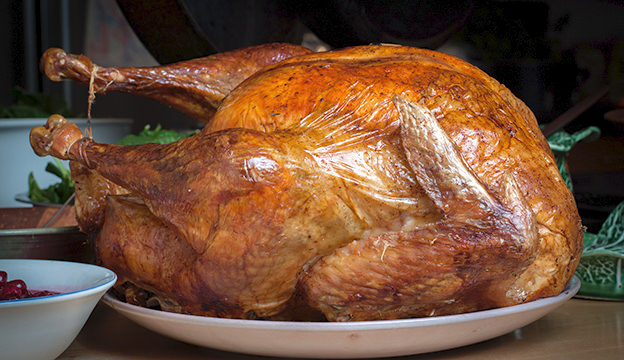
This week as turkeys roast and glasses toast, let us give thanks to the farmers who connect our menus from field to plate. Perhaps more than any other holiday on the calendar, Thanksgiving is—or at least should be—the equivalent to a ticker-tape parade for farmer-heroes who make our feasts possible.

For those of us with urban farms, backyard or community gardens, or a few rural acres, Thanksgiving can mark our seasonal transition from outdoor duties to those quieter winter months inside, when we dive into the abundance of root-cellared, frozen or canned produce—to enjoy the taste of the fruits of our labor.

So how are some of our farmer-heroes spending their Thanksgiving? We asked them, and here’s what they said:

Using Fresh, Not Processed, Ingredients

“For us, it’s all about the stuffing,” says Logan Peterman with a smile. He and his wife, Katie, run Laughing Sprout Family Farm in central Wisconsin.

While they keep a mostly vegetarian diet, they do cook a turkey for visiting family on Thanksgiving. Satisfying their preference for vegetables, however, they prepare a vegetable-based stuffing to showcase their fall crops.

“I think too many people think stuffing has to come out of a pre-made, processed box,” Peterman, says. “Stuffing is surprisingly easy to make. In addition to the dry, hardened bread, I’ll add onions, celery and carrots, and season with sage, thyme and garlic—showcasing the harvest from our farm.”

Showcasing Their Roots

“My family is Greek. My mother was born in Patras, so our menu often looks a little different than typical American fare,” explains Neysa King, a young farmer outside Austin, Texas, who shares her beginning-growing experience through her blog, Dissertation to Dirt. “There’s the turkey, of course, but in addition, we always have spanakopita, spinach and cheese baked inside filo dough, along with Greek-style potatoes baked with olive oil, white wine and oregano.”

But King and her husband, Travis Czerw, will also bring new flavors to the family table when they head to her mom’s house in Dallas this week: “Roasted root vegetables were never something my mother made until I began farming and bringing home delicious and sweet beets, carrots and turnips. Now roasted roots are a standard at our Thanksgiving table.”

Keeping Active

Beth Osmund who runs Cedar Valley Sustainable Farm, the first meat CSA (community-supported agriculture) serving Chicago, shelves her boots and Carhartts at Thanksgiving and puts on running shoes.

“We’re starting a fresh tradition this year by participating in a local 3-mile Turkey Trot run/walk as a family,” Osmund shares. “Both my husband and I along with our three sons have been training together in order to keep our activity levels up as the weather cools off. The race is on Thanksgiving morning, so we’ll get some good exercise before relishing that pasture-raised turkey from farm.”

Setting Her Own Rules

Who said you must eat turkey on Thanksgiving? That’s exactly what Kriss Marion of Circle M Farm in southern Wisconsin asked. She and her family celebrate Thanksgiving a week early.

“We open our doors a week before Thanksgiving and have friends and family over for a traditional meal, including my one of the farm-raised heritage-breed turkeys and favorite squash soup with our heirloom winter squash,” explains Marion. “Our actual Thanksgiving day is a very quiet, informal gathering with just my husband and kids, where we’ll kick back with no responsibilities in the kitchen, hang out in our pajamas, and maybe pop into town and go out to eat. It’s fun and super-relaxing to have a totally free day like this—just what we need after the busy summer running our CSA.”

Marion really plays by her own rules: “For that early Thanksgiving meal with family and friends, if we sell all our turkeys to our CSA members, I’ll just cook chicken and ham instead.”

So have a tasty Thanksgiving however you celebrate the food and the farmers who make it possible. Check back next week for techniques and recipes for one of our favorite classic holiday dishes: Eggs Benedict.

Categories
Animals

2011 Livestock Population Trends

Brown cow, two white sheep and chicken graze in a farm field; fence in background
Courtesy Zoonar/Thinkstock
As the global human population exceeded 7 billion this year, livestock populations are also on the rise.

As the population soars—it topped 7 billion in November 2011, up from just 3 billion in the 1960s, according to the United Nations—researchers are asking whether there is enough livestock to keep pace with worldwide demand.

“The big question is, ‘Will we have enough food?’” notes Nancy Morgan, livestock economist for the United Nations Food and Agriculture Organization. “With the existing animal [population] and good management practices, there is enough livestock to feed the world.”

The FAO tracks livestock populations worldwide. According to their research, there are nearly 19 billion chickens, 1.5 billion cows and 1 billion each of sheep and pigs around the globe.

With 1.3 billion residents, China is the most populated nation in the world; it’s also the world leader in the number of chickens and pigs. The largest number of cattle is found in Brazil and India. In fact, India has become one of the top five beef-producing countries, thanks to a rise in the demand for dairy products creating an increased number of male cattle available for slaughter.

The resurgence of the “Where’s the Beef?” ad campaign might be apt given that the U.S., which together with Brazil supplies one-third of global beef production and exports, has reduced cattle herds to their lowest levels since the 1950s due to severe drought in major grazing areas.

Canada and several South American countries, including Brazil and Argentina, are also experiencing significant declines in cattle.

The number of cattle in Kazakhstan is on the rise thanks to government subsidies for breeding animals and feed.

Asia is home to 65 percent of the global pig population. Although pork is still plentiful, disease outbreaks in 2010 took a toll on pig herds; the Republic of Korea lost one-third of its pig population. The nuclear fallout in Japan led to lower piglet births in affected provinces; the nation has also suffered from a 13-percent reduction in the number of pig farms since 2008.

If it seems staggering to imagine that the human population has more than doubled in the past 50 years, consider this: In 1961, there were only 3.9 billion chickens worldwide—about one per person; the chicken population has skyrocketed to 19 billion, or nearly three chickens for every person on the planet. There are more than 455 million chickens in the U.S. alone, according to the USDA’s National Agriculture Statistics Service.

According to Morgan, poultry has the fastest-growing population among livestock because of its low cost of input and low market price.

“It takes just 2 kilograms of grain to produce 1 kilogram of meat,” she explains.

Morgan is quick to point out that while it’s interesting to assess livestock populations around the globe, the total number of animals is less important than how those animals are used.

The real goal is figuring out “how to increase production without increasing the number of animals,” she says. “We don’t want to increase the number of animals because of soil erosion and other environmental issues; we need to get more meat from the same number of animals to meet the population demand.”

The FAO is not advocating for increased use of growth hormones or similar measures; instead, Morgan cites the need for better management of livestock, including vaccinations, to ensure long-term health.

“It’s a matter of giving people the tools, not increasing populations,” she says.

Categories
Equipment

Not Your Neighborhood Flea Market

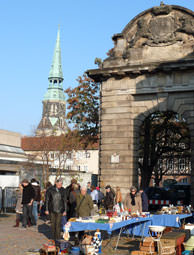
Hannover, Germany, flea market at city gate
Photo by Jim Ruen
Hannover, Germany, plays host to Europ’s largest continuous flea market.

Three of my favorite things in life are travel, flea markets and trade shows. All three are adventures into the unknown. No matter how much time you put into planning a trip, there are always surprises, and they are often the most memorable. Walk down a flea market aisle, and you never know what treasures await. Cruise through a trade show, and your head swims with new products and new uses for old products. Sifting through them all for things that matter to you (or in my case, my readers) is the adventure.

Earlier this month, I enjoyed all three of my passions. I traveled to Hannover, Germany, for Agritechnica, the world’s largest farm-equipment show. More than 2,600 firms from all over the world had exhibits there. An expected 400,000-plus visitors would attend the show over its six-day run. Exhibits fill 24 huge halls. I have never seen so many and such varied farm machines in a single show in my life. Everything from giant tractors and combines to leek harvesters, one-row tomato seedling planters and walk behind tractors. I only had two days there, but I could have spent the whole week.

The trade show started on Sunday, but I arrived late Saturday morning and spent the rest of the day wandering the streets of Hannover. The city is one of the main centers of commerce for the country and just happens to host Europe’s largest continuous flea market. Set along both sides of a small river, just outside the region’s parliament building and old city gates, the market was active even on an early-November weekend.

Stall after stall was filled with old CDs, clothes and knick-knacks of all sorts. Finally, I saw what I was looking for … tools.

(Continued next week.)

<< More Shop Talk >>

Categories
Urban Farming

Hain Celestial Feeds Homeless

Thanksgiving dinner

thinkstockiStockphoto

This Thanksgiving Day, Hain Celestial’s Simon family will join 700 other volunteers at The Bowery Mission to help prepare traditional turkey dinners for homeless New Yorkers.

The Bowery Mission in New York City has served homeless and hungry New Yorkers since 1879 — a tradition that will continue this Thanksgiving Day. On November 24, from 10:30 a.m. to 11:30 a.m., Irwin D. Simon, founder, president and CEO of The Hain Celestial Group, Inc., and his family will help the mission provide meals to over 5,000 people.

Hain Pure Protein Corporation, Hain Celestial’s affiliate, is contributing 200 vegetarian-fed, antibiotic-free turkeys raised on local family farms; Hain Celestial’s Terra® brand, known for its 100 percent natural exotic vegetable chips, is contributing 2,000 pounds of sweet potatoes; and Hain Celestial is also donating other food items to help provide complete meals in celebration of Thanksgiving Day.

“As the leader of one of the nation’s top natural and organic food companies, I have made it my personal mission to do what I can to see that no one goes hungry — especially children,” Simon says. “I am thankful that Hain Celestial and my family are able to assist The Bowery Mission in this way.”

The Simon family will join nearly 700 other volunteers to prepare traditional turkey dinners and serve guests in the century-old Bowery Mission chapel, which will be decorated for the occasion.

Meals will be served at 227 Bowery (between Houston and Delancey Streets) at 8 a.m., 10 a.m., 12 p.m., 2 p.m., 5 p.m. and 7 p.m. Each guest will receive a Thanksgiving meal, as well as a new coat and “blessing bag” filled with winter clothes and hygiene items; children will receive toys. Food prepared by The Bowery Mission will also be served at 20 other locations in all five New York City boroughs.

To learn more about The Bowery Mission or see how you can help, visit https://www.bowery.org/.

To learn more about The Hain Celestial Group, Inc., visit www.hain-celestial.com.

Categories
Animals

Gratitude

Black and white goat peering from behind a gray fence
Photo by Sue Weaver
I’m grateful for my kids that look just like me!

This week is Thanksgiving, a time of year when people are grateful for the good things in their lives. But gratitude is something to be felt year-round. Counting blessings makes people feel good.

Mom keeps a collection of little books she calls her gratitude journals. She started her first list of “happy things” more than 30 years ago when she felt depressed. She kept the list in a hardback composition book from the five-and-dime (that’s what they called dollar stores in the olden days) and wrote something in it every day. When she felt bummed, she’d open her happy-things book and start reading. It helped a lot.

Tracking your blessings can change your life! A researcher called Dr. Robert A. Emmons divided a study population of college students into three groups and tracked their progress for 10 weeks. He asked the first group to write down five things they were grateful for in the last week for each of the 10 weeks; this was the gratitude group. The second group wrote down five daily hassles from the previous week; they were the hassles group. The third group listed five events that had happened during the last week, whether positive or negative; they were the control group. Before and during the study participants kept daily journals to track their moods, physical health and general attitudes.

Dr. Emmons found that people in the gratitude group felt 25-percent happier than the rest. They were more optimistic about the future, they felt better about their lives, and they did almost 1.5 hours more exercise a week than those in the hassles group. When he checked back, most of the gratitude group kept listing their blessings for a long time after the study was completed.

It’s easy to keep a gratitude journal. Try it! Here’s what to do:

  1. Buy a blank book to write in; it can be a fancy, readymade journal with handmade paper or a plain old spiral notebook, whatever feels right to you. Or download Patricia M. Poole’s free, 40-page gratitude journal or Henrietta Chan’s free, interactive gratitude journal page to fill out and print every night.
  2. Once you begin, use your gratitude journal every day. If you like to write, write a paragraph about each daily blessing; if not, just make a list. Decide how many things you’ll add every day; a famous lady named Oprah says five things is a good number to aim for but you can list more if you like. (Mom shoots for 10 per day, at least.)
  3. Then stay aware during your day. What will you list in your book tonight? That a good friend you haven’t seen in ages called you on the phone? That the sunset was beautiful almost beyond words? That your goat gave you a kiss when she jumped off the milking stand? Or even that you’re healthy and have clean, country air to breathe?

Keep your list and review it often. Reading it will make you feel good. And next Thanksgiving you can get out your journal and see what a blessed year it’s been.

« More Mondays with Martok »

Categories
Urban Farming

Fairfield University’s Energy Dashboard

Energy Dashboard

Photo courtesy of Fairfield University

Fairfield University’s Energy Dashboard monitors electrical and thermal consumption.

Fairfield University, in Fairfield, Conn., has installed a new device called the Energy Dashboard in the lobbies of residential facilities that posts electricity usage and heating and cooling BTU for student apartments in real time. Also available for tracking usage is the website www.fairfield.edu/dashboard.

The actual device installed in the lobbies is similar to a flat-screen TV.

“Look at that big, red bar,” says Helen Nelson, an environmental science major/Spanish major from West Haven, Conn., observing a student apartment’s considerable electrical usage. “They do provide a more visible way to observe your energy consumption. They’re not nebulous; you can see the direct impact of the choices you make.”

Once connected, the website shows details of how much electrical and thermal usage have been expended by hour, day, week and month. Not only does it show buildings, but it also shows exactly how much each separate apartment is using. The “carbon footprint per bed” is accounted for, showing how many tons of C02 is used and how many acres of trees are needed to offset each building’s carbon footprint.

According to Fairfield University’s website, “The new website provides a snapshot of focus areas, such as ‘teaching and research,’ ‘living and learning,’ ‘campus sustainability projects,’ and avenues to ‘get involved.’”

The buildings currently connected to the Energy Dashboard are: 70 McCormick Road, 51 McInnes Road, John C. Dolan Hall, Claver Hall, Kostka Hall, the Barone Campus Center and the DiMenna-Nyselius Library. Eventually, the school will have Energy Dashboards in all of its campus buildings.

In 2010, the U.S. EPA gave the university an Energy Star CHP Award for its energy-smart combined heat and power plant, whose usage the Energy Dashboard monitors.

Fairfield’s Action plan has set its emissions reduction goals at 20 percent by 2020 and 85 percent by 2050 against 2005’s numbers.

Categories
Crops & Gardening

A Peek at the Holiday Nursery

Close-up of jewel-toned Christmas ornaments
Courtesy Stockbyte/Thinkstock
The local nursery is showing Christmas ornaments of all colors, getting me excited for the holiday season.

I spent the morning on leaf duty again, raking and using the leaf vac to clear off the back patio and perennial beds. I’m already looking forward to harvesting all the leaf compost I’m sure to have come spring, but it’s hard to believe the holiday season is just around the corner.

I gave a talk to a group of gardeners at a local nursery yesterday afternoon about gardening with deer—a popular topic around western Pennsylvania. While I was there, I had the opportunity to walk around the nursery and check everything out. Aside from all the Thanksgiving decorations, they had some fabulous displays of Christmas merchandise. It put me in the holiday mood long before I want to be!

I’m not ready to start shopping or decorating yet (let’s enjoy Thanksgiving first), but it was fun to get a glimpse of some of this year’s expected decorating trends. They had lots of candles, hand-carved Nativity scenes, shabby chic accessories, wooden ornaments and lots and lots of colors—and not just red and green either. There was lots of teal and pink and purple and all the jewel tones. It looked very festive indeed!

Of course, I also checked out the plant material while at the nursery. From what I hear, it was a pretty decent year for independent garden centers, so I wasn’t surprised to see that they didn’t have a lot of green goods remaining on the nursery shelves and greenhouse benches. There were some beautiful variegated hollies and boxwoods, some bayberries, some ornamental kale and a handful of various balled and burlapped trees.

Although it’s getting late to plant around here, I was very tempted. The prices were certainly reasonable (I’m sure they don’t want to have to overwinter their remaining nursery stock) and the plants were in very good shape. I refrained, though, knowing that at the moment, I have my own gardening hands full of projects to be completed before winter sets in in a few short weeks. 

« More Dirt on Gardening »

Categories
Recipes

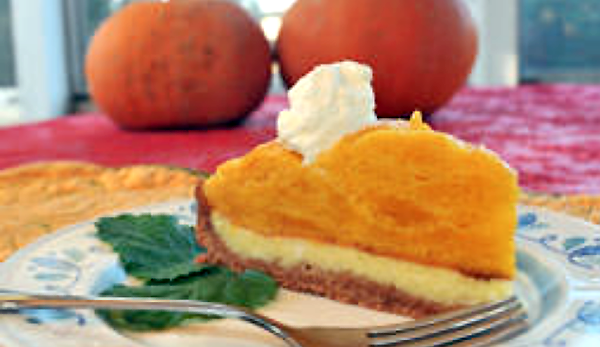
New Menu Traditions: Pumpkin-mousse Cheesecake

If you feel like you’re on annual autopilot when it comes to your Thanksgiving menu, give gratitude for the opportunity to transform classic fall-garden ingredients in new holiday-inspired ways.

Take pumpkin pie, for example. While there’s no bad pie in our book, traditional pumpkin pie that reaches back to Pilgrim times isn’t our personal favorite. It’s not quite sweet enough and is a dash too heavy for post-turkey consumption. But we love the flavor and raise lots of pumpkins on our farm in Wisconsin. After growing elongated New England Pie and Long Pie pumpkin varietals (we stack them on our front porch like cordwood), we discovered that pie pumpkins glow with flavor, not jack-o’-lantern candles.

While pumpkin and mousse might seem like dance partners from different dessert planets (dropping a pumpkin on your toe hurts, but a mousse, by its culinary definition, is light and fluffy), our recipe for Pumpkin-mousse Cheesecake transforms garden bounty, like pumpkins, into a new tradition that’s so delicious your kids won’t know they’re “eating their vegetables.”

Recipe: Pumpkin-mousse Cheesecake

Yield: 12 servings

Ingredients

Crust

  • 24 graham crackers (See the Farmstead Chef cookbook for a homemade recipe)
  • 1/4 cup sugar
  • 1/3 cup butter, melted

Cream-cheese layer

  • 8 ounces cream cheese, softened
  • 2 eggs
  • 3/4 cup sugar

Pumpkin layer

  • 3 eggs, yolks and whites separated
  • 2 cups cooked pumpkin purée
  • 3/4 cup sugar, divided
  • 1/2 cup milk
  • 1 tsp. cinnamon
  • 1 tsp. nutmeg
  • 1/4 tsp. salt

Topping

  • 1 cup heavy cream, whipped

Preparation
Preheat oven to 350 degrees F.

Crust
In food processor (or in plastic bag with rolling pin), crush graham crackers. This should result in about 1⅓ cups graham crackers. Mix in sugar, and drizzle in melted butter until crumbs clump together. Press into lightly oiled 9-inch spring-form pan.

Cheesecake
Cream-cheese layer: In mixing bowl, beat cream cheese until fluffy. Beat in eggs, one at a time, and mix in sugar until well-blended. Spread cream-cheese mixture over crust and bake at 350 degrees F for about 25 to 30 minutes or until firm. Cool completely.

Pumpkin layer: In saucepan over medium heat, mix egg yolks with pumpkin purée and cook until thickened. Stir in 1/2 cup sugar, milk, cinnamon, nutmeg and salt. Turn heat to the lowest possible setting (or off if using electric stove), and let sit on burner for 5 minutes. Remove from heat and cool completely.

In large bowl, beat egg whites until stiff. Add remaining 1/4 cup sugar, and beat until well-blended. Fold egg whites into pumpkin mixture, and pour over cooled cream-cheese layer. Bake at 350 degrees F for 15 minutes or until set. Cool completely and chill overnight before serving.

Serve with dollop of whipped-cream topping.