Categories
Urban Farming

Get Out of the Way

urban cornfield

Photo by Rick Gush

This “cornfield” in Italy is growing in a tiny space between a parking lot and a building.

The photo to the right carries a message for us urban farmers: Be humble, and every once in a while, admit that the best agricultural practice is just to get out of the way.

A common foible farmers and gardeners have is that we begin to feel omnipotent, as if everything that happens in the garden is the result of our own hard work. The reality is that it just ain’t so. We are merely infinitesimally small specks in the great parade that is nature. Sometimes we can force things and make it look like we’re getting our way; I think that’s one reason why we like to plant our crops in straight rows, just because straight rows seemingly demonstrate our power over the crops. But we are not the boss.

Shown is a pair of corn plants that decided to produce ears of corn in a most unlikely place — a crack between a brick wall and an asphalt parking lot; not exactly the well-prepared bed we assume would be the best place to grow corn plants. I doubt the plants were ever watered, fertilized or sprayed with Bacillus thuringiensis to discourage worms. The part that causes the most humility (and amusement) is that I had a number of stunted plants in my own carefully prepared and tended corn patch this year that did not grow nearly as well as these two healthy specimens.

I had a similar experience a few years back when I found a full-grown tomato plant loaded with fruit growing amidst the boulders that line the oceanfront promenade in Rapallo, Italy. There is no visible dirt there; it’s just a bunch of large boulders with bits of seaweed and trash stuck in between the rocks, where waves occasionally splash. Again, that tomato plant was doing considerably better than some of the pampered tomato plants in my own garden.

Maybe we farmers are actually more like the directors and choreographers of a musical show involving pre-school children. Sometimes the little actors will accidentally line up correctly in a row and chirp their lines correctly, but our control is not really the most important part of the program. We usually just have to step back and let things flow as they will and learn to appreciate our lack of control. The things the kids will do on their own are often more charming than all the steps we had rehearsed for them, and the plants in my garden behave in much the same manner. Similarly, we also have little control over when an animal will pay a surprise visit to our gardens. Just this week, we had another visit from a badger. It came in during the night and dug up half the lettuce bed on the top terrace. On the one hand, I am sorry to have lost the little lettuce plants that were only another week or two away from being harvested. But I am also quite excited to know that we still have an animal as exciting as a badger occasionally visiting us.

The badger is a magnificently arrogant beast, not at all afraid of us or our car, and sneers at us casually before walking calmly off into the forest. Badgers are dangerous, and when encountered, should not be approached. The best plan is, once again, just get out of the way.
Read more of Rick’s Favorite Crops »

Categories
Urban Farming

Two-Wheeled Pizza Delivery

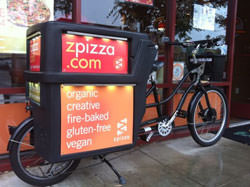
Zpizza bike

Photo courtesy Zpizza, Seal Beach, Calif.

Zpizza locations in Seal Beach, Calif. and Huntington Beach, Calif., deliver pizzas with the help of electric-powered bicycles.

The latest pizza trend isn’t about off-beat toppings like elbow noodles, squid ink or fried eggs; instead, it’s coming from some independently owned pizzerias that are taking steps toward improving air quality: by delivering fresh-out-of-the-oven pies on bicycle.

Faced with soaring gasoline prices and cramped parking conditions outside their restaurants, as well as in neighborhoods where the pizza is delivered, several pizzerias — from Southern California to New York City — have decided to put their delivery drivers on two wheels. In some cases, now that circling the block for a parking spot or opting for double-parking is out of the equation, this has put the hot pies into customers’ hands faster.

While restaurants and pizzerias in populated sections of Europe and New York City have been doing this for awhile, the practice is just now catching on in other regions, particularly the West Coast, where warm weather (and beautiful conditions for bicycling) prevails all yearlong.

Among the newest pizzerias to add bicycle delivery are two in Portland, Ore.: Hot Lips Pizza and Old Town Pizza. Old Town Pizza uses tangerine-colored bicycles with a hefty metal box attached to the back (to store the pizzas and keep them hot) to deliver the pies. Its pizzas are eco-friendly, too; many of the toppings are from local organic farms, and the flour is sourced from Northwest farms that use environmentally and socially responsible farming practices. Portland’s Hot Lips Pizza also follows sustainable practices, including sprinkling locally grown spinach and regional bacon on its pizzas. Bicycle deliveries are offered within 3 miles of each store.

Farther down on the West Coast, Zpizza locations in Seal Beach, Calif., and Huntington Beach, Calif., deliver pizzas with the help of electric-powered bicycles. The service launched in 2009, and earlier this year, the pizza chain announced it was adding even more bikes. Made in nearby Santa Ana, by Thrust Electric Bicycles, these bikes are perfectly suited for hauling hot food, with a small basket just under the handlebars and a larger container just behind the seat.

“The bike is an efficient and earth friendly way to get pizza to our customers,”  says Alan Grant of Zpizza in Seal Beach, Calif. “Since it is electric powered, we can get to local customers as fast as a car can — sometimes faster.  It saves us from having to use gas to just drive around the block, and it sends a message to people that an electric vehicle can be a viable replcement for a car.”

PizzaMarketplace.com, which provides industry insight about trends in the pizza business, reported in January that Ed Zimmerman, president of the Food Connector says that, “green is the new black” for many pizzerias, including product traceability. Tying into that, and also under a sustainability umbrella, bicycle deliveries help pizzerias market themselves as an eco-friendly restaurant.

Categories
Crops & Gardening

Empty Pumpkin Vines

Pile of pink and warty Galeux d'Eysine pumpkins
Photo by Jessica Walliser
Because none of my pumpkin vines produced fruit, I might have to purchase a warty Galeux d’Eysine pumpkin from the farmers’ market.

I’m so disappointed that we didn’t get any of our own pumpkins this season! I planted five pumpkin vines, including an Atlantic Giant, a Howden, and some others I don’t remember, but none of them managed to set any fruit.

Actually there was a small pumpkin on the Atlantic Giant vine at one point early in the season, but I think the deer managed to sneak over the fence and eat it. It was there one day and gone the next. Thankfully, it was only softball-sized when it disappeared so I wasn’t overly attached to it yet.

It’s a very bad feeling when you nurture a pumpkin for weeks and weeks and then the deer get it before you do. That’s happened to me many times … and not just with pumpkins. It’s precisely why I will never try to grow a record-breaker: If I were to put that much energy into growing something and the deer got it or if I dropped it off the back of the truck en-route to the weigh-in (which is exactly the type of thing that happens to me), I would be in tears.

And so I’ll have to go to the farmers’ market next week to buy our pumpkins, which, in truth, I don’t mind. They have such beautiful heirloom pumpkin varieties there, it is so much fun to pick and choose the ones you want. I’d definitely like to get a warty pumpkin and a Cinderella variety, but we have to get the traditional jack-o’-lantern type, as well. Can’t beat those for carving!

I guess I should just be happy I’m not a colonist. Were it not for their pumpkins, they wouldn’t have made it through the winter. I feel certain I’ll survive just fine without pumpkins of my own. 

« More Dirt on Gardening »

Categories
Animals

Infographic: The Meat Makers

Raising meat on your hobby farm to feed your family is a noble venture, but it’s no small undertaking. Getting the quality meat from your livestock requires giving them quality care and attention. Before you invite livestock to the farm, spend some time thinking about what species and breeds you want to raise, the length of time is will require to grow your meat, and how much return on investment you will receive. Use the infographic below to compare different livestock species, and start thinking about what meat you can raise on your farm.

Categories
Crops & Gardening News

Scientist Searches for New Greenhouse Bumblebee

The plight of the bumblebee has been causing both scientists and farmers concern, with bumblebee populations declining over the past several years. Bumblebees, like Honey bees, are important pollinators of native plants and are used to pollinate greenhouse crops, like peppers and tomatoes. But colonies of Bombus occidentalis, used for greenhouse pollination, began to suffer from disease problems in the late 1990s and companies stopped rearing them. Populations of other bumblebee species are also believed to be in decline.

In addition to trying to learn the cause of bumblebee loss, USDA entomologist James Strange is searching for a species that can serve as the next generation of greenhouse pollinators. Strange performs his research through the Agricultural Research Service’s Pollinating Insects—Biology, Management and Systematics Research Unit in Logan, Utah.

To understand the decline of B. occidentalis, Strange and his colleagues have been tracking its habitat range and population trends. Evidence they’ve gathered so far shows that the range and populations of B. occidentalis have declined, that it is not as genetically diverse as it used to be, and that it has higher pathogen prevalence than other bee species with stable populations. The results were published in the Proceedings of the National Academy of Sciences.

The researchers also have assembled a large database with information on more than 80,000 Bombus specimens representing 10 species throughout the country, including B. occidentalis. With Geographic Information System modeling technology, they were able to construct historic and current range maps of several bumblebee species.

One bee species Strange has been studying is an orange-striped generalist bee, Bombus huntii, native to the western half of the country, that could be used in greenhouses in the western United States. He’s determining how to best rear B. huntii in a laboratory setting, a vital step in commercializing it.

Many greenhouse growers now use commercially produced Bombus impatiens, a generalist pollinator native to the Midwest and eastern United States and Canada. But scientists are concerned about using a bee outside its native range. Some western states even restrict the import and use of non-native bees. If B. impatiens were to escape and form wild colonies in the western United States, they could compete with native bees for food and resources and expose native bumblebees to pathogens they are unable to combat.

Categories
Equipment

Nifty Websites for Home Shop Work

The great thing about the Internet is the instant access to information. I use it on a regular basis for owner’s manuals and user suggestions. You can find almost anything in the way of how-to videos on www.youtube.com or dozens of other “how to” sites. I got more than 5,000 responses when I Googled “how to fix a chainsaw.” Some sites rely on amateurs, while others offer high-quality professional work, placed there by a company to promote their product and services.

I recently heard about and visited a site that isn’t free, but may be well worth their $10 per month fee. Advanced Technical Training Network offers high-quality, very well-done videos using professional mechanics to walk you through preventative maintenance and troubleshooting. The site is easy to access, and it’s easy to find the information desired.

Chainsaw maintenance is broken into 13 segments that cover everything from bar to motor maintenance. While I was familiar with and practice many aspects that are covered, seeing the mechanic work through them and resolve problems was very helpful. I realized that I was guilty of not checking and cleaning the oil hole and oil channels in the bar as I should. To be perfectly honest, I am guilty of not doing a lot of other preventative maintenance items also covered in the videos. It’s nice to know I can still improve.

The one drawback to any web-based video is accessing it when you need it. The ATTN website requires online access. If you have WiFi in your home, that’s not a problem. Of course, you could always convert part of the family room to a shop!

<< More Shop Talk >>

Categories
Urban Farming

Surveys Foster Consumer-Farmer Dialogue

The Food Dialogues

Photo courtesy PRNewsFoto/U.S. Farmers & Ranchers Alliance

Results from surveys of farmers, ranchers and consumers.

Last week, the findings of two national food production surveys were released during “The Food Dialogues,” a town hall-style discussion presented by U.S. Farmers & Ranchers Alliance. The surveys, conducted by phone by Ketchum Global Research Network and Braun Research in August, 2011, focused on the opinions, attitudes and questions consumers and farmers/ranchers have about the current and future state of how food is grown and raised in the United States.

Results reveal that lack of access to information, as well as no interest or passion for the topic, have divided consumer opinion on the direction of agriculture.

“Americans have a lot of questions about where their food comes from, how it is raised and if it is good for their health long-term,” says Bob Stallman, chairman of USFRA and president of the American Farm Bureau Federation. “USFRA commissioned two separate surveys to first ask farmers and ranchers what they wished Americans could have more information about where their food comes from. We then asked consumers what questions they have on the same topic. The findings of both surveys indicate there is an opportunity for more dialogue between farmers, ranchers and the American public about how food is grown and raised in the U.S.”

The results of both surveys were shared and discussed during The Food Dialogues, which took place last Thursday in four U.S. cities and online via Facebook and www.fooddialogues.com.

Highlights of the research include:

  • While nearly all Americans agree that food production is important to the success of the country, they are split over whether it is going in the right or wrong direction
  • Consumers think about food production constantly, yet know very little about how food is brought to the dinner table
  • Overwhelmingly, farmers and ranchers share the same values as consumers on issues related to environmental stewardship and animal care

The survey revealed that consumers have become disconnected from their food, yet think about the subject regularly. Consumer survey highlights include:

  • 72 percent of consumers know nothing or very little about farming or ranching
  • 69 percent of consumers think about food production at least somewhat often
  • 70 percent say purchase decisions are affected by how food is grown and raised, with three-quarters (72 percent) of Americans saying they think about this topic while purchasing groceries
  • 42 percent or two-in-five Americans say the way that food is grown and raised has improved in the last 10 years, while a slightly smaller group say it has worsened (37 percent)
  • Those who say the way that food is grown and raised has improved cite food safety (22 percent) and food quality (17 percent), whereas respondents who said the way food is grown and raised has worsened also cite food safety (21 percent) and food quality (21 percent)
  • Of all the aspects of how food is grown and raised, Americans are most satisfied with the availability of healthy foods (73 percent) and food safety standards  (66 percent)
  • One in five consumers who say food production has worsened in the last 10 years cite environmental impact as the top area of demise 79 percent of consumers say producing healthy choices for all consumers is very important for farmers and ranchers to consider when planning farming and ranching practices

The purpose of the consumer survey was to ask Americans what additional information, in relation to how food is grown and raised in the U.S., they would like to learn more about. The top five topics that drew the most interest include:

  • How chemicals are used in farming/ranching
  • How pesticides are used in farming/ranching
  • Food safety standards
  • Effect of government regulations on farming/ranching
  • How antibiotics are used and genetic engineering in crops

The goal of the farmer/rancher survey was to identify topics that farmers and ranchers wished Americans had more information about when it comes to food and how it is grown and raised in the U.S. According to the survey, farmers and ranchers said the top misconception they need to overcome as an industry is that a few “bad actors” are representative of the entire industry. Additionally, farmers and ranchers identified the effect of pesticides, antibiotics and fertilizers on food as the most important priorities they should address when communicating with consumers. Farmer/Rancher Survey Highlights include:

  • 86 percent of farmers/ranchers responded that the average consumer has little to no knowledge about modern farming/ranching
  • 58 percent of respondents in this survey felt consumers have a completely inaccurate perception of farming and ranching
  • Nearly all farmers and ranchers say that protecting the environment (99 percent) and practicing humane animal care (96 percent) are very or somewhat important goals or practices related to their business
  • 80 percent of farmers/ranchers say that consumers have little to no knowledge about proper care of livestock or poultry
  • 83 percent of farmers/ranchers responded that new ways of improving yields with fewer environmental inputs will have a major impact on farming/ranching in the futureWhen asked which top five topics were most important to educate consumers about, farmers and ranchers responded:
    • The effect of pesticides, fertilizers and antibiotics on food
    • Where food comes from in general
    • Proper care of livestock and poultry
    • Effect of government regulations on farming/ranching
    • Economic value of agriculture

    “We hope the results of the survey, combined with [last week’s] Food Dialogues event, will continue the conversation between farmers, ranchers and anyone who is interested in learning more about how food is grown and raised in the United States,” Stallman says.

    For additional information on the surveys or The Food Dialogues event, visit www.fooddialogues.com.

    To learn more about U.S. Farmers & Ranchers Alliance, visit www.usfraonline.org/.

Categories
Animals

Nan

Nan the goat stands next to her caretaker Piper Nelson
Courtesy Al Lloyd/ Canadian 21st Batallion CEF
Doesn’t Nan look striking beside her caretaker, Piper Nelson?

Last week, we goats were lying in the shade, chewing cud. When I mentioned I’d blogged about the wartime exploits of William de GoatKing Neptune and Sergeant Bill, my daughter Emony said, “What about Nan? She was a wartime hero, too!”

“She’s a wartime heroine, darling, not a hero” Bon Bon told the girls. She sighed and gave me The Look. “It’s just like a buck to only mention males.”

So, to mollify my family and for all of you female readers, here is the story of Nan, a brave girl goat from Canada who served in World War I.

Nan, then called Celestine, was purchased by a soldier of the Canadian Expeditionary Force’s 21st Battalion while the battalion was in Brockton, Ontario. She served with the men of the 21st Battalion from its mustering in 1914 through its demobilization in 1919. During that time, 3,328 men of the 21st Battalion were killed, wounded or went missing in action; only 106 of the unit’s original soldiers—and Nan—entered Germany at the end of the war. Like Sergeant Bill, Nan earned the 1914/1915 Star, the British War Medal and the Victory Medal for her valor at the front.

When it came time for her battalion to move, Nan watched for the men of the Quartermaster’s Detachment and Transport section to fix her a comfy spot on one of the general service wagons; then without prompting she hopped aboard, ready for deployment.

On the Battalion’s way to the Battle of Somme in France, the unit’s Transport Officer decided the soldiers put too much of their time and effort caring for Nan. He sold her to a French woman for 20 francs. When Nan’s boys discovered she was gone, they were so horrified and outraged that the sale was annulled and Nan returned to her place in the ranks. Nan saw action in many of the same battles in which Sergeant Bill served. And on one not-so-unlucky Friday the 13th (in December 1918), she was the first Allied mascot to cross the Rhine River.

Nan’s closest brush with death, however, came at war’s end when her men unloaded her at Southampton, England. It was against British Board of Agriculture regulations to bring an animal into England from a foreign country. Nan, the Board insisted, would have to be slaughtered or deported back to France. Her friends objected, allowances were made, and after three weeks in strict quarantine, she boarded the Cunard liner, Carolina, along with the men of the 21st Battalion and departed for Canada.

Nan spent the rest of the summer at Mowat Hospital, cared for by Piper William Nelson. A member of the newly disbanded 21st Battalion, Nelson was a former shepherd from the Orkney Islands; he’d been Nan’s special caretaker in France and was her closest friend. In the fall, she moved to the Royal Military College in Kingston, Ontario, where she lived for the rest of her days.

On September 22, 1924, at the ripe old age of 12, Nan was euthanized due to failing health. Her head was sent to be mounted and now resides in the Princess of Wales’ Own Regiment Museum in Kingston. The rest of Nan was buried with full military honors in Cataraqui Cemetery in Kingston.

Emony’s right, Nan was as much of a military hero as any of the other goats who served.

« More Mondays with Martok »

Categories
Urban Farming

Chirpy

baby sparrow on shoulder

Photo by Audrey Pavia

Me and Chirpy, a House Sparrow we raised from a nestling.

Lately, when I throw feed to my chickens in the morning, a thieving flock of House Sparrows flies down, grabs some of the pellets and flies up into the bushes to feast. Rather than get irritated at them, I am reminded of a very special baby sparrow I once knew.

Chirpy came into our lives one night a few years ago, when my sister, Heidi, and her husband, Rod, were living with me and Randy. One of Heidi’s cats got out and ran into the bushes, emerging with something in his mouth. We wrestled it away and discovered it was a blind, featherless baby sparrow that had fallen out of a nest in the eaves of the house.

Being a veterinarian, Heidi knew exactly what to do. She set the little guy up with a makeshift nest and heating pad, and raced to the pet store to buy baby parrot food. She showed everyone in the house how to feed the baby sparrow, who quickly earned his name with his incessant chirping.

Chirpy grew fast, and after a month or so, it was time to give him a taste of the outdoors. Our ultimate goal was to release him back in the wild.

We kept Chirpy on the patio in a birdcage. Cups of seed and occasional mealworms supplemented his diet of baby-bird food, which he begged for several times a day.

Eventually, Heidi opened the cage door so Chirpy could come out if he wanted to. He hopped out, but seemed reluctant to fly. That’s when we all stepped in to give him flying lessons. He was so closely bonded to all of us that all we had to do was stand on the lawn 10 feet away from each other and call him, one at a time. He would fly to each of us in turn.

One late afternoon I came home and saw that Chirpy was not in his cage. It wasn’t uncommon for our House Sparrow to fly off for a while, but he’d always be back before sundown to get one last meal of baby food and roost in his cage for the night. I called to him, but he didn’t come. Worried that he was too young to spend the night out of his cage on his own, I began searching the neighborhood.

I can only imagine what my neighbors thought when they saw me walking up and down the street looking into the trees, desperately calling, “Chirpy! Chirpy!” He didn’t respond, and I ran back home hoping my sister was there so she could help. Both Heidi and Rod were home, and the three of us set to work trying to find our lost House Sparrow. I continued to comb the neighborhood, while Heidi and Rod stood in the backyard calling him.

Suddenly, I heard a loud chirping from a huge eucalyptus tree across the street. Then I saw a young sparrow fly down from the tree into my backyard. I ran and looked over the fence, and there was Chirpy, perched atop Heidi’s head.

As the days went on, Chirpy spent more and more time away from his cage until one day, he never came back. I wasn’t upset this time; I knew he was ready. But that didn’t stop me from missing him. And every now and then, when I see a House Sparrow in the yard that doesn’t fly off right away when I approach, I wonder if it might not be Chirpy, come home for a visit.

Read more of City Stock »