Categories
Urban Farming

Milk Desserts

buttermilk pie

Photo by Judith Hausman

Buttermilk pies are easy to make, and their simple flavors are deliciously comforting.

Lisa had made a mistake in the cheese house, but like many a food mistake, a new product resulted. When her apprentice, Blair described the dense texture and tangy flavor of the goat milk, I knew I had to take home a quart to experiment with.

Although it was snowy white, we called the cultured goat milk “Oobleck,” from Dr. Seuss’ classic: Bartholomew and the Oobleck (Random House, 1949). Since it fell somewhere between yogurt and crème fraiche, it seemed just right for my milk dessert recipes.

Milk desserts are so light and cooling for balmy nights — especially when accompanied by the gorgeous fruits of summer, such as the local peaches just now coming in.

The easiest milk dessert is more about assembling than cooking. Buy some really good peaches — the best you can find — and some whole-milk ricotta and local honey. You’ll also need some chopped almonds or pine nuts, as well as some vanilla.

Split open the peaches and carefully pry out the pits. Mix a teaspoon of vanilla into a cup of ricotta. Make peach and ricotta sandwiches, and roll their edges in the nuts. Once you’ve assembled the peaches on a plate, drizzle them with the honey to taste, and you’re done. Yum!

The second milk dessert requires just a little stovetop cooking and a few hours to chill. Panna cotta means “cooked cream,” but this version has just a little cream, and the fat level of the dairy products can be dialed up and down according to taste. It’s essentially milk Jell-O, and though that sounds unappealing, it’s actually delicious with berries or figs and should be made in advance.

I like to steep herbs, such as sage or lavender, in the milk as it reaches scalding temperatures, but you can add a pinch of saffron instead. You can also substitute honey for sugar, too. The Oobleck worked perfectly in this favorite but so will any plain (cow milk) yogurt.


Flexible Panna Cotta
1 packet gelatin
1 1/4 cups milk (lower fat is fine)
1/2 cup cream (light or heavy)
1/4 cup sugar
1/2 teaspoon orange flower water or vanilla
1 cup plain yogurt (pick the fat level you like)

Whisk the gelatin into 1 1/4 cups of cold milk in a small pan. Then stir it as it softens and heat it over low heat until it dissolves. Do not boil. Stir in the rest of the milk, cream and sugar, stirring until the mix just scalds. Strain the mix into a bowl and whisk in the vanilla or orange flower water. Set aside until just warm; then stir in the yogurt. This makes one large panna cotta or six 4-ounce ramekins. Chill until it sets.

My last milk dessert, buttermilk pie, requires baking but is still very, very easy to make. Not to mention, the coconut version is spectacular.

I think of buttermilk pie as a Southern dish. Its comforting, simple flavors are the perfect underpinnings for bright blueberries or raspberries. The Oobleck had the right tang and texture for this dessert — though buttermilk or plain yogurt will work, too.

Start with your favorite homemade or store-bought pie crust, unbaked but prepped. For a deeper pie, make 1 1/2 times the recipe. I also like baking a custard-y pie by setting the pie dish in a larger pan, filled with water to halfway up the pie dish. This sets the custard more softly and tenderly.


Buttermilk Pie
1 pie crust, unbaked
1/4 cup butter
2/3 cup sugar
3 eggs
3 tablespoon flour
1 cup buttermilk or plain yogurt
1 tablespoon vanilla
Grated rind of one lemon or 1 cup unsweetened flaked coconut (both optional)
Nutmeg for garnish

Cream together the butter and sugar. Beat in the remaining ingredients, and pour into the unbaked pie shell. Sprinkle on the nutmeg. Set the pie dish in a larger pan filled with water up to halfway up the pie dish. Bake at 400 degrees Fahrenheit for 10 minutes; then turn down to 350 degrees Fahrenheit for about 35 minutes or until just set. Do not over bake.

Read more of The Hungry Locavore »

Categories
Equipment

Brian Is With Him

Farmhouse
Courtesy Comstock/Thinkstock

I was visiting my nephew, Peter, and his family the other day. They were at his parents’ vacation home, an old farmstead that has been fixed up considerably. Peter did a great deal of the fixing. Talented in many fields, from music to carpentry, Peter has a degree in design and technical theatre. Over the years he has evolved into a carpenter of all trades. He is as at home in the Lincoln Center for the Performing Arts as he is working on an outdoor stage or pounding nails on a house remodel.

Nearly 10 years ago, he took a summer off to work on the old farmhouse. He brought with him two older, skilled craftsmen to help him rough out the job.  When they returned to New York, he stayed behind to finish.

As we visited, Peter told how he had been thinking about one of them. Brian had died earlier this year. Uncle to one of Peter’s close friends, he was a near-father to Peter. As he had sat there mourning his friend, he realized that Brian was still with him and always would be, in part because of the work they shared.

I write of Peter and Brian, but I think of my dad and mother and so many with whom I have labored, who now are gone. When I am gone, I know my children will likely think of me and the work we shared when they see a stone retaining wall or a pile of dirt. A part of me will be with them. That’s the beauty of physical labor shared, whether it’s measured in square feet or acres, gardens or fields. It creates a unique bond between the workers that neither time nor even death can ever break.

<< More Shop Talk >>

Categories
News

Good Husbandry Grants Available

Chickens
Photo by Rachael Brugger
Preference for the Animal Welfare Approved Good Husbandry Grants will be given to poultry-genetics projects.

Animal Welfare Approved, an organization certifying farmers that raise animals according to high welfare standards, has made Good Husbandry Grants available to AWA-certified farmers for projects improving the welfare of farm animals. Hobby farmers may submit a proposal for one 2011-2012 project to receive a maximum of $5,000.

Project proposals will be considered based on priorities set by AWA. Preference will be given to projects concerning livestock genetics, specifically poultry, hogs, dairy and other ruminants (listed in order of priority); outdoor livestock housing, specifically mobile housing; welfare improvements for the slaughter process; nonlethal predator control; and other projects improving animal welfare. Granted funds may also be used to purchase breeding stock that positively impact animal welfare or to partially fund larger projects. Details on grant priorities can be found on the AWA website.

To apply for an AWA Good Husbandry Grant, hobby farmers must complete the grant application for farms (a separate form is available for slaughter facilities), including a detailed and accurate proposal for the project budget. The original application plus five copies must be sent to Good Husbandry Grants, Attention: Emily Lancaster, 1007 Queen Street, Alexandria, VA 22314, and must be postmarked by Sept. 30, 2011.

Former grantees are eligible to apply for and receive this year’s grants.

Grantees will receive a letter detailing the terms of the grant by Jan. 3, 2012, and funds will be disbursed during the 2012 calendar year. Grants will be awarded based on each project’s potential to deliver the greatest benefit to farm animals, as determined by the AWA’s grant-review panel.

Categories
Urban Farming

SAME CAFÉ Named Winner of RFMA Gives Program

SAME Cafe

Photo courtesy PR NEWSWIRE

Denver’s SAME Cafe has been chosen for a 2012 makeover by the RFMA Gives Program.

The Restaurant Facility Management Association recently announced Denver’s SAME Café as the recipient of the annual RFMA Gives program for 2012. Through the program, SAME Café will receive a kitchen remodel, provided by the contributions of RFMA member companies and individuals.

The restaurant, which stands for So All May Eat, was founded by Brad and Libby Birky in 2006 and operates under a unique concept: no set menu or set prices. The couple opened SAME café with the desire to serve everyone, even if some patrons may not have the sufficient funds to pay for their meals. Guests pay for what they can afford, or they work at SAME Café in exchange for their meals.

“Our philosophy is that everyone, regardless of economic status, deserves the chance to eat healthy, organic food while being treated with dignity,” says owner Brad Birky. “Customers who have no money are encouraged to exchange one hour of service — sweep, wash the dishes, weed the organic garden — for a meal. Likewise, guests who have money are encouraged to leave a little extra to offset the meals of those who have less to give.”

The makeover involves adding a 60-inch double oven with a griddle top, a 10-foot center island prep table and an under-counter dishwasher. The restaurant’s design will also be remodeled to add more space and productivity.

Locally-based facility managers will oversee the 2012 project, and RFMA vendor member companies will donate much-needed new and used equipment while providing labor and material at no cost.

“I anticipate the RFMA community will once again embrace this project with time, labor and money,” says RFMA Executive Director Tracy Tomson. “The RFMA Gives Program enables RFMA members the opportunity to really make a difference.”

To learn more about SAME Café, click here. To learn more about the Restaurant Facility Management Association, click here.

Categories
Animals

Baa-ck in Time

Sheep postcard
Courtesy Sue Weaver
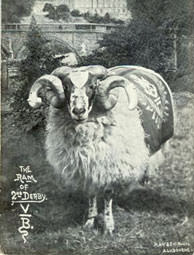
Here’s another animal-historical tidbit this week: This old postcard in Mom’s collection probably came from around the 1920s.

Mom sent in the manuscript for her sheep book the day before yesterday. Now she isn’t as grouchy and harried. In fact, she’s been telling us some of the things she wrote about, including a sheep named Private Derby.

Did you know that military units used to keep pets as mascots? Some still do, especially in Britain, where Private Derby lives. Private Derby is a member of 2nd Battalion Mercian Regiment (Worcesters and Foresters) in Derby, England, and he’s a sheep! He’s a Swaledale ram, to be exact, and the 29th Private Derby to date.

The 95th Derbyshire Regiment of Foot, forerunner of the 2nd Battalion Mercian Regiment, acquired the first Private Derby in 1858 at the siege and capture of Kotah, in India, when the unit’s commanding officer spied a handsome fighting ram tethered in a temple yard. He requisitioned the ram, which marched more than 3,000 miles with the regiment. During that time, the first Private Derby was undefeated in 33 matches against other fighting rams. At war’s end he was awarded an Indian Campaign Metal, the only British mascot to win one. He died in 1863.

Later, Private Derbys were requisitioned in whatever part of the world the unit was stationed. Some were gifts, like Derby VI, who served from 1882 to 1884, a black ram presented by His Royal Highness Syed Muhammad Kalby Ali Khan the Nawab of Rampur (that’s in India). In 1912, the Duke of Devonshire began providing rams from his flock of champion Swaledales. The tradition continues today.

The current ram enlisted on Jan. 15, 2009. He has his own handlers, the Ram Major and the Ram Orderly, to look after him. He leads the regiment in parades and represents it at other public appearances, where he wears his full Private Derby regalia, a scarlet jacket faced with Lincoln green and gold.

The Army recognizes Private Derby as a regular soldier. He has his own regimental number and documentation and he’s paid £3.75 per day. He also draws his own rations like any other soldier, has a leave card, and takes an annual holiday during the mating season.

Lots of British military units have mascots, though Private Derby is the only sheep. Some have used drum horses as part of their regimental bands since the mid-1700s. Drum horses carry two solid silver kettle drums plus a rider, so a drum horse must be big and powerful to carry the weight. His main role is to stand still on parades. Other unit mascots are Shetland ponies, Irish Wolfhounds, a Staffordshire Bull Terrier, ferrets, and an Indian Blackbuck antelope. But best, of course, are the regimental goats! I’ll tell you all about them next week.

« More Mondays with Martok »

Categories
Urban Farming

Eat, Pray, Ride

Audrey and Cowboy

Photo by Audrey Pavia

Me and Cowboy in the hills of Three Rivers, Calif.

Being an urban farmer is really great, but every once in a while, I have the urge to get out to the country where the serious farmers live. I get this craving for the open road and the need to see acres of undeveloped land.

To satisfy my urge, I packed Nigel up this weekend and drove north to the town of Three Rivers, Calif., about five hours away, nestled in a valley in the foothills of the Sierra Nevadas. I booked two nights at a dog-friendly bed and breakfast and gave my friend, Christy, who’s a horse trainer, the heads up that I’d be in town.

The drive up was a real education in how much of California is still used for agriculture. As we drove through the San Joaquin Valley in the central part of the state, we passed acre after acre of assorted crops. Peaches, almonds, lemons, grapes — just about everything you can think of is grown here, for distribution throughout the country.

Of course, the sight I was most interested in was the livestock. We saw steers grazing on the dry, golden grass that gives California its moniker of the Golden State. We saw lots of horses too, and even an unusual flock of sheep.

Once we arrived in Three Rivers, we saw plenty of rural properties with horses, goats, ostriches and emus. Christy took me for a ride in the hills on Saturday morning. I was on a beautiful Appaloosa gelding named Cowboy when I saw the first ostrich, walking around among the wild oak trees that grow everywhere.

After two days in this rural atmosphere, I was sad to have to get on the road to come back to the concrete and traffic of Southern California. But that feeling only lasted until I got to my house. As soon as I unpacked, I laid down on a lounge chair in the backyard and watched the chickens bed down for the night and my horses play with one another. That’s when I realized living in the city isn’t so bad after all.

Read more of City Stock »

Categories
Animals

Brucellosis in Cattle

Cattle
Courtesy rburgoss/Stock.XCHNG
Brucellosis in cattle is not a huge concern, though the disease can be transmitted among different animal species.

Brucellosis, or Bang’s disease, is a disease of cattle caused by Brucella abortus. It’s a public health concern because it is zoonotic—it can be shared by animals, including sheep, water buffalo, pigs, deer and elk, moose, equines, camelids, marine animals, canines, and humans.

In cows, brucellosis causes abortion; in humans it causes undulant fever, a condition that comes and goes like malaria. The first sign of infection in cows is abortion or birth of weak calves, typically between the fifth and seventh month. Other signs include lower fertility and poor conception rates (the most prominent signs in all animals), retained afterbirth, and enlarged, arthritic joints. Even when calves are born healthy, the infected cow still harbors and sheds the disease. Once the cow is infected, there is no way to cure it. Animals become infected through breeding or eating contaminated feed. The disease is shed in the infected animal’s milk, aborted fetus and afterbirth.

In humans, the infection can cause extreme joint pain, fever, depression and chronic fatigue. Humans can contract the disease by handling a cow’s aborted fetus or afterbirth or by eating or drinking contaminated milk products such as unpasteurized milk or cheese from an infected cow. Humans can be treated for the infection effectively with antibiotics; however, they may still experience symptoms of the disease.
In the 19th century, French chemist and biologist Louis Pasteur recognized that heating milk to a minimum temperature of 161 degrees F for at least 15 seconds kills both Brucella and the agent that causes tuberculosis; hence, we began pasteurizing milk. In the 1950s, there was a big push to eradicate tuberculosis and brucellosis in livestock in the U.S. Today, brucellosis is well controlled, but bacteria have a way of reinventing themselves.

The biggest problem today remains with the brucellosis-carrying bison and elk in the greater Yellowstone area, including the national park. They are not restricted to one area, so they migrate out of the park and have the potential to infect domestic cattle, particularly on ranches in southern Montana and northwestern Wyoming.

Hobby farmers with cattle should still be concerned, and there is a simple vaccination called the brucellosis or Bang’s vaccine. In many states, such as California, state law requires a one-time vaccination to every calf before it is 11 months old. After the animal is vaccinated, it’s given a mandatory tattoo and an optional ear tag (called the Bang’s tag) to show it has been vaccinated.

Brucella melitensis, one of three strains of Brucella found only in goats and transmissible to humans, causes abortion in goats and Malta fever, a condition worse than undulant fever, in humans. It’s always a good idea to have your veterinarian take a blood sample to check for Brucella melitensis before introducing a new animal to the herd, because the most common method of spreading the disease is through contact with new, untested livestock. If the newbies were born on your property and your farm’s been disease-free, it’s not that big of a deal. Unfortunately, no vaccine in the United States or Canada protects against Brucella melitensis.

—John Maas, DVM, MS, DACVIM, veterinarian and beef cattle specialist for the University of California, Davis Cooperative Extension

This article originally appeared in the September/October 2011 issue of Hobby Farms.

About the Authors: Sharon Biggs Waller is an award-winning writer and author of Advanced English Riding (BowTie Press, 2007). She lives on a 10-acre hobby farm in northwest Indiana with her husband, Mark, 75 chickens, two Lamancha goats, two horses, and an assortment of cats and dogs. Dr. Lyle G. McNeal is a livestock specialist in the Department of Animal, Dairy and Veterinary Sciences at Utah State University.

Categories
Animals

Feral Mustang Hoof Care

Feral Mustangs
Courtesy Tom Brakefield/Stockbyte
/Thinkstock
Take care with an adopted feral Mustang’s hooves, as the horse is likely not used to your farm’s environment and terrain.

If adopting a feral Mustang from the Bureau of Land Management, there are many things you will have to keep in mind during the training process. Among them, hoof care is especially important. All adopted Mustangs need hoof trimming and, in some cases, shoeing, depending on their use and the terrain.

In a four-year study conducted on Australia’s wild horses by the Australian Brumby Research Unit within the School of Veterinary Science at the University of Queensland, Dr. Brian Hampson determined six different environments of weather and ground condition in the country. The researchers captured brumbies (the wild horses) and moved them to different locations—some wet, some dry and so on. Some of the horses’ feet didn’t hold up well. This was especially true with horses moving from the wet environment to the dry environment, which proves that when you take a horse out of its natural environment, there are going to be changes in its hooves. So when we take feral horses out of their environment and put them in a man-made environment, we have to provide man-made solutions.

In the wild, horses move around on arid and abrasive ground and wear down their hooves as they go. If you put them in a paddock, they lose this opportunity completely. When you make horses domestic, domestic-horse rules apply.

As a side note, Mustangs can have genetically bad hooves, too. Some of the horses have hoof structures that are badly shaped; they may live in the wild, but they certainly aren’t thriving. In the Australian study, some of the horses’ feet (before they were moved to a new location) were completely beaten up.

Domesticated Mustangs can also have issues stemming from improper nutrition. Mustangs survive on little sustenance in the wild, but when domesticated, they eat good food and often overeat, leading to a high number of overweight horses, horses with quick-growing hooves and horses with laminitis, a serious hoof condition. Find a good farrier, and speak to your veterinarian about a proper nutrition plan for your Mustang.

Because you have a feral horse, you’ll have to train your horse to accept hoof care. Teach it barn and shoeing manners. If you don’t have experience with a feral horse, seek assistance from someone who does.

—Steve Kraus, head of farrier services at Cornell University Hospital for Animals in Ithaca, N.Y.

This article originally appeared in the September/October 2011 issue of Hobby Farms.

About the Authors: Sharon Biggs Waller is an award-winning writer and author of Advanced English Riding (BowTie Press, 2007). She lives on a 10-acre hobby farm in northwest Indiana with her husband, Mark, 75 chickens, two Lamancha goats, two horses, and an assortment of cats and dogs. Dr. Lyle G. McNeal is a livestock specialist in the Department of Animal, Dairy and Veterinary Sciences at Utah State University.

Categories
Animals

Frostbite in Chickens

Be careful when letting your chickens roam around the barnyard during the winter, especially if snow is on the ground. In cold weather, chickens are prone to frostbite on their feet and combs. When frostbite happens, the chicken’s leg will be very warm to the touch. It won’t want to put weight on it and will perhaps limp, as well. Unfortunately, the lameness is permanent.

Frostbite is most commonly found on the combs of males because they have a larger surface area. Hens’ combs can also be affected, particularly in a chicken breed with a large comb, such as a commercial Leghorn, as opposed to those with a pea or rose comb.

For the most part, preventing frostbite comes down to choosing the appropriate type of environment for your chickens. Some people choose to keep chickens outside during the winter, but it’s probably a good idea to keep them in a coop. You can still provide your birds access to the outdoors, but most will stay inside or only venture a few feet from the coop.

Depending on the temperature, you might want to provide your chickens some supplemental heat, too—50 to 70 degrees F is best. If you have an insulated coop, just button it up for the winter, but monitor the moisture in the coop—excessive moisture can cause health issues. Put one or two heat lamps somewhat close to the perch so the birds can get radiant heat; however, because heat lamps can also overheat poultry, making them inadaptable to ambient temperature variations, low heat is recommended.

If the heat lamp is not overly bright, you shouldn’t notice a significant change in egg production. You can keep it on until the spring. As the days grow warmer and the natural light comes in, you can turn the heat lamp off without a change in productivity.

Also consider a heat lamp’s potential as a fire hazard, especially if you use shavings or cereal straw for bedding. Keep adequate distance between the heat lamp and bedding, and be sure your heat lamps have lamp guards to prevent feather and comb burns from direct contact with the birds.

People also put hot water bottles in the coop so the birds can nest against them at night.

Many people choose to clean the coop in the fall, but really, you can wait until spring. That extra layer of litter in the coop over winter will help insulate the building. Ammonia needs moisture to develop, so occasionally top dress the bedding with shavings or straw to prevent it from building. Also make sure you have adequate ventilation with vents at the top of the ceiling where air can be pulled in one side and vented out the other, as poorly ventilated coops can cause respiratory-health problems.

—Darrin M. Karcher, PhD, poultry extension specialist for the Department of Animal Science at Michigan State University

This article originally appeared in the September/October 2011 issue of Hobby Farms.

Categories
Animals

How to Splint Goat Legs

It’s very common for healthy kid goats to display a condition where they start walking on the front of the front hooves. It can be extreme with goats displaying bowed legs, walking almost on pasterns, buckling down over the knuckles, or bending back legs in at the hock joint toward the body so it looks like the leg is broken. If left alone, most of these problems will improve with age, and within one or two weeks, the kid should be walking normally. If it is severe and doesn’t show improvement within a few days, you can splint the leg, and it will usually clear up. Normally, this isn’t a genetic problem, but it can be inherited, usually through inbreeding.

You can make a splint with a tongue depressor padded with cotton. Place it down the back of the leg and secure it with electrical tape or veterinary elastic wrap. Wrap the tape several times around the hoof, above the pastern joint and up the leg. Do not wrap it too tightly: You’ll cut off the circulation. (A good guideline is to wrap it as tightly as you would your own ankle.) If using electrical tape, you can also put cloth or gauze around the leg so the tape doesn’t stick to the hair.

Another way to splint a leg is with a length of PVC pipe that is the same diameter as the leg. Cut the PVC pipe in half lengthwise, pad the inside with cotton, lay the kid’s leg inside (the open section will be on the front of the leg), and secure it with electrical or veterinary elastic tape. If you’re splinting the front leg, the pipe should reach the elbow joint. For a back leg, the pipe should extend to the hock joint.

Leave the splint on for three to four days, then remove it to see if the problem has been corrected. If it hasn’t, replace the splint for an additional three days before inspecting it again. Depending on the severity of the joint displacement, the leg may require five to six weeks of treatment with the splint. There’s no surgical option for correction: The goat either grows out of the problem, or it doesn’t.

When I was a child, my family inbred some Angora goats resulting in offspring with legs that were bent and joints that were stiff. We splinted these goats and straightened the legs to some degree, but some had stiff legs for the rest of their lives.

I’ve been involved in ram performance tests in Wyoming and Texas in the past, and researchers often see a condition called bent leg (bowed front legs) in both sheep and goats. We’ve always thought it was a general mineral imbalance, mainly phosphorous, but never came to a definite conclusion because the animals receive this nutrient on a regular basis in their feed. You’ll see a condition in young goats that are “out in the shoulders,” and you’ll see adult animals like this. Many people will say they stand wide, but it’s actually bowing out in the shoulder. This is a skeletal flaw, but this may not be the case in your kid—it could grow out of it with time. The skeletal flaw is genetic, so avoid breeding goats with this condition to prevent passing the trait on to its offspring.

—Frank Craddock, PhD, Texas A&M University Extension sheep and goat specialist

This article originally appeared in the September/October 2011 issue of Hobby Farms.

About the Authors: Sharon Biggs Waller is an award-winning writer and author of Advanced English Riding (BowTie Press, 2007). She lives on a 10-acre hobby farm in northwest Indiana with her husband, Mark, 75 chickens, two Lamancha goats, two horses, and an assortment of cats and dogs. Dr. Lyle G. McNeal is a livestock specialist in the Department of Animal, Dairy and Veterinary Sciences at Utah State University.