Categories
Urban Farming

DeKalb Market Opens

Brooklyn's DeKalb Market's community farm.

Photo by Jessica Toplliver

Brooklyn’s DeKalb Market’s community farm sits behind the salvaged shipping containers which now house restaurants, retail shops and a radio station.

Downtown Brooklyn, N.Y’s Fulton Mall is now the home of DeKalb Market, an entrepreneurial, creative group of businesses made entirely of 160-square-foot salvaged shipping containers. Twenty-two companies, including restaurants, a farm coffee shops, retail shops and a radio station, have re-appropriated the containers thanks to Urban Space Management, a container-construction company famous for its blooming public spaces and temporary markets.

Allison Robicelli, who sells her signature cupcakes at DeKalb Market, says, “It’s amazing how this is all coming together. It’s creating a new history for Brooklyn.”

DeKalb Market is open seven days a week and includes a farm tended by eight local organizations, thanks in part to Build It Green of Long Beach, N.Y. Behind the garden will be a kitchen and a classroom. Organizations keeping the farm up include 3rd Ward, the Brooklyn Grange, Atom’s Eco, Malcom X Grassroots Movement, Family Cook, New York City College of Technology and Newton Farm Cooperative.

Market Spokesperson Jessica Tolliver says, “We are excited for the market to be a community hub for retail, art and design, as well as a functioning green space.”

The ambitious Urban Space Management has more than 30 years of experience working with local governments in urban regeneration initiatives. The company renews the economic state of run-down and under-used areas by developing, investing and managing new retail, community and workshop spaces. It is responsible for the Greenwich Market, Container City, Container City, Chelsea Farmers Market, Elephant and Castle, in London, U.K., Green Station, in Bath, U.K., Sneinton Market Square, in Nottingham, U.K. and Union Square Holiday Market, New York City, N.Y., among many others.

Visit DeKalb Market online for more information.

Categories
Urban Farming

Package-free Shopping

bag-free store

Ryan McVay/Photodisc/Thinkstock

In.gredients will become the first zero-waste grocer in the nation when it opens in fall.

When an Austin, Texas, grocer, in.gredients, opens this fall, it will cater to eco-minded shoppers hungry for package-free goods. Every single item sold on in.gredients’ shelves — including household cleaners and edibles such as beer, milk, spices and olive oil — will be sold without packaging, essentially creating a zero-waste environment.

It’s estimated that 40 percent of landfills in the United States are overrun with packaging. Most groceries use plastic packaging, as well as non-recyclable cardboard, paper and metal. In.gredients co-founders and brothers Christian, Patrick and Joseph Lane saw an opportunity to not only make a difference, but to also teach consumers how to drastically reduce their reliance on packaging.

The store is based in the same city as the organic and all-natural grocery store Whole Foods Market’s home base, where the chain’s first store opened 30 years ago.

In.gredients will be the first zero-waste grocer in the nation. Even with the two large, organic, all-natural grocery stores, there is still room in Austin for lots of innovation: In.gredients will feature gardens and an on-site composting area open to the community, making the inevitable chore of grocery shopping more fun.

Since shoppers will be required to bring their own containers (which might be an empty wine bottle for a refill or a Tupperware container with a lid for dry goods) or make use of compostable containers provided in-store, almost everything can be bought in bulk at the zero-waste grocer.

If customers aren’t already cooking in-season, they soon will be. Eliminating products with packaging means only locally sourced or locally grown groceries will make the cut. This includes coffee beans from a local roaster and heirloom tomatoes grown in nearby gardens, with the majority of In.Gredients’ offerings being organic.

If you can’t get to Austin for in.gredients’ opening day but still want to employ a package-free approach to your next grocery-shopping trip, here are five tips:

Buy the larger size: The percentage of extra packaging that goes into a larger size of the same product is minimal and certainly less than purchasing two smaller sizes. When you can, spring for a larger bottle of ketchup or an extra-large olive-oil container. This is especially good for items like condiments or oils that don’t expire quickly.

Fill your own containers: Bath and body products, such as shampoos and liquid soaps, as well as household cleaners are often dispensed by the ounce into customers’ personal containers at many natural-food stores.

Reuse plastic: Tortillas and loaves of bread almost always come in plastic bags. Instead of tossing them into the recycling bin once you’ve consumed the product, reuse them as lunch sacks or a means to transport snacks (especially good if you’re bicycling or walking and it starts to rain).

Soap by the ounce: Many organic and all-natural stores sell bars of soaps displayed in loaves of colorful, textured bars. Simply cut off a wedge from a huge slab and pay by weight.

Shop the bulk aisle: Most grocers, including conventional stores, feature a bulk aisle where flours, sugars, nuts, cereals, pasta and dried fruits are sold by the pound. By dumping your purchases into a reusable bag or a lightweight container, you are rejecting plastic packaging that holds similar products sold on store shelves.

To learn more about in.gredients, click here.

Categories
Animals

Donkeys Guard, Too

Donkey
Photo by Sue Weaver
Istar is not a guardian donkey.

When I told Ishtar, our donkey, that I wrote about Feyza and livestock guardian dogs in my blog, she tossed her head and said, “Humph, donkeys guard, too!” Uzzi and I looked at each other. Ishtar hangs out with the horses and sometimes even chases the sheep.

She saw our expressions, then she shook her ears and added, “Some donkeys guard. It’s not my job. My job is being a horse.” Uzzi muttered under his breath, “Mom picks weird animals, doesn’t she?” That pretty much sums it up.

Because Ishtar is the only donkey we’ve ever known, and she definitely isn’t guardian material, Uzzi and I decided we’d check to see if she’s telling the truth. So we crept into the house last night and Googled livestock guardian donkeys. Here is what we learned.

Donkeys have an inborn hatred for anything that looks like wolf. (Uzzi nodded. Ishtar chases our dogs, too.) Because of that, some donkeys make great herd guardians where coyotes and prowling dogs are a problem. They chase them away while braying, biting, and sometimes pawing or kicking the interlopers. Donkeys have keen hearing and good eyesight, so nothing sneaks past a donkey on guard.

Healthy, well-cared-for donkeys live 25 to 30 years, and they don’t cost much to buy or keep. But to become guardians they have to be standard (burro) size or larger because things that sheep, goats, and alpacas can kill Miniature Donkeys, too.

Gelded (castrated male) donkeys make the best guardians. Jennets (females—some people call them jennies), especially if they have a foal, are good, too. But sometimes jacks (intact males) savage animals they dislike. Some jacks have even been known to stomp newborn kids, lambs, and crias. A few misguided jacks try to breed the does, ewes or female alpacas they’re hired to protect, sometimes causing serious—even fatal—injuries.

Another bad thing is that donkeys prefer the company of other donkeys (or in Ishtar’s case, horses) because unlike guardian dogs, donkeys haven’t been bred for generations to look after other livestock. Some simply aren’t interested in bonding with animals not of their kind.

Chances are, however, a carefully chosen donkey will do the job. W.F. Andelt, author of the USDA publication “Livestock Guard Dogs, Llamas and Donkeys” says that 59 percent of Texas producers who use guardian donkeys rated them good or fair for deterring coyote predation and an additional 20 percent deemed them excellent or good. And 9 percent of the sheep and goat producers polled for a 2004 National Agriculture Statistics Service livestock predation survey kept and endorsed livestock guardian donkeys.

And, let’s face it, donkeys are cute. Mom has kept donkeys for just about a million years and she wrote a book all about them, called The Donkey Companion. If you’re thinking of getting a donkey, check it out!

« More Mondays with Martok »

Categories
Urban Farming

Attack of the Figeater

figeater

Photo courtesy of Jengod/Wikipedia

The June bug that went after me last weekend looks just like this one.

This spring, my sister, Cyndi, came to visit me from the island where she lives in the South Pacific. While I was at work one day, she planted a garden of tomatoes. Now, four months later, I have bushels of the luscious red fruit.

Today I was outside picking some tomatoes, tossing the overripe ones to my chickens and placing the good ones in a bag, and as I bent over the plants with my face deep into the leaves, I heard a loud buzz. Suddenly, a giant, green figeater beetle — which most people call a June bug — flew into my face.

Although I’m an urban farmer, I’m rather squeamish when it comes to giant bugs (potato bugs scare me nearly to the point of passing out). When this big, green buzzing thing flew right at me, I screamed like a little girl and ran like hell.

I dashed across the patio and didn’t stop until I no longer heard the buzzing. Assuming the scary creature was gone, I went back to the garden to pick up the tomatoes I dropped in my haste to escape. No sooner did I bend down to pick them up did I hear the loud buzzing again. I looked up and the beetle was hovering in front of my face, looking right at me.

I dropped the tomatoes again and ran. But no matter how far I ran from the tomato garden — which I decided the beetle must be guarding — the bug was close behind. It wasn’t until I reached the back door that the beetle flew away.

As I paused to compose myself, I noticed that my chickens were all on the lawn, staring at me. The dogs, Nigel and Olivia, were also looking at me, perplexed. The horses were ignoring me — they had hay in their feeders — and it would take more than me running from a bug to get them to notice.

Mortified by the aggression of this insect, I went in the house and did an internet search for June bugs. I found out that the species where I live, in the Southwest, is called a figeater. I failed to find anything about these beetles being aggressive and chasing people. All information I found on June bugs and chasing involved the bugs being chased, not humans.

I also discovered that chickens eat June bugs. I found stories about hens pursuing June bugs all over the yard until they catch them. My chickens have no interest in them. It’s probably because I have bantams; to them, these bugs look like behemoths.

The moral of the story is that I’ll have to find some environmentally safe way to deal with this figeater, who has laid claim to my tomatoes. Either that or go out and get some normal-sized chickens.

Read more of City Stock »

Categories
News

“Longest Yard Sale” Sets Up on US 127

127 Corridor Sale
Courtesy Hollen Freeman
In Gadsen, Ala., Hollen Freeman and her family attract shoppers at the 127 Corridor Sale by renting an old barn to display their sale items.

Get ready. Get set. Go find a barnyard bargain. This weekend, Aug. 4 to 7, 2011, the famous 127 Corridor Sale will bring together shoppers from across the country and around the world for a weekend of rural roadside deals.

This year marks the 23rd year of what has become known as the world’s longest yard sale. Now stretching from Hudson, Mich., to Gadsden, Ala., the sale extends 675 miles through America’s rural counties and is nearly twice the size of the original sale.

Mark Walker, former county executive of the Fentress County Chamber of Commerce in Jamestown, Tenn., teamed together with other county officials in 1987 to launch the 127 Corridor Sale as a way to highlight the beauty and usefulness of America’s back roads. According to the Fentress County Chamber of Commerce, more than 300 attractions stretch along the corridor, including crafts people, horse farms, fishing, hiking and railroads.

As the sale has garnered a following over the years, farms along the corridor have discovered ways to take part in the action; some sell wares, like antiques and collectibles, while others rent out pieces of their land along the road to other vendors.

Having taken part in the sale since they bought their land in 2005, the owners of Boulder Belt Eco Farm in Eaton, Ohio, do both. This year, the CSA farm, which has committed to growing local and sustainable food for its area, is selling antiques, household goods and fresh produce, as well as commemorative T-shirts and totes, says owner Lucy Goodman, who runs the farm with her husband, Eugene. They also offered a 10- by 20-foot vendor space for $20 per day.

Taking part in the event has boosted the number of visitors to the farm.

“The first year we had around 10,000 people stop by during the four-day event,” Goodman says. “Last year, it was over 30,000.”

Down at the southern tip of the sale in Gadsden, Ala., Holly Freeman and her parents take a smaller approach and rent a barn for the sale.

“My dad fixes up the inside of the barn so people can walk in and see what tools and things he has all around,” she says. “I just love seeing people walk by and find just the right things that they have been looking for.”

If you don’t have your spot along the 127 Corridor, it’s not too late to take part this year or plan for next year. Use these tips from Goodman, Freeman and the Fentress County Chamber of Commerce to have a successful farm sale:

1. Pick a prime location.
Vendors clustered together with other rural farmers and sellers are more likely to attract business than those set up alone. Or take a cue from Freeman, and set up in a unique space in a high-traffic area.

“The barn is on a semi-busy street with houses all around it, so when anyone says ‘the red barn on Tabor Road, it’s pretty easy to know where it is,” she says. “People think it’s cool to come in and look around because it’s an old barn.”

If you need help finding the perfect location for your table, visit the 127 Corridor Sale website’s vendor page for a list of contacts that can help you find a space.

2. Play by the rules.
Always check ahead of time with the local government where you want to sell for any necessary permits or licenses. A good place to start looking for this information is on the 127 Corridor Sale website, which lists information about health and sales-tax regulations.

3. Stick to what sells.
With 675 miles of sales to pick through, shoppers won’t just buy any old junk you set out on the table. Antiques and oddities work best, according to the 127 Corridor Sale website, and items like used clothing should be avoided because they’re easily passed over.

Goodman has also found produce doesn’t sell well: “I have found melons and corn to be decent sellers, but our sales are nowhere near what they would be at a farmers’ market, as these folks are usually traveling long distances (most are trying to do the entire route or most of it) so they are not looking for food.”

4. Start online.
Days before the sale officially begins, shoppers and sellers congregate on the 127 Corridor Sale’s Facebook page to swap sale secrets and gear up for the big event. You can use the Facebook page to team up with other vendors in your area, promo your best goods or get ideas for marketing platforms.

5. Be a good neighbor.
The point of the 127 Corridor Sale is to have fun and celebrate the beauty of rural America. Encourage people to learn about your farm or the area where you live, and do not charge admission to your booth.

Categories
Urban Farming

Building Bottle Walls

bottle wall

Photo by Rick Gush

My bottle wall is really coming along! These walls are sturdy and, when done properly, look great.

My finger has finally healed to the point that I can work with my hands again. Whoopee! Thanks to this, I’ve been building a new bottle wall in the garden to create a new terrace area for planting. Aside from having to carry sacks of cement up the cliff, it is ridiculously easy — I’m pretty sure monkeys could do it, too.

Basically, I just stack the bottles with a slop of concrete in between, leaving the butt end of the bottles exposed and the necks on the unseen, inside of the wall. When I reach the desired height, I make a flat and level top area, upon which I put a row of red clay bricks. This last step is a unifying decorative touch that pulls the sprawling set of terraces together and makes them all seem to be part of a whole. I think this aesthetic is an important part of the project.

When I started building the bottle walls, I had no idea I was part of an almost-movement. I got the idea from some old buildings made from bottles that I’d seen in ghost towns in Nevada when I was a kid. All the old wood buildings in these ghost towns were slowly crumbling, but the bottle houses were still intact.

It turns out, bunches of other people are also building things out of bottles. So far, the best bottle structure has to be an entire Buddhist temple built of Heineken and Chang beer bottles in Thailand’s Si Sa Ket province. On the other end, lots of crazy artists have built really crappy-looking houses, but those are outnumbered by the many projects that simply used bottles instead of bricks when building walls. If one Googles “bottle building images,” pages and pages of pictures of various bottle structures will appear — pretty interesting.

The work on the new Urban Farm University in Amsterdam has been going along rather well, considering the project is only about two weeks old. I’ve been spending most of my time these days writing plans, filling out application forms and studying Dutch. The complex we are envisioning already has a few buildings but we need to build more dormitories, work sheds and greenhouses. We’ll be using bottle walls in all of these cases wherever appropriate.

I’m not sure what the term is for recycling something without reducing its form. Perhaps upcycling? Instead of reducing a bottle to molten glass and making a new bottle, upcycling recycles the bottle in its original form. One of the first research projects of the university — already underway — is an investigation into the various ways in which we might be able to upcycling materials found in the trash stream.

Read more of Rick’s Favorite Crops »

Categories
Crops & Gardening

Garden Headaches: Stinkbugs and Weeds

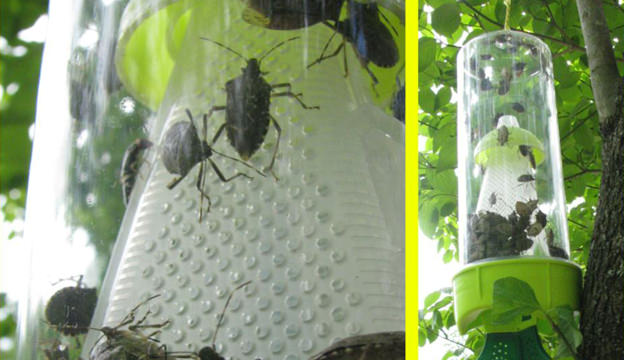
Ugh! The stink bugs are in full force now. I knew it would happen, but this is crazy! I have finally started harvesting my tomatoes, and they’re all covered in stink-bug nymphs. The skin and flesh of the fruits is completely corked from their feeding.

The stink-bug nymphs were really getting into the raspberries, too, so I hung up a Rescue! stink-bug trap in hopes of catching some of ‘em. As you can see by the picture, a week and a half later, it seems to be working. I just got another trap to put up in the tomato patch. I will let you know how many I catch in there.

I am surprised there are so many stink-bug nymphs caught in the trap because it’s a pheremone based trap and the nymphs aren’t “looking for love” yet at such a young age, but, hey, who am I to argue? It’s working, and I don’t really care why! The company says there is some sort of light contraption that you can put in the top and actually use it in the house as well. I’m definitely going to try that this fall when they will, no doubt, start moving in.

My mom and dad were out for a visit last week and commented on all my beautiful weeds. Admittedly, I have more weeds this year than I have ever had before. We spent so much time this spring on installing the new landscape, they got way ahead of me. I did manage to spend a few hours yesterday weeding the strawberry patch and one of the new raised garden beds. I pulled three 30-gallon tubs full of weeds! I think I managed to get most of them before they dropped seed, which is a must do unless I want bigger trouble next year. There are still lots more to go, but at least I feel like I made a dent.

As I mentioned earlier, I have finally started harvesting tomatoes and have been enjoying them greatly. And I have more cucumbers than you can shake a stick at. The first harvest was 39 fruits, the second was 46, and yesterday’s was 48! I have been making pickles and trying desperately to share them with any friends that care to.

Categories
Equipment

Owner’s Manual Revisit

Equipment maintenance form
Photo by Jim Ruen
I’ll use this service form hung above my workbench to keep track of my long-term mower maintenance.

I’m one of those assemble first, read the directions later people. Over the years, I have tried to be better about reading the instructions first—or at least while I assemble. It is amazing how much smoother things go.

The one time I do pay particular attention to my manual is when a problem develops. The other day, the drive belt on my rough-cut rotary mower started to peel apart. Replacing the belt required the idler and the brake be adjusted, which required checking the manual.

This in itself was valuable, in particular, because I don’t believe I adjusted it properly when it was new. Even more valuable was taking a few minutes to review other maintenance tips, one of which was to grease the blade spindles every 10 hours.

“Ouch!” I have not been doing so. I haven’t even been tracking my use hours. One of the problems is that I use the machine sporadically—an hour here or an hour there, sometimes for three or four hours at a time but, again, very sporadically. It is easy to lose track of when the gas engine was last serviced, much less when the blade spindles were lubricated.

My immediate response was to grease the zerks. For the longer term, I made a use chart to hang above my workbench. It’s nothing fancy, but it should help. My goal is to fill in when I actually use the mower and note when I service it. Perhaps a little regular maintenance will prevent some high-cost repair. I may even revisit some of my other manuals before problems develop. It may not be the most stimulating reading, but it I know it will be worthwhile.

<< More Shop Talk >>

Categories
News

Americans Prefer Organic Over Local

Local food
Courtesy Ceatas/Jupiterimages/Thinkstock
More Americans are interested in buying local food, but a greater number still prefer food labels containing the terms “natural” or “organic.”

What appeals most to Americans on a food product label? Eco Pulse, an annual survey conducted by Shelton Group researchers, finds Americans opt for the terms “natural” or “organic” on their food labels rather than “Grown in the USA,” but also finds all three growing in consumer consciousness.

When asked about the best descriptions to read on a food label, 25 percent of consumers said they preferred “100-percent natural” or “all natural,” while 24 percent said “USDA Certified Organic” or “100-percent organic.” A smaller group, 17 percent, preferred “Grown in the USA.”

“This looks baffling on the surface because we Americans like our bananas, oranges and strawberries year-round. We’re used to eating fresh fruits and vegetables grown out of season, including some that can’t even be grown in the U.S.,” says Suzanne Shelton, president of Shelton Group, an advertising and research firm that focuses on marketing green products to mainstream Americans.

However, Shelton says that interest in nationally produced foods reflects three trends.

“First, Americans are increasingly worried about food contamination, and they’re concerned about water treatment and crop fertilization in other countries,” she says. “Second, there is growing support for family farms and local sourcing—a trend that’s gone mainstream in the last several years, including at Walmart. And finally, people are concerned about the economy and job losses, so buying ‘Grown in the USA’ is a way to help fellow Americans.”

Researchers queried 1,013 Americans for the Eco Pulse survey. Among its findings:

1. Recycling is on the rise.
More than 60 percent of Americans said they regularly recycle aluminum cans, plastic bottles and newspaper. However, convenience still plays a big role in recycling: Households without curbside service recycle at a significantly lower rate than those who do have it.

2. Americans love the idea of recycled content. 
Forty-three percent said “made with 100-percent recycled content” was the best description to read on a package of disposable plates or cups. However, a significant number of Americans (40 percent) said they’re buying less disposable or single-use tableware.

“That’s why manufacturers should focus on developing disposable tableware made from more sustainable materials to help assuage Americans’ growing guilt about single use,” Shelton says.

3. More shoppers buy with sustainability in mind.
The number of Americans who say they’re searching for more energy-efficient, natural or sustainable products increased almost 10 percent over the past two years. Today, almost seven in 10 American consumers say they’re searching for sustainable products. In fact, green buying behavior seems to be crossing all socioeconomic classes.

4. The price of sustainability concerns Americans.
Only 23 percent of Americans consistently buy green across multiple product categories, such as natural foods, green detergents and energy-efficient appliances. While most desire greener products, many mainstream consumers are turned off by the higher cost. Seventy-one percent of Americans said green products usually or always cost more.

“Most Americans will try a greener product if it is comparably priced and offered by a known brand,” Shelton says. “But if helping the planet is the only benefit, most consumers aren’t willing to pay the extra cost. In this economy, consumers prefer a greener wallet over a greener planet.”

Categories
Urban Farming

New Program Prepares Students for Start in Urban Farming

carrots

Photo courtesy Hemera/Thinkstock

The Certificate in Commercial Urban Agriculture program offers a comprehensive introduction to starting an urban farm.

While the U.S. has seen an increase in the demand for locally grown foods by consumers, restaurants and retailers, there has be a decrease in the number of Americans who grow up on farms and have the necessary skills to pursue a career in farming.

ECO City Farms, located in Edmonston, Md., offers a local solution through its Certificate in Commercial Urban Agriculture training program, presented in partnership with Prince George’s Community College, in Largo, Md. A first of its kind in the region, the program provides a comprehensive introduction to urban farming.

“The local food movement emphasizes the benefits of growing food close to where people live,” says Margaret Morgan-Hubbard, CEO of ECO City Farms. “For heavily populated areas like Prince George’s County, we’ll need a mix of rural and urban farms to provide a variety of local food options. We are working to demonstrate the possibilities of fresh food production inside the Beltway, and these courses let us share our knowledge — to empower others to start urban farms.”

The Certificate in Commercial Urban Agriculture program consists of six courses, which total 28 hours of instruction. Taught at ECO City Farms, the courses may be taken individually, but students are required to complete all six courses in order to receive the Certificate in Commercial Urban Agriculture.

Course Dates:

AGR-301 Urban Farming: The New Frontier
Tuesday, September 6; 6:00-8:00 pm

AGR-311 Starting Your Urban Farm
Tuesday, September 13 and Tuesday, September 20; 6:00-9:00 pm

AGR-320 Composting for Urban Agriculture and Sustainable Landscaping
Tuesday, September 27 and Tuesday, October 4; 6:00-9:00 pm

AGR-330 High Tunnel Construction & Applications
Tuesday, October 11 and Tuesday, October 18; 6:00-9:00 pm

AGR-321 Introducing Urban Livestock on Your Farm
Tuesday, October 25 and Thursday, October 27; 5:30-7:30 pm

AGR-312 Post-Harvest Processing and Marketing
Tuesday, November 1 and Thursday, November 3; 5:30-7:30 pm

Course descriptions and registration information are available here. To register, click here.