Categories
Recipes

Apple-croissant Pudding

Apple Croissant Pudding
Photo by Rhoda Peacher

Ingredients

  • 3 large croissants (about 7 ounces total)
  • 1¾ cup peeled, diced apple (any kind)
  • 3 eggs
  • 1 cup half-and-half
  • 1/3 cup pure maple syrup
  • 4 T. butter, melted
  • 1/2 tsp. cinnamon
  • 1/8 tsp. salt
  • 1/2 cup coarsely chopped pecans
  • additional maple syrup and heavy cream for garnish

Preparation
Preheat oven to 350 degrees F. Generously butter a glass, 8- by 8-inch baking pan.

Tear croissants into bite-sized pieces and place in large bowl. Add diced apple. In separate bowl, whisk eggs and half-and-half until frothy. Whisk in maple syrup, melted butter, cinnamon and salt. Pour over croissant pieces and apples, and use hands to mix thoroughly so that bread soaks up egg mixture. Pour into buttered baking dish and cover with foil. Bake for 30 minutes, remove foil and sprinkle pecan pieces evenly across top. Bake, uncovered, for an additional 15 to 20 minutes or until pudding is set (knife inserted in center comes out clean) and top is light golden brown.  Serve warm; with cream and warm maple syrup to drizzle on top. 

Serves 6.

Categories
Equipment

Instant Workbench

Instant Workbench
Photo by Jim Ruen
I used HANDy Bucket Builder lids to create an instant workbench.

When I saw the HANDy Bucket Builder lids at our favorite paint store, I was sold immediately. I bought two to try out and picked up six more the next time I was at the store. The Bucket Builder is a lid for a 5-gallon pail that gives you the option of stacking another pail on top or using it to hold one or two 2x4s.

Set out two pails with the lids on them, and you can create an instant knee-high workbench. Stack two sets of bucket and lid pairs and with 2x4s locked into the top lids and you have a narrow, but workable waist level workbench. I set up four pairs of buckets with lids and four 2x4s for a very stable work area. As you see in the picture, I added a few clamps and had a solid surface for my bench-top table saw.

The beauty of the lids is the way you can insert two 2x4s flat or one 2×4 on edge. The molded plastic has ready-made starting holes if you want to make the 2x4s semi permanent. Simply drill in a screw, and the 2×4 is locked in place. Even without screws, the molded plastic has pressure points that help hold the 2x4s tight.

Bercom, a small Minnesota company that has introduced a number of devices to make painting easier, makes the lids. Suggested retail price is under $10. I think mine ran around $8. Check with your favorite paint store or big-box retailer. If they carry other Bercom painting products, they should be able to order the Bucket Builders. I really like them and hope you get a chance to check them out.

<< More Shop Talk >>

Categories
Animals

Steve the Farm Dog

Farm dog
Photo by Sue Weaver
Steve, a Rottweiler-Chow Chow mix, ventured across the field and to become our farm dog.

Last week, when I wrote about our livestock guardian dog, Feyza, David from Omaha left a nice comment about general purpose farm dogs. (Thank you, David.) We have one of those, too. His name is Steve.

We have lots of dogs—nine to be exact—including Feyza. Most of them are ours because uncaring people who no longer wanted them and dropped them off along the roadside to fend for themselves. They got lost and hungry, and when Mom and Dad saw them, they stopped the van and picked them up to bring them home. Mom and Dad try to find new, caring owners for the lost dogs, but sometimes that’s hard. So some of the dogs stay on with us forever.

Steve wasn’t dropped off along the road, though. He came across the field to become our dog. Mom was feeding the horses late one evening when a scrawny, sad, half-grown puppy came creeping up the hill. (This was before Dad built the woven wire perimeter fence around our farm.) She called to the pup, but he was scared and scampered away. She went to the house and made him a pan of kibble with noodle soup on it and left the pan by the fence. The next morning, the puppy was cowering in the barn. He was still terrified, but knew he’d found himself a home.
 
Steve grew up to be a powerful dog. Right away, Mom and Dad could tell he was part Rottweiler and also something else, but what? They found out a few months later when a neighbor dropped by and said, “I know that dog!”

Steve was one of a litter of 11 unwanted puppies whose mom was a registered Chow Chow and whose dad was a purebred Rottweiler. Steve got most of his looks from his Rottweiler father but his tongue is black like a Chow Chow’s

Mom and Dad asked Steve’s first owners if they wanted him back. They still had a bunch of half-grown pups from that litter, and thankfully, they said no.

Steve’s never gotten over being afraid of being chased by scary things like the guineas or Katy the Alpine goat. And if someone unexpectedly moves too fast, Steve still cowers. Nevertheless, despite his puppyhood fears, Steve stepped into the role as farm dog, and he does his job very well.

When Mom got sheep, she was afraid that Steve would chase and hurt them because Rottweillers have strong prey drives. But Steve liked the sheep. He snoozed with them when they grazed in the yard and let the lambs spronk off of his back. Then, he assumed the role of bottle baby trainer and guarded them in the yard by day and indoors by their sleeping crate at night.

Even though he’s scared of little things, Steve helps Feyza patrol the farm and keep interlopers away. He’s a good example of the old saying, “You can’t judge a book by its cover” A Rottweiler-Chow Chow farm dog? No way! But Steve is a good one.     

« More Mondays with Martok »

Categories
Urban Farming

Morning Zeal

Mr. Mabel and the chickens

Photo by Audrey Pavia

Morning time with my flock is always entertaining.

I’m not sure if it’s the fact that my chickens wake up a lot earlier than I do, or if it’s just that they are eager to start the day, but mornings with my flock are always quite entertaining.

The scene is always the same: I go outside, feed the horses and then make my way to the coop where the flock was locked in for the night. Mr. Mabel paces and leaps at the door of the outdoor section of the coop, anxious to come out. Mr. Molly is still indoors, hanging low. Apparently, Mr. Mabel can’t be trusted to be nice this early in the morning.

A couple of the hens hang around in the outdoor section too, but most of them are indoors with Mr. Molly. All of them seem reluctant to get too close to Mr. Mabel.

I open the door to release the hostages, and Mr. Mabel races out. He stands up very straight and starts doing his alpha-rooster strut. The hens hang back; they have learned what happens to the first hen to set foot outside that coop.

As Mr. Mabel blusters around nearby, one of the hens gingerly walks out the gate. Mr. Mabel spies this and runs to her — seems he is very amorous in the morning. The hen runs for her life, squawking in protest with Mr. Mabel in hot pursuit.

While my boss rooster is preoccupied with the hen he’s chasing, the other three quietly sneak out the coop door. Mr. Molly is always last. He waits for Mr. Mabel to be long gone before he dares to set foot into the daylight.

The next segment to the morning ruckus is the race to the horse stalls. Mr. Mabel finds some fresh new bit of food in there that apparently wasn’t noticed the night before. (I don’t know — or care to know — what they’re eating.) As my roo emits his unmistakable “come and get it” clucks to hens, they race over to see what’s for breakfast.

As I make my way to the garage where I keep the lay pellets, I suddenly feel like the Pied Piper. The entire chicken crew follows close behind me. They take their positions on the lawn, and I go into the garage to get them their feed. I throw handfuls of the pellets onto the grass and watch the free-for-all as they hunt for the feed between the blades.

Once they’ve had their breakfast, the flock settles down. Their crazy morning energy dissipates and they begin their day, which consists mostly of roosting in the bushes, scratching in the dirt for bugs, and maintaining the soap opera that makes up the dynamic of the flock. I leave them to their adventures, wishing I didn’t have to go to work but could instead just sit around all day and watch my charming birds.

Read more of City Stock »

Categories
News

Maryland Challenged to Buy Local

Farmers' market
Courtesy iStockphoto/Thinkstock
Farmers and consumers in Maryland and throughout the U.S. are encouraged to participate in Buy Local Challenge Week.

Maryland’s 5th annual Buy Local Challenge kicked off Thursday at Governor Martin O’Malley’s mansion with a cookout decked out with—you guessed it—local foods. After the event, more than 3,000 Marylanders had signed a pledge to participate in Buy Local Challenge Week (July 23 to 31, 2011), in which they committed to consuming at least one local product each day of the week.

“It’s a win-win program,” says Christine Bergmark, executive director at the Southern Maryland Agricultural Development Commission, an organization helping to organize the week’s events. “The farmer wins, the consumer wins, politicians win—everyone wins. … It’s a small investment you can make with your dollar and it keeps farms in business.”

And Maryland, along with the rest of the U.S., continues to face the problem of farmland loss. According to the USDA’s 2007 Agriculture Census, the amount of farmland in Maryland has dropped by nearly 42 percent since 1959 to slightly more than 2 million acres.

The goal of Buy Local Week, however, is to put farm-fresh products at the forefront of consumers’ minds, giving extra visibility to local farms, increasing visitation to farmers’ markets and getting people to think about where their food comes from.

“Our farmers say there is a spike in sales in the time around and after the Buy Local Challenge,” Bergmark says. “It’s our hope to get people exposed to the idea [of buying locally] and trying it.”

Not only does buying from local farmers help the U.S. meet national health goals, it also helps to boost the local economy. If households spend just $12 a week for eight weeks on local products, $10.7 billion are reinvested directly to the nation’s farms, says Bergmark, pulling from U.S. Census data. Plus, she says, local farmers are likely to reinvest that money into the local community. For example, when you buy your cheese from the local dairy farmer, he might use that money to purchase feed from a local farm store.

During this year’s Buy Local Challenge, an emphasis is being placed on the workplace. Marylanders are encouraged to take the official Buy Local Challenge pledge as an office and can enter a photo contest, showcasing how they as an office intend to fulfill the pledge. The most unique entry from a Marylander will receive a catered lunch for up to 20 people and a gift basket of Maryland farm products.

The SMADC and its partner, the Maryland Agricultural Marketing Professionals, are also encouraging participants in the challenge nationwide. Interest in the challenge has already been generated in Virginia, Washington, Florida and Washington, D.C., Bergmark says. Those outside Maryland wanting to promote buying local in their workplace can download promotional materials from the Buy Local Challenge website.

“We hope people will buy local all year round and hope people will buy local while product is abundant across the U.S.,” Bergmark says. 

Categories
Urban Farming

Urban Farming in Amsterdam

woman farming in Amsterdam

Photo by Rick Gush

Amsterdam was full of urban gardens and happy people working in them.

Last week, I was in Amsterdam, Netherlands, for two days of meetings with the developer of a game on which I’m working, so my wife and I tacked our summer vacation onto the trip. The weather was great, my wife was a fun travel companion, and I was able to tour all sorts of farms and gardens. I even managed to stumble into an unbelievably cool project: My new partners will be converting an abandoned farm on the edge of the city into a new-style urban farming university. Cool, huh?

Amsterdam’s coastal location makes it a lot like Vancouver, British Columbia, — a “banana belt” that allows people here to grow some great gardens. The soil there was really sandy, so there wasn’t much need to sift rocks out of the soil, which was a great relief to me.There were a lot of tulip fields and greenhouses, as well as a countless little farms scattered around the edge of the city, too.

About a century ago, the Dutch government gave factory owners big patches of land, which they in turn parceled out to the factory workers so they would all have someplace to grow their food. Many thousands of these gardens still exist.

After a tour of one of these locations, I was amazed at how deluxe the small building was. It was not a rough garden shack, but more like a hip little getaway home. The place I toured had 55 plots and a communal beekeeping facility to insure pollination.

I also toured what seemed like multiple gardens belonging to a big commune. The place was right in the middle of the city and reminded me of what Berkeley probably wanted to become back in the ’60s. There were lots of happy workers busily attending to their various tasks and moving in and out of several-dozen buildings and farm structures.

We’ll see how things work out with the urban-farming university. Listening to “experts” every once in awhile is a good thing, but in the long run, everyone will be responsible for their own farm or garden, and will need to make cultivation decisions themselves.

The only downside to all this is that commuting to Amsterdam might have to happen since my computer-game work there is going quite well. I absolutely hate to ever be away from my idyllic life in Italy, but these opportunities are hard to resist.

Read more of Rick’s Favorite Crops »

Categories
News Urban Farming

San Francisco Airport’s Farm-to-Flight

Photo courtesy Comstock/Thinkstock

Travelers can now purchase locally grown food at Terminal 2 at San Francisco International Airport.

San Francisco International Airport’s newly renovated Terminal 2 is bringing the hustle and bustle of an international airport and the quiet life of the farm together.

SFO is the first airport terminal looking solely for vendors who sell local, healthy food. So far, three quarters of the food sold in Terminal 2 are made up of local fare. Included in this area is Napa Farms Market, a 5,000-square-foot marketplace featuring products from Bay Area farms.

The farm-to-flight idea fits perfectly in an airport situated in California, home of the food belt and the United States’ largest agricultural producer. According to American Farmland Trust, the San Francisco Bay Area produces $1.8 billion of food a year.

Launched in February, the Silver Diner at Baltimore/Washington Thurgood Marshall airport has a similar farm-to-flight program on a smaller scale. The retro, neon-lit restaurant’s burgers and buns are purchased from sustainable, local sources. Everything from local milk to bread to eggs fill the menu throughout the year.

There are many initiatives to bring local foods into international travel hubs and seek to offer alternative food choices. In return, they expose visitors — whether stopping in on a short layover or on an extended stay — to unique elements of local culture and history. Los Angeles International Airport’s newly renovated Terminal 5 is planning to bring a version of the farmers market on Third and Fairfax in Los Angeles. Former dairy farmer and now oil tycoon Arthur Fremont Gilmore started the famous market to help farmers during the Great Depression, and it has been serving the city every since.

Napa Farms Market offers the “farm-to-flight” concept where you can pick up prepared meals and bring them onboard your flight. Included are salads and sandwiches and Cowgirl Creamery cheese.

SFO is encouraging all food vendors to use sustainable seafood, cage-free and antibiotic eggs, organic produce and meats, non-hydrogenated oils, fair trade coffee and milk free of rBST hormones.

Categories
Crops & Gardening

Newfound Coleus Supplier

Gay's Delight coleus
Photo by Jessica Walliser
This year’s I’m growing Gay’s Delight coleus, but next year there are so many more varieties I want to try.

I recently wrote an article on coleus for my weekly newspaper column in the Pittsburgh Tribune-Review and found out about a terrific mail-order company that I had never heard of before. Now, I have always liked coleus and I grow several different ones in my garden every year, but I had no idea how many hundreds of different cultivars there are out there and just how stunning some of them can be. I have always felt limited by the handful of selections available at our local nurseries, but now that I know how many gorgeous varieties are out there, I am really feeling short changed!

Rosy Dawn Gardens in New Hudson, Mich., has hundreds of coleus varieties listed alphabetically on its website. With images to accompany each one, it’s easy to find your favorites. (Narrowing them down, however, is not!)

I would love to visit this place sometime and walk through their greenhouses and see all the different coleuses close up. I usually grow Black Dragon, which is a variety started by seed that Rosy Dawn does not supply, as well as a couple selections started from cuttings. This year, I am growing Gay’s Delight in my front window boxes and just love it. I also like the trailing varieties for my window boxes and containers, too. I fell in love with Inky Fingers a few years ago, and after perusing this website, next year I’m going to have to get Apocalypse, Sparkler, Ruby Laser, El Brighto, Felix and Darth Vader. Can’t wait!

« More Dirt on Gardening »

Categories
Urban Farming

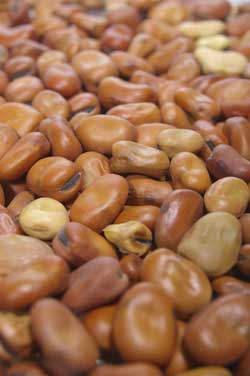
A Lesson from Fava Beans

fava beans

Photo by Judith Hausman

Who knew I would learn so much from fava beans?

Last Thursday, my garden co-op  harvested our entire aphid-attracting fava-bean crop. We pulled up all the bushes, which had bent under the weight of the bumpy green pods, piled them into a wheelbarrow, and trundled them over to a shady spot behind the garden house. Six of us stripped the fava bean pods, divvied them up roughly into 10 large bagfuls (to include the absent members), and wheeled the waste to the compost pile.

Then, once in the kitchen, we each had more to do before we could enjoy the fava beans: opening the tough pods; rinsing and cooking the beans briefly; and draining, cooling and then popping each of them out of their second skin. My own bagful resulted in about 2 1/2 quarts, I think.

Here’s the thing: When and if you find fava beans in the supermarket, the pods are a smooth and sleek green and there are piles and piles of them. You can also buy frozen peeled and dried fava beans, too. As my hands got blacker and blacker from opening my brown-spotted share during the first round, I kept thinking about what would have to be done to a fava-bean crop to make them so grocery-store “perfect.” What goes into growing and prepping so, so many of the beans?

This is a sobering, if not obvious, thought I frequently have when I’m harvesting my vegetables or buying organic ones at the farmers market.

A fennel bulb is really about one-third the size of a supermarket fennel bulb; the central head of a real Savoy cabbage is not the size of a soccer ball; a real strawberry lasts about two days; fava beans are often brown or black-spotted … and take a lot of prep work.

I can’t even imagine what it takes to have as many shrimp that chain restaurants do, as much roast beef fast-food sandwiches contain, or as many drumsticks you-know-which Colonel has. If you want to see this graphically, check out the documentaries “Food, Inc.,” and “Food Matters.”

The hopeful lesson I can take from my fava beans, along with making the most wonderful salads when topped with shaved Parmesan and thin-sliced fennel or chopped tomatoes, mint and red onion, is a deeper appreciation for this vegetable. To me, it is a delicacy, but it is almost a staff of life in many Middle Eastern countries. It takes a lot of work to grow and prepare it to eat. It must take acres and acres to grow as many as humans need.

The favas aren’t pristine and naturally bright; some interventions I’m probably uneasy with happen to make them so. What’s more, it’s likely most of what I eat undergoes similar interventions to not only keep the food pretty but also to feed our multiplying population, sometimes not so well, unfortunately.

This lesson also makes me feel the deep privilege of being able to grow food in the suburbs; of working hard and gardening with dedicated friends; of raving over the squash or the fava crop and harvesting as a group, wise-cracking and trading recipes with the lovely lull of chortling turkeys, satisfied chickens and peeping guinea fowl.

Read more of The Hungry Locavore »

Categories
Equipment

Expect the Unexpected

Chainsaw
Courtesy iStockphoto/Thinkstock
A healthy respect for chainsaws, including the damage they can do, is a good thing.

As I have written before, I have a weakness for chainsaws, a respect for the work they can do and even more respect for the damage they can cause when misused. I always do my best to prepare the way for safe felling. The other day, I was reminded that the best of preparations can go for naught.

I was helping my brother and nephew lay out a new fence line angling up a wooded hillside alongside an old cow path. Because of the uneven nature of the slope, there were spots where the ground fell away beneath the bottom wire. Knowing calves would quickly discover the gap, I decided to cut a 40- to 50-foot cedar, strip the branches and place a section of trunk as a barrier.

The job seemed simple enough. I trimmed away lower branches and made the prerequisite cuts, taking out a large wedge across the face of the tree. I then made a high cut from the other side, angling down to a point just above the wedge.

I expected it to fall straight ahead. It didn’t!

I cut completely through to the wedge. The trunk slipped about 2 inches vertically. No forward movement could be observed at all. It seemed to be defying the laws of gravity and the rules of physics.

Only then did I notice a spot about 15 feet up. What had appeared to be two cedar branches extending past an ash in fact extended into and through the ash. The ash had grown around the stout cedar branches. A few minutes later, I had sawn through the ash and the two trees fell to the ground.

Gravity still rules, but when using a chainsaw in dense woods, always expect the unexpected.

<< More Shop Talk >>