Categories
Animals

Mad City Chickens: An Egg-cellent Documentary

Consuela the chicken
Courtesy Robert Lughai
The survival story of Consuela the chicken and her rescuer Liz Perry appears in the documentary Mad City Chickens.

Mad City Chickens (Tarazod Films, 2008) gets our highest praise: an eggs-cellent rating of 4 eggs, of course. We love this film, not just because of its subject matter, but because it’s a well-made documentary, skillfully weaving together several stories into a fun, interesting narrative.

MCC will certainly cause you to smile and might even have you shed a tear (not this reviewer, but it certainly got to his wife). Although the movie title comes from the Madison, Wis., chicken movement to legalize backyard hens within city limits, that is only a small portion
of the film.

Other stories include how a young family goes from being poultry-free to ordering chicks and building a chicken coop in their backyard, while another portion centers on Liz Perry, a pet-food store owner who reluctantly starts purchasing organic chicken feed for her customers and ends up with a chicken of her own. That story is somewhat amazing and certainly inspiring (Warning: This segment might cause you to tear up!) It details how Perry rescued a chicken that was gassed by the nearby commercial poultry farm but refused to die and was running around the local dump. The chicken, hence named Consuela, now has a new life as a backyard hen, thanks to Perry.

Another segment deals with the history of Murray McMurray Hatchery, located in Webster City, Iowa, and how this business kept a family going through the Depression and continues to fulfill orders for chicks today. It’s so interesting to go inside the hatchery to see how all the chicks are hatched, sexed and shipped to waiting chicken keepers.

You can’t go wrong by spending some time watching Mad City Chickens. And once you’ve seen it, you can pass it along to your non-chicken-keeping friends. Who knows? Maybe it’ll inspire them to get some hens, too!

Read more about Mad City Chickens in the Summer 2011 issue of Chickens magazine.

Categories
Urban Farming

L.A. Gets Growing

handful of tomatoes

Photo courtesy Getty Images/Comstock/Thinkstock Images

Community gardens such as El Sereno teach families to grow their own fruits and vegetables while providing a setting that fosters community spirit.

When plans to construct a road through the heart of a Los Angeles neighborhood were put on hold, residents lobbied to start a community garden in a vacant lot owned by the L.A. Department of Transportation.

The group, with the support of the Los Angeles Conservation Corps, wrote a proposal and presented it to city council. It was approved in 2003.

“They trusted that we were going to do something really great with the space,” says community garden co-founder Marie Salas.

Volunteers began clearing the space in 2004, removing tires, bottles, furniture and needles from the vacant lot. The city donated $100,000 to offset the cost of construction and supplies, and L.A. Conservation Corps, a nonprofit organization that provides at-risk youth with job opportunities, managed disbursement of the funds.

Determined to create an oasis in the heart of Los Angeles, founders called the garden El Sereno, meaning “serene.”

“In the beginning, we were considered a pilot project, and rumor has it that people thought the garden wouldn’t succeed,” Salas says. “The first several years were a really rocky road, but the community never gave up on the garden. Our garden has sparked other gardens to start in the neighborhood.”

Seven years after El Sereno was founded, the garden is still growing strong. Salas attributes its success to the community spirit found growing alongside the fresh fruits and vegetables.

The 2 1/2-acre plot, which is on loan to residents by the City of Los Angeles on a month-to-month basis, has 40 plots. El Sereno provides all of the tools as well as compost, water and electricity; gardeners are responsible for providing their own seeds and plant starts.

In exchange for a plot where they can grow organic produce, gardeners are charged a fee of $50 per year. Even though the fee is minimal, it is still out of reach for some residents of the low-income community, but Salas is determined not to turn anyone away; some residents have established payment plans to rent plots in the garden.

“If they are willing to do the work, we are willing to work something out,” says Salas. “A garden brings so much to a community: It brings families together, teaches them to plant their own food, brings out a sense of exploration in kids and has the unity of volunteerism; we don’t want to turn anyone away.”

Salas has worked alongside other garden members and volunteers to ensure that El Sereno is a true community garden. In addition to plots where members grow tomatoes, peppers, beans, squashcucumbers and other veggies, a section of the garden is planted with fruit trees, and members are invited to pick their fill when the fruits are ripe.

There is also a space for community events. Nonprofit groups have used the space for fundraisers, film festivals and gardening classes. A local family held a bake sale in the garden to raise money for the funeral of a loved one.

“The one thing I’ve learned [from volunteering in the garden] is how important it is to bring community, families and elected leaders together to find common ground,” Salas says. “Our philosophy has always been to use the garden to teach people how to become sustainable, and our community has embraced that.”

About the author: Jodi Helmer is the author of The Green Year: 365 Small Things You Can Do to Make a Big Difference (Penguin Group, 2008).

Categories
Urban Farming

A Close Call

Nigel

Photo by Audrey Pavia

Nigel had the unfortunate experience of being stomped on by Rio.

It was an ordinary morning: My alarm went off at 6:30 and I ignored it for half an hour before getting out of bed. Then, partly comatose, I staggered around the bedroom, putting on my robe and looking for my slippers.

Still not fully awake, I went out the back door to feed the horses, with Nigel following close behind. Instead of seeing my small herd in their paddocks staring at me as they do most mornings, I found Rio on the back lawn, munching away. Only mildly surprised that he had gotten out of his stall at some point during the night, I shuffled off to my tack room to get a halter so I could catch him.

As soon as I got to the back gate that led to the tack shed, Rio spied Nigel sitting on the patio. He left the lawn and walked over to my corgi with his neck arched and ears pricked. Nigel didn’t move, but just cowered as Rio stood over him. Then, to my horror, Rio struck out at Nigel with his front hoof.

I have never been so terrified in my life! Nigel yet out a yelp and a snarl and jumped at Rio in self-defense. I was screaming at the top of my lungs while running toward them. If Rio struck again and his hoof landed in the right spot, Nigel could be dead in a matter of seconds.

Fortunately, instead of launching another strike, Rio tossed his head and trotted off. I ran to Nigel, who was looking at me with the most pathetic expression he’d ever given. I ran my hands over his back where Rio had landed his blow; fortunately, Nigel didn’t seem to be hurt. I asked him to jog alongside me across the patio, and he wasn’t favoring any of his legs. I was so relieved I could have cried. I put him back in the house and again went toward the tack shed to get a halter so I could catch Rio.

Although it may be hard to believe after reading this story, Rio doesn’t have a mean bone in his body. To him, everything is play. He’s like a giant kitten, trying to turn everything into a game. When the chickens wander into his stall, he chases them. Not because he wants to hurt them, but because it’s just fun to watch them run.

I’m sure Rio’s strike at Nigel was not intended to hurt him. I have seen horses act with aggression toward dogs and other animals, and their intent to injure is obvious. This was more of a “Hey, let’s play!” Of course, Rio has no clue that he weighs 600-plus pounds and could annihilate a 30-pound corgi with one blow of the hoof.

Even though it’s fun to have a pony around, I really can’t wait ‘til my cute little gelding matures into a boring adult.

Read more of City Stock »

Categories
Urban Farming

Innovation

Fireworks in Rapallo, Genoa, Italy

Photo by Rick Gush

The Madonna festival in Rapallo, Italy, has seen many innovations throughout the years.

I’m a big fan of innovation. Not much drives me nuts more than to hear someone say, “Well, that’s the way we’ve always done it.” I wrote a musical comedy about a group of Neanderthals, where the protagonist was an inventor from the Stone Age who had trouble convincing people that his ideas were useful. The other cavemen didn’t like the fire he showed them because it was too dangerous and it made food too hot to eat. They used his newly invented wheel as a toilet seat, and they thought his idea of deliberately cultivating plants and animals was ridiculously funny. Sometimes this is what happens with innovation; people are scared of it.

In the 10 years I’ve been watching the Rapallo, Genoa, Italy, Madonna celebration, during which they anchor a barge in the middle of the bay and use it as a platform to launch fireworks, the organizers have progressively innovated their schedule and show. This is a bit odd for Italians, the kings and queens of “that’s the way we’ve always done it.”

First, the organizers scheduled both daytime and nighttime fireworks displays. A lot more people, especially kids, are able to enjoy daytime spectaculars. Emphasis is placed on lots of really loud noises and whizzers during daytime fireworks. Next, they started putting paper cutouts in the rockets so it looked like whole crowds of people were falling down from the heights. This year, they used a lot of wild-colored smoke. There were fluorescent greens, wild reds, a bunch of different blues and even some crazy shots that looked like huge dahlias with yellow and orange petals trimmed with lavender stripes. I can’t wait to see what innovative ideas they come up with for next year!

Currently, I’m writing a short piece for Urban Farm’s sister publication, Hobby Farms on the topic of new agriculture; in particular, about the race to develop perennial grain crops. This isn’t a new idea. I remember talking about it in the ‘60s. It’s great to see our collective intelligence finally realizing that relying so much on annual grains, which need a lot of petroleum products, we produce is in fact not a good idea in the long run. Personally, I think the single largest agricultural research effort in China these days is the hunt for types of perennial rice.

I think Americans are being ignorant about perennial agriculture and new agriculture in general. Although there are a few organizations talking about the need to develop perennial grains, the huge corn and soybean industry is doing everything it can to quash any talk of its practices not being good for society. Rome stopped becoming innovative and we all know what happened to its. The U.S. needs to wake up and start rethinking our agricultural system.

Read more of Digging Italy »

Categories
Urban Farming

Breast Cancer Prevention Partnership: Organic Living

basket of vegetables

Photo courtesy Martin Poole/Digital Vision/Thinkstock

Organic Living emphasizes the positive impact that an organic lifestyle can have on breast health and the health of the environment.

Breastcancer.org recently announced the launch of Organic Living, an innovative online partnership with Stonyfield Farm.

Updated weekly with articles, recipes, videos and lifestyle tips, Organic Living emphasizes the positive impact that an organic lifestyle can have on daily life.

“Changing your life can help reduce your risk of breast cancer,” says Marisa C. Weiss, M.D., president and founder of Breastcancer.org. “Even small changes in what you eat, drink and breathe in, as well as the supplements and medicines you take, the personal products you use, and how you manage your weight, can help lower your risk of ever developing breast cancer or reduce your risk of recurrence after treatment.”

By encouraging consumers to live more mindfully and avoid chemicals in food, beverages, personal care products and the environment, Organic Living highlights the critical relationship between breast health and the health of the environment.

“While there are no guarantees with any lifestyle change, it’s better to be safe than sorry and do the best you can to lead a healthier life,” Weiss says.

Organic Living serves as a valuable addition to Breastcancer.org’s global breast cancer prevention initiative: Think Pink, Live Green. The world-wide program educates women about the impact that external environmental factors have on women’s bodies, which may in turn negatively affect breast health.

“My life has been personally touched by breast cancer,” says Gary Hirshberg, president and CEO of Stonyfield Organic. “My wife, Meg, is a 10-year breast cancer survivor and life-long organic enthusiast. Therefore, this partnership with Breastcancer.org is deeply meaningful to me, personally and professionally.

“It is so important for people to understand the negative consequences of what we’re putting in our bodies. The President’s Cancer Panel states that 41 percent of Americans will be diagnosed with cancer at some point in their lives, which is staggering,” Hirshberg says. “We are committed to this partnership with Breastcancer.org because the Think Pink, Live Green initiative is working to empower families with resources to lower their risk and make healthier choices in their lives.”

Visitors to Organic Living can learn how to start an organic garden and find helpful tips for shopping organic on a budget, selecting organic skincare, and more.

To learn more about Organic Living, click here.

Categories
Crops & Gardening

Of Bugs and Berries

I headed to the raspberry patch last night to pick a few berries for dessert and couldn’t help but notice how alive the plants were. All sorts of insects were out and about and I was struck with how many different insects were in one 8- by 8-foot patch of brambles—and these were just the ones I could see! I ran back inside and grabbed my camera. Although I’m no professional photographer, I thought you might enjoy seeing what I found.

« More Dirt on Gardening »

Categories
Urban Farming

Beets Are the Best!

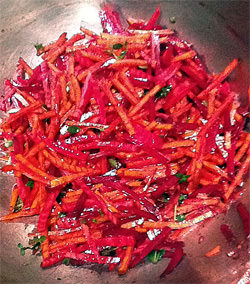
grated, raw beet salad/></p><p
class=Photo by Judith Hausman


This grated, raw beet salad is healthy and beautiful.

I never ate beets growing up but now they are among my favorite vegetables, especially the beautiful, juicy new beets that are so abundant this time of year. Beets are also really good for you; they contain unique antioxidants and vitamin C, folates and potassium. They also keep well, so you can cook a mess of them and have them at the ready. Come to think of it, in the summer, I almost always eat them cold, so cooking them in advance (or when you have a cooler day) works well.

The easiest beet-cooking trick is to wrap them in foil, pop them in a baking dish and put them in a corner of the oven when you have it turned on for anything else. Even if the oven temperature is low, the beets will just take a little longer, from 20 to 40 minutes, depending on size and then pierce one with a fork to test. When the beets are cooled, open the foil and slide off the skins. Then, slice and, for example, alternate with slices of goat cheese or oranges and dress with a light vinaigrette. If you can get a hold of gorgeous yellow beets and concentrically red-and-white striped Chioggia beets, a mix of them makes a colorful array.

Another great cooking idea is to roast white turnips and cubed or small potatoes at the same time as the beets. These mixed roast vegetables can be served warm or dressed and then at room temp as a side dish. Maybe strew a few chopped scallions or fewer chopped garlic scapes over them.

Don’t rush those beet greens to the compost, especially if they are farmers-market-fresh and perky. Treat them just as you would their cousins, Swiss chard. The leaves are similarly sweet and taste great balanced with a little acid. The quickest preparation is olive oil and garlic, finished with a splash of balsamic vinegar. Some beet lovers prefer a butter sauté and a squeeze of lemon juice. The important thing is to dry the washed, chopped leaves and cook them with a lid to wilt them down, and then cook them without a lid so they dry out a little.

I also throw beet greens in with any other tender greens (spinach, chard, turnip), add feta cheese, oregano and egg, maybe a tablespoon of flour to bind and use this as a base for a quiche or a filling for filo or puff pastry … sort of a cheater spinach pie. Warning: even a huge pile of greens cooks down very quickly to a very little amount, so you’ll need several pounds.

Beets can dye your hands like exotic henna. My friend, Gerald Stern, of New Rochelle, N.Y., braves red hands to make this vibrant, quick salad. “The longer it sat the better it got, but it was so delicious, it didn’t last long!” says Stern.

Recipe: Raw Beet Salad

Ingredients

  • Two to three medium-to-large beets per person

Dressing:

  • lemon juice
  • red wine vinegar
  • extra virgin olive oil
  • salt & pepper
  • fresh thyme
  • Chopped scallions, garlic scapes or radishes, optional

Preparation

Use a mandolin or a food processor to julienne the beets. Mix the vinaigrette and dress the beets. If possible, let sit about 30 minutes before serving.

Read more of The Hungry Locavore »

Categories
News

USDA Encourages Local Food in Schools

School lunch
Courtesy Hemera/Thinkstock
Schools are encouraged to buy food for school lunches from local farmers.

The USDA’s child-nutrition programs are implementing new rules designed to encourage the use of local-farm products in school meals.

The final rule, published in the Federal Register, will let schools and other providers give preference to unprocessed locally grown and locally raised agricultural products as they purchase food for the National School Lunch, School Breakfast, Special Milk, Child and Adult Care, Fresh Fruit and Vegetable, and Summer Food Service programs. The rule is part of the Healthy, Hunger-Free Kids Act of 2010 signed into law by President Obama in December 2010.

“This rule is an important milestone that will help ensure that our children have access to fresh produce and other agricultural products,” says Agriculture Under Secretary Kevin Concannon. “It will also give a much-needed boost to local farmers and agricultural producers.”

The rule supports USDA’s Know Your Farmer, Know Your Food initiative, which emphasizes the need for a fundamental and critical reconnection between producers and consumers. The effort also builds on the 2008 Farm Bill, which provides for increases and flexibility for USDA programs in an effort to revitalize rural economies by supporting local and regional food systems. Know Your Farmer, Know Your Food is helping break down barriers that keep local food systems from thriving, create new opportunities for farmers, ranchers, consumers and rural communities, and expand access to healthy food throughout the country. USDA expects consumer demand for locally grown food in the U.S. to rise from an estimated $4 billion in 2002 to as much as $7 billion by 2012.

The Farm-to-School component of this effort is designed to help connect schools with regional or local farms in order to serve healthy meals using locally sourced products in their cafeterias. The USDA currently is sending out teams to select school districts to work on farm-to-school issues. Some of these programs also incorporate nutrition-based studies as well as food-learning opportunities, such as farm visits, gardening, cooking and composting activities.

The Healthy, Hunger-Free Kids Act authorizes USDA’s child-nutrition programs, including the National School Lunch Program and the Summer Food Service Program. It will allow USDA, for the first time in more than 30 years, the chance to make reforms to the school lunch and breakfast programs by improving the critical nutrition and hunger safety net for millions of children. 

Categories
Equipment

Ultimate Engineering

The human body is the greatest farming tool someone could have
Courtesy Jupiterimages/
Photos.com/Thinkstock
Our bodies are the most effective and versatile tools we will use on the farm.

I was talking to an engineer one day, and as he described a project he was working on, he began explaining it with examples of the body’s musculature and skeleton. The more he described, the more I realized how similar the study of engineering is to the study of anatomy.

I asked him if he had ever studied anatomy. While he hadn’t, he too has recognized the parallels, hence the descriptors he used. We agreed that it would probably be time well spent for any engineer to study how muscles and ligaments are attached and how they react to forces and movement.

My recent bad back relapse reminded me of that conversation. I realized that if my back were a crane, I would never have expected it to handle the torque of bending, reaching and twisting at the same time, as I had over my raised garden bed. And yet, if my muscles had been in good repair, with adequate stretching and exercise in preparation, it could have handled the chore with no problem.

It truly is amazing what the body structure can do with tension, extension, flexion and all the other movements our muscles can make. Our bodies are the ultimate in engineering and the most effective and versatile tools we will ever have at our disposal.

Time to go do some stretches …

<< More Shop Talk >>

Categories
Urban Farming

Garden-Share Releases Garden Trends Survey Results

community garden

Photo courtesy Chris Steer/iStockphoto

A recent survey from Garden-Share.com showed vegetable gardening is the most popular gardening trend.

Garden-Share.com, the interactive social network where more than 27,600 recreational and professional gardeners connect, network and share content, conducted a survey of its 27,688 professional and recreational gardeners, of which 20.6 percent of the 1,139 respondents respondents said “vegetable gardening” is the most popular gardening trend. “Small-space gardening” was selected by 17.1 percent and “organic gardening” was chosen by 16.3 percent.

“Vegetable gardening has enjoyed a surge in popularity due to the economy, the price of gas and consumer concerns about the origins of the food they eat,” says John Mitchell, founder of Garden-Share.com. “Add to that the personal satisfaction you get by growing your own food and it is no wonder vegetable gardening is the most popular trend.”

Other findings include:

  • 43.6 percent responded that “yes, you can save money by vegetable, fruit and herb gardening.” Another 28.2 percent said “it doesn’t matter, it’s enjoyable.”
  • 56.9 percent said tomatoes, though technically a fruit, are their “favorite vegetable to grow.” At 8.1 percent, peppers were second.
  • Basil was chosen by 35.6 percent as “most favorite herb to grow.” Rosemary at 12.2 percent and chives at 8.0 percent were other favorites.
  • Berries were picked by 31.4 percent as the “most favorite fruit to grow.” Apples were chosen by 6.7 percent and citrus by 5.2 percent.
  • 45.8 percent of survey respondents cited “relaxation and enjoyment” as their main reason for gardening. 25.8 percent chose “garden for beauty and decoration.”

“As a gardener, I typically plant according to the season. Spring is in the air and the survey results definitely show that there is lot of activity,” says Mitchell.

Garden-Share.com followers offer these seven tips for productive, enjoyable vegetable gardening:

    • Plan in advance. Decide what you want to grow and how much time and space you can devote to your garden. Learn what works in what season. Tomatoes and berries seem to be the easiest.
    • Select a site and start small. A 3-by-6-foot raised bed and a few containers are enough to get you started and to hold your interest. Consider one each of plants like zucchini or cucumbers, two to three of peppers or tomatoes and four to five plants of smaller crops like beans or lettuce.
    • Prepare the soil. You’ll want fertile, well-drained soil. Building raised beds allows the soil to drain faster and warm more quickly.
    • Check the lighting. Most vegetables will need at least six hours of direct sun a day. If you have less than that, consider growing leafy green vegetables or root crops like beets, carrots and radishes.
    • Grow what you will eat. Pick a favorite vegetable, plant a few seeds and have fun watching them mature.
    • Be patient. The time it takes from planting to picking can vary. For example, radishes take about three weeks, cucumbers about six weeks and peppers about 12 weeks. Anyone who has eaten fresh produce knows that a garden is worth the effort.
    • Have fun and share. Your garden doesn’t need to be perfect. Enjoy what you are doing and share your experiences and photos.

For a copy of the survey results, click here.