Categories
Animals

Using Laying Hens for Meat

Layer chicken
Photo by Rachael Brugger
When layer hens no longer lay eggs, chicken keepers can consider culling them from the flock to be used as meat.

When Ken and Heidi Chester moved to a 19th-century farm in Hancock, N.H., in 2004, it seemed like a good opportunity to grow and process some of their own food. Heidi was particularly interested in continuing her family tradition of raising chickens for meat and eggs.

Heidi’s primary goal in keeping chickens was to maintain as continuous a supply of fresh-as-possible eggs while raising her hens naturally—free of artificial lighting and allowing them to free-range around the farmstead.

She established a small laying flock of mixed chicken breeds ranging from bantam hens to full-size dual-purpose hens, which she renews annually by replacing chickens (typically six) that are no longer laying as well with the same number of younger chickens she raises herself. Her total number of birds at any given time is based on available area in the chicken coop, and culling is usually done in the fall of the hens’ second year of laying, when the total number of eggs produced begins to noticeably decline.

When a Hen No Longer Lays

According to Jay Rossier, author of Living with Chickens (The Lyons Press, 2004), young pullets begin to lay around 18 to 20 weeks of age and will lay continuously for approximately one year before the first molt, when chickens “shed” their old feathers, so new ones can grow. Hens typically stop laying during the molting period, which may last from a few weeks to a few months, depending on the bird. Once they resume laying, hens usually produce as many eggs during the second year as they did during the first year, but then are most often culled.

Heidi is philosophical about the need to cull and kill hens that are past their prime to maintain a productive flock. She strongly believes that meat-eaters need to accept the responsibility that their diet is part of the natural cycle of life and death. Heidi admits that butchering chickens is not her favorite part of animal husbandry, but she appreciates the opportunity to humanely dispatch an animal that she has enjoyed getting to know as part of the hobby farm flock, knowing that it enjoyed a good life prior to slaughter.

About the Author: A dedicated gardener for more than 25 years, Cynthia Amidon has also kept poultry, sheep and horses. She lives in a small town in New Hampshire.

Categories
Animals

Oak (Again)

Goat eating oak leaves
Photo by Sue Weaver
I love to eat oak leaves! Yum!

You know how much we goats love yummy acorns, but did you know oak leaves are us goats’ favorite summer treat? That worried Mom for a long time because many toxic-plant lists say oak is poisonous.

Every day when the does and wethers go out to browse, they rush down the ridge to nibble leaves and twigs from oak sprouts (what Ozark people call little oak saplings) that pop up in our pastures each year. Dad buzzes them off with the tractor and bush hog, but they grow back up by next spring. Uzzi and I make a beeline for the oaks in our yard after storms. The wind brings down lots of yummy leaves!

Mom started searching for oak information online. Did you know there are more than 600 species of oak around the world? In some countries people cut oak boughs for animal feed. She learned that in a British research paper by the Natural Resources Institute called “Use of Trees by Livestock.” The “Quercus” chapter (quercus is Latin for oak) says cattle, sheep, goats, horses, and pigs all eat oak leaves and acorns. Wild animals like deer and elk like them, too.

Oak toxicity happens when we consume too high a proportion of oak leaves or acorns in our diets. That’s because oak contains a compound called phenol, which includes tannins. This compound is toxic in large amounts. The leaves and acorns from some species contain more tannins than others. Green acorns contain 1½ to 3 times more tannins than ripe acorns and new spring leaves and winter buds have more phenol in them than mature oak leaves.

Studies show that pigs and goats show the greatest tolerance to oak toxicity and cattle and buffalo the least; sheep and horses fall midway between. In all species, young animals are more susceptible to oak poisoning than grown-ups, like Uzzi and me.

In Europe, leaves and twigs from some species, like holm oak trees found in the Mediterranean region, are used as a protein supplement for goats. In India and Nepal, dried oak is a major source of livestock feed.

The trick, Mom learned, is feeding oak in moderation as a very small part of our diet (think: as a treat) and in choosing mature leaves and acorns over early spring growth and unripe acorns. Red and black oak varieties contain the most tannins; white oak varieties contain the least. If you’re not sure, break open a mature acorn and taste the nut. If it’s so bitter that it makes your mouth pucker, it’s chock full of tannins; if it’s sweet, there are fewer tannins. Many species of acorns can be eaten raw by animals and humans, but others require that the tannins be leached from the nut. 

Don’t let any kind of livestock except for swine eat their fill of yummy acorns. Some horses, for example, obsess on acorns and pig out; this can lead to painful, crippling laminitis. And cows that consume oak leaves and acorns for more than 75 percent of their diet are prone to potentially fatal oak poisoning. Even as much as half their diet from oak leaves and acorns leads to oak poisoning symptoms. According to the University of Arkansas, symptoms include lack of appetite, constipation, diarrhea (which may contain blood) and kidney failure.

The bottom line: Mom is bringing Uzzi and me two big branches of mature oak leaves every day. Yay, we love it! And Mom isn’t worried about us getting poisoned any more. 

« More Mondays with Martok »

Categories
Animals

Our Friend, Feyza

Livestock Guardian Dog
Photo by Sue Weaver
Our friend, Feyza, a livestock guardian dog, keeps us sheep and goats protected from predators.

A sad thing happened to one of Mom’s friends this week. Her sweet, orphan bottle lamb was attacked by her neighbor’s dogs and killed. That’s a shepherd’s worst nightmare. And dogs can kill other livestock, too.

According to USDA figures, 39 percent of all sheep and lambs and 32.5 percent of goats and kids that died in 2009 were killed by predators. Farmers and ranchers lose almost $100 million annually due to livestock kills, according to a Hobby Farms article by Carol Ekarius. It’s important to protect us not only from big, scary killers like bears and mountain lions but things like coyotes and dogs, too. That’s where our friend Feyza comes in.

Feyza is a livestock guardian dog. (Some folks call them LGDs.) These are big, strong breeds developed long ago in Europe and Central Asia, specifically to guard groups of goats and sheep. They lack the prey drive that makes most dogs chase small livestock. Instead, they bond with the animals they live with and protect. Humans developed them in colors to match the sheep or goats with whom they lived, so many livestock guardian dogs like Feyza are white or tan.

Feyza’s father was an Anatolian Shepherd, a big, short-haired breed developed in Turkey thousands of years ago. Her mother was Great Pyrenees, an equally ancient long-haired breed from France. There are lots of other guardian breeds too, like Kangal and Akbash dogs from Turkey, Polish Tatra Sheepdogs from Poland, Kuvasz and Komondors from Hungary, Karakachans from Bulgaria, Estrela Mountain Dogs from Portugal, Maremma Sheepdogs from Italy, Caucasian Ovtcharkas from Russia, and Tibetan Mastiffs from Central Asia.

Feyza came to live with us when she was only 8 weeks old. She was so sweet and cute; she looked like a fuzzy little bear. Mom wanted to keep Feyza in the house, but in order to bond with us sheep and goats, she had to come live with us right away.

Mom and Dad fenced off part of the big goat shelter for her using pipe gates. That way she could stay in her area or go out among the goats whenever she pleased. In just a few days, she started sleeping cuddled up against a mama Boer goat named K’ehlyr. She and K’ehlyr are like Uzzi and me: best friends.

Now Feyza is 7 years old. During the day, she goes out in the pasture with our sheep and goats. At night she stays in the Boer goats’ sleeping paddock, but she’s big and strong, so she can jump over fences if anything bothers the rest of us sheep and goats.

Uzzi and I think every sheep, goat or any other vulnerable small animal should have a friend like Feyza to protect them.

Categories
Urban Farming

Coyotes in the Midst

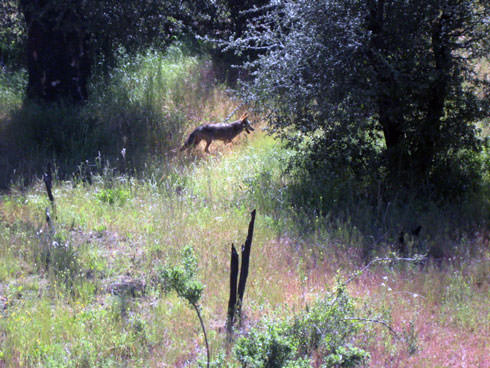
coyote in california

Photo by Audrey Pavia

Seen as a nuisance by many, I see coyotes as animals that bring a little excitement to the night.

A lot of people don’t like coyotes; they raid trashcans and eat the family cat. Some people are afraid of coyote attacks on their kids. But not me — I love coyotes.

I’m lucky enough to live in a suburb that is close to the open land and filled with coyotes. On some nights, when I go outside to feed the horses, I hear coyotes singing in the hills. One time, I howled back at them after they had stopped. Nigel started howling with me, and then the coyotes joined in. I felt like a werewolf, howling along with the canids.

When I ride on the bridle paths here in town, I sometimes see coyotes. Last weekend, I saw a roadrunner alongside the trail and then a coyote a few minutes later. I half expected to see a stack of ACME TNT next.

Coyotes seem to follow me everywhere. I think I see more than my fair share of them. When I go on competitive trail rides with Milagro, I often see them. Sometimes, when I walk around the lake at work, I see them too. In fact, the most amazing encounter I’ve ever had with a coyote happened just last week.

I was sound asleep at 4:30 a.m., when my eyes suddenly popped open. I could hear what sounded like three yipping coyotes in the moonlight. The thing is, they seemed to be right outside my bedroom window, which would have put them in my backyard.

I was shocked. As I lay there listening to them, my heart started to race. Not only was my heart racing from the excitement of being so close to such wild creatures, but also because I wondered if they had just caught something. I began to panic. I jumped out of bed and staggered into the living room, half asleep, to get a head count on all the cats. They gazed at me sleepily as I gradually located each one in different parts of the living room. All four were present and accounted for.

Next, I worried about coyote attacks on my chickens. I stood in the kitchen trying to clear the sleepy fog from my mind so I could remember if I had locked up to coop before I went to bed. I remembered locking it, so the chickens were safe. I shuffled back to bed and hoped not to find the blood of a neighbor’s cat or a desert cottontail on my patio.

The next morning, I saw no signs that coyotes had been anywhere near my property. Had I dreamed the whole thing? Given the number of times I have seen coyotes over the past couple of months, it was entirely possible. With all these close encounters with coyotes on my mind, I decided to investigate the Spirit of Coyote, according to Native American tradition, to see what it represents. It turns out Coyote is a trickster and prankster, which makes sense. I must have looked pretty funny wandering through the house half asleep looking for my cats and contemplating my chickens.

Read more of City Stock »

Categories
News

Confining Cattle Ups Carbon Footprint

USDA studies show keeping cows outdoors all year makes less environmental impact
Courtesy DC Productions/Photodisc/
Thinkstock

Studies show that keeping dairy cow herds outdoors year-round rather than spending part of their time in the barn is better for the environment.

Computer simulation studies by scientists at the USDA suggest that a dairy cow living year-round in the great outdoors may leave a markedly smaller ecological hoofprint than its more sheltered sisters.

Agricultural Research Service agricultural engineer Al Rotz led a team that evaluated how different management systems on a typical 250-acre Pennsylvania dairy farm would affect the environment. Rotz works at the ARS Pasture Systems and Watershed Management Research Unit in University Park, Pa.

For this study, Rotz and his team used the Integrated Farm System Model, a computer program that simulates the major biological and physical processes and interactions of a crop, beef or dairy farm. The scientists collected a range of field data on grazing systems, manure management and their effects on nutrient loss to the environment. Then they used their farm model, supported by the field data, to evaluate the environmental dynamics of four different dairy farms in all types of weather over a 25-year period.

The model generated estimates for ammonia emissions from manure, soil-denitrification rates, nitrate-leaching losses, soil erosion and phosphorus losses from field runoff. Estimates for emissions of carbon dioxide, methane, and nitrous oxide from both primary production and the secondary production of pesticides, fuels, electricity, and other resources were also considered.

Compared to high-confinement systems, keeping dairy cows outdoors year-round lowered levels of ammonia emission by about 30 percent. The model results also indicated that the total emissions for the greenhouse gasses methane, nitrous oxide and carbon dioxide were 8 percent lower in a year-round outdoor-production system than in a high-production confinement system.

Another plus: When fields formerly used for feed crops were converted to perennial grasslands for grazing, carbon sequestration levels climbed from 0 to as high as 3,400 pounds per acre every year. The results also suggested that a well-managed dairy herd kept outdoors year-round left a carbon footprint 6 percent smaller than that of a high-production dairy herd kept in barns.

Categories
News

Pesticides Shown to Affect Prenatal Brain Development

Pesticides on foods have been shown to adversely affect prenatal brain development
Courtesy Digital Vision/Photodisc/Thinkstock
Pregnant women can eat organic foods to reduce exposure to agricultural pesticides that have been shown to cause developmental problems in children.

Three recently published independent studies found that children whose mothers are exposed to common agricultural pesticides are more likely to experience a range of harmful effects in their cognitive development, according to a statement released by the Organic Trade Association. The effects include lower IQ, as well as impaired reasoning and memory.

“Less pesticide exposure during the maternal life stage means less risks to your babies for a variety of diseases that will only manifest years later. Since women eat more during their pregnancy, one significant way to reduce their pesticide exposure is to eat organic foods,” says Chensheng (Alex) Lu, PhD, of the Department of Environmental Health at the Harvard School of Public Health.

Lu led previous research that found that pesticide residues, which show up in the urine of children eating conventionally produced fruits and vegetables, disappeared from children’s urine when they switched to organic produce.

The peer-reviewed studies, all funded by grants from the National Institutes of Health and published on the National Institute of Environmental Health Sciences’  Environmental Health Perspectives website, found links between delayed cognitive development and both dietary and environmental exposure to some of the most widely used agricultural pesticides. The studies examined individuals from a range of ethnic backgrounds and those who lived in both rural and urban settings. The lead researcher of one of the studies, Brenda Eskenazi, professor at the University of California at Berkeley, likened the effects of prenatal pesticide exposure to that of high lead exposure. Lead has been shown to disrupt brain function in young children.

“Consumers should know that organic practices prohibit toxic and persistent chemicals being applied on the farm. For those seeking to minimize their exposure to these chemicals, it’s worth it to seek out foods with the USDA Organic label,” says Christine Bushway, CEO and executive director of the OTA. “Label claims abound, but organic is the only system that uses certification and inspection to verify that these chemicals are not used on the farm all the way to our dinner tables.”

Organic production is based on a system of farming without the use of toxic and persistent pesticides and synthetic fertilizers. Organically produced foods also must be produced without the use of antibiotics, synthetic hormones, genetic engineering and other excluded practices. Organic foods are minimally processed without artificial ingredients, preservatives or irradiation to maintain the integrity of the food.

Click below to read the studies in their entirety:

Categories
Urban Farming

Datterini and Trombetti

trombetti and datterini

Photo by Rick Gush

I spend my afternoons picking trombetti and datterini for my homemade lunches.

Here is my typical day: I ride up to our building on my scooter, climb up to the cliff garden and harvest a few things for lunch, and then climb back down to the street and walk up the stairs to our home on the third floor — which is called the second floor here in Italy, the ground level being called piano terra, literally ground level — to eat my bounty.

Yes, it’s nice. I really enjoy not having a car, and harvesting fruit for lunch is even more fun than playing golf. I am scoring big family political points because my wife, sister-in-law, mother-in-law and niece are all quite enthusiastic about the return of the fresh tomatoes and squash.

These datterini (little dates) tomatoes are essentially a type of cherry tomato. The fruit grows in clumps of as much as a dozen, ripening variably within the clump. The plants are particularly vigorous, and I try in vain to keep them on 8-foot stakes. I also plant datterini near the edges of walls, from which they cascade.

Datterini seem to really like early planting. I can’t explain why, but plants from the same grower, set out a month later than the first, never seem to show the same monstrous growth as the earlier plantings.

I usually use plastic bottle bodies as cloches to protect the fruit from heavy rain and cold, but last year I started cutting the bottoms off 1-gallon glass jugs, which make deluxe little cold frames. I can’t wait until I’ve collected a few dozen of those jugs.

The squash shown in the photo are the trombetti (little trumpets) that I’m so evangelical about. I’ll bet I’ve mailed more than 100 packets of trombetti seeds to people in the United States. I find this squash even easier to grow than zucchini, and the flavor is great! I always leave a few to become monsters — up to 4 feet long and 3 inches wide. These can be held for consumption as winter squash.

The awkward catch with this squash is that they curl up into circular shapes if they’re grown on the ground. If they are allowed to hang, however, the vines produce much straighter fruits that are easier to cook.

Luckily, the cliff garden offers lots of places where the trombetti can be planted on overhead trellises so the fruit will hang down. It cracks me up, but I find it emotionally satisfying to reach up and pick trombetti and cucumbers as if they were grapes on an arbor. I think the cumulative pleasure of harvesting fruit hanging overhead for an upcoming lunch or dinner and carrying them home in my scooter helmet is a big part of  why I like to garden. It’s a lifestyle choice with which I am quite comfortable.

Read more of Rick’s Favorite Crops »

Categories
Urban Farming

Butte College Improves Energy Efficiency, Goes “Grid-Positive”

solar panel

Photo courtesy PR Newswire

California’s Butte College becomes the first college in the nation to be grid-positive.

Oroville, California’s Butte College recently became the first college in the United States to go “grid-positive. Not only will the college generate more electricity from its solar arrays than it consumes, but it will also contribute to energy efficiency by delivering power back to the electric grid.

“Butte College has had a longstanding commitment to sustainability. Achieving grid-positive status marks the culmination of years of effort to build Butte College’s supply of solar power and to improve energy efficiency on campus,” says recently retired Butte College president Dr. Diana Van Der Ploeg.

Despite project costs and interest, the college estimates that, by eliminating its electricity bill, getting paid for excess electricity production and avoiding future electricity rate increases, it will save between $50 million and $75 million over a span of 15 years.

Butte College plans to use these savings to increase enrollment and improve student offerings.

Currently, Butte College operates a total of 25,000 solar panels that generate over 6.5 million kilowatt hours of electricity per year – enough to power more than 941 average-sized homes, or the equivalent of removing 615 passenger cars from roadways.

“Future generations are counting on us to address the profound challenge of global warming, and we know that our future prosperity will hinge on America’s ability to be a leader in the clean-energy economy,” says House Democratic Leader Nancy Pelosi (CA). “Butte College’s accomplishments in renewable energy and sustainability help show the way toward building a stronger economy while preserving the planet.”

Operating as a self-contained city, Butte College has its own water system, maintains its own sewage treatment facility and operates the largest community college transportation system in California. The college implemented its first solar-power project in 2005 and its second one in 2008.

To learn more about Butte College, click here.

Categories
Crops & Gardening

No Rain on Our Party


Photo by Jessica Walliser
Our young party guests got their first taste of carrots straight from the ground.

Things are looking beautiful in the garden, thanks in large part to the sprinkler. It’s been terribly dry here, and I have been watering nearly everyday.

This is certainly not my usual M.O. I have seldom had to water in the past (maybe a handful of times each summer) because I mulch so well and have tried my darndest to pick drought-tolerant plants. But with all the new plantings we did this year, watering is a necessity. It’s driving me crazy to use so much water, but I know if we don’t, we will end up replacing dead plants and sowing yet another new lawn. I’m crossing my fingers for a little more rain over the coming weeks so I can put the sprinkler back in the shed.

On a positive note, the dry weather meant our first official party on the new patio went off without a hitch. Last evening, we invited over some long-time friends and their four little boys. They came for a picnic and campfire, and then the boys camped out in tents in the backyard (until they got scared and had to come inside to get any actual sleeping done).

I sometimes forget that not every kid has a garden, nor do they have the opportunity to eat something fresh from the ground. They boys wanted to explore the veggie patch last night and were utterly thrilled when I showed them the carrots, allowed each of them to dig one up, washed the roots off with the hose and then encouraged them to eat the carrots with the greens still attached. I can’t say they were a hit, but at least they tried them. My son, of course, has eaten carrots from the garden many times, but somehow seemed to be more excited about it this go-round. Seeing his friends so excited must have rubbed off on him.

Then another big moment of excitement happened this morning when I showed them the raspberry, blackberry and blueberry patches! They were excited to share the berries with their mom and dad and even with one another. Everyone got to try some (even baby Nick who is not quite walking).

When we were done, I wished so badly that there were more to harvest. Charlie, the boy who is closest to my son’s age, cried when he dropped his last blackberry and was unable to eat it. His dad found a substitute red raspberry, which only slightly tamed his disappointment. Near as I can tell, they left with the intention of planting some blueberries and strawberries of their own. (I promised to share as many strawberry runners as they’d like.) I hope the boys find it even more thrilling when they get to pick their own!

« More Dirt on Gardening »

Categories
Urban Farming

Foam Container Ban in California

California bans foam food containers

Photo courtesy iStockphoto/Thinkstock

SB 568 bans all polystyrene foam food containers in the next five years.

Restaurants and other businesses in California will have to stop using polystyrene foam food containers in the next five years under legislation approved by the state Senate (SB 568).

Sen. Alan Lowenthal (D-Long Beach) says the foam containers are often used for just minutes by fast-food customers but, because they do not decompose quickly, end up lingering for years in landfills, storm drains and ocean waters.

“SB 568 would help protect the environment, create green jobs and save taxpayers millions of dollars in clean-up costs,” Lowenthal says.

Most Republican senators who oppose the measure say SB 568 will hurt businesses and drive up prices for consumers if more expensive alternative containers are required. Food vendors in school districts or local governments with styrofoam recycling programs that meet or exceed a 60 percent recycling rate are exempt.

“This one is going to cost money,” says Sen. Tom Berryhill (R-Modesto). “This bill will limit consumer choice.”

The California Restaurant Assn., California Chamber of Commerce and American Chemistry Council also oppose the measure. These opposing groups say the foam is the best material for food packaging because it is inexpensive, lightweight and effective in keeping food warm or cold.

Supporters said the foam containers represent about 15 percent of litter. Nearly 50 cities and other jurisdictions in California have already banned them.