Categories
Recipes

Mediterranean Date Cake

Mediterranean Date Cake
Photo by Stephanie Staton

Ingredients

Cake

  • 2 cups water
  • 2 cups pitted, coarsely chopped dried dates
  • 1/4 cup salted butter
  • 1/2 tsp. baking soda
  • 1 cup all-purpose flour
  • 1½ tsp. baking powder
  • 1/2 tsp. ground nutmeg
  • 1/2 cup uncooked couscous
  • 1 cup walnuts, chopped
  • zest of 1 lemon
  • 1/2 cup sugar
  • 4 eggs

Icing

  • 1 cup confectioner’s sugar
  • 6 tsp. milk
  • 1/2 tsp. anise extract

Preparation

Cake
Place oven rack in middle position. Preheat oven to 350 degrees F.

In saucepan over medium-high heat, bring water, dates, butter and baking soda to a boil. Cook for 3 minutes, stirring constantly. (Reduce heat slightly if splattering occurs.) Transfer mixture to a bowl and refrigerate until chilled.

Sift together flour, baking powder and nutmeg. Stir in couscous, walnuts and lemon zest, making sure walnuts are completely coated with flour mixture.

In large mixing bowl, beat eggs and sugar until mixture is pale-colored, tripled in volume and falls from the beaters in a ribbon (about 10 minutes).

Using rubber spatula, fold dry ingredients into egg mixture. Then, fold in date mixture.

Pour batter into a buttered, floured, parchment-lined 9½-inch springform pan. Bake 45 minutes or until a toothpick inserted in center comes out clean. Let cool completely on a rack before icing.

Icing
Whisk together sugar, milk and anise extract until smooth. Spread icing on top of cake, allowing it to run down sides.

Serves 10.

Recipe courtesy Shannon Sylvia, Modesto, Calif.


Get more reader-submitted cake recipes!

Categories
Urban Farming

Eat Your Vegetables!

Vegetable Tien.

Photo by Judith Hausman

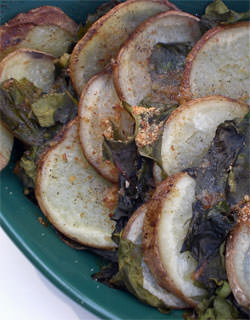
Vegetable Tian is great for using a lot of your veggies in one dish.

Right in the middle of National Eat Your Vegetables month comes Eat Your Vegetables Day on June 15—today! What will you do to celebrate? More importantly, how will we all eat the five servings of fruit and vegetables daily that we know we should? The new USDA Dinner Plate, which replaces the problematic Food Pyramid, leaves a nice big area of the plate for those veggies. And in June, there’s almost no excuse not to eat them.

Which vegetables did your parents have to push you to eat when you were growing up? When I think of the iceberg lettuce in our salads and the frozen green beans that alternated with canned peas, I’m surprised I like green things at all now. At home, I’d never eaten greens such as chard or kale. Beets, turnipskohlrabi and celeriac never crossed the family threshold. We did have lovely tomatoes and corn and the novelty item artichokes from time to time, but the supermarkets of the time, as well as my dad’s limited palate, meant very little variety. There was a world of vegetables to discover when I started feeding myself.

I can find it a challenge that requires some thinking to eat as many servings as I should. Two-thirds of a day’s meals may be over and I’ve consumed little that counts other than a tangerine and some chopped celery in my tuna-salad sandwich. I keep 11.5-ounce cans of 100 percent vegetable juice around to help; that’s two very low-calorie servings. Vegetable soup can make a couple of servings easy, too.

Another trick is to cook lots of vegetables at once so they simply need reheating. When they are all ready, I’m more likely to grab them out of the fridge. It’s also energy-efficient to cook them at the same time as other things. For example, roast some beets and leeks while your morning muffins are baking in the oven and eat the veggies later that night.

Teach yourself a few favorite, flexible, go-to recipes. Roasting in olive oil is a terrific and fast way to cook all root vegetables, squashes and potatoes. An aglio e olio (garlic and oil) sauté is a no-fuss dish and tasty for all leafy vegetables. Here’s another recipe I use a lot: the tian, a southern-French gratin without the cream that works with any combination if you adjust the cook time and liquid a little.

Recipe: Vegetable Tian

Ingredients

  • 1 medium onion, sliced 2 cloves garlic
  • 2 to 3 pounds vegetables, thinly sliced*
  • dried breadcrumbs
  • herbes de Provence or fresh herbs, chopped
  • olive oil
  • salt and pepper
  • stock, as needed
  • 1/2 cup Parmesan or Gruyere, grated or goat cheese, optional

Preparation

Sauté the onions and garlic in olive oil until they are soft. Strew them in an oiled gratin or baking dish. On top of this layer, overlap the sliced vegetables attractively in rows. You can also intersperse leafy vegetables like chard or spinach with firmer ones like potatoes. Douse them with a bit more olive oil. A juicy vegetable like summer squash will likely not need more liquid. Drier ones, such as carrots or potatoes, may need a 1/4 inch of water, stock or wine poured gently over them.

Keep the added liquid to a minimum; the idea is to let the vegetables cook one another with their own moisture. Sprinkle on the breadcrumbs, cheese (if using) herbs and seasoning. Cover well, but uncover 10 minutes before they’re fully tender to dry out the tian a little. Bake at 375 degrees Fahrenheit for 35 to 55 minutes.

Serves 4 to 6.

*Experiment, but eggplant, zucchini, tomatoes, potatoes and fennel are more or less traditional in the south of France.

Read more of The Hungry Locavore »

Categories
News

Intentional Flooding Overtakes Farmland

Floodwater
Courtesy FEMA/ Jace Anderson
Floodwater from the Birds Point levee is receding, but areas of rural Missouri are still affected.

In the words of country-music artist Luke Bryan, “rain is a good thing.” But what happens when that good thing becomes so counterproductive it destroys the livelihood of thousands and threatens wide-scale disaster cleanup efforts?

The unusual weather patterns of spring 2011 posed this dilemma to farmers, as record-setting amounts of rain fell on the Midwest and the South. In communities like Cairo, Ill., located where the Mississippi and Ohio Rivers merge, and New Orleans and Baton Rouge, La., the result was  swollen and flooded rivers.  

To combat overflowing rivers threatening to take out major U.S. cities, the Army Corps of Engineers decided to open several levees along the length of the Mississippi River and flood rural farmland instead. Farms in several states have been impacted by the floodwater, including Kentucky, Tennessee, Arkansas, Louisiana and Missouri. In Missouri alone, more than 100,000 acres of rich farmland have been consumed by water from the Birds Point levee breech.

Most of the farmland belongs to large-scale farmers, says Michael Aide, Southeast Missouri State University’s agriculture department chair, but he reports family farms, including those that have been in families for generations, have been affected, as well. 

Flooding has not occurred strictly from the levee breechings but also from heavy rains, Aide notes. In a sense, everyone has been affected, from small-scale farms and garden producers to horticulturists and individuals in the lawn-care business.

Much of the damaged farmland is used to raise traditional crops such as corn, soybeans, wheat and some cotton, but larger organic farms have been hit, as well, Aide says.

Flooded organic farms will likely not need to be re-certified after cleanup, Aide says. His concerns are the economic effects and the unusual problems the flooding has created for farms. The watershed could bring in seeds—both weeds and crops—to farms from other areas that take root in a new area, he explains.

“I have tomatoes growing in my corn,” he says.

Counties affected by the floodwaters could also see financial strain on other community resources, as money used for schools, roads, police and fire departments might be reallocated for disaster cleanup. The financial damage created by the flooding will reach into the millions, Aide says.

“Farming is a lifeblood,” he says. “It’s really sad.”

Intentional flooding is not a new idea. In the 1930s, Missouri opened up the Birds Point levee to avoid a similar disaster, and the Bonnet Carre levee New Orleans has been opened 10 times over the years for the same reason. Every year, intentional flooding is a possibility, Aide says.

These areas may still see more flooding this year.

“Everyone is scratching their heads,” Aide says of recent weather patterns. “It’s been a most unusual year.” Missouri has already gone from floods to 100-degree-F days.

There will be some relief for farmers thanks to Farm Service Agency loans, which assist farmers through such times of loss with the goal of preventing the farms from shutting down entirely.

“Even small operations could turn to FSA programs for disaster assistance, emergency loans to carry them through loss,” says James Patton, FSA executive director. 

FSA also offers crop insurance if policies were purchased before planting and the crop was already in the ground prior to the flooding.

Categories
Equipment

When a Company Goes Away

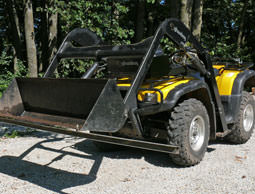
Groundhog loader
Photo by Jim Ruen
In the modern world, the Internet makes it easier to find information about pieces of equipment no longer in production.

It’s happened to all of us. We have a piece of equipment we like, and then one day, the company that produces it goes away. They close their doors and cut off the phones. There was a time when we were left holding the phone in frustration. Where were we going to get parts? What about service? And what were we going to do about that missing page in the manual—you know, the one that had the part that fell off sometime in the last week.

How much this has changed hit home today when I received an email from a stranger. He had purchased a used Groundhog (all hydraulic) loader for his ATV. The reason he contacted me was I’ve written several stories about using that piece of equipment on my ATV. He was missing a manual and some parts and wondered if I could help. Unfortunately, the Groundhog is no longer being made, and the company that made it has closed its doors.

In the old days, my new friend would have been out of luck if he didn’t personally know someone with a similar piece of equipment. In today’s world, that has all changed. For all I know, there’s a manual for the Groundhog for sale on eBay. Doing a quick search, I saw at least one loader for sale. If you Google “Groundhog loader,” you get 4,500 listings. 

So what happened to my friend? Well, I do have my manual, so I’ll do what I can to help him at least identify the parts he’s missing. Meanwhile, if anyone is interested in starting a business to make loaders for ATVs, let me know. There’s a neat design waiting to be revitalized and at least two of us out here who may need parts.

<< More Shop Talk >>

Categories
Animals

A Lamb is Born—Finally!

Ewe and lamb
Photo by Sue Weaver
Mom and Dad woke up this morning to find Ursula and her new lamb.

Ursula really fooled Mom this year! She still looked just like in the second picture of yesterday’s post when Mom and Dad went to bed last night. Mom checked Ursula at 1:00 a.m., but there were no changes and Ursula was calmly chewing cud. Then when Mom went out at 6:00 a.m., the lamb was already born!

Ursula’s lamb is a tiny, black girl with lots of white markings on her face. Mom named her Dixie Moon after a line in old song she likes (“Heart of the Night” by Poco). She’s cute. Ursula’s udder didn’t fill out a bunch until the lamb was already born and several hours old. So much for birthing signs in advance!

« More Mondays with Martok »

Categories
Urban Farming

Common Garden Pests

You’ve recently noticed the leaves on your cantaloupe have a strange trail on them and your plums have deep, dark holes. These are signs of a starving alien invader giving in to its needs on your fruits and vegetables. We all want to rid our gardens of these hungry mini beasts, but we don’t want to use poison to do it.

Watch the slide show of the eight most commonly spotted and easily recognized garden pests and then click on our Garden Pest Guide for a more comprehensive look at these insects. For more information, visit our guide on organic pest control.

Click here for our Garden Pest Guide for a more comprehensive look at these pests.

Categories
Urban Farming

The Photosynthetic Restaurant

Crocker Art Museum

Photo courtesy of Bruce Damonte

The world’s first restaurant for plants will be at the Crocker Art Museum in Sacramento.

The Crocker Art Museum in Sacramento, Calif., will open the world’s first photosynthetic restaurant this spring. Conceptual artist Jonathon Keats has developed a gourmet cuisine for flora by filtering and mixing different wavelengths of sunlight. Keats’ installation will be on view in the floral plantings in front of the historic Crocker from April 16 through July 17, 2011.

An experimental philosopher, Keats has a long history of encompassing other species in his installations. He has choreographed a ballet for honeybees by selectively planting flowers around their hives. He has also produced travel documentaries for houseplants by projecting videos of foreign skies onto their foliage in a darkened theater.

“What motivates me is curiosity. In the case of my photosynthetic restaurant, I wondered what it’s like to be human and to do peculiarly human things like savoring a good meal,” Keats explains. “Adapting a common human activity to the plant kingdom, without anthropomorphizing the plants, is a way to explore an aspect of human behavior that we otherwise take for granted.”

Keats’ efforts to share aspects of human culture with other species encourages us to scrutinize our own cultural values. He adds, “If this project succeeds, the plants at the Crocker will eat well, and the people who encounter them, myself included, will have a provocative conversation.”

Categories
Crops & Gardening

6 Steps to Stifle the Summer Growing Slump

Watermelon
Courtesy iStockphoto/Thinkstock
Provide water and added nutrition for your crops to help increase summer production.

Summer often brings some relief from the hard labor and aching backs of gardeners invested in planting vegetable crops. But the life of the hobby farmer rarely includes the luxury of complete rest. Vegetable gardens and crop fields require regular attention and upkeep. When the sun is high and the days are long, one thing is certain: Sweat is a standard byproduct of any successful garden.

By committing to these six gardening activities, you can increase your summer crop production and stifle the perils that a long, hot summer can pit against your garden.

1. Water
As a rule of thumb, your garden beds demand about 1 inch of water per week. Mother Nature doesn’t always provide that type of consistent hydration. A well-designed garden affords irrigation opportunities from a simple garden hose to complex irrigation systems.

There are two schools of thought when watering: light and frequent or heavy and occasional. A watering can works well for light, frequent watering. Soaker hoses, with higher water delivery rates, are the perfect solution for a heavy and weekly watering regime. Always avoid watering in the heat of the day because the water will evaporate more quickly and your plants could burn. Morning is best for watering, but evening will also work. 

2. Control Weeds
No matter how great a gardener you are, weeds will torment your garden bed. Undesirable plants rob valuable moisture and nutrients from your garden’s soil. Use plastic weed barriers, herbicides, tillage and the age-old practice of weeding to help control those photosynthetic villains.

3. Control Pests
Whether they don fur, feathers or a hard exoskeleton, hungry critters are out there, ready to nibble on your precious garden crops. Garden pests love succulent newly growing stems or the juiciness of a ripening fruit or vegetable. Vigilance is the key to protecting your garden crop, and invasions should be immediately remedied. Consider dusting your vegetables with basic farmer’s lime to deter insect pests or blood meal to keep furry foragers at bay.

4. Feed Plants
Pay close attention to the color and growth of your crops—these will show the signs of your crops nutrient density. An in-season application of fertilizer may be just the ticket to turn a weak crop into a bumper one.

To avoid “burning” your plants, use an organic fertilizer or a liquid fertilizer, like Miracle-Gro.  Some great organic fertilizers to consider are fish emulsion (except for use on salad crops) or blood meal. Consider “brewing” your own compost tea by soaking compost or manure in a burlap bag in a barrel. Apply the liquid fertilizer or compost tea once during a seven- to 14-day period, and repeat as needed. Other organic fertilizers, like fish emulsion or bone meal, can be applied once and are slowly released in the soil.      

5. Harvest Crops
Yup, the more you pick the more your crops are likely to give. Lackadaisical gardeners not only miss vegetables for table, but minimize the total amount of crop the garden will produce.

Learn your crops and how they respond to harvest. Pole beans will respond favorably to frequent harvest, but cucumbers, for example, will yield varying volumes based on size of the cucumber being harvested. (A lot of picklers can be produced or a few larger cucumbers.) Perennials, like asparagus, can be over-harvested, minimizing future harvest or killing the plant.

Pay attention to seed-packet information for the crops you’re growing. It’s also worthwhile to stop by the library and check out some high-yield-gardening books. Take notes and save yourself money on buying literature! 

6. Mulch Garden Beds
As your crops grow and become well-established, consider a mulching regime to assist in many of the areas discussed above. Mulch preserves moisture, controls weeds and adds valuable organic matter to your soil. Chopped leaves, grass clippings and sawdust can be used as mulch and save you time in garden maintenance, but be advised that decomposition of mulch may impact your garden’s nitrogen supply. Perform regular soil tests to keep tabs on your soil quality over time.

Don’t let the dog days of summer stifle your garden investment, put in the time and effort and beat the summer slump. You can rest when there’s snow on the ground and your pantry is full.

About the Author: John Morgan owns a hobby farm in central Kentucky, where he raises a garden with his family.  He’s a certified wildlife biologist with degrees from Penn State and the University of Georgia. 

Categories
Animals

No Lamb!

Friday was the day Ursula the ewe was supposed to have her lamb. But she wasn’t ready, so Mom and Dad were scratching their heads. “Is she pregnant—or just fat?” they asked.

See, it takes 138 to 159 days for a ewe to make lambs, but most are born around 147 days after the ewe is bred; Ursula’s lambs have always been born on day 147 or one or two days before or after that. But you can tell when a ewe is going to lamb (or a doe is going to kid or a mare is going to foal) by the way she looks and acts, and Ursula isn’t doing it this time.

With sheep and goats, first-time mom’s udders begin to expand up to three weeks before lambing, but they won’t fully fill until a week or so before they lamb. The udders of veteran ewes, like Ursula, fill with milk anywhere from a few weeks to a short time prior to delivering their lambs. Most ewe’s develop firm, fully filled, strutted udders a day or so before lambing. A strutted udder is so engorged with milk that it’s shiny, and the teats are round and stick out a little to the sides.

The hairless area around a ewe’s or doe’s vulva bulges out a bit during the last month of pregnancy. About 24 hours before lambing or kidding, the bulge diminishes and the vulva becomes longer, puffier and very loose. If the ewe or doe has pink skin, her udder and vulva turn a much deeper pink.

Release of a hormone called relaxin causes structures in a ewe or doe’s hindquarters to soften as birthing approaches. Her rump becomes steeper, both from hips to tail and viewed from side to side. The area along the spine seems to sink and her tail head rises.

Ursula isn’t doing any of that. She’s very round, but Ursula is always fat. And her udder hangs down, but it’s still floppy. She’s had lots of lambs, so it could just be stretched out of shape.

But remember when I talked about our rumens? Our rumens are huge and take up most of the left side of our abdominal cavities, so when we lie down, we stick out to that side. When Ursula lies down, she sticks out on both sides, with a great, huge lump on the right. That should be her lamb. But is it?

I’ll post an update every day until next week’s column or she lambs, whichever comes first. In the meanwhile, look at the pictures below and see if you can tell. Is she pregnant or isn’t she? Post your comments. We want to know!

Pregnant ewe?
Photos by Sue Weaver
Compare how pregnant Ursula looked last year just hours before she lambed (left) to how she looks this morning (right). Do you think she’s pregnant or just fat?

P.S. Mopple the sheep-geep is blogging at MyFarm! He calls his blog Mopple’s Place. He says he’s going to blog about daily happenings at our farm. Maybe you’d like to check it out?

« More Mondays with Martok »