Categories
Urban Farming

Urban Farmers Fight Legal Hurdles

Courtesy Hemera/Thinkstock

In attempts to grow foods locally, some urban farmers have violated local laws.

While aphids are raiding gardens for a taste of the tomatoes, city officials are conducting raids of their own, handing out fines to urban farmers for breaking the law. Yep, growing tomatoes—or any food crops—is illegal in some municipalities.

Certain cities require permits to grow food while others limit the amount of fresh fruits and veggies that can be grown on residential lots. Sound crazy? These urban farmers think so, too.

Novella Carpenter: Oakland, Calif.

Urban farming icon Novella Carpenter was targeted for breaking the law. Her crime: selling Swiss chard from her 4,500-square-foot garden in Oakland, Calif.

According to city officials who visited Carpenter’s Ghost Town Farm in March 2011, Carpenter needed a conditional-use permit to grow food and raise livestock on her Oakland farm and a business license to sell produce. The cost: $2,500 for the permit and $40 for the business license.

On her blog, Carpenter writes, “City of Oakland: You are playing with people’s lives … I might have to get rid of my animals. All because one guy came to my house, took photos and decided that I wasn’t in compliance with some confusing code.”

Oakland enacted new zoning laws, including laws pertaining to urban agriculture, in April 2011. Under phase one of the new law, urban farmers growing fruits and veggies on vacant lots do not need permits; livestock, including the chickens, ducks, rabbits and goats that Carpenter keeps on her farm, do require conditional-use permits.

Carpenter says she plans to apply for a permit. In the meantime, she has suspended operations of her farm stand.

Steve Miller: Clarkston, Ga.

Steve Miller had no idea he was breaking the law by growing broccoli and cabbage on his 2-acre homestead outside of Atlanta.

In January 2010, code enforcement officials informed Miller of strict legal limits on the number of vegetables that could be grown in residential areas; the amount of produce that Miller was growing exceeded those limits.

“As agriculture comes back into urban areas, we are dealing with old laws on the books,” Alice Rolls, director of Georgia Organics, told southwestern Georgia’s WALB News.

Intent on following the law, Miller, who shares his bounty with neighbors and has a produce stand at the local farmers’ market, put his garden on hiatus last summer to have his property rezoned. The charges were put on hold while his application for rezoning was pending. Although he received approval for rezoning, Miller continues fighting with authorities.

In a legal tangle neighbors have dubbed Cabbage Gate, Miller is being sued by Dekalb County for $5,000. The county is intent on prosecuting Miller for the earlier charges because he was in violation of the ordinance before his lot was rezoned. Miller estimates he’ll spend $27,000 fighting the charges.

Dirk Becker and Nicole Shaw: Lantzville, British Columbia

Dirk Becker and Nicole Shaw can fill their 2½-acre lot with squash, potatoes and garlic—as long as the couple eats all of the veggies themselves. Selling their produce violates local laws.

The couple started Compassion Farm at their home in Lantzville, British Columbia, Canada, in 2006. Every week, they sell truckloads of their homegrown produce at the Bowen Road Farmers’ Market, a local market that the couple started for the community.

A commitment to providing organic, local produce got Becker and Shaw in trouble with the authorities. In November 2010, the couple was given a 180-day warning to cease operations on their urban farm because it violated a local bylaw. According to local zoning laws, home-based businesses do not include agriculture, and that means growing food for sale is against the law in Lantzville.

“These bylaws are quite typical in communities all across the country,” Becker told the Nanaimo Daily News.“It’s time for governments to catch up to Canadians who want to grow more food themselves.”

Becker, Shaw and other supporters of urban agriculture pressured the Lantzville City Council to amend the bylaws and had some success. In March 2011, the council agreed to issue temporary permits to residents who want to engage in activities, like urban farming, that fall outside zoning regulations; permits cost $1,150 CAD and are good for three years.

Categories
Beekeeping Crops & Gardening

Backyard Bees

Backyard bees
Photo by Jessica Walliser
My gardener friend is keeping backyard bees and has inspired me to do it myself one day.

I visited a friend’s house today for a little garden tour and a lunch date. I love to see other people’s gardens and find out what they have going on.

I feel good about checking out a friend’s garden when we grow on or about the same level—meaning that neither of us cares too much about too many weeds or about the lawn not being mowed or about a long list of things that need to be done. I have a harder time visiting the garden of a friend (or a stranger) whose garden always looks perfect. It’s kind of depressing knowing that your place will never look as good, or worse still, always wondering what they are thinking when they drop by your place and see all the dandelions in full bloom. My friend certainly has his share of weeds; me too.

One thing he had in his garden that was pretty exciting was a bee hive.  A community organization in Pittsburgh called Burgh Bees set up his hive and maintains it, eventually teaching him how and turning over the reigns after a few years. Watching all those bees busy at work on a sunny day was pretty cool. The funny thing is that I didn’t even notice it in the corner of his veggie garden until after he pointed it out. Someday maybe he’ll teach me how and my husband and I can have a hive of our own, too.

In the meantime, work has halted on our backyard renovation due to the massive amounts of rain we’ve experienced in the past few weeks. I guess it’s hard to grade and install a French drain when the ground is completely saturated. We’re crossing our fingers for a drier week so they can get the skid steer in here and gussy it up for us.  In the meantime the yard’s a mud pit.

« More Dirt on Gardening »

Categories
Urban Farming

Blank Slate

Homemade pizza

Photo by Charles Diaz

We enjoyed our homemade pizza “on the rocks” during a hike.

No wonder there’s been so much written about pizza: how to grill it, wood or coal-fire it; how to make it at home; how to do the cheese, the crust and so on. It’s understandable because pizza really is the greatest blank slate for your creativity. It flexes for the simple or the elaborate, the classic or regional. (But come on, pineapple and ham? Tuna and egg?) And you can make a very nice pizza both from scratch and from the refrigerator case.

The two challenges I’ve had making pizza at home are a) how to make it really thin and b) how to simulate the super-hot pizza oven. A friend described it this way:

“Pizza dough has a memory. You have to make it forget it was once fat.”

Pizza Crust

To make a thin-crusted pizza pie entails bringing the dough to room temp, stretching it on a greased surface (sprinkled with cornmeal, too, if you like) and then letting it rest. Then repeat: Stretch and rest three times, until the dough gets the picture and lets go of its sproingy need to retract into fat edges.

To get the crust really crisp, crank up the oven as high as it goes. (Turn off your smoke alarm first!) Prick the stretched-out dough, and prebake for 10 minutes. Then turn the oven down to 400 degrees F, cool the crust slightly, and add the sauce, fillings and cheese. Bake again for 15 to 25 minutes. You may not get the authentic burnt edges, but at least the middle of the pizza won’t be soggy.

Or try grilling your blank slate. Brush it with olive oil; lay it on the hot barbecue for five to seven minutes on one side. Turn it over and slide it onto a big plate where you can deftly spread on the sauce and the toppings. Then slide the pizza back on the grill, close the grill top and cook for three minutes more, until the cheese melts. Oh boy!

Pizza Sauce

For the sauce, I’m a purist. A few quick spoonfuls of crushed tomatoes with salt and pepper. No cooked or jarred sauce necessary. My friend mixes in some tomato paste to thicken it, but I don’t mind a thin pizza sauce. In fact, omit sauce completely if your toppings clash with tomato. In season, sliced, fresh tomatoes can be enough.

Pizza Cheese

As for cheese, I confess that I’m not a huge mozzarella fan. I find it bland. Still, slices of whole-milk or buffalo mozzarella on top of the fresh, sliced tomatoes that I suggested above, are pretty yummy in the summer. I like feta, Asiago, good grated Parmesan, goat cheese or Gorgonzola a lot more.

Pizza Toppings

What goes in between, over the sauce under the cheese? The better question is: What doesn’t? Here’s where any locavore can knock herself out.

During the winter, you must settle for pantry pizzas: capers, sun-dried tomatoes, anchovies, onions and olives. Fall brings roasted winter squash (like acorn squash or butternut squash) with caramelized shallots or thinly sliced potato with rosemary and Parmesan. Wonderful.

Right now, I’m thinking spinach and Swiss chard; I don’t even need to sauté the moist leaves. I just layer them on the prebaked pizza dough and let the natural moisture and the cheese wilt them. Ditto a fines herbes pizza draped with prosciutto and topped with Asiago or Fontina.

For an arugula pizza, bake the dough at 400 for 20 to 25 minutes with just sauce; then throw the fresh arugula and finely crumbled goat cheese on afterwards and bake no further.

How about the green-peppers-still-in-the-freezer pizza? The slathered-with-last-year’s-pesto pizza, with or without tomato sauce mixed in? Any ratatouille still knocking around your freezer? Just drain it a bit. This is just the beginning: The same obedient dough will welcome sautéed eggplant and zucchini, roasted beets, red pepper rings, slices of grilled sausage or chicken, and more.

Read more of The Hungry Locavore »

Categories
Equipment

A Tool is a Tool, Except …

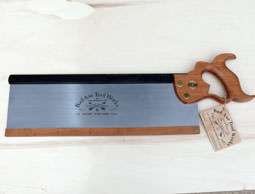
Tenon saw
Photo by Jim Ruen
This tenon saw may be impractical, but it’s the sharpest saw on my workbench at the moment.

Last week, I picked up my handmade 16-inch, 12 ppi, hybrid-cut cherry handle tenon saw. Mark Harrell, owner of Bad Axe Tools and saw maker extraordinaire, handed it to me and set up a wood scrap so I could try cutting a tenon.

I froze. I was totally inhibited by this tool. I made a few preemptory swipes with it, remarked what a beauty it was and felt like a total imposter. What was I doing? I am a rough-cut tool guy, not a fine-cabinet maker or post-and-beam builder! I nail and screw and glue things together. I don’t do mortise and tenons.

I took it home and set it on my workbench. I may keep it … or not. Either way, it has served a purpose. It reminds me why I am most comfortable with simple tools that fit my needs.  A lot of my old tools are just that: old tools. They are slightly beat up, whether I bought them new or used, but like an old shoe, they feel comfortable.

I know I will buy other new tools, like the sabre saw I recently picked up, but they will be tools I need at the time. I will also buy other old tools, like the block plane, broadaxe and a few other things I picked up at antique/used stuff stores I visited this past weekend. Again, for the most part they will be things that I see a purpose in and know I will use.

I’ll probably keep my tenon saw with its cherry handle. Someday I may even try making a tenon. In the meantime, I’ll use it as needed. After all, it’s the sharpest saw on the bench, and it does handle nicely!

<< More Shop Talk >>

Categories
News

Pesticides Linked to Bee Deaths

Pesticide residue found in beeswax has been shown to shorten lifespans and hinder development in bees
Courtesy John Foxx/Stockbyte/Thinkstock
A study at Washington State University found that pesticide residue delayed bees’ larval development and shortened bees’ lifespans.

New research is the first to demonstrate the sublethal effects of pesticide-residue exposure on an insect largely responsible for a third of the human diet.

Judy Wu, a former entomology graduate student at Washington State University and current PhD student at the University of Minnesota, found that low levels of pesticides build up in Honey bee brood comb wax and cause serious consequences for developing worker bees and adult worker bees’ lifespans. The brood comb is the breeding quarters of a hive and the place where food is stored.

Bees are economically critical because of their pollination services, so colony health is a high priority in entomological research. While honey is also valuable, it doesn’t compare to the contribution bees make as pollinators.

The pesticides involved in Wu’s study include those used by beekeepers, growers and homeowners, including miticides, insecticides, fungicides and herbicides. The accumulation occurs because beekeepers reuse their combs to save on the expense of replacement.

Wu surmises that the pesticide residue contamination in the brood comb and its effects may be a potential contributing factor to losses associated with colony collapse disorder, a term coined in 2007 to describe the mysterious phenomenon that results in the disappearance of worker bees from hives. In recent years, the number of hives that beekeepers think should be healthy but are not has significantly increased.

Steve Sheppard, chair of the Department of Entomology at WSU and a widely respected authority on bees, says that CCD has a lot of possible causes. However, he’s confident that while sublethal pesticide effects alone do not explain the disorder, Wu’s research shows that low levels of pesticide accumulation cause abnormal Honey-bee development.

Some of the consequences to Honey bees that Wu found were delayed larval development and a shortened adult lifespan, which can indirectly result in premature shifts in hive roles and foraging activity.

If a bee’s life span is shortened, it dramatically changes the dynamic of a hive. According to Sheppard, foragers are the bees that provide pollination and bring food back to a hive.

“A bee’s life span as a forager is on average only the last eight days of its life,” he says. “This research shows that if raised with pesticide residues in the brood comb, an individual’s foraging life span is shortened by four days, a 50-percent cut.”

If there’s not a sufficient number of foragers in the colony, the colony makes up the deficit by using younger bees that are not physiologically ready. The result is a negative cascade effect on the entire hive all the way down to the larval bees because individual nurse bees must prematurely move toward foraging behavior and stop feeding larvae, Sheppard says.

In addition, according to Wu’s study, longer development time for bees may provide a reproductive advantage for Varroa destructor mites. Varroa mites are parasites that live in hives and prey on Honey bees. The extended bee developmental period enables these mites to produce more offspring that devastate hives.

Categories
News Urban Farming

Bulbs to Receive Energy Star Label

Energy-efficient light bulb

Courtesy Jeffrey Hamilton/Digital Vision/Thinkstock

Light bulbs carrying the Energy Star label will be 30 percent more energy efficient starting in October 2011.

The U.S. Environmental Protection Agency recently updated its standards for light fixtures to qualify for the Energy Star label. To qualify for the Energy Star label, light fixtures will need to increase energy efficiency 30 percent above currently qualified fluorescent-based fixtures. The standard will go into effect October 1, 2011, and in 2013, performance requirements will increase further, providing 40-percent higher energy efficiency compared to currently qualified models.

Light fixtures that earn the Energy Star label save consumers money on their energy bills and reduce the costs and hassle associated with bulb replacement. The bulbs in Energy Star qualified fixtures last at least 10 times longer than standard light bulbs. The fixtures will continue to meet other strict performance requirements that ensure quick start-up and high-quality light output, as well as reduced toxics in the fixture materials. Additionally, the fixtures will come with a 3-year warranty, which is above the industry practice.

Consumers can expect to see a range of technology options qualifying under the new Energy Star requirements—including fluorescent and LED lighting—each held to the same standard. In order to earn the Energy Star label under the new requirements, product performance must be certified by an EPA-recognized third-party, based on testing in an EPA-recognized laboratory. In addition, manufacturers of the products must participate in verification testing programs run by recognized certification bodies.

Energy Star was started by EPA in 1992 as a market-based partnership to reduce greenhouse-gas emissions through energy efficiency. Today, the Energy Star label can be found on more than 60 different kinds of products as well as new homes and commercial and industrial buildings that meet strict energy-efficiency specifications set by EPA. Last year alone, Americans, with the help of Energy Star, saved $18 billion on their energy bills while reducing greenhouse-gas emissions equivalent to 33 million vehicles.

Categories
Animals

The Rains Came

The rain has wreaked havoc on animals and living spaces alike
Photo by Sue Weaver
The rain we’ve had on our farm have caused problems for our sheep and other animals.

Everything is muck and mire on our farm. According to our rain gauge, 13 inches of rain fell in just four days! Uzzi and I huddled in our Port-a-Hut while storm after storm roared by. Uzzi hates thunder, so he was scared.

Now, it’s over, but oh, the mud! Our pens and paddocks are a quagmire. Uzzi and I lounge on top of our Port-a-Hut to get away from it (Dad made us a cool ramp up to the top), but the sheep are living in the yard.

The sheep’s night fold is a mass of soggy, waste hay (sheep are messy eaters) and inches and inches of squishy mud. This way they can sleep on grass. Sam the Lamb came to see us yesterday morning with rain dripping off of his fleece. Uzzi asked him, “Hey, Sam, aren’t you afraid your wool will shrink?” That’s goat humor. (Sam didn’t laugh).

Tumnus, Big Mama and Shebaa the ewe are limping today. Mom thinks they’re getting foot scald, a problem when cloven-hoofed animals stand in mire. It’s caused by an anaerobic bacterium called Fusobacterium necrophorum present in most soil; anaerobic means they die when exposed to oxygen—but they love thick mud. Fusobacterium necrophorum is half of a combination of bacteria that cause a nasty disease called foot rot; the other is Bacteroides nodosus, but we don’t have that on our farm. Foot scald is a milder infection of the skin between the two claws on a cloven-footed animal’s hoof. The skin gets pink to white in color, moist and raw. It’s painful and it makes us limp, but unlike hoof rot, it doesn’t deform and destroy our hooves.

Solid-hoofed animals, such as horses and donkeys, get foot problems from standing in muck, too. One disease is called thrush.

And all of us, from horses to the sheep to Carlotta the pig, are prone to a mud-related disease of the skin called dermatophilosis because the agent that causes it is in the soil on our farm. Dermatophilosis, also called Mycotic dermatitis, is caused when a bacterium, Dermatophilus congolensis, invades teensy abrasions in skin softened by prolonged exposure to rain. When it occurs on an animal’s body, people call it rain rot, rain scald or lumpy wool (on sheep). It’s usually found on an animal’s back and neck, but in bad cases, it spreads all over the body. Sometimes it occurs only on legs, especially legs with white markings, and then it’s called scratches or grease heel. It causes scaly, itchy, scabby skin that lifts off in crusty patches. Ouch!).

« More Mondays with Martok »

Categories
Urban Farming

Spring Fever

Roosters

Photo by Audrey Pavia

My roosters Mr. Mabel and Mr. Molly get along great—until springtime.

The flowers are all blooming on my property: huge pink and white blooms on my cactus, purple and yellow starburst on the native plants around the yard. But the most evident sign of spring for me is the behavior of my roosters, Mr. Molly and Mr. Mabel.

Brothers hatched from the same clutch, these two guys usually get along really well. Mr. Mabel is the dominant roo, and it’s not surprising. He is bossy, loud and very opinionated. Mr. Molly, on the other hand, is sweet and laid back. He seems happy to fade into the background while Mr. Mabel runs the show. That is, until spring comes.            

The trouble usually starts around March, when the hens start laying eggs again after a winter break. Mr. Molly, who usually just wanders around with the flock like one of the hens (except for his morning shuffle dances and clucks when he finds something good to eat), begins to get amorous. He starts paying more attention to the hens until finally, one day, he tries to mate with one of them.

This is when Mr. Mabel kicks into high gear. If he sees the indiscretion, he runs at Mr. Molly and the adulterous hen and chases his brother all around the yard. If Mr. Molly retreats, all turns out well in the end. Mr. Mabel, satisfied with the chase, stops and walks away, confident that he has made is clear that mating with the hens is his privilege only.         

The trouble starts when Mr. Molly refuses to back down. 

This happens every year. So far, it hasn’t happened yet, but I’m waiting.            

When Mr. Molly decides to “flip the bird” at Mr. Mabel, things can get ugly. The two brothers start fighting, just like roosters do in movies that feature cockfighting. They peck and claw at each other with such violence, blood quickly begins to flow.

The only way I’ve found I can break up one of these fights is to turn the hose on them. When both roosters are completely soaked with water, they stop fighting. If the battle wasn’t decided, it’s only a matter of time before it starts up again. In the end, I’ve found that I just have to let them work it out, hoping neither one gets seriously hurt.           

It’s the beginning of May now, and so far, the two are getting along. I did see Mr. Molly sneak one in the other day with one of the Jos. Mr. Mabel saw it and chased him off. Mr. Molly retreated, as he should. I can only hope his cowardice continues.

Read more of City Stock »

Categories
News

Farming Film Contest

Farmer
Courtesy Digital Vision/Digital Vision/
Thinkstock
The Alltech Farming Film Festival will celebrate farmers that have met tough challenges in their farming careers.

Alltech, a leading company in the animal health and nutrition industry, is launching the first Farming Film Festival, giving budding videographers the chance to tell a farmer’s game-changing story. The film festival will be held in conjunction with Alltech’s 27th Annual International Animal Health and Nutrition Symposium, held May 22 to 25, 2011, in Lexington, Ky.

Following the theme of the symposium, The Game Changers, farmers and agricultural enthusiasts can submit videos that focus on an idea or technology that helps farmers meet the tough challenges in their careers.

“Emerging new media, such as YouTube and other social-media outlets, have been game changers for many in the agriculture industry,” says Pearse Lyons, PhD, president and founder of Alltech. “Sharing these game-changing stories with others ignites a new wave of hope and innovation, and that’s what we hope to do with the Farming Film Festival.”

Participants in the Farming Film Festival may enter by uploading their videos to YouTube and emailing the link to contest@alltech.com. Winners will be chosen by a panel of science and agricultural journalists based on creativity, quality of video, story interest and number of views and will be awarded up to $2,000 cash. The deadline for submission is May 13. For the official rules and information about how to participate, visit Alltech’s contest website.

Alltech’s 2011 International Animal Health and Nutrition Symposium will provide animal-health professionals opportunities to attend specialized breakout sessions on topics such as aquaculture, beef, dairy, equine, poultry, pig production, traceability and communication in agriculture. All sessions will be dedicated to the open discussion of creative game-changing strategies for revolutionizing industry practices and thus redefining its future. Finalists’ videos will be shown at a film screening during the symposium and will be available to view online.

Categories
Urban Farming

Dirt Work

Garden bed soil

Photo by Rick Gush

I use this log in my lettuce bed to break up the soil.

It’s early spring, and that means that I’m spending a lot of time preparing the soil in the garden beds prior to planting. I like working with the dirt, breaking up the clods and getting rid of all the weeds. The sight of a freshly prepared bed is almost as exciting to me as the later view, when the plants are bearing fruit. Things don’t always grow perfectly, but there’s something perfect about a newly prepared bed that triggers the imagination to envision rows of lush and perfectly growing plants.

In most of my beds I still need to run the soil through a soil sifter to break it up, remove rocks and add organic material, such as dried manure or compost.

I use a 1/2-inch metal screen for most work, digging the soil out of the garden bed and running it through the screen. I also add the amendments through the screen to more fully break it up. After each few shovelfuls through the screen, I scoop out the rocks left behind in the screen. Over the course of several years using this admittedly arduous practice, I can really clean and invigorate the soil in a garden bed. Plus, the removed rocks make a swell pathway material.

For garden beds into which I’ll be seeding directly, I use a 1/4-inch screen. This gives a really finely pulverized soil mix that I can adjust to be quite rich in organic matter. I scoop out a trough where I’m going to plant, run that soil through the screen and refill the trench with the fluffy mix. I also use the quarter-inch screen to make potting soil.

Most of the soil in my garden is really young — a mix of recently eroded minerals that clump together in a sticky mass when wet and harden into brick-like clods when dry. It’s amazing what good potting soil I can make by running soil through the screen and adding organic materials.

Obviously, my soil sifters are some of my favorite tools. But I have a few garden beds that I’ve already worked to the point that they have few rocks and a high organic material. I grow the slightly more demanding things like lettucebasil and arugula in these mature beds.

Still, the soil in these garden beds has to be worked each time before planting. In these beds I don’t need to use the energy-consuming screens. Instead, I use a pounding log. I use a trowel or little shovel the break up the soil, then I take the clumps of dirt and smash them on the firewood log I’ve put in the bed. The solid surface of the log makes it really easy to break up the clods, and the bigger pieces fall away together where they can be picked up and smashed again. The log is a humble tool, but it lets me prepare the lettuce bed in much less time than any other method I’ve tried.

Read more of Rick’s Favorite Crops »