Categories
Animals

Cheviot Dolls

Cheviot Doll sheep
Photo by Sue Weaver
Chrysanthemum, a Cheviot Doll sheep, was cute as a lamb.

Have you ever heard of Cheviot Dolls? They’re half Babydoll Southdown and half Miniature Cheviot or Classic Cheviot. We’re going to get one!

Mom wrote an article about Babydoll Southdowns for the May/June 2007 issue Hobby Farms. At the same time, her friend Rebecca and Danielle Russell of Glenwood, Iowa, were raising two Babydoll Southdown ewe lambs. Rebecca’s ram is a handsome black Classic Cheviot ram named Woolson who came from our little flock, so when the Babydoll lambs, Lily and Tutu, got old enough, Woolson got to be their boyfriend. Voilà, Cheviot Doll lambs! Rebecca sold her first lambs, Chrysanthemum, Jazzmyn and Thorn to Abby Glann of Sugar Creek Farm in Swan, Iowa. Now she’s raises Cheviot Dolls, too.

If you didn’t read Mom’s Babydoll Southdown article, “Oh Baby!,” you can order a digital copy. Otherwise, here are a few things to know about Babydoll Southdown sheep:

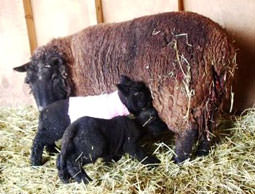
Cheviot Doll lambs
Photo by Sue Weaver
This year, Chrysanthemum had lambs of her own.

Babydoll Southdowns are the same size and build as the original British Southdown sheep developed around 1780 by John Ellman of Glynde of Sussex, England. Southdowns are one of the oldest of the Down breeds. (Those are meat breeds that originated in the chalk downs of southern England.) However, after World War II, consumers wanted larger cuts of meat, so the original small Southdowns were crossed with larger New Zealand Southdowns to produce today’s bigger, longer-legged, Southdown sheep.

Olde English Babydoll Southdown Registry founder, Robert Mock, began searching for old-type Southdowns in 1990. He renamed them Olde English Babydoll Southdowns (Babydolls) so people wouldn’t confuse them with today’s commercial Southdowns. Unlike their ancestors, Babydoll Southdowns aren’t raised for meat. They’re sweet and gentle, so they’re mostly kept for pets. And, handspinners love their short, soft wool in white, shades of black and even spotted. Babydoll Southdowns are carpeted with wool from head to toes with only their ears and noses sticking out. And they always look like they’re smiling. They’re so cute!

Cheviot Dolls are a nice compromise between Babydoll Southdowns and Miniature or Classic Cheviot sheep. Cheviot Dolls have longer, springier fleece than Babydoll Southdowns and less wool on their faces and legs. That can be a good thing because sometimes, Babydoll Southdowns get “wool blind” when they have so much wool they can’t see out; then you have to “wig” them by trimming the wool around their eyes.

And Rebecca’s giving Mom a Cheviot Doll ewe lamb! There are two to choose from, but Mom and Rebecca haven’t decided which one will be ours. Maybe we will raise Cheviot Dolls in the future? When I find out, I’ll let you know!

« More Mondays with Martok »

Categories
Urban Farming

Diminish Spring Garden Stress

Pepper plant

Courtesy Hemera Technologies/AbleStock.com/
Thinkstock

When choosing plants this spring, try to find disease-resistant varieties in order to reduce garden-related stress.

Starting a garden in the spring can bring loads of rewards throughout the gardening season, but can be intimidating for the urban dweller without loads of experience under his belt. Along with the fruits of labor come battles with rain, drought, disease and pests.

As National Garden Week (April 10 to 16) wraps up, use these tips from Ron Wolford, horticulturist with the University of Illinois Cooperative Extension, to enjoy your gardening efforts and keep stress to a minimum.

1. Improve your soil.

“The foundation of your garden is your soil,” Wolford says. “Loose, fertile, well-drained soil will make your gardening experience a good one.”

When starting a new garden plot, have your soil tested. Many cooperative extensions have soil test labs, and if not, they may be able to refer you to lab in your area. A basic soil test costs $15 to $20 and will tell you if you need to improve the nutrient levels of your soil.

If you live in an area with heavy clay soils, add a 2- to 4-inch layer of organic matter, and till it into your garden 6 to 8 inches deep. Continue to test your soil every three to five years.

2. Choose a good garden location.

Choose a site for your garden as far away from trees and shrubs as possible to avoid competition from their root systems for water and nutrients. Select a site close to a water source and with adequate sunlight. Most vegetables and flowers need six to eight hours of full sunlight for best growth.

3. Water your garden properly.

“Vegetables and flowers need at least 1 inch of water per week,” Wolford says. “Buy a rain gauge to check rainfall amounts in the garden. Water the soil to a depth of at least 6 to 8 inches.”

For best results, water the base of the plant. Wetting the foliage can invite disease. Use soaker hoses instead of overhead sprinklers for watering, but if you must use overhead sprinklers, try to water early enough in the day to allow plants to dry before nightfall. Avoid watering during the hottest part of the day, though, as you are apt to lose up to 50 percent of the moisture during this time.

4. Buy disease-resistant plant varieties.

This is the best way to control disease, Wolford says. Verticillium and fusarium wilt are two major diseases that attack tomatoes.

“Tomato varieties like Celebrity and Better Boy have a built-in resistance to these diseases,” he says. “Some annuals and perennials have a built-in resistance to powdery mildew.”

Also avoid working in the garden when plants are wet because diseases thrive in wet conditions. Proper spacing of plants will allow good air circulation around plants, allowing them to dry quickly after watering or rain.

5. Control pests with integrated-pest-management techniques.

“Try to avoid using insecticides in the garden,” Wolford says. “If you must use them, use only as needed. Some insecticides will kill bees. Bees are needed for pollination in order for fruit production to occur. Identify the insect before you use insecticides or any alternative treatment.”

Many cooperative extension offices will help with pest identification. Monitor your garden on a daily basis for pests, as they can increase rapidly. Don’t forget to check under the leaves. To avoid future pest problems, clean up your garden at the end of the growing season. Many pests will overwinter in debris left in the garden.

6. Start a compost pile.

Composting helps improve the soil fertility; saves water by retaining moisture in the soil and reducing water runoff; and makes use of organic waste, reducing air and water pollution from refuse trucks and runoff and extending the life of our landfills.

“Composting is nature’s way of recycling and is the key to healthy soil and a healthy environment,” Wolford says. “It is a satisfying way to turn your fruit, vegetable and yard trimmings into a dark, crumbly, sweet-smelling soil conditioner, and it saves you money by replacing store-bought soil conditioners.”

Check with your local municipality about any composting regulations before starting a composting project.

7. Use mulches.

“Mulches conserve moisture, prevent weed growth and help to maintain even soil temperatures,”
Wolford says.

During the growing season, spread a 2- to 4-inch layer of organic mulch around plants after the soil has warmed up in the spring. Be prepared to replenish the mulch during the growing season, as it will gradually decompose. Organic mulches can be turned into the soil at the end of the growing season.

Plastic mulch can be used for warm-loving plants like tomato, pepper, pumpkin, cucumber and sweet potato. Soil temperatures under black plastic mulch will be 10 degrees F higher than bare soil. Organic mulches applied around perennials in late fall after the ground has frozen will help to prevent freezing and thawing, which can expose roots to cold temperatures.

8. Do garden research.

Get to know your plants before using hard-earned dollars to purchase them. Checking out the growing requirements and potential insect and disease problems of plants before you purchase them can save you a lot of headaches. Use your local library, cooperative extension and the Internet as resources for gardening information.

9. Learn from gardening challenges.

Keep in mind that all gardens have challenges. Running into them doesn’t make you a gardening failure—the key is to learn from the challenges and to persevere in the garden.

Among his gardening challenges over the years, Wolford started a 1,000-square-foot garden at the Cook County Jail near Chicago in 1991. That July brought a 9-inch rainfall, flooding the garden.

“People were swimming in low spots on the Dan Ryan Expressway,” he recalls. “Many people were skeptical that the garden would survive. We replanted and had a small harvest. Today, we will be starting our 19th year at the Cook County Jail garden, which has recently added a greenhouse and now grows vegetables on 15,000 square feet of land.”

Categories
Urban Farming

Wisteria Frenzy

Wisteria

Photo by Rick Gush

The cascading purple wisteria reigns here in Italy.

It’s full-blown spring now in Italy, and things are blooming like crazy. I helped my friend use a weed eater on his olive groves this week, and though I cut down a lot of grass, I mostly mowed down fields of full blooming ajuga and dandelions. 

Back when I was a wholesale nursery salesman, I sold hundreds of flats of ajuga some weeks because it’s a great low groundcover for semi-shady areas. Here in Liguria, ajuga grows wild and very well. The blue flower stalks are almost a foot tall and thrive among the nooks of the orchards.

In the sunnier locations several different types of dandelions mass themselves and produce so many flowers that in some spots, only yellow is visible. Now that I’m a dandelion eater (my wife uses it in delicious vegetable pies), I couldn’t help thinking about the food value of all that I was mowing down. But we’ve already got enough tender young dandelion leaves in our own garden, so I just kept cutting.

Among all the riot of blooms, there’s one queen that dominates this season—the wisteria vine. The purple wisteria variety is really popular here, and the landscape is dotted with hundreds of lushly blooming vines these days. 

Wisterias are pretty hardy and don’t usually get killed by the frosts every decade, so there are a lot of really old wisteria vines. One big vine at a local ex-monastery is known to have been planted before Napoleon came to rule Italy in the early 19th century. On the road to my friend’s house yesterday, I saw a very tall pine tree that was almost engulfed by a wisteria vine, making, in effect, a 60-foot-tall wisteria tree with a huge head full of hanging purple blooms. Some of my favorite wisterias are on the roadway fences of some of the big estates. Wisteria blooms cover 10 vertical feet for a distance of several hundred yards.

I’ve got another friend who has a large, second-story terrace entirely covered by wisteria vines. The effect of standing on the terrace while all the purple flowers hang down causes me disbelief at how wonderful it all looks, sort of like a fairytale land. That I don’t really have a spot or the space for a wisteria in our garden is one of my continuing problems. The place would look great with a bunch of wisteria rambling across and hanging down from all the little terraces, but then we wouldn’t have much space left for growing vegetables.

The dark-purple wisteria variety represents probably 99 percent of the plantings. There’s also a nice pale-lavender variety, a pink variety, and a few plants in white. I’m usually highly in favor of lavender, pink and white flowers, but in wisteria’s case, I’ll go along with the majority and agree that the dark purple wisterias are clearly the most interesting color.

Read more of Digging Italy »

Categories
Recipes

Crab-stuffed Deviled Eggs

Ingredients

  • 6 hard-boiled eggs, peeled, rinsed and cut in half
  • 1 T. yellow mustard
  • 1 tsp. hot red chili sauce
  • 1/2 cup mayonnaise
  • 6 ounces white crab meat
  • 1/4 cup red onion, minced
  • paprika or Cajun seasoning for garnish

Preparation
Remove the yolk from each egg half. Place yolks, mustard, chili sauce and 1/4 cup mayonnaise in a food processor or blender. Process until smooth and thick. Empty mixture into mixing bowl, and add remaining mayonnaise, stirring well to incorporate. Fold in crab meat and onion, mixing well.

Using a teaspoon or piping bag with a large tip, fill each egg-white half with the crab mixture. Chill well and serve cold. Garnish with paprika or Cajun seasoning.

Makes 12 appetizers.

Categories
Recipes

Green Beans with Roasted-vegetable Salsa

Instead of oven roasting oiled vegetables, dry roast them on the stovetop without oil until they char. This technique gives the salsa its essential, deep flavor: slightly bitter and smoky. The salsa recipe is generous; I like to use about 1 cup of it over the beans and save the rest for another use.

Ingredients

Green beans

  • 1/4 tsp. salt
  • 6 cups water
  • 1 pound fresh green beans, washed, trimmed and cut into 11⁄2-inch lengths
  • 2 tsp. olive oil
  • 4 ounces Cotija cheese (a semi-soft Mexican cheese, similar to feta), crumbled
  • 6 ounces avocado, peeled and thinly sliced
  • 1 T. freshly squeezed lime juice

Salsa

  • 1 serrano chili
  • 1 fresh poblano chili
  • 2 plum tomatoes (such as Roma)
  • 2 large garlic cloves, unpeeled
  • 2 slices from a large white or yellow onion, sliced 1/2-inch thick, skin removed
  • water
  • 1 or 2 dried pasilla chilies, approximately 1/8 ounce
  • 1/4 cup chopped fresh cilantro
  • salt and sugar to taste

Preparation

Salsa
Heat a 10- or 12-inch cast-iron skillet over medium-high heat. Add unpeeled serrano and poblano chilies, and cook, turning occasionally, until charred all over. (Cooking time will vary, but approximately 10 minutes will do.) Transfer peppers to a plate.

Place tomatoes and unpeeled garlic cloves in the skillet and cook, turning regularly, until charred. Remove tomatoes and garlic to plate.

Finally, place onion slices in the skillet and cook, flipping once, until both sides are evenly charred; transfer to plate.

When peppers, tomatoes, garlic and onions are cool enough to handle, peel the garlic and remove the charred skins from peppers and tomatoes, being sure to leave some charred bits in place to provide flavor. Stem and seed the chilies. (Wear rubber gloves when doing so.) Coarsely chop garlic, tomatoes, chilies and onions. Place all vegetables in food processor. Add 2 tablespoons of water, and process to a chunky purée; leave in processor, and set aside.

Return skillet to medium-high heat. Add pasilla chilies and cook, flipping once, until toasted, about 2 minutes. Transfer chilies to a bowl and cover with 2 cups hot water; let sit for 20 minutes to soften. Drain water; peel, stem and seed chilies. Add to tomato mixture in food processor, and purée until mostly smooth, with some small texture remaining.

Transfer to a bowl, add cilantro, season with salt and sugar, and stir well. Cover and set aside.

Green beans
In a large saucepan, add 1/4 teaspoon salt to 6 cups of water and bring to a boil. Add the beans, and cook at a gentle boil until just crisp-tender, about 5 minutes. Drain the beans, rinse with cold water to cool quickly, and allow to drain completely.

Place beans in a large, shallow casserole or baking dish. Drizzle with olive oil, and stir gently to coat. Gently stir in Cotija cheese. Spoon salsa evenly over top.

If serving immediately, top with avocado slices and sprinkle with lime juice. If transporting for picnic travel, cover bean-salsa mixture, pack lime juice and take uncut avocado. Peel and slice avocado, and add the lime juice immediately before serving. Best served at room temperature.

Makes 8 to 10 servings.

Categories
Recipes

Chilled Carrot Soup with Nutmeg and Chives

Chilled Carrot Soup
Photo by Stephanie Staton

Ingredients

  • 6 T. olive oil
  • 5 cups carrots, thinly sliced
  • 2 cups white or yellow onion, thinly sliced
  • 1 T. fresh thyme leaves
  • 1 tsp. brown sugar
  • 1/2 tsp. freshly ground nutmeg
  • 4 cups chicken broth
  • 1/4 cup orange juice
  • salt and pepper to taste
  • fresh chives, chopped, for garnish

Preparation
Heat olive oil in a large saucepan or Dutch oven over medium heat. Add carrots and onions, and sauté for four minutes. Add thyme, brown sugar and nutmeg; continue sautéing until carrots just begin to get tender, about six minutes.

Add chicken broth. Cover saucepan; simmer over medium-low heat until carrots are very soft, about 25 minutes.

Using a slotted spoon, transfer vegetables to food processor. Add 1/4 cup cooking liquid, and purée until smooth. Return purée to saucepan. Stir in orange juice, and season to taste with salt and pepper. Chill. Can be made one day ahead. Serve cold, garnished with chives.

Makes 6 servings.

Categories
Recipes

Roast Beef Wraps with Garlic-basil Aioli

Roast beef wraps
Photo by Stephanie Staton

How you serve these depends on your fellow picnickers. If you’re serving four big eaters, serve one wrap per person. Cut in half for eight smaller appetites. You can even cut each wrap into smaller pieces and secure them with toothpicks for appetizer servings.

Ingredients

  • 1/2 cup mayonnaise
  • 1 T. minced garlic
  • 1/2 cup coarsely chopped, loosely packed fresh basil
  • 4 8-inch whole-grain sandwich wraps
  • 3 ounces fresh spinach leaves, stems removed
  • 6 ounces roast beef (Italian-style if available), thinly sliced
  • 6 ounces Provolone cheese, thinly sliced

Preparation
To make the aioli, place mayonnaise, garlic and basil in blender; purée until smooth.

Spread each wrap evenly with aioli. Lay spinach evenly over aioli. Place beef, then Provolone in single layers over spinach. Roll up tightly.

Chill until ready to serve.

Makes four wraps.

Categories
Equipment

Power Equipment Purchasing Options

Walk-behind tractor can be used for smaller farming areas
Courtesy Earth Tools, Inc.
A two-wheel walk-behind tractor may be the best choice for tilling 1 or 2 acres of garden.

For small-acreage farmers, there are more choices today than ever before when it comes to powering attachments and implements—all-terrain and multi-use vehicles, two-wheel walk-behinds, and a range of four-wheel tractors ranging from subcompacts to utility or larger. Each offers its own unique features and benefits that will fit one farm better than the next. There can also be a surprising degree of overlap from one type to another.

Hobby Farms MagazineNo longer is a traditional tractor the only motorized alternative to a horse. My pull-behind rough-cut mower works as well behind my ATV as it does behind a compact tractor. A two-wheel walk-behind may be a better choice for tilling 1 or 2 acres of garden or even harvesting a few acres of hay than a four-wheel tractor. Recognizing the power source is a personal choice and depends on your particular needs.

“It comes down to what your primary and secondary uses will be,” says Kevin Lyons of Bell Creek Equipment LLC in Preston, Md. “If your primary needs are recreational but you want a blade to push some snow, then an ATV may be the right choice. If you need to primarily mow grass and do other small jobs, a compact tractor or even a zero-turn mower may be the answer.”

Lyons sells ATVs, tractors, implements and zero-turn mowers. With that range of power sources to select from, he’s confident he can meet a customer’s needs, including budgetary, once they have been identified.

“I want to know exactly what my customer plans to use the purchase for now and what their plans are for the future,” says Lyons. “It helps to know the number of acres and how often and how hard the equipment will be used. You don’t want an ATV if you need a front-end loader, and you don’t want an entry-level engine that will last 600 hours if you plan to put that many hours on the tractor in a year or two.”

Part of a dealer’s job, suggests Lyons, is to help customers fine-tune their purchases. “Most people come into our store knowing what type of equipment they want,” he says. “Then we try to help them narrow their choice down between similar options. Sometimes they think they need a 60-horsepower tractor when they only need 25 horsepower. We need to get them to the right product.”

Walk-behind haying equipment is useful for low-acreage jobs
Courtesy Earth Tools, Inc.
Lightweight walk-behind haying equipment is a good option for low-acreage jobs and hard-to-navigate areas.

Walk-behind Equipment
Sometimes the right product is smaller than 25 horsepower. Joel Dufour, owner of Earth Tools, Inc., in Owenton, Ky., grew up using two-wheel tractors on the family acreage and helping his dad sell them to other small farmers. He has been selling, servicing and using walk-behind tractors for more than 30 years.  He says scale of the operation is key to determining if you need a two-wheel (walk-behind), a four-wheel tractor or, perhaps, a combination of both.

“Working up to 3 acres of crops or mowing 10 acres of hay with our mid- to upper-size two-wheel tractors is quite doable without wearing the equipment out,” says Dufour. “However, if you want to mow 30 acres of hay or plant 8 acres of vegetables, this should not be your primary machine.”

That said, Dufour has a customer in northern Vermont who harvests 20 acres of hay with his two-wheel BCS tractor-powered 5-foot sickle-bar mower, rake and baler. The light walk-behind equipment lets him work steep slopes and marshy areas he couldn’t harvest with a four-wheel tractor. The small baler produces net-wrapped, 40- to 60-pound, 23-inch-diameter and 21-inch-long round bales at a rate of one per minute. While the customer could hire a neighbor to bale some of the acres, hay quality would then depend on when that farmer had time.

Buying new or even used four-wheel equipment to do a small acreage can be cost prohibitive.

“A set of new walk-behind hay equipment, including a two-wheel tractor, might cost $16,000, and half of that is the cost of the baler,” says Dufour. “Even a small compact four-wheel tractor with a mower, rake and small baler will cost $40,000 or more.”

If putting up hay with a two-wheel tractor isn’t in your plans, it still may be a good option for market gardening, maintaining woodland and prairie trails, or keeping brush from encroaching on meadows. Dufour points to the versatility, maneuverability and economy of walk-behind equipment, even for larger acreages.

“I have customers who buy a four-wheel tractor for primary tillage, loader work and haying and use a walk-behind for everything else,” says Dufour. “It doesn’t have to be one or the other. The fact is, a walk-behind can do things and go places a larger tractor can’t, but on many farms, there is application for both. If you want a front-end loader or a post-hole auger, a walk-behind won’t do.”

Four-Wheel Equipment

Compact tractors can be for mowing and other tasks
Courtesy New Holland
If your primary needs include mowing and other small tasks, a compact tractor could be the right fit.

If the size or type of the jobs to be done points to four-wheel tractors, there are some basic factors to examine. Specialized attachments, like loaders, augers, or rear- or front-mount implements, require minimal levels of hydraulic power and horsepower. If loads are to be pulled in the field or on the road, braking ability and load handling come into play.

Too light of a tractor can result in jackknifing, rollovers and other hazards when going down a slope or trying to stop, even on the level. Not enough power, combined with not enough mass and braking power when heading up a slope, can result in the tractor stalling out and being pulled back down the slope. Having been in that position with a utility-size tractor, I can vouch that it doesn’t build confidence.

While the size of the acreage to be worked is an important consideration in picking a power source, it’s only one of several factors to keep in mind, suggests Gary Roberson, PhD, PE, an associate professor and extension specialist in biological and agricultural engineering at North Carolina State University in Raleigh, N.C. In his machinery management course, he reminds students that factors such as soil type, conditions and slope can all influence power needs for the same tillage implement.

When considering the size of the tractor needed, identify the implement to be used with the highest implement power (total of required drawbar, PTO, hydraulic and electrical power) needs. As a general rule of thumb, implement power requirements should not exceed 80 percent of rated tractor power.

Desired operating speed also comes into play when sizing your tractor and implements. A tractor able to handle a larger implement may be needed if acres completed per hour are a concern. However, it may be more economical in fuel use and initial investment to go with a smaller implement and tractor if time is not as big a factor.

Hydraulic or fluid power is reflected in both gallons-per-minute flow rate and pounds-per-inch pressure and deserves special attention. If either flow rate or pressure are insufficient or at the low end of recommended levels, work slows or may not get done. One of my few frustrations with the hydraulic loader on my ATV is the slow response when raising or lowering it. A larger hydraulic pump and fluid storage would resolve the problem.

Other important factors to consider include drive, transmission and tire options. Conventional two-wheel drive, front-wheel assist or full-time four-wheel drive impact fuel use, maintenance needs and tractor capabilities in the field. Of course, they affect the list price and eventual resale value, too.

Standard transmissions in older tractors and some lower-priced new tractors are sturdy and should last for years, if not decades, without a problem; however, they don’t offer the ease of use or responsiveness of newer power shift and hydrostatic drive transmissions. Mechanical transmissions also tend to be a little more fuel efficient than hydrostatics. Shuttle options that let you quickly move between reverse and forward without clutching are worth their weight in gold if you’re using a front-end loader all day. Test drive a tractor with the type of transmission you’re considering to be sure you are comfortable with it and what it offers.

Tire options are easy to overlook. Agricultural tires come in a variety of treads and sizes, in standard bias-ply design or radial. They can be ballasted for additional traction or left as is for decreased soil compaction. Duals can be added if more traction without more soil compaction is desired. Discuss current and eventual needs and options with your dealer before making your final order.

Page 1 | 2

Categories
News

Control Poison Hemlock Early In The Spring

For farmers looking to keep pastures and livestock healthy this year, controlling poison hemlock in pastures early this spring could be key.

“Poison hemlock is potentially poisonous to livestock, particularly when animals may graze poison hemlock plants when other forages are limited or if large quantities of hay containing poison hemlock are consumed by animals,” says J.D. Green, extension weeds specialist with the University of Kentucky College of Agriculture. “In addition, poison hemlock can crowd out desirable plants in areas where it becomes established.”

Introduced to the U.S. as an ornamental plant in the 1800s, poison hemlock is widespread throughout much of North America. In the past, it was typically found along roadways, abandoned lots, fencerows and other non-cropland sites. In recent years, its population has exploded, and it is now in many pastures and hayfields.

Poison hemlock can be toxic if ingested by livestock or humans. Cattlegoats and horses are considered the most likely to consume it, though other animals will as well. If ingested, poisoning symptoms appear within 30 minutes to two hours, depending on the animal species and quantity consumed. Lethal doses for cattle range between 0.2 and 0.5 percent of the animal’s weight. Poisoning symptoms include nervousness, trembling, muscle weakness, loss of coordination, pupil dilation, coma and eventually death from respiratory failure. If ingested by a pregnant animal, it can cause fetal deformities.

The best time of the year to effectively control poison hemlock using herbicides, particularly those containing 2,4-D, is in the early spring when plants are small and in the rosette growth stage. In the rosette growth stage, poison hemlock can be more difficult to find, so look for it in areas where the plant has grown in the past. It’s recognizable in the rosette stage due to its shiny-green, triangular, parsley-like leaves; larger plants may be 12 to 18 inches tall. When full grown, this invasive, noxious weed can reach 6 to 8 feet tall.

If poison hemlock is found later in the season, mow it over before the plant flowers to prevent further seed production. If found while making hay, mow around the plant to keep it out of the animals’ food supply, Green recommends.

Poison hemlock is often confused with Queen Anne’s lace, which is a nontoxic weed. Both plants produce leaves and clusters of small, white flowers that look similar; however, poison hemlock has smooth stems with purple spots throughout, while Queen Anne’s lace has hair along its stem and leaf bases. During poison hemlock’s peak bloom period in late May and early June, Queen Anne’s lace is just beginning active growth for the season.

Categories
Crops & Gardening

Trying Onion Seedlings

Lettuce seeds
Photo by Jessica Walliser
The lettuce seeds are ready to plant in the garden.

And so the work continues here. I’ll post some new pics next week of how the new patio is progressing. It will be a few more weeks until the grading work and retaining walls are done. In the meantime, it’s a big muddy mess out there, but it sure is fun to watch the progress happening.

I have finally gotten around to spreading the compost in the veggie patch and planting my lettuce, broccoli, cabbage and onions. I was very excited to find onion plants at a local nursery as I have always grown onions from sets and then read some research about how you get bigger onions by starting from seedlings. I called around to some local nurseries and was surprised that I could locate onion seedlings at only one store—and it’s almost an hour away! Thankfully, we have some friends that live close to this nursery so we made a stop on our way to a visit with them last week.

The seedlings came in bundles of 30. I got Walla Walla and Red Candy—two varieties that are supposed to be great for northern gardens. I’m tempted to plant a row of sets just to do a side-by-side comparison of the final product. I’m all about those kinds of experiments in the garden. 

I was feeling kind of guilty about dedicating so much garden space to onions, but then I decided that they are one vegetable that we eat a lot, and because they store so well, they are worth the amount of real estate they take up out there. I still have to plant the peas, carrots and some beets. Hopefully that will be done by the week’s end.

« More Dirt on Gardening »