Photo by Jessica Walliser My seedlings, which I started using my new grow-light stand, are ready to transplant into the garden.
I finally got around to transplanting all the seedlings growing on my new grow-light stand. They look so great!
I had surprisingly good germination on many of them and disappointingly bad germination on others. Strangely enough, some of the lousy germination was from the newer seeds. Not sure what’s up with that, but life will go on I’m sure. I had to re-sow some more “Mini Bells” peppers, as only a few came up (all the other peppers did great). I planted more Bells of Ireland, too, because only three out of 10 germinated. I have never grown them under lights before, preferring to sow them directly in the garden, but I thought I’d give it a try in hopes of getting some earlier blooms.
Last week, I also planted a nice selection of flowering annual seeds. Zinnia, cosmos, amaranth, nicotiana and some salvia. Some of them are already up and looking good. If all goes according to plan, it’s going to be a colorful year out in the garden!
I’m considering going outside later this afternoon to cut down all my ornamental grasses. The temps are pretty cool, but I’m afraid if I don’t do it soon, the new growth will start and I’ll end up trimming that, as well. I still need to prune our young fruit trees and cut back the butterfly bush, not to mention plant the onions and 75 new asparagus crowns that will go in the new raised beds that I still haven’t gotten around to building. So many chores! I better quit typing and get to work …
Other cities, notably Chicago, may be further along in utilizing green rooftops, if not growing food on them. Nonetheless, the rooftop growing efforts of young urban farmers and their communities in my neck of the woods are still impressive.Other cities, notably Chicago, may be further along in utilizing green rooftops, if not growing food on them. Nonetheless, the rooftop growing efforts of young urban farmers and their communities in my neck of the woods are still impressive.
The roof Eagle Street Rooftop Farm sits on is protected by layers of root barrier, felt and drainage material that minimize watering and protect the skin of the roof.
At only three years old, New York’s Eagle Street Rooftop Farm produces crops, eggs and honey to sell at farmers markets, to restaurants and through a community-supported agriculture operation in addition to being a center to build community.
Other cities, notably Chicago, may be further along in using green rooftops, if not growing food on them. Nonetheless, the rooftop growing efforts of young urban farmers and their communities in my neck of the woods are still impressive.
In 2010, Brooklyn Grange (actually in Queens) was the biggest yet. Farmer Ben Flanner managed a 40,000-square-foot farm (just less than an acre), growing greens, cabbage, tomato plants, corn, carrots, Swiss chard, and various herbs and root vegetables in the sky.
Annie Novak
This year Gotham Greens will finally start producing hydroponically from a rooftop-greenhouse project in Jamaica, Queens. The 15,000-square-foot facility will annually produce more than 30 tons of premium-quality, pesticide-free, sustainably grown vegetables, fruit and culinary herbs. The greenhouse will be partially powered by on-site solar panels and irrigated by captured rainwater and will participate in other energy-saving innovations, such as bicycle-only distribution.
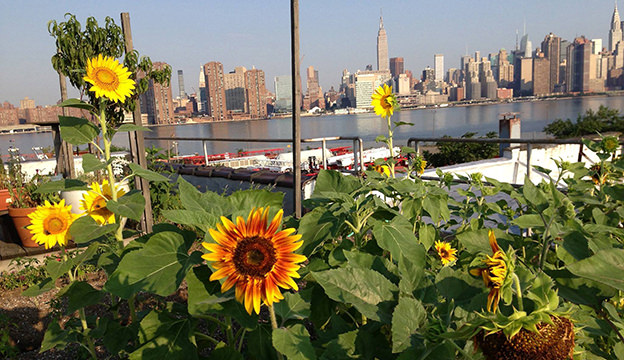
But nobody can beat the view from the tomato patch at Annie Novak’s Eagle Street Rooftop Farm. From the beds in Greenpoint, Brooklyn, weeders can look across the East River at the United Nations, the Chrysler building and the Empire State building. This year marks Novak’s third growing season.
The roof Eagle Street Rooftop Farm sits on is protected by layers of root barrier, felt and drainage material that minimize watering and protect the skin of the roof. The growing medium — 200,000 pounds of a specially engineered soil mix called Rooflite — is enriched with post-mushroom materials and composted food scraps from the Brooklyn Food Co-op.
Just a few years out of college, Novak had some farm internships under her belt when she started her farm. Now, on top of the third-floor warehouse owned by Broadway Stages, 6,000 square feet of garden produces enough to supply a farm stand, a CSA, a farmers’ market stall and a number of restaurants. (Deliveries made by bicycle!) Novak’s onions are mulched with hair from local barber shops. (There are no grass clippings or hay in an urban farm.) She has developed a narrow crop range that’s best adapted to the roof’s arduous growing conditions, such as the hot summers, the windy winters and the 6 inches of soil that precludes root crops.
In 2010, Eagle Steet Rooftop Farm added six chickens in moveable cages to supply eggs and fertilize the beds. A few beehives stand on less stable pieces of roof beyond the beds. But produce, eggs and honey aren’t the only things growing here. Eagle Street builds community through visits from local school children, workshops for other potential urban farmers, and support of chefs who clamor for arugula grown so nearby. The farm is open weekly to the public and hosts two yoga workshops and a Kite Flying Day.
To tend the garden, Novak depends on volunteers and an intern program in cooperation with a second nonprofit Novak created called Growing Chefs. Its mission is to use farm-based education because to connect to food, from field to fork, is to raise a generation of healthier eaters, more confident chefs and better ecologically minded citizens. It would be thrilling for any gardener-farmer to cut tender lettuces in full view of the skyscrapers of Metropolis, and Novak’s energy and leadership have helped that happen.
Courtesy Thinkstock Images/ Comstock/Thinkstock If your lawn mower isn’t ready to take down growing grass, now is the time to do a little maintenance.
Now if you are well organized, your lawn mower was put away last fall with a clean air filter, oil and filter replaced, gas lines and tank drained, and the spark plug removed, cleaned and replaced. If you did all that, all you will likely need to do is fill the gas tank, choke and start.
If your fall wasn’t quite as well organized as you would have liked, you may be facing a different situation with your lawn mower. Ethanol in gas tends to evaporate, and what is left can really gum up fuel lines and the carburetor. If this is the case for you, drain the old fuel out of the tank and lines, and do the other fall maintenance that was left undone.
Before refilling the tank, add 2 ounces of Sea Foam Motor Treatment or other stabilizer to a gallon of gas for the new fill. Sea Foam breaks down the old fuel and residue. I use it in all my small engines, especially if they sit for any length of time.
Don’t forget to sharpen and then balance your blade before putting it back on the mower. Take too much steel off one end when grinding out nicks and you could end up with a poorly balanced blade. It’ll vibrate, and that can damage your engine.
A quick way to check for balance is to stick a rod, bolt or even the shaft of a screwdriver through the center hole in the blade. Hold the rod horizontal with the blade perpendicular to the rod. If one end dips when you let it go, it’s probably out of balance. You can try to grind down the heavy side and rebalance, or better yet, spend a few bucks on a new blade. It’s worth it for a smooth cut and a smooth-running engine.
Courtesy Same Deutz-Fahr Lamborghini has been a big name in tractors among Italian farmers since the end of World War II.
It may be surprising, but the vast majority of Lamborghini owners around the world don’t think twice about getting their vehicles muddy or using them to drag around heavy machinery. The reason for this is that most Lamborghini owners have the company’s tractors rather than its exotic sports cars.
When speaking with Italian farmers who own Lamborghini tractors, I find they are often either amused or contemptuous of the legendary status of the sports cars.
“A Lamborghini tractor is much better made than a Lamborghini car,” one grizzled old farmer told me.
At the end of World War II, there was a great demand for agricultural machinery in Europe, and it seems like almost everybody was thinking about making tractors. Porsche made a lot of tractors, and even the Ferrari factory later dabbled in this field. The most notable new tractor business after the war was started by Ferruccio Lamborghini in a barn by using parts from salvaged military vehicles. Success came quickly to the new tractor manufacturer, who came from a farming family, and the resultant wealth led to him starting his own sports-car factory. But he held his tractor business most dear, and even today, in the Ferruccio Lamborghini museum, the tractors he built take center stage.
Courtesy Same Deutz-Fahr Lamborghini tractors are respected among Italian farmers for their technical innovation and low operation costs.
Modern Lamborghini tractors are produced by the Same Deutz-Fahr group, the largest privately owned agricultural-machinery manufacturer in the world. The group includes tractor companies originating in Italy, Switzerland and Germany. It was started by the Cassani family in the late 1920s, and in the 1970s, the last official act of the Cassani patriarch was to purchase the Lamborghini tractor division.
Amusingly, the Same Deutz-Fahr executives decided in 2003 to add sex appeal to the Lamborghini tractors, which had previously been boxy, black-and-white machines. The new silver Lamborghini tractors with blue trim were designed by the luxury automobile designers Pininfarina and Giugiaro and made to slightly resemble the famous Lamborghini Miura car.
I toured the Lamborghini tractor factory in Treviglio, Italy, (a half an hour east of Milan) in March 2011, which was exciting for me because I’ve seen these tractors all over Italy, where I currently reside, and my pal in Melbourne always tells me how the farmers in Australia are nuts for them. Sadly for my stateside friends, Lamborghini tractors are not sold in the United States. Instead, an American farmer may find a tractor manufactured by the same company under the Deutz-Fahr brand name.
The inside of the factory is extremely well organized and, much to my surprise, the floor was cleaner than the floor in my own office. Deutz-Fahr tractors are built alongside the Lamborghini tractors, and besides the color difference (Lamborghini in silver and Deutz-Fahr in green), both looked very similar to me. Lamborghini offers an impressive range of styles, from 35-horsepower models to 270-horsepower models. Because of the hilly terrain around Liguria, Italy, where I live, I see mostly the smaller tractors on the farms, but the flatlands around Milan boast the monster Lamborghinis working huge fields.
Among the many Italian farmers to whom I have spoken about Lamborghini tractors, the brand is respected for its useful technical innovation and low cost of operation. The older generation of farmers likes Lamborghini tractors for the capacity for two or three simultaneously working power take-offs and for being one of the first tractors with four-wheel drive. Lamborghinis are also known for the amount of gears, as many as 80 or 90 on a single tractor when all of the forward, reverse and hi-lo gears are counted.
I can’t really say that it is unfortunate that farmers in the U.S. cannot easily buy Lamborghini tractors for their own use because the Deutz-Fahr models and a great number of other brands are available, but I must say that I came away with a new sense of respect for the company that produces the tractors here in Italy.
Courtesy American Livestock Breeds Conservancy Java chicken populations in the U.S. have dropped to 700 birds, according to a census by the American Livestock Breeds Conservancy.
When it comes to protecting American legacies, the American Livestock Breeds Conservancy is never one to back down from a challenge. In its latest project to recover American heritage chicken breeds, the ALBC is focusing on the country’s second-oldest chicken breed, the Java.
The project, started in 2009 by Jeannette Beranger, an ALBC research and technical program manager, follows on the heels of the Buckeye chicken recovery project, which successfully raised the breed to historic standards. The Java, which is listed as Critical on the ALBC’s Conservation Priority List, was selected among those breeds in need of recovery based on its low population numbers, its loss of valuable breeding stock and its dual-purpose production, says Steven Moize, another ALBC research and technical program manager.
According to the 2011 census of Java chickens, overall populations have decreased by about 200 birds in the past five years, but the number of breeding Javas has nearly doubled.
“That is great news,” says Moize, who took over the project this year. “What it means is a lot of the smaller flocks are no longer being maintained; however, the people keeping birds and selecting for APA Standard of Perfection is increased.”
The Java recovery project will work with breeders and grow-out farms to develop quality bloodlines in the chicken breed. This year, the ALBC will place specific bloodlines on grow-out farms and evaluate the chickens at 12 weeks of age to determine the breeding stock for next year. This process will continue until there are established breeding flocks that meet the historic standards and production traits.
“As the flocks and the project grow, the placement of birds will strategically spread outward,” Moize says. “The ultimate goal is to increase the population and the quality of the birds, while increasing chef and consumer interest in the meat and eggs.”
The Java breed is known for its distinct body type, which has a rectangular shape with a long, sloping backline. It has a full breast, tight feathers, a single comb and moderately large wattle. The breed comes in black, white, mottled and auburn varieties, but only the black and mottled are currently recognized by the APA Standard of Perfection. Historically an extremely hardy chicken, the Java has been used to develop a number of other chicken breeds, including the Barred Plymouth Rock and the Rhode Island Red.
The ALBC invites Java chicken keepers to get involved with the project. For those who haven’t participated in the Java census, Moize urges them to contact the ALBC to complete the survey. It identifies Java bloodlines and location and chicken keepers who can provide hatching eggs or chicks or that want to be a grow-out farm.
Moize also encourages Java breeders to pay close attention to the APA Standard of Perfection in their breeding flocks.
“Breed only those birds that meet the standard,” he says. “Breeding low-quality birds is not beneficial for the breed in the long run. Cull low-quality birds or remove them from the breeding flock.”
Likewise, new Java chicken keepers should purchase from reputable breeders with quality stock and work to maintain or improve that quality.
By planting more native plants in their home gardens, residents can help mitigate stormwater runoff that pollutes the Chesapeake Bay.
From their backyards to the Bay, homeowners in Richmond, Va., Baltimore, the D.C. Metro area and the Hampton Roads region are joining an environmental-awareness campaign that aims to grow some good.
The Plant More Plants campaign—led by the Virginia Department of Conservation and Recreation, with a number of other Chesapeake Bay Program partners in Virginia, Maryland and Washington, D.C.—provides homeowners with resources to grow more plants as a way to mitigate stormwater runoff and erosion and ultimately help improve the health of the Chesapeake Bay.
The message to homeowners is simple and encourages an activity they’re already taking part in. By increasing the size of their gardens and adopting conservation gardening and lawn-care practices, residents improve home landscapes while helping protect one of the most important resources in the region. The Chesapeake Bay is the largest estuary in the United States, providing more than 500 million pounds of seafood and affecting nearly 17 million people. Its complex ecosystem, along with its connecting waterways, provides habitat, food and protection for diverse groups of animals and plants. However, water quality in the Chesapeake Bay is poor, and the delicate ecosystems that exist within it are at risk.
Stormwater runoff is one of the fastest-growing sources of pollution and water-quality degradation within the Chesapeake Bay, yet many homeowners don’t realize the connections among their lawns, stormwater and water quality in the Bay. As spring approaches, rains threaten to wash the chemicals and fertilizers designed to make lawns green and attractive into streams and rivers that flow into the Chesapeake Bay. Once in the waterways, these pollutants fuel the growth of excess algae, which threatens the health of the Chesapeake Bay’s entire ecosystem. To improve water quality, the flow of pollution must be reduced.
By planting native trees, shrubs and perennials, homeowners can help filter stormwater and prevent runoff. “Plant More Plants” partners with industry organizations and advocates to educate consumers on ways they can provide Bay-friendly solutions and resources for homeowners as they seek to enhance their curb appeal.
Several of the organizations and advocates presently involved in the campaign include Virginia, Maryland and D.C. master gardeners, the Virginia Green Industry Council, the Chesapeake Conservation Landscaping Council, and the Marylanders Plant Trees Program. Each are finding ties to the campaign through mutual goals.
Plant More Plants was funded through a grant from the National Fish and Wildlife Foundation as part of its efforts to improve the Chesapeake Bay’s watershed.
Photo by Sue Weaver Gracie says that being born is hard work.
Last night, Wren had her babies in one of the stalls attached to the round pen. That’s only a little way from my buck pen, so Uzzi and I got to listen in.
Wren started having pains around 2 p.m. Mom was glad because the weatherman said it was supposed to storm close to morning and keep on storming for days. She wanted Wren’s babies born before the storm. So she rushed to put everyone in and fed us early so nothing would disturb Wren’s labor.
Mom was going to let Wren lamb wherever she wanted but Nick (Wren’s buddy and kind of a big, dumb boy) kept following her around. Wren didn’t like it, so Mom fastened her in a stall and Nick had to watch from outside.
After Dad got home and he and Mom finished an early supper, Mom took her birthing kit out to the round pen and sat down outside the stall to watch through the gate and be with Wren until her lambs got born. Dad kept coming out and saying things like, “Ow!” and “That doesn’t look like much fun.”
Photo by Sue Weaver Wren introduces her new daughter.
Then at about 9 p.m., Mom picked up the birthing kit and went in the stall. She started saying, “Push, Wren!” and “Here comes lambie!” (Mom always says, “Here comes lambie,” unless she’s coaching a mama goat.)
Then, here came lambie. We heard Mom cry, “Good girl! One more push. Yes, here he is!” But then Mom got excited. She said, “No, no, here she is!” Last year all our lambs were boys, so Mom was hoping for a girl.
Dad came out and they ohhed and ahhed over the lamb while Mom dipped its umbilical stump in iodine and Wren cleaned it up. Wren is a good mama; she was excited, too. She licked and licked her lamb, but then she started looking worried and stomping her feet. She stopped licking, spun around, plopped down, and out popped another little girl!
The lambs are big, healthy and really odd colors. They are dilute blacks, but one has brown shadings and the other has silver under her wool. Mom named the firstborn Gracie (Wolf Moon Grace O’Malley after the famous pirate queen) and the second lamb, Sarah (Wolf Moon Sarah Grizzel after a cool old shepherd lady in the book, The Wee Free Men).
Once both babies were nursing, Mom and Dad packed up the birthing kit and went in to bed. But first Mom strolled over to Ramsgate (that’s our rams’ paddock) and told the lambs’ daddy, Baamadeus, “Well done!”
Mom got up several times though the night to check on the new family, and she took pictures of Wren and her little girls this morning. They’re pretty cool lambs, don’t you think?
Until yesterday, I thought my urban-farm critters lived independently from one another. The horses are obviously tuned into one another, and the chickens have their own drama going amongst themselves. The dog has his little life back there, unrelated to the other animals. Or so I thought.
While outside doing my chores yesterday morning, I heard a big commotion at the chicken coop. A few members of my free-ranging flock were gathered around the coop, while others lurked inside. A lot of hollering was going on among the birds, including the characteristic pah-kuck! that indicates alarm was rampant among the birds.
As I looked in their direction trying to figure out what the ruckus was about, I noticed that the horses had stopped eating and were staring wide-eyed at the chickens. Rio in particular was most curious about what was going on in the coop, and refused to go back to his hay. He watched me intently as I walked over to the coop to see what had gotten the chickens all riled up.
When I looked inside the coop, I saw the reason for all the squawking. A lone, freshly laid egg sat shimmering in one of the nest boxes. The birds quieted down as they watched me remove the egg, and then went about their business. When Rio saw that the drama had ended, he turned back to his lunch.
Not long afterwards, Nigel, who was outside with me, began to bark at someone who was leaving a flyer at the front door. He ran to the back gate and gave his most ferocious Corgi woofs. Now it was the chickens’ turn to wonder what was going on. They all stopped what they were doing, stretched high up on their legs, and peered in the dog’s direction. A few let out what I call “the question.” It’s basically a loud squeak that clearly ends with a question mark. It’s as if the bird is saying “What???”
When the guy leaving the flyer left the front door and walked past the other end of the house on his way to the neighbor’s place, Nigel ran across the yard to bark at him from the other gate. I saw Red perk his ears up and put his head over the fence of his paddock, intently watching the dog and trying to get a handle on what was going on. The look on Red’s face was clear: “Why is Nigel barking, and should I be concerned about it?”
I guess I never thought about how the different species in my yard might view one another other. I never realized until now what an amazing little barnyard community I have.
A study found that many industrial livestock farms contribute large amounts of air pollution.
When it comes to air pollution, big cities are often in the spotlight. It’s not just the factories in Detroit and the taxis in New York that are to blame for poor air quality. A report found that the air at concentrated animal feeding operations (CAFOs) is often dirtier than the most polluted cities in the United States.
Researchers at Purdue University measured concentrations and emissions of ammonia, hydrogen sulfide, particulates and volatile organic compounds—all pollutants that have significant health risks, ranging from heart problems and respiratory illnesses to premature death—at 15 livestock-confinement sites, nine livestock waste lagoons and one dairy corral in nine states. The U.S. Environmental Protection Agency supervised the study.
According to the findings, 11 of the sites in the study emitted more than 100 pounds of ammonia on an average day—an amount that would trigger EPA pollution-reporting requirements in non-livestock industries; six of the farms released fine-particle pollution that was much higher than the federal 24-hour exposure limit; and data suggested that hydrogen-sulfide emissions exceeded 100 pounds per day at several large hog and dairy CAFOs, which must be reported under federal right-to-know laws applied to other industries.
“No other industry in the country would be allowed to pollute at these levels without triggering EPA emissions reporting laws that have applied to other large industries for decades,” explains Tarah Heinzen, an attorney with the Environmental Integrity Project, a nonpartisan, nonprofit organization that advocates the effective enforcement of environmental laws.
Although EIP was not involved in the collection of the data, Heinzen believes that researchers used the EPA definition of CAFO—feed lots or facilities where animals are confined and fed for a total of 45 days in a 12-month period and waste is discharged to a river, lake or stream—to choose farms to include in the study, though this was not confirmed. She also believes that researchers selected a cross-section of operations that were meant to serve as a representative sample for research purposes.
Although the data showed that CAFOs are significant sources of pollution, these large-scale operations are not subject to the same environmental regulations as other agencies thanks to a deal that was brokered by the Bush administration in 2008, exempting CAFOs from federal pollution reporting rules. EIP hopes their analysis will lead the EPA to overturn this ruling.
“We believe that certain actions the [EPA] had taken were completely illegal and not based in sound science,” Heinzen explains. “We hope the EPA acts to protect public health and starts to regulate CAFOs as large industries that are so different from small family farms.”
In the report, EIP recommends several steps to remedy CAFO pollution problems, including establishing an independent committee to oversee the emission-estimating methodology process and drafting regulations necessary to use the Clean Air Act to protect public health from ammonia, volatile organic compounds and other factory-farm pollution.
Heinzen is not aware of plans to conduct future studies using non-CAFO farms. Similarly, there is no push for legislation requiring small-scale farms to follow the same EPA emissions reporting guidelines that EIP believes should be mandatory for factory farms.
“Smaller, more diversified farms are already doing things right [when it comes to environmental stewardship],” she says.
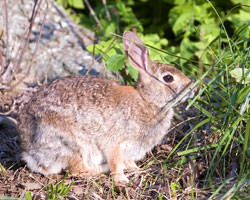
Use wire mesh to keep wild rabbits from enjoying a lunch from your garden.
As you begin to salivate over the luscious tomatoes and crispy peppers you’ll soon have growing in your garden, think about how you can get the fruits of your labor to the dinner table unblemished. While starting plants from seed and defending against disease are hurdles to successful gardening, wildlife in the garden can present a challenge all its own.
“Often, we plant gardens to attract birds and butterflies; however, other wildlife may be annoying,” says Nancy Pollard, a horticulture educator at the University of Illinois Cooperative Extension. “Rabbits nip off tender shoots or girdle the bark of young trees; squirrels eat food intended for birds and nip off buds and branches; skunks dig in the yard, raid garbage and leave a memorable musk when frightened.”
Uninvited wildlife is attracted by food, water and shelter. Bird feeders, trash cans with lids easy to remove and pet food left outside overnight offer a smorgasbord that unintentionally invites wildlife into your garden.
Pollard offers some tips for co-existing peacefully with wildlife.
“Animals, like humans, are creatures of habit,” she says. Upon observing landscape harm, take steps immediately to prevent further damage before the animals’ habits become firmly ingrained. “Discouraging damaging habits usually requires multiple strategies.”
Rabbits
In a small garden, you can exclude rabbits using a wire-mesh fence with holes 1 inch or smaller; to prevent burrowing under the fence, bury the mesh 6 inches deep. To do this, purchase a 4-foot-wide mesh roll, and bend the bottom 6 inches outward. This allows for 3 feet of fence above ground. You can also protect trees with cylinders made from wire mesh that has 1/4-inch by 1/4-inch holes. The smaller-sized holes guard against mice, as well. Keep in mind gates provide entry points for rabbits as well as people.
Squirrels
Wildlife experts recommend using a 2-foot-wide metal collar 6 feet off the ground to keep squirrels from terrorizing isolated trees and poles. To allow for tree-trunk growth, attach the metal collar with wires fastened together with springs.
“Squirrels can jump 8 feet, so this only works on isolated trees,” says Pollard. “Trim back trees to prevent access to roofs and attics. If you have room, provide corn for the squirrels away from the bird feeders to distract them from the feeders. Enjoy their antics.”
Skunks
Even if skunks aren’t rummaging through your vegetable garden, their stench may be apparent, even if they haven’t sprayed. If you have skunks in your yard, keep handy the recipe and ingredients for skunk-odor removal. Mix 1 quart 3 percent hydrogen peroxide solution, 1/4 cup baking soda and 1 teaspoon liquid soap; do not add water. The concoction can be used for washing skin, clothes, dogs and other sprayed items. Note, the peroxide in the solution may lighten the fur of pets.
To find more tips about living with wildlife, visit the the University of Illinois Extension Living with Wildlife website.